

I’m 68 and I can see myself approaching the point where one asks himself, “Is this all there is to it?”
I would like to plan well ahead and be able to choose the way I wish to die.
I have the modus operandi down to a T. Its my Glock17. I keep it cleaned and oiled at all times, tucked away in a recess in the wall behind the dryer. Once every six months, I replace the rounds with fresh ones after a stint at the range. It’s a semi-automatic, loaded, with the safety off. I don’t even have to cock it. All I have ta do is press the muzzle to my temple and squeeze the trigger. One round will end it all. Quick and painless.
I want to be cremated, nice and easy. No wake, no funeral, no eulogies, no signs left of my existence except for a fistfula ash. I would like there to be a party though, with topless waitresses, so scantily dressed that you can count the cotton molecules in the fingers of yore hand.
————————-
One way I won’t want to go is by running myself through with a knife or sword to my stumik. Man, that’s a slow, excruciating way ta die. The blade will slice effortlessly into my small intestines and if I twist it this way and that, it will tear apart my spleen, liver and kidneys, causing massive internal hemorrhaging. If the blade didn’t find my abdominal aorta, it’ll take me a long long time to die.
Only schmucks want to run themselves through.
———————-
It was different in ancient Rome, however. If you were a military commander facing defeat, you’d probably be looking at running yourself through as a viable option.
In the case of Marcus Junius Brutus (the ‘et tu Brute’ guy), this was 43BC and he believed it was the only honorable thing left to do. His forces had just been routed in the Battle of Phillipi.
Running through, impaling oneself by his own sword or spear, conveyed a sense of chivalry and was regarded as the signature of a true hero in a world that hated pussies. Not killing oneself, trying to make a run for it, would make the vanquished seem cowardly. He would be derided and shunned and that was just about the worst thing that could happen to a man at the time.
Either you won or died in battle. There was no third ground.
So, there was Brutus in 43BC, reclining inside a tent outside the Macedonian town of Phillipi, defeated. His comrade-in-arms, Cassius, had already taken his own life by, you guessed it, ordering his personal slave to run him through. A year had passed since the two, Brutus and Cassius along with others, had murdered Julius Caesar.
Brutus tried one last thrust. He combined his and Cassius’ forces and tried to fight the Triumvirate (Octavian, Mark Anthony and Lepidus) but he failed. Now his ass was grass and the choices were limited. He could gather a legion and a hundred slaves and flee east to some far flung province like Parthia (present day Iran) with very fragile Roman control. Or he could stay put and face Roman justice for capital murder – execution.
Today, executions in most of the developed world are humane. They could be by lethal injection, electrocution, hanging, the gas chamber or a firing squad, but they all have one thing in common – death comes in seconds. One minute you’re there and the next, you’re gone. Within the hour, you are in an unmarked prison cemetery plot and in a year you’ll be raising the daisies.
By contrast, ancient Roman methods of execution were exotic. They could chop you up alive, a little at a time. They could make you sit on the tip of a sharpened wooden stake that was stuck vertically in the ground and let gravity do the rest while they eagerly waited to see it appear out of your mouth. They could prise your jaws open and pour molten lead down your throat.
They could crucify you. It’d you a week to die, give or take. Crucifixions were slow – five to seven days of starvation combined with the unbelievable agony of being nailed to a cross, your weight trying to tear flesh at the nails. Do you think Jesus or Spartacus would be the heroes that they are today, if they had simply been poisoned? Naaah.
Or they could simply tie your extremities to two horses facing in opposite directions and mercilessly whip ‘em till they tore you apart, at the weakest spot – your waist.
Running through was a dream compared to the above.
—————————-
Which brings us back to Shakespeare and Brutus’s suicide. Sure enough for his slow and painful demise, Brutus was lionized even by his vanquishers. After Strato broke the news of Brutus’ suicide, Mark Anthony was all teared up and had this to say –
“…His life was gentle, and the elements So mix’d in him that Nature might stand up And say to all the world,”This was a man.”
Octavian – later to be Rome’s first emperor, Augustus/Octavius – didn’t want to be outdone by Mark Anthony’s eloquence, so he held forth….
“…With all respects and rights of burial. Within my tent his bones tonight shall lie. Most like a soldier, order’d honorably…”
If instead, Brutus had swigged down some hemlock and croaked, the very same Octavian would have said derisively, “Chuck the SOB into the Tiber and lets get the hell outa here. I don’t want to be late for tonight’s orgy. Those broads I got from my Macedonian campaign can really give head.”
What’s with this hullabaloo about the most honorable way to die? If you’re dead, you’re dead, that’s it. Beats me why you would give a fuck how the rest of the world saw you based upon the way you died.
——————————-
Getting back to Shakespeare’s penchant for gore, his work is replete with mayhem and that’s because Elizabethan audiences reveled in gore. While a good comedy once in a while didn’t do any harm, the 16th century English folk overwhelmingly went for treachery, debauchery, deceit and fountains of blood.
Violence was the primary reason why Billy Shakes became so famous.
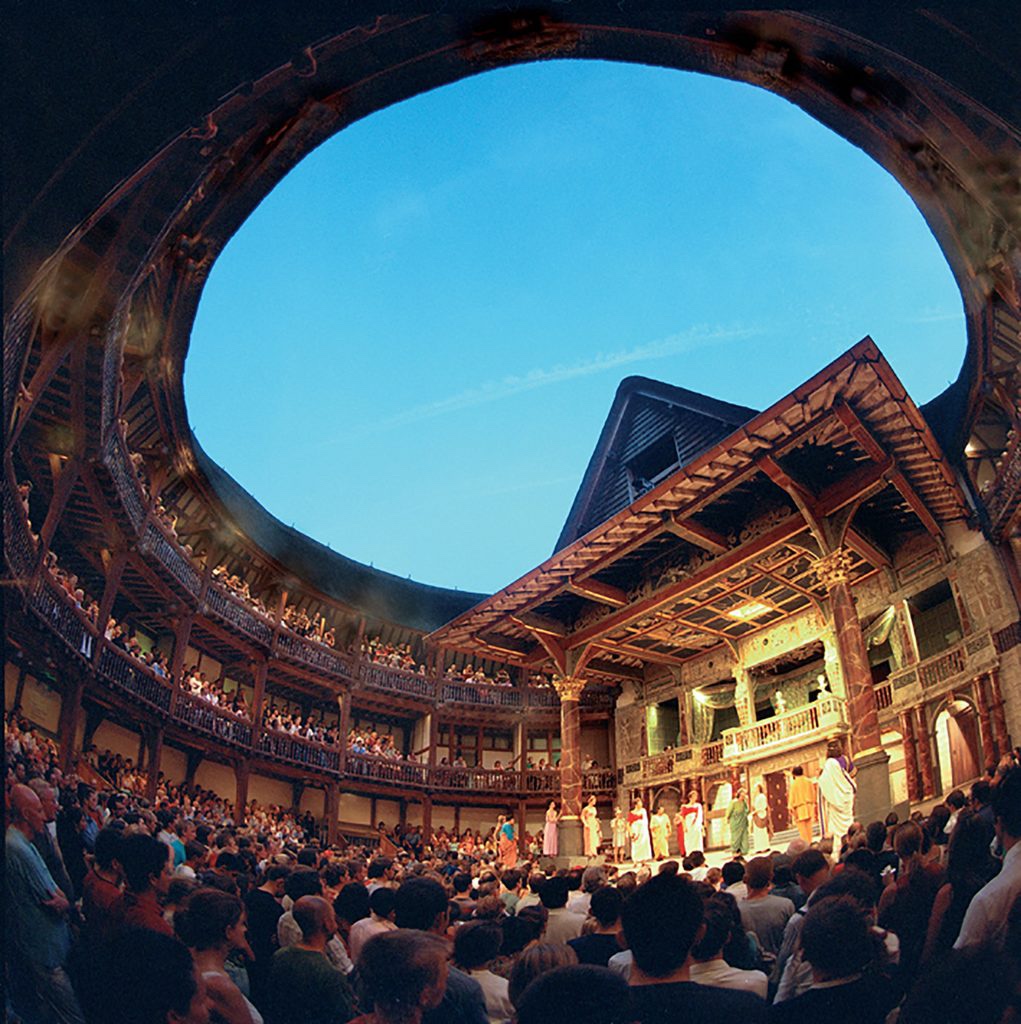
Elizabethan audiences loved the shocking drama. The blood had to be realistic and so the theatre management at “The Globe” had a small barn at the back where they kept sheep, lotsa sheep. Every two consecutive renderings, one was slaughtered and its blood, heart, lungs, liver, etc were used as props for the mayhem in the plot. When the props began to stink, they simply went ahead and killed another sheep.
————————-
Realism drove the theatre producers to even use actual human beings sometimes, I’m not kidding. In Thomas Kyd’s ‘The Spanish Tragedy’ (a sorta Andrew Lloyd Webber of gore), which had several gruesome revenge killings on opening night, they needed an actual human being to be strung up from a tree branch and hanged, so they simply got a condemned prisoner from the Tower to do the act.
The play became a overnight rage. Soon they were running outa fresh bodies, so the Queen’s dragoons began picking up random folks right off the streets who looked even remotely suspicious of any wrongdoing. Trials were fast-tracked and the death sentences confirmed, so they could act in Thomas Kyd’s play that very evening, even though it was going to be a one night stand. Since at least some of the sods really were criminals, the law and order situation in and around London improved drastically.
————-
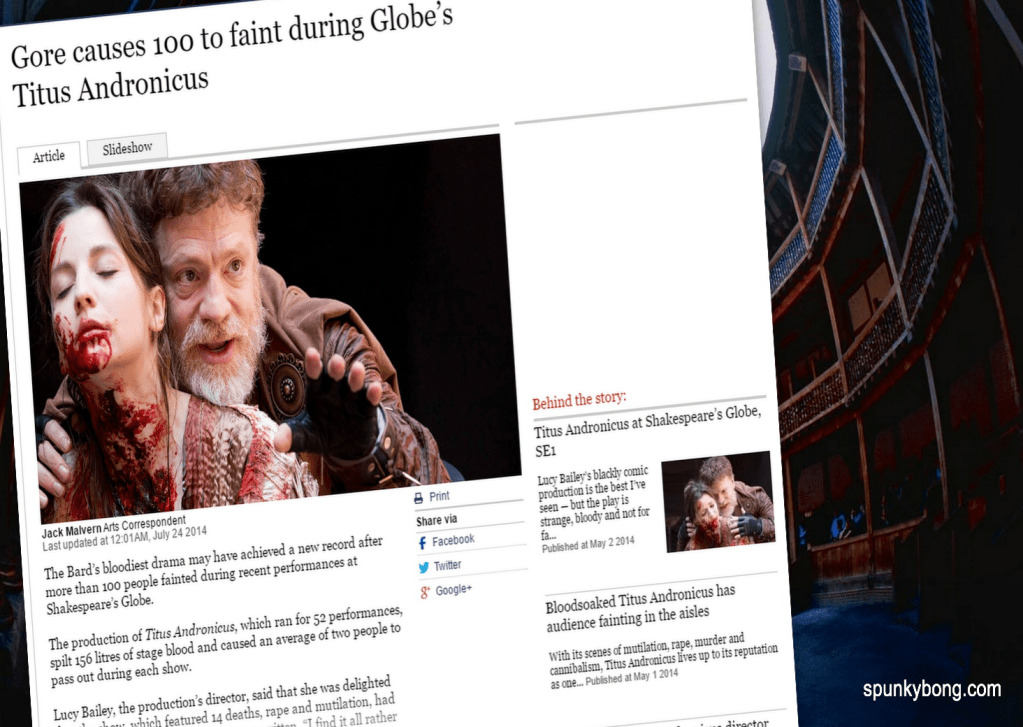
Some of Shakespeare’s most violent plays were by far the most popular. Titus Andronicus – Billy’s first and most violent tragedy – was a huge success at The Globe. Touring troupes fell over each other, wanting to play Titus Andronicus. In the play, two of the characters were baked in a pie……. literally……
Titus had the Roman emperor-to-be, Saturninus and his wife, Tamora, over for dinner and after the horses of the ovaries had been cleared away, Titus revealed that the meat pie the couple had just devoured was actually what remained of their two sons, Demetrius and Chiron. While they were in a state of shock, Titus butchered Tamora with a carving knife and in return, was killed by Saturninus right after.
Titus had to be stupid. If I was going to tell you I just baked your kids in a pie, I’d make sure I had back-up. Titus had justification for the pie though. The duo had raped and mutilated his only daughter, Lavinia and he had had to honor-kill her after he found out, ‘to spare her the shame’. Boohoo. And then, Titus’s son, Lucius, nabbed Tamora’s Moor lover boy, Aaron and had him buried in the desert sand upto his chin and left to starve ta death.
And you thought ‘Friday the 13th’ was horrifying.
Billy Shakes was particularly gruesome in Hamlet – when King Hamlet (Hamlet’s dad) was napping in his orchard, his treacherous bro Claudius, poured a ‘leperous distillment’ into his ear. The poison curdled his blood and caused his skin to develop horrible sores. The King died in his garden, hideously disfigured, a victim of his brother’s treachery.
I am imagining The Globe issuing a casting notice, a job ad, announcing…. ‘Actor wanted, to play King Hamlet. Must bring his own vial of henbane and dropper and don’t forget the down-payment on casket…’
And then there was that shmuck, Polonius, newly crowned King Claudius’s trusted aide. Acting on the orders of Claudius, Polonius hid behind the drapes in Queen Gertrude’s chambers, to eavesdrop on her conversation with Hamlet, whom Claudius suspected of plotting to overthrow him. Polonius however had this fatal habit of almost all of Willy Shakes’ characters – he constantly talked to himself.
Thus, while Hamlet spoke with his mom, Polonius had this running commentary going with himself, in a sort of a low mumble. Alas, the mumble wasn’t low enough – Hamlet overheard him and drove his sword through the tapestry, killing the shmuck.
If you wanted to play Polonius and at the same time had a desire to come out of the show alive, you had to have fast reflexes because you had only a microsecond from the time the sword emerged through the drapes and entered your gut.
Ophelia, driven insane by Hamlet’s murder of her beloved father, Polonius, plunged from a tree branch into the current below. Actually she slipped and didn’t know how to swim. But Elizabethan England would have labelled her a nitwit, so Billy Shakes wrote it in as a suicide.
That’s nothing. In Macbeth, Lady McDuff was chased across the stage at the Globe and slaughtered when she jumped off and fell into the arms of the ladies in the front row, splattering them with gore. It was so real that….it was real. Even for a million quid nobody wanted to play Lady McDuff in those days.
Willy Shakes really knew how to keep audiences titillated, with ingenious new ways in which to die. He was the 16th Century version of Quentin Tarantino.
If you were to believe everything Willy wrote, you would be a regular at the friendly neighborhood pharmacist in those days, shopping for a pitcher of concentrated hemlock. And its antidote of course. You would be a shmuck not to order the antidote and keep a vial chained safely to your waist, just in case somebody in your household poisoned you.
Antidotes those days were even more valuable than gold and silver. Look at today’s cyber-security stocks, Christ’s sakes, I have been saving up for a year to buy Crowdstrike, Palo Alto and Zscaler.
—————-
According to Willy, Mark Anthony and Cassius too ran themselves through. For different reasons of course. Cassius, for being Brutus’ defeated co-conspirator and Mark Anthony, for losing the power struggle with Octavian.
Cassius handed his loyal Parthian slave, Pindarus, the very sword with which he had stabbed Caesar. He then commanded, John Gielgud-style, “Now with this good sword, that ran through Caesar’s bowels, search this bosom…. And when my face is covered, as ‘tis now, guide thou the sword.” Pindarus later made his escape to some place Willy Shakes doesn’t mention in his play. Slaves didn’t count for much of a mention in 16th Century England. In forcing a slave to murder him, Cassius selfishly put Pindarus’ life in danger. If captured I shudder to think what would have been done to him.
Mark Anthony ran himself through alone, duped into believing that the love of his life, Cleopatra had already taken her life. She was in fact alive when his corpse was brought into her inner sanctum and laid to rest in her arms, under the orders of Octavian. At this point, the despondent Cleopatra shoved her hand inside a basket of dates that had an asp placed inside on her orders. Mark Anthony had been popular with Cleopatra’s generals and might easily have been able to commandeer a fast galley and a few slaves and skip to the friendly kingdom of Kush (present-day Sudan) to the south. But the schmuck that he was, Mark Anthony chose to run himself through.
———————
Shakespearean plots were always very complex, with rivalries and deceit, temporary alliances and treachery, cowardice and chivalry – all woven inside a huge cauldron of blood and gore. One moment you see two characters thick as thieves and after a coupla acts they are at each other’s throats.
Other than his Titus Andronicus, which was fiction, all of Shakespeare’s tragedies were based on history. If Billy Shakes had been alive in the present day, he would surely have found in Afghanistan the perfect fodder for a tragedy. The buddy movie of the American and the Taliban raising toasts in sunny Doha and then the treachery of the Americans, leaving their faithful Afghan fixers at the mercy of the Taliban.
Oh yeah, there’s a Shakespearean zigadoo in everything today. Take a look at who was fighting whom in Syria just a while back….
Bashar Assad was trying to put down an armed insurrection, with the help of his Shiite friends, Iran and and the Lebanese Hezbollah and his long-term ally and benefactor – Russia. The Americans were arming the rebels and drawing “red lines” against Assad, while they were also paying Assad to let them rent off-site real estate for torture and rendition in the so-called ‘war on terror’. The Israelis were, time to time, bombing Assad’s ammo dumps and all the while, making nice with Putin. And all this time Bashar was keeping alive a hope he would one day be back in America’s good books and be able to get his hands on all the frozen assets. All this, when at home Assad was playing a devoted husband with a British born prim and propah Syrian wife who liked to show off her Oxford accent and her pearls.
And all of them, the Syrians, the Americans, the Russians, the Israelis, the Iranians, the ships, the shoes, the sealing wax, the cabbages and the kings – they were all fighting the ISIS.
Truly Shakespearean, ain’t it??
 Spunkypedia