
———————————
“I’ve been here on the ground with my nose in it since the whole thing began. I’ve nurtured every sensation man has been inspired to have! I cared about what he wanted and I never judged him! Why? Because I never rejected him, in spite of all his imperfections.
Who, in their right mind could possibly deny that the twentieth century was entirely mine?”
– Al Pacino, as the Satan, in “The Devil’s Advocate”
———————————

In architecture, a frieze is the wide central section of the inner walls of a hall or large chamber, usually a public place, that is decorated in panels, with bas-reliefs or even paintings (frescos). It is situated usually above eye level, way up, just below the cornices.
Friezes were popular with ancient Roman and Greek architects, glorifying the exploits of their rulers and their Gods, the Parthenon Frieze being the most famous and perhaps the most elaborate. Sculpted between 443 and 438BC, it is a high-relief marble sculpture that once adorned the upper part of the Parthenon’s inner walls. About 80% of the Parthenon frieze still survives. Not in Greece – at the British Museum in London.
Yes, if you steal, put your loot on public display in your most prestigious museum (or the crown), charge an entrance fee to anybody who wants to see it and say brazenly to the actual owners, “finders keepers, so fuck you”, then you must be British.
—————————————–
Another frieze, this one sculpted in 1935, exists around the inner walls of the highest seat of justice in America – The US Supreme Court, the place where all judicial bucks come to rest. The frieze glorifies men who, through history, were known to have formulated laws and advanced the cause of justice as they saw it being relevant in their time.

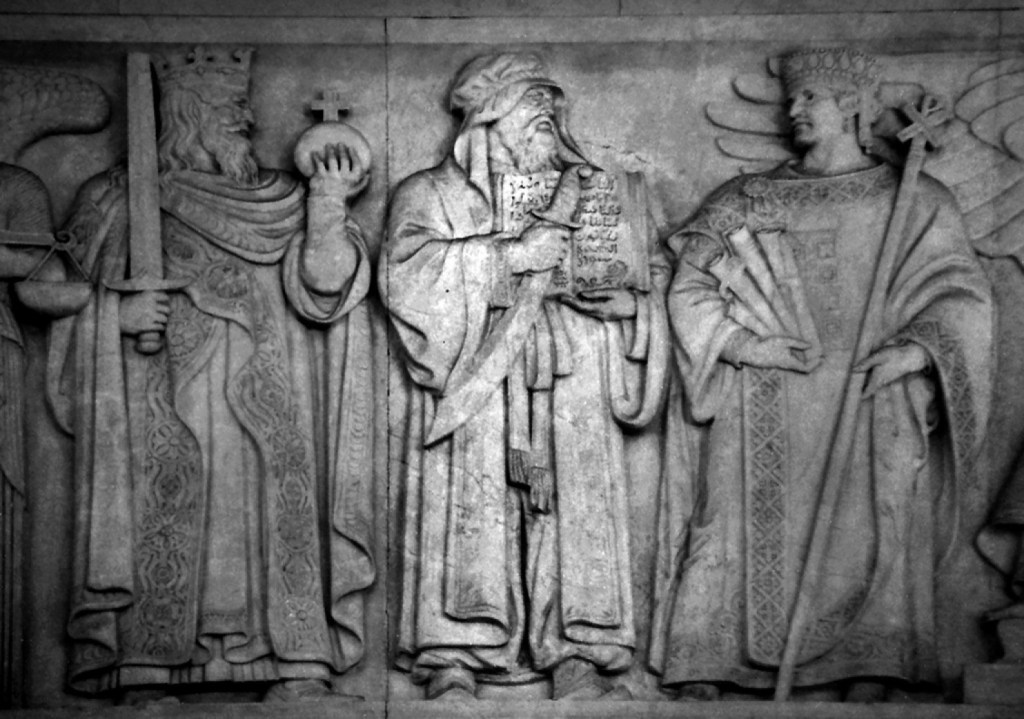
The prophet is flanked by the Holy Roman Emperor, Charlemagne, to his right and Justinian-I (aka Justinian the great) to his left.
The above carving is a section of the frieze on the upper walls of the US Supreme Court(see image above)
——————————————————————-
In case you are a frieze freak, you might like to check out my post on The US Supreme Court frieze
The South Wall Frieze has figures of lawgivers from the ancient world. It includes Menes, Hammurabi, Moses, Solomon, Lycurgus, Solon, Draco, Confucius and Octavian. The North Wall Frieze shows lawgivers from the Middle Ages onward. It includes representations of Justinian, Charlemagne, John of England, Louis IX of France, Hugo Grotius, Sir William Blackstone, John Marshall and Napoleon.
The sculptor of the friezes has attempted to remain as secular as possible. The Moses frieze depicts him holding only six through ten of the Ten Commandments, the ones that are usually considered the more secular commandments.
There is another figure on the North Wall, a bearded man cloaked in a flowing robe, his feet encased in the curved sandals worn by men who inhabit the Middle-East even today. In his left hand he holds the Holy Quran, it’s pages open and in his right hand, he has a long curved scimitar which he is holding, not by the haft, but by the upper blunt part of the blade, next to the hilt, the way a seasoned warrior is expected to hold it.
It is the figure of the Prophet Mohammad.
He is seen sandwiched between the Eastern Byzantine Emperor, Justinian, to his left and the Western Holy Roman Emperor, Charlemagne, to his right. The frieze is positioned in the US Supreme Court Chamber depicted above. It is one of the two friezes on the sides that are not clearly visible.
———————————
In 1997, six decades after the frieze panels had been carved, the Council on American-Islamic Relations (CAIR) asked for the frieze of the Prophet to be removed from the façade.
While appreciating that Muhammad was included in the court’s pantheon of 18 prominent lawgivers of history, CAIR argued that Islam discourages depictions of the prophet in any artistic form. CAIR also took exception to the fact that Mohammad was shown holding a sword, which they thought reinforced long-held stereotypes of Muslims as intolerant conquerors.
This is notwithstanding the fact that the Prophet was known to have his scimitar by his side at all times, he and the faith he propagated being essentially a warlike culture. The Salafists, Wahabis and the Deobandhis actually believe that there is no such thing as peace and tranquility, forgiveness and mercy. To them, these concepts themselves mean giving in, submitting to something other than Islam – the very name a word which suggests ‘submission, to the one and only God and his Prophet, Mohammad’.
A prominent US-based Islamic Law scholar then stepped up and declared that the sculpture was in fact a great honor bestowed by non-Muslims and should be appreciated. Subsequently, Chief Justice William Rehnquist rejected the request to sandblast Mohammad, saying the artwork “was intended only to recognize him, among many other lawgivers, as an important figure in the history of making of laws. It is not intended as a form of idol worship”.
The court later added a footnote to the image on its tourist brochures, calling it “a well-intentioned attempt by the sculptor to honor the Prophet Mohammad”.
After that one 1997 blip, nothing more has been heard from either the CAIR or Muslims worldwide, fanatical or moderate, about Mohammad’s presence on the US Supreme Court frieze.
————————
(Phew!)
————————
The dispute shows how opinions of Muslims on images of the prophet can get real petty and monolithic. The view that all representations of Muhammad are banned, not just those deemed blasphemous, obscures a more nuanced past, before the rise of those militant strains of Islam that ultimately influenced a group of desperados into trying to bring down the Jyllands Posten and the gunmen who attacked Charlie Hebdo magazine.
In comparison to the US Supreme Court frieze, I have to admit that the Jyllands Posten lampoons of the Prophet were in poor taste, though that still didn’t justify a fatwa and wholesale murder.
———————————————-
A few years after the Jyllands Posten controversy, a 26-year old cyber security whiz named Edward Joseph Snowden settled down to work as a contractor for the computer giant, Dell, which managed computer systems that handled highly sensitive data for multiple government agencies in the US.
In March 2012, Dell assigned Snowden to the NSA’s Hawaii office which focuses on the electronic monitoring of China and North Korea. Then, for some reason, just three months before he fled to Hong Kong, he joined the security consulting firm, Booz Allen Hamiltom, where his job was to break into the internet and telephone traffic around the world for the NSA.
It was around the time that Snowden was settling himself into life in Hawaii that one evening, he happened to switch on the TV and heard the Director of National Intelligence, James Clapper, blatantly lying under oath to the US Congress that the NSA was not tapping the phone calls and internet traffic of ordinary Americans illegally, without a warrant.
Snowden claims that that was when something snapped inside him and he decided to reveal everything. In May 2013, he took a leave of absence, telling his supervisors he was returning to the mainland for some medical treatment. Instead, Snowden caught a fight to Hong Kong, where he met with two reporters from the British newspaper, The Guardian.
In all, Snowden revealed the contents of 1.7 million classified documents, 160,000 email and text messages and 11000 classified online accounts, that he had managed to download while at Hawaii.
——————————————-
Some of the Snowden cache revealed a new, previously hidden layer in the saga of the 2008 terrorists attacks, carried out on Mumbai by militants from the Pakistan-based Lashkar-e-Toiba (LeT) militant group. It showed that, months before the massacre, the British counterpart of the NSA, the GCHQ (General Communications Headquarters), had managed to hack into the laptop of a guy named Zarrar Shah, who turned out to be the technology chief of the LeT and one of the key plotters of the Mumbai attacks.
Soon, the British engineered trojan, that had inserted itself into the Shah’s laptop, spread like wildfire into all the other computers that it communicated with, inside the LAN network that the Pakistani ISI had set up for the LeT, in an apartment that was situated in a quiet neighborhood of the Pakistani port city of Karachi.
Now, every comma and semicolon, every image and video, every communication between the Pakistani establishment, the LeT leadership, the ISI and the Karachi terror cell, was laid bare to the British in real time.
In the early days of the intelligence coup, the GCHQ learnt that Shah was looking for someone, a man who could pass himself off as a western businessman/tourist without raising any suspicion. He would have western citizenship and a passport whose authenticity would be unquestioned, since it would be completely genuine. He would get out there on the ground and conduct extensive reconnaissance of India’s financial capital, for the planning of the logistical aspects of a possible strike on Mumbai.
The scout would try to ascertain which was the best way for a group of militants to enter Mumbai, whether by land through Nepal (a long risk-frought over-land route) or by sea, direct to a deserted beach at Mumbai. There were hundreds of beaches available. Mumbai had a 60km long coastline. He would acquire maps, GPS coordinates – information that could lead even a blind man into Mumbai.
And of course, the scout’s main mandate would be to help identify a list of possible targets that would convey the maximum symbolism to the world. He had to record directions, traffic patterns, available transportation, etc, anything that would help the team get from A to B and then to C in a swift, seamless manner, expending as little time as possible.
The scout would also be mandated to figure out the best possible escape route after the mayhem but that was not a priority since the LeT didn’t expect the militants to survive and make it back to Pakistan.
Here comes the innate hypocrisy – while the LeT did not believe in suicide terrorism, deeming suicides as anti-Islamic, dying in a hail of bullets was perfectly acceptable and the LeT fully expected it’s killers to ensure they gave their lives away in that manner.
Meanwhile, unknown to Shah, the LeT had already found such a scout – an American with a Pakistani Muslim father and a white Christian mother. Fortunately for him, he had inherited almost all his mother’s genes and was therefore indistinguishable from other white folks.
That man went by the name of David Coleman Headley, son of Sayed Salem Gilani and Alice Serill Headley. Deceptive by birth, he had chosen to have his mother’s surname.
(Watch this space for Part-2)
 Spunkypedia