
“Thou shall not covet thy neighbor’s house; thou shall not covet thy neighbor’s wife, or male or female slave, or ox, or donkey, or anything that belongs to thy neighbour…..” (Exodus 19;20-25)

Best selling authors like Frederick Forsyth, Larry Collins and Dominique LaPierre, Leon Uris, James Michener and Tom Clancy have a common work ethos – they take months, sometimes years, to painstakingly research their subject, in order to render a degree of authenticity to their novels.
There was another ‘researcher-novelist’ and to my mind he was the capo-di-tutti-capi of them all :-
British-Canadian Arthur Hailey (1920-2004).
Hailey wrote a string of blockbuster novels in the 1960s and 70s that stand tall as classics of research-driven story telling. “Wheels” is the result of a comprehensive study of the inner workings of Ford, GM and Chrysler. “Overload” is on the American electricity company ConEd, “Moneychangers” is about a bank, “Strong Medicine” – a pharmaceutical company, “The Final Diagnosis” – a hospital and “Hotel” – a 5-star boutique hotel.

In Hailey’s novels, each chapter is a seemingly stand-alone mini narrative having its own protagonist but you know all along that in the end, these narratives will fit perfectly together in a shattering cliffhanger of a climax.
In Hailey’s 1968 blockbuster, Airport, events are quickly escalating inside and around a fictional Lincoln International Airport (based upon his research of Chicago’s O’Hare).
In Airport too, the chapters are seemingly separate narratives that are running side by side.
- A jobless suicidal loser has boarded a US to Rome flight. A highly experienced demolition expert, he is carrying a briefcase that is rigged with a bomb, the trigger a string attached to it’s handle. He plans to pull the string and end it all while the plane is over mid-Atlantic, so that his wife gets the insurance payout. He believes that only then will he redeem himself in her eyes.
- Another airliner that just touched down, took a wrong turn taxiing in. It’s front wheels slid off the asphalt into the soft slushy snow and it is now stranded with its tail and nearly half it’s fuselage sticking into the runway, blocking incoming traffic.
- A tiny municipality abutting a runway is threatening to sue the airport authorities because pilots are refusing to follow hazardous noise abatement procedures which require airliners to bank steeply away after take-off, increasing the chances of a stall.
- The airport general manager and his wife are going through a heart wrenching separation. She is having an affair and he himself is getting cozy with the comely customer relations agent of a major airline.
- A stewardess has informed the married airline pilot she is fucking that she is pregnant and wants to keep the baby.
- A habitual stowaway, an old woman – who often steals into a plane while it is boarding and the crew are too busy to notice. She does this whenever she gets lonely and wants to visit her daughter in Seattle. Early tonight she was caught trying the same thing but she managed to escape and gain entry into the first flight that was boarding, the one to Rome that has the suicidal guy. Her seat is next to his.
- The worst snowstorm in history is threatening to shut down the airport. A blizzard is raging outside the large panoramic plate glass windows. Winds are in the excess of 60 knots. While a jet liner can take a lot of headwind, it cannot remain steady in crosswinds above 40 knots. Tonight that limit is breached and has rendered all but one runway functional (The one that is blocked by the airliner that plowed into the snow).
All these separate unrelated narratives come together in a shattering climax.
It usually took Hailey three years to write a book. The first 12 months were spent on travelling, interviewing, witnessing first hand and researching the subject. The next 6 months he reviewed his notes and the remaining 18 months he sat at his typewriter writing the novel.
The result was a plot-driven, character-driven, research-driven masterpiece of fiction.
————————
Arthur Hailey’s distinctive storytelling style first emerged in 1962, with “In high places”, a novel that is a melange of three seemingly separate chains of events. One is the professional and personal lives of the Canadian Prime Minister and his right-hand man who is having an affair with the PM’s secretary. The second is an illegal immigrant who is a stowaway inside a ship docked at Vancouver whose lawyer is trying to gain him entry as a refugee into Canada.
The third storyline is what this post is about. It is the chilling depiction of events that lead to a situation where the possible annexation of Canada by the US is being decided upon, when fresh intelligence shows an imminent threat of a Soviet nuclear attack on the US.
Seemingly the three separate narratives are unconnected but, indirectly they are.
There have been many novels on nuclear armaggedons but In high places holds a special place among them.
Let me start the chills for you –
It is the 1960s and North America is preparing to defend itself against an imminent nuclear first strike by the Soviet Union, an act of aggression brought on by a paranoid ultra-nationalist Russia which is beginning to recognize that it‘s communist utopia is actually a sham. More nations are turning to the western style democracies than the Soviet system and hardliners within the Supreme Soviet have decided it is time to stop the trend.
All intelligence from assets deep within the Kremlin point toward an attack that will come over the North Pole. A barrage of 10 to 20 R-36 Vovoda ICBMs will launch from Kozel’sk, Pervomaysk, Kostroma and Tatischevo and the 5-minute boost from their first stages will send them soaring 250 kms into space in an elliptic path whose major axis is vertical.
The missiles will rapidly gain altitude to 1200 kms and then fly through space 5265 kms over the North Pole before their noses dip to reenter the earth’s atmosphere somewhere over Canada’s Baffin Island inside the Arctic Circle. They will cross Canadian airspace, still so high up in the upper atmosphere as to be indistinguishable to the naked eye.
Somewhere around Northern Alberta, the ICBMs will bear downward, rapidly losing altitude and diverging toward separate destinations deep within the heart of America.
Each reentry vehicle will have a single 25-Megaton thermonuclear warhead, 17000 times more powerful than the “Little Boy” device that was detonated over Hiroshima.
Arthur Hailey correctly surmises that the Soviet attack won’t use Tsar Bomba-type “airdrop” bombs that have to be dropped from subsonic Tu-95 bombers – sitting ducks for the US Air Force’s new Lockheed F-104 Starfighters. He goes for ICBMs instead.
————————-
The Soviet missile barrage will be swift – 23 times the speed of sound kinda swift. However, it is still expected to give America around 10 minutes to respond – enough time to launch interceptor missiles from their silos in North Dakota, Montana and Wyoming. Since the Soviet warheads are of the contact-detonation type, America doesn’t need the interceptors to be very high yield. Fission-type MIRV warheads with 750 kiloton yields should be sufficient to blow the incoming Soviet ICBMs to smithereens.
The missiles will be transiting Canadian airspace, so the Americans have shared with Canada the results of numerous simulations (done on gigantic IBM mainframe computers of the day), which show that the intercepts will occur over some of the most industrialized and densely populated regions of Canada – Quebec and Ontario to the east, Alberta in the mid-west and British Columbia on the western seaboard.
The Soviets are expected to target food sources – American food sources. But given the intercepts, those food sources shall unfortunately be Canada’s vast mid-western farmlands that seem to stretch to eternity.
A sure way to ensure the demise of a nation is to contaminate its farms.
If the intercepts go through as planned, the central Canadian provinces of Saskatchewan and Manitoba will be hit with fallout. And in order to ensure that every square mile is blanketed with heavy fallout of highly radioactive debris, the detonation of these warheads is going to be ‘airburst’, set off automatically at a height of 5000 feet.
It’s population decimated, industry shattered and farmlands rendered untouchable for at least a century, Canada as a nation will cease to exist.
The US will not go unscathed but the damage, in the form of contaminated landmass, is expected to be marginal. If at all, only the far corners in the North-West (around Washington state) and the North-East (around Vermont and Maine) will be marred by those deadly wind-blown white flakes that folks will mistake for snow. This is because the wind patterns over Canada are almost invariably lateral – in the east-west direction.
Most major industrial cities and coastal population centers in the US shall remain untouched. One analysis shows that below the 35th parallel, America won’t suffer any radioactive fallout at all.
The US would survive the first strike, but Canada would not.
—————————-
The Canadian military has always been a toothless, token force and now, as the gloves begin to come off, it looks as if Canada might look like a collateral damage statistic in the Phd thesis of some fresh faced political science graduate student.
There is of course NORAD – North American Aerospace Defense Command – the new US/Canadian joint defense initiative that is supposed to ward off an airborne assault. But this is 1962 and NORAD is still nascent, having been made operational only a year earlier. NORAD’s base of operations is under construction – a sprawling, heavily fortified underground bunker deep inside the Cheyenne Mountain, a 3000-metre triple peak outside Colorado Springs, in Colorado.
NORAD is not yet capable of staving off a thermonuclear first strike that will be so massive that it will be beyond the pale of human understanding.
———————————–
Now the good news (if you can call it that). To prevent Canada’s demise, In high places delivers a chilling twist……
America has made Canada a Corleonesque offer, one that Canada cannot refuse – America will annex Canada as an integral part of the US (it’s 51st state), immediately becoming world’s largest country in terms of, not only landmass, but mineral wealth as well.
In return, those interceptor missile batteries will be moved north and stationed along the northern Canadian tundra. Now the intercepts shall happen over mostly uninhibited, ice-bound wasteland. Sure, the polar bear and caribou population will be decimated, but shit happens. And thanks again to the lateral wind patterns, hopefully most of Canada will be spared the fallout.
If you haven’t read “In high places”, consider it an imperative.
——————————
The narrative in Hailey’s novel is based upon an outside threat, the Soviet Union. What if Canada did face annihilation, not from Russia but from its very own protector, America, the country that had once signed a treaty swearing to treat Canada’s security as its own?
We would be in a nasty pickle and for that, Canada has itself to blame, for never attempting to go nuclear and never trying to build up its own independent military and firepower. With its large deposits of high grade Uranium and its pioneering work on nuclear reactors, Canada could have stockpiled at least 250 warheads to ensure no one ever fucked with it.
Alas, Canada broke the first law of state craft – never place your blind trust on another nation.
Trump wants to “annex” Canada as its 51st state. His reasons are basically the same as the erstwhile Soviets’ – “I want Canada and its riches and I can take it, so fuck everybody”.
—————————–
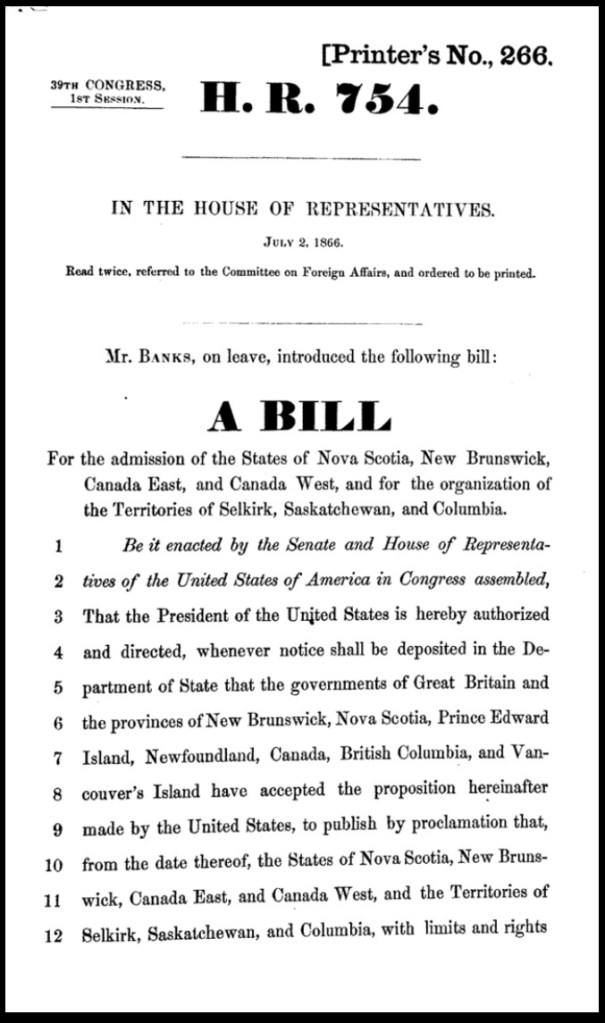
Even before Trump happened, the US annexation of Canada – by force, if required – was already a reality waiting to happen. A bill, tabled in 1866, called “Bill to Annex Canada [HR754]” has been in the US Congress, technically still an active proposal, awaiting deliberation, waiting to go into law ever since it was first tabled.
H.R.754 proposed, without real consent or plebiscite, that the “British” provinces of Canada, ie : the English-speaking provinces would be constituted and admitted as States and Territories of the United States of America, with military force if necessary.
At that point in time, Quebec – a French-speaking province where I live – was not targeted for annexation.
Therefore, back in 1866, H.R.754 was seeking to annex 85% of Canada, in terms of both, land mass and population and almost 100% of all its natural resources.
————————–
 Spunkypedia
This article makes me want to read In High Places, Achyut. I might have flipped through Hailey’s books in the seventies, but knowing myself I was probably trying to find any dirty parts they might have had. To be honest at a young age I had already read Hugo and Hemingway, but the tawdry sex scenes of cheap novels always attracted me more by the time I was in my teens. But thanks to your article I will take a closer look at Hailey’s books as soon as I can.
P.S. Come to think of it I am now fondly remembering the Hustler magazines I secreted into my room to peek at when I was a teen. 🙂
LikeLike
You’ll enjoy Arthur Hailey, Gary. Start with “Hotel”
LikeLike