
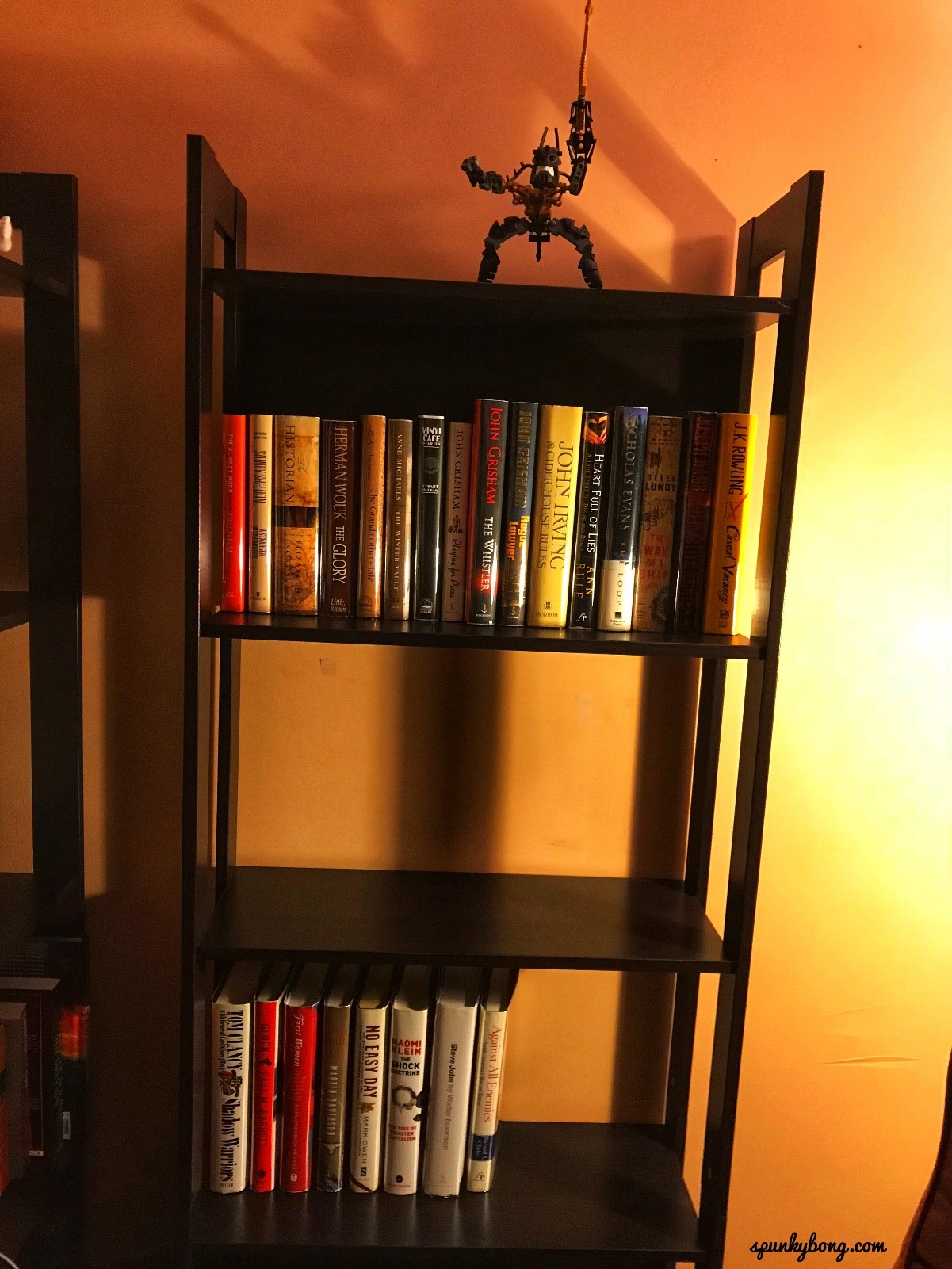
The First Editions rack in the library in my den downstairs. Oops, shouldn’ta disclosed the location. There are folks who could kill for my collection.
And those two fine ladies are Thelma and Louise on the middle shelf, with their beloved Chevy.
—————————–
First, set yourself up……
Prepare a private space in your home, a quiet little nook where you can be by yourself, preferably in the basement, away from pesky wimin who want you to mow the lawn or clean the laundry room.
Line the walls with book racks, just like you see ‘em in libraries. Categorize the shelves and maintain an Excel spreadsheet of all titles that you own, with columns showing the rack number and shelf number of each title. You must be able to tell if you actually own a title and if yes, what shelf/rack number its on.
Position an arm chair with deep cushions and a foot rest next to the shelves. And a coffee table with ‘dingar -dangar’ [roasted peanuts, dill-soaked cashew nuts and chocolate wafers]. And a bowl of bananas and apples, if you insist. A body can get hungry with all the reading, know what I mean?
Don’t forget the shelf within easy reach for stationery – pens, pencils, scissors, scotch tape, stickies, highlighters, erasers, notepads and cardboard page markers. Have an electric socket bar close by, to connect all your electronics. On a separate stand, leave enough space for your IPad, Iphone and Kleenex.
Have a set of high-quality wi-fi speakers. I recommend Sonos or Bose. Sometimes, one wishes to sweep aside his book, lay back, close his eyes and listen to ‘Addagio for Strings’. Or stock tips from ‘The Dividend Guy’ podcast. Or true crime, like “Cold Case Files”.
I woulda thrown in a well-stocked liquor cabinet but I stopped drinking. (I didn’t know when ta stop, couldn’t hold my liquor and I turned into a jerk when I drank). But you can have alcohol at hand, even a big-chested blonde from Jiggle City on your lap if you like. But listen, drinking and canoodling don’t go too well with serious reading, capische?
—————————————-
Now that you’re all set up, its time to collect First Editions, a hobby that is enriching in more ways than one. First, financially – I swear all those books are going to be worth a pila cash if I let them hibernate a while and sell ‘em in maybe 2050.
What? Of course I’ll be alive in twennie fifty. I’ll only be ninnie-fye by then and these days, that’s young-middle aged. I’m only concerned if the world is going ta still be around by then.
—————————————-
I have a JK Rowling that can easily go for a grand, right now if I sell it. I got her in pristine condition at Nova, the second hand book store by the river, for 25¢. Touching it is like running my fingers over Rowling herself. Selling it for a grand will be a 4000-fold return on investment if you know yore math. I got a Herman Wouk, some John Grishams, an RK Narayan, a few Walter Isaacsons , couple O’Henrys, a John Irving. Even a Sidney Sheldon, signed by Sid himself. All in mint condition.
I am looking for a Paul Gallico or maybe a Faulkner or a Wodehouse – early 20th century first printings. If anyone can meet me up with the owner of a hard cover ‘To kill a Mockingbird’ or ‘Screw it, Jeeves’, I’ll be eternally grateful.
Take it easy, there’s no ‘Screw it, Jeeves’. I made it up ta make you laf.
First editions are worthless if you don’t keep ‘em in good condition. To protect my stash, I have a climate controlled basement. Temp 10°C, humidity 35% and Gretchen Wilson. Yes, books love music, I swear they do. I reckoned first editions would go for country rock. Since Thelma and Louise are rednecks, I have ta play Gretchen Wilson’s Redneck woman in a continuous loop for them.
And I don’t collect paperback first editions. They aren’t majestic like hard covers. Besides, the two aforementioned wimin don’t like paperbacks.
Listen, everything in the previous two paragraphs was a lie actually. I just have First Editions on one book rack, that’s it. Thelma and Louise are finely crafted figurines I picked up at Nova, where I get my books.
——————————-
If you are interested to start collecting First Editions as a hobby, the first thing you got ta acquaint yourself with is the definition of ‘First Edition’ – it is the first printing of a title by a specific publisher. However, a popular title (a Rowling or a Grisham) may have multiple publishers – all of whom will naturally have their own first editions. In that case, the one that came out first is the official First Edition, a.k.a the ‘true first edition’.
If the initial print run of the first edition sells out and the publisher decides to produce another printing with the same typeset, no changes, the book is described as a first edition – second printing. On the other hand, if changes have been made by the author or the publisher (like updating the latest status of an event described in the first edition or adding a new chapter or a foreword), the book is then described as the second edition.
If you are a collector like me, you’ll go for the true first edition – ie: the very first printing of a title, the one that precedes all other first editions chronologically. So, open the copyright page and it will tell you the printing history. Assuming you have an average level of intellect (which you have, since you’re reading my blog), you’ll be able ta decipher the gobbledegook on the page.
So, a recap – just because you got a book brand new at your local Indigo outlet, it doesn’t necessarily mean it is a First Edition. You will have ta learn to recognize a First Edition and here’s how….
First of all, if you’re lucky the copyright page will mention the words ‘First edition’, like the Naomi Klein hard cover on her seminal work on ‘Disaster Capitalism’, a form of capitalism that takes advantage of natural or man-made disasters. An example that readily comes to mind is the free-for-all cash grab that followed Hurricane Katrina in the southern US in 2005 during the “reign of error” of George (Dubya) Bush.…
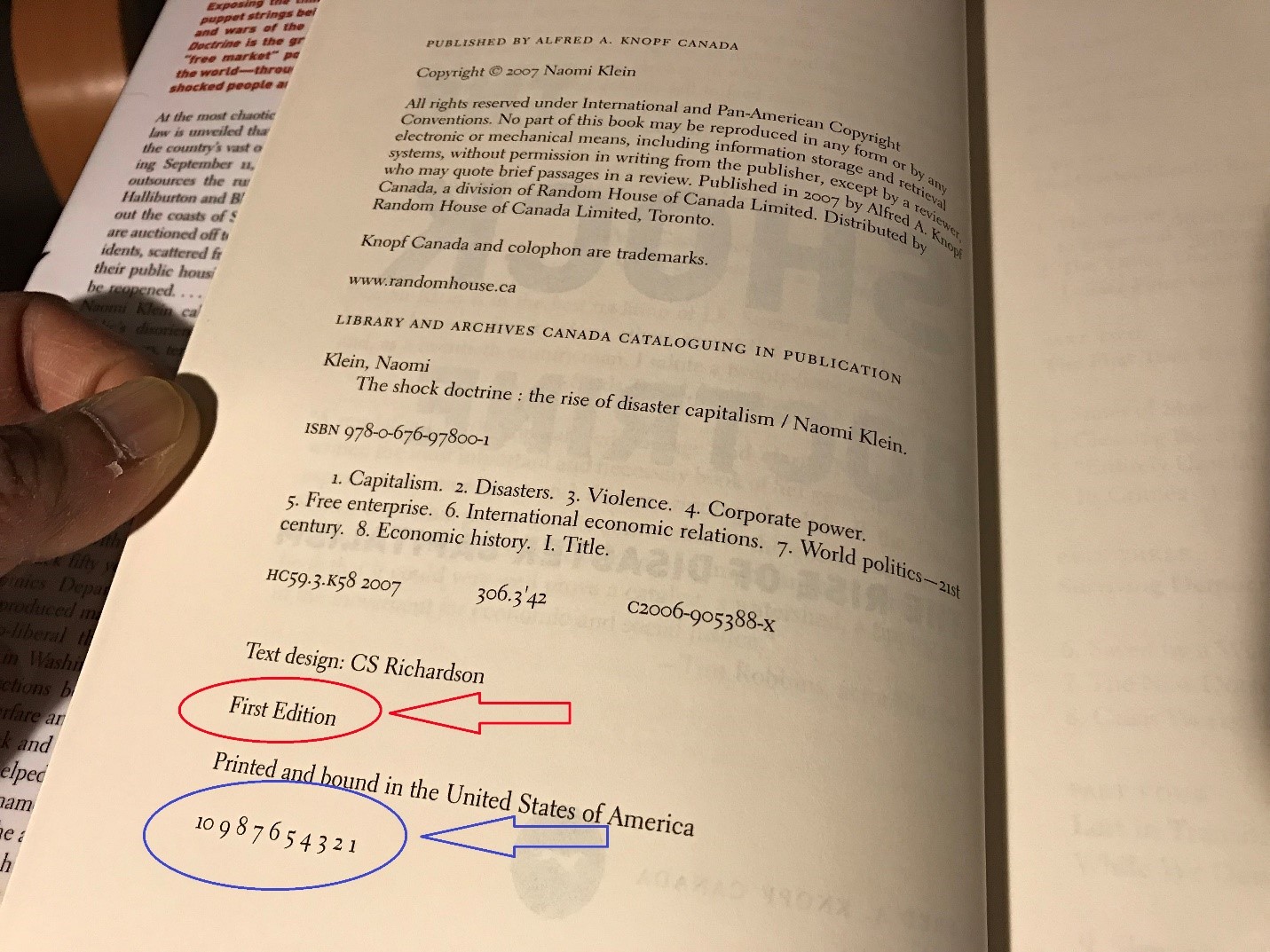
If you see ‘First printing’, instead of ‘First edition”, it’s the same thing.
Sometimes, you won’t find any of these terms on the copyright page. No problem, look for the ‘number line’. It is a series of numbers that usually appears at the bottom of the page. If the line begins or ends with a ‘1’, it’s a first edition.
————————–
Other times the number line is preceded by the term ‘First edition’, but be careful because some publishers leave on the words ‘first edition’ even when the book is in its third printing and that fact is reflected in the ‘3’ in this number line….
First edition
3 4 5 6 7 8 9 10
The following sequence is supposed to be on a book that is in it’s 2nd printing (the ‘2’ at the end) and has come out in 1975 (the ‘75’ in front) …..
75 76 77 78 79 10 9 8 7 6 5 4 3 2
What do you do if neither the ‘First edition’ nor the number line appears on the copyright page? Relax, read on….

In many cases, you may not see either the number line, or the ‘First edition’ mentioned on the copyright page. Not a problem, just check if the copyright date and the printing date match up, like it does above, in the copyright page for astronaut, Scott Kelly’s ‘Endurance’, about his 340-day saga aboard the International Space Station.
——————————–
The second most important thing to remember about first editions is that they have got to be looked after, since their value is directly dependent on their condition, unless you happen to have an ancient original…..
Certain first editions can’t be found in mint condition. In those cases, their archaeological value trumps everything. Like the 2700-year old Dead Sea Scrolls that the ancient Jewish sect, the Essenes, produced and secreted for posterity inside earthenware jars in caves around the Dead Sea. Since they didn’t have printing presses or xerox back then, they must be first editions.
The most valuable part of a first edition hard cover is it’s dust jacket. A dust jacket is 90% of the value of a first edition. So, don’t be a shmuck and fuck it up, like dropping coffee on it or jotting down your grocery list or something. Make sure there are no stickers or handwritten markings on it either.
Libraries usually use mylar dust jacket covers to protect dust jackets. I use Brodart™ dust jacket covers for all my first editions and other hard covers that I specially treasure.
————————————
Unfortunately I don’t own any signed first editions. That Sydney Sheldon I spoke about earlier is a signed first edition but the signature is a print, not an original signature by the author’s own hand.
Original hand signed first editions are serious cash – maybe 10, 20 times the value of an unsigned first edition. I have decided to begin frequenting book signings. To that end, I have created an account on Chapters.com. If you are a collector, make sure you get a photo taken with the author signing your copy. It’s not incontrovertible proof but it is still valuable circumstantial evidence that the signature on the book is authentic.
In case you think it’s crazy to collect books, even first editions, remember vinyl records? They are back with a bang. I was such a schmuck to throw away my LPs and my Garrard record changer. We humans are nuts – we don’t care about stuff when we buy them new, but we go ape shit for them when they are vintage.
I could kill myself for chucking out my illustrated hard cover of Vatsyayana’s Kama Sutra after its pages got sorta kinda crinkly and brittle with all the dried DNA I had inadvertently splashed on it. Imagine how priceless that Kama Sutra could have been by maybe 2850AD. Forensic archaeologists would be creaming over the ancient life form they detected on it.
Who says you can’t be creamed over, huh?


Achyut. I think I have over 1000 books. But I don’t know how many are first editions other than the First American edition of Patrick Suskind’s Perfume. And you know what is cool about that book? It has an original postcard that actually came with the book and that I still have inside it. I wish more publishing houses would put something like that inside their books. God knows we pay enough for them!
LikeLike
I suggest try going in for first editions and antique books. Become a collector. If you go to a second hand book store, you’ll find stuff people drop off, like books that might have belonged to a recently deceased family member. I have found books printed in the late 1800s with little love notes, greeting cards, newspaper clippings still stuck inside. Priceless!!!
LikeLike
Thaank you for being you
LikeLiked by 1 person