
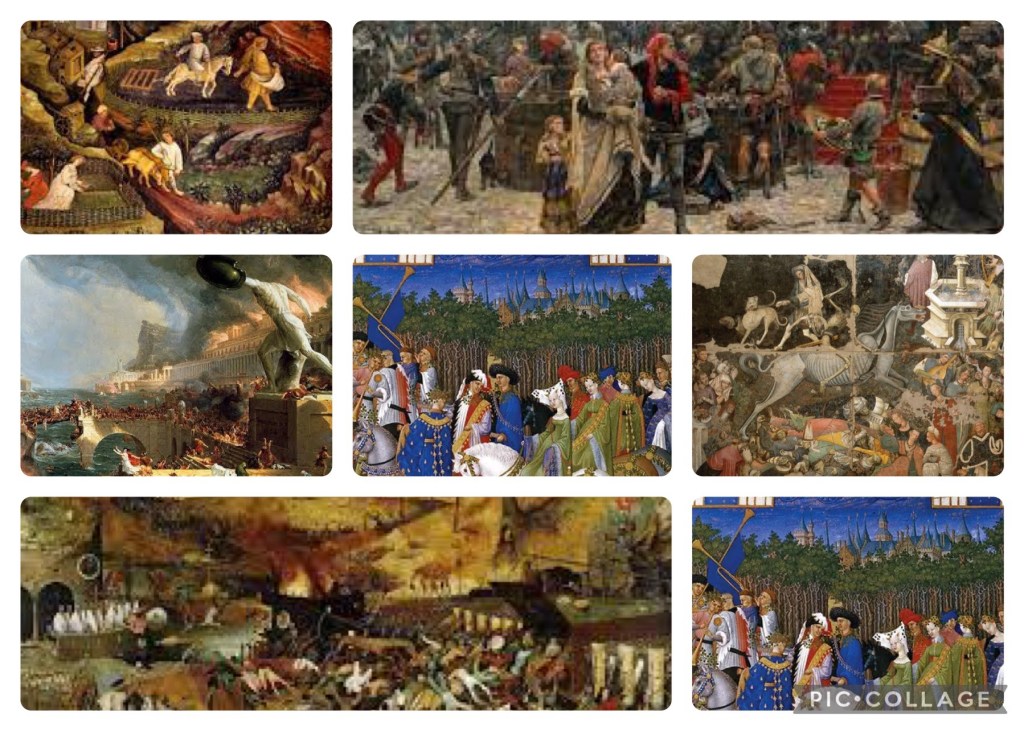
Imagine you are a commoner in 800AD England. Hang on, that’s not possible. As per Wikipedia, the Angles, Saxons and Danes unified to form England only around 927AD, so that is still a century away.
So, let’s say you live in a village in the Kingdom of Wessex.
If you are taking a morning walk, you learn to stay away from the sidewalk and you stick to the middle of the road even though a passing horse might kick you in the nuts.
You avoid the sidewalks because folks clear out their ablutions by simply opening a window and chucking the contents of their bedpans out. You wouldn’t want that in your face, would you? It’ll be another 1000 years before they have gotten on to the concept of bathrooms and toilets and sewer systems.
In the absence of soap, you wash with ashes and you do that very rarely. Many of your friends and relatives don’t bathe or wash at all. They simply wait for it ta rain. It’s normal ta own only one set of clothes and wear it all year round. You wash it by leaping into a pond or just by being out in the rain. Children up to 10 run around barefoot and stark naked when the weather is not too cold.
The only motive power is the horse or other pack animal, such as the mule or the donkey and they are expensive. Everything, from the tallest fortress to the finest fabric, is made by hand. Books are copied by hand, at great expense, each edition the toil of one rare literate worker. Raw materials and hand tools are precious assets.
The fields are plowed by hand, sown only once in two or three years, left fallow and unfertilized when not sown. The only fertilizer is manure and not enough for all the land. The crop yield per acre is a third of what it will be in another thousand years, by which time agriculture will be an organized industry. Right now, there is not enough grain to feed the population, so land is precious, even to kill for.
Are you healthier than my kind (ie: folks from the 21st Century)? In general, no, because even underdeveloped places will have better healthcare and disease prevention. But if you wonder if the strongest among you in the Dark Ages is stronger than the strongest man in the 21st Century, your man will win hands down and that’s because of the hard physical labor he is used to. His diet is likely to be unrefined and even raw. Obesity isn’t even a word right now.
The only organized industry sectors that employ workers in numbers are construction, lumber, handicrafts and weaponry. Basic necessities are made at home. Peasants like you spin wool and weave linen. The fabric for clothing is very strong, so strong that one dress can last a lifetime literally and even be handed down after death. Of course, your late grandma’s surcoat might stink but it is not an issue, you are immune to smells.
Small mom-and pop businesses are everywhere – blacksmiths, tinsmiths, potters, carpenters, saddlers, wood and stone sculptors, lacemakers, weavers and cobblers, these are folks with skills that have been handed down through the ages by ancestors. Serfs in these businesses usually do better than the rest.
Living conditions leave a lot to be desired and comfort has declined. You make do without things that in ancient Rome were considered necessary for basic comfort. Beds are a luxury and you sleep on straw, on the ground. The principal item of home furniture is the multipurpose ‘coffer’, which acts as a seat, a bed and a chest for storing household stuff.
When it is time to eat, wooden planks are set on trestles, as makeshift tables. Tableware is practically non-existent and the members of a family eat with their bare hands out of the same wooden bowl, dipping slices of hard, stale bread into the bowl.
Peasants build themselves huts to live in and these burn down from time to time. In the densely packed alleys within town walls, fires are an ever-present menace. However, the huts can be rebuilt in a jiffy, the owner hardly suffering any loss beyond a few clay pots and blankets of skins. Grain stocks are buried underground, in sacks, so they are not destroyed by fires.
There are no drainage systems and a spell of wet weather can turn courtyards and streets into quagmires. With huge quantities of dung from the large number of horses, cattle, lambs and sheep, a town can have an all-pervasive stink of ordure, smoke and damp.
There is yet no such thing as medical science. There is no medication or medical procedures. That’s the great leveller these days. Disease doesn’t give a fuck if you are rich or poor, king, vassal, overseer or serf.
Disease and death are everywhere. There are hundreds of ways you can end up dead, starting from birth. You might simply catch the flu, inhale smoke from the ever burning hearth with no ventilation, contract tuberculosis, venereal disease from dirty richards and pussies, food poisoning from putrid meat. There are no sewers, no method for the removal of human waste. Pasteurization is centuries away and you could ingest well water contaminated with faeces.
The Dark Ages are known for its pandemics. Disease can be brought in by rats from a docked merchant vessel, wipe out millions and last over a century. One, the Justinianic Plague, began 250 years prior and killed a fifth of Europe’s population. There are still affected pockets everywhere in your time, though the acquired herd immunity has almost completely stamped it out by now.
——————————-
After dark is when life gets dicey. Remember, there is no established law and order. You try not ta venture out anywhere after the sun sets. The only light is from wax candles, resin torches or tallow that release as much smoke as light. Anything that is used to produce light is very very expensive. You avoid expending your meagre store of illumination by rising and going to bed with the sun.
In the end, what is important these days is manual dexterity and muscular strength. You have ta have strong feet and legs. The only mode of travel for a commoner like you is by foot. For you, a 50, or even 250-mile walk to the next town is du jour, run-of-the mill, like. Distance is of course not measured in miles. It’s in days of travel, like a “3-day walk”.
You’ll take several days to reach your destination but there are inns on the way who will give you room and board if you cut their load of wood for the fire.
There are other units of distance measurement, like the “furlong”, roughly 220yds, the distance an ox can furrow in one go. 40 “poles” make one furlong. The smallest unit of length is a “barleycorn” which is roughly a third of an inch. I bet you guys get together in a tavern, load up fulla ale and joke about some guy’s ’barleycorn-sized” richard.
On your travels, some innkeepers will let you stay just to hear the “tidings”. You’re their only source of news. Writing is the luxury of the few literati and you’re not one of ‘em, so people like you have developed solid memories. You have no intellectual baggage beyond what you carry in your head in the moment. Those innkeepers love it when you offload those memories on them. You can even be a professional story teller, like a walking Wikipedia and boy, then the innkeeper’s plump daughter is yours for the night, like.
The shortage of the tools of daily life has given rise to adaptability. If you are a traveler, you are able ta tell the direction by the stars and the time by the movement of the sun. In your head you carry a calendar that is able to broadly forecast the seasons and the change in weather patterns. You know which plants are medicinal though not yet why.
For what you do not know, the theoretical, you rely on the tales of the elders of your family and their painstakingly acquired experiences of life in general.
——————————
Today, here are the things I value, stuff that I don’t necessarily need ta survive but I still covet ta lead a comfortable life…. A sturdy Toyota Tundra, a lake side property, maybe a chalet in the country, cash to fly me to vacation spots, maybe a small single-engine Cessna 172 to appease my adventurous side.
Now let’s check out what you think of being of value to you….. horses, mules, donkeys, oxen, bulls, sheep and poultry. And a little plot of land ta grow wheat and barley, maybe some hemp and flax. Have these and you will consider yourself contented. Livestock provide you with nearly all your day to day needs. Flayed skins protect you from the cold. Blood is mixed in with clay to make cement. Horns are used for cups, wool for clothes and feathers for quilts and mattresses.
One thing that you don’t have ta pray for is wild game, lotsa wild game. You have that in plenty. Wild life is abundant. The woods are filled with the clamour of birds singing.
This paucity of grain does not cause starvation however, due to the abundance of meat from wild game. Most of England is covered in dense forest, teeming with bear, boar and wild fowl. Herds of deer nonchalantly browse the clearings. Hare, rabbits, partridges, foxes and wolves, they pack the woods with relentless cacophony. Sometimes, the skies darken with dense flocks of migrating geese. You just have ta aim at the general direction. Everyone is a hunter. You go out and hunt what you want for dinner, it’s that simple.
Hunting is not a pastime. It is a serious job of work. The object is your daily nourishment, though you have managed to make it kinda fun, like a sport, with competing teams and their own spotter dogs. Slaughtered boar and stags are brought home in triumph. On the eve of village feasts, your job is to contribute hundreds of quail, partridge, thrushes and ducks. You bring them in a game bag and tip them in a bloody heap on the kitchen floor, completely unaware of the concept of hygiene.
Your home has a perpetual stink of tanning hides, animal blood, mingling with the aroma of roasting meat, further mixed with the odor of earth, smoke, sweat, dogs and faeces.
And bad breath, body odor and the disgusting smell of toe jam. Man, I have no idea how you manage ta live in close proximity to unwashed bodies. How can you even think of having sex with your spouse who hasn’t bathed in a year, Dude?
I have a theory. Maybe you get turned on by body odor, how about that? I know of an African tribe in present day Senegal whose women won’t sleep with their men unless they go at least a fortnight without washing. Ugh!
———————————
Post-Script
——————————
The above was a chat I had with a random Medieval man when I time travelled to 800AD and now it’s time ta get back to the present day.
The dark ages were truly dark but there is a belief among some historians that had there never been a period of stagnation, there would most certainly not have been a Renaissance and an industrial age thereafter. Great creativity and enlightenment always follows pervasive ignorance. And vice versa.
Will MAGA America similarly lead to progressive enlightenment? Chances are slim, but who knows? The Dark Ages were somehow necessary, it is thought, so maybe MAGA America is necessary.
Necessary or not, the Dark Ages were an Eurocentric phenomenon. It was only Europe that stagnated, where folks dumbed down. Outside, the world flourished…..
The Muslim Arabs had an explosion of scientific output. Al-Khwarizmi gave us algebra around 820AD. Avicenna and Jamshīd al-Kāshī made advances in trigonometry, geometry and Arabic numerals. Islamic doctors came close to finding remedies for diseases like smallpox and measles and challenged classical Greek medical theory.
In India, as early as 500AD, mathematicians like Aryabhata and Bhaskara were giving us geometry and trigonometry. Interestingly, Aryabhata was born the same year that the Roman Empire fell to the Goths and triggered the Dark Ages. The move from zero as merely a placeholder by the Mayans and Babylonians – a tool to distinguish larger numbers from smaller ones – to a digit of its own was established in India by Aryabhata and then began being used in calculations by Bramhagupta around 800AD.
But Middle eastern and Indian advancements during Europe’s Dark Ages pale against the brilliance of the Chinese during this period. China’s Tang Dynasty (618-906AD) brought spectacular scientific innovations into the world, beginning with binary code, paper, printing, the compass and gunpowder, to name just a few. Although legend has it that the Mesopotamians first invented the abacus, the first archaeological evidence of a working model similar to one used today, came from 1200AD China.
Alas, the East had not realized that scientific advancement had to be in lock step with advancements in military power. The Dark Ages had cemented Europe as a martial entity that had learned how to fight and conquer, while on the other side of the world enlightenment and peace prevailed. So, while the Europeans learned to colonize, the east remained blissfully trusting.
The pendulum has swung back again. The east is once more on the rise, this time with sufficient military power to make a wannabe conquerer think twice. No East India Company will succeed this time around.
That’s life, isn’t it?
 Spunkypedia