
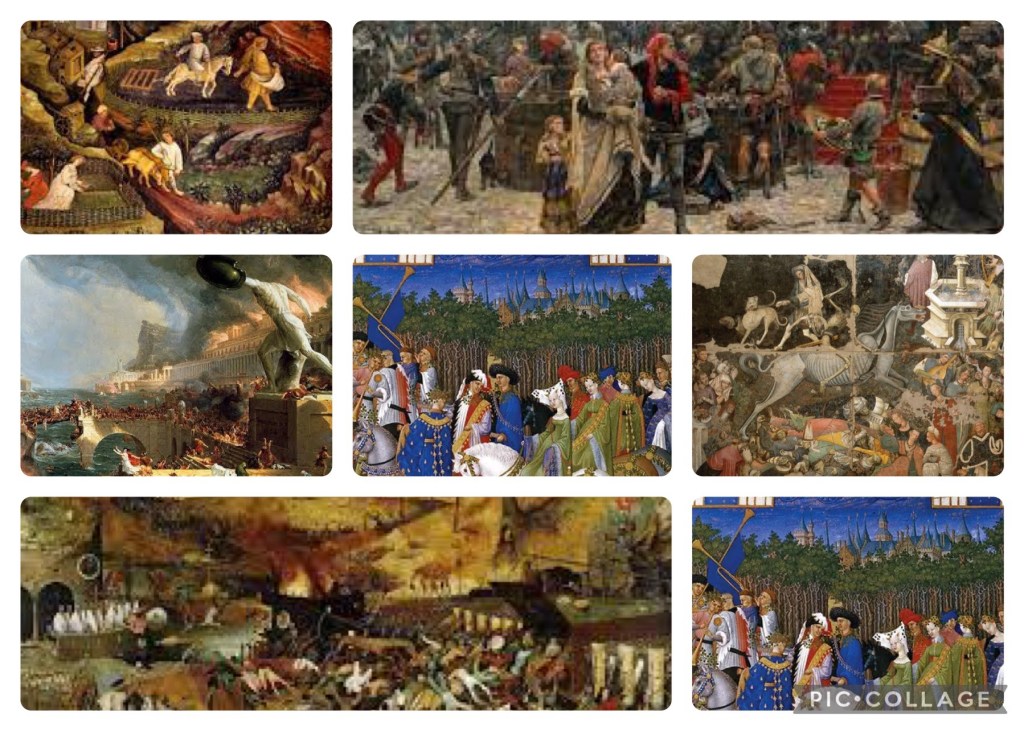
“In public, your bottom should emit no secret winds past your thighs. It disgraces you if other people notice any of your smelly gas.”
This useful bit of advice, for young courtiers in the early 13th century, appears in “The Book of the Civilised Man”, by a Daniel of Beccles. It is the first English guide to manners.
Ian Mortimer, a historian, argues that this and other popular works of advice that began appearing around the same time represent something important: a growing sense of social self-awareness, self-evaluation and self-control.
The ancient Romans were the first to use mirrors made of glass. Mirrors made it possible for men and women to see themselves as others did. It inspired them to be more presentable and in turn, be better prepared for success in their lives.
With the gradual demise of the Roman Empire, aesthetics, etiquette and other finer aspects of day to day living vanished. The hordes from the north, the Huns, didn’t believe in them.
But the barbarism didn’t last too long. Around 1200AD, mirrors were back in vogue all over Europe. One can take this as people once again waking up to their persona.
By 1500, mirrors were cheap, and their impact had spread through society. Europe seemed to be recovering from the Huns.
However, all that most of us see in this era of revival is a time marked by violence, ignorance, superstition and centuries-long pandemics that decimated populations.
Many historians believe that this time in history, from just after the fall of the Roman Empire to around 1500 AD, saw considerable social and economic progress. It laid the foundation of the modern world. Inventions such as gunpowder, the magnetic compass and the printing press, all found their way from China to transform war, navigation and literacy in Europe.
For Europeans, the horizons expanded. In the 11th century Europeans had no idea what lay to the east of Jerusalem or south of the Nile. By 1600 there had been several circumnavigations of the globe.
Law and order was another frontier. Thanks to the arrival of paper from China in the 12th century and the advent of the printing press in the 1430s, document-creation and record-keeping, which are fundamental to administration, surged. Between 1000 and 1600 the number of words written and printed in England went from about 1m a year to around 100bn.
In England, a centralised legal and criminal-justice system evolved rapidly from the 12th century. Violent deaths declined from around 23 per 100,000 in the 1300s to seven per 100,000 in the late 16th century.
In the fields of science and math, the Arabs introduced Europe to Algebra, including linear and quadratic equations. The now common byword “algorithm” was born out of the name “Al-Khwarizmi”, a pioneering Persian math wizard of the early 10th century AD.
Another “horizon” was speed and the sense of urgency that went with it. By 1600 a letter bearing important news could be carried 200 miles in a single day, thanks to people starting to use relays of horses at staging posts. Over the course of the 14th century mechanical clocks were developed, allowing time to be standardised and appointments to be kept.
The period was also marked by growing personal freedom, with the banning of slavery within England by the English church in 1102 and the rapid decline of serfdom after the Black Death of 1348-49, when nearly half the labour force perished. Political power expanded to include a growing land and property-owning yeoman class.
All over Europe, great military leaders ruled even-handedly, gradually bringing order everywhere – William the Conqueror, Alfred the Great, Charlemagne, Justinian-I, Richard-I (the Lionheart), Louis the 14th, Henry-V and Edward-III were some of the pillars on whose shoulders modern Europe was built.
Why then do we insist on calling the period between 800 to 1500AD the “Dark Ages”?
—————————
Ps : The Dark Ages is a Europe-centric thing. There were no such identifiable dark ages or period defined in any other history anywhere else in the world.
————————
Citations :
– The Reformation – Will Durant
– The Crusades – Zoe Oldenbourg
 Spunkypedia