
“The world’s geological strata are like a book that is missing some pages and chapters, paragraphs, sentences and words, leaving us to piece together the narrative from isolated parts. Some of those parts tell stories richer in detail than others…”
– Charles Darwin
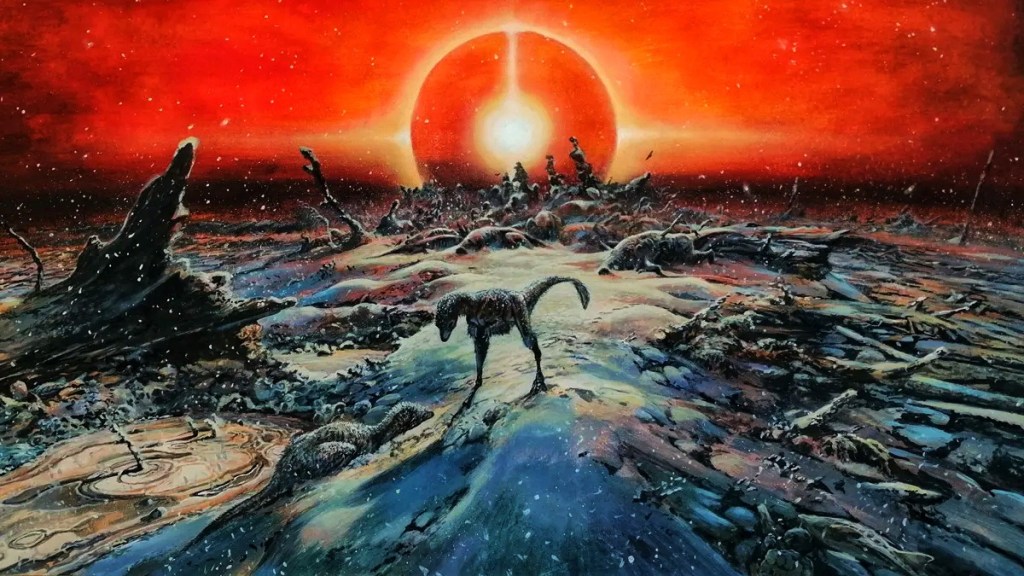
The dinosaurs met with what is known as an Extinction Level Event [ELE].
Usually ELEs happen over a protracted period of time, like over 500,000-1,000,000 years. A million years might seem like a long time but in geologic time scales, it is like 10 minutes. In comparison, the dinosaurs got wiped out in just 33000 years and that’s like a microsecond.
There was a far more devastating ELE, 200 million years prior to the dinosaur wipeout, when a chain of super volcanos erupted in the northern Siberian region, at a location now known as the Siberian Trap. For a mind blowing 2 million years, the super volcanos kept on erupting and by the time they fell silent, 95% of all life on earth had perished, leaving behind a vast expanse of bare volcanic rock the size of Mongolia.
The Super Volcano eruption is known as the Permian-Triassic Event. It formed the boundary between the end of the Permian Age and the start of the age of the dinosaurs.
—————————
Interestingly, this very spot – the Siberian Trap – was the scene of the world’s deadliest man-made thermo-nuclear test detonation in 1961, when a Soviet Tu-95V strategic bomber dropped a 27ton device from a height of 30000ft. Soon as it crossed 13000ft, the bomb exploded automatically with a force equal to the explosive force of 58 million tons of TNT, registering an earthquake of a magnitude of 8.5 in the Richter scale and shattering windows in Norway.
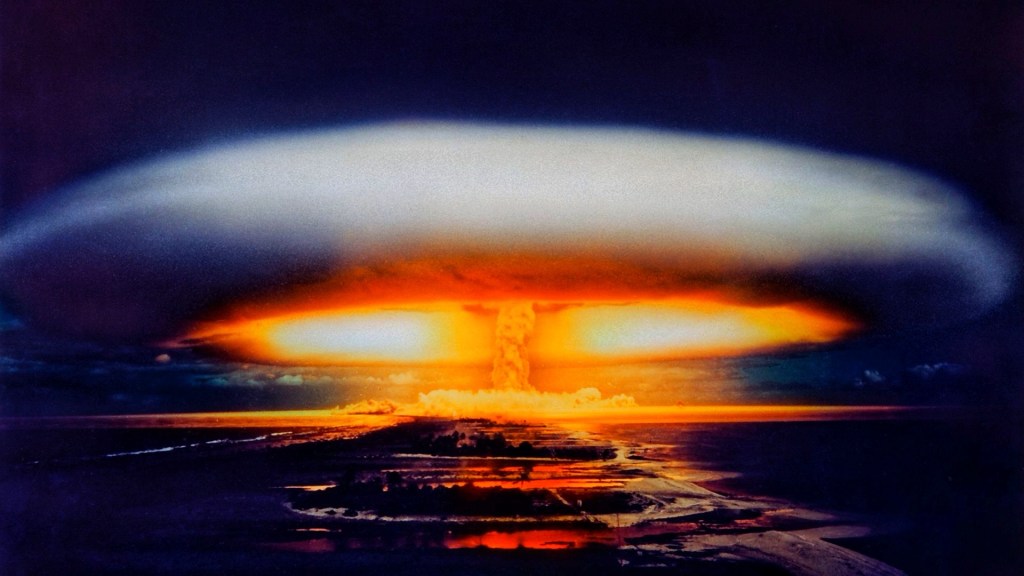
Prior to the detonation, the then Soviet leader, Nikita Khrushchev, had given the bomb the nickname “Kuzkina Mat” (Kuzka’s mother). Earlier in 1954, the Americans had tested their most powerful fusion bomb “Castle Bravo” that yielded 15 Megatons and in a phone call to the then US Vice President, Richard Nixon, Khrushchev had derisively called the bomb, “Kuzka” (pipsqueak)……
“That’s it? Wait, we’ll show you Kuzkina Mat (Kuzka’s Mother)!” Khrushchev had thundered over the hotline.
I wanted to tell you that the Soviets built another, far more powerful 100 Megaton device that they wanted to drop on China, their then mortal enemy, but they decided not to. Khrushchev had already given it a name – Kuzkina Tetya (Kuzka’s Aunt).
But I am digressing.
—————————-
Let’s get back to where we left off in Part-1 ….
The trigger for dinosaur extinction became a matter of hot debate among geologists, geophysicists, palaeontologists, geochemists and paleo-climatologists through the late 19th and 20th Century….
“It got too hot”, some said. “No, it got too cold”. “Maybe a terrible disease ripped apart the dinosaurs’ lives.” “Nope, it must have been sea level rise.” “The herbivores ate up all the vegetation and starved and since they died, the carnivores had nothing to eat.” “The furry mammals stole and ate all the dinosaur eggs”, “Who said 33000 years is sudden?”
The debate went on and on, but two things are certain – something terrible and sudden had befallen the dinosaurs. And 33000 years is an instant in geological age terms.
Then, in 1980, it all began to become clear. Battered crystals, prehistoric soot and a highly dense, corrosion-resistant, very very rare metal called iridium were discovered at the exact geologic strata as the dinosaur fossils. Iridium is so rare that in 2023 only 6 tons were mined and refined from ore in the whole world. But on asteroids, it is a thousand times more abundant for some unknown reason.
The high concentration of iridium made it highly likely that some extraterrestrial object had slammed into our planet. The battered crystals and soot were deemed to be the product of the impact.
Then, in 1960, scientists working for the Mexican state-owned oil giant, Pemex, discovered a massive 186-mile wide impact crater lying across half of the Chicxulub landmass and the sea bed under the Gulf of Mexico, in the Yucatan Peninsula.
It wasn’t until 1990 that researchers were able to link the Chicxulub crater to the Cretaceous-Palaeogene asteroid impact, the ELE that killed off all the dinosaurs.
——————————
Back to 66 million years_BC….
Scotty the T-Rex doesn’t see it coming. Neither do the pterosaurs. All that they notice is that it has gotten suddenly very quiet. Everything, all movement, seems to have frozen in place.
A chunk of the dead triceratop’s arm still attached to his teeth, Scotty straightens and raises his savage eyes up to the skies with a kind of “what the fuck was that” look.
A mile away on the other side of the swamp, a frisky juvenile Edmontosaurus is itchy as hell. He wants a scratch badly. Those mother fucking bugs are annoying him.
Yeah, as dinosaurs have evolved into massive beasts, so have numerous tiny parasites and bugs multiplied, benefitting from all that dinosaurian real estate to bite into.
There is a beech stump nearby that is just the right height, its bark unnaturally smooth and polished. It has probably been rubbed by other dinosaurs seeking similar relief. The hadrosaur raises himself on his two hind legs and begins scratching vigorously, his pleasured grunts saying, “ Ah, that sure feels good.”
The rubbing causes gooey sap to begin oozing out here and there through the bark, which after a while will harden solid. Someday, in another 66 million years, the goo – now rock hard and an unnaturally transparent reddish orange – will be prized out of the basalt 65 ft deep. A few will have tiny fossilized millipedes trapped inside, clearly visible, dead for 66 million years. The rock-hard fossils will be carefully shaped, polished and sold as amber for $150 USD an ounce.
After a while, the young hadrosaur lets out a satisfied honk and drops back on his four three-toed feet and ambles off into the thicket to catch up with the rest of the herd. He is still young, unaware that he lives in a landscape of fear. He doesn’t realize that he must remain within the shifting territory of the herd. Perhaps one day he will feel Scotty’s 8-inch long fangs sinking into his neck and realize it is too late.
The small herd of 20 is calm as it grazes on open ground, a light breeze mussing the fluff on back of their heads. There is no sense of impending doom, no shifting of winds, no darkening of clouds, no thunder or lightning. In this little patch of Frenchman River Valley, all is as it has always been for those dinosaurs.
—————————
But more than two thousand miles to the south a piece of rock has just slammed into the earth at close to 72000 miles an hour. It began its journey as a part of a much bigger rock from a distance of 75000 Au, deep within the Oort Cloud. 1 Au (Astronomical Unit) = 93 million miles or the average distance of the sun from the earth.

————————-
That one rock, initially 55 miles across, travelled across the darkness, randomly gaining speed and trajectory through multiple ‘gravity assists’ from the pushes and pulls of Pluto, Neptune and Uranus and their moons and sundry asteroids it passed, until it reached the vicinity of Jupiter when it began being drawn into the gas giant’s orbit.
But the rock resisted, its speed too high for Jupiter to ensnare it and that is when big daddy (our Sun) intervened, it’s invisible pull beginning a tug of war that blew the rock apart into multiple small bits, most of which were too tiny to resist Jupiter’s gravity and ended up plunging into Jupiter’s thick hydrogen soup, lost forever.
There was this one fragment, 7 miles across, that still had enough momentum to flip Jupiter the bird and continue on, drawn toward the centre of the Solar System. It had some scary close calls with the asteroid belt and also when it flew by Mars 100000 miles from its surface, but by now it was zipping at 200000 miles an hour, a speed too high for its mass to be captured by the Mars gravity.
The rock fragment continued on and would have gone straight through to disappear forever inside the Sun’s corona and been reduced to fine ash, incinerated by the 500000°C heat.
But it didn’t. Fate placed the third planet from the sun in the rock’s path. Here is where things went horribly wrong. Or should I say, right? Bear with me…
Had the rock been flying in the same direction as that of the earth’s orbit, it would have received a gravity assist and swung out into outer space in a random direction that depended upon its orientation at that moment. Like a sling shot. The earth would have been saved and dinosaurs would continue ruling it, until evolution deemed changes necessary.
Unfortunately for the dinosaurs, the rock was speeding in a direction opposite to the direction of the earth’s orbit. It struck the mesosphere with an explosive bang and glowing red, shedding little bits of its outer layers, it flew far above the Siberian forestland, its speed now 65000 miles an hour. There has never been any feel or comparison of 65000 miles per hour, a speed so fast that it is almost unimaginable.
How does one imagine an object covering 20 miles every second?
With cold indifference, the rock continued on in a south-westerly direction high over the Norwegian Sea, Northern Europe and the North Atlantic, before finally ending it all, coming in at an angle of 45° to the horizontal and slamming into the Chicxulub region of the Yucatan Peninsula with the force of 100 trillion tons of TNT. Three-fourths of the impact location is now under the Gulf of Mexico.
The force of the impact was nearly 2 billion times greater than Kuzkina Mat.
It had been a long voyage, taken the celestial wanderer 1595 years to get to earth from its home base in the vast Oort Cloud.
—————————————————————————
Earth
Frenchman River Valley, Saskatchewan, Canada
66,050,000_BC (+\- 500,000)
Ambient : Max +49°C / Precipitation 95% / Humidity 85%
———-
At Frenchman River Valley, two thousand miles to the north, this moment has gone unnoticed.
The Edmontosaurus herd is searching for some shade trees and an afternoon of siesta. Maybe they’ll take a mud bath later some place along the coastal plain.
It is the same everywhere in Europe. A Quetzalcoatlus Northropi , the largest flying bird on the planet, is heading home. Not that he believes in the concept of a permanent residence. For some strange reason, he just wants to get back to where he was born, a fern covered flatland in northern Norway where, millions of years later, there will breathtaking fjords and snow-covered slopes.
In the eastern end of Russia, there is a land bridge that connects to the American mainland. This land bridge will emerge and submerge many times over the earth’s geologic history. 66 million years from now, it will be submerged, under a 55-mile wide body of water known as the Bering Strait.
Today the land bridge is a dinosaur migration highway of sorts. Right now a 6-ton Torosaurus, a usually gentle herbivore, is ambling across the land bridge in search of a male to mate. Today she isn’t her usual self. She is horny and she is dangerous and unpredictable when she is horny. Even Scotty would give her a wide berth right now.
All’s well in the world.
———————————
Watch out for Part-3 … “The Lost Cretaceans – Impact”
(Not now, silly. It’s isn’t written yet).
 Spunkypedia
Pingback: Fiction Cretacean – The Day Before Impact | Spunkypedia