
“What is the next thing that can kill me?” Should be a constant question on every astronaut’s mind during a mission – Chris Hadfield, Canadian astronaut & ex-Commander of the ISS, in his book, “An astronaut’s guide to life on earth”
——————————
If you spin a bucket of water around your head fast enough, the water will never spill out. You have created a force to make the water remain where it is, inside the bucket, a force known as centripetal force. The same force, also called gravity, makes the earth go around the sun and the moon around the earth. It is the same physics.
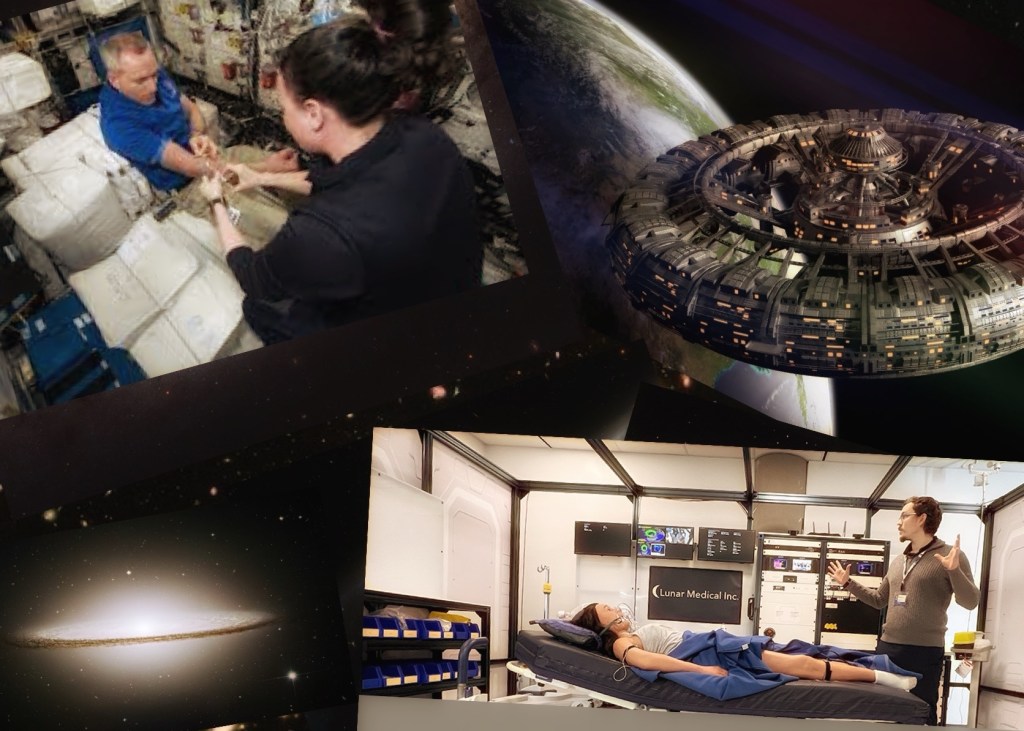
Like the bucket of water, if you could make a spacecraft spin around its axis, you could walk along its inside walls with your feet rooted firmly, creating an artificial gravity and eliminating the risks of the debilitating physiological changes in your body touched upon earlier in Part-1.
For the spin-induced gravity to be practicable however, the spin speed & the radius of the spin have to be optimal. To replicate earth’s gravity, you are therefore looking at a very large tubular ring-like space craft, much like the one in Arthur C. Clarke’s “2001 – A space odyssey”. Engineering, transporting in bits and assembling such a spaceship in space has not yet been attempted, given the costs involved.
Such a rotating spacecraft will be able to vary that artificial gravity merely by changing its speed of rotation. There could a day in space, when you could tune your gravity through 9am-to-5pm, like adjusting a thermostat. You might spend your workday in microgravity. Then you might go for a jog or just rest in 1g. Maybe as you age and your joints start aching, you move to rooms in 0.75 g, where gravity is tempered just enough to put the spring back in your step. Senior living, in space.
Artificial gravity is still a fantasy, but one that is necessary. Till then, getting to Mars and back will most likely require living in microgravity for more than a year. This raises physical concerns: Will those astronauts be able to stand up when they arrive at Mars, whose gravity is one-third the earth’s? If they can stand, will they pass out? If they pass out, will they break a bone? And if they break a bone over there, will it heal as it would on Earth?
—————————-
The first attempt, specifically designed to learn what could happen to a human body on a long duration mission to Mars, was made with American Navy Pilot and astronaut Scott Kelly, on the ISS.
The mission was a double whammy. Scott has an identical twin brother, Mark Kelly, a retired astronaut and now a Democratic Party senator from Arizona. While Scott Kelly went to space, a close genetic replica of him stayed behind. When he returned, researchers were able to compare the two men at a molecular level to see what had changed in Scott but not in Mark.


———————————-
Space appeared to remodel Scott Kelly in subtle but significant ways. He suffered a small amount of DNA damage, believed to be caused by radiation exposure. Changes in genes are heritable, a feature that helps humans and other creatures pass on adaptations of themselves to their descendants.
Fortunately, as in the case of his spinal disc, these alterations reverted back nearly to their baseline state after Scott’s return, giving scientists a sense of which genes might be most impacted by lengthier stays in space.
One of the most puzzling changes researchers observed was in Scott Kelly’s gut microbiome, the bacteria, fungi and viruses that live in the digestive tract. Their proportions in relation to one another had changed dramatically, probably because of all that freeze-dried, pre-cooked space food Scott ate. On long space flights, these changes affect digestion, metabolism and thus, immunity. Reduced immunity can be especially dangerous in space, where microgravity can make bacteria more resistant to antibiotics and more likely to cause serious infections.
Then there were the blood clots. Scientists once thought blood clots were unlikely to occur in the absence of Earth’s gravity and then one happened. In a 2019 study, an international group of researchers reported that the blood flow in the jugular veins of six of 11 ISS crew membersthey monitored had, by around Day 50 in space, either stagnated or reversed direction and one of the six had a potentially fatal thrombosis with no symptoms. Luckily, physicians had already stocked the ISS with a 40-day emergency supply of anticoagulants, just in case.
———————————-
Space-medicine experts are adept at imagining dire situations. What if an astronaut develops appendicitis? If we go to Mars, you can’t pull a U-turn. Do you send a surgeon? What if the surgeon is the one who gets appendicitis? In 1961, a 27-year-old Soviet doctor, Leonid Rogozov, had to give himself an appendectomy at a base that he and a team of 11 others built in Antarctica. He did it by feel, after finding the inverted images in a mirror disorienting. Within two hours, he had removed the infected organ and sutured himself up. A helpful colleague snapped photographs for posterity.
Space however, has major drawbacks. It is an environment in which doctors may be called upon to perform medical procedures with limited supplies of tools and support staff. Dr McCoy on the original “Star Trek” had a snazzy surgical suite. In reality, it costs over $10,000 per pound to put a payload into orbit, and anything that goes on the spacecraft must earn its place at the expense of something else. There’s a defibrillator and a portable ultrasound on the ISS, not much else.
Besides, major surgery could result in the patient’s insides floating out. Even giving injections in space requires comprehensive planning. In Antarctica, Rogozov could at least give himself Novocain shots as local anesthesia. In space, getting liquid into a syringe is complicated.
———————————
One of the weird traits we humans are born with is that the moment we find ourselves in a new environment — say, a mountain peak, an airplane toilet, a hot air balloon or the Everest Base Camp — we feel compelled to find out what will happen if we have sex there.
So it is on a trip in space. On a long duration mission, it is very likely that astronauts will feel horny and want to fuck at some point, either during the journey or at the destination. They might even get pregnant and have a baby in space. NASA does not yet have any guidelines that might become necessary to enforce for long duration space flight.
Should space travelers choose abstinence until NASA officially declares space sex safe?
More pertinently, is it possible that sexual intercourse has already happened in space and we don’t know it? Fewer than 700 people (men and women) have flown to space so far and we all know who they are. Sunita Williams has been a NASA astronaut and veteran of 608 days in space, two of them each almost 10 months long. There must have been days when she had been alone with just one hunky cosmonaut in the Russian module, while the other short-duration crews were being rotated. Could they have shtupped then? Nyet? Alas, we’ll never know.
It would be fun to learn that she did, though. I am imagining globules of semen escaping the telephone booth-sized sleep pod and floating around in the ISS, while the Capcom in Mission Control and the Glavni at the Russian TsUP (Mission Control Center) watch and chuckle in amusement.
But seriously, we do know some basics. There are good indications that sexual erection and lubrication are not inhibited in space and that microgravity does not subject contraceptives to leave any side effects. Behavioral scientists are, however, concerned about the morning-after crew dynamics. Could romance and/or adultery blossom aboard a spacecraft to Mars or Jupiter? Theoretically, of course it could.
——————————
What about the effects of loneliness and isolation in space on our psych and our health? Certainly these are expected to be more significant, the longer a mission lasts. Being in space is like the pandemic lockdowns many people experienced in 2020, except you can’t open a window or take a walk outdoors. And the farther you get from Earth, the more time lapse there is between your sending a message and your loved one back home receiving it. On Mars, the wait time is 20 minutes, one-way. On Europa, one of Jupiter’s moons, a favourite space destination aggrandized by sci-fi writers, it is approximately an hour.
In 2014, NASA issued a report, “Examining Psychosocial Well-Being and Performance in Isolated, Confined and Extreme Environments,” that considered data from submarines, underground bunkers and polar expeditions. It also detailed how career competition and differences in personality, values, culture and language derailed a 105-day ISS simulation in 1999, in which a crew occupied connected hyperbaric chambers. A physical fight broke out among two of the crew members, a sexual-harassment incident was reported and one protesting crew member withdrew from the study.
In an earth-bound simulated spaceflight, an individual can simply say ‘fuck it, I’m done” and walk out of isolation, but in a real mission escape or mission termination is not an option. Space voyagers will have to learn to get along, for the success of the mission.
—————————-
And then what about depression, caused by acute home sickness? Those of us who might one day leave earth for good, won’t we miss it? Are we capable of fully casting off our home planet that had nurtured us and leave our loved ones on earth forever? Or could we become the very extraterrestrials that we have fantasized about for so long, stranded on a strange planet, wailing plaintively, “ET go home”?
We are humans. One way or another, we are going to finding out.
 Spunkypedia