
—————-
The Strait of Malacca
*****************
February, 1988
*****************
For even a seasoned nuclear submariner, navigating the Sea of Japan is a scary experience. These are the busiest waters of the world’s oceans.
Busy, with regard to submarine traffic.
To a sonar technician hunched over his console, headphones glued to his ears, this part of the Pacific Ocean feels like a blue-water version of Times Square in New York, if one could draw an analogy.
Aside from the Russians, the Chinese, the Koreans and the Japanese (who have the right to be there since it is their backyard), this part of the world’s oceans plays host also to US subs of all types, from Los Angeles-Class nuclear attack subs to 19000-ton Ohio-Class ballistic missile SSBNs, under the US’s Submarine Force Pacific (SUBPAC).
The ‘traffic congestion’ has steadily gotten worse. You can find every class of sub there is. Ballistic missile subs, hunter-killer attack subs, cruise missile subs, diesel-electric subs, you name it and the Sea of Japan has it snooping around somewhere in its murky depths, armed to the teeth.
The combined firepower under the surface is frightening and the chances of a sleep-deprived sonar technician bungling distances inside that opaque soup, are hair-trigger. If you are just passing through in peace, you will need to make a lot of noise so everybody knows exactly who and where you are and leave you alone. Switch off your active sonar and you are asking for trouble.
Besides the possibility of collisions with other subs, there is always the danger of hitting “seamounts”, undersea mountains that rise up many thousands of feet from the ocean floor.
———————-
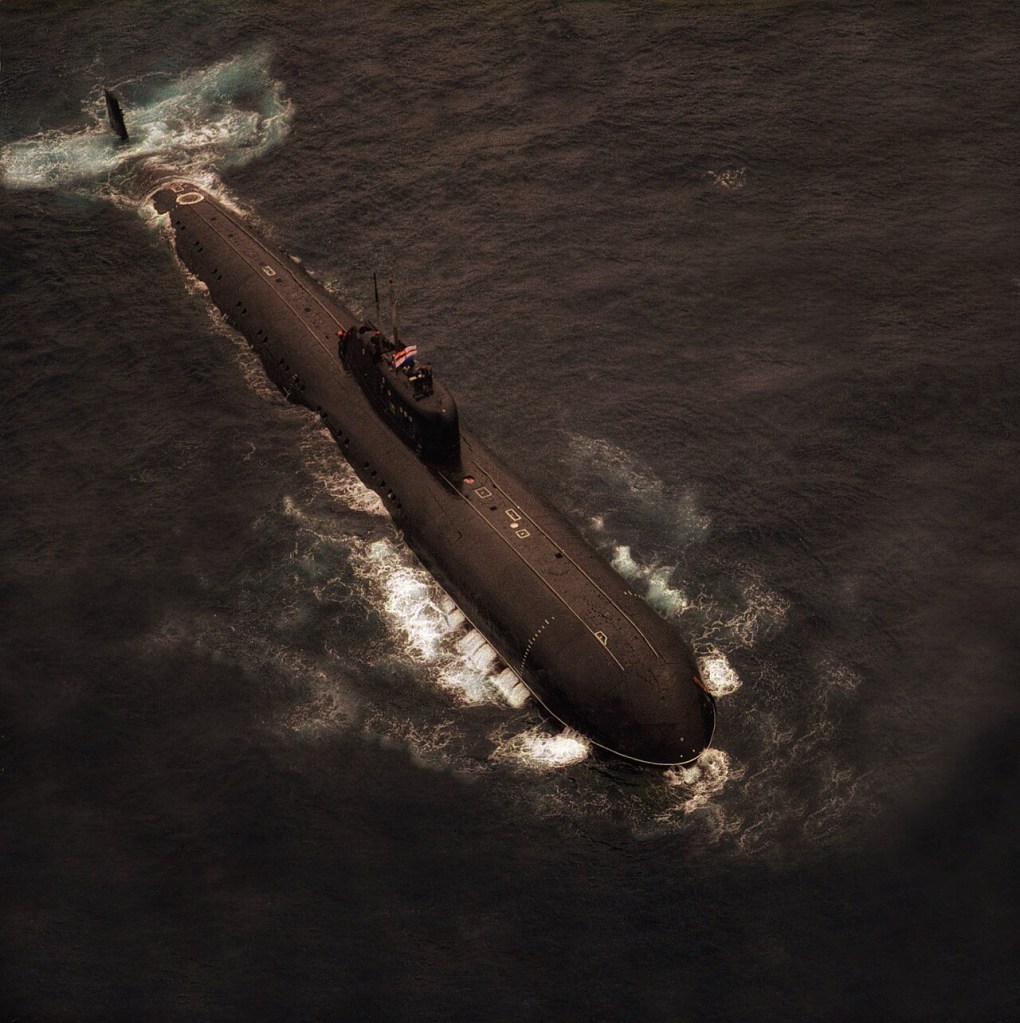
Tonight there is another prowler, a 6000-ton nuclear ballistic missile sub that had begun its service life in the Soviet nuclear fleet 20 years prior. At that time it had a no-frills name, ‘K-43’.
K-43 now has new name – INS Chakra – on a 3-year lease to India.
India is not actively engaged in the Sea of Japan and therefore the sub is making damned sure it isn’t deliberately quiet. It is doing a steady 22 knots, occasionally rising to periscope depth, to take a quick look-see and then diving back into the surreal haze.
Somewhere along, a Chinese Jin-Class SSBN had latched on and doggedly kept pace at 1500 meters, joined a day later on the surface by a North Korean OSA-1 missile frigate. Every time the Chakra came up to periscope depth, so did the Chinese.
It looked as though the roadside romeos were out eyeballing the new bride, while she was being carried in her palki through their mohalla.
The Indians could have taken evasive action of course, just to test the Chinese’s nerves, they could have dove deeper, maybe right down to the sub’s test depth, to see how far he would dare, but they didn’t take any chances.
———————-
Let me explain the diving depths on a sub. Depth ratings are the measure of a submarine’s ability to operate underwater, limited only by the strength of it’s hull. The pressure of the water outside increases by around one atmosphere, when you go down every ten meters. The deeper you plan to go, the stronger your hull must be.
The Test Depth – approximately 500 meters – is the maximum depth at which a submarine is permitted to operate under normal peacetime conditions and is roughly 80% of the Design depth. Your next-of-kin can sue the manufacturer or your country’s Navy if the sub implodes above the test depth.
The Design Depth – usually around 600 meters – is the maximum depth listed in the submarine designer’s manual, where it says that the designer cannot be held responsible for any hull implosions below this depth.
The Never-Exceed Depth – 700 meters, give or take – is the maximum depth beyond which a submarine is not allowed to operate under any circumstances. Beyond this depth, the hull’s integrity begins to be compromised. The welds start to give very very gradually, in microscopic increments, unknown and unseen.
The never-exceed depth is the very edge of the safe depth for the sub, beyond which you might have just enough time to recite the Lord’s prayer if you happen to know it by heart. Beyond this depth, you might but you are not likely to survive.
The Crush Depth – roughly 800 meters – is the depth at which it is certain that a submarine’s hull will collapse due to excessive pressure. Being a calculated depth, the crush depth is not always accurate. Submarines have been known to have survived even deeper and have risen, unscathed. But you don’t want to go there unless you are losing ballast and the torpedo tube hatches are breached or you are just plain suicidal.
The crush depth is also the point at which you start wishing you were a whale…….
A whale can withstand pressures of 200 atmospheres or more, easily. That is because its body is flexible, it’s ribs bound by loose, bendable cartilage, which allows the rib cage to collapse under pressure. The whale’s lungs too collapse safely as it dives. When it’s lungs collapse in a controlled manner, the air inside them is compressed, thus maintaining a balance between the inside and outside pressure. Sperm whales have been seen diving up to 2200 meters without breaking into a sweat. They have to go down to those depths to get at those yummy giant squid who live there.
The depth figures quoted above are approximate and refer to 6000-ton Charlie Class nuclear subs like the Chakra. If you dive and implode at 400 meters, I shall not be held responsible. The Soviets were never great at quality control.
If the sub does implode under the pressure, you will die, no question about it. Even though the human body itself is essentially water and virtually incompressible, it has too many cavities that won’t stand the pressure. The water will crush your rib cage and squish out your lungs and all the veins and arteries inside your body. Your bones will swiftly develop aseptic bone necrosis and your capillaries will fail. If the water is gradually breaching the vessel, one bulkhead at a time, the pressure on you will build up over 15 to 20 seconds. They say that your eyes will recede, the sockets having turned literally inside out after 7 seconds. A second or two later, your ear drums will implode. Air at sixty atmospheres will force its way through your rectum into your intestines stretching and blowing them apart, leaving a mess within that resembles fruit salad with papaya in it.
All in all, it will be a horrible way to die.
————————-
Soon after the Chakra exited the Sea of Japan and sailed into the South China Sea, the North Korean melted away, but the Chinese SSBN hung on. Two days from the Strait of Malacca, a Vietnamese Sigma-class corvette fell in but winked off after a while. Ten hours after it finally exited the strait and entered the Andaman Sea, the INS Dunagiri appeared over the western horizon, took a wide circle and joined escort for the home stretch to Vizag (Visakhapatnam, Indian Navy’s submarine home base).
A constant fixture whenever the Chakra rose to periscope depth was a P3-Orion, flying high above, in figures of eight. Alternating between its outer and inner engines, the 4-engined turbo-prop driven P3 can remain in the air for over 18 hours at a stretch, filming, eves-dropping, jamming and generally snooping around. And if its tanks are topped up by a KC-135 Stratotanker and has a relief crew, it can fly on non-stop for 36 hours, covering over 20000 kms.
Anyway, P3 or no P3, it was calm and sunny on the surface and the Indian Captain gave the order to surface again. Ventilation, even inside a snazzy new nuclear-powered sub, sucks. After a week you’ll be smelling nothing but dirty socks and farts. The chance to open the hatch and take a stroll outside is gold-plated. Everybody trooped up in turns, including Sasha Karimov and his crew.
Instead of utilizing the time stretching their legs, the Russians took turns jumping up and down, showing the large reconnaissance plane their middle fingers, while Karimov looked on indulgently and laughed. The ever-frisky reactor room technician, Senior Matrose, Ilya Suslov, even pulled his pants down and waved his sizable broggly at the plane. At 10000ft, the high-res cameras on the P3 must have recognized an adult commie penis being brandished at it.
The P3 stayed a long while. The Indians assumed it was an American out of the US military base in Subic Bay, Philippines(¹). Later on, the Dunagiri confirmed that the Orion had actually been an Australian from their TUDM Butterworth air base, off Penang.
The dogged pursuit from the Chinese SSGN and the tenacious shadowing of the P-3 were quite understandable. India’s acquiring a nuclear powered submarine was indeed a game-changing event and deserving of the attention. It was not surprising at all, considering the fact that never before had one nation leased out, not only a nuclear-powered submarine but also the technology, to another nation, with very few strings attached.
As a result of this trust, India is now only the sixth nation after the US, UK, Russia, China and France, to indigenously build nuclear submarines. At the time of writing this, it has already commissioned two of these subs and a third is on its sea trials – the Arihant Class nuclear ballistic missile submarine (SSBN).
—————————
Some nations see nuclear-powered submarines as their sole private reserve. India’s acquiring the Chakra was seen with alarm by them. It is a matter of record that the US President, Ronald Reagan, tried his damnedest to scupper the lease deal.
The US objections arose at a time of glasnost and perestroika, when it was becoming apparent that the Soviet Union was going to implode. There were many in high places at the Kremlin who were already busy putting spit and polish on their democratic credentials and checking on interest rates at banks on Cayman Islands and Zurich. At one point Kremlin seemed ready to back out and even barred the Indian naval personnel from boarding the sub.
That’s when India’s Rajiv Gandhi proved he had more than a bit of his mother, Indira Gandhi, in him. He personally moved Mikhail Gorbachev to re-engage and India finally got the Chakra.
Once the lease was a go, the international media began calling India “an emerging superpower”, “the new oriental bully”, “dark horse to watch” and so on.
That was perhaps the first time that India’s middle finger was up and waving saucily. Boy, did I feel proud.
—————————-
As the Chakra entered the Bay of Bengal, the Captain received an eyes only burst transmission from an IAF Beriev A-50 that had appeared four hours prior and was patiently circling overhead, at 41000ft (The P3 had realized it was by now too far from base and had turned back). The Beriev is basically a modified Russian IL-76 with Israeli Early Warning and Control Technology installed in it. The transmission was patched through by the Dunagiri.
A burst transmission is a spit of an encrypted digital recording that has been speeded up till it is only a fraction of a second long, like when you fast forward a video cassette. Instead of a two-hour long movie, the fast forwarded video tape zips through in around fifteen seconds. A burst transmission is more than a thousand times faster than even that.
At the other end, the receiving sub sends up a buoy with a receptor which catches the transmission and relays it down to the sub, where it is slowed down and decoded. The buoy is necessary because normal radio transmissions don’t travel easily through good conductors like salt water, unless they are very low frequency.
The message said that brass would be there at Vizag, to greet the sub. C-in-C, FOC-in-C East, FOCEF, the Soviet ambassador, Victor Isakov and submarine chief, Commodore Rajaram (Rambo) Desai – COMCOS(E). And the Minister of Defence, the honorable K.C.Pant. And the Prime Minister, the right honorable Rajiv Gandhi.
———————————
(¹) The Americans relinquished Subic Bay in 1992
 Spunkypedia
Brilliant! Really enjoyed it!!
LikeLike
Thank you, dear elder brother. They say, that more than one apple can fall not far from the tree.😂
LikeLike