
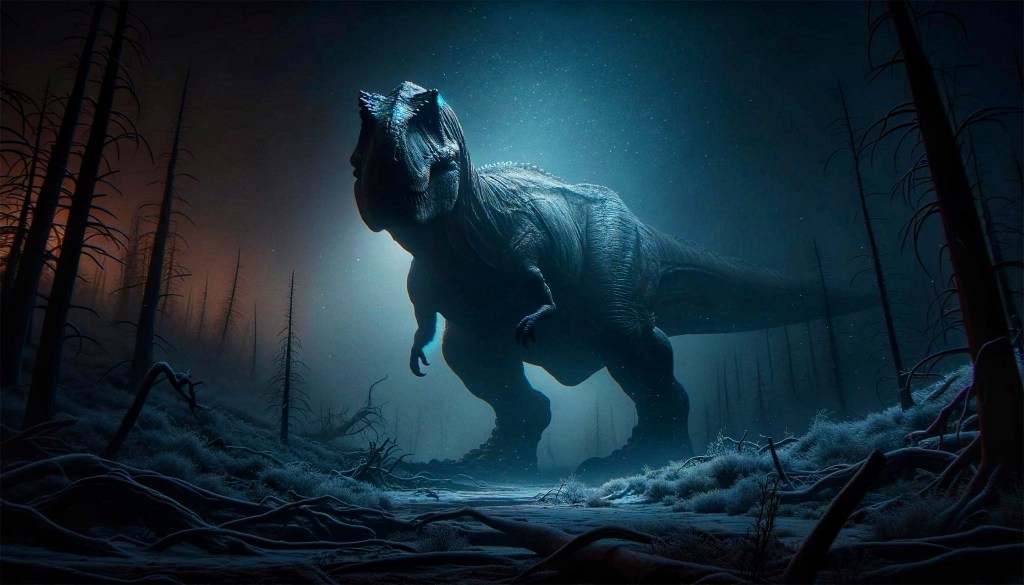
Frenchman River Valley, Saskatchewan, Canada
66,050,000 BC (+/-500,000)
The day after impact
————————-
There was no dawn this morning. Since last night, a black shroud has covered Frenchman River Valley, as microscopic silica dust from pulverized rock hangs in the air, along with soot from the planet wide conflagration that even the usually fire-retardant plants cannot withstand.
It is a world you wouldn’t want to live in. Giant carcasses are strewn everywhere. The shaking, the 200 mph winds, those have died down. There is a roar but it is not the roar of those huge carnivores. They are all dead. The noise is from the fires.
It is the morning after the impact and it is the officially recognized end of the Mesozoic Era of the great reptiles and the beginning of the Cenozoic Era, a.k.a the Age of the Mammals.
As of this moment we are living in the Cenozoic Era.
All over the world, there are fallen trees everywhere, burnt to charcoal. Massive dinosaur carcasses are strewn around, carnivores and herbivores, not squabbling, no longer fighting for dominance, finally at peace with each other in death, the flesh beneath their scales burnt beyond recognition.
Death had rained down yesterday, in the form of ejecta debris that had been thrown up by the impact into the mesosphere, the very edge of the atmosphere 60 miles up. The debris had re-entered the atmosphere, hurtling back at the speed of a bullet, big school bus-sized chunks of molten, burning rock that together made the air itself catch fire, let alone the vegetation. In hours the whole surface of the earth was engulfed in flames.
Today those flames are still relentless, still burning, even after 24 hours. Anything and everything, no matter how wet or how fire retardant it is, is burning with an intensity that has no precedent. The temperature of the ambient, all around, is 350°C and rising.
The only species that seem to have a chance of survival are the mammals and the birds, who have always lived and bred in shelters underground or hidden under rocky overhangs, away from the elements, hidden from predators.
——————————-
The impact has released over a million tons of fine black soot in the atmosphere which will block out the sun completely for the next 2 years, halting photosynthesis.
Research suggests that ecosystems can recover after a period of darkness of up to 150 days. However, after over 200 days, some species will start going extinct. A darkness interval of 650 to 700 days, will wipe out 80% of all species. 2 years and we are looking at a near total extinction level.
Next, the oceans will start chilling due to the lack of the sun’s heat, by 10°C every six months. The oceans will gradually freeze and over the next 100 years, a full-blown ice-age will set in, but it will be gradual, allowing some of the still living species to adapt to the cold and wiping out the remaining life forms that could not make the transition, like the dinosaurs.
The species that will adapt and will do so spectacularly, are the furry mammals and birds. Yeah, the same hardy little furry beasts that survived the impact. They will manage to survive the extreme cold. It is almost as if they had foreseen the future and have deliberately grown fur coats for exactly this eventuality!
Like the mammals and the birds, the other survivors of this catastrophe will be those that, by sheer accident, have the traits, the DNA that will allow them to survive. They are not the largest nor are they the deadliest. Many of them are commonplace, mundane little animals found almost everywhere.
It is an irony that the tiniest and the most defenceless living beings will get through this calamity, not the ones on top of the food chain – the massive reptiles who liked to live and roam out on the open ground, arrogant, unafraid. Now, all over the surface of the earth, that open ground is nothing but a mess of dry skeletal remains of vegetation turned to charcoal, sizzling and burning at 400°C.
Whoever coined the aphorism, “the meek shall inherit the earth” certainly didn’t have dinosaur extinction on his mind. It is true however. It is true not only this time but has also been true in all four previous extinction events.
Isn’t evolution amazing? It makes one almost begin to believe that there might be a divine design behind all this.
Unlike the other Extinction Level Events (ELEs) that came before, where the destruction was gradual, the last one spread over a million years give or take, this one is a catastrophe compressed into one day. In the blink of an eye, it is exit stage left for the dinosaurs and entry stage right for the furry mammals and birds.
As much as we love dinosaurs, enshrining them in museums, bringing them back to life in films, reading about them in comic books as children, holding them in awe, we know that we exist only because they ceded the evolutionary centre stage to our ancestors.
We owe them a debt.
———————————
There are few questions that grip us as breathtakingly as the story of us, as a civilization and as a species. How did the earth come to be? How did it evolve and change over time?
In a recurring dream, I see myself walking down the aisle of a gigantic cosmic library. As I walk, I run my fingers over the rows of books chronicling the history of the universe.
The rows of books and the number of volumes in them stretch on and on into infinity and I seem to possess eternal life. Millenia pass as I walk the aisles, my fingers brushing against each book.
After what seems like eons, at the very last shelf, my hand slaps against one book that appears to jut out just a wee bit. It is in a forgotten, dusty corner that few visit.
In my dream, I pause, pull the book out and go sit at a table and begin reading. The first chapter is about our solar system’s birth, the next on the collision with another smaller object that produced the moon. The next few chapters are about how the earth cools and life emerges.
I eventually come upon the chapter on the emergence of humanity. If each chapter represents 100 million years, we humans don’t appear until Chapter 45. In the final page of that chapter, we progress from hunter-gatherers to intelligent beings capable of complicated analysis.
In that last page of Chapter 45, we develop science, art and culture; war, unrest and famine; organized settlements, organized agriculture and organized government; religion, oppression, bigotry and migration and finally, our own morality, truth and deceit.
The rest of the pages of this book of earth are blank, yet to be written. The story has finally reached us here; today; now.
When I try to turn the first blank page, the dream ends and I am awake, but I realize that the story will not end here. There should be another 10 chapters still waiting to be written, another 1 billion years, before all life on earth ceases to exist, incinerated by a depleted, bloating sun that is inexorably turning red, growing more and more massive.
Throughout recorded history, our Sun has nurtured us, given us the will to live and prosper and now it is turning against us. Sudden flares are shooting out unannounced, penetrating what is left of our mesosphere. The Sun has already gobbled up Mercury and Venus, it’s surface now so close that had there been a self-nourishing, heat resistant survivor looking up at the sky, 80% of his sight will be blocked by the flaming giant.
This will be the final Extinction Level Event.
The story of the earth will not end even then. There will still be 40 chapters left to the book, another 4 billion years before our earth, now an arid, lifeless, smouldering rock, ceases to exist, completely engulfed by a red giant sun, vaporized and ionized, shredded into the very fragments it had been built from.
Start to finish is an estimated time frame of 10 billion years, of which 4.5 billion years are already in the past and life has blossomed on earth for 3.7 of those 4.5 billion years.
After life appeared on earth, there have probably been many ELEs but current research has recorded with certainty only two so far where 95% of all species disappeared – the first was the Permian-Triassic Event, 252 million years ago, triggered by a chain of super volcanos in what is now Siberia. And the second was the one this series is all about – the Cretaceous-Paleogene Event, 66 million years back, caused by the impact with a killer asteroid.
Assuming that a future 95% extinction ELE will probably wipe us humans out, how many more ELEs do we have in the future, before we face the one with our doom in it? How will the remaining chapters be written? How will it all end?
Or will we be among the lucky 5%, progressing, multiplying and evolving if not on earth, then on another planet, in another solar system?
———————————-
 Spunkypedia
A deeply disturbing look into the past and the future. And it’s not as distant as we would like to believe…
LikeLike
We have our own self medication- not dwelling upon what we cannot change.
LikeLike