
“Most people believe that good governance leads to harmony. It may, but only temporarily. In the end, good governance always lays itself bare to conflict.” – Noccolò Machiavelli
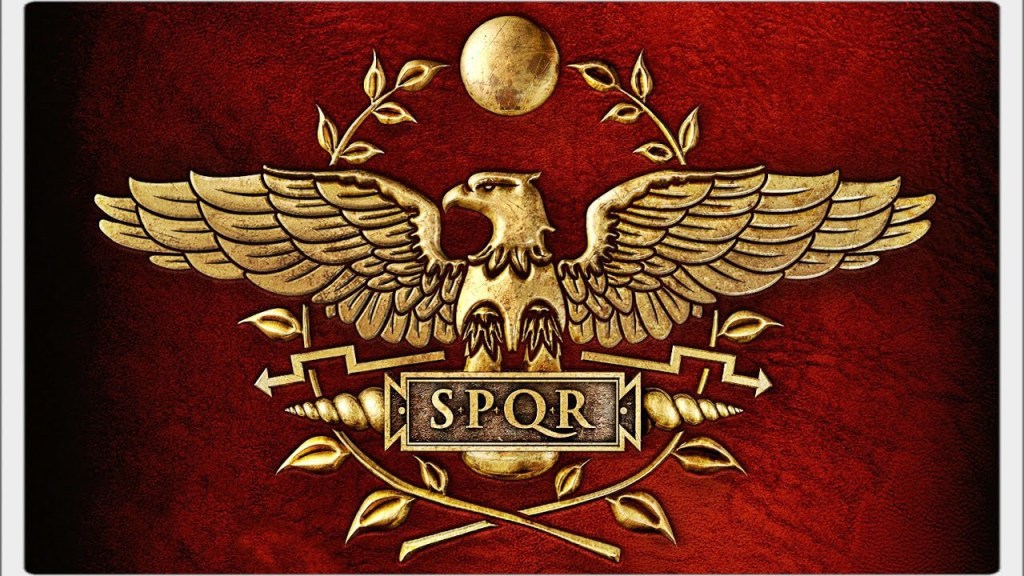

E PLURIBUS UNUM (Out of many, one). This gobbledygook is found everywhere in America.
Both the above standards depict an eagle, the universal symbol of a predator. Now check out the two Latin phrases above…..
The ancient Roman one, Senatus Populus Que Romanus, is simply an announcement of identification.
The real Roman motto is festina lente [make haste, slowly], used by Augustus, the first Roman Emperor, on his standards and coins. Throughout his long reign Augustus had this one motto. He emphasized it to his generals and thought it so important that he had coins minted with an image symbolizing it. “The fastest way to get something done is to do it right the first time. Especially when you’re feeling the crunch, take your time”, he exhorted.
To defeat the combined militaries of Cleopatra and Mark Anthony, Augustus waited patiently for the right moment to invade and annex Egypt and finish the two lovers off.
Augustus’s advice is backed up by today’s science. In “Thinking Fast and Slow”, Daniel Kahneman, the Nobel Prize-winning psychologist, described two schools for thought. School-1 is fast and emotional and relies on stereotypes. School-2 is slow and difficult and relies on calculation. The more you hurry – and even more importantly, the more you feel that you are hurried – the more you rely on School-1. There are situations when you need to do that, but most of the time, you’ll be far better served taking your time, thinking your way through a crisis than letting your emotions govern your decisions.
Festina lente is both, paradoxical and an oxymoron. How can we make haste slowly? How can we go faster by going slower? Many of the deep human realities at first do seem counterintuitive and this is one of them. We have all heard that the greatest person will be the servant of all, and that those who humble themselves will be exalted and those who exalt themselves will be humbled, or that pride goes before a fall, etc, etc, etc.
All in all, the Roman motto has weight.

—————————
The other motto, the American one, E pluribus unum [Out of many, one] is a pompous piece introduced in the late 18th Century, hundreds of years after Latin had receded into obscurity.
What the fuck is wrong with saying it in plain English?? Why not simply say something like, “Prosperity in unity” or some other similar crap? But no, it has to be in Latin, a faux effort to sound profound. In today’s context, when billionaires control 70% of America’s wealth, it sounds phony as hell too.
One can’t blame the Americans alone for being pretentious. Look at my land of birth, India’s motto, Satyameva Jayate [Truth alone triumphs], delivered in Sanskrit, a language so obsolete that the Last Supper was actually centuries into the future when it was in vogue. The last time any Indian man-on-the street spoke Sanskrit as a matter of course was around 600AD.
The dash of Sanskrit in the Indian motto is meant to make it appear deep and profound, when in reality it is just another pompous piece of schlep to be regurgitated on occasions like the Independence Day, very very far from any desire for truth, in a country hijacked by a cabal of rich businessmen and organized crime capo-turned politicians, pandering to a barely literate tea shop owner living out his right-wing fantasies.
—————————-
Let’s leave India and get back to Rome…..
When it came into existence – circa 800BC – it was just a small town that was little more than a village, population 150, by the banks of a river that was little more than a stream that one could easily wade across, somewhere in middle Italy.
The village didn’t begin with any grand plans of being an empire, but in the course of a thousand years, it would stretch through three continents and secure within its borders the lives of roughly 100 million free citizens and 30 million slaves.
And the stream never imagined that resourcefulness and engineering would divert nearby streams to join its flow, turning it into what is today the turbulent Tiber.
By the time it grew to it’s mightiest in 200AD, the Roman Empire would be constantly fighting wars of conquest and quelling rebellion in it’s distant outposts, expending in today’s dollars – trillions, in order to sustain it’s hegemony.
And all the while that the Roman legions were conquering distant lands, back home tax collectors, judges, senators, policemen, firefighters, medicine men, carpenters, builders, farmers, accountants, poets and historians – they would be going about their orderly lives, free Roman citizens, blissfully comfortable in the thought that those wars could never touch them. This should sound familiar to any American.
It wasn’t really a picture of harmony though – by today’s standards. Ancient Rome was in a state of ‘controlled barbarism’. Rich businessmen sponsored ‘Munera’, reality shows held live in vast amphitheaters where on weekends, citizens brought their wives (and some even their children) to watch hand-picked slaves slash, bludgeon and stomp each other to death.
A vastly different version of morality reigned in 1st Century AD Rome. If you were a Roman housewife, you could have your domestic Nubian slave bludgeoned to death for the slightest of infractions. If you didn’t like the looks of your new born female child, you could say it had a curse that had to be exterminated. And then, you proceeded to smash her head against the stable door and threw her little corpse into the rubbish heap, no questions asked.
If you were a plebeian (commoner) and to your dismay your friendly neighborhood quaestor (Senator) took a fancy to your nubile teenage daughter, you had a choice – to either let him take her away, never to be seen again, in exchange for a tip of ten talents and a job in his stables or to face the prospect of hard labor in the arsenic-laced gold mines outside town.
Your daughter got raped either way.
That was civilization 1.0, oh yeah.
————————-
While the citizens within the walls of Rome lived their lives in that quasi-barbaric state of peace, it was quite another world outside. Around the fringes of the Empire was a very violent environment of treacherous mini-empires and rogue city states that were perpetually squabbling and then forming alliances with the intention of marching on Rome and burning it down to the ground.
Invasions and conquests in those days were quite ‘comprehensive’, designed to ensure that the invader wouldn’t get any more trouble from the invaded. If you were a Roman legionnaire, you didn’t just put an arrow through the invaded guy and loot his livestock. You wiped him off the face of the earth. You burned his cities and temples down. You raped his women and then killed them. You threw his children into large burning pits. You took the able-bodied as slaves and worked them to their deaths building your monuments and aqueducts.
For the leaders of the conquered lands who refused to fall in line, you reserved the worst possible fate – you had hot molten lead poured down their throats……alive.
Oh yeah, it was a brutal world. The bloodshed – if it were to happen today – would leave every man, woman and child in the conquered territories with Stage-5 PTSD, while turning most of them into paranoid schizophrenics. And in turn, those invading troops would be suicidal wrecks suffering from acute moral injury.
It speaks to the adaptability of the human psyche that that hasn’t happened. Rome still exists, at the heart of a mediocre but stable European nation, in the midst of a continent of stable, prosperous democracies, none of whom suffer from any consequences of two thousand years of invasions.
Amazing how things haven’t gone south long term, no?
—————————-
The analogies between ancient Rome and present day America are startling. Just for fun, let’s compare the two at the height of their hegemony – Rome in 200AD : An empire that stretched from The Azores(east Atlantic) in the west to the mouth of the Tigris(Iraq) in the east and Scotland in the north to Nubia(Sudan) in the south, with 20% of the world’s population as its subjects. And America in the present day, virtually unchallenged, 800 military bases grasping the earth in a stranglehold……
The similarities between the two are striking. Rome started in the 9th Century BC as a lawless haven for the indigents and the unwanted from nearby Carthago, Neapolis and Syracusa. Likewise, America began with the puritans and exiles who came over because they were universally considered assholes and unwanted in Britain. Both started with the dregs, disenfranchised jetsam and flotsam.
Romans went about their daily lives in Rome, oblivious to the suffering their militaries caused in distant lands and so do Americans today.
————————-
Even the mysteries behind the rise of Rome and America mirror each other. How did a small village in central Italy manage to grow into a 4-million square mile empire, bigger in area than Europe? Likewise, how did a little village named Jamestown on the banks of the Powhatan, Virginia (which in fact marked the start of the British Empire) ultimately grow into the world’s most powerful nation? Exactly what is it that set the two apart from the rest?
Romans and Americans have always had an overblown, almost cringeworthy, sense of nationalism. Like Americans today, Romans thought that the sun rose and set with them and that they had a God-given right to dominate and rule over the rest of the world. Philosopher-Emperor, Marcus Aurelius, once exhorted his citizens thus……, “When you arise in the morning, think of what a precious privilege it is to be alive as a Roman – to breathe, to think, to enjoy, to love and to conquer, as a Roman.”
If you are American, you’ll hear similar bullshit from every American President – “Shining city on a hill”, “Greatest nation on earth”, etc. Every balcony, in every small town, must fly the Stars and Stripes. Every school child must memorize the ‘oath of allegiance’ at least once a day. Every speech must end with “God bless America”.
If you are an American, at least once in your lifetime, you’ll hear an American leader deliver shitty eulogies that include the words… “those brave men and women in uniform who are fighting all around the world to keep Americans safe…”.
God, how I despise those phoney words!!! Question what those brave men and women are doing all around the world and exactly how that keeps Americans safe and you will be labelled “Un-American”.
Then, when those brave Americans return home to civilian life, despairing husks, left to fend for themselves, trying desperately to survive PTSD, you will treat them like pariahs.
——————————-
Will America too fade away like Rome and barely exist, a shadow of its former self, another mediocre developed nation, struggling to stay economically afloat?
Quite possibly yes, because American leaders do not believe in Augustus’ festina lente. For America, everything must happen on steroids.
Remember Britain and “Rule, Britannia, rule the waves, Britons shall never be slaves”???? That Britain now has a per capita GDP less than that America’s poorest state, Louisiana.
————————-
 Spunkypedia