

One of the only six airworthy World War-2 B-17 bombers left on earth, was on display in my town recently. Guess who that incredibly good-looking guy in shorts is.
When I entered the fuselage of the plane, it was a transforming experience. The emotions I felt almost choked me up. I felt like I had been there in a previous life.
I have a propensity to fantasize, so I decided to make my wanderings through the belly of the beast, sound as if I was a ball turret gunner from the 376th Bombardment Group,…..
—————————-
Benghazi Field, North Africa
It is a star-studded, moonless night in August 1943.
I am striding with my buddies toward a Boeing B17 Flying Fortress, 12730 of which will be built and by the time the war is over, B17s will drop over 640,000 tons of bombs on Italy, Germany and the Japanese mainland.
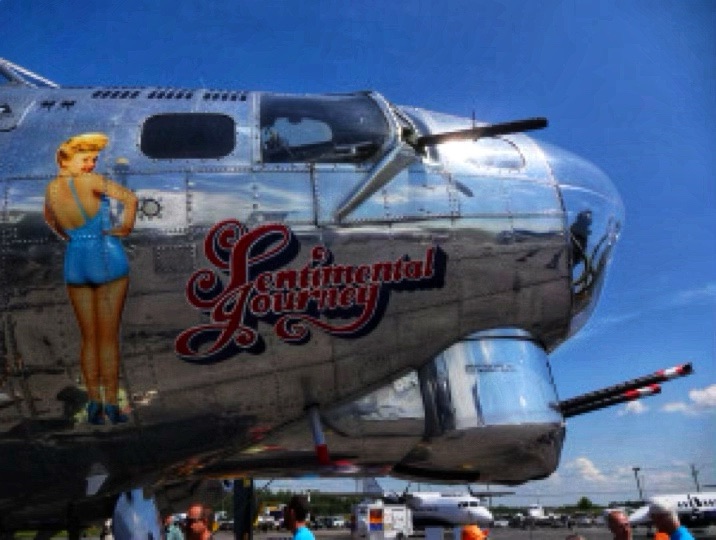
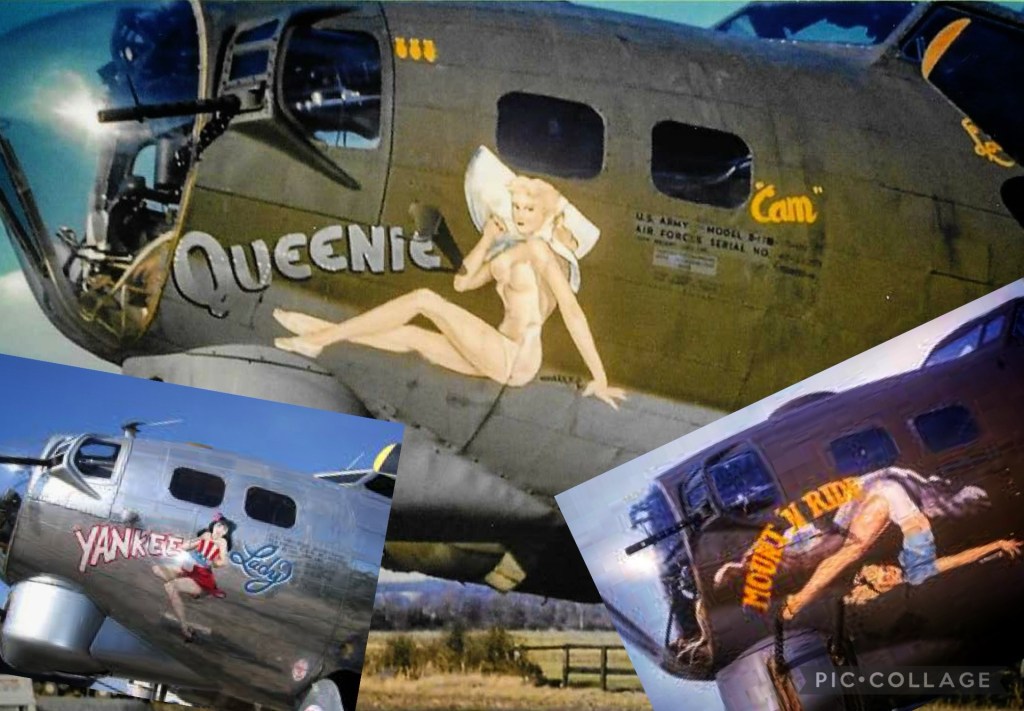
As I approach the bomber, the first thing that I notice is the nose art, usually a picture of a pin-up girl of the war years, this one being Betty Grable and the bomber’s nickname, ‘Sentimental Journey’ slapped on with a flourish, just below the cockpit window. Nose art and plane nicknames are standard features on every single American military aircraft and they will continue to get more and more creative into the future.
——————————-
——————————-
I climb gingerly up the ladder and stick my head inside the fuselage. My eyes are now at floor level and I am appalled. There is just enough space to wriggle through and I have got to be very careful. Immediately above is a bulkhead that won’t let me continue climbing into the bomber erect, unless I fancy a concussion. I will have to hoist myself with my elbows onto the floor and twist a bit to the right and sort of slither in on my elbows and knees.
Before I begin introducing the crew to you, here’s a little sketch that shows where everybody is stationed and what everyone is supposed to do.

——————————
Having completed the entry maneuver, I can now stand up to my full height. I am now facing the flight engineer, Staff Sergeant Archibald “Maddy” Mathies’s tiny cubicle. Maddy is 24 and diminutive, as all bomber crew have to be. A B17 is no place for large hulking men.
There’s standing space only and Mathies stands all through the 6 hour ride to the target and back. If the bomber is under attack from above from those gull-winged Ju-87 Stukas, he will let loose with the single M2 Browning Machine Gun, that sticks out saucily from the top turret.
The M2, affectionately called “Ma Deuce”, is a terrifying air-cooled, belt-fed mother that spews out .50 inch rounds, 20 every second, in a murderous rampage that can tear metal to shreds at a range of two kilometers. If you are in the way, the round will go through you and your twin, if he happens to be standing right behind you.
—————————-
I got that ‘twin bro’ thing from an Alistair Maclean that I had read as a kid. I think it was his ‘When eight bells toll’ that mentioned it on the very first page, where Maclean waxes eloquent on what a Peacemaker Colt .45 is capable of. But I digress. Old men frequently do.
————————-
Sentimental Journey has altogether 13 of those lethal babies, the M2s. Except the pilot and co-pilot, who have got to fly this bucket to the target and back, every other crew member has to man at least one M2, besides his normal duties, should the occasion arise.
I turn toward the front of the bomber. Up ahead, within touching distance are the pilot and co-pilot. I can almost hear 1st Lt. Donald J. Gott, 21, pilot and overall commander, repeating ‘check’ as co-pilot, 2nd Lt. William E. Metzger Jr., also 21, goes through each item on the check-list.
Their voices are a forced casual banter, masking the tension that comes from knowing that the odds that they will return to base after the mission are 40/60. Gott and Metzger are officers and so are the bombardier and navigator (I’ll let you meet them in just a while).
The 6 remaining crew, including me, are enlisted men. In the army, we would be known as the “grunts”.
I crouch a little and there are two more men up front. The man right in front of me at a lower level, is the navigator, 24-year old 1st Lt. Walter E. Truemper. Truemper has a tiny wooden bench to sit on and a tinier table with charts and a headset. He also has an M2 to man, which pokes out of the fuselage top.
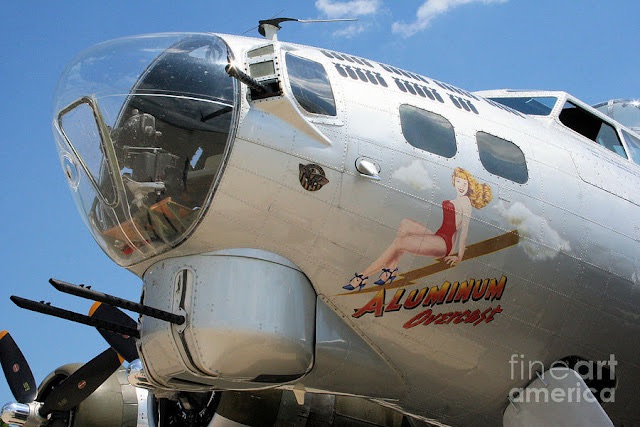
Further down, right up front at the nose, the most forward position in the plane, is the bombardier, 2nd Lt. David R. Kingsley, 25, of Portland, Oregon. Kingsley is protected from the onrushing -60 ̊C, 250mph wind by a plexi-glass bubble. Poking out menacingly through the bubble, are two M2s that are his responsibility to man.
Besides the two guns, as bombardier, Kingsley is the lynch-pin of the sortie. If he turns out to be a schmuck, we get to come back without hitting the target and then have the boys make fun of us at the mess hall. Worse still, we could stray into a schwarm of blood-thirsty Me109s. (I’ll explain what a schwarm is, in the next para).
———————————
The B-17 bristles with machine guns. It has to. Even though it is extremely robust in design and can withstand an awful lot of punishment in the form of anti-aircraft shelling, there are roving Messerschmitt109 wolf packs, which are highly skilled 4-fighter teams known by the Germans as schwarms, that roam the skies in search of lumbering bombers like ours. Their 20mm cannons can rip a B-17 fuselage to shreds, destroying vital links and control cables and rendering the bomber unfit to remain in the air.

The 4-aircraft Messerschmitt “schwarm” was a tight-formation, three dimensional unit designed to ensure that at any point in time at least one of the pilots did not get blinded by the glare of the sun during a dogfight.
———————————-
I now do a turn-around very carefully, without scraping my elbow against metallic thingamabobs poking out all over the place. The designers at Boeing did not build this thing with comfort in mind.
I start moving toward the rear of the bomber cautiously. The moment I pass by Flight Engineer Mathies’ cubicle, I am treading on a precarious, 6-inch wide fabricated gangway. All around and below is cavernous emptiness with the bomb doors in the bottom.
Slung inside that space are 8 sinister-looking, cylindrical olive-green objects with fins in the rear. Stenciled in white on each is more gobbledegook that essentially means that six of them are 500kg high-explosive fragmentation bombs and two are incendiary. The 6 frag bombs will destroy every erect structure around the impact site and the 2 incendiary babies will burn so hot that they will suck all the oxygen out of the air within a radius of about 4000 yards, killing by asphyxiation, the survivors who were just staggering up to mutter, “Phew, that was close,” after managing to escape the frag bombs.

———————————
I hold on to rails on both sides and walk the gangway, my steps carefully placed, one after the other, heel to toe. At 30000 feet, a squall is buffeting the B-17 and it takes all my strength and concentration to stay on the gangway so I won’t fall and hit those bombs, ricochet and come to rest against the reinforcement ribs on the ice-cold bomb doors.
Thankfully, the gangway is a short walk and I find myself in this tiny space with a bench and table. On the table is a large black box with dials and needles flickering across frequency ranges. A man is hunched over, headphones clamped over his ears, trying to understand the incoming radio signal above the din of the four huge Hornet engines.
Meet the radio operator, Tech. Sargent Forrest Lee Vosler, 21, of Lyndonville, New York. If he hadn’t mentioned it I would have missed the lone M2 poking out of the Perspex above his head. He leaves his radio and mans the gun when there is a Fritz hurtling down on him.
At the moment, Vosler is pre-occupied. He is screaming into the mike,” Broadsword calling Danny Boy, come in Broadsword. Over.”
“Danny Boy to Broadsword, did you deliver the plums and the jelly beans? Over.”
“We missed, but Father McCrea got ‘em, Broadsword. Fritz is wide awake now, that’s for sure. Hope they haven’t run out of marshmallows down there. Next transmission at 0600. Over and out.”
“Bar-B-Que Boris.”
“Sautéed Sepp.”
“Fried Fritz.” Vosler lets loose a manic giggle.
(That ‘broadsword calling dannyboy’ bit was Alistair Maclean again. “Where Eagles Dare”, slightly modified. I’m incorrigible).
Past the radio room, I walk directly over the bottom ball turret with its twin M2s. This is my own little hell hole. I sit there all by myself, cut off from the rest of the crew, unable to determine what is happening elsewhere inside the aircraft, praying everything is okay.
I am so used to raw terror that it doesn’t bother me anymore. Besides, I love the way the turret swivels every which way, by a mere touch on the built-in triggers on the hand-grips. And the view, Gott-im-himmel, I have the best panoramic view of all. That’s why I always have my Brownie-Reflex ready.


——————————-
I am Albert “Bud” Porter, the ball turret gunner, slung under the belly of the plane. Statistics give me a 25/75 chance of coming out of the war alive, the ball turret being a terrifyingly exposed crew station in a B17.
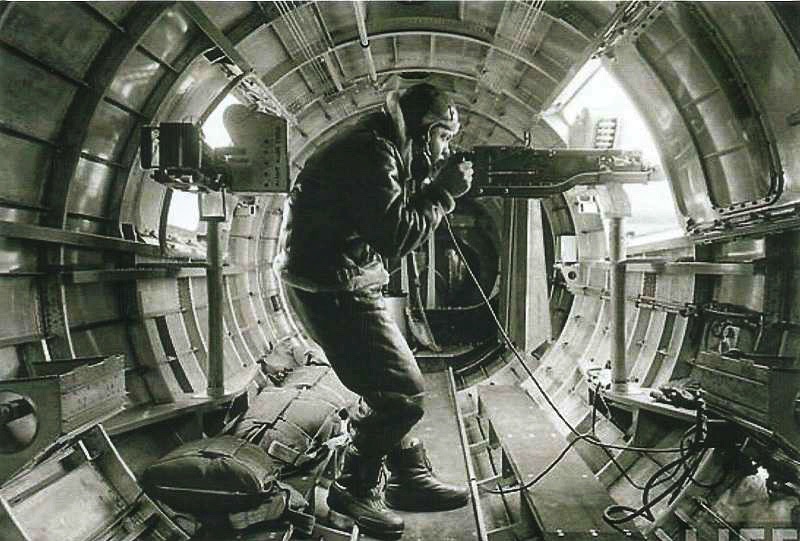
I continue on the gangway and squeeze past the two waist gunners. Staff Sargent Maynard Harrison Smith, 29, is the oldest crew member, affectionately addressed by the rest as Daddy Smith. Port side is Henry Eugene “Red” Erwin Sr., 21. They sit looking out through plexi-glass bubbles on opposite sides of the fuselage somewhere around the mid-section of the bomber. The Messerscmitt109s always target gunners first and Smith and Erwin know it. They are two very grim-faced, scowling dudes whom I like to leave well alone and that is exactly what I do.
————————
I am now approaching the back of the plane and space is getting even more restricted as the fuselage tapers. I am nearing the man whose life-expectancy, at less than 10%, is the lowest among all the crew members. It’s the tail gunner, Lloyd Herbert “Pete” Hughes Jr., 21. Hughes has to hunch over in a kneeling position, like the way folk kneel in a church. Ironic, considering that he is the one who has to pray the hardest.
Tailing Messerschmitts always get the tail gunner first. More often than not, a B-17 limps back with the tail turret blown out, the gunner either dead or simply not there anymore. Percentages that Hughes will come out of this war alive, are in single digits.
Interestingly Pete Hughes is the most frivolous, always pulling a gag on someone and making everybody laugh, always making grand plans on what he’ll do when he gets back home after the war, the Chevy convertible he’ll buy and zoom around the countryside “until the tyres fall off”. It teaches us something – how the power of positivity helps one face extreme danger.
Considering the risk he runs, Hughes has been given certain unwritten privileges – free cigarettes and drinks at the mess hall and if during a mission, bail-out becomes necessary, he gets to jump first.
So, there, now you know me and all my buddies in there.
————————————
The men whom I mentioned by their names were not really there last Sunday. But those names are of real USAAF aviators who flew in B-17s like the Sentimental Journey and they all have one common denominator – they were all awarded the US Military’s highest decoration for conspicuous valor on the battlefield, the Congressional Medal of Honor.
There was another thing that these gents had in common – the fact that they showed exemplary courage in willfully giving their lives. A few chose to remain inside their burning plane instead of bailing out and saving themselves, in order to nurse their severely wounded colleagues who were too incapacitated to be able to evacuate. Others died trying to steer their plunging planes away from populated areas. Two gave away their parachutes to others whose chutes had been damaged.
———————————
From my perch as the ball-turret gunner, I crane my neck to look down and I can see nothing. In the pitch darkness, I imagine the Mediterranean slipping by 30000ft below. The engine noise from the four Pratt and Whitney “Hornet” radial engines is deafening, even through the earmuffs.
Operation Tidal Wave is on and by the tomorrow morning, it will go down in history as the most expensive air raid ever – 120 allied aircraft, 310 crew and 36 German fighters destroyed.
The target is the cluster of oil refineries at Ploiesti, Romania, that were fuelling the Nazi war effort. It is believed by the Allied forces that destroying the refineries will cripple the German war effort permanently.
That is the end of my fantasy/dream.
——————————
‘Sentimental Journey’ is a beautifully restored B-17 with all original parts. Designed by Boeing and built at the Douglas Aircraft Corporation (later to be known as McDonnell Douglas), she was delivered to the US Army Air Force in March 1945, at the fag end of the war. She did not see combat, though she performed many other non-combat military and civilian duties faithfully.
And yes, bombers are female.😁

—————————-
Since 1947, Sentimental Journey has had many avatars – photo-mapping aircraft out of Clark Air Force Base in Manila, air-sea rescue off Elgin Air Force Base in Florida, mother ship for target drone squadron off Patrick Air Force Base, Florida, till she got transferred to participate in aerial reconnaissance during atmospheric nuclear tests in the 1950s.
Finally, January 1959, technology having rendered her redundant, the old lady was sent into storage at the AMARG aircraft storage facility at Tucson, Arizona, known as the ‘Boneyard’, a sort of retirement home where she was content for a while to be among 4400 other similarly retired American military aircraft.
Her retirement however, was short-lived. After a few months at AMARG, she was acquired by a private aviation company to fight forest fires, a task she carried out with exemplary diligence for the next 18 years.
In 1978, Sentimental Journey was donated to a museum, the Commemorative Air Force (CAF) and around that time, she got her name, Sentimental Journey, taken from the title of a Doris Day song from 1940s. She also got herself the Betty Grable nose art around the same time.
Once in possession of the plane, CAF began a decade long restoration program. Having been in all sorts of civilian duties for so long, Sentimental Journey looked like anything but a real B-17. There were no turrets, no guns and the bomb bay doors had rusted from all the water the plane had been carrying around in its forest-fire fighting avatar.
Restoration began in 1981. The turrets were located and painstakingly installed. The upper turret was difficult to find but one was eventually located at the “Bomber Gas Station” , a real gas station-cum-restaurant in Milwaukie, Oregon, where a real B-17 had been sitting on top of the station, its wings sheltering the pumps, for over three decades. It had a beautifully preserved upper gun turret and the owners agreed to hand it over to CAF.

I am sure you are dying to find out how that B17 got there? Well here’s the story…..
In February 1947, gas station owner Art Lacey announced that he planned to buy a mothballed bomber to attract—and shade—customers. A friend bet him five bucks that it would never happen. “If you told my dad he couldn’t do something,” his daughter Punky Scott says, “then he was going to do it.” The story of how he did it has been Lacey family lore for 70 years.
Lacey borrowed $15,000 and hightailed it to the airport that very night. At Altus Army Airfield, Oklahoma, he bought a well-used B-17 for $13,750. Although Lacey was an experienced pilot, he had never flown anything with more than one engine. But after a few taxi runs, he felt confident enough to take a test hop.
Everything went fine until it came time to land. The landing gear refused to extend, so Lacey bellied in and slid into a second B-17. Fortunately, the War Assets Administration officer took pity on him, and declared it “the worst case of wind damage I’ve ever seen.” Then he sold Lacey another B-17 for a mere $1,500.
This time, Lacey summoned two friends with B-17 experience to help. They arrived with a case of whiskey—Oklahoma was a dry state at the time—to barter for fuel (which base firefighters siphoned from other mothballed bombers). After a stop in Palm Springs, California, where Lacey wrote a bad check to cover refueling, the crew ran into a blizzard.
Visibility was miserable. Lacey slithered into the front turret so they could fly IFR—I Follow Railroads. This worked well until Lacey saw, through a break in the clouds, that they were about to hit a mountain. The crew barely cleared the obstruction.
Eventually they reached Portland but hit another problem after landing: Lacey couldn’t get a permit to truck the big airplane to Milwaukie. He disassembled the B-17, loaded it onto four flatbeds and hired funeral-procession motorcycle escorts to give the operation a patina of legality. As a backup, he also paid some hot-rodders to join the parade.
“He told them, ‘Do not stop for anything,’ ” says his grandson, Jayson Scott. “ ‘If anybody gives you a hard time, you peel out and burn rubber in different directions, and I’ll pay all of your tickets.’ ” Lacey got off lightly, with a $10 fine for transporting the airplane without a permit. The B-17 Lacey Lady became a landmark on Highway 99E leaving Portland.
Lacey Lady did the trick, and customers flocked to the gas station. Over the years, visitors stole virtually everything that wasn’t bolted down. The wooden floorboards were replaced seven times, before a young boy fell out of the B-17, prompting a lawsuit that shuttered the bomber in the late 1950s.
By the time Art Lacey died in 2000, the airplane looked forlorn. The rainy northwest is not kind to unprotected airplanes, and the B-17 proved an attractive nesting place for local birds. The nose section was removed in 1996 for a restoration project, which stalled when cash ran short.
So, there you have it, the story of the Bomber Gas Station.
———————————
After Sentimental Journey received the upper gun turret from the Bomber Gas Station, Boeing pitched in and helped locate the other turrets, some of which were sitting brand new, in their warehouses at Seattle. I understand that Pratt and Whitney helped with the engines, which though originally Wright Cyclone, were later made in Pratt and Whitney during the war.

——————————
Sentimental Journey remains with CAF museum as on date, either on display at their Mesa, Arizona, facilities or flying around and giving ordinary folk like us joy rides.
 Spunkypedia
Wonderful!
Brings that terrific flying machine to life.
Keep them coming!!
LikeLike
Glad you liked the piece, Dadi ❤️
LikeLike