
In the first 5-8 years after the Second World War, China and the USSR became close friends. They signed a friendship treaty that saw military and economic aid flow from the USSR into an impoverished, agro-based China.
The bromance appeared to bring in a new age of Sino-Soviet co-operation, until the unthinkable happened. All of a sudden in 1953, Stalin died and Nikita Khrushchev, a vastly different personality, took over. Unlike Stalin, Khrushchev was a bit like an earlier version of Gorbachev – a watered-down peacenik. Unlike Gorbachev, Khrushchev didn’t want personal freedoms for Soviet citizens, however. All he wanted was the scaling down of the nuclear posturing and peaceful co-existence.
When Khrushchev, in 1956, publicly denounced Stalin – an action once considered blasphemy – China’s Mao-Tse-Dong realized he could no longer take Soviet support for granted. Khrushchev’s openness could infect Chinese politics as well and threaten his grip on power. Mao wanted to keep his absolute power and his Leninist scorched-earth ideology intact.
That same year, when the Soviets invaded Hungary to crush an anti-communist rebellion, Mao feared the same thing could happen to China. Helpless without sufficient military might, constantly pressured to obey Soviet dominance in the communist bloc and paranoid that the Soviets could invade China and annex it with ease, Mao began devising a long term plan that would maintain the USSR’s standing as an ally but ensure a partnership that was more equal. He announced the “Great Leap Forward”, a hurricane-speed action plan to modernize China from an agrarian to an industrial economy.
Turns out, Mao’s great leap was an unmitigated disaster. Having already purged the “intellectual class”, he had no brain power available to carry his megalomania forward. The pulling of manpower from the farms to the industry devastated China’s agricultural output, causing a famine the world had never witnessed. Millions starved to death.
Meanwhile, sensing the sudden Chinese coldness, the Soviets gradually began to withdraw their industrial and military experts from China. Aid to China reduced to a trickle. Then, on a visit to the US, Khrushchev felt first-hand the vast chasm between America’s technological advances and sophistication and the Soviet system’s primitive industry.
Along a parallel track, Khrushchev initiated a series of moves that would later come to be known as Détente, a period of relaxation of strained relations, with the west.
It was at this point that fate decided to take matters into its own hands once again.
———————————-
The 39-member Presidium of the Supreme Soviet, the highest body of Soviet State Authority, itchy at the sudden closeness with the west, removed Nikita Khrushchev. Obviously, like Mao, the members of the Soviet Presidium too thought that Khrushchev was moving the USSR toward too much peace, too quickly.
Earlier removals had been accompanied by summary executions, but Khrushchev’s life was spared. He was told to henceforth shut the fuck up and relegated to a dacha outside Moscow, to spend the rest of his life in comfortable retirement.
Once again a Stalin-like hardliner took over, a guy called Leonid Brezhnev, not as foaming-in-the-mouth as Mao but close enough. Bezhnev’s ascent however didn’t help to lessen Mao’s paranoia, since the Soviets decided it was in their best interests to continue on with the détente process with the US.
The mutual mistrust between the Soviets and China gradually led to sporadic border skirmishes that flared up with increasing frequency, until it began to appear like the beginning of a much wider conflict.
—————————
There have been moments in history when actual events have progressed rapidly out of control like cannoning dominoes, only to be aborted at the brink of an Armageddon.
One such event occurred in the early autumn of 1969, a month after Neil Armstrong set foot on the moon.
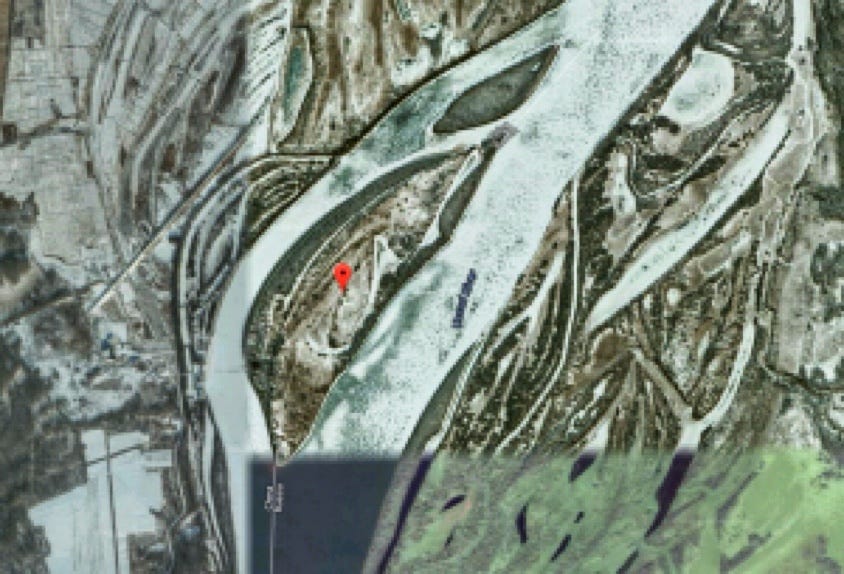
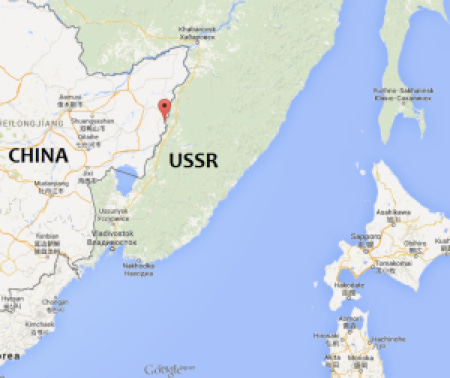
It had begun that spring actually, when a group of 30 Chinese PLA soldiers waded through the chill, waist-deep waters of the Ussuri, onto a disputed 1 ½ mile long diamond-shaped spit of an island in the middle of the river, that was called Zhenbao by the Chinese and Damansky by the Russians.
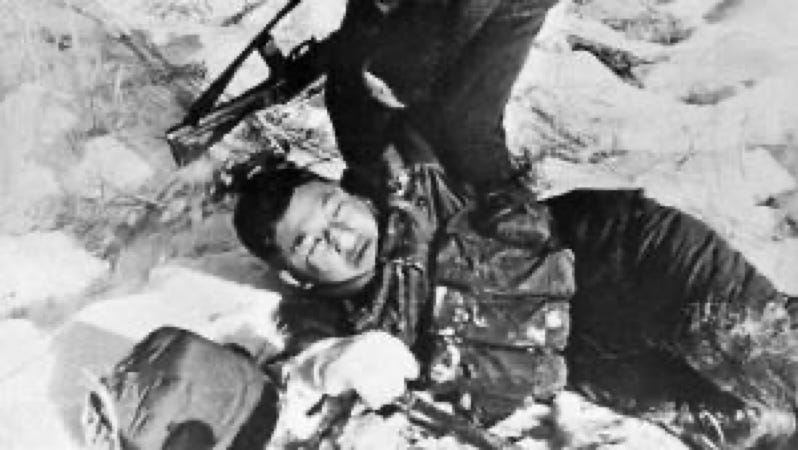
Once on the island the Chinese soldiers engaged the KGB Border Guards, sparking off a series of skirmishes, that collectively came to be known as the Zhenbao incident.
There is no question though, that the whole affair had been orchestrated by the Chinese leader, Mao Tse Tung, to deliver an indirect message to the US that, by breaking with the USSR, China was prepared to begin normalizing relations with the US, a process that later came to be known as the Sino-US Rapprochement.
Then, in the middle of August 1969, a startling thing happened at a luncheon at the Hotel America’s Beef and Bird Restaurant in Washington DC. The meeting had been proposed by Boris N. Davydov (Second Secretary, Embassy of the USSR) with William L. Stearman (Special Assistant for USSR, China and North Vietnam, Department of State).
Davydov was paying. His proposal was pretty straightforward……
“We plan to bomb the Chinese – especially their nuclear installations and major population centres – back to stone-age in a pre-emptive strike, to eliminate any further threat on our southern borders. If you go along, you have two pluses – First, you will benefit from one less communist power to confront and second, Vietnam is yours. We will lay off Vietnam the moment we sign a deal. We didn’t like those gooks anyway.”
For once, the US acted with maturity. It declined the offer and cautioned the Soviets that any pre-emptive strike could start a nuclear conflagration and that was totally unacceptable.
————-
What the Americans (or the world) could not have known was that the Soviet proposal was actually only an intimation, not a proposal at all. The pre-emptive strike was already on.
What went down is cloaked in secrecy even today, but if you want to know what could well have happened, you’ll have to wait for Part-2.
 Spunkypedia