
————————————–
Kraznyi Luch Soviet Air Force Station,
Ukrainian Soviet Socialist Republic,
July, 1942
——————————–
At first it was a small grey dot barely visible over the tops of the fuel reservoirs and the meteorology station situated a few hundred meters beyond the runway perimeter fence, where the slope up the hill began. Then, as it approached, growing perceptibly larger by the second, it did something that made the collective hearts of the personnel watching below, skip a beat.
Devouring 170 meters every second, the Yak turned up its nose and shot up almost vertically, till it leveled off at 12000 feet. It didn’t dally there long and instead, the fighter flipped over on it’s back and began a dizzying nose dive aimed straight at the control tower, screeching down at near-sonic speed.
Time appeared to stand still for Staff Sargent Yuri Jakobiev who was on his swivel chair in observation window of the tower, enjoying a cigarette. It had now plopped out of his mouth and burnt a hole through his tunic as he gaped up at the nose of the fighter which seemed to be bearing down on him directly.
Just a microsecond before it was going to hit the observation deck, the Yak did another funny thing. It pulled up sharply, a tortured scream emanating from it’s single Klimov V-12 engine as it effortlessly took the fighter out of the dive, leveling off with barely ten feet to spare above the asphalt.
The Yak-1b was perhaps one of only four really fearsome fighter aircraft of the Second World War. Named after its designer, Alexander Sergeevich Yakovlev, it was an extremely versatile single-seater.
The Yak was in exalted company, its contemporaries being the German Messerschmitt 109, the British Supermarine Spifire and the American P-51 Mustang, to none of which it came second. More maneuverable in tight spaces and better suited for dogfights, it was less technologically sophisticated but at the same time easy to maintain, especially during the harsh winters of Northern Europe.
———————————
Having scared the bejesus out of everybody in the hangars, the fighter did a tight turn, throttled back and came skimming back over the treetops, to make a perfect touch-down, coming to a halt in front of a row of parked Yaks, the release of tension palpable as two mechanics ran toward it, wedge-like chocks in hand.
One of the mechanics attempted to place a small step ladder on wheels, next to the plane but the canopy popped opened with a loud snap and the pilot, still in his skull cap and goggles, climbed over and took a nimble leap on to the asphalt and began a skipping run toward the mess hall. As the mechanics shook their heads in mock exasperation, the pilot, in mid-sprint, took off the skull cap and flung it into the air. A mass of curly blonde hair spilled out onto the pilot’s shoulders.
Soviet Air Force Junior lieutenant, Raisa Komarova, waved back at the mechanics and raced into the squat building.
———————
The reason for the spring in her step was obvious. Lieutenant Komarova had just downed not one, but two Messerschmitts. While most of their compadres were escorting Ju88 formations to Stalingrad, those two had seemed like they were just tooling around on a ‘free hunt’. They disappeared inside a cloud bank and she went after them, nose to tail. They didn’t make it out of the cloud bank but she did.
When she emerged from the cloud bank, she immediately became aware that she was no longer alone. There were two others at her 10 o’clock, seemingly unaware of her presence, maybe because the sun was behind her. Seeing them was not a surprise. Soviet pilots were well aware of the deadly Messershmitt “schwarms” – wolf packs that roamed the skies in tight packs of four 109s, two leaders and two wingmen.
She throttled the Yak forward till she was level with them, a bit to the rear on the right, just 50 meters, wingtip to wingtip. On the fuselage of the near one, was a painted cobra. She had earlier been briefed to avoid cobra-head Messershmitt at all costs – its driver was an ace.
——————-
An almost insane urge came over Jr. Lieutenant Komarova and instead of diving and getting the hell out of there, she stayed by their side for what seemed like an eternity. In the gathering gloom, she could clearly make out the outline of the cobra just below the canopy, frozen in place – it’s head reared back to strike.
She wondered why they didn’t try to come after her lone Yak, but another cloud bank was coming up ahead. Thumbing her nose had always been Raisa Komarova’s infuriating habit, ever since she first did it to her elder brother, Dmitri, when she was six. She raced the Yak just a wee bit ahead so the Germans would clearly see her, waggled her wings promiscuously and dived into another cloud bank that had appeared directly below. When she emerged, they were gone.
It was the 13th of July, 1942, the day when the Second World War got it’s first female fighter ace, at a small regimental airfield outside Kraznyi Luch, in south-eastern Ukraine.
—————-
The fighter sat still on the tarmac, its canopy open. It had already flown two sorties that day and it would not be long before it was up in the air again. This machine was a little different from the 12 other Yaks that stood in the line-up on the asphalt.
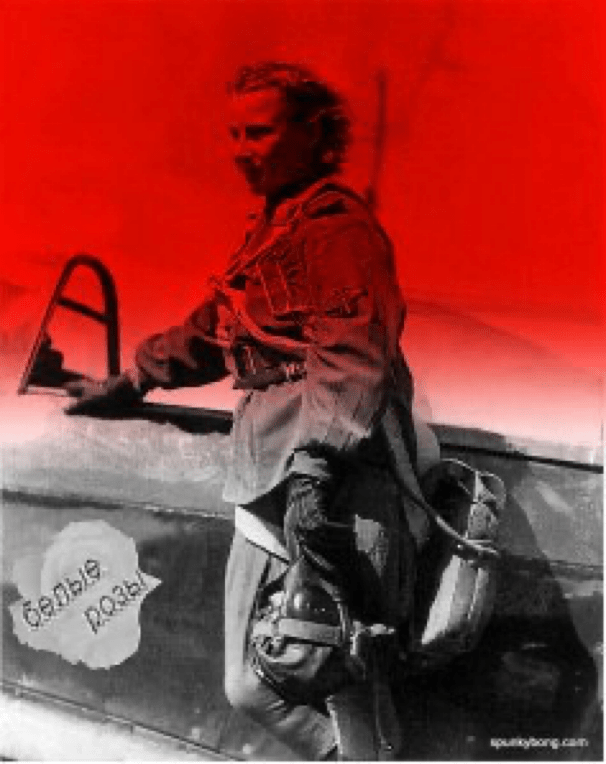
Besides the two bright red stars on each side, just ahead of the elevators, the fighter had two words, painted in a flourish, white on grey, just below the canopy. It was the pilot’s call sign – “Belaya Roza”.
In Russian the words meant “White Rose”.
—————————
There would be one more brush a month later between Belaya Roza and Cobra, both surviving the encounter.
Then, a decade after the guns in Europe fell silent – sometime in 1952 – Jr. Lieutenant Komarova, now Colonel Komarova of the Long-Range Aviation Division of the Soviet Strategic Air Forces, would come face to face with the Cobra, this time at a West German Embassy dinner. He would be introduced as General Kurt Strassner of the BND, the West German equivalent of the CIA.
When Strassner’s drunk KGB minder dozed off in the men’s cloak room, the Cobra would take the Rose by her hand into a closet, where they would mate, climaxing with a crescendo befitting Wagner’s ‘Gotterdamerung’.
Neither the Cobra, nor the White Rose would ever realize that they had met before – in the skies over war-torn eastern Ukraine. That closet in the West German Embassy would be the only time they would ever see of each other.
(Look out for Part-2)
 Spunkypedia