
———————————————————
Mig Alley
North Korea – China border
March 1952
————————-
You are probably wondering why the story has suddenly moved to the Korean peninsula.
Listen, this blog is mine and I can take the story anywhere I please, capisce? Just bear with me and you’ll see the connection at some point in the future.
—————————
When the Korean War began in 1950, the North Koreans didn’t have an air force worth its name. Their bosom pals, the Chinese, did but they could not have done much to help since they themselves had a pitiful air force consisting of hand-me-down Yak1s, Mig-2s&3s and assorted other World War II planes that the Soviets had been about to mothball.
Besides, China was itself a paraplegic in 1950, decimated and sucked dry by decades of brutal Japanese occupation.
As to the other communist nation that could have helped, Stalin’s Russia, it was still reeling from the devastation of the Second World War and just beginning to gather its shit together, ill-prepared to provide the North Koreans with any significant support.
North Korea was wide open.
Those days, victory depended solely on air power and America had overwhelming superiority there. Could America have moved in and delivered the coup de grace, bombed Kim Il Sung’s communist dictatorship back to stone age, united Korea into one vibrant democracy that is today’s South Korea and built a permanent presence right at the communists’ doorstep? Did it overestimate the USSR/China’s military capability at that moment? Did America chicken out? I think that it did.
America had no reason to be so apprehensive about a Soviet counter strike.
Yes, a Nazi son-of-a-bitch theoretical physicist named Klaus Fuchs, had recently been saved from the Nuremberg noose and pampered by the US. Yes, he had been put to work on the atom bomb in the Manhattan Project and yes, he had defected and shown the Russians how to build an atom bomb and they had tested their first device in 1949.
But the Soviets were yet to build a reliable nuclear inventory. My bet is that uniting the two Koreas would have been a cakewalk for America if they hadn’t chickened.
The 500BC Chinese military strategist, Sun Tzu, has written that it is necessary to have an intelligence apparatus that has the means to assess the capability of the enemy. Israel’s Mossad and Aman have proved that. America’s intelligence agencies failed to accurately gauge the Soviet/Chinese preparedness and therefore we now have to live with two nations, North and South Korea, both nuclear-armed in an antsy truce, divided by a deadly DMZ on the 38th parallel.
——————————-
There is one country that profited hugely from the Second World War – The United States of America.
For America the Second World War turned out to be a boon which saw unparalleled economic prosperity, of the kind that is especially reserved for nations that fight wars in other lands far from their own.
Let’s get a sense of how the America that we know today became the America that we know today……
Before Pearl Harbour, the US was a peacenik nation, happy not to interfere in the conflicts of others, reasonably secure from cross-border invasions by two great oceans on either side and two friendly nations, Canada and Mexico, to the north and south.
Pearl Harbour changed everything. In the words of Franklin Roosevelt, it “awoke a sleeping giant”.
Between 1941 and 1945 the US government signed $175 billion (USD 4 trillion today) worth of prime defence contracts, 25% of which went to just seven companies – Boeing, Lockheed, North American, Grumman, GM, Ford and Chrysler. Between them, they provided the flying machines, the tanks, artillery, jeeps, trucks and armoured vehicles that were required for the war.
American industry provided almost two-thirds of all the Allied military equipment produced during the war: 297,000 aircraft, 193,000 artillery pieces, 86,000 tanks and 2,000,000 armoured personnel carriers and trucks.
In four years, American industrial production, already the world’s largest, doubled in size.
Numerous large American corporations, that were making cars and trucks, home appliances, toys and other products for peacetime use, switched and transitioned swiftly to wartime production. Ford Motor Company began producing B24 Liberators, 18200 of which were built in the period 1940-1944. In addition to aircraft, Ford plants built 277,896 vehicles (tanks, armored cars and GPW (General Purpose Willys – reconnaissance vehicles known as Willys Jeeps). Chrysler’s wartime production included trucks, tanks, aircraft parts, guns, ammunition, rockets and bombs. GM’s Chevy specialized in all kinds of trucks, aircraft engines and artillery shells. Buick produced the M18 Hellcat tank destroyers and supplied radial engines for Boeing B-17s and B-24s, Douglas C-47s and C-54s. Alcoa, the aluminum giant, switched to airplane fuselages. The Lionel Toy Train Co. began making aircraft parts. Mattatuck, a nail manufacturer, switched to producing machine gun magazines and ammo.
Then there were large shipyards and steel companies such as Bethlehem Steel, Newport Shipyard, Norfolk Dry Dock and New York Naval Shipyard who churned out battleships and submarines by the dozen. By January 1945, the US Navy had 61,045 ocean-going vessels including 23 battleships, over 100 aircraft carriers, 59 cruisers, 425 destroyers, 400 destroyer-escorts, 237 submarines and 54,000 landing craft and assault ships. Plus 37,000 planes.
All of these armaments were built at American factories that were never touched by aerial bombardment.
Before the Second World War, America was a nation ravaged by depression, with a 40% rate of unemployment. By 1950, 5 years after the war, that America was unrecognizable. Those same factories kept on humming with activity, quickly switching back to peacetime production of consumer goods and reconstruction materials.
Every European nation needed household appliances, cars, washing machines, radios, medicine, movies, food, concrete, cement, steel and everything else. Europe’s industrial sector had been flattened and there was a virtual monopoly named America, ready to sell. The Europeans stood in a queue, hungry to rebuild.
America’s employment and household incomes skyrocketted. Every home now had a car, a TV and a front lawn and every man, a job.
America had just discovered that it loved making war.
America had also realized that war was good business. The $175 billion had paid off.
And that is how, in the initial stages of the Korean War, American P51 Mustangs, F80s and F86 Sabre jets (and later on, F100s and F104s) came to own the skies over North Korea.
The term ‘Shock and awe’ would be an understatement. Bridges, railway sidings, workshops, army barracks, civilian settlements, large built-up areas…nothing was spared. North Korean ground forces were clobbered, bombed and strafed mercilessly. It was a turkey shoot.
————————————
Then, suddenly the tide turned. Strange things began happening. Pilots in the F86s started engaging a new kind of hostile jet fighters that looked a lot like their own F86 Sabres, but were heavier armed and could climb faster. They would appear out of nowhere in tight boxes of four that came to be known as a ‘swarm’. Frequently a swarm would zoom right through, above and below a formation of F86s, leaving the Americans gaping, like ‘What the…&???? What were those?’
At first, some imagined them to be rogue American pilots in aircraft that had either been stolen or reverse engineered from the F86s. Given that the F86 Sabre was just a year into service then, the appearance of enemy hardware that strongly resembled and even outperformed F86s, was disquieting to the Americans.
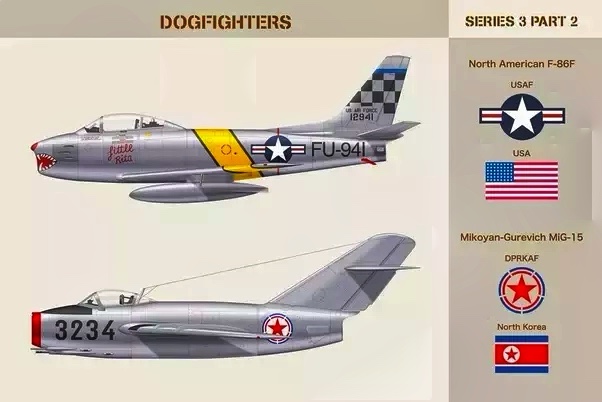
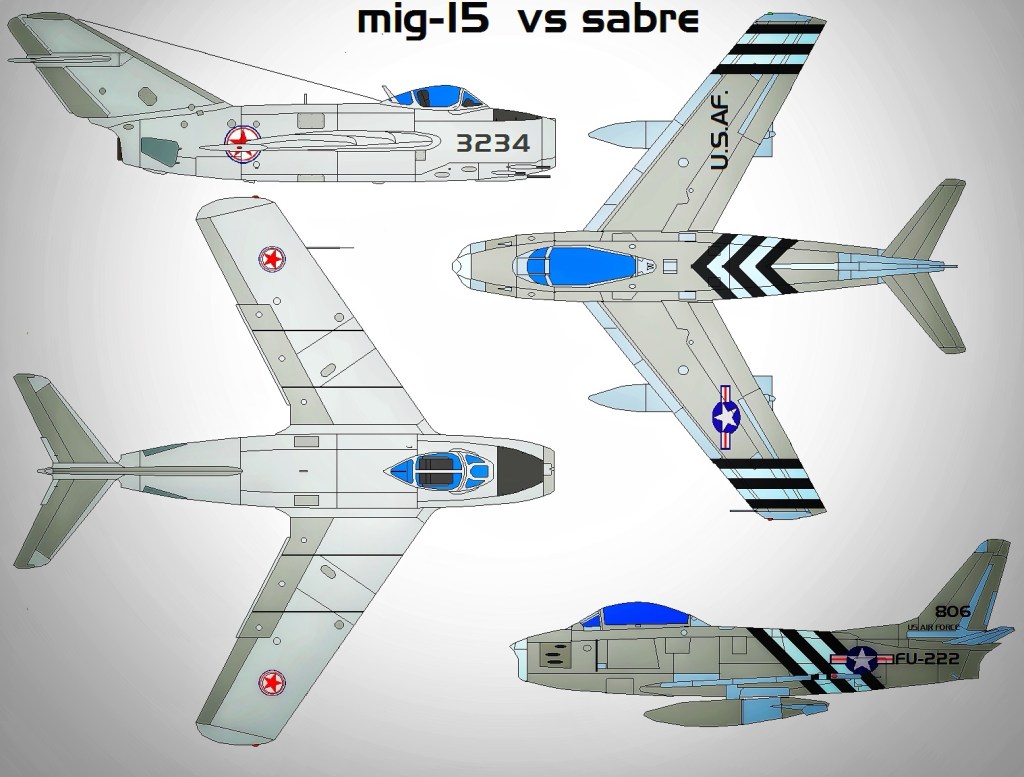
Those “freaky fighters” were the newly developed Soviet Mig-15. In all 18000 were built. NATO gave the fighter the code name “Fagot”, a sobriquet that was meant to be a denigration that soon looked undeserved.
Quickly the American supremacy over the North Korean skies disappeared. The Americans were now fighting the North Koreans as equals. Only, these were not North Koreans actually. They were Soviet and a handful of Chinese pilots in Mig-15 jet fighters that had been loaned by the Soviets to the Chinese.
—————————-
As per the mandates of the farce that we all now know as the UN, it was important to maintain the illusion that the North and the South Koreans were fighting each other and not the Soviets & the Chinese, against the US & UK. These were nuclear powers at a time when the rules of nuclear engagement had not even begun to be written. Nuclear holocaust was just a trigger-happy pinkie away. Neither side wanted to risk expanding the war beyond the Korean peninsula.
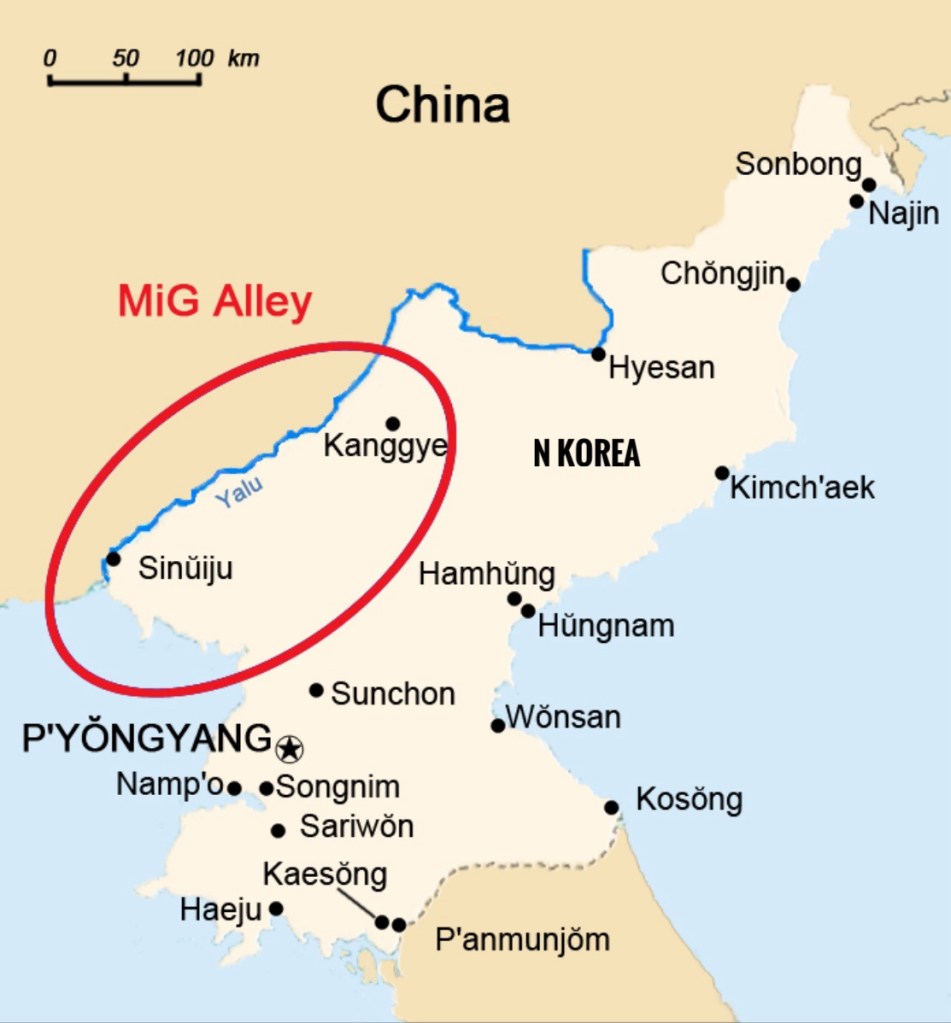
The Mig-15s and the F86s engaged in dogfights and skirmishes mainly along a stretch of the border between North Korea and China where the Yalu River empties out into the Yellow Sea. The Migs launched from Antung Air Field, close to the border on the Chinese side and the Americans, from Kimpo and Suwon, 350kms away, in South Korea.
The stretch of the border, where the two sides slugged it out 30000 feet above the ground, came to be known among the US pilots as Mig Alley. (Check out the box shown in the top of this piece).
Since the Americans had a greater distance to cover, they came to the party, equipped with drop-tanks and were therefore heavier and slower, a distinct disadvantage, especially when trying to maneuver or climb out of a tight situation. On the plus side, the American pilots were better trained and the F86 Sabres were more user-friendly and comfy, with heated cockpits that was spacious and a large bubble canopy that afforded the pilot a panoramic view.
But by far the greatest advantage that the Americans had was the invention of the G-suit, a sterling example of American ingenuity. The G-suit was a set of inflatable bladders that connected with a compressed air outlet inside the cockpit. Let me explain…..
G-forces bear upon a human body in motion, during sudden accelerations or decelerations or vector changes (ie: change in direction of motion). The more abrupt the change, the more severe is the effect on the human body. You may have noticed how your body gets shoved forward when you are driving and have to brake suddenly. Or how you feel the securing straps bite into your chest when you are on a monster roller coaster that has begun its downward plunge. In both cases, the force that impacts your body is known as the G-Force.
The internationally accepted unit of acceleration caused by gravity is “1G”. In metric units, it is equivalent to the weight of 9.81 Newtons of force per one kilogram of mass.
Imagine you are a F86-Sabre pilot coming out of a dive to get away from a Mig tailing you. You are pulling more than 6-7Gs. At that vector change, blood fails to reach your brain and your eyes, preferring to remain around your ankles. You develop tunnel vision and black out within minutes. Not a good situation to be in when the ground is rushing up at you at twice the speed of sound.
A fighter pilot’s G-suit bladders inflate and squeeze tight against the lower body parts, preventing blood from going down, allowing it to circulate to the brain. The Mig pilots didn’t have G-suits and many Migs were lost in dives or tight maneuvers, without a single shot being fired. To the Sabre pilots, this was a huge advantage.
—————————-
The most severe recorded case of G-force death was that of Princess Diana when her limo slammed into a Paris tunnel entrance at 70 mph. Without her seatbelt on, her body experienced a sudden deceleration, relative to her heart, that had the force of 70Gs. If we assume she weighed around 80kgs, that would have been a force of nearly one metric tonne. In that instant it tore her pulmonary artery, a condition that was impossible to survive. Had she worn her seat belt, the deceleration would be around 30Gs and she might have had broken ribs but would most likely have survived.
———————————
A Mig-Sabre party in Mig Alley usually lasted only 20-30 minutes max. But that half-hour looked like the Battle of Britain, the famous 1941 air battle for Britain’s skies where hundreds of British Spitfires and Mosquitos buzzed around hundreds of German Messershmitts and Stukas inside a restricted airspace of maybe one or two city blocks, often colliding with each other and breaking apart in mid-air.
In the Korean skies, at one point in the spring of 1951, a dogfight recorded 50 Mig-15s, 48 B-29s and 54 F86s at the same time, zipping around inside an airspace that resembled a box with sides just 10kms long.
Mig Alley saw the dawn of a new kind of air warfare – aerial dogfights with jets zipping around at 600mph. Soon pilots on both sides realized that they needed far swifter reflexes in order to come out of a dogfight unscathed.
Dogfights create aces and within weeks of the arrival of the Mig15s and the start of the aerial skirmishes, Mig Alley began producing aces among the American pilots.
————————————
Aces were being born on the Chinese/Soviet side as well. A wiry young 23-year old Chinese, the eldest of three children of a carpenter from Anshan in the far eastern province of Liaoning, became the first Chinese ace of the Korean War.
That Chinese ace was Flight Lt. Zhao Baotong, Zao Bao to his mates in the 4-aircraft Mig-15 schwarm that he lead.
In case you are still wondering what all this has to do with Babayev, his Tu-95 and his bombing run, take it easy, Part-4 is coming soon.











 Spunkypedia