Spunkypedia

~ – There’s always something to write about

Spunkypedia

Author Archives: spunkybong

Understanding Evil [Part-1]

19 Friday Apr 2024

Posted by spunkybong in Uncategorized

≈ Leave a comment

———————————

“I’ve been here on the ground with my nose in it since the whole thing began. I’ve nurtured every sensation man has been inspired to have! I cared about what he wanted and I never judged him! Why? Because I never rejected him, in spite of all his imperfections.

Who, in their right mind could possibly deny that the twentieth century was entirely mine?”

– Al Pacino, as the Satan, in “The Devil’s Advocate”

———————————

Cavalry, from the Parthenon Frieze, British Museum

In architecture, a frieze is the wide central section of the inner walls of a hall or large chamber, usually a public place, that is decorated in panels, with bas-reliefs or even paintings (frescos). It is situated usually above eye level, way up, just below the cornices.

Friezes were popular with ancient Roman and Greek architects, glorifying the exploits of their rulers and their Gods, the Parthenon Frieze being the most famous and perhaps the most elaborate. Sculpted between 443 and 438BC, it is a high-relief marble sculpture that once adorned the upper part of the Parthenon’s inner walls. About 80% of the Parthenon frieze still survives. Not in Greece – at the British Museum in London.

Yes, if you steal, put your loot on public display in your most prestigious museum (or the crown), charge an entrance fee to anybody who wants to see it and say brazenly to the actual owners, “finders keepers, so fuck you”, then you must be British.

—————————————–

Another frieze, this one sculpted in 1935, exists around the inner walls of the highest seat of justice in America – The US Supreme Court, the place where all judicial bucks come to rest. The frieze glorifies men who, through history, were known to have formulated laws and advanced the cause of justice as they saw it being relevant in their time.

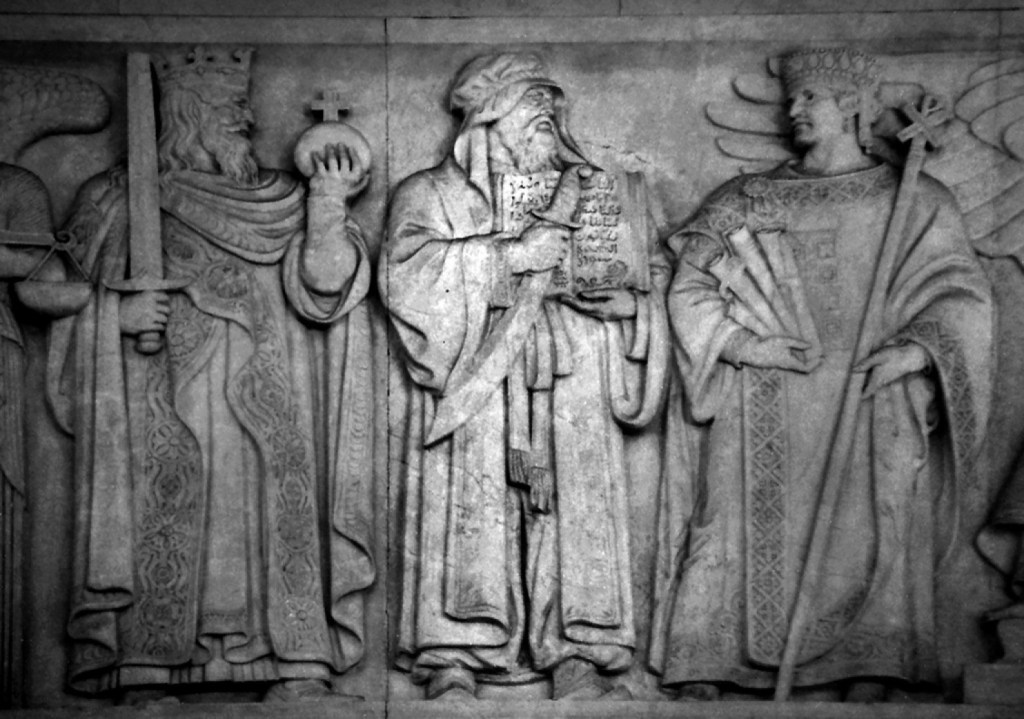
Prophet Muhammad (middle) cradling the Quran in his left arm, while gripping a scimitar in his right hand.
The prophet is flanked by the Holy Roman Emperor, Charlemagne, to his right and Justinian-I (aka Justinian the great) to his left.
The above carving is a section of the frieze on the upper walls of the US Supreme Court(see image above)
——————————————————————-

In case you are a frieze freak, you might like to check out my post on The US Supreme Court frieze

The South Wall Frieze has figures of lawgivers from the ancient world. It includes Menes, Hammurabi, Moses, Solomon, Lycurgus, Solon, Draco, Confucius and Octavian. The North Wall Frieze shows lawgivers from the Middle Ages onward. It includes representations of Justinian, Charlemagne, John of England, Louis IX of France, Hugo Grotius, Sir William Blackstone, John Marshall and Napoleon.

The sculptor of the friezes has attempted to remain as secular as possible. The Moses frieze depicts him holding only six through ten of the Ten Commandments, the ones that are usually considered the more secular commandments.

There is another figure on the North Wall, a bearded man cloaked in a flowing robe, his feet encased in the curved sandals worn by men who inhabit the Middle-East even today. In his left hand he holds the Holy Quran, it’s pages open and in his right hand, he has a long curved scimitar which he is holding, not by the haft, but by the upper blunt part of the blade, next to the hilt, the way a seasoned warrior is expected to hold it.

It is the figure of the Prophet Mohammad.

He is seen sandwiched between the Eastern Byzantine Emperor, Justinian, to his left and the Western Holy Roman Emperor, Charlemagne, to his right. The frieze is positioned in the US Supreme Court Chamber depicted above. It is one of the two friezes on the sides that are not clearly visible.

———————————

In 1997, six decades after the frieze panels had been carved, the Council on American-Islamic Relations (CAIR) asked for the frieze of the Prophet to be removed from the façade.

While appreciating that Muhammad was included in the court’s pantheon of 18 prominent lawgivers of history, CAIR argued that Islam discourages depictions of the prophet in any artistic form. CAIR also took exception to the fact that Mohammad was shown holding a sword, which they thought reinforced long-held stereotypes of Muslims as intolerant conquerors.

This is notwithstanding the fact that the Prophet was known to have his scimitar by his side at all times, he and the faith he propagated being essentially a warlike culture. The Salafists, Wahabis and the Deobandhis actually believe that there is no such thing as peace and tranquility, forgiveness and mercy. To them, these concepts themselves mean giving in, submitting to something other than Islam – the very name a word which suggests ‘submission, to the one and only God and his Prophet, Mohammad’.

A prominent US-based Islamic Law scholar then stepped up and declared that the sculpture was in fact a great honor bestowed by non-Muslims and should be appreciated. Subsequently, Chief Justice William Rehnquist rejected the request to sandblast Mohammad, saying the artwork “was intended only to recognize him, among many other lawgivers, as an important figure in the history of making of laws. It is not intended as a form of idol worship”.

The court later added a footnote to the image on its tourist brochures, calling it “a well-intentioned attempt by the sculptor to honor the Prophet Mohammad”.

After that one 1997 blip, nothing more has been heard from either the CAIR or Muslims worldwide, fanatical or moderate, about Mohammad’s presence on the US Supreme Court frieze.

————————

(Phew!)

————————

The dispute shows how opinions of Muslims on images of the prophet can get real petty and monolithic. The view that all representations of Muhammad are banned, not just those deemed blasphemous, obscures a more nuanced past, before the rise of those militant strains of Islam that ultimately influenced a group of desperados into trying to bring down the Jyllands Posten and the gunmen who attacked Charlie Hebdo magazine.

In comparison to the US Supreme Court frieze, I have to admit that the Jyllands Posten lampoons of the Prophet were in poor taste, though that still didn’t justify a fatwa and wholesale murder.

———————————————-

A few years after the Jyllands Posten controversy, a 26-year old cyber security whiz named Edward Joseph Snowden settled down to work as a contractor for the computer giant, Dell, which managed computer systems that handled highly sensitive data for multiple government agencies in the US.

In March 2012, Dell assigned Snowden to the NSA’s Hawaii office which focuses on the electronic monitoring of China and North Korea. Then, for some reason, just three months before he fled to Hong Kong, he joined the security consulting firm, Booz Allen Hamiltom, where his job was to break into the internet and telephone traffic around the world for the NSA.

It was around the time that Snowden was settling himself into life in Hawaii that one evening, he happened to switch on the TV and heard the Director of National Intelligence, James Clapper, blatantly lying under oath to the US Congress that the NSA was not tapping the phone calls and internet traffic of ordinary Americans illegally, without a warrant.

Snowden claims that that was when something snapped inside him and he decided to reveal everything. In May 2013, he took a leave of absence, telling his supervisors he was returning to the mainland for some medical treatment. Instead, Snowden caught a fight to Hong Kong, where he met with two reporters from the British newspaper, The Guardian.

In all, Snowden revealed the contents of 1.7 million classified documents, 160,000 email and text messages and 11000 classified online accounts, that he had managed to download while at Hawaii.

——————————————-

Some of the Snowden cache revealed a new, previously hidden layer in the saga of the 2008 terrorists attacks, carried out on Mumbai by militants from the Pakistan-based Lashkar-e-Toiba (LeT) militant group. It showed that, months before the massacre, the British counterpart of the NSA, the GCHQ (General Communications Headquarters), had managed to hack into the laptop of a guy named Zarrar Shah, who turned out to be the technology chief of the LeT and one of the key plotters of the Mumbai attacks.

Soon, the British engineered trojan, that had inserted itself into the Shah’s laptop, spread like wildfire into all the other computers that it communicated with, inside the LAN network that the Pakistani ISI had set up for the LeT, in an apartment that was situated in a quiet neighborhood of the Pakistani port city of Karachi.

Now, every comma and semicolon, every image and video, every communication between the Pakistani establishment, the LeT leadership, the ISI and the Karachi terror cell, was laid bare to the British in real time.

In the early days of the intelligence coup, the GCHQ learnt that Shah was looking for someone, a man who could pass himself off as a western businessman/tourist without raising any suspicion. He would have western citizenship and a passport whose authenticity would be unquestioned, since it would be completely genuine. He would get out there on the ground and conduct extensive reconnaissance of India’s financial capital, for the planning of the logistical aspects of a possible strike on Mumbai.

The scout would try to ascertain which was the best way for a group of militants to enter Mumbai, whether by land through Nepal (a long risk-frought over-land route) or by sea, direct to a deserted beach at Mumbai. There were hundreds of beaches available. Mumbai had a 60km long coastline. He would acquire maps, GPS coordinates – information that could lead even a blind man into Mumbai.

And of course, the scout’s main mandate would be to help identify a list of possible targets that would convey the maximum symbolism to the world. He had to record directions, traffic patterns, available transportation, etc, anything that would help the team get from A to B and then to C in a swift, seamless manner, expending as little time as possible.

The scout would also be mandated to figure out the best possible escape route after the mayhem but that was not a priority since the LeT didn’t expect the militants to survive and make it back to Pakistan.

Here comes the innate hypocrisy – while the LeT did not believe in suicide terrorism, deeming suicides as anti-Islamic, dying in a hail of bullets was perfectly acceptable and the LeT fully expected it’s killers to ensure they gave their lives away in that manner.

Meanwhile, unknown to Shah, the LeT had already found such a scout – an American with a Pakistani Muslim father and a white Christian mother. Fortunately for him, he had inherited almost all his mother’s genes and was therefore indistinguishable from other white folks.

That man went by the name of David Coleman Headley, son of Sayed Salem Gilani and Alice Serill Headley. Deceptive by birth, he had chosen to have his mother’s surname.

(Watch this space for Part-2)

Share this:

  • Share on X (Opens in new window) X
  • Share on WhatsApp (Opens in new window) WhatsApp
  • Share on Facebook (Opens in new window) Facebook
  • Email a link to a friend (Opens in new window) Email
  • Print (Opens in new window) Print
  • Share on Tumblr (Opens in new window) Tumblr
  • Share on Reddit (Opens in new window) Reddit
  • Share on Pinterest (Opens in new window) Pinterest
  • Share on LinkedIn (Opens in new window) LinkedIn
Like Loading...

Sinister Neutrality

09 Tuesday Apr 2024

Posted by spunkybong in Uncategorized

≈ 2 Comments

Tags

Nazi Germany, Swiss banks, Swiss neutrality, World War 2

———————-

“The power of judgement, which is called ‘reason’ or ‘good sense’, is the most equally distributed in all of us from birth. Most of us think we are so full of this power that we do not require a larger measure of it than we already have.

What sets us apart from each other, however, is in the way we utilize the reason and the sense that we possess.”

– René Descartes (1596-1650), mathematical genius and philosopher, in his “Discourse on Method of Rightly Conducting Reason and Seeking Truth in the Sciences”

I always thought that the Swiss are really smart folks, possessed in abundance with René Descartes’s ‘good sense’ and ‘reason’.

Stealing millions in cash, gold and art that had been confiscated from Jews by the Nazis and left in Swiss bank vaults guised as safe havens at the end of the Second World War, now that took real smarts. Pioneering the concept of a no-questions-asked repository for ill-gotten gains from around the world salted away in anonymous numbered accounts, man, that was brilliant.

In the early 1930s when Nazism reared its head, many Jews in Central and East Europe sought to protect their assets by depositing money in Swiss accounts, and their valuables in Swiss safe deposit boxes. To encourage such transfers, in 1934 the Swiss even strengthened special banking secrecy laws which facilitated preservation of depositor anonymity.

For a while, the Swiss National Bank looked to Europe’s Jews the way the tablet on the Statue of Liberty looked to “the wretched masses”.

To the delight of the Swiss, most of the Jews who transferred their assets, did not survive the Holocaust. The Swiss were very happy to accept Jewish capital but not as happy to accept Jewish refugees, some of whom were often their own depositors. Jewish refugees attempting to flee Germany and occupied parts of Europe were blocked from entry.

In 1938, the Swiss requested that Berlin mark the passports of Jews with a “J”, so that German Jews could be instantly distinguished from German gentiles – and be denied admission to Switzerland. Indeed, the great majority of those denied sanctuary in Switzerland perished in the German death camps.

As the war raged, Switzerland turned into a repository for Jewish assets smuggled out of Nazi Germany and its satellite states. Vast quantities of gold and other valuables plundered from Jews and others all over Europe landed up inside Swiss banks. Right up until the end of the war, Switzerland laundered those assets feverishly. Gold bars with the swastika on them were melted down and re-embossed and went into anonymity around the central banks of Europe, each of whom knew full well where the gold was really from.

It is estimated that the loot was worth more than 500 billion in today’s US dollars.

The Swiss skulduggery didn’t go unnoticed. The US President Roosevelt declared Switzerland a war profiteer and by 1944, when it became clear who in the end the losing side would be, the Allies threatened to freeze all Swiss assets in Britain, France and the US and announced a blanket boycott of all Swiss industries that had done business with Germany, unless the Swiss froze all Nazi assets in Swiss banks.

Then came VE Day and all over Europe, the guns fell silent. Deafeated, Nazi Germany was no longer able to claim the loot it’s elite had stashed in Switzerland.

To the Allies, the Nazi riches in Swiss banks were their’s to disburse, not just from a legal but a higher, moral, standpoint. They decided that after repatriation of specific assets such as jewelry, pieces of art and property to their rightful owners, the sizeable balance in hard currency and raw precious metals such as unidentifiable gold and silver bars would be compensation to the winning side for their economic losses and reconstruction costs.

Smooth move. The age old dictum – To the victor goes the spoils.

Now for the real genius of the Swiss……

—————————

At the war’s end Switzerland successfully fought Allied calls for the repatriation of plundered assets to their rightful owners and that’s where Swiss bureaucracy stepped in, pointing to Swiss law and demanding proof of ownership, death certificates and proof of identity as the legal heirs. Thanks to the wipe-out by the Nazis, almost all proof of legal right to the assets had been destroyed, either deliberately or in the bombings.

In 1946, the Allies signed a document called the “Washington Agreement of 1946” which was seen as a capitulation to Swiss’s position. The Allies contented themselves with acceptance of a mere 12% of the stolen gold. Holocaust survivors and the heirs of those who perished met an implacable wall of bureaucracy. A handful managed to reclaim just a fraction of their assets.

At the time the Washington Agreement was signed, there were numerous rumours that the lead negotiators on the Allied side (and their leaders and their political parties) were personally rewarded by the Swiss with bulging numbered accounts of their own. Political donations skyrocketed.

Further doubling down on the steal, the Swiss utilized the funds in some of the dormant accounts to satisfy claims of Swiss nationals whose properties had been seized by Communist regimes in East Central Europe.

———————————-

What takes the Swiss into the realm of pure genius beyond anything that even Descartes could have imagined is the way they project themselves as a pink-cheeked, cute and cuddly nation with it’s picture-perfect hills that serve as settings for Bollywood song and dance sequences, it’s chalets, it’s cheeses, it’s pastries, it’s chocolates, it’s fine watches and all those other things in the world that we associate with innocence. Man, that requires real brains.

Ask anyone in the west and he will be aghast at the idea that Switzerland can be branded a rogue criminal state, intent upon stealing, defrauding hapless individuals. To him, Switzerland is nothing but a bunch of poor misunderstood white guys in wealth management, who are just being resourceful.

Everyone loves the Swiss and what is more important is that the Swiss believe that everyone loves the Swiss. Switzerland conjures up an image of purity, a 99.99%-oxygen air, plump goats sampling organic grass on green rolling meadows, stretching as far as the eyes can see.

And of course, unadulterated, organic hospitality. If you are rich, Switzerland is a joint where you can get away from your conflicts and just relax, like you would in an exclusive spa, The snowy peaks that surround you will make you feel like you’re in a Catholic confessional. You can scream out your sins to them and the breeze will exorcise you, wiping you clean. After two weeks, you are good as new, back in Manhattan, paying a lobbyist to pay a congressman to skirt the law.

——————————

Let’s go back a bit……

After the First World War, the victors (the French and its allies) decided to build an international organisation that would ensure that another world war didn’t happen. This was where the Swiss displayed their smarts. Already known for their tranquility, they volunteered to be the base for the proposed entity. Geneva, their second largest city, was chosen as the Headquarters of the organisation that was named the “League of Nations”.

Besides boosting tourism (just like the UN does in New York City) the ‘League of Nations’ did jack shit, bupkis, zilch, you get it, nothing. Just like the UN. It certainly didn’t prevent world wars. To Switzerland however, the presence of the global HQ of the League of Nations made it the world’s go-to place for settling disputes. It gave the Swiss prestige.

——————————

Switzerland displayed its smarts in other ways too, such as the deft handling of its more powerful neighbour, Germany, starting well before and right through the Second World War. Correctly foreseeing the upsides of neutrality, it declared itself a neutral country, ensuring it would remain a haven of tranquility, a sovereign state at a time when Germany was gobbling up it’s neighbors. A neutral country pledges to remain neutral in all conflicts and to not join military alliances like NATO, CSTO, etc. In return it is guaranteed non-aggression by all sides.

Just as passive income investors invest in dividend stocks, the Swiss have invested in neutrality and it is a very smart investment indeed. Your stock portfolio might halve in value in a market crash but Switzerland’s investment always wins. During conflict, warring sides threatened by invasion need a haven for their liquid assets and for the safe-keeping of those assets, they are willing to part with a percentage of their net value. That has been the ROI of the Swiss.

————————————

During the initial years of the Second World War, the Swiss allowed bomber overflights from both sides but after 1942, when the Nazis sensed the tide beginning to turn against them, they threatened Switzerland with annexation unless it made overflying allied bombers either land or turn back.

Scared shitless, the Swiss acceded to Hitler’s demands but here’s where their deftness in playing both sides showed. To calm hurt feelings among the Allies, allied airmen who landed or bailed out over Swiss territory were returned unharmed. Likewise, escaped Allied POWs who made it to Switzerland were given medical attention and repatriated unharmed.

WW2 ended in 1945 and while the rest of Europe looked like a post-apocalyptic hellscape, one country remained standing, unscathed. You guessed it – it was Switzerland. Except for damage from a few accidental bombings from both sides, Switzerland remained materially untouched, while economically, it resembled Yukon during the gold rush.

—————————

Other European nations too designated themselves as neutral in the 2nd World War but they ended up either taking sides and/or letting the Nazis use their territory for logistics/troop transit or having the output from their mines diverted for the Nazi war effort, in exchange for the assurance that they wouldn’t be invaded.

Switzerland not only avoided annihilation, but it actually prospered, its banks filled fit to bursting with gold bars, recast with the swastika stamped on them, jewelry, hard currency, priceless art, even gold tooth fillings extracted from incarcerated Jews. If there were descendants, freshly liberated from concentration camps, they were barely alive. Psychologically broken, they had neither the paperwork to prove they could claim those assets, nor the will to go looking for them.

In the closing weeks of the war, even corrupt Nazi big shots began transferring truckloads of snatched valuables in their personal possession to Swiss banks, from which those banks are reported to have earned a cut of up to 50% of their value.

Today Switzerland is the fourth richest country in the world, with a per capita personal annual wage income of $73000(USD) and the third in terms of per capita GDP ($103,000(USD).

—————————

Another facet of Switzerland’s genius is it’s pragmatism.

In spite of its neutrality and in spite of a population of only 8.9 millions to protect, Switzerland has built itself a strong modern military, its army equipped with the latest hardware money can buy. Battalions of armoured corps with Leopold Pz-7 Main Battle Tanks, squadrons of F18 Hornets, you name it they have it. With a penchant for producing intricately crafted machinery, the Swiss excel in small arms. Manufacturers such as SIG and Oerlikon are household names, their annual arms exports to military and law enforcement agencies all over the world topping $2 billion.

The martial ethos is drilled into Swiss males at an early age. Military service is mandatory for all male Swiss citizens from 16, up to the age of 34. All of the population within this demographic undergo an 18-week basic training and two-thirds end up as conscripts.

Here too the Swiss have displayed immoral genius – exporting arms to all sides in a conflict. It is an open secret that Swiss-made small arms and infantry rifles have been supplied through middlemen to all sides in Syria, Yemen and Libya in the aftermath of the Arab spring.

“Say yes to the ban of Swiss war materials export!” Says this poster at a Bern protest over exports to all sides in the Arab Spring, 2011.

———————————-

What can one call a country so seeped in criminality? The French essayist, Charles Baudelaire(1821-1867), once said, “The greatest trick the Satan ever pulled was convincing the world that he didn’t exist”.

Let me tweak Baudelaire’s quote to read…

“The greatest trick the Satan ever pulled was convincing the world that his representatives are unrecognizable as what they really are.”

Share this:

  • Share on X (Opens in new window) X
  • Share on WhatsApp (Opens in new window) WhatsApp
  • Share on Facebook (Opens in new window) Facebook
  • Email a link to a friend (Opens in new window) Email
  • Print (Opens in new window) Print
  • Share on Tumblr (Opens in new window) Tumblr
  • Share on Reddit (Opens in new window) Reddit
  • Share on Pinterest (Opens in new window) Pinterest
  • Share on LinkedIn (Opens in new window) LinkedIn
Like Loading...

Were the Dark ages really dark?

24 Sunday Mar 2024

Posted by spunkybong in Uncategorized

≈ Leave a comment

Society, Love and War in the Dark Ages

“In public, your bottom should emit no secret winds past your thighs. It disgraces you if other people notice any of your smelly gas.”

This useful bit of advice, for young courtiers in the early 13th century, appears in “The Book of the Civilised Man”, by a Daniel of Beccles. It is the first English guide to manners.

Ian Mortimer, a historian, argues that this and other popular works of advice that began appearing around the same time represent something important: a growing sense of social self-awareness, self-evaluation and self-control.

The ancient Romans were the first to use mirrors made of glass. Mirrors made it possible for men and women to see themselves as others did. It inspired them to be more presentable and in turn, be better prepared for success in their lives.

With the gradual demise of the Roman Empire, aesthetics, etiquette and other finer aspects of day to day living vanished. The hordes from the north, the Huns, didn’t believe in them.

But the barbarism didn’t last too long. Around 1200AD, mirrors were back in vogue all over Europe. One can take this as people once again waking up to their persona.

By 1500, mirrors were cheap, and their impact had spread through society. Europe seemed to be recovering from the Huns.

However, all that most of us see in this era of revival is a time marked by violence, ignorance, superstition and centuries-long pandemics that decimated populations.

Many historians believe that this time in history, from just after the fall of the Roman Empire to around 1500 AD, saw considerable social and economic progress. It laid the foundation of the modern world. Inventions such as gunpowder, the magnetic compass and the printing press, all found their way from China to transform war, navigation and literacy in Europe.

For Europeans, the horizons expanded. In the 11th century Europeans had no idea what lay to the east of Jerusalem or south of the Nile. By 1600 there had been several circumnavigations of the globe.

Law and order was another frontier. Thanks to the arrival of paper from China in the 12th century and the advent of the printing press in the 1430s, document-creation and record-keeping, which are fundamental to administration, surged. Between 1000 and 1600 the number of words written and printed in England went from about 1m a year to around 100bn.

In England, a centralised legal and criminal-justice system evolved rapidly from the 12th century. Violent deaths declined from around 23 per 100,000 in the 1300s to seven per 100,000 in the late 16th century.

In the fields of science and math, the Arabs introduced Europe to Algebra, including linear and quadratic equations. The now common byword “algorithm” was born out of the name “Al-Khwarizmi”, a pioneering Persian math wizard of the early 10th century AD.

Another “horizon” was speed and the sense of urgency that went with it. By 1600 a letter bearing important news could be carried 200 miles in a single day, thanks to people starting to use relays of horses at staging posts. Over the course of the 14th century mechanical clocks were developed, allowing time to be standardised and appointments to be kept.

The period was also marked by growing personal freedom, with the banning of slavery within England by the English church in 1102 and the rapid decline of serfdom after the Black Death of 1348-49, when nearly half the labour force perished. Political power expanded to include a growing land and property-owning yeoman class.

All over Europe, great military leaders ruled even-handedly, gradually bringing order everywhere – William the Conqueror, Alfred the Great, Charlemagne, Justinian-I, Richard-I (the Lionheart), Louis the 14th, Henry-V and Edward-III were some of the pillars on whose shoulders modern Europe was built.

Why then do we insist on calling the period between 800 to 1500AD the “Dark Ages”?

—————————

Ps : The Dark Ages is a Europe-centric thing. There were no such identifiable dark ages or period defined in any other history anywhere else in the world.

————————

Citations :

– The Reformation – Will Durant

– The Crusades – Zoe Oldenbourg

Share this:

  • Share on X (Opens in new window) X
  • Share on WhatsApp (Opens in new window) WhatsApp
  • Share on Facebook (Opens in new window) Facebook
  • Email a link to a friend (Opens in new window) Email
  • Print (Opens in new window) Print
  • Share on Tumblr (Opens in new window) Tumblr
  • Share on Reddit (Opens in new window) Reddit
  • Share on Pinterest (Opens in new window) Pinterest
  • Share on LinkedIn (Opens in new window) LinkedIn
Like Loading...

A Totenkopf’s Tale

14 Thursday Mar 2024

Posted by spunkybong in Uncategorized

≈ Leave a comment

Amazing how one can bump into interesting people on a park bench. 74-year old Titus Kastner is one such guy I met one Sunday last summer.

Kastner is a first-gen Cretan immigrant from Arkadi, Crete, having received his landed status in 1976. His father had been SS Hauptscharfuhrer Franz Kastner of the SS-Totenkopfverbande, the Death’s Head Unit of the Waffen-SS, a sledge hammer-like division within the SS during WWII, which followed behind the regular Wehrmacht troops and dealt with townsfolk, rounding up Jews, as the German armies marched through conquered lands.

A Kastner from Crete? It’s like a VHP member having a name like Lashkar Kumar Toiba.

If you aren’t too busy, I can explain…..

20yr old Franz Kastner was a member of a Totenkopf SS squad that was parachuted into a field 20kms north of Arkadi, Crete, one winter’s night in 1941. Leaping from the Junkers-52 at 9000ft, Franz and his comrades drifted through the highly humid, still air for a while.

While the others were floating down bunched up together, Franz got carried further north by a sudden freaky gust and landed at a spot roughly 10 miles from the rest of the squad. 10miles on hilly terrain can be a very long distance to cover, especially when it is pitch dark and you’re blundering over jagged rocks and can’t switch your flashlight on.

Staying put till daybreak would invite capture by the partisans, so Franz began picking his way through the rocky valley floor. After 50 yards, his right foot snagged under something, snapping his ankle in two. With a shattered ankle, Franz dragged himself for days, slithering beneath rocky ledges at night for shelter.

He was found under a rocky overhang on the fourth night, delirious with fever from the onset of gangrene, by a 15yr old girl who half carried, half dragged him to the nearby farmhouse where she lived, with her parents and brothers.

Her name was Lorenza and she promptly proceeded to nurse the blue-eyed, flaxen-haired young German back to health.

There is this titbit Titus shared with me that has stayed…..

First, a background. The Totenkopfen were hand-picked men who underwent extensive training, to disable all macros such as emotion, remorse, pity and empathy from their brain cells. This was important for them to be able to function normally and carry on their day-to-day lives, ie: slaughtering Jews during the work day and then going home, playing with the kids, watering the roses. That sort of thing.

The Totenkopfen had to be able to switch from the Satan to the dutiful husband in the course of 24hrs. Evenings, they would do the dishes, help the children with their homework, enjoy a leisurely late evening smoke with kamarads and laugh at some silly joke about how fat the base commanding officer’s wife was. Mornings they would butcher little Jewish children by holding them by their feet, swinging them around over their heads and smashing their little heads against the trunks of trees.

The young Totenkopf, Franz, was probably no different. As she nursed him back to health, Lorenza paid no attention to his mirthless blue eyes and complete lack of any humor.

Cretans have always had this urge to make outsiders feel comfortable, tourism having been the mainstay of their economy before the war. This had been another reason why most Cretans spoke passable English. Titus’s father too knew spoken English, having been trained in it at the Totenkopfverbande. Important, since the invasion of England was in an advanced stage of planning at the time.

One day, when the delirium of gangrene had passed and Lorenza was wiping the sweat from his face, Franz reached out and grasped her wrist. Pulling her close till her lovely hazel eyes were inches away, his blue eyes brimmed over.

“Why?” he asked, his eyes frantically surveying her, for a moment disregarding the pain in his ankle, “Why do you help me? I’ve done nothing good my entire life.”

“Funny,” she replied, “When I look at you I see nothing bad.” She couldn’t see the Totenkopfen in Franz.

Titus’s Dad hid inside that farmhouse till the allied forces took back Crete. Then, when the time came, he gave himself up to a passing British patrol and was incarcerated for 6 months, before they let him go.

Late 1945, as he was making plans to go back to Hamburg, Franz got news that both his parents had been killed in the allied bombing, their house completely destroyed. He stayed back in Crete, and began working in Lorenza’s father’s orchards.

I’d love to tell you that Franz and Lorenza fell in love, married and lived happily ever after and that is what indeed happened, but not right away. It took a few years. And many tumbles in the barn. On Titus’s grandfather’s hay.

One such tumble created Titus.

Since it was a given that they’d eventually marry, Lorenza’s parents and brothers didn’t mind all the barn sex. The Cretans are in fact a very lusty people. Easy to see why. Their women are the loveliest in Europe. Wish I had been born a Cretan. (Maybe the Holy Spirit did give me my wish but his secretary missed the typo …..she typed an ’i’, instead of an ‘a’.)

When they were bored with all the tumbling, Franz taught Lorenza to make franzbrötchen, a pastry that his mother would make on Sundays before the war, and frikadelle, meatballs made from pork, beef and onions, then popular in Hamburg. Lorenza began adding spicy pickled zuchinis to the frikadelle. Franz loved it. As he did, her Apáki, a kind of marinated, spicy BBQed pork, and Tzatziki, a Turkish yoghurt with cucumbers and garlic peppers.

Parachuting and paragliding were a passion for Franz and so it was natural that he opened a club and operated it profitably, for tourists who were in Arkadi to visit the famous orthodox monastry there.

Just a few days shy of Titus’s 11th birthday in 1973, Franz went for a practice jump. His chute didn’t open and he was found just a few feet away from the spot where he’d landed 30yrs prior, as an SS Hauptscharfuhrer.

Franz was laid to rest right beneath the same rocky ledge where Lorenza had first found him.

————————-

The moral of this story is….. Always open a conversation with the person sitting next to you on a park bench.

Share this:

  • Share on X (Opens in new window) X
  • Share on WhatsApp (Opens in new window) WhatsApp
  • Share on Facebook (Opens in new window) Facebook
  • Email a link to a friend (Opens in new window) Email
  • Print (Opens in new window) Print
  • Share on Tumblr (Opens in new window) Tumblr
  • Share on Reddit (Opens in new window) Reddit
  • Share on Pinterest (Opens in new window) Pinterest
  • Share on LinkedIn (Opens in new window) LinkedIn
Like Loading...

Collective euphoria

25 Thursday Jan 2024

Posted by spunkybong in Uncategorized

≈ 2 Comments

131826-02A147Q4

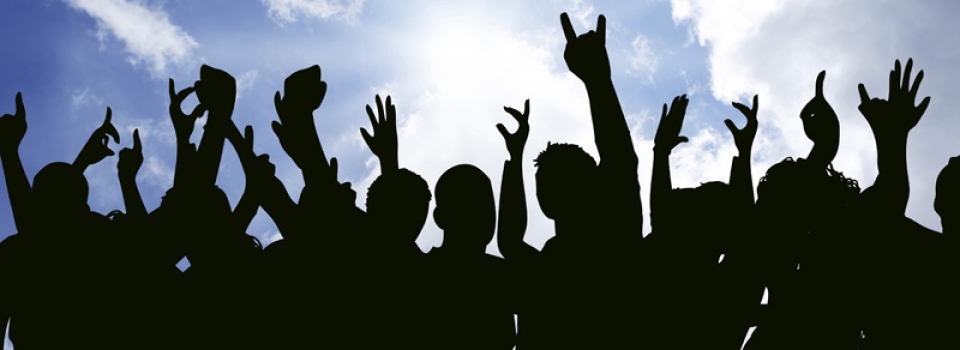
Collective euphoria (Image courtesy : Dreamdis)

————————-

On the morning of 14 August, 1945, 21-year-old Greta Zimmer, reported for work as a dental assistant on Lexington Ave, New York City.

All morning, Greta had been hearing rumors that the Japanese had surrendered after being hammered by those two atomic bombs. Two months prior, in May, Nazi Germany had surrendered and this meant that World War II was finally over.

When the announcement finally came over the radio, businesses across New York (and in fact all over America and the world) downed their shutters and countless men and women left whatever they were doing and spilled into the streets in giddy, chaotic revelry.

Mass euphoria is a fascinating, spell-binding thing, a cathartic release. It is a moment of intense emotional high, usually brought about events like victory in war, as in this case. People will collectively go overboard by other events too, such as sports competitions, music festivals, religious gatherings or even the toppling of a brutal dictator. Singular events of awesome human achievement, like the moon landing, also bring people out on the streets. 

Mass euphoria can go the other way as well. In Orwell’s 1984 or Hitler’s 1939 Reichstag address, the mass euphoria was not spontaneous joy, but an engineered emotional state, manufactured and weaponized by a totalitarian power. It blinded the revellers to suffering and injustice.

Sigmund Freud called mass euphoria a temporary disconnect or reprieve, from reality, which in this case was the crippling economic depression raging through America at that time.

On that August day it was a sudden release from not only the pent-up anxieties and fears of six years of brutal warfare but also the bottled up anger over the previous two decades of economic meltdown that had come to be known as The Great Depression.

Sigmund Freud called mass euphoria a temporary disconnect or reprieve, from reality, which in this case was the crippling economic depression raging through America at that time.

Greta Zimmer’s joy was sobered by her recent past – she had landed in America as a Jewish refugee who escaped Austria in the nick of time in 1938, leaving her parents behind. As of that euphoric day, she hadn’t heard from them and feared they hadn’t survived.

Nevertheless Greta took off. In a happy daze, she wandered aimlessly west toward Manhattan. At the Times Square, which was – as it is even now – ground zero for spontaneous celebrations, thousands had descended, having left their hotels, offices and apartments, to be in close proximity with each other, some openly crying, while others hugged or shook hands.

At the very moment when Greta Zimmer was wandering into Time Square, 21-year old US Navy Ensign, George Mendosa was inside a cinema with his date, Rita, watching a war movie with Robert Mitchum in it. All of a sudden the show was halted and the lights came on and over the theater’s PA system came the announcement that the war had ended. Those inside the theater, George and Rita included, sprang up and rushed out into the street.

They couldn’t find a bar that wasn’t jam-packed, so the couple decided to simply mingle with the crowds that meandered around Time Square and soak up the historic moment. George had been enjoying the last few days of his shore leave and now he was overjoyed that he may no longer be redeployed in the Pacific.

If you had been a woman on Broadway or Times Square that day, chances were good that you would be scooped up and kissed by random strangers and most likely you wouldn’t mind it even a bit. Still, Greta Zimmer was shocked when she suddenly found herself jostled and then before she could gather her wits, she was grabbed and kissed by a brawny young man in a sailor’s uniform – Navy Ensign, George Mendosa.

pic2

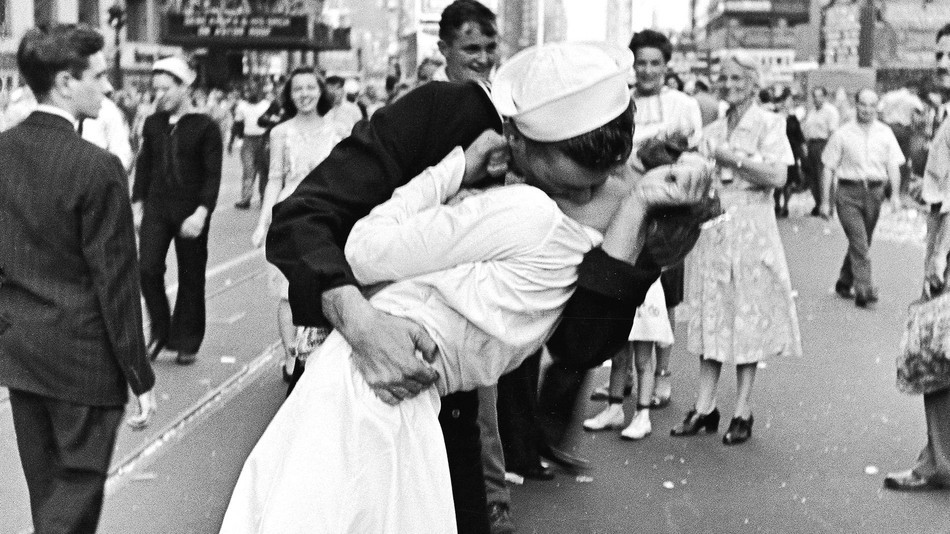
Navy Ensign, George Mendosa, kisses nurse, Greta Zimmer, on a euphoric impulse. Greta has her left arm up, perhaps in instinctive defense.

Every man was kissing every woman that day, so George’s date, Rita, wasn’t even a bit ruffled when he scooped Greta up. In fact if you check out the photo closely, that’s Rita, visible over George’s right arm, with a grin on her face. (pic courtesy Life Magazine)

—————————————-

pic1

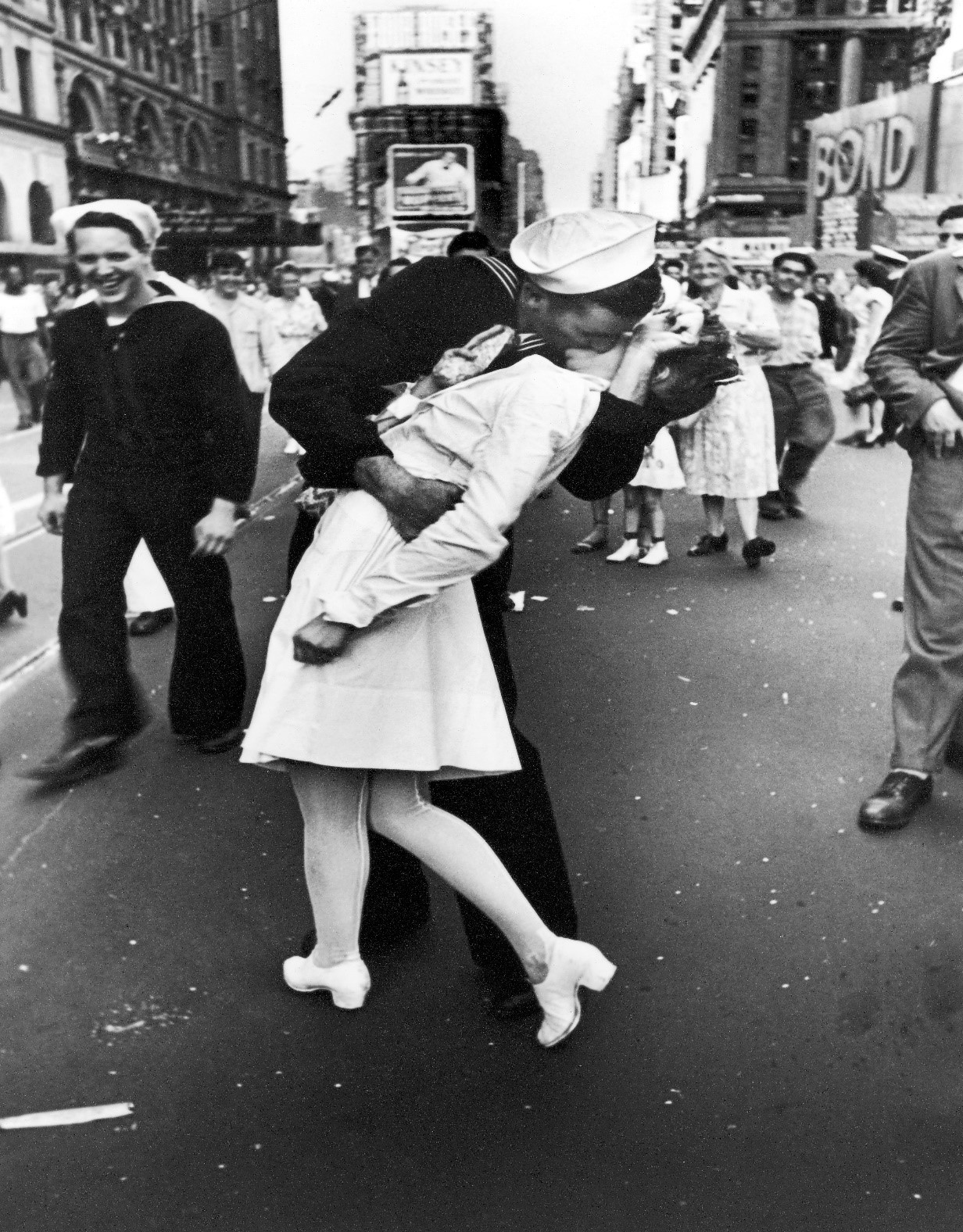
This photo is a different one, perhaps taken seconds after the previous one. I figure this one was a few moments after because the nurse no longer has her left arm up in defense, resigned perhaps to the sudden assault. The kiss must have been a sloppy one, because Greta’s fist is clenched in cringing, grudging acceptance.

Judging by the reactions of others in the photo, the action has universal approval.

————————————

I am sure the feeling among most women in America that day must have been one of gratitude, like they owed the men in uniform a debt. Letting themselves be grabbed and kissed (aka sexually assaulted) was seen by them as a gesture of that appreciation perhaps.

Meanwhile, unbeknownst to the two kissers, noted Life Magazine photographer, Alfred Eisenstaedt, had captured the moment. The photo was published a few weeks later but both, Zimmer and Mendonsa, would go years without knowing about “the photo that ended the Second World War” and of their newfound status as icons. The sailor kissing nurse photo has since spread around the world, as an iconic representation of the power of collective euphoria.

I recall sensing that same euphoric feeling once, in 1983, when India won the Cricket World Cup for the first time. The whole city of Pune – at least a million folks – had gathered around the Lakdi Pul and girls were out dancing with abandon, letting themselves be hugged, squeezed and cuddled openly, by total strangers. Straight-laced as I am, I found all that open rub-a-dub very gross, even though I remember having hormones that were barking like a Doberman pinscher, urging me to grab some of the action.

Later on I walked into a store to buy cigarettes and gestured at the still running commentary and on-pitch interviews on TV, saying to the store keeper – a young Muslim woman in hejab, “Wasn’t that simply awesome?”

“Mubarak ho! Mubarak ho!” she replied and smiled, as her hubby looked indulgently from behind her. The woman, someone who had probably been schooled to not speak with male strangers, was bubbling with the desire for release.  Historic moments seem to break barriers, peel off those layers of social norms that we wrap around ourselves.

I am sure that this dropping of all inhibition would hold true for even doomsday events of biblical proportions. Just suppose an asteroid the size of Greenland was a week away from wiping out all life on earth and any hope that it would pass us by had evaporated. You would be able to walk out into the streets and make love to just about anybody right there and then, wouldn’t you?

—————————————

George Mendosa later married Rita and stayed that way until 2012, when George passed on, at 90. Greta meanwhile lived to be 92, passing away in September 2016. Folks who knew both are unanimous that they lived happy and healthy lives.

But here’s a piece of advice to all my male readers – don’t get carried away thinking the moral of the story is – grab and kiss any random woman and she’ll grab and kiss you right back and you’ll live happily ever after. Remember that it works only if there’s just been a World War and your side won or if the world is about to come to an end.

On all other occasions, you’ll end up with a knee in your nuts.

Share this:

  • Share on X (Opens in new window) X
  • Share on WhatsApp (Opens in new window) WhatsApp
  • Share on Facebook (Opens in new window) Facebook
  • Email a link to a friend (Opens in new window) Email
  • Print (Opens in new window) Print
  • Share on Tumblr (Opens in new window) Tumblr
  • Share on Reddit (Opens in new window) Reddit
  • Share on Pinterest (Opens in new window) Pinterest
  • Share on LinkedIn (Opens in new window) LinkedIn
Like Loading...

The other war on terror

22 Monday Jan 2024

Posted by spunkybong in Uncategorized

≈ 4 Comments

“The things you did that haunt you the most…they were the things that you weren’t ordered to do.”

– Clint Eastwood’s character, Korean War vet Walt Kowalski, in “Gran Torino”

———————————-

ptsd1

————————————–

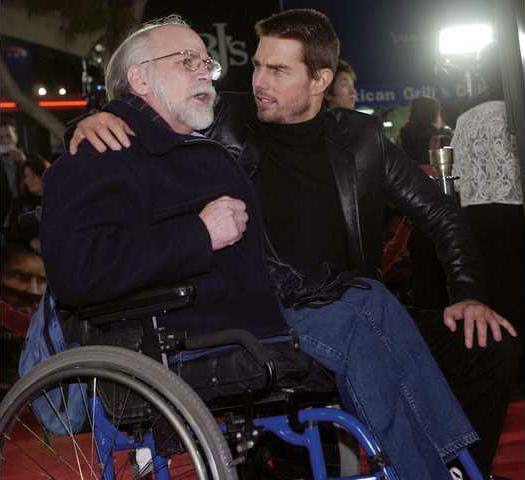
Before I start, let’s watch this clip from the 1989 Oliver Stone film, ‘Born on the 4th of July’. The movie is a true account, based on the life of paraplegic Vietnam vet, Ron Kovic, skilfully played by Tom Cruise…

http://www.youtube.com/watch?v=HhZ3H18ynTA

In the clip, Kovic is being given a hero’s welcome in his hometown after return from a tour of duty in Vietnam. Asked to say a few words, Kovic begins warming to his speech, waxing eloquent about how America is doing the right thing in Vietnam and will surely win the war in the end.

As he gets to the part about his experiences in the war, a baby in the crowd of spectators begins bawling loudly and Kovic’s voice falters. The voices of crying Vietnamese kids blanket his consciousness and he is overwhelmed by the sheer untruth in the rosy picture he just presented. The stark sounds of Nam, the thaka thaka thaka beat of a Huey’s turbo-shaft engine, come back and swamp him. Kovic just sits there on his wheelchair, trying to form the words but can’t.

Ron Kovic’s sudden meltdown from simply hearing a baby cry was a reaction known as ‘intrusive recall’, an anxiety disorder which in those days hadn’t yet been recognized as an injury that needed treatment.

Ron Kovic had what we now know as Post Traumatic Stress Disorder (PTSD), a psychological scarring that is characterized by anxiety, panic attacks, nightmares and horrific flashbacks, all of these arising from witnessing unspeakable events.

Fighting the scourge of PTSD is the other war on terror.

Ron Kovic, with Tom Cruise

———————-

Here’s another classic example of PTSD……

“…Back there I could fly a gunship, I could drive a tank, I was in charge. Back here I can’t even hold a job parking cars, man! I had all these guys back there, my buddies. Out here there’s nothing, man, no buddies. Where is everybody?

Remember Joey Danforth? He was always talking about Vegas and he was always talking about this big fuckin’ red ’58 Chevy convertible. ‘We are gonna cruise till the tires fall off, man’, he’d say.

Then we were in this bar in Saigon and this kid comes up, this little kid carrying a shoe-shine box. And he says “Shine, please, shine!” I said no. But he kept askin’ and Joey said “Yeah, okay.” And I went to get a couple of beers. The box was wired and the kid opened up the box, fucking blew his body all over the place. And Danforth, he’s layin’ there, screaming. There’s pieces of him all over me and I’m tryin’ to pull him off, you know, my friend, he’s all over me, man! The guy’s fuckin’ insides keep comin’ out and I keep tryin’ ta hold him together! He’s repeatin’ over and over, “I wanna go home, Johnny!” He keeps calling my name! “I wanna go home, Johnny! I wanna drive my Chevy!” And I’m lookin’ at him and I’m thinkin’, “With what? I can’t find your fuckin’ legs!”

— John J Rambo, Green Beret, in the 1982 film ‘First Blood’

The above may be fiction, but it is a very close representation of the senseless mayhem that is war. Combat veterans always say that it is hard to make civilians understand what they have been through. The following account is of a real Vietnam Vet, taken from a 1971 issue of Time Magazine that I chanced upon….

“The noise, the confusion, the suddenness of the shelling, the deadly invisible snipers, the dank heat, the incessant rain, the terror and with it the desire to stay put even though that could cost me my life. The nearest cover is a large rocky outcrop about a hundred meters’ straight sprint from where we are.

There’s pin-drop silence but we know they are there, behind those trees to the left with their heavy machine guns, waiting. I turn to look at the guy closest to me inside the hollow. Its the Captain. The Captain I looked up to on the parade ground is cowering down there, a flesh wound somewhere on his left arm soaking his tunic through.

The Captain is just a kid out of West Point and he has defecated in his pants. I can tell, because in the close quarters of the ditch, the stench of his filth is intense. He is just sittin’ in there, trying to form words but he can’t get them out. I nudge him impatiently and he lets out a hoarse whisper,” I want to see my Mommy. I want my Mommy…”

I remove his army-issue Colt from his holster and put it to his head and order him to pull himself together and issue the command….“

Close your eyes and try to imagine what it must have been like for the GI who wrote this account. You’ll find it hard if you have been a civilian all your life. Most would look at the captain who had simply snapped, with derision.

—————————————-

Fast forward to now……

340kms northeast of Moscow is a town of 250,000 called Kostroma. In the early morning hours of the 5th November, 2022, a Russian Army soldier named Stanislav Ionkin walked into the packed downtown Poligon Café and set fire to it with a flare gun. In total, 15 died in the blaze which required 50 firefighters and seven hours to put out and still razed the café to the ground.

Ionkin had been wounded near Mariupol, Ukraine and shipped back a week prior. In the first police interview right after the incident, Ionkin seemed disoriented and couldn’t quite put a finger on why he did what he did, except to say…. “I was looking for enemies. No one understands, so I wanted to go somewhere, kill someone”.

Stanislav Ionkin was diagnosed with a different kind of PTSD, one that comes from guilt, known as “Moral Injury”. Usually associated with combat veterans who had been engaged in unprovoked acts of aggression, moral injury is the damage to an individual’s moral conscience and values. Guilt, shame, contempt and rage at the society at large, are common emotions that a person with moral injury deals with.

————————————–

I have an American colleague, Stan, whose late father had been a navigator in B-24 Liberators during the Second World War. He flew over forty sorties and bailed out twice over German territory. The first time, it was very close to the Swiss border and he managed to slip across to freedom and find his way back to his squadron in Malta.

His second jump was in December, 1944. His squadron was on a bombing run over Ulm, an industrial town deep inside Germany that had several large lorry manufacturing plants, belonging to the auto major, Deutz. These factories were believed to be churning out armored personnel carriers for the Wehrmacht.

It was December 1944 and Stan’s dad’s squadron had been told that the Luftwaffe had been completely wiped out and therefore the bombers were flying that night without fighter escort. The planes were carrying 2-ton ‘blockbuster’ bombs that were meant to churn up the air and cause turbulence over the city’s boulevards. The blockbusters would be followed by white phosphorus and thermite incendiary bombs that would then set the rushing air on fire, incinerating everything.

A pair of Messerschmitt-109s suddenly appeared out of nowhere and tore into the lumbering B-24s with their 20mm cannons. The plane that Stan’s dad was in took multiple hits. Both right engines and the complete right wing were chewed up and the fuselage and tail section ripped to shreds. They were going down.

As the big plane tipped its nose for the downward spiral, Stan’s father jumped directly over the city. He suffered a cracked ankle as he hit a stretch of ground that was covered with jagged rocks, right next to a street that was paved with asphalt. It was a grotesque sight straight from hell.

The asphalt had melted and was boiling in the heat of the white phosphorus. Flames were licking up from the bubbling black tar. Here and there, people were stuck in the tar. They were on their hands and knees, trying to extricate themselves. They were stark naked, their clothes having been blown off their bodies by the blast of the firestorm.

Stan’s Dad was immediately spotted and captured and he spent the remaining months of the war as a POW inside a nearby prison camp run by hardened SS-Totenkopfen. Tortured and deliberately starved, he lost 60lbs in the six months that he was incarcerated there. By the time he was liberated at the end of the war, he was barely alive.

Despite being brutalized in the prison camp and witnessing horrifying scenes of death and destruction for five long years, the Stan’s dad survived, regained his health, settled down to a solid family life, went on to build a successful business and finally passed on peacefully in his sleep at the ripe old age of 94, last summer. He had never shown any signs whatsoever of post traumatic stress.

Why does one man succumb to PTSD while another is able to shrug off the horror and move on?

Let me take this a bit further. If one were to compare the horrors of the Second World War with the Vietnam War, there is no question that the WWII was far more horrific. Yet, the surviving Allied military personnel of the Second World War appeared to have weathered it more ably, since we never heard of a rush of PTSD cases among WWII veterans.

I posed this to Stan and he said his father and his buddies saw WWII as a “just war”, one that America had entered reluctantly, only because its allies needed it’s support. The American GIs knew who the enemy was. They knew what they were fighting for and they were proud of that noble goal. The war galvanized and united America and when it was over, it paved the road to unprecendented prosperity and power.

In comparison, the Vietnam War was very different. At the height of the Vietrnam War(1967), the US Secretary of Defense, Robert S. McNamara commissioned a top-secret study that would cover the entire history of American involvement in Indochina, right from the end of WWII. Maybe he wanted to record it for posterity.

The resulting 47-volume document, now famous as “The Pentagon Papers” described in vivid detail an infamous 1964 plan to create NSA-doctored radar images that were made to look like North Vietnamese torpedo boats attacking a US Navy destroyer in the Gulf of Tonkin. The goal was to conjure up the justification to launch military attacks inside North Vietnam, a sovereign nation that had never done the US any harm.

That NSA subterfuge is now infamous as the Gulf of Tonkin incident. It started the Vietnam War.

Deceit doesn’t remain under wraps for long and by 1971, The Pentagon Papers was being serialized and published chapter and verse by the New York Times and the Washington Post. (Check out the 2017 Steven Spielberg movie “The Post” which is centered on the Pentagon Papers).

The exposé left Americans feeling cheated. GIs returned home defeated, riddled with guilt, from the realization that they had been directly involved in the killings of thousands of innocent civilians in a sovereign nation half a world away, one they had no business being in.

When they returned home from Vietnam, veterans were universally reviled. Shouts of “Baby killer!!” followed them wherever they went. Homeless shelters turned olive green, with men in tattered uniforms, wracked by additions. The following excerpt of a 1982 Don Hill song encapsulates the agony that the veterans faced. It is the theme song from the Sylvester Stallone movie, “Rambo – First Blood”……

————————-

It’s a long road
When you’re on your own
And it hurts when
They tear your dreams apart
And every new town
Just seems to bring you down
Trying to find peace of mind
Can break your heart
It’s a real war
Right outside your front door I tell ya
Out where they’ll kill ya
You could use a friend
Where the road is
That’s the place for me
Where I’m me in my own space
Where I’m free that’s the place

————————–

Iraq took the Vietnam deceit one step further. Not only did the US participate in a subterfuge designed to fool the world about a non-existent threat, but it showed America to be capable of harboring leaders who might otherwise have been prosecuted and even convicted as war criminals, had they been from another nation, if the existing international treaties on war crimes were allowed to be applied.

In terms of the number of diagnosed cases of PTSD, the 2003 Iraq war has even larger numbers which, according to a study, is expected to cost the US exchequer billions to treat over the next two decades.

If weapons of mass destruction had indeed been found in Iraq and if Saddam Hussein was found to be really in bed with Osama Bin Laden, would there have been less PTSD cases among Iraq war veterans, since the 2003 invasion could then be termed a just war?

I don’t know, to be honest.

Share this:

  • Share on X (Opens in new window) X
  • Share on WhatsApp (Opens in new window) WhatsApp
  • Share on Facebook (Opens in new window) Facebook
  • Email a link to a friend (Opens in new window) Email
  • Print (Opens in new window) Print
  • Share on Tumblr (Opens in new window) Tumblr
  • Share on Reddit (Opens in new window) Reddit
  • Share on Pinterest (Opens in new window) Pinterest
  • Share on LinkedIn (Opens in new window) LinkedIn
Like Loading...

Carlo Gambino – The Little Don

15 Monday Jan 2024

Posted by spunkybong in Uncategorized

≈ 2 Comments

——————————————————————————

“Be the little guy. That way, they don’t see you comin’.”

“Judges, lawyers and congressmen have a license to steal. We don’t need one.”

“Perfection is achieved, not when there is nothing more to better, but when there is nothing left to steal”

– FBI wiretap transcripts of Don Carlo Gambino, giving sagely advice to a newly ‘made’ rookie mafioso at his initiation ceremony.

——————————————————————————

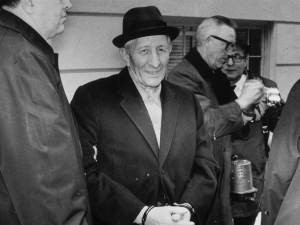
carlo-4

When the FBI came to his home to arrest him, Carlo Gambino had his wife serve them coffee and cookies. He was acquitted in this one, as in almost all of the other indictments he faced. In 50 years of crime, he endured only 22 months in prison. That is if you could call a comfortably furnished room with TV, his choice of wine and hot meals from home, prison. (Photo courtesy: LA Times)

———————–

Do you play Scrabble? If you play it with family and friends casually, that’s okay, but if you play competition, it pays to be aware of some two and three letter ‘hook’ words that you never knew existed. These are words that hook the letters in your tray onto a string on the board, sometimes leading to a big score. In a competition, it is those little words that decide if you’ll win or you’ll lose.

(Did you know that ‘ed’ is a word? I bet you didn’t. No, it doesn’t stand for ‘Erectile Dysfunction’. It means ‘specialized’.)

If a human could be likened to a scrabble hook word, then there was once such a man in America, far more powerful than any President. For a while in the 1940s through the 1970s, he ruled America as the head of a vast criminal enterprise larger than America’s largest business enterprises.

If I may draw a parallel, this man managed his affairs in some ways similar to the Roman Emperor, Claudius, quietly, away from the spotlight. Historians say that Claudius was the most consequential of the Julio-Claudian emperors and so was this man. He was from the same part of the world as Claudius, only he was born 1800 years later, in a dirt poor household in Palermo, Sicily. In 1919, unable to get work, he stole away in a freighter to the US, aged 17.

Meet Don Carlo Gambino (1902-1976).

Like Claudius, Gambino too went on to become an emperor in his own right. Only, in his case it was not a country, but a tightly-knit, murderous fraternity. The members of the fraternity didn’t just call him an emperor, but as a sign of respect and fear that he generated, Carlo Gambino was known as the Capo di tutti Capi (boss of all bosses), the most powerful American mobster in history.

And the most respected. Carlo Gambino gained the trust and confidence of his peers and this borne out by the fact that he was one of just a handful of mafia bosses who managed to die a natural death, of old age.

A diminutive man with beedy eyes, a large nose and a mild, pleasant and deferential demeanor, Gambino was anything but imposing in stature. He never made his orders sound like demands. He issued them as requests that were deferential in tone. A compatriot of his, Joe Bonnano, one of the powerful heads of the five New York crime families of the 50s, once called Gambino a ‘squirrel of a man’. Maybe he did have the looks of a squirrel but he was anything but that. In fact Don Carlo Gambino had what he exhorted his men to acquire – the heart of a lion, speed of a cheetah, cunning of a fox and venom of a viper.

To rise through the vicious world of the mafioso right around the time organized crime was coming of age in America and be able to reach the very pinnacle, keeping at bay and earning the respect of the legends of the time – Lucky Luciano, Albert Anastasia, Vito Genovese, Joe Colombo, Frank Costello and Meyer Lansky – needed a special kind of nerve and only Don Carlo had it in him.

—————————————-

Gambino had the rare ability to see two moves ahead and act without hesitation when he saw an advantage. His mantra was……’when you want to get at the other guy, first make him believe you are giving in to what he wants’. When the ambitious Vito Genovese tried to grab territory that belonged to him, Gambino laid a trap for him. He knew that Genovese was heavily involved in drug trafficking, an activity that was still in a nascent stage and frowned upon by the mafia bosses of the day. He also knew that three other bosses – Frank Costello, Meyer Lansky, and Lucky Luciano – hated Genovese.

Gambino saw an opportunity. He roped the other three in and put together a lucrative drug deal that was too good for Genovese to pass up. Then Gambino paid a Puerto Rican drug dealer $100,000 to rat on Genovese to the FBI. The dealer was small fry and could not possibly have had access to mafia bosses. Besides, his testimony should have been struck down as hearsay. But the FBI wanted Genovese so bad that they swallowed the Puerto Rican’s account as authentic and managed to win a conviction. Genovese was put away for 20 years, eventually dying of a heart attack while still incarcerated.

In the film “The Godfather”, Michael Corleone says to his lover, Kay Adams, “My father is no different than any other powerful man. He’s like a President or a Senator, any man who feels responsible for others, his friends, his family, his people…” That would aptly describe how Carlo Gambino saw himself. It was a sentiment that played large in his psyche – that he was the savior. The author, Mario Puzo, created Don Vito Corleone, the character of the Godfather, from a melange of real life mobsters but the most striking resemblance is to Carlo Gambino.

While the other New York mafia bosses would lead ostentatious lives – owning palatial mansions, flashy limos and strings of mistresses, Don Carlo was a singularly unpretentious man who was content living in a modest 2-storey brick house in Brooklyn that he shared with his wife of 40 years, the only difference being that the house was at the end of a heavily guarded cul-de-sac with a single entrance and exit, surrounded on all sides by thick reinforced concrete and guarded round the clock by armed patrols with orders to shoot at sight. All the other buildings inside the cul-de-sac were occupied by trusted family members, his underboss and his capos. You would need a battalion of M1A2 Abrams to breach that security.

Find a similarity with “The Godfather”? I bet you do. Don Vito Corleone and Don Carlo Gambino are like mirror images of each other.

—————————————–

At the height of his reign as Capo di Tutti Capi, Carlo Gambino is said to have amassed a fortune that was worth upwards of $50 billion. His underboss, Aniello Dellacroce, once quoted Gambino exclaiming exultantly,” Well, what do you know, we are bigger than US Steel!” (The line was later used by the character, Hyman Roth, in the Francis Ford Coppola hit The Godfather- Part II).

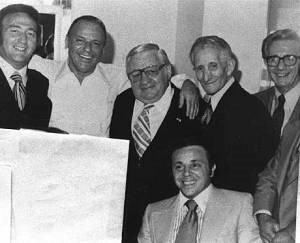
carlo-5

The singer all America still idolizies – Frank Sinatra, who was feted by Republican Presidents who ran their campaigns on a platform of ‘law and order’. Here is Sinatra (second from left) and his law breaking sponsor, Carlo Gambino, standing, second from right (Photo courtesy: Wikimedia)

——————————————

Gambino could bear a grudge too, as was evident by the Scialo killing…….

A feared soldier of the Colombo crime family, Dominick Scialo, was once at a restaurant when he spotted Carlo Gambino and began to harass and insult him in front of others. Gambino kept his cool and did not say a word.

Scialo was not touched, not a hair on his head bent. Instead, some time later, he was grabbed as he was entering a Colombo family social club, driven to Brooklyn and gently set down inside an open space that had a flat concrete surface, enclosed by vertical wooden slats that stood upright.

It was the foundation of a high-rise under construction and as Scialo stood there trussed up like a chicken, concrete was poured over him. Gambino is reported to have stood over the guy and watched. Then, while his head was still clear, the gooey concrete now lapping against his chin, Gambino stooped and placed a cigarette between his gasping lips and said,” Here, have a drag. It will calm you down.”

Concrete shrinks as it hardens and sets. A human body placed inside concrete when it is still wet, would be crushed by the contraction caused by the drying, shrinking concrete. After Scialo’s execution, leaving victims untouched and alive inside setting concrete became the disposal mode of choice for the American mob.

(If you are walking by a construction site in Queens and you see the concrete churning on its own, inside the setting molds and you happen to hear wails and moans, like “Glub..glub… help..”, chances are good that the mixer operator is from Sicily.)

In 1969, Gambino became the ‘Chairman of the Board’ of what became known as the National Crime Syndicate or simply “The Commission”. And then in the early morning hours of Oct 15, 1976, he died of cardiac arrest at his home. The excitement of watching the New York Yankees winning the previous evening had gotten to him.

————————–

Don Carlo Gambino lay in state inside a Brooklyn church for two days, so that thousands of ‘the faithful’ could come to pay their respects to the little, soft-spoken man. At the time of his death, the Gambino crime family was raking in $40-50 billion a year.

Don Carlo left his mark even at his own funeral. A number of unmarked cars stood on the opposite curb with FBI agents inside, filming the people going in and out. The FBI agents waited, shivering in the chill of the fresh October rain, unable to even get out to relieve themselves.

That’s when members of the Gambino crime family brought trays of lemonade and sandwiches to them and afterwards invited them in, to use the outhouse toilet at the back of the garden. Don Carlo had always reminded his men that the “FBI are doing their jobs, feeding their families, seeing their kids through school, just as we are…”


Share this:

  • Share on X (Opens in new window) X
  • Share on WhatsApp (Opens in new window) WhatsApp
  • Share on Facebook (Opens in new window) Facebook
  • Email a link to a friend (Opens in new window) Email
  • Print (Opens in new window) Print
  • Share on Tumblr (Opens in new window) Tumblr
  • Share on Reddit (Opens in new window) Reddit
  • Share on Pinterest (Opens in new window) Pinterest
  • Share on LinkedIn (Opens in new window) LinkedIn
Like Loading...

The Savage

12 Friday Jan 2024

Posted by spunkybong in Uncategorized

≈ 2 Comments

“No one climbs mountains for scientific reasons” – Sir Edmund Hillary

————————————

Austrian alpinist, Gerlinde Kaltenbrunner, scaling the Bottleneck at 8200 metres, well inside the Death Zone, the most dangerous stretch of the climb to the summit of K2. (Photo courtesy : National Geographic Magazine, April 2012)

—————————————————–

Far to the north of Pakistan is a small hill deep inside the Karakoram Range which forms a natural barrier between Pakistan and China. The hill has a monument on it, an earthen mound with a cross and a thin tin plate nailed to it, with a name embossed by hand on it, possibly with the point of an ice pick – “Art Gilkey(USA), RIP, Aug 10, 1953, Avalanche”.

In the seven decades since, that hill has become home to hundreds of such monuments and the reason for that is the mountain standing next to the hill, a behemoth that seems to pierce through the clouds and reach right into the heavens. The makeshift monuments are a grim reminder of what it is like, to challenge the behemoth, which has over the years gained quite a few monikers – the ‘mountaineers’ mountain’, the ‘killer mountain’, the ‘mountain with no name’ and ‘Godwin-Austen’.

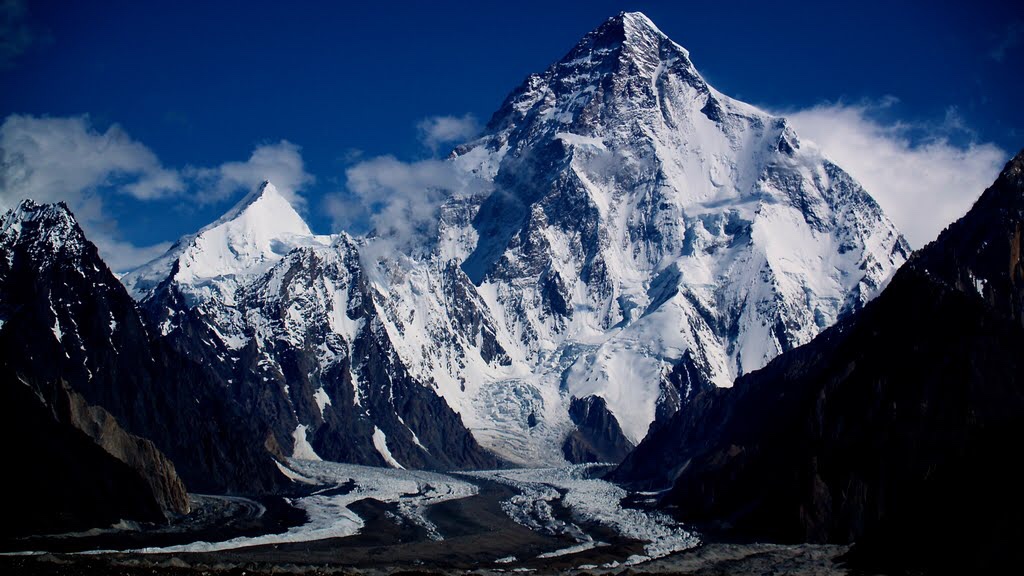
Officially the mountain is known as K2, though I like the name that is the most apt, one given by the alpinist who first attempted to climb it – The Savage. The leader of that failed summit assault, an American theoretical physicist named George Bell, later said, “It’s a savage mountain that will try to kill you”.

You don’t conquer the Savage. She simply decides to tolerate you and if you don’t promise to make your stay a short one, she makes you a permanent house guest. The Savage is a testament – to bravery and futility, ambition and failure, to fatal attraction for a beast like none other.

————————

No one knows why K2 didn’t get a decent name on official record. It was designated Karakoram-2(K2) by one T.G.Montgomery of the Geological Survey of India around 1856, when he was logging peaks in the Karakorum Range as K1, K2, K3 and so on. The second mountain in his list happened to be K2 and old Monty simply left it at that.

K2 has other names that accord it a certain degree of respectability. The Chinese call it Qogir Feng , meaning ”magestic mountain”. Likewise the Tajiks, the Tibetans and the Pakistanis have their own names, all expressing awe – Dapsang, Chogori, Lamba Pahar and so forth. But to the world at large, it remains simply K2. A much lesser peak – situated 32kms from the K2 – the Masherbrum, which is a puny 7821 metres by comparison, has been logged as the K1, as if to deny the Qogir it’s rightful place at the top of the Karakoram peaks.

It is easy to understand why the K2 is so feared by alpinists who make the trip from distant lands to attempt to conquer it. They almost never make it on the first attempt. In fact they consider themselves lucky if they are alive after even a failed attempt.

Straddling the border between Pakistan and China, the 8611-metre behemoth is the mountain where one in every four climbers has died, attempting either to scale the near vertical faces or descending from them. Only those who are trained rock and ice climbers rolled in one, can successfully scale it. If you are trying to break trail at 20000 ft on the K2 and you are the one fixing the ropes, the terrain over which you are moving is hard rock and ice, steep – with a 60° slant that is so smooth, that a sudden gust may simply flick you off the face in an instant.

At 28250ft, the K2 is just 750 ft lower than the world’s tallest peak, the distant Chomolungma, better known as Mount Everest. Although it is second highest, K2 is actually a longer climb than Everest, if measured base-to-peak, not sea level to peak. It has a far larger base-to-peak height, which means that you have to climb more. The Everest may be taller, but it’s base – the base camp from which attempts to the summit begin, is already at 17600ft. In comparison, the K2’s base camp height is only 16400ft. The K2 climb is therefore 1200ft longer. That 1200 ft means two hours more at the Death Zone, a term that alpinists use for heights above 8000 metres.

At sunset, the shadow of K2 falls over China, covering hundreds of miles

Easy to sketch for even a six year old, because of its near perfect Euclidian isoceles shape, K2 belongs to an exclusive club known as the ’14 sisters’, the 14 tallest mountains in the world, all situated on the Himalayan Ranges and all above 8000 meters (26000ft).

If given a choice of mountains to die on, alpinists prefer K2 over the others and there’s a reason for that choice. On the other peaks, an accidental fall can be short – maybe you’ll come to rest on a crag or a ridge a few hundred meters below, crushed but still breathing. Death will be slow. That won’t happen on the K2, where your ultimate ride is going to be a long and painless drop – all the way down to the Qogir Glacier. You’ll of course be dead long before you hit a serac on the inching glacier, having choked to death from the icy wind rushing past at terminal velocity.

K2, a near perfect isosceles triangle, with the Qogir glacier in the foreground.

————————-

The only way to reach K2 from the west is to catch a flight to Pakistan’s capital city, Islamabad, hire a 4X4 and drive to a tiny picturesque town called Askoli, from where almost all the summit attempts on the 20000ft plus peaks of the Karakoram are launched.

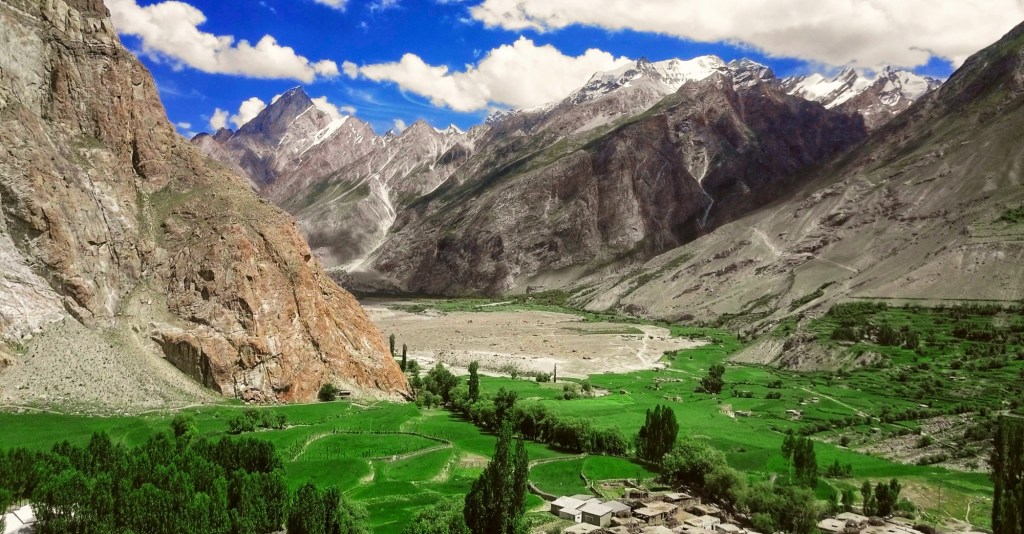
Askoli, the host of K2

There is an alternative route that could take a lot less time – a 1-hour flight to a town called Skardu and from there, a drive to Askoli, but flight schedules get cancelled at short notice pretty regularly due to bad weather.

So let’s assume you chose the drive. You will have to be careful not to blunder into Indian territory since it’s close. You’ll actually be driving in an arc, skirting the Line of Control with India in order to get to Askoli.

At some point you’ll get on the Karakoram Highway, the only paved road that leads through the Karakoram Range into China. A technological marvel, the 1500km long highway is the highest paved highway in the world , with spectacular bridges spanning deep gorges and long tunnels.

The Karakoram Highway is often called the 8th wonder of the world.

————————

After a while you’ll get off the highway, take a right and head for Askoli, where you‘ll stay the night at a lodge and then, at first light, you’ll begin your trek to Base Camp. The drive took you three days in total and now the trek will take you 10 more days and it will be the trek of a lifetime.

Around the 7th day of your trek, you are on the Baltoro Glacier. The mule trains and porters ahead of you are picking their way through this treacherous ice field of cracks and crevasses and creating a trail for you to follow. Over here a shattered kneecap or ankle, from tripping over all those loose boulders and you’ll forget the jaw-dropping scenic beauty, while the helicopter airlift and hospitalization will set you back $30000.

As you inch forward, large walls of ice that weigh thousands of tons, called seracs, loom above you. Seracs are what cause avalanches, when they gain more weight through snowfall than they can bear, ultimately breaking loose, to tumble down the mountainsides like a thousand freight trains all at once, obliterating everything in their path.

As you pick your way through the rocky floor of the Baltoro, around you are mountains, not just any mountains, but tall peaks rising thousands of metres, mountains that are tall enough to have their own names – Paiyu Peak, Great Trango Tower, Cathedral Towers, Muztagh Tower, Mitre Peak, Sia Kangri. Among them, towering even higher are some 8000Plus metre peaks – Broad Peak, Gasherbrum-II and Gasherbrum-IV, the 12th, 13th and 17th highest mountains in the world.

And if you look beyond, across the glacier to the left, you’ll see K2 in the distance, towering over everything else.

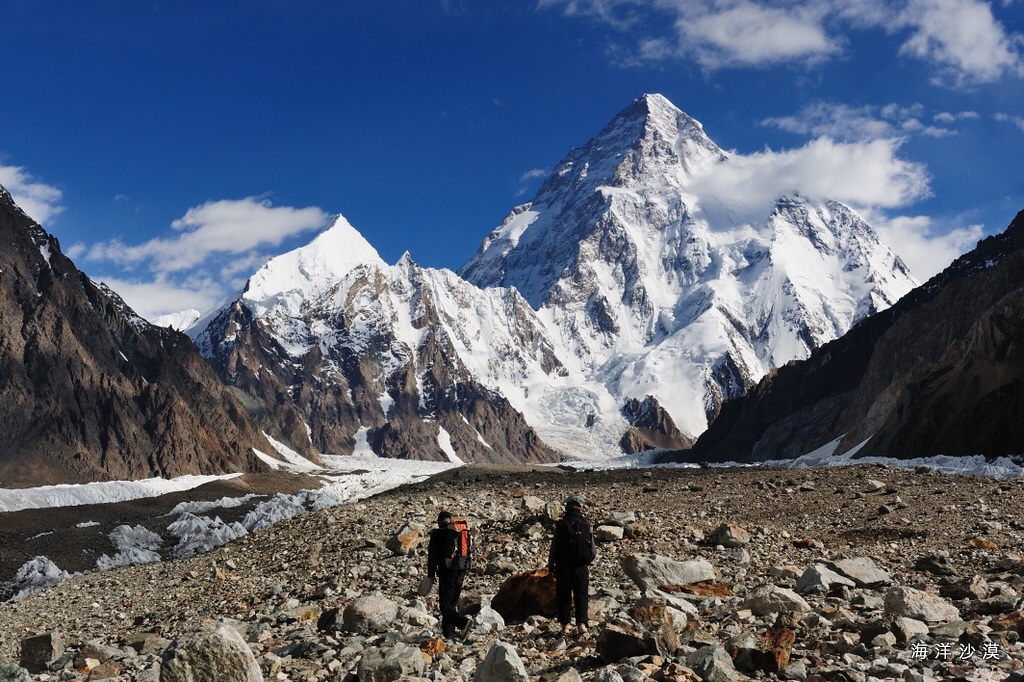
As the shadows lengthen at the end of the 7th day, you are at Concordia, a chaotic, boulder strewn field that is at the confluence of three glaciers that flow around the base of K2 – the Baltoro Glacier, the Abruzzi and the Godwin-Austen(a.k.a Qogir). It is a breathtaking 360° panorama not witnessed anywhere else in the world. The locals call it “The Throne Room of the Gods”.

Concordia, the Throne of the Gods, with K2 straight up ahead

You spend the night at the “Throne” and begin your scramble forward on the 8th day. Another stopover further ahead and on the 10th evening, you are at the Base Camp. You are breathing a little harder. It is 16400ft above sea level here. But you made it. It has been a half of a mini Himalayan expedition.

The Base Camp is nothing more than a bunch of tents belonging to the various expeditions, a few toilet tents and a couple of medical tents, with a doctor specializing in high altitude medicine. The Base Camp doctor is usually a member of an ongoing expedition, present there on a strictly voluntary basis, his expenses paid for by his service.

The most popular tour package among macho thrill seekers round the world is the 4-week K2 Base Camp package. For $30000, they’ll take you up to the Base Camp, acclimatize you on the way, with many overnight acclimatization stopovers and then let you spend a few nights at Base Camp. You’ll hobnob with experienced alpinists getting ready to make their fifth or sixth summit attempts, take autographs and then the guides will bring you down.

If you are lucky you won’t get HAPE during the time you are at the Base Camp. HAPE – High Altitude Pulmonary Edema, is an affliction that fills the lungs with fluid and asphyxiates to death, fatal unless given immediate medical care in the form of a pressurized, hermetically sealed oxygen tent. (HAPE can happen at altitudes above 8000ft, which is well below the Base Camp height).

————————————-

Picture this……….

You have crossed over, up into the Death Zone. At that altitude, rescue has never been successfully attempted. You know you have to either make it out of there on your own steam or perish and remain, perfectly mummified in the cold for the next five thousand years.

But you are Gerlind Kaltenbrunner, an accomplished alpinist, in fact one of the best in the game. A few years back you conquered that peak over there to the south, Broad Peak, one of the ’14 sisters’. Cruel, but not as deadly as K2. Nothing, not even Everest, is as deadly as K2.

You have done it all and come out unscathed. This is your seventh attempt at K2 and by God you’ll get her if that’s the last thing you ever do.

——————————-

It’s your turn and you are breaking trail. You are around 15 metres above and to the left of the others in your team of three. You started at 2:30am local time And it’s now nine in the morning and you are in the Death Zone. The sun is up, its a clear day, the horizon a turquoise blue and the wind – the deadly wind – is almost non-existent. The wind seems to have lost interest in you and you are thankful for that.

But you know that the weather on the Savage can turn swiftly on a dime. It’s the reason why this is your seventh summit attempt. High up on K2, there are no long stretches of good weather. Your visibility can get to zero very quickly and in the white out, you won’t see rocks falling from above, large boulders that can crack your skull or dislocate your shoulder or simply flick you off your perch like a backhanded swipe from an angry giant. Being injured anywhere on a Himalayan peak can be a death sentence but you are climbing K2, where any small injury that hampers movement is certain death.

The snow under your boots is frozen so solid that driving your front pointed crampons in requires real effort and you can slip from the recoil. A -60° windchill and even a 40kmph wind can easily pick you off the slope if you’re not tethered adequately, but this morning the windchill is only -30° and the wind just a breeze. The incline is approximately 60° and it is a straight, uninterrupted 20000 ft drop from the narrow ice ledge over which you are inching forward.

To lessen the weight, your team is climbing without oxygen and tents. You have packed bivouacs which are special lightweight sleeping bags that you can breathe through without accumulating moisture. At that altitude you wouldn’t want moisture.

You stop to drive a piton and an ice screw into the ice a few inches above your head, feeling your left crampon slowly sink into the hard snow under foot. The snow closes around the sharp spikes of your crampon tightly. Meanwhile, you snake your rope in through the eye of the piton you just drove in and snag it to your waist. You tug the rope to let the others know you’re secure. The Pakistani guide, Mohammed Arif Khan, tugs back in acknowledgement.

You begin to lift your left boot to inch forward. It won’t budge. The crampon is set solid in the ice. You wriggle your foot a bit and give it a second tug and there’s a clear ‘snap!’ as the crampon comes loose and remains in the snow when your boot lifts up.

All your weight is on your right foot now. You take a deep breath, steady yourself and move your chin down to take a look. The crampon is set into the ice and there’s no way you can bend down to prise it loose. Even if you did, it’d be impossible to slip it on again. You turn your torso slightly to look down at the others.

The Pakistani has noted your situation and probably understood what has happened. With four previous summit attempts on the K2 and six of the fourteen sisters under his belt, he knows you are doomed. He gestures to the third member of the team, Jaegar, to halt.

That’s when you feel the snow beneath your right boot begin to give. You desperately try to grapple around in that narrow space trying to locate even a tiny hand-hold, but the ice face is too slippery and smooth. The ledge beneath suddenly disappears and you plunge. You fall 20ft before the slack is taken and the rope is taught, straining at the piton you just installed. The wind is now picking up and blowing snow off the rock face and right into your eyes as you swing free, 20620ft above the Quogir glacier.

You’re no sissy. You survey the ice face as you continue swinging, trying not to dwell on the possibility that that piton you drove in may not take your weight for too long. A little over six metres to the left and above, you see a niche around four feet wide and as deep. It’s on the far side of the others but you have no other option. You start widening the swing of the rope, feeling it abrade against the rough surface and soon you are swinging in 60 degree arcs. Your next swing brings you close enough for you to grip the ledge of the cornice and you pull yourself up into the niche. You push yourself as far back into the little dugout space as possible and are relieved not to feel the pinpricks of the blowing snow anymore.

Sometime during the afternoon, you peek over the edge of the niche. Far below, the base is obscured by a thick layer of clouds, like cushions strewn haphazardly around. You peer to the right. The Pakistani and Jaegar are out of your field of vision. They did right. They moved on, since there was absolutely no possibility of success of any rescue attempt. A helicopter extraction from a near vertical ice face in the Death Zone is unheard of and has never been attempted. The niche is virtually inaccessible to climbing, the faces on either side nearly vertical and solid ice.

You know your time is up. Your eyes stray to the luminous dial of your watch. It’s getting to 2pm. By the time the dial reaches that position in twelve hours, you will be dead.

During the afternoon another expedition passes within 50 meters of your shelter, so close you can see their faces. You watch and weakly wave as the trail breaking lead trains his glasses at you and waves back. He has obviously been notified about you over the satellite radio. The expedition moves on and disappears from your line of vision after a while. You don’t hold it against them. There is simply no way that they could come to your aid, so inaccessible is your perch.

Above the Death Zone, there is a certain code of conduct that trained alpinists strictly adhere to – if a fellow climber contracts HAPE or is injured and incapable of moving ahead, you don’t waste time and effort trying to save him. You leave him and you try to survive yourself. This code of conduct may seem cruel and outside the norms of civilized behaviour, but the Death Zone decides what is civilized behaviour and what isn’t.

Besides, you remind yourself, this is the life you chose. It was you who decided that a life on the edge was what you wanted. You are at that edge and the game is finally up. It has been a wild ride while it lasted and your lips form a smile at that thought.

Before the sun has dipped over the the 24100 ft Skil Brum to the west, two more expeditions pass you by. They too spend a brief while peering at you. You smile back a drunken lightheaded smile. You have become something of a spectacle. You try to wave back at them but your hands can’t seem to be able to move up from where they are, on your lap. Strangely, you don’t feel the cold anymore.

When exhausted and oxygen-deprived alpinists realize they are at a point of no return, they get into a dreamlike state of complete apathy. The urge to stay put becomes overpowering, even though it is fatal to remain still. Even time seems to stand still.

You are now approaching that dreamlike, light-headed stupor. The sky is now a clearer, a deeper, darker blue. The wind has stalled. To your left, on the ice face, the trail along which you had seen the three expeditions pass you by, is no longer visible, having been overtaken by the lengthening shadows from adjoining peaks. Idly, you wonder how many made it to the top.

You stare out into the void. The view makes you catch your breath. Over to your right, around 10kms as the crow flies, seeming so near that you could reach out and touch it, is another one of the fourteen sisters, the 26100 ft Broad Peak. You note a wisp of what looks like smoke from a chimney but is in fact snow being blown off the peak by 100 kmph winds.

You remember losing Kurt on Broad Peak last August. Over the years you have lost many partners on the thirteen sisters that you have summited. This was to be your fourteenth and last. You think of the Vienna University position you wanted to take after this. And the Vienna University history scholar you’d spent last winter with. Ralf was right now waiting anxiously at the lodge at Askoli for word from your team leader. Maybe he already knows by now, thanks again to satellite phones.

—————————-

It is dark now, still clear, the wind velocity almost zero, the entire vista bathed in diffused moonlight reflecting off the snows. You are a headstrong woman and you will choose even the way you die. You stretch and start moving on your belly toward the edge, the lip of the niche. Your head clears the edge and you stare into the void below. The view is obscured by the cloud tops at 15000 feet. You swing your legs over the edge of the niche and pause for a moment as you hang.

At that moment everything suddenly clears, as if a veil has lifted. You clearly hear the voice. You are fourteen and it’s your father, Hans Gunther and he’s looking down at you, his face calm and composed, while you hang precariously from the lip of that recess a thousand metres from the base of the Eiger.

“It’s OK, Gerlinde, I have you. You can let go now….. Geree, let go.. Now”

You crane your neck one last time to look down at the cloud tops far below. In real life, Hans had been above you but now he is a tiny dot down there but you can make out his broad smile. You let go.

——————————-

You don’t come to rest a 100 metres below in a crag, a gulley or an out crop and writhe in pain for hours before you die. There are no crags or outcrops on this baby. You sail through the rarefied air, swiftly attaining terminal velocity. You keep descending at a steady 200kmph, until you hit a ridge at 7000ft, bounce off it and come to rest on the Qogir Glacier, a full 20000ft below where you lost your crampon.

In all, the fall has taken approximately two minutes, give or take, not enough time to see your past flash by, the -30° windchill ensuring that you’re dead long before you hit the glacier and disappear into one of it’s many crevasses.

High above the inching Qogir, sudden streaks of lightning blaze through the dusk and it starts snowing, the wind picking up speed until the snow is gusting horizontally. In minutes, the world has turned into a wall of thick white, as if a funeral shroud has come down and wrapped everything under it, including you.

The Savage is celebrating. The Savage doesn’t like you. And by the time the night is done, the Savage won’t leave any traces.

———————————

ps:

The above is fiction, but Gerlinde Kaltenbrunner is a real alpinist, the only woman to have scaled all ‘14 sisters’ without supplemental oxygen. The last peak she summited was K2, in 2011.

Only K2 took her seven attempts before she finally made it.

Share this:

  • Share on X (Opens in new window) X
  • Share on WhatsApp (Opens in new window) WhatsApp
  • Share on Facebook (Opens in new window) Facebook
  • Email a link to a friend (Opens in new window) Email
  • Print (Opens in new window) Print
  • Share on Tumblr (Opens in new window) Tumblr
  • Share on Reddit (Opens in new window) Reddit
  • Share on Pinterest (Opens in new window) Pinterest
  • Share on LinkedIn (Opens in new window) LinkedIn
Like Loading...

That Christmas – A Short Love Story

22 Friday Dec 2023

Posted by spunkybong in Uncategorized

≈ 2 Comments

A month or so after Shanta passed on, in May of 1969, I began going out with the Culvers for breakfast every morning at the Tim Hortons, the one down by the ESSO pump, on Sherbrooke West and Grand.

I’m referring to Irv and Sally Culver, retirees like me, living on the same floor, down the corridor, by the fire escape.

At first they felt I was lonesome and needed company and that’s why they invited me to join them at Tim Horton’s for turkey bacon sandwiches one morning, early July 1969. They must have liked the experience because they insisted on having me around everyday thereafter. I felt comfortable with them and came to enjoy those outings.

I remember the morning of July 20th, 1969. Irv, Sally and I were talking animatedly about the moon landing the day before. The live broadcast had been phenomenal. In fact I am sure that everyone else in the cafe was wrapped up in it too.

“Did you watch Neil Armstrong’s little speech? One small step for man, one giant leap for mankind?” That was Irv.

“Of course. Very apt, wasn’t it?” My interest perked up.

“Sally says Armstrong actually said ‘one small step for a man’ but I clearly remember him saying ‘one small step for man’.  Sally rolled her eyes at that and I couldn’t help thinking how lovely she still looked, even at 52.

“Interesting, how an article can twist the whole meaning of a sentence. Did you know him, Irv? Neil Armstrong?”

Almost all his working life, Irv Culver had been at Lockheed’s Skunk Works, as a part of the team that developed what would come to be known as the SR-71 Blackbird. In later years, the Skunk Works developed such legendary flying machines like the freakily angular F117 Nighthawk, the F22 Raptor and the F35 Lightning.

At the mention of Neil Armstrong, Irv perked up, “Not personally, but I’d seen Armstrong a few times over the years. The first time was when he was visiting the Skunk Works, this must have been around 1962, maybe ‘63.  He was a member of the ‘new nine’ group of astronauts, invited to take a look at the new YF-12A prototype, the fore-runner of the SR-71 Blackbird. We had tested out the TEB igniter on the JP-7 fuel inside the lab and were going to have a test flight that day.  Things were pretty antsy around the huge shed. JP-7 burns only at elevated temperatures and is therefore quite safe to have lying around, but TEB ignites on contact with air. And without TEB injected into it, JP-7 wasn’t going to light up.”

Sally and I exchanged glances and smiled. Irv was in his elements and unstoppable now, “While the others in the group of astronauts spoke only with our Chief Engineer, Kelly Johnson, Armstrong made it a point to go around, stopping by every member of the Skunk Works team and even the Pratt and Whitney guys working on the J-58 power plant. He listened attentively to each one of us. My last glimpse was of him shaking hands with a contractor’s man who was holding a ladder while another changed a light bulb.”

I was primed by now and bristling with questions. “Wait, don’t move, I’m going to get us some more coffee and you’re going to tell me more.” I hurried back holding three mugs and I was firing away as I placed them on the table,” How did the Skunk Works get that name?”

“Well, when we started, back in ’43, it was in a converted circus tent as there was no other space within the Lockheed facility. And we happened to be right next to a plant producing manure, its odor permeating our tent. When my phone rang one day, I jokingly said,” Skunk Works inside man, Culver speaking.” The name caught on right away. Since then, the term “skunk works” has been widely used to describe a group, within an organization, given a high degree of autonomy and unhampered by bureaucracy, tasked with working on advanced or secret projects.”

Irv and Sally had an engagement that day and had to leave and so my curiosity had to wait till the next breakfast.

——————-

A year slipped by, 365 blissful days of walks, breakfasts and stimulating conversation with the Culvers. Shanta would have loved these two.

I reckon it was around that time that Irv began fading away. Gradually. Right before our eyes. It began with him not being able to locate the car keys. Another time, he got lost coming back from the pharmacy and someone saw him wandering listlessly around and called 911 and a cop arrived and drove him home.

Alzheimer’s crept up on Irvin Culver steadily for the next nine years. Until one particularly frigid December night in 1980, when he quietly died in his sleep at the Montreal General. Of course, one doesn’t die of Alzheimer’s. One just fades away. Irv actually succumbed to colon cancer. Sally had always pestered him to eat more greens but he never listened. Anyway, for Sally, Irv’s passing was more like the grand finale of a painful nine year long goodbye.

——————–

After Irv, Sally and I would see each other at least once every day. We would accompany one another to our doctors’ appointments. I had a painful knee condition that got aggravated in the cold. Sally was trying to keep her cholesterol and BP down. I had no living relatives in Canada and Sally’s only daughter, Cora, lived somewhere on the west coast.  Therefore, for the most part, we had just each other. While we couldn’t bring ourselves to enter the Tim Hortons again, we had our daily walks down Sherbrooke.

Some days we took the pedestrian path up to the Westmount Library where we sat for an hour catching our breath and browsing through the journals. I loved the National Geographic and I loved watching Sally peer through her bifocals into the People Magazine or Vanity Fair.

Sometimes we ambled west, toward the Montreal West train station. We’d flop down on the benches by the tracks and watch the ebb and flow of the commuters. Once in a while, a long distance freight train thundered by. We’d sit a while and then make our way back, stopping at the Pharmaprix, right across from our apartment block, to pick up a prescription or maybe a toilet paper roll or something.

We would then trudge back. To our separate little worlds. 

I don’t know when it first happened but it gradually seemed natural that we held hands as we walked.

————————-

I don’t remember too good these days but I think it was the Christmas Eve of 1985. Cora had written that she wouldn’t be able to make it, so for Sally and me, it was like any other day. Except for the daily Christmas carol bombardment on TV and radio. She didn’t want to go for the mass at St Joseph’s this time. Said she was tired. We went for a walk, a shorter one, up Cavendish and back. As I said before, my knees didn’t like the Canadian winter. Sally too had grown gaunt, with all her food restrictions. So, while the whole city seemed to explode in merriment, we were back, waiting, while the elevator took us up to the 14th floor.

The ritual thereafter began predictably. Like hundreds of other evenings. Me, giving Sally a quick peck on the cheek at her door and walking down the length of the hallway to my apartment. And her, waiting till I reached my doorstep and giving me a tiny wave. Only this time, she wouldn’t let go of my hand. She slid her arms through mine and pressed up against me. “Don’t go…stay….please.” Her voice was a whisper.

Afterward, we lay in the dark, our faces inches away, lazily giving each other tiny kisses all over. My head felt heavy, like all this was a dream.

The Christmas eve excitement was ramping up outside our tiny oasis as we lay back and listened to the sounds coming from the corridor outside. Squeals of delight, hurrying footsteps, the pitter patter of kids running ahead, to catch the elevator. Across from us, a mother was shutting her front door with,” Nicholas, did you remember to take your mittens?” A door opened somewhere and sudden slurred shouts of welcome erupted and then muted as it slammed shut.

When I turned to look at Sally, she was asleep, a smile still playing on her lips, like some supernova remnant. “Goodnight, darling,” I whispered and held her close till I drifted off.

Sally moved in with me the next day, Christmas Day and surrendered her lease within a month. It seemed like the most natural thing to do.

We might follow the Canada geese next fall. If my knees can take it.

———————————

Ps:

The above was narrated to me many summers past, by an American – Indian couple, Shankar Ghosh and his second wife, Sally Culver. I had come to know them through Shankar’s son, Prabir, who was my colleague at Pratt and Whitney.

I took the liberty to make it sound like it was Shankar Ghosh speaking instead of them both. Sally’s telling felt so vivid that I guess I wanted to put myself in Shankar’s place and view it as him. What can I say? I am a complicated man.

Both, Shankar and Sally are no more, having succumbed to Covid in 2020.

Share this:

  • Share on X (Opens in new window) X
  • Share on WhatsApp (Opens in new window) WhatsApp
  • Share on Facebook (Opens in new window) Facebook
  • Email a link to a friend (Opens in new window) Email
  • Print (Opens in new window) Print
  • Share on Tumblr (Opens in new window) Tumblr
  • Share on Reddit (Opens in new window) Reddit
  • Share on Pinterest (Opens in new window) Pinterest
  • Share on LinkedIn (Opens in new window) LinkedIn
Like Loading...

Tether your Camel

17 Sunday Dec 2023

Posted by spunkybong in Uncategorized

≈ 5 Comments

—————————————

“Trust Allah, but tie your camel.” – ancient Arab proverb

—————————

Ruins of a Medieval church in the aftermath of the devastation of the Plague of Justinian|541-542AD| (Image courtesy:Scott Masterton/Getty Images)
——————————————-

When a Bedouin, visiting Prophet Mohammad at Medina, left his camel untethered outside the mosque, the Prophet noticed and asked him why he didn’t tie the animal. The Bedouin replied that he had placed his trust on Allah and therefore it was not necessary to secure the animal.

Mohammad famously replied,” Trust Allah, but tether your camel.”

Interesting quote. It is not an either-or……it’s not either you trust Allah or you tie your camel, which implies that if you tie your camel, you don’t really trust Allah enough.

It is a diplomatic do-it-anyway statement.

On the face of it, Mohammed’s advice is very empowering. It exhorts us to look at our situation dispassionately and take the necessary steps to address it. But don’t his words actually caution us against relying too heavily on faith? To me they seem like they do.

You and I have a certain level of intelligence, an ability to reason and make sense and we must utilize it. We are responsible for our own destiny. It is our ass on the line. Hard science tells us today, in the face of the viral endemics, to vaccinate. That same science warns women to end pregnancies when they have stricken foetuses in them.

Science has repeatedly issued upgrades to help us live healthy lives.

But organized religion is the only thing that has never issued any upgrades. It still peddles the same old “as you sow, so you reap” crap, which it has been hustling for the last three millennia, during which time history has proved exactly the opposite – that you don’t reap as you sow and that many have reaped without bothering to sow at all.

Believers turn to their faiths in panic, during the 1350AD bubonic plague in Europe which lasted 5 years and wiped out 30 million. Given that the world population then was around 300 million only, the wipe-out was 10% of all humans alive.
—————————————

The world has seen plagues galore, since the beginning of recorded history. If there is one singular fact that we have learnt from them it is that religion has not, cannot and will not save us from them. But that goes against a fundamental tenet in all religions – that there is an all-powerful God (Or Gods) who can make anything happen and stop anything from happening.

Thankfully, the human race has never actually waited for divine interventions. We have found out the hard way that we are on our own and thanks to our ingenuity, we have survived. The fundamentalist kooks and their dumb believers might say, “but it was God who gave us the ingenuity to develop ways out of every jam. He encouraged us to find our own solutions to our problems”.

So here we have a mind-fuck of a lifetime. Our God is all-powerful, can get anything done, prevent any catastrophe from befalling us………. but he won’t. He’ll let us solve our own problems while he sits up there and just watches. Innocents, believers and little babies who aren’t old enough to develop the means to decide what defines a virtuous life, they will all die horrible deaths, painful sores covering their bodies, high fever turning them delirious. But God will just stare back, he’ll do a Marlon Brando in “Apocalypse now”.

Death, as a skeleton with wings, hovers over a new-born, as he is made to sign an agreement which acknowledges that human existence is nothing but a brief and miserable episode. Oil “Humana Fragilitas” by Salvatore Rosa, during the plague of 1656. The infant in the image is his son, Rosaldo, who died in the pandemic.
——————————————-

That Bedouin at Medina had the right to feel confident he could leave his camel untied. His own religion had taught him that if he had been virtuous, it was okay to leave everything up to God and everything meant literally everything, even a fucking camel on the loose. But then here was God’s sales rep – his prophet, telling the Bedouin, “ummm, nyet, buddy. That’s not a good idea. You had better be safe than sorry. Just tie the bleeping camel up.”

Within the mafia there is an unwritten contract between the Capo and his crew – that if they do strictly as they are told to do, the Capo will have their backs. It is a covenant that is set firmly in stone and the single most important reason why the organized crime gangs like the N’Drangheta remain a deadly force. It is why a made wise guy can put a bullet into anyone’s head in broad daylight and still get away with it. He is invincible as long as he has that covenant.

A man of faith must expect a similar covenant with God, no? Why is it unreasonable for him to believe that if he remains virtuous, God will protect him and his family from misery, prevent robbers from stealing his camel? Is it too much to ask of God to hold up his end of the bargain? Alas, history shows it is. History tells us that when needed most, God has been the “absentee landlord”.

It’s all very simple actually. There never has been any “my virtue for your protection” quid-pro-quo covenant with God. It was our desperation to cling to beliefs.

Titian(1488-1576), as himself in tatters, prostrating in front of the dying Jesus in the arms of Mary, begging for his and his son Orazio’s life during the Venetian pandemic. It didn’t work. Both succumbed in 1576.
————————————

When the Roman Empire was at the height of it’s power (250AD), an ebola-like plague ravaged it, killing over 5000 a day, causing crippling manpower shortages, severely weakening Rome’s defenses, nearly bringing the empire to it’s knees. It is known as the “Plague of Cyprian”, after the guy who wrote a treatise on it. Over a period of 14 long years, the virus spread all across the Italian peninsula and into the adjacent regions of Gaul, Hispania and Sicilia, ending up killing 27 million. It took the life of even the Emperor at the time, Hostilian.

The Plague of Cyprian had a consequence – Romans believed the plague to be a “lack of performance“ by their existing pagan deities. Hadn’t they prayed to them constantly, offered sacrifices in their honour? And yet..??? It was not long before Romans began to see the hollowness of their pagan beliefs.

Waiting in the wings for over two centuries was a new, yet untested alternative – one that preached a single, omnipotent God of all things, who had the power to heal the worst of plagues – Christianity.

The conversion to and rise of Christianity in Rome is commonly credited solely to Constantine the Great, whose reign began in 306AD. The actual fact is that by the time he came to power, fifty years had passed since the Plague of Cyprian. Fifty years of excruciatingly painful recovery from a pandemic. Fifty years of looking for alternatives. In Christianity, the Romans found that alternative.

The Roman citizens actually mistook herd immunity for a saviour religion!! Constantine merely made it official.

Unfortunately, the Christianity upgrade from paganism remains a “Beta” version till this day. There have been 20 major plagues since the one in Rome and they have killed a billion people so far. Religious adherence could not prevent them.

Christianity has managed to cling on, but there have been hiccups. When the 14th Century “Black Death” killed 100 million in Europe, Christians felt they weren’t getting the bang for their buck and Catholicism splintered, giving way to Protestant Reformism.

“The Virgin appears to plague victims” – Antonio Zanchi(1666), at the Scuola Grande di Rocco in Venice, the city which invented the practice of quarantine, a word which In Venetian literally means 40 days, the amount of time for which foreign ships were impounded during the period of the plague.
—————————————————-

Today Christianity stands further divided into scores of different denominations – Lutherans, Protestants, Eastern Orthodox, Pentacostals, Baptists, Anglicans, Jehovah’s Witnesses, Mormons, Coptics and on and on and on. I haven’t forgotten the largest, most viciously evil, most corrupt denomination of them all – Catholicism.

The christianity practiced today is unrecognizable from the one Jesus Christ envisaged. Just like the Islam of today – the prophet Mohammad would have great difficulty recognizing it.

There is no question that pandemics (and other natural disasters) shake people’s faith in religion. The fastest growing new religion today is actually – No Religion. As secularism grows, the influence of atheism and agnosticism is expanding. Driven by growing apathy and disenchantment, churches all over the western world are going bankrupt.

Extreme fundamentalists like Mennonites and Amish and their faith are succumbing to the relentless onslaught of technology and vanishing. In North America, the religiously unaffiliated (atheists and agnostics) now form over 30% of the population, while across the Atlantic, one in two Europeans think religion is senseless and irrelevant.

I look at pandemics not so much as the scourge of humanity but much more as nails in the coffin of organized religion.

———————————

Okay, so pandemics affect religious belief, but does religion influence the way we look at pandemics? Are you kidding me? Of course it does.

The concept of a higher power that controls everything began to crystallize around 11000 BC in a little settlement called Jericho, in present day Israel. Since then as more settlements grew, humanity acquired a new travelling companion that has stayed with us ever since – pandemics. Viral infectious diseases have regularly wiped out two-thirds of a population.

With the growth of settlements came self-appointed holy men and belief systems, some of which advocated staying put and just sitting out the scourge, while others said run, head for the open spaces.

And then came Christianity and Jesus Christ’s reputation as a healer. His followers listened rapt as Jesus said, “Do unto others as you would have them do unto you. Love your neighbour as yourself. Greater love has no man than this, that he should lay down his life for others.”

Jesus healed a number of ailments, such as blindness, leprosy, lameness and demonic possession. He didn’t (or maybe couldn’t) heal plagues or any sort of viral infection. It is a known fact that viruses do not survive extreme heat and the Levant being an exceedingly hot and dry region for most of the year, maybe the opportunity simply didn’t arise for Jesus to try his hand at curing viral infections.

Be that as it may, Christianity encouraged tending to the sick and risking death as that was a sure path to heaven. When the 1527 bubonic plague hit, Martin Luther – the father of Protestant Reformism – refused calls to flee the city and stayed back to minister to the sick. Martin Luther articulated the Christian response to pandemics clearly. He proclaimed that “the plague has turned the sick into crucifixes, on which we must be prepared to impale ourselves and die…” As a consequence, his daughter Elizabeth fell victim to the plague.

Christianity’s brother religions, Islam and Judaism however didn’t buy into all that altruism. They simply said,”Hey it’s all God’s will. We can do jack-shit about it. Only God can handle pandemics, so let God take care of the scourge. We should just sit tight, remain faithful and finger our prayer beads.”

If that Bedouin in Medina had come to me instead of Mohammed, I would have told him, “Tether your camel, you dumb fuck!”

Share this:

  • Share on X (Opens in new window) X
  • Share on WhatsApp (Opens in new window) WhatsApp
  • Share on Facebook (Opens in new window) Facebook
  • Email a link to a friend (Opens in new window) Email
  • Print (Opens in new window) Print
  • Share on Tumblr (Opens in new window) Tumblr
  • Share on Reddit (Opens in new window) Reddit
  • Share on Pinterest (Opens in new window) Pinterest
  • Share on LinkedIn (Opens in new window) LinkedIn
Like Loading...
← Older posts
Newer posts →

Blog Stats

  • 71,209 hits

© Achyut Dutt 2013

Meta

  • Create account
  • Log in
  • Entries feed
  • Comments feed
  • WordPress.com

Recent Posts

  • Belaya Roza (Prequel)
  • Oh my God, those bulbous heads are here !!
  • The Bio-Hazard called Deep Space [Part-1]
  • Oh my God, they’re watching us on Pornhub!!! [Part-1]
  • Coveting thy neighbour [Part-2] – Trashing the 9th Commandment
  • Coveting thy neighbour [Part-1] – The Present
  • The godmens’ godman
  • Dressed to Kill – The Black Widows of the Caucasus
  • Kuzkina Tetya [Part-1] – A souring Bromance
  • Kuzkina Tetya [Part-2] – The Bear
  • My Tryst with Betty Grable
  • 4th July – The Normality of the Abnormal
  • La Sexie Folie
  • Want a Halo Hoop?
  • 18 Wheels – A Tribute to Truckers
  • Paanwala
  • Luchnyk Khalifa [Part-1] – The Archer
  • A Beedi in a Storm
  • The first “First Man” [Part-1]
  • Beheading…. Sigh, the Lord has His ways
  • The Hunt [Final Part]
  • The Hunt [Part-7]
  • The Hunt [Part-6]
  • The Hunt [Part-5]
  • The Hunt [Part-4]
  • The Hunt [Part-3]
  • Fierté Montreal – Haj, for Gay Folks
  • The Hunt [Part-2]
  • The Hunt [Part-1]
  • Kuzkina Tetya [Part-4]
  • Kuzkina Tetya [Part-3]
  • Kuzkina Tetya [Part-2]
  • The Main
  • Spilt [Part-2]
  • Spilt [Part-1]
  • Hillbilly Eulogy
  • Illusionist
  • Autocracy, Inc. – Not a review
  • The Killing of the Little Giant [Part-2]
  • The Killing of the Little Giant [Part-1]
  • I was stoned but didn’t miss it
  • Getting Older Without Getting Old
  • The right to bare
  • Fucking with the 7th Commandment
  • The Cretaceous–Paleogene Extinction Event – Episode : 5 – 10 years after Impact
  • E Pluribus Multis
  • The Cretaceous–Paleogene Extinction Event – Episode : 4 – The Day After
  • The Cretaceous–Paleogene Extinction Event – Episode : 3 – Impact
  • Jamai Shashti
  • Charlie-Class

Top Posts & Pages

It takes more than friezes to deliver justice
Were the Dark ages really dark?
Amish – Islands of sanity in a whirlpool of Hate
Just imagine you're Hank the 8th
The Impressionists and their Genitalia Envy

Enter your email address to follow this blog and receive notifications of new posts by email.

Join 100 other subscribers

© Achyut Dutt 2013

Blog Stats

  • 71,209 hits

Meta

  • Create account
  • Log in
  • Entries feed
  • Comments feed
  • WordPress.com

Enter your email address to follow this blog and receive notifications of new posts by email.

Join 100 other subscribers

Recent Posts

  • Belaya Roza (Prequel)
  • Oh my God, those bulbous heads are here !!
  • The Bio-Hazard called Deep Space [Part-1]
  • Oh my God, they’re watching us on Pornhub!!! [Part-1]
  • Coveting thy neighbour [Part-2] – Trashing the 9th Commandment
  • Coveting thy neighbour [Part-1] – The Present
  • The godmens’ godman
  • Dressed to Kill – The Black Widows of the Caucasus
  • Kuzkina Tetya [Part-1] – A souring Bromance
  • Kuzkina Tetya [Part-2] – The Bear
  • My Tryst with Betty Grable
  • 4th July – The Normality of the Abnormal
  • La Sexie Folie
  • Want a Halo Hoop?
  • 18 Wheels – A Tribute to Truckers
  • Paanwala
  • Luchnyk Khalifa [Part-1] – The Archer
  • A Beedi in a Storm
  • The first “First Man” [Part-1]
  • Beheading…. Sigh, the Lord has His ways
  • The Hunt [Final Part]
  • The Hunt [Part-7]
  • The Hunt [Part-6]
  • The Hunt [Part-5]
  • The Hunt [Part-4]
  • The Hunt [Part-3]
  • Fierté Montreal – Haj, for Gay Folks
  • The Hunt [Part-2]
  • The Hunt [Part-1]
  • Kuzkina Tetya [Part-4]
  • Kuzkina Tetya [Part-3]
  • Kuzkina Tetya [Part-2]
  • The Main
  • Spilt [Part-2]
  • Spilt [Part-1]
  • Hillbilly Eulogy
  • Illusionist
  • Autocracy, Inc. – Not a review
  • The Killing of the Little Giant [Part-2]
  • The Killing of the Little Giant [Part-1]
  • I was stoned but didn’t miss it
  • Getting Older Without Getting Old
  • The right to bare
  • Fucking with the 7th Commandment
  • The Cretaceous–Paleogene Extinction Event – Episode : 5 – 10 years after Impact
  • E Pluribus Multis
  • The Cretaceous–Paleogene Extinction Event – Episode : 4 – The Day After
  • The Cretaceous–Paleogene Extinction Event – Episode : 3 – Impact
  • Jamai Shashti
  • Charlie-Class

Top Posts & Pages

It takes more than friezes to deliver justice
Were the Dark ages really dark?
Amish – Islands of sanity in a whirlpool of Hate
Just imagine you're Hank the 8th
The Impressionists and their Genitalia Envy

https://www.facebook.com/profile.php?id=61550932467326

Blog at WordPress.com.

Privacy & Cookies: This site uses cookies. By continuing to use this website, you agree to their use.
To find out more, including how to control cookies, see here: Cookie Policy
  • Subscribe Subscribed
    • Spunkypedia
    • Join 100 other subscribers
    • Already have a WordPress.com account? Log in now.
    • Spunkypedia
    • Subscribe Subscribed
    • Sign up
    • Log in
    • Report this content
    • View site in Reader
    • Manage subscriptions
    • Collapse this bar
 

Loading Comments...
 

    %d