Spunkypedia

~ – There’s always something to write about

Spunkypedia

Author Archives: spunkybong

The Savage

12 Friday Jan 2024

Posted by spunkybong in Uncategorized

≈ 2 Comments

“No one climbs mountains for scientific reasons” – Sir Edmund Hillary

————————————

Austrian alpinist, Gerlinde Kaltenbrunner, scaling the Bottleneck at 8200 metres, well inside the Death Zone, the most dangerous stretch of the climb to the summit of K2. (Photo courtesy : National Geographic Magazine, April 2012)

—————————————————–

Far to the north of Pakistan is a small hill deep inside the Karakoram Range which forms a natural barrier between Pakistan and China. The hill has a monument on it, an earthen mound with a cross and a thin tin plate nailed to it, with a name embossed by hand on it, possibly with the point of an ice pick – “Art Gilkey(USA), RIP, Aug 10, 1953, Avalanche”.

In the seven decades since, that hill has become home to hundreds of such monuments and the reason for that is the mountain standing next to the hill, a behemoth that seems to pierce through the clouds and reach right into the heavens. The makeshift monuments are a grim reminder of what it is like, to challenge the behemoth, which has over the years gained quite a few monikers – the ‘mountaineers’ mountain’, the ‘killer mountain’, the ‘mountain with no name’ and ‘Godwin-Austen’.

Officially the mountain is known as K2, though I like the name that is the most apt, one given by the alpinist who first attempted to climb it – The Savage. The leader of that failed summit assault, an American theoretical physicist named George Bell, later said, “It’s a savage mountain that will try to kill you”.

You don’t conquer the Savage. She simply decides to tolerate you and if you don’t promise to make your stay a short one, she makes you a permanent house guest. The Savage is a testament – to bravery and futility, ambition and failure, to fatal attraction for a beast like none other.

————————

No one knows why K2 didn’t get a decent name on official record. It was designated Karakoram-2(K2) by one T.G.Montgomery of the Geological Survey of India around 1856, when he was logging peaks in the Karakorum Range as K1, K2, K3 and so on. The second mountain in his list happened to be K2 and old Monty simply left it at that.

K2 has other names that accord it a certain degree of respectability. The Chinese call it Qogir Feng , meaning ”magestic mountain”. Likewise the Tajiks, the Tibetans and the Pakistanis have their own names, all expressing awe – Dapsang, Chogori, Lamba Pahar and so forth. But to the world at large, it remains simply K2. A much lesser peak – situated 32kms from the K2 – the Masherbrum, which is a puny 7821 metres by comparison, has been logged as the K1, as if to deny the Qogir it’s rightful place at the top of the Karakoram peaks.

It is easy to understand why the K2 is so feared by alpinists who make the trip from distant lands to attempt to conquer it. They almost never make it on the first attempt. In fact they consider themselves lucky if they are alive after even a failed attempt.

Straddling the border between Pakistan and China, the 8611-metre behemoth is the mountain where one in every four climbers has died, attempting either to scale the near vertical faces or descending from them. Only those who are trained rock and ice climbers rolled in one, can successfully scale it. If you are trying to break trail at 20000 ft on the K2 and you are the one fixing the ropes, the terrain over which you are moving is hard rock and ice, steep – with a 60° slant that is so smooth, that a sudden gust may simply flick you off the face in an instant.

At 28250ft, the K2 is just 750 ft lower than the world’s tallest peak, the distant Chomolungma, better known as Mount Everest. Although it is second highest, K2 is actually a longer climb than Everest, if measured base-to-peak, not sea level to peak. It has a far larger base-to-peak height, which means that you have to climb more. The Everest may be taller, but it’s base – the base camp from which attempts to the summit begin, is already at 17600ft. In comparison, the K2’s base camp height is only 16400ft. The K2 climb is therefore 1200ft longer. That 1200 ft means two hours more at the Death Zone, a term that alpinists use for heights above 8000 metres.

At sunset, the shadow of K2 falls over China, covering hundreds of miles

Easy to sketch for even a six year old, because of its near perfect Euclidian isoceles shape, K2 belongs to an exclusive club known as the ’14 sisters’, the 14 tallest mountains in the world, all situated on the Himalayan Ranges and all above 8000 meters (26000ft).

If given a choice of mountains to die on, alpinists prefer K2 over the others and there’s a reason for that choice. On the other peaks, an accidental fall can be short – maybe you’ll come to rest on a crag or a ridge a few hundred meters below, crushed but still breathing. Death will be slow. That won’t happen on the K2, where your ultimate ride is going to be a long and painless drop – all the way down to the Qogir Glacier. You’ll of course be dead long before you hit a serac on the inching glacier, having choked to death from the icy wind rushing past at terminal velocity.

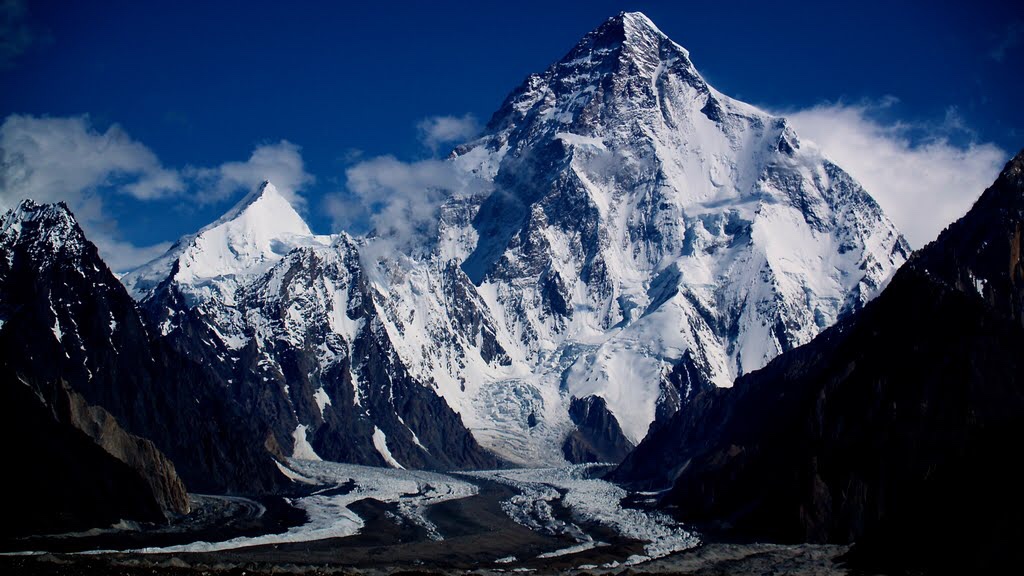
K2, a near perfect isosceles triangle, with the Qogir glacier in the foreground.

————————-

The only way to reach K2 from the west is to catch a flight to Pakistan’s capital city, Islamabad, hire a 4X4 and drive to a tiny picturesque town called Askoli, from where almost all the summit attempts on the 20000ft plus peaks of the Karakoram are launched.

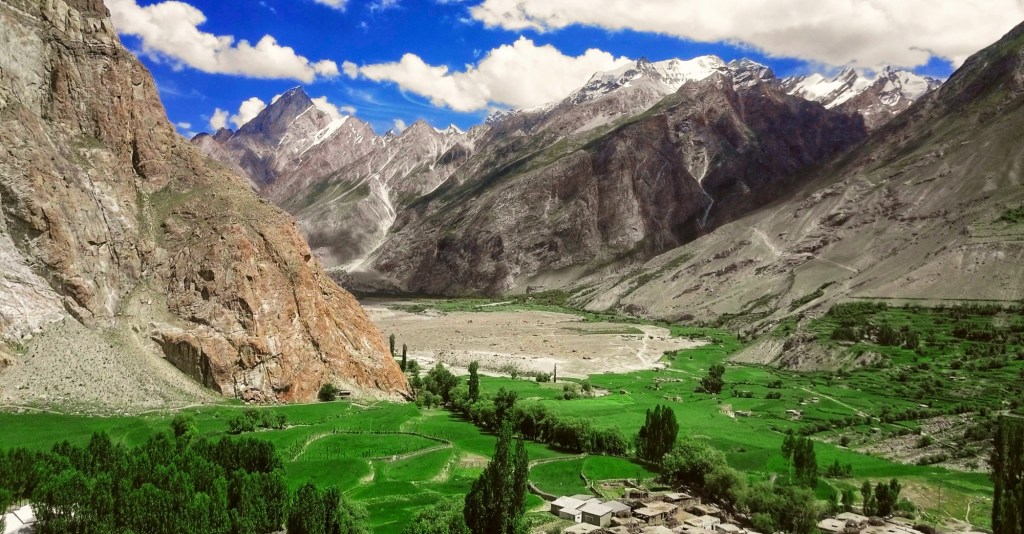
Askoli, the host of K2

There is an alternative route that could take a lot less time – a 1-hour flight to a town called Skardu and from there, a drive to Askoli, but flight schedules get cancelled at short notice pretty regularly due to bad weather.

So let’s assume you chose the drive. You will have to be careful not to blunder into Indian territory since it’s close. You’ll actually be driving in an arc, skirting the Line of Control with India in order to get to Askoli.

At some point you’ll get on the Karakoram Highway, the only paved road that leads through the Karakoram Range into China. A technological marvel, the 1500km long highway is the highest paved highway in the world , with spectacular bridges spanning deep gorges and long tunnels.

The Karakoram Highway is often called the 8th wonder of the world.

————————

After a while you’ll get off the highway, take a right and head for Askoli, where you‘ll stay the night at a lodge and then, at first light, you’ll begin your trek to Base Camp. The drive took you three days in total and now the trek will take you 10 more days and it will be the trek of a lifetime.

Around the 7th day of your trek, you are on the Baltoro Glacier. The mule trains and porters ahead of you are picking their way through this treacherous ice field of cracks and crevasses and creating a trail for you to follow. Over here a shattered kneecap or ankle, from tripping over all those loose boulders and you’ll forget the jaw-dropping scenic beauty, while the helicopter airlift and hospitalization will set you back $30000.

As you inch forward, large walls of ice that weigh thousands of tons, called seracs, loom above you. Seracs are what cause avalanches, when they gain more weight through snowfall than they can bear, ultimately breaking loose, to tumble down the mountainsides like a thousand freight trains all at once, obliterating everything in their path.

As you pick your way through the rocky floor of the Baltoro, around you are mountains, not just any mountains, but tall peaks rising thousands of metres, mountains that are tall enough to have their own names – Paiyu Peak, Great Trango Tower, Cathedral Towers, Muztagh Tower, Mitre Peak, Sia Kangri. Among them, towering even higher are some 8000Plus metre peaks – Broad Peak, Gasherbrum-II and Gasherbrum-IV, the 12th, 13th and 17th highest mountains in the world.

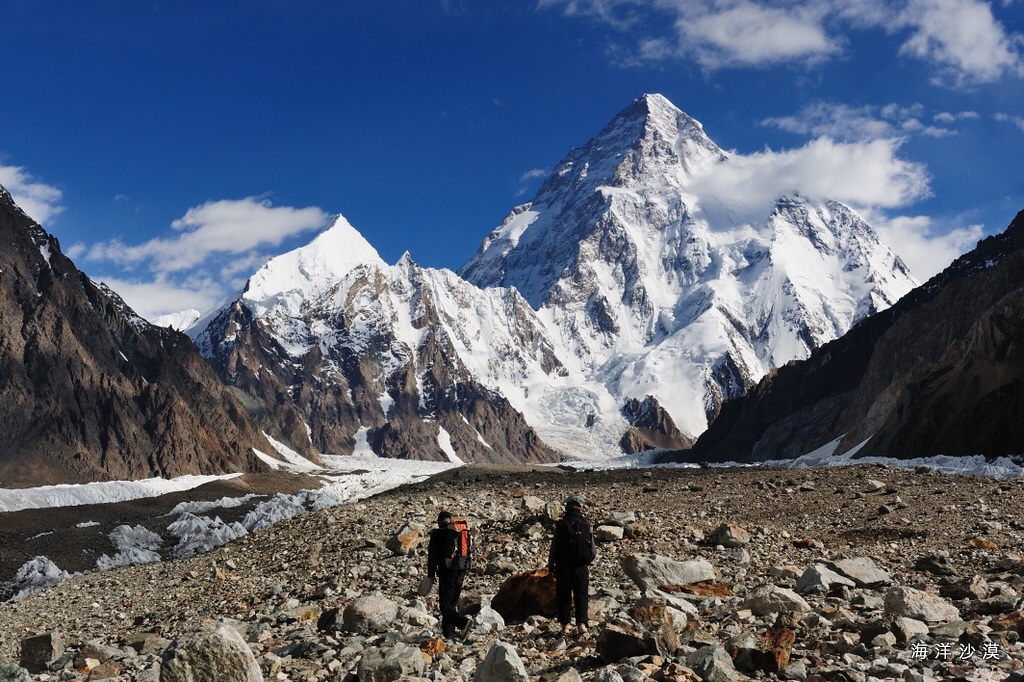
And if you look beyond, across the glacier to the left, you’ll see K2 in the distance, towering over everything else.

As the shadows lengthen at the end of the 7th day, you are at Concordia, a chaotic, boulder strewn field that is at the confluence of three glaciers that flow around the base of K2 – the Baltoro Glacier, the Abruzzi and the Godwin-Austen(a.k.a Qogir). It is a breathtaking 360° panorama not witnessed anywhere else in the world. The locals call it “The Throne Room of the Gods”.

Concordia, the Throne of the Gods, with K2 straight up ahead

You spend the night at the “Throne” and begin your scramble forward on the 8th day. Another stopover further ahead and on the 10th evening, you are at the Base Camp. You are breathing a little harder. It is 16400ft above sea level here. But you made it. It has been a half of a mini Himalayan expedition.

The Base Camp is nothing more than a bunch of tents belonging to the various expeditions, a few toilet tents and a couple of medical tents, with a doctor specializing in high altitude medicine. The Base Camp doctor is usually a member of an ongoing expedition, present there on a strictly voluntary basis, his expenses paid for by his service.

The most popular tour package among macho thrill seekers round the world is the 4-week K2 Base Camp package. For $30000, they’ll take you up to the Base Camp, acclimatize you on the way, with many overnight acclimatization stopovers and then let you spend a few nights at Base Camp. You’ll hobnob with experienced alpinists getting ready to make their fifth or sixth summit attempts, take autographs and then the guides will bring you down.

If you are lucky you won’t get HAPE during the time you are at the Base Camp. HAPE – High Altitude Pulmonary Edema, is an affliction that fills the lungs with fluid and asphyxiates to death, fatal unless given immediate medical care in the form of a pressurized, hermetically sealed oxygen tent. (HAPE can happen at altitudes above 8000ft, which is well below the Base Camp height).

————————————-

Picture this……….

You have crossed over, up into the Death Zone. At that altitude, rescue has never been successfully attempted. You know you have to either make it out of there on your own steam or perish and remain, perfectly mummified in the cold for the next five thousand years.

But you are Gerlind Kaltenbrunner, an accomplished alpinist, in fact one of the best in the game. A few years back you conquered that peak over there to the south, Broad Peak, one of the ’14 sisters’. Cruel, but not as deadly as K2. Nothing, not even Everest, is as deadly as K2.

You have done it all and come out unscathed. This is your seventh attempt at K2 and by God you’ll get her if that’s the last thing you ever do.

——————————-

It’s your turn and you are breaking trail. You are around 15 metres above and to the left of the others in your team of three. You started at 2:30am local time And it’s now nine in the morning and you are in the Death Zone. The sun is up, its a clear day, the horizon a turquoise blue and the wind – the deadly wind – is almost non-existent. The wind seems to have lost interest in you and you are thankful for that.

But you know that the weather on the Savage can turn swiftly on a dime. It’s the reason why this is your seventh summit attempt. High up on K2, there are no long stretches of good weather. Your visibility can get to zero very quickly and in the white out, you won’t see rocks falling from above, large boulders that can crack your skull or dislocate your shoulder or simply flick you off your perch like a backhanded swipe from an angry giant. Being injured anywhere on a Himalayan peak can be a death sentence but you are climbing K2, where any small injury that hampers movement is certain death.

The snow under your boots is frozen so solid that driving your front pointed crampons in requires real effort and you can slip from the recoil. A -60° windchill and even a 40kmph wind can easily pick you off the slope if you’re not tethered adequately, but this morning the windchill is only -30° and the wind just a breeze. The incline is approximately 60° and it is a straight, uninterrupted 20000 ft drop from the narrow ice ledge over which you are inching forward.

To lessen the weight, your team is climbing without oxygen and tents. You have packed bivouacs which are special lightweight sleeping bags that you can breathe through without accumulating moisture. At that altitude you wouldn’t want moisture.

You stop to drive a piton and an ice screw into the ice a few inches above your head, feeling your left crampon slowly sink into the hard snow under foot. The snow closes around the sharp spikes of your crampon tightly. Meanwhile, you snake your rope in through the eye of the piton you just drove in and snag it to your waist. You tug the rope to let the others know you’re secure. The Pakistani guide, Mohammed Arif Khan, tugs back in acknowledgement.

You begin to lift your left boot to inch forward. It won’t budge. The crampon is set solid in the ice. You wriggle your foot a bit and give it a second tug and there’s a clear ‘snap!’ as the crampon comes loose and remains in the snow when your boot lifts up.

All your weight is on your right foot now. You take a deep breath, steady yourself and move your chin down to take a look. The crampon is set into the ice and there’s no way you can bend down to prise it loose. Even if you did, it’d be impossible to slip it on again. You turn your torso slightly to look down at the others.

The Pakistani has noted your situation and probably understood what has happened. With four previous summit attempts on the K2 and six of the fourteen sisters under his belt, he knows you are doomed. He gestures to the third member of the team, Jaegar, to halt.

That’s when you feel the snow beneath your right boot begin to give. You desperately try to grapple around in that narrow space trying to locate even a tiny hand-hold, but the ice face is too slippery and smooth. The ledge beneath suddenly disappears and you plunge. You fall 20ft before the slack is taken and the rope is taught, straining at the piton you just installed. The wind is now picking up and blowing snow off the rock face and right into your eyes as you swing free, 20620ft above the Quogir glacier.

You’re no sissy. You survey the ice face as you continue swinging, trying not to dwell on the possibility that that piton you drove in may not take your weight for too long. A little over six metres to the left and above, you see a niche around four feet wide and as deep. It’s on the far side of the others but you have no other option. You start widening the swing of the rope, feeling it abrade against the rough surface and soon you are swinging in 60 degree arcs. Your next swing brings you close enough for you to grip the ledge of the cornice and you pull yourself up into the niche. You push yourself as far back into the little dugout space as possible and are relieved not to feel the pinpricks of the blowing snow anymore.

Sometime during the afternoon, you peek over the edge of the niche. Far below, the base is obscured by a thick layer of clouds, like cushions strewn haphazardly around. You peer to the right. The Pakistani and Jaegar are out of your field of vision. They did right. They moved on, since there was absolutely no possibility of success of any rescue attempt. A helicopter extraction from a near vertical ice face in the Death Zone is unheard of and has never been attempted. The niche is virtually inaccessible to climbing, the faces on either side nearly vertical and solid ice.

You know your time is up. Your eyes stray to the luminous dial of your watch. It’s getting to 2pm. By the time the dial reaches that position in twelve hours, you will be dead.

During the afternoon another expedition passes within 50 meters of your shelter, so close you can see their faces. You watch and weakly wave as the trail breaking lead trains his glasses at you and waves back. He has obviously been notified about you over the satellite radio. The expedition moves on and disappears from your line of vision after a while. You don’t hold it against them. There is simply no way that they could come to your aid, so inaccessible is your perch.

Above the Death Zone, there is a certain code of conduct that trained alpinists strictly adhere to – if a fellow climber contracts HAPE or is injured and incapable of moving ahead, you don’t waste time and effort trying to save him. You leave him and you try to survive yourself. This code of conduct may seem cruel and outside the norms of civilized behaviour, but the Death Zone decides what is civilized behaviour and what isn’t.

Besides, you remind yourself, this is the life you chose. It was you who decided that a life on the edge was what you wanted. You are at that edge and the game is finally up. It has been a wild ride while it lasted and your lips form a smile at that thought.

Before the sun has dipped over the the 24100 ft Skil Brum to the west, two more expeditions pass you by. They too spend a brief while peering at you. You smile back a drunken lightheaded smile. You have become something of a spectacle. You try to wave back at them but your hands can’t seem to be able to move up from where they are, on your lap. Strangely, you don’t feel the cold anymore.

When exhausted and oxygen-deprived alpinists realize they are at a point of no return, they get into a dreamlike state of complete apathy. The urge to stay put becomes overpowering, even though it is fatal to remain still. Even time seems to stand still.

You are now approaching that dreamlike, light-headed stupor. The sky is now a clearer, a deeper, darker blue. The wind has stalled. To your left, on the ice face, the trail along which you had seen the three expeditions pass you by, is no longer visible, having been overtaken by the lengthening shadows from adjoining peaks. Idly, you wonder how many made it to the top.

You stare out into the void. The view makes you catch your breath. Over to your right, around 10kms as the crow flies, seeming so near that you could reach out and touch it, is another one of the fourteen sisters, the 26100 ft Broad Peak. You note a wisp of what looks like smoke from a chimney but is in fact snow being blown off the peak by 100 kmph winds.

You remember losing Kurt on Broad Peak last August. Over the years you have lost many partners on the thirteen sisters that you have summited. This was to be your fourteenth and last. You think of the Vienna University position you wanted to take after this. And the Vienna University history scholar you’d spent last winter with. Ralf was right now waiting anxiously at the lodge at Askoli for word from your team leader. Maybe he already knows by now, thanks again to satellite phones.

—————————-

It is dark now, still clear, the wind velocity almost zero, the entire vista bathed in diffused moonlight reflecting off the snows. You are a headstrong woman and you will choose even the way you die. You stretch and start moving on your belly toward the edge, the lip of the niche. Your head clears the edge and you stare into the void below. The view is obscured by the cloud tops at 15000 feet. You swing your legs over the edge of the niche and pause for a moment as you hang.

At that moment everything suddenly clears, as if a veil has lifted. You clearly hear the voice. You are fourteen and it’s your father, Hans Gunther and he’s looking down at you, his face calm and composed, while you hang precariously from the lip of that recess a thousand metres from the base of the Eiger.

“It’s OK, Gerlinde, I have you. You can let go now….. Geree, let go.. Now”

You crane your neck one last time to look down at the cloud tops far below. In real life, Hans had been above you but now he is a tiny dot down there but you can make out his broad smile. You let go.

——————————-

You don’t come to rest a 100 metres below in a crag, a gulley or an out crop and writhe in pain for hours before you die. There are no crags or outcrops on this baby. You sail through the rarefied air, swiftly attaining terminal velocity. You keep descending at a steady 200kmph, until you hit a ridge at 7000ft, bounce off it and come to rest on the Qogir Glacier, a full 20000ft below where you lost your crampon.

In all, the fall has taken approximately two minutes, give or take, not enough time to see your past flash by, the -30° windchill ensuring that you’re dead long before you hit the glacier and disappear into one of it’s many crevasses.

High above the inching Qogir, sudden streaks of lightning blaze through the dusk and it starts snowing, the wind picking up speed until the snow is gusting horizontally. In minutes, the world has turned into a wall of thick white, as if a funeral shroud has come down and wrapped everything under it, including you.

The Savage is celebrating. The Savage doesn’t like you. And by the time the night is done, the Savage won’t leave any traces.

———————————

ps:

The above is fiction, but Gerlinde Kaltenbrunner is a real alpinist, the only woman to have scaled all ‘14 sisters’ without supplemental oxygen. The last peak she summited was K2, in 2011.

Only K2 took her seven attempts before she finally made it.

Share this:

  • Share on X (Opens in new window) X
  • Share on WhatsApp (Opens in new window) WhatsApp
  • Share on Facebook (Opens in new window) Facebook
  • Email a link to a friend (Opens in new window) Email
  • Print (Opens in new window) Print
  • Share on Tumblr (Opens in new window) Tumblr
  • Share on Reddit (Opens in new window) Reddit
  • Share on Pinterest (Opens in new window) Pinterest
  • Share on LinkedIn (Opens in new window) LinkedIn
Like Loading...

That Christmas – A Short Love Story

22 Friday Dec 2023

Posted by spunkybong in Uncategorized

≈ 2 Comments

A month or so after Shanta passed on, in May of 1969, I began going out with the Culvers for breakfast every morning at the Tim Hortons, the one down by the ESSO pump, on Sherbrooke West and Grand.

I’m referring to Irv and Sally Culver, retirees like me, living on the same floor, down the corridor, by the fire escape.

At first they felt I was lonesome and needed company and that’s why they invited me to join them at Tim Horton’s for turkey bacon sandwiches one morning, early July 1969. They must have liked the experience because they insisted on having me around everyday thereafter. I felt comfortable with them and came to enjoy those outings.

I remember the morning of July 20th, 1969. Irv, Sally and I were talking animatedly about the moon landing the day before. The live broadcast had been phenomenal. In fact I am sure that everyone else in the cafe was wrapped up in it too.

“Did you watch Neil Armstrong’s little speech? One small step for man, one giant leap for mankind?” That was Irv.

“Of course. Very apt, wasn’t it?” My interest perked up.

“Sally says Armstrong actually said ‘one small step for a man’ but I clearly remember him saying ‘one small step for man’.  Sally rolled her eyes at that and I couldn’t help thinking how lovely she still looked, even at 52.

“Interesting, how an article can twist the whole meaning of a sentence. Did you know him, Irv? Neil Armstrong?”

Almost all his working life, Irv Culver had been at Lockheed’s Skunk Works, as a part of the team that developed what would come to be known as the SR-71 Blackbird. In later years, the Skunk Works developed such legendary flying machines like the freakily angular F117 Nighthawk, the F22 Raptor and the F35 Lightning.

At the mention of Neil Armstrong, Irv perked up, “Not personally, but I’d seen Armstrong a few times over the years. The first time was when he was visiting the Skunk Works, this must have been around 1962, maybe ‘63.  He was a member of the ‘new nine’ group of astronauts, invited to take a look at the new YF-12A prototype, the fore-runner of the SR-71 Blackbird. We had tested out the TEB igniter on the JP-7 fuel inside the lab and were going to have a test flight that day.  Things were pretty antsy around the huge shed. JP-7 burns only at elevated temperatures and is therefore quite safe to have lying around, but TEB ignites on contact with air. And without TEB injected into it, JP-7 wasn’t going to light up.”

Sally and I exchanged glances and smiled. Irv was in his elements and unstoppable now, “While the others in the group of astronauts spoke only with our Chief Engineer, Kelly Johnson, Armstrong made it a point to go around, stopping by every member of the Skunk Works team and even the Pratt and Whitney guys working on the J-58 power plant. He listened attentively to each one of us. My last glimpse was of him shaking hands with a contractor’s man who was holding a ladder while another changed a light bulb.”

I was primed by now and bristling with questions. “Wait, don’t move, I’m going to get us some more coffee and you’re going to tell me more.” I hurried back holding three mugs and I was firing away as I placed them on the table,” How did the Skunk Works get that name?”

“Well, when we started, back in ’43, it was in a converted circus tent as there was no other space within the Lockheed facility. And we happened to be right next to a plant producing manure, its odor permeating our tent. When my phone rang one day, I jokingly said,” Skunk Works inside man, Culver speaking.” The name caught on right away. Since then, the term “skunk works” has been widely used to describe a group, within an organization, given a high degree of autonomy and unhampered by bureaucracy, tasked with working on advanced or secret projects.”

Irv and Sally had an engagement that day and had to leave and so my curiosity had to wait till the next breakfast.

——————-

A year slipped by, 365 blissful days of walks, breakfasts and stimulating conversation with the Culvers. Shanta would have loved these two.

I reckon it was around that time that Irv began fading away. Gradually. Right before our eyes. It began with him not being able to locate the car keys. Another time, he got lost coming back from the pharmacy and someone saw him wandering listlessly around and called 911 and a cop arrived and drove him home.

Alzheimer’s crept up on Irvin Culver steadily for the next nine years. Until one particularly frigid December night in 1980, when he quietly died in his sleep at the Montreal General. Of course, one doesn’t die of Alzheimer’s. One just fades away. Irv actually succumbed to colon cancer. Sally had always pestered him to eat more greens but he never listened. Anyway, for Sally, Irv’s passing was more like the grand finale of a painful nine year long goodbye.

——————–

After Irv, Sally and I would see each other at least once every day. We would accompany one another to our doctors’ appointments. I had a painful knee condition that got aggravated in the cold. Sally was trying to keep her cholesterol and BP down. I had no living relatives in Canada and Sally’s only daughter, Cora, lived somewhere on the west coast.  Therefore, for the most part, we had just each other. While we couldn’t bring ourselves to enter the Tim Hortons again, we had our daily walks down Sherbrooke.

Some days we took the pedestrian path up to the Westmount Library where we sat for an hour catching our breath and browsing through the journals. I loved the National Geographic and I loved watching Sally peer through her bifocals into the People Magazine or Vanity Fair.

Sometimes we ambled west, toward the Montreal West train station. We’d flop down on the benches by the tracks and watch the ebb and flow of the commuters. Once in a while, a long distance freight train thundered by. We’d sit a while and then make our way back, stopping at the Pharmaprix, right across from our apartment block, to pick up a prescription or maybe a toilet paper roll or something.

We would then trudge back. To our separate little worlds. 

I don’t know when it first happened but it gradually seemed natural that we held hands as we walked.

————————-

I don’t remember too good these days but I think it was the Christmas Eve of 1985. Cora had written that she wouldn’t be able to make it, so for Sally and me, it was like any other day. Except for the daily Christmas carol bombardment on TV and radio. She didn’t want to go for the mass at St Joseph’s this time. Said she was tired. We went for a walk, a shorter one, up Cavendish and back. As I said before, my knees didn’t like the Canadian winter. Sally too had grown gaunt, with all her food restrictions. So, while the whole city seemed to explode in merriment, we were back, waiting, while the elevator took us up to the 14th floor.

The ritual thereafter began predictably. Like hundreds of other evenings. Me, giving Sally a quick peck on the cheek at her door and walking down the length of the hallway to my apartment. And her, waiting till I reached my doorstep and giving me a tiny wave. Only this time, she wouldn’t let go of my hand. She slid her arms through mine and pressed up against me. “Don’t go…stay….please.” Her voice was a whisper.

Afterward, we lay in the dark, our faces inches away, lazily giving each other tiny kisses all over. My head felt heavy, like all this was a dream.

The Christmas eve excitement was ramping up outside our tiny oasis as we lay back and listened to the sounds coming from the corridor outside. Squeals of delight, hurrying footsteps, the pitter patter of kids running ahead, to catch the elevator. Across from us, a mother was shutting her front door with,” Nicholas, did you remember to take your mittens?” A door opened somewhere and sudden slurred shouts of welcome erupted and then muted as it slammed shut.

When I turned to look at Sally, she was asleep, a smile still playing on her lips, like some supernova remnant. “Goodnight, darling,” I whispered and held her close till I drifted off.

Sally moved in with me the next day, Christmas Day and surrendered her lease within a month. It seemed like the most natural thing to do.

We might follow the Canada geese next fall. If my knees can take it.

———————————

Ps:

The above was narrated to me many summers past, by an American – Indian couple, Shankar Ghosh and his second wife, Sally Culver. I had come to know them through Shankar’s son, Prabir, who was my colleague at Pratt and Whitney.

I took the liberty to make it sound like it was Shankar Ghosh speaking instead of them both. Sally’s telling felt so vivid that I guess I wanted to put myself in Shankar’s place and view it as him. What can I say? I am a complicated man.

Both, Shankar and Sally are no more, having succumbed to Covid in 2020.

Share this:

  • Share on X (Opens in new window) X
  • Share on WhatsApp (Opens in new window) WhatsApp
  • Share on Facebook (Opens in new window) Facebook
  • Email a link to a friend (Opens in new window) Email
  • Print (Opens in new window) Print
  • Share on Tumblr (Opens in new window) Tumblr
  • Share on Reddit (Opens in new window) Reddit
  • Share on Pinterest (Opens in new window) Pinterest
  • Share on LinkedIn (Opens in new window) LinkedIn
Like Loading...

Tether your Camel

17 Sunday Dec 2023

Posted by spunkybong in Uncategorized

≈ 5 Comments

—————————————

“Trust Allah, but tie your camel.” – ancient Arab proverb

—————————

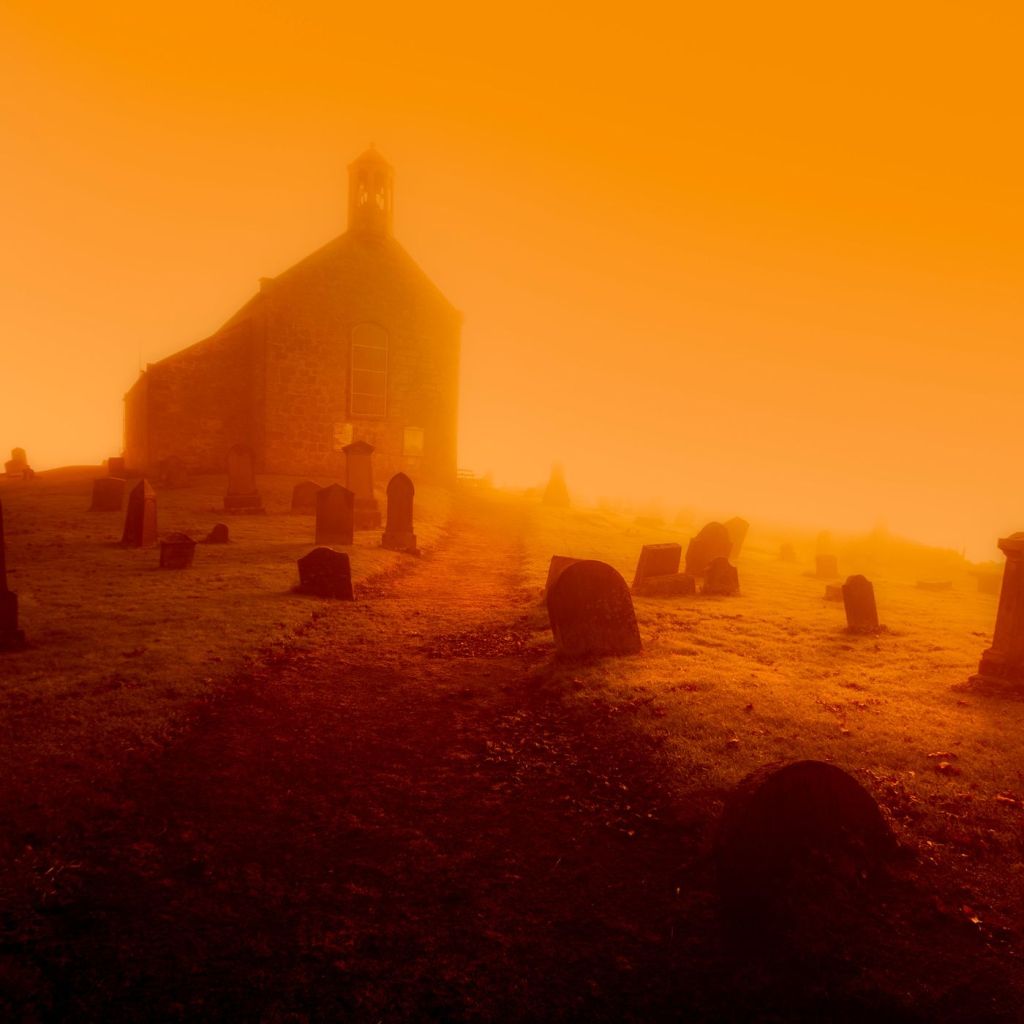
Ruins of a Medieval church in the aftermath of the devastation of the Plague of Justinian|541-542AD| (Image courtesy:Scott Masterton/Getty Images)
——————————————-

When a Bedouin, visiting Prophet Mohammad at Medina, left his camel untethered outside the mosque, the Prophet noticed and asked him why he didn’t tie the animal. The Bedouin replied that he had placed his trust on Allah and therefore it was not necessary to secure the animal.

Mohammad famously replied,” Trust Allah, but tether your camel.”

Interesting quote. It is not an either-or……it’s not either you trust Allah or you tie your camel, which implies that if you tie your camel, you don’t really trust Allah enough.

It is a diplomatic do-it-anyway statement.

On the face of it, Mohammed’s advice is very empowering. It exhorts us to look at our situation dispassionately and take the necessary steps to address it. But don’t his words actually caution us against relying too heavily on faith? To me they seem like they do.

You and I have a certain level of intelligence, an ability to reason and make sense and we must utilize it. We are responsible for our own destiny. It is our ass on the line. Hard science tells us today, in the face of the viral endemics, to vaccinate. That same science warns women to end pregnancies when they have stricken foetuses in them.

Science has repeatedly issued upgrades to help us live healthy lives.

But organized religion is the only thing that has never issued any upgrades. It still peddles the same old “as you sow, so you reap” crap, which it has been hustling for the last three millennia, during which time history has proved exactly the opposite – that you don’t reap as you sow and that many have reaped without bothering to sow at all.

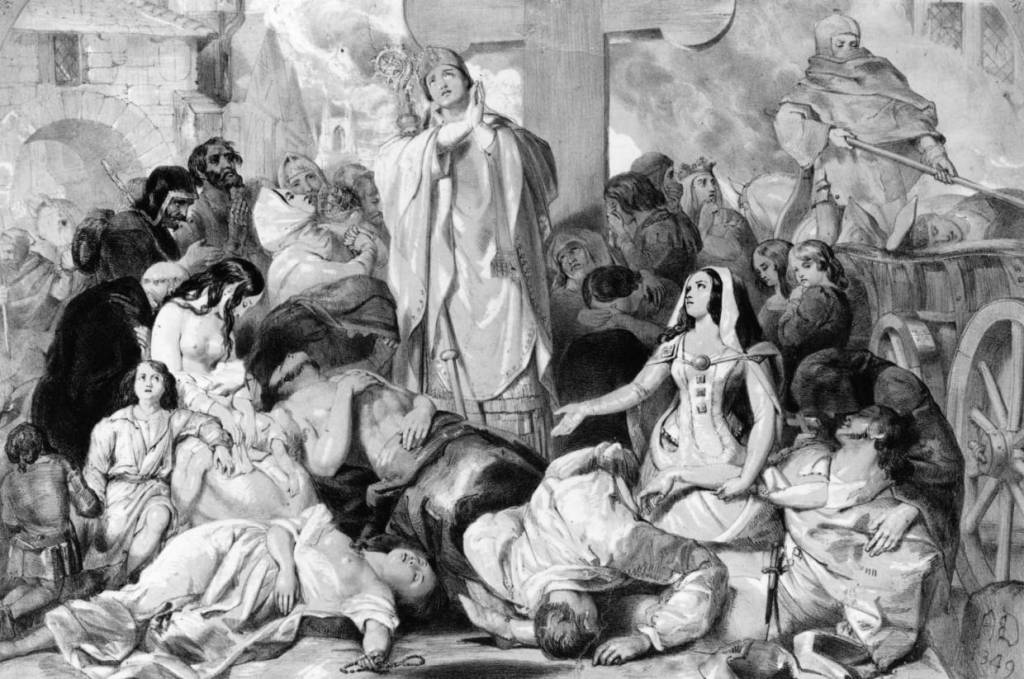
Believers turn to their faiths in panic, during the 1350AD bubonic plague in Europe which lasted 5 years and wiped out 30 million. Given that the world population then was around 300 million only, the wipe-out was 10% of all humans alive.
—————————————

The world has seen plagues galore, since the beginning of recorded history. If there is one singular fact that we have learnt from them it is that religion has not, cannot and will not save us from them. But that goes against a fundamental tenet in all religions – that there is an all-powerful God (Or Gods) who can make anything happen and stop anything from happening.

Thankfully, the human race has never actually waited for divine interventions. We have found out the hard way that we are on our own and thanks to our ingenuity, we have survived. The fundamentalist kooks and their dumb believers might say, “but it was God who gave us the ingenuity to develop ways out of every jam. He encouraged us to find our own solutions to our problems”.

So here we have a mind-fuck of a lifetime. Our God is all-powerful, can get anything done, prevent any catastrophe from befalling us………. but he won’t. He’ll let us solve our own problems while he sits up there and just watches. Innocents, believers and little babies who aren’t old enough to develop the means to decide what defines a virtuous life, they will all die horrible deaths, painful sores covering their bodies, high fever turning them delirious. But God will just stare back, he’ll do a Marlon Brando in “Apocalypse now”.

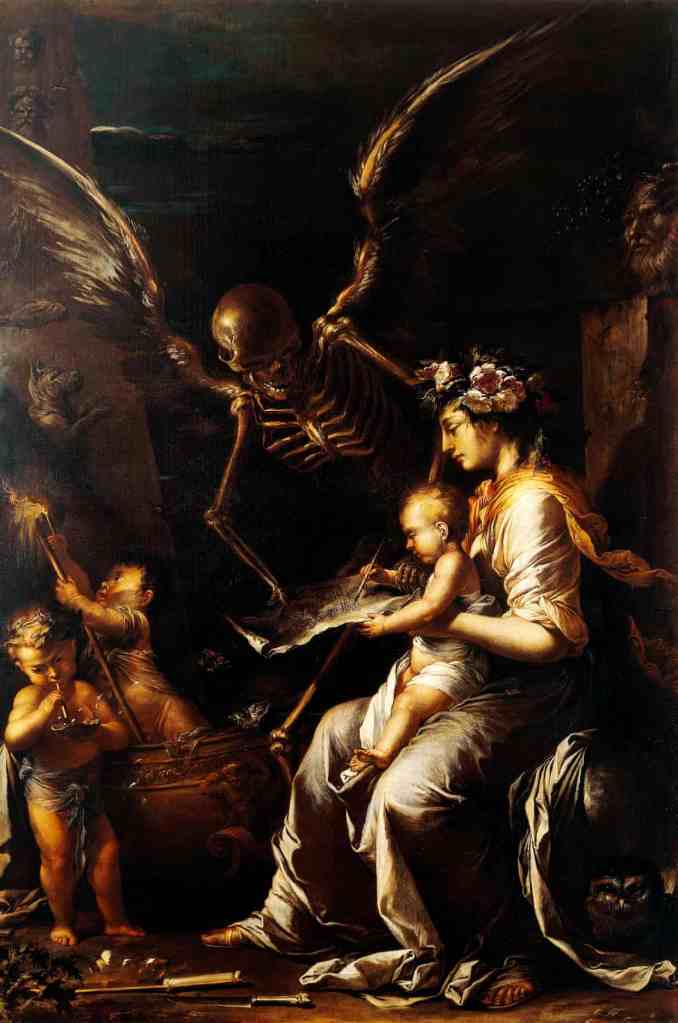
Death, as a skeleton with wings, hovers over a new-born, as he is made to sign an agreement which acknowledges that human existence is nothing but a brief and miserable episode. Oil “Humana Fragilitas” by Salvatore Rosa, during the plague of 1656. The infant in the image is his son, Rosaldo, who died in the pandemic.
——————————————-

That Bedouin at Medina had the right to feel confident he could leave his camel untied. His own religion had taught him that if he had been virtuous, it was okay to leave everything up to God and everything meant literally everything, even a fucking camel on the loose. But then here was God’s sales rep – his prophet, telling the Bedouin, “ummm, nyet, buddy. That’s not a good idea. You had better be safe than sorry. Just tie the bleeping camel up.”

Within the mafia there is an unwritten contract between the Capo and his crew – that if they do strictly as they are told to do, the Capo will have their backs. It is a covenant that is set firmly in stone and the single most important reason why the organized crime gangs like the N’Drangheta remain a deadly force. It is why a made wise guy can put a bullet into anyone’s head in broad daylight and still get away with it. He is invincible as long as he has that covenant.

A man of faith must expect a similar covenant with God, no? Why is it unreasonable for him to believe that if he remains virtuous, God will protect him and his family from misery, prevent robbers from stealing his camel? Is it too much to ask of God to hold up his end of the bargain? Alas, history shows it is. History tells us that when needed most, God has been the “absentee landlord”.

It’s all very simple actually. There never has been any “my virtue for your protection” quid-pro-quo covenant with God. It was our desperation to cling to beliefs.

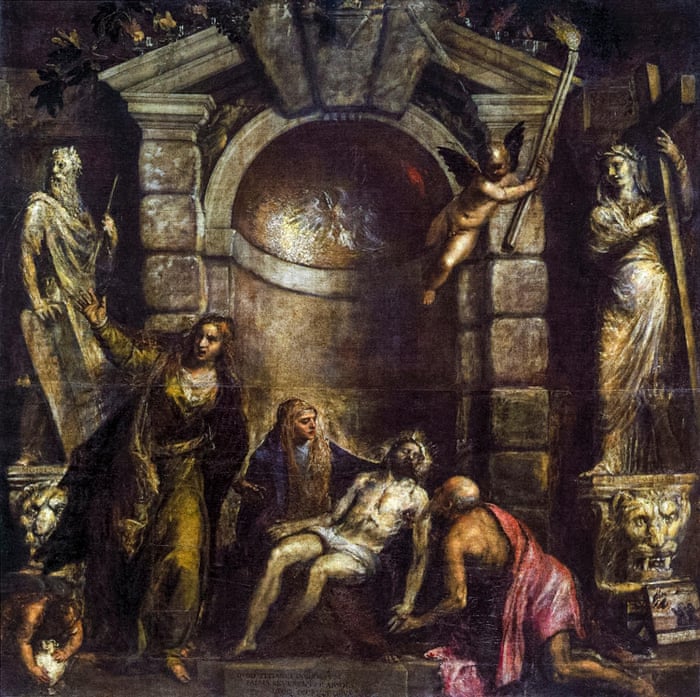
Titian(1488-1576), as himself in tatters, prostrating in front of the dying Jesus in the arms of Mary, begging for his and his son Orazio’s life during the Venetian pandemic. It didn’t work. Both succumbed in 1576.
————————————

When the Roman Empire was at the height of it’s power (250AD), an ebola-like plague ravaged it, killing over 5000 a day, causing crippling manpower shortages, severely weakening Rome’s defenses, nearly bringing the empire to it’s knees. It is known as the “Plague of Cyprian”, after the guy who wrote a treatise on it. Over a period of 14 long years, the virus spread all across the Italian peninsula and into the adjacent regions of Gaul, Hispania and Sicilia, ending up killing 27 million. It took the life of even the Emperor at the time, Hostilian.

The Plague of Cyprian had a consequence – Romans believed the plague to be a “lack of performance“ by their existing pagan deities. Hadn’t they prayed to them constantly, offered sacrifices in their honour? And yet..??? It was not long before Romans began to see the hollowness of their pagan beliefs.

Waiting in the wings for over two centuries was a new, yet untested alternative – one that preached a single, omnipotent God of all things, who had the power to heal the worst of plagues – Christianity.

The conversion to and rise of Christianity in Rome is commonly credited solely to Constantine the Great, whose reign began in 306AD. The actual fact is that by the time he came to power, fifty years had passed since the Plague of Cyprian. Fifty years of excruciatingly painful recovery from a pandemic. Fifty years of looking for alternatives. In Christianity, the Romans found that alternative.

The Roman citizens actually mistook herd immunity for a saviour religion!! Constantine merely made it official.

Unfortunately, the Christianity upgrade from paganism remains a “Beta” version till this day. There have been 20 major plagues since the one in Rome and they have killed a billion people so far. Religious adherence could not prevent them.

Christianity has managed to cling on, but there have been hiccups. When the 14th Century “Black Death” killed 100 million in Europe, Christians felt they weren’t getting the bang for their buck and Catholicism splintered, giving way to Protestant Reformism.

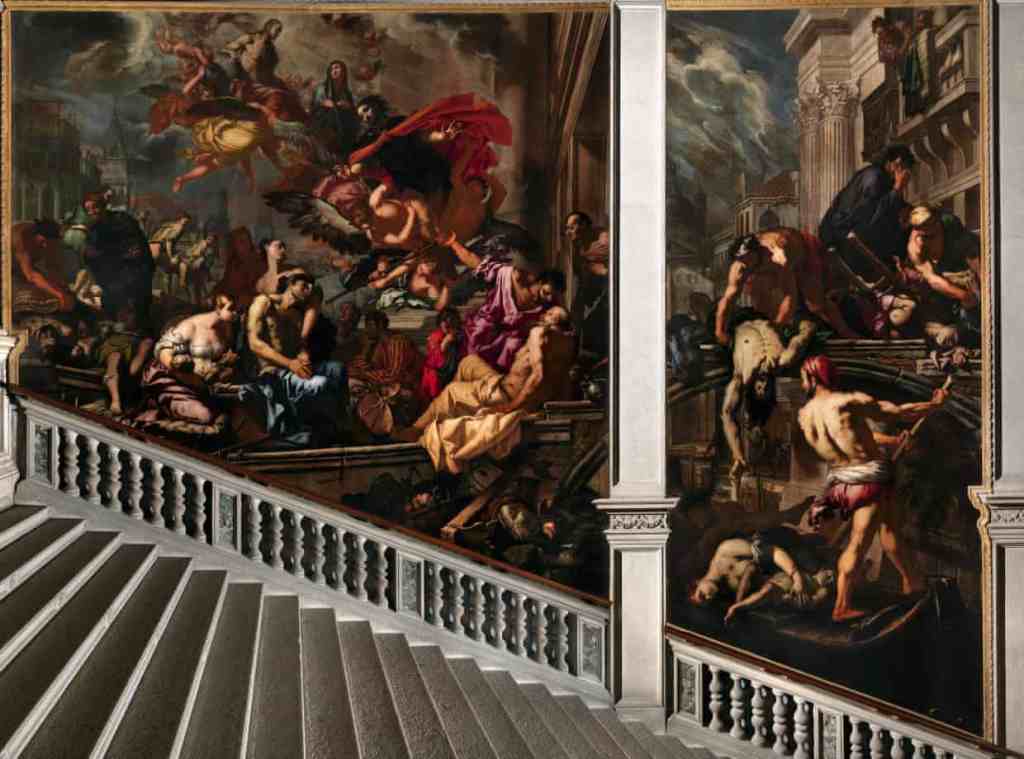
“The Virgin appears to plague victims” – Antonio Zanchi(1666), at the Scuola Grande di Rocco in Venice, the city which invented the practice of quarantine, a word which In Venetian literally means 40 days, the amount of time for which foreign ships were impounded during the period of the plague.
—————————————————-

Today Christianity stands further divided into scores of different denominations – Lutherans, Protestants, Eastern Orthodox, Pentacostals, Baptists, Anglicans, Jehovah’s Witnesses, Mormons, Coptics and on and on and on. I haven’t forgotten the largest, most viciously evil, most corrupt denomination of them all – Catholicism.

The christianity practiced today is unrecognizable from the one Jesus Christ envisaged. Just like the Islam of today – the prophet Mohammad would have great difficulty recognizing it.

There is no question that pandemics (and other natural disasters) shake people’s faith in religion. The fastest growing new religion today is actually – No Religion. As secularism grows, the influence of atheism and agnosticism is expanding. Driven by growing apathy and disenchantment, churches all over the western world are going bankrupt.

Extreme fundamentalists like Mennonites and Amish and their faith are succumbing to the relentless onslaught of technology and vanishing. In North America, the religiously unaffiliated (atheists and agnostics) now form over 30% of the population, while across the Atlantic, one in two Europeans think religion is senseless and irrelevant.

I look at pandemics not so much as the scourge of humanity but much more as nails in the coffin of organized religion.

———————————

Okay, so pandemics affect religious belief, but does religion influence the way we look at pandemics? Are you kidding me? Of course it does.

The concept of a higher power that controls everything began to crystallize around 11000 BC in a little settlement called Jericho, in present day Israel. Since then as more settlements grew, humanity acquired a new travelling companion that has stayed with us ever since – pandemics. Viral infectious diseases have regularly wiped out two-thirds of a population.

With the growth of settlements came self-appointed holy men and belief systems, some of which advocated staying put and just sitting out the scourge, while others said run, head for the open spaces.

And then came Christianity and Jesus Christ’s reputation as a healer. His followers listened rapt as Jesus said, “Do unto others as you would have them do unto you. Love your neighbour as yourself. Greater love has no man than this, that he should lay down his life for others.”

Jesus healed a number of ailments, such as blindness, leprosy, lameness and demonic possession. He didn’t (or maybe couldn’t) heal plagues or any sort of viral infection. It is a known fact that viruses do not survive extreme heat and the Levant being an exceedingly hot and dry region for most of the year, maybe the opportunity simply didn’t arise for Jesus to try his hand at curing viral infections.

Be that as it may, Christianity encouraged tending to the sick and risking death as that was a sure path to heaven. When the 1527 bubonic plague hit, Martin Luther – the father of Protestant Reformism – refused calls to flee the city and stayed back to minister to the sick. Martin Luther articulated the Christian response to pandemics clearly. He proclaimed that “the plague has turned the sick into crucifixes, on which we must be prepared to impale ourselves and die…” As a consequence, his daughter Elizabeth fell victim to the plague.

Christianity’s brother religions, Islam and Judaism however didn’t buy into all that altruism. They simply said,”Hey it’s all God’s will. We can do jack-shit about it. Only God can handle pandemics, so let God take care of the scourge. We should just sit tight, remain faithful and finger our prayer beads.”

If that Bedouin in Medina had come to me instead of Mohammed, I would have told him, “Tether your camel, you dumb fuck!”

Share this:

  • Share on X (Opens in new window) X
  • Share on WhatsApp (Opens in new window) WhatsApp
  • Share on Facebook (Opens in new window) Facebook
  • Email a link to a friend (Opens in new window) Email
  • Print (Opens in new window) Print
  • Share on Tumblr (Opens in new window) Tumblr
  • Share on Reddit (Opens in new window) Reddit
  • Share on Pinterest (Opens in new window) Pinterest
  • Share on LinkedIn (Opens in new window) LinkedIn
Like Loading...

You’ve come a long way, baby

06 Wednesday Dec 2023

Posted by spunkybong in Uncategorized

≈ 2 Comments

Achilles slays Penthesilea, the Queen of the Amazons and regrets it immediately (Plaster by Bertel Thorvaldsen, 1837)

—————— 

At the fag end of the Trojan War the desperate Trojans, facing defeat, recruited a mercenary army of Amazons – ravishingly beautiful and at the same time brawny muscular big-breasted women, trained in hand-to-hand combat. The Amazons were the Wagner Group of the 13th Century BC. Only, they were female and beautiful.

Big-breasted, geeze, why wasn’t I born in 13th century BC Greece?

Palaephatus, a 4th Century BC compiler of Greek mythology, thought that the Amazons were actually men mistaken for women by their enemies because they wore clothing which reached their feet, shaved their beards and tied up their hair in headbands.

Of course, you and I know that the Amazons were broads. Legend has it that they made love to a man only once, because he died right after, his richard squashed under crushing vaginal muscle control, which must have been like the pressures that the “Trieste” felt at the Challenger Deep. If you were an Amazonian man in those days, you had a hard choice to make – you either had the mother of all orgasms that was immediately followed by your penis being squeezed into a neutron star-like twiddledeedum and death or you could choose to skip sex, played a game of tennis and remained alive.

———————————-

When the Trojans decided to call in the Amazons in their war against the Achaeans(a.k.a the ancient Greeks), it was a matter of time before Penthesilea – the Queen of the Amazons was facing off against the Greeks’ silver bullet hero, Achilles. If Penthesilea had had the right intelligence briefing, she’d have known that Achilles had been given the boon of invincibility by Zeus and he could never get whacked by anyone.

Unless. Unless the guy knew about Achilles’s heel, which unfortunately Penthesilea didn’t. No one had told her about it. Long story short, Achilles slew her. Oh yeah, in ancient Greece you didn’t kill anyone, you slew them.

When Achilles removed the helmet and chest plate from the corpse and saw what was underneath (especially under the chest plate) he immediately regretted killing her. Some historians say Plutarch wrote that Achilles muttered under his breath, “My oh my! Hey, Patroclus, get a load of those knockers!” 

According to Homer, Achilles was bowled over by Penthesilea’s beauty and fell head over heels in love with her – her corpse, that is. He begged his mother, Zeus’s favorite sea nymph Thetis, to bring Penthesilea back to life.

Thetis could bring Penthesilea back to life if she wanted to. Zeus had given her magical powers in exchange for oral sex morning noon and night. But to Achilles’ dismay, Thetis made excuses and begged off. Knowing Zeus’s roving eyes, she didn’t want competition.

In case you come across a differing version of the story of Penthesilea and Achilles, ignore it. This is the official one. Oh yeah.

Whatever the truth about the Amazons, there have been exceedingly strong women through the ages who have kicked ass. There have been many, some good and some scheming, but they all had some things in common – they knew exactly what men wanted.

Like the Roman Empress, Aggripina the Younger, for instance. Aggripina would stop at nothing in order to see her son, Nero, crowned emperor and that included poisoning her own hubby, the incumbent Emperor Claudius. In overwhelmingly patriarchal India, the Rani (Queen) Lakshmibai of princely Indian state of Jhansi, led her fighters against the British during the 1857 rebellion. They say, she knew each of the thousands of soldiers she commanded personally by name and made them feel special. 400 years prior, Jeanne d’Arc did exactly that. She infused tremendous morale into a rag tag French army and kicked English badunkadonk to hell and back. (It didn’t end well for her though. She got burnt at the stake but we’ll leave that story for another time).

Now burnt this into your soul…….

History has shown that women are far more capable of strong resilience under adversity than men. Research by the Harvard Business Review has concluded that women are perceived by their managers — particularly their male managers — to be more effective than men in virtually every functional area of work. They are more adept at multi-tasking and constantly exhibit initiative and nerve. They are eager to professionally develop themselves and are more firmly focused on results, while displaying high integrity and honesty. The HBR study found women to be more effective in 84% of the competencies that employers treasure the most in their managers.

If one goes by the number of years – perhaps ever since walls came up in 11000BC around the first human settlement on the northern coast of the Dead Sea at a tiny hamlet that would later be known as Jericho – yes, ever since then, gender inequality has been the longest running human rights issue ever.

————————

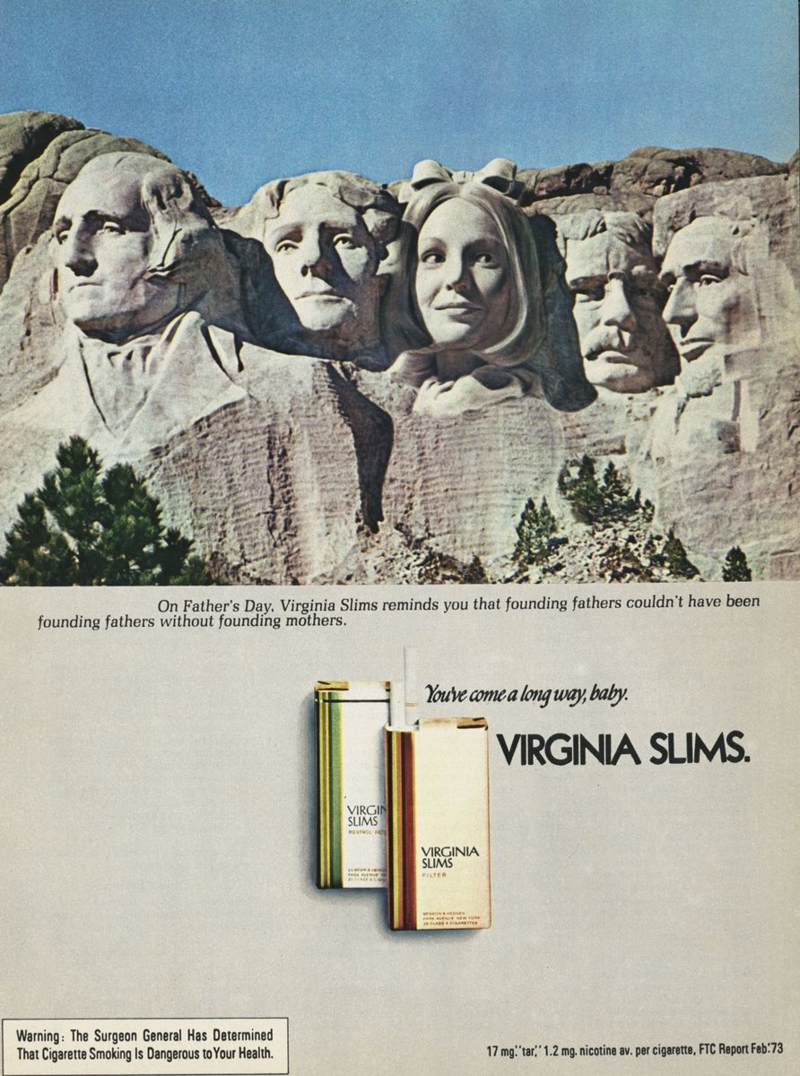
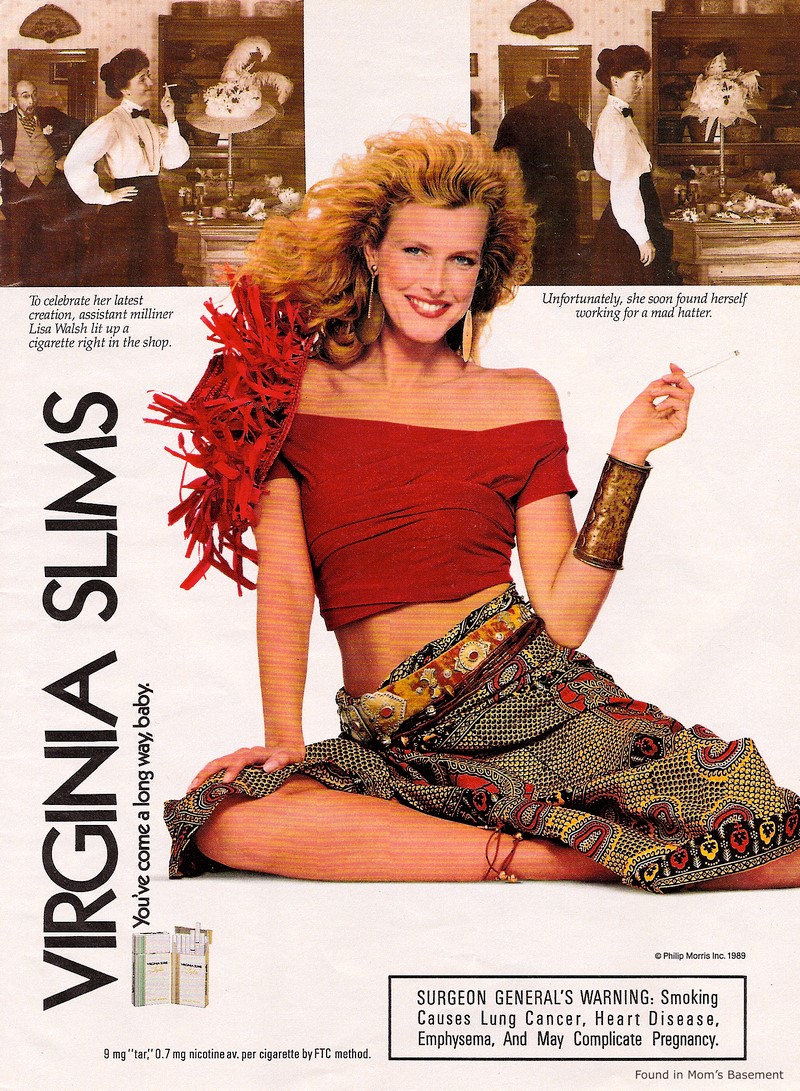
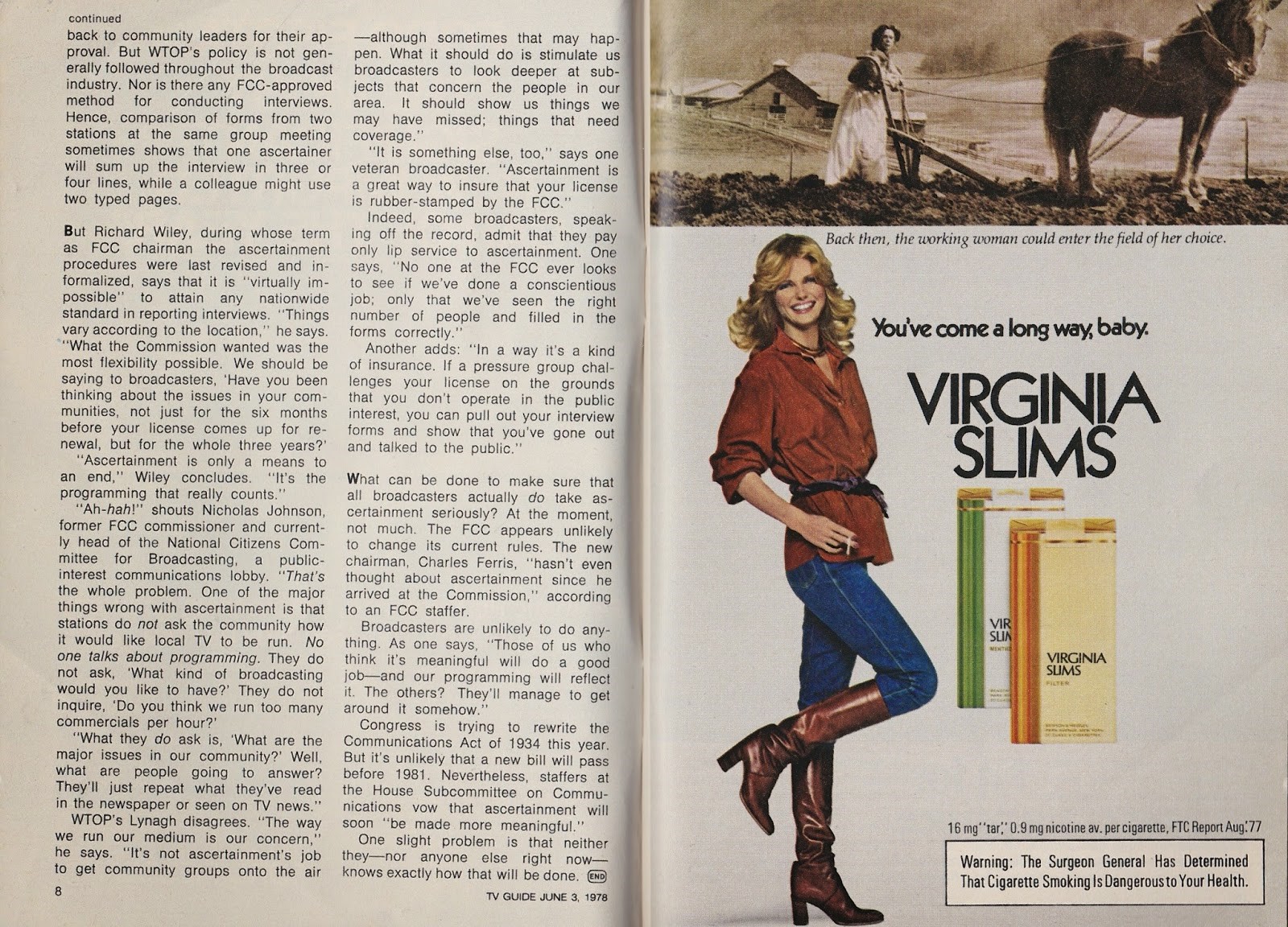
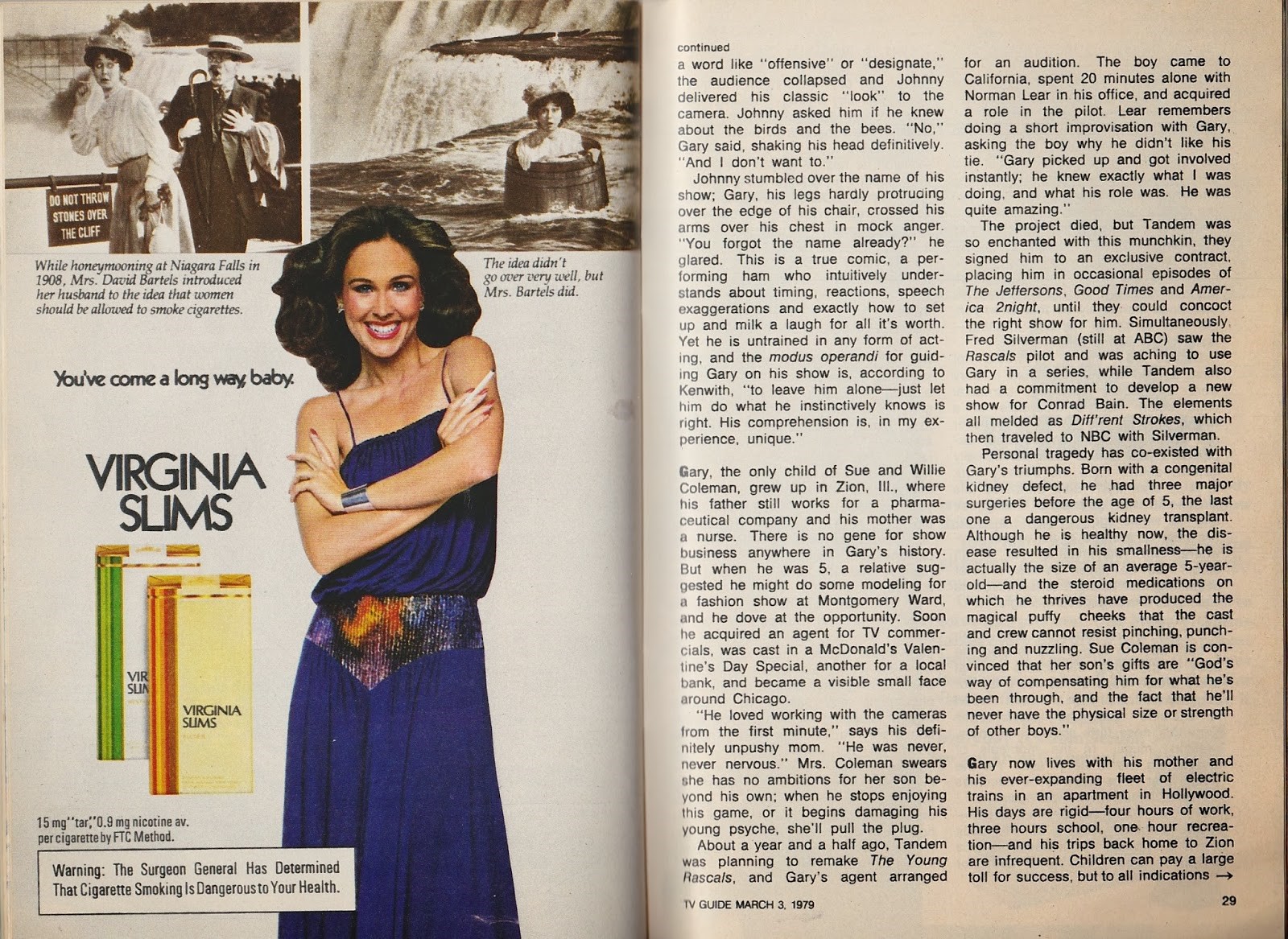
In 1960s, the American cigarette maker, Phillip Morris, launched a cigarette with a single target market – women. Unlike regular cigarettes, the new product, “Virginia Slims“, were slender and longer, making them look and feel feminine and elegant.

In those days cigarette ads were legal and so the launch was accompanied by a prize-winning ad campaign that had the tagline – “You’ve a come a long way, baby”. The copy was cheeky, aimed to portray the modern woman as being emancipated and no less than men.

Here is a collection of those ads. Take a minute to read the funny captions on the photos, they are hilarious………

——————————

1

3

4

5

6

7

8

9

10

11

This one speaks the loudest – it portrays a stylish black woman in a freaky Afro top and bell bottoms, looking like she doesn’t give a damn. It is the only one that does not have any funny accompanying caption. The presence of a carefree black woman in the 1960s is the point.

———————————–

In the real world, gender equality remains a distant mirage even today. The percentage of women in senior leadership roles in business is still very low. In spite of the fact that women make better leaders, only around 5% of Fortune 500 CEOs are women.

Maybe I should have named this post “You still have a long way, Baby”.

Share this:

  • Share on X (Opens in new window) X
  • Share on WhatsApp (Opens in new window) WhatsApp
  • Share on Facebook (Opens in new window) Facebook
  • Email a link to a friend (Opens in new window) Email
  • Print (Opens in new window) Print
  • Share on Tumblr (Opens in new window) Tumblr
  • Share on Reddit (Opens in new window) Reddit
  • Share on Pinterest (Opens in new window) Pinterest
  • Share on LinkedIn (Opens in new window) LinkedIn
Like Loading...

Dialogue with the Grim Reaper : the Extinction Edition

28 Tuesday Nov 2023

Posted by spunkybong in Uncategorized

≈ 5 Comments

——————————-

“In all things that you see breathing the breath of life, either courage or craft or speed has from the beginning of it’s existence protected and preserved each particular race. But those to whom nature has granted none of these qualities, so that they could neither live by their own means nor perform for us any usefull service in return for which they could be safe under our protection, they lie exposed untill nature brings them to extinction”

– Lucretius(99-55BC), in De Rerum Natura (“On the nature of things”), 1900 years prior to Charles Darwin’s natural selection

———————————-

It is 1598 and a boat from a large sailing ship beaches itself on a deserted island in the Indian Ocean, that we know today as Mauritius. Sailors jump out, wade ashore and begin exploring the surroundings. As they cut through the undergrowth, they see something they haven’t seen before – a huge ugly blunt-beaked bird, standing a metre tall, with brown feathers. The bird seems docile, as if it is domesticated. Having never come face to face with a predator, it makes no attempt to flee, seeming completely unafraid of the visitors.

They name the bird the “Dodo”.

Mauritius is soon transformed by the men from the ship. Over the next two years, more ships arrive and soon there’s no place for the dodo to go. The men slaughter the dodos indiscriminately for their meat and the animals they had brought with them (the dogs and the rats that had stowed away in their crates), they eat the dodos’ eggs. In less than a century, the entire species disappears. The last dodo was sighted in 1688.

At the time no one believed that the dodo could be absolutely wiped out as a species. The word “extinction” hadn’t yet appeared in the world’s lexicons. Why would God create an animal, some thought, only to let it die out?

It took another 150 years for the dodo to be officially declared “extinct”.

Today we know a lot more about what drives animals to extinction. We have also become aware of the pressures that have started to bear down on our own species and it’s fragile longevity.

Yet, we think of ourselves as invincible, too smart to go the way of the dodo.

—————————

It is the summer of 1918. Phillis Brown, the daughter of a British army officer, lives in an upscale neighbourhood in the heart of London. When the First World War broke out four years ago, she joined the Volunteer Aid Detachment, where she still works as a nurse, taking care of wounded soldiers returning from the Western Front in France.

In the autumn of 1918, the howitzers finally fall silent across Europe and Londoners begin to pick up the pieces and get on with their lives. Phillis hears pre-school children in her neighbourhood singing a strange new nursery rhyme. When I was a kid growing up in India, I was made to sing the same song, quite unaware of what the words really meant…

Ring-a ring o-Rosies, pocket full of posies

A-tishoo!! A-tishoo!!

And we all fall down

I had a bird and it’s name was Enza

I opened the window

And in flew Enza!

As the war is drawing to an end, Phillis notices more and more of the returning soldiers having severe breathing problems. No one has a clue as to what the disease is but whatever it is, its deadly. Some of the soldiers have a dark purple flush spreading all over their bodies. Their lungs are filled with a kind of sticky pus and they gasp and wheeze as they try to breathe, their eyes filled with the kind of terror one feels when one is unable to understand what is happening to him.

The soldiers die in the hundreds, their screams caught inside their choked throats. After that those who come to visit them – their relatives and friends – they begin dying and their friends and relatives and theirs and theirs. Phillis realizes that this a mysterious infection of some kind, which starts with a head cold.

The winter of 1918 is now around the corner when one day Phillis catches a chill, followed by high fever and a dry cough. In order not to infect her family, she moves out and begins living in a nearby boarding house. Two days later aged just 20, one chill evening a week from Christmas, Phillis Brown breathes her last.

It is estimated that 50-100 million people died in the 1918-1919 influenza pandemic that is now known as the “Spanish flu”. More people died of this disease than all the fatalities from the two World Wars combined.

——————————-

The COVID-19 pandemic – a common flu with a tweaked DNA that triggers acute respiratory distress syndrome or asphyxiation – makes one wonder about coming close to extinction. You are infected by just being in the same room as an infected person who is simply breathing normally. COVID-19 does not need someone to cough or sneeze next to you.

The virus, a microscopic parasite that has the ability to survive outside a host body for 3-4 days, deposits itself in the cells that line your throat and lungs and turns them into mini corona virus factories that churn out even more viruses that infect more cells, all the while disguising itself as a normal microbe, one of the many harmless microbes that already live inside you.

Soon your body is hijacked and you don’t even know it. That’s just the incubation period, when there are no symptoms, not even a sore throat or a cough. All around you people are beginning to wear masks so they don’t carry or receive the infection.

If you are an American, of course you are imbued with a typically American sense of faux bravado, a carry-forward of the American exceptionalism that we see today. “Lets go about our lives normally, let’s not let the virus dictate how we live,” you’ll say. Visiting a nightclub is your birthright and no one can take that away from you, not even a virus. “Didn’t we go about leading normal lives the very day after 9/11? That way, the terrorists didn’t win and so will it be with this pesky virus. Isn’t our’s the greatest country in the world?” you’ll say and you will go out on a date.

But the virus is not a terrorist. It has no ideology, no emotion, no passion and no devotion to any belief. The virus does not have the ability to think. It has a single-minded goal – to find a host and replicate, to keep it’s host alive so it can live in it and multiply.

By the time you leave the establishment that evening, you will have infected 35 other people, including the girl you brought along.

5 days into the onset of the infection, your immune system has finally begun to fight the virus. You start getting the chills of fever, perhaps aching muscles, a sore throat and dry coughs too. You begin to lose your sense of taste and smell. Your immune system is now beginning to overreact. It is causing inflammation inside vital organs within your body, filling tiny sacs that hold oxygen in your lungs with water, in much the same manner as HAPE (High Altitude Pulmonary Edema) afflicts alpine climbers. On X-rays, your lungs begin to exhibit dark patches – a sign that pneumonia is setting in. You try to take deep breaths in order to breathe in some air but you only wheeze. Your chest feels like it is in a vice grip.

At this point, if there is no emergency room doctor to insert a tube down your throat and connect you to a ventilator you will see a gaunt man in a cape holding a long scythe hovering near your hospital bed, waiting to snip the thread that connects your soul to your body. If he has his middle finger raised as in the image above, you are history.

When there are millions like you across the world, it is a pandemic and that’s what happened in 2020

———————————————

The good news – so far, natural cataclysms have never wiped us out as a species, although a super-volcano in Indonesia 76000 years ago almost did. The eruption, known as the ”Toba Event”, ejected volcanic ash into the Earth’s upper atmosphere, creating a 1000-year long cooling cycle that left only a few thousand human survivors in the whole world.

Pandemics too are natural disasters that have the ability to wipe us out as a species but somehow we have managed to survive those as well.

During the beginning of the Dark Ages, 540-542AD, the “Plague of Justinian” decimated the population of the region in and around the Byzantine Empire, around the same time that an Icelandic volcano erupted, blanketing the earth’s atmosphere with ash and bringing on a decades long winter. While the plague remained active for two centuries and took 100 million lives in Europe, the sudden cold caused by the volcanic eruption decimated crops the world over, triggering famines and taking another 100 million lives.

800 years on, around 1350AD, we had the bubonic plague known as the Black Death or Pestilence, in Eurasia,. Within just three years, a third of the world’s population (200 million) had perished.

————————

But just because we’ve never been completely wiped out in the past, doesn’t mean we won’t be in the future. The threat of new potentially deadlier existential threats have appeared over the horizon. Climate change, drug-resistant viruses, nuclear war, large asteroid impact, out-of-control artificial intelligence, super volcanos, coronal mass ejections (solar flares) – these are very real threats of the modern age that could wipe us all out completely.

Historical record shows that once every thousand years, an event has occurred that has wiped out a sizeable percentage of the human population. Occasionally a mammoth cataclysm like the super-volcano in Toba has brought us a hair-breadth from extinction.

Dr Simon Beard, a researcher at the Centre for the Study of Existential Risk in Cambridge, thinks of himself as an optimist, but in his work he spends most of his time trying to figure out how the world might end. He says that an existential threat does not necessarily mean every last human being will die out. It could instead be something that destroys civilization as we know it. Humanity may just make it but we could be reduced to a handful, surviving at the subsistence level of hunter-gatherers who roamed Africa 100,000 years ago.

———————————-

The two above mentioned plague pandemics started at European ports, carried in by merchant ships that had stowaway rats which had plague-infected fleas. In the case of the COVID-19, Chinese scientists suspect the source to be pangolins, a species of ant-eater that is highly sought-after in China for it’s meat and scales.

If only the Chinese would stop eating crazy shit like cockroaches and snakes and dogs and pangolins, maybe the world would be a safer place. SARS (Severe Acute Respiratory Syndrome) was caused by the Chinese eating civets that in turn had transported the virus from horseshoe bats to humans. Goddammit, who eats civets? We gift our women with jackets lined with civet fur but we have to wait till the Chinese have eaten them first.

If one were to follow the thousand-year thumb rule then it is now time for the next big one. Will it be another infinitely more infectious COVID-19 style virus? Could the thousand km diameter super magma chamber boiling and frothing beneath the Yellowstone National Park explode, its éjecta ushering in a millenium long winter? Or will it be 99942 Apophis, the half-kilometre thick near earth asteroid that is very likely to impact the Earth in 2029?

Will there be an end game and if so, what’s it going to be?


Share this:

  • Share on X (Opens in new window) X
  • Share on WhatsApp (Opens in new window) WhatsApp
  • Share on Facebook (Opens in new window) Facebook
  • Email a link to a friend (Opens in new window) Email
  • Print (Opens in new window) Print
  • Share on Tumblr (Opens in new window) Tumblr
  • Share on Reddit (Opens in new window) Reddit
  • Share on Pinterest (Opens in new window) Pinterest
  • Share on LinkedIn (Opens in new window) LinkedIn
Like Loading...

Those little words that Matter

21 Tuesday Nov 2023

Posted by spunkybong in Uncategorized

≈ 2 Comments

John and Annie Glenn

When he died, in December 2016, Marine combat pilot, war hero, astronaut and US Senator, Col John Glenn had been married 68 years, to his childhood sweetheart. He credited Annie for being the very reason for his success in life.

The story of John and Annie Glenn is the very well spring of inspiration.

John first met Annie when they were neighbors and their moms would put the two five-year olds together in a large basket swing in the backyard and they would spend the afternoons giggling and screaming.

As Annie grew, she was found to have a severe stutter in her speech, so bad that she couldn’t even utter certain words without going into a long stutter. That led her to be shunned and bullied in school – until John took charge of her ‘security’. After that, she was never bothered again.

Glenn remained true to Annie through seven decades and sometime during this very long honeymoon, Annie was able to conquer her stutter through therapy and perseverance.

In 1982, a reporter for The Boston Globe asked Glen, who was then considering running for the 1984 US Presidential elections, whether marrying someone with such a severe stutter ever made him reconsider his presidential bid.

“That never really made any difference,” he replied,” we grew up together with her stutter and I knew the person she was and I loved the person she was and that was that.”

John Glenn passed on in December 2016. For me, it is okay to have never ever met a man like John Glenn but still feel a sense of loss at another little bit of good, chipped away and lost inside the maelstrom of survival. Annie Glenn passed away in May 2020, her death caused by complications from a severe Covid-19 infection. She was 100.

There must be so many ways to show your love for each other. Little simple ways, like this one I read about the Glenns somewhere…..

John and Annie liked to play a secret game between themselves. Whenever, as a combat pilot in the fifties, Glenn went on a mission, he would turn at the front door of their little cottage at the air base and give Annie a quick peck on the cheek and say with faux curtness,” I’m going down to the corner store for some gum. You want any? Yours is pineapple, isn’t it?”

“No, silly,” Annie would smile,”Jill Travers at middle school liked pineapple. Mine is orange. And don’t be too long. There’s shepherd’s pie for dinner….”

The same conversation played out on a clear blue February morning in 1962, when Glenn stood at the door of the astronauts’ bus and she touched the visor of his helmet.

This time she strained to hold back her tears as she said, “Don’t be too long….”

“I know. There’s shepherd’s pie for supper,” he finished with a grin.

She watched him board the Mercury-Atlas rocket that stood with vapor steaming from it a mile away, ready to fly him into the unknown.

————————————

A Pakistani-Canadian colleague had just returned after a month in Karachi, settling his father’s affairs after his funeral. He was the only offspring and his mother had predeceased her husband of 60 years the previous spring. We were at the lunch table at work, when I said to him, “Your father, what kind of a father was he?”

He thought for a moment and said,” I never got to know him actually. He was always so busy running his restaurant chain, while my mother brought me up. One thing I do remember though and it was when I was in college. Late evenings, I would be upstairs in my room, books and notes spread around me, trying to cram as much as I could, for a test. When Abbu arrived home, it would be late and my mother would be asleep in bed in their ground-floor bedroom, the first door to the right from the front door.”

Here my colleague’s eyes got misty and he cleared his throat as he carried on, “At the sound of the front door opening, I would go over to the landing, in time to see him stoop to remove his shoes. He would give me a little wave and tip-toe over to the bedroom door which was always left ajar so there would be some circulation in the steamy heat. He would stand still for a long while, looking in, staring at my mother’s still form and then he would turn to me and ask in a whisper, “Has she eaten?”

———————————

It is hard to put in words the transcendental emotion, the sublime feel of couples who have been married 40,50,60 years. My wife and I have been together 28 years. Almost all long-married folks agree that it is tough making marriages work, but that in the end they choose to stay together because of an almost indescribable connection that has been formed over the years by myriads of little things that they feel about each other.

Its the little words they say to each other that matter.

————————————-

Share this:

  • Share on X (Opens in new window) X
  • Share on WhatsApp (Opens in new window) WhatsApp
  • Share on Facebook (Opens in new window) Facebook
  • Email a link to a friend (Opens in new window) Email
  • Print (Opens in new window) Print
  • Share on Tumblr (Opens in new window) Tumblr
  • Share on Reddit (Opens in new window) Reddit
  • Share on Pinterest (Opens in new window) Pinterest
  • Share on LinkedIn (Opens in new window) LinkedIn
Like Loading...

Acquiescence

16 Thursday Nov 2023

Posted by spunkybong in Uncategorized

≈ Leave a comment

———————-

She was cute, I’ll hand you that.

Slightly built, she sat at the edge of the bed, her hands clasped on her lap, like they had nowhere to go. She slipped her ghunghat (veil) off, reached up and carefully undid the pins holding up her slightly messed up hair. It cascaded down in curls, over her shoulders.

Her gaze went back toward the floor, unsure of what she must do next. The bed covers were strewn with rose petals but she seemed oblivious to them.

For the moment, she was trying not to pass out, under all that bridal finery and the oppressive heat. Slim jhumkas (traditional Hindu ear rings) peeked out from under the curls. She had on, the bridal ‘mangal sutra’ that I’d tied round her neck an hour or so back, at the ceremony – a yellow braided string, coated with turmeric, with a tiny gold pendant, flanked on either side by black beads.

—————————

I recalled the wedding. The mangal sutra had been handed to me open ended, with knots on both ends, so the beads wouldn’t escape. As I had slipped my fingers behind her neck to tie the two ends together, she repeated after the priest, in a soft but distinct whisper, “You are the reason of my existence. With this thread around my neck, I shall pray that may you live long.”

As her lips formed the words, for a brief moment, she lifted her eyes to search into mine, “Who are you, Robindranath Dey?” they seemed to enquire.

The 3-day ceremony was now over and here I was, my butt on the opposite edge of the bed, still in my sherwani, kurta and churidar, the air conditioning hardly able to drive away my discomfort at the May humidity. Goddamn, why the heck does May have to be the auspicious month for Hindu marriages? Wish I had my bermuda shorts on.

——————-

Bermuda shorts reminded me of the last time I wore them, the Saturday before I left for India. It was at the ball game, NY State vs Ohio. Vicky Tannenbaum had come along and as she sat next, her left arm loosely draped over my bare thigh, her hand had snuck further in, unnoticed. While 10000 guys cheered the NYS team on, she’d suddenly dug her nails in playfully.

“Ouch, watch it, will you? I only have two of those” I’d shouted out, with pain mixed with sudden pleasure. She’d giggled, nuzzling her red head against my chest.

“Take me to your dorm, Robby” she’d whispered into my ear. Back in my room, we’d torn at each other for the rest of the day. That night had been our last together and Vicky knew it. It didn’t bother her even a bit. She was attractive, on her way through med school with a straight-A average. Her parents had an already well established medical practice which she would simply walk into, after she got her MD. And she was cute as a button. There were lots of other fish in her pond.

When we were finally done, she lay across my chest, her red curls tickling my nose and me on my back. And as she slowly wrapped her legs round my thigh and lazily rocked herself back and forth, her wetness rubbing up against me, she mused, “You’re off to be married, to a Bengali country girl in a saree and my Dad will probably like to see me wed one of those orthodox toads in a Yarmulke, with those payots hanging from either side of his head. Well, I’ll teach Mr. Yarmulke a thing or two about putting those two side locks where they tickle,” she’d giggled.

——————-

And now once again back in the present, the thought of Vicky started up a stirring within, as I found myself facing that almirah with mirrored doors, by the wall. From where I sat, perched on the opposite edge of the bed, I could see my bride in the mirror clearly, facing away, at an angle.

Her anchal (the end of the saree that’s slung over the left shoulder) had fallen and lay like a wreath round her, on the bed. She had a ‘nath’ (nose ring) on one nostril and a bala (wrist band) on each soft hand. They looked like they’d been handed down, from her mother . Her hair was still flecked with all that sprinkly, shiny stuff they chuck at you in a wedding. Her feet were beautiful. Pink, bordered by ‘alta’, a vermillion dye that Hindu women have on, after marriage. Pretty toes, some with rings on them, peeped through her slippers. Payals, probably of imitation silver, transformed her ankles into the loveliest I’d seen. Yellowish-brown mehndi lines adorned both feet as well as her hands.

Don’t know how long we just sat there, facing away from each other, on either side of the bed but it was she who broke the ice first. She brought her gaze up to me, “Shunoon, ei biye ki aapnar moter birudhdhey hoyeche?” (Did this marriage happen without your acquiescence?)

I straightened and walked to the barred window that looked out on Hazra Rd. An ice-cream vendor was pushing his cart down the sun baked lane, his head covered by a wet gamcha (wash cloth made from a thin cotton fabric), knarled feet in torn flip-flops. “Kwaliteee!” he cried plaintively.

I turned back toward her and lifted my eyes to hers’, in a slow and excruciatingly painful effort. “No,” I replied and I quickly turned back to stare out the window. The ice-cream vendor was gone, but I could still hear his cries faintly in the distance, “Kwaliteee!” By now a bunch of stray mongrel dogs had decided to give him harmony. Every time he cried out, they barked and bayed at him, shuffling a few paces behind.

Just a minute had passed, when I felt her soft hands on my shoulders. She’d risen and come round the bed, to stand by my side, a little behind, away from the window. I shivered at her touch. I didn’t turn but continued to stare blindly at the scorching pavement below.

“Then why don’t you speak with me?” she reached up and held my cheeks in her palms and turned them so I was looking down at her beautiful face, “I left my home, my parents, my sisters and my little brother. And I have made this my home…..” her voice caught and I noticed that those long eyelashes were brimming with tears.

I gently grasped her two wrists and lowered her palms from my cheeks, till her hands were by her side. And I moved away just a bit. Don’t know why, but her touch was electric. I felt safer a couple of inches away. I was more comfortable with English. But she didn’t know a word of it. So Bengali it had to be, “And you? Was this with your approval?”

She nodded, dabbing her eyes with her anchal. “My father’s decision is my decision,” she said simply, “And now, your wish is mine. Forever”. QED- Theorem and corollary, I thought. With that simple statement, she leaned against me, and broke down into silent sobs.

I reached out and pulled her to me, gently holding her fragile body in my arms. After a while her sobbing subsided and I could feel her even breath on my chest, when all of a sudden, she wriggled out of my grasp, saying, “Wait, I’ll show you something.” She went up to the whatnot in the far corner and took out an ornate box made of brass. It was a ‘paaner dibey’, a small container normally used for betel leaves, nuts and zarda (chewing tobacco).

She ran her fingers lightly over the box. “My grandma used it when she was alive. Now, it’s mine.” She opened it carefully. Inside was just one article – a photo. It was me, striking a pose in front of the Lincoln Memorial. The one I’d sent through Baren when he came to India on his match-making expedition. “I spoke with you every day, ever since Barenda left it with us. I said to God, “Dear God, keep him safe”.

She left the box standing on the whatnot and turned, her young breasts squeezed up against my chest. An incredible warmth spread through us like wild fire, as I gently tilted her face up by her chin and said in mock severity, “My wish is yours. hmmmm. Do you have any idea what my first wish is?”

She smiled at that, feeling me harden against the pit of her stomach. With mock helplessness, her breath on my nostrils, she whispered, “No, why don’t you show me?”

—————————————–

It is 48 years now, since that first magical night. Madhu still has that box. She likes to call it her ‘treasure chest’. It has a few additions in it. Pictures of a young man, his American wife, Betty and daughter, Sona. And a young woman, with her banker husband, Tod and journalist son Michael.

And one more picture, at the very bottom, a photo, frayed with age, of a young man, much slimmer then but still recognizable now, posing in front of the Lincoln Memorial.

Share this:

  • Share on X (Opens in new window) X
  • Share on WhatsApp (Opens in new window) WhatsApp
  • Share on Facebook (Opens in new window) Facebook
  • Email a link to a friend (Opens in new window) Email
  • Print (Opens in new window) Print
  • Share on Tumblr (Opens in new window) Tumblr
  • Share on Reddit (Opens in new window) Reddit
  • Share on Pinterest (Opens in new window) Pinterest
  • Share on LinkedIn (Opens in new window) LinkedIn
Like Loading...

Imagine you live in the Dark Ages [Part-2]

13 Monday Nov 2023

Posted by spunkybong in Uncategorized

≈ Leave a comment

Imagine you are a commoner in 800AD England. Hang on, that’s not possible. As per Wikipedia, the Angles, Saxons and Danes unified to form England only around 927AD, so that is still a century away.

So, let’s say you live in a village in the Kingdom of Wessex.

If you are taking a morning walk, you learn to stay away from the sidewalk and you stick to the middle of the road even though a passing horse might kick you in the nuts.

You avoid the sidewalks because folks clear out their ablutions by simply opening a window and chucking the contents of their bedpans out. You wouldn’t want that in your face, would you? It’ll be another 1000 years before they have gotten on to the concept of bathrooms and toilets and sewer systems.

In the absence of soap, you wash with ashes and you do that very rarely. Many of your friends and relatives don’t bathe or wash at all. They simply wait for it ta rain. It’s normal ta own only one set of clothes and wear it all year round. You wash it by leaping into a pond or just by being out in the rain. Children up to 10 run around barefoot and stark naked when the weather is not too cold.

The only motive power is the horse or other pack animal, such as the mule or the donkey and they are expensive. Everything, from the tallest fortress to the finest fabric, is made by hand. Books are copied by hand, at great expense, each edition the toil of one rare literate worker. Raw materials and hand tools are precious assets.

The fields are plowed by hand, sown only once in two or three years, left fallow and unfertilized when not sown. The only fertilizer is manure and not enough for all the land. The crop yield per acre is a third of what it will be in another thousand years, by which time agriculture will be an organized industry. Right now, there is not enough grain to feed the population, so land is precious, even to kill for.

Are you healthier than my kind (ie: folks from the 21st Century)? In general, no, because even underdeveloped places will have better healthcare and disease prevention. But if you wonder if the strongest among you in the Dark Ages is stronger than the strongest man in the 21st Century, your man will win hands down and that’s because of the hard physical labor he is used to. His diet is likely to be unrefined and even raw. Obesity isn’t even a word right now.

The only organized industry sectors that employ workers in numbers are construction, lumber, handicrafts and weaponry. Basic necessities are made at home. Peasants like you spin wool and weave linen. The fabric for clothing is very strong, so strong that one dress can last a lifetime literally and even be handed down after death. Of course, your late grandma’s surcoat might stink but it is not an issue, you are immune to smells.

Small mom-and pop businesses are everywhere – blacksmiths, tinsmiths, potters, carpenters, saddlers, wood and stone sculptors, lacemakers, weavers and cobblers, these are folks with skills that have been handed down through the ages by ancestors. Serfs in these businesses usually do better than the rest.

Living conditions leave a lot to be desired and comfort has declined. You make do without things that in ancient Rome were considered necessary for basic comfort. Beds are a luxury and you sleep on straw, on the ground. The principal item of home furniture is the multipurpose ‘coffer’, which acts as a seat, a bed and a chest for storing household stuff.

When it is time to eat, wooden planks are set on trestles, as makeshift tables. Tableware is practically non-existent and the members of a family eat with their bare hands out of the same wooden bowl, dipping slices of hard, stale bread into the bowl.

Peasants build themselves huts to live in and these burn down from time to time. In the densely packed alleys within town walls, fires are an ever-present menace. However, the huts can be rebuilt in a jiffy, the owner hardly suffering any loss beyond a few clay pots and blankets of skins. Grain stocks are buried underground, in sacks, so they are not destroyed by fires.

There are no drainage systems and a spell of wet weather can turn courtyards and streets into quagmires. With huge quantities of dung from the large number of horses, cattle, lambs and sheep, a town can have an all-pervasive stink of ordure, smoke and damp.

There is yet no such thing as medical science. There is no medication or medical procedures. That’s the great leveller these days. Disease doesn’t give a fuck if you are rich or poor, king, vassal, overseer or serf.

Disease and death are everywhere. There are hundreds of ways you can end up dead, starting from birth. You might simply catch the flu, inhale smoke from the ever burning hearth with no ventilation, contract tuberculosis, venereal disease from dirty richards and pussies, food poisoning from putrid meat. There are no sewers, no method for the removal of human waste. Pasteurization is centuries away and you could ingest well water contaminated with faeces.

The Dark Ages are known for its pandemics. Disease can be brought in by rats from a docked merchant vessel, wipe out millions and last over a century. One, the Justinianic Plague, began 250 years prior and killed a fifth of Europe’s population. There are still affected pockets everywhere in your time, though the acquired herd immunity has almost completely stamped it out by now.

——————————-

After dark is when life gets dicey. Remember, there is no established law and order. You try not ta venture out anywhere after the sun sets. The only light is from wax candles, resin torches or tallow that release as much smoke as light. Anything that is used to produce light is very very expensive. You avoid expending your meagre store of illumination by rising and going to bed with the sun.

In the end, what is important these days is manual dexterity and muscular strength. You have ta have strong feet and legs. The only mode of travel for a commoner like you is by foot. For you, a 50, or even 250-mile walk to the next town is du jour, run-of-the mill, like. Distance is of course not measured in miles. It’s in days of travel, like a “3-day walk”.

You’ll take several days to reach your destination but there are inns on the way who will give you room and board if you cut their load of wood for the fire.

There are other units of distance measurement, like the “furlong”, roughly 220yds, the distance an ox can furrow in one go. 40 “poles” make one furlong. The smallest unit of length is a “barleycorn” which is roughly a third of an inch. I bet you guys get together in a tavern, load up fulla ale and joke about some guy’s ’barleycorn-sized” richard.

On your travels, some innkeepers will let you stay just to hear the “tidings”. You’re their only source of news. Writing is the luxury of the few literati and you’re not one of ‘em, so people like you have developed solid memories. You have no intellectual baggage beyond what you carry in your head in the moment. Those innkeepers love it when you offload those memories on them. You can even be a professional story teller, like a walking Wikipedia and boy, then the innkeeper’s plump daughter is yours for the night, like.

The shortage of the tools of daily life has given rise to adaptability. If you are a traveler, you are able ta tell the direction by the stars and the time by the movement of the sun. In your head you carry a calendar that is able to broadly forecast the seasons and the change in weather patterns. You know which plants are medicinal though not yet why.

For what you do not know, the theoretical, you rely on the tales of the elders of your family and their painstakingly acquired experiences of life in general.

——————————

Today, here are the things I value, stuff that I don’t necessarily need ta survive but I still covet ta lead a comfortable life…. A sturdy Toyota Tundra, a lake side property, maybe a chalet in the country, cash to fly me to vacation spots, maybe a small single-engine Cessna 172 to appease my adventurous side.

Now let’s check out what you think of being of value to you….. horses, mules, donkeys, oxen, bulls, sheep and poultry. And a little plot of land ta grow wheat and barley, maybe some hemp and flax. Have these and you will consider yourself contented. Livestock provide you with nearly all your day to day needs. Flayed skins protect you from the cold. Blood is mixed in with clay to make cement. Horns are used for cups, wool for clothes and feathers for quilts and mattresses.

One thing that you don’t have ta pray for is wild game, lotsa wild game. You have that in plenty. Wild life is abundant. The woods are filled with the clamour of birds singing.

This paucity of grain does not cause starvation however, due to the abundance of meat from wild game. Most of England is covered in dense forest, teeming with bear, boar and wild fowl. Herds of deer nonchalantly browse the clearings. Hare, rabbits, partridges, foxes and wolves, they pack the woods with relentless cacophony. Sometimes, the skies darken with dense flocks of migrating geese. You just have ta aim at the general direction. Everyone is a hunter. You go out and hunt what you want for dinner, it’s that simple.

Hunting is not a pastime. It is a serious job of work. The object is your daily nourishment, though you have managed to make it kinda fun, like a sport, with competing teams and their own spotter dogs. Slaughtered boar and stags are brought home in triumph. On the eve of village feasts, your job is to contribute hundreds of quail, partridge, thrushes and ducks. You bring them in a game bag and tip them in a bloody heap on the kitchen floor, completely unaware of the concept of hygiene.

Your home has a perpetual stink of tanning hides, animal blood, mingling with the aroma of roasting meat, further mixed with the odor of earth, smoke, sweat, dogs and faeces.

And bad breath, body odor and the disgusting smell of toe jam. Man, I have no idea how you manage ta live in close proximity to unwashed bodies. How can you even think of having sex with your spouse who hasn’t bathed in a year, Dude?

I have a theory. Maybe you get turned on by body odor, how about that? I know of an African tribe in present day Senegal whose women won’t sleep with their men unless they go at least a fortnight without washing. Ugh!

———————————

Post-Script

——————————

The above was a chat I had with a random Medieval man when I time travelled to 800AD and now it’s time ta get back to the present day.

The dark ages were truly dark but there is a belief among some historians that had there never been a period of stagnation, there would most certainly not have been a Renaissance and an industrial age thereafter. Great creativity and enlightenment always follows pervasive ignorance. And vice versa.

Will MAGA America similarly lead to progressive enlightenment? Chances are slim, but who knows? The Dark Ages were somehow necessary, it is thought, so maybe MAGA America is necessary.

Necessary or not, the Dark Ages were an Eurocentric phenomenon. It was only Europe that stagnated, where folks dumbed down. Outside, the world flourished…..

The Muslim Arabs had an explosion of scientific output. Al-Khwarizmi gave us algebra around 820AD. Avicenna and Jamshīd al-Kāshī made advances in trigonometry, geometry and Arabic numerals. Islamic doctors came close to finding remedies for diseases like smallpox and measles and challenged classical Greek medical theory.

In India, as early as 500AD, mathematicians like Aryabhata and Bhaskara were giving us geometry and trigonometry. Interestingly, Aryabhata was born the same year that the Roman Empire fell to the Goths and triggered the Dark Ages. The move from zero as merely a placeholder by the Mayans and Babylonians – a tool to distinguish larger numbers from smaller ones – to a digit of its own was established in India by Aryabhata and then began being used in calculations by Bramhagupta around 800AD.

But Middle eastern and Indian advancements during Europe’s Dark Ages pale against the brilliance of the Chinese during this period. China’s Tang Dynasty (618-906AD) brought spectacular scientific innovations into the world, beginning with binary code, paper, printing, the compass and gunpowder, to name just a few. Although legend has it that the Mesopotamians first invented the abacus, the first archaeological evidence of a working model similar to one used today, came from 1200AD China.

Alas, the East had not realized that scientific advancement had to be in lock step with advancements in military power. The Dark Ages had cemented Europe as a martial entity that had learned how to fight and conquer, while on the other side of the world enlightenment and peace prevailed. So, while the Europeans learned to colonize, the east remained blissfully trusting.

The pendulum has swung back again. The east is once more on the rise, this time with sufficient military power to make a wannabe conquerer think twice. No East India Company will succeed this time around.

That’s life, isn’t it?

Share this:

  • Share on X (Opens in new window) X
  • Share on WhatsApp (Opens in new window) WhatsApp
  • Share on Facebook (Opens in new window) Facebook
  • Email a link to a friend (Opens in new window) Email
  • Print (Opens in new window) Print
  • Share on Tumblr (Opens in new window) Tumblr
  • Share on Reddit (Opens in new window) Reddit
  • Share on Pinterest (Opens in new window) Pinterest
  • Share on LinkedIn (Opens in new window) LinkedIn
Like Loading...

That Diwali

09 Thursday Nov 2023

Posted by spunkybong in Uncategorized

≈ 4 Comments

thatdiwali

Some things from that evening seem faded, so faded that it takes a lot of effort now, remembering each detail.

After all it was more than half a century back – Diwali, 1965. But it’s a Diwali that still shimmers, in the haze, except that the haze – it grows denser as the years roll by and the lines, once sharply etched, now seem blurred.

Sukhoranjan, our Jeeves, lit the oil lamps and arranged them along the terrace parapet, the balcony balustrade and even on the window ledges – of employees’ quarters, Type-E, No.34, MAMC Colony, Durgapur, West Bengal, Eastern India.

The October breeze was mild, but the lamps flickered and inevitably some went off after a sudden gust, making Sukhoranjan scurry around, relighting them. “Oof! Aaj eto hawa hobar ki dorkar chilo ? **”of all the days, did it have to be so windy today?”***he fussed.

Meanwhile right after the first fire crackers went off in the neighborhood, our dog, Shepherd, took refuge under the bed – my bed, our bed, mine and my two elder bros’. Shepherd made frightened, whiny noises as he slinked in, tail well between his legs. (He didn’t emerge till it was dinnertime, the festivities were over and the neighborhood had fallen silent.)

My father had his arm round my mother’s shoulders, while they stood back and watched their three kids waving crackling fuljhari sticks wildly around. My favorite was the thubri, a firecracker crammed inside an onion-shaped clay pot with a hole on top like the caldera of a volcano, through which it kept spewing stuff out high in the air like a fountain.

The thubri was a dazzling display of colors that lasted around 30 seconds and then the pot lay spent but smoldering, with a tiny flame still licking up from within. I loved giving it a hard kick then. Who lit the first thubri – Chorda? No, perhaps Dada?

Heck, I just can’t seem to remember that clearly anymore.

What I do remember is that the war with Pakistan had just ended in a ceasefire. The single-seater Folland Gnat jet fighters from the nearby Panagarh airbase had finally stopped screeching past at treetop level, by the time Diwali came around. While the mood was upbeat on the one hand, there was also some grieving at the sudden death of the revered Indian Prime Minister, Lal Bahadur Shastri.

The squeals of excitement of that Diwali, the laughter – it all comes back in snatches, like when you are turning the knob of an old radio and the music from a short wave station keeps swooshing in and out.

————————————–

Some other moments are still etched. Like the fact that the stash of firecrackers that our father could reasonably afford happened to be far smaller than those of all the other Joneses in the neighborhood. And we didn’t want to finish before the others. A dark and silent house in the midst of bursting crackers would be an embarrassment.

My father had an ingenious way to address that. He took us for a long walk round the neighborhood, ostensibly to admire the Diwali lighting on the houses and the crackers others were bursting. It killed time till it became unbearable and the three of us raced back to our individual fire cracker stashes, to begin.

Afterwards, there were heaped plates of mutton pulao for dinner. This was a big deal because we had meat on the table only once every fifteen days or so. Mutton was all we could afford, chicken being prohibitively expensive in those days. Though there had never been any discussion on it, beef was never an option, even though it was the least expensive.

As always, my mother busied herself laying the table and waiting on her four men while they ate. By the time she took her seat, all the mutton was gone and only a bit of the pulao (the rice) was left, stuck to the walls of the pan like a thick plaster. When Dada protested that she didn’t have enough, she smiled and gave him a hug,” If you kids are full, I’m full.” I can still see her scraping the bottom of the pan with her thumb and licking it appreciatively,” You missed the tastiest part, you know.”

—————————–

I remember Sukhoranjan well. How can you not remember someone you grew up with? Sukhoranjan was a 16 yr old from Orissa who had found work as a chaprasi (gopher) in my father’s office. In return for free lodging and board in the servants’ quarters attached to our house, he became our odd-job man, getting the groceries, fixing things around the house, mopping and sweeping, a job that he took as gospel.

Sukhoranjan had left his native Baleshwar with his uncle when he was 6, at the peak of the 1955 famine and the cholera out-break that had claimed both his parents and his younger sister.

After a brief stay with abusive relatives in Chakradharpur, Sukhoranjan ran away and boarded a train to Durgapur, alone, as a frightened 8 yr old. Years of toil in tea shops and grocery stores followed and it was when he was 14, working as a door-to-door fruit seller, that one day his shadow fell across our doorstep.

It had been a blisteringly hot day and Sukhoranjan struggled to lift the fruit basket back on his head, when my mother persuaded him to lay it back down on the ground and asked him to rest a while in the shade of our front porch. Soon a sumptuous lunch followed, which he wolfed down in seconds.

My mother took him in that day and he had been with us ever since. A bright and cheerfully illiterate country boy, a year older than Dada, Sukhoranjan still called him ‘Borda’ (big brother). And he was especially invaluable in my leisure-time pursuits, having taught me the intricacies of gulli-danda, marbles and how to make a gulti (sling) out of a forked wooden twig and rubber strips cut from bicycle tubes.

It was only when you tried to ask Sukhoranjan about his parents or sister that he clammed up. My mother had once seen a photo inside that tiny steel trunk of his that held all his worldly possessions. It was a picture of a couple in front of a hut. He had simply nodded and looked away when my mother had asked him if they were his parents.

—————————————-

And Shepherd. He was a good looking, unusually large, dirty white mongrel pup when he found us. India is teeming with dogs without a home, that loiter around every street, scrawny and emaciated, with open sores and wounds from fights over scraps with other dogs.

But Shepherd was different. With a dark grey stripe through the middle of his forehead, from between his eyes to the tip of his nose, he was unnaturally fluffy and plump. As he grew, Shepherd got this bushy white tail and when he confronted another dog, it rolled up tight and went into a high frequency, low amplitude quiver, while his bright aggressive unwavering eyes stayed on the other guy and a low growl escaped from his slightly parted lips. Most dogs quickly figured out that the odds against having a ear torn or a shoulder gashed were very little and made a whining exit which sounded to me more like, “Fuck it, tennis anyone?”

I have a hunch that Shepherd’s father was one of those Siberian huskies that the Soviet experts brought over with them. This was 1965 – at the apex of Indo-Soviet cooperation. We were living inside a township that had technical experts from the Soviet Union helping us build coal mining machinery. The husky must have taken a shine to a local babe and one thing had lead to another. We never got acquainted with his mother. Guess she’d passed on by the time Shepherd, the pup, found us.

Shepherd truly was a Soviet dog. The KGB couldn’t have done any better, penetrating a third world country. Shepherd eased himself into our house gradually in strategically planned moves. He was first spotted sunning himself occasionally on our garden wall parapet and then we noticed he had promoted himself to the top of one of the two concrete garden gate posts. It was not long before he drew my mother’s attention,”Dakh re, kukur ta ki mishti dekhte” (look guys, isn’t that a cute pup?).

Soon Ma was flinging leftovers to him after our meals. One day, when Sukhoranjan was about to garbage an old frying pan, Ma decided to keep it and use it as Shepherd’s dinner plate. She had Sukhoranjan remove the handle and clean it out and began having one of us kids go out and leave it filled with scraps, on his favorite gate post.

As Shepherd grew however, that gate post proved to be too small and he kept inadvertently knocking the pan off it in his eager enthusiasm. Soon we started leaving the pan on our doorstep instead.

———————————————-

The monsoon of 1965 was particularly severe and I remember this one late night. Ma and Baba were asleep, their bedroom door shut. I suddenly woke to see Dada and Chorda standing by our bedroom window, holding the grills and looking out, talking in a low tone. I jumped out of bed and went up behind them. My eyes were at the level of their waists and I had to push my little head through to see what was grabbing their attention. In the blinding sheets of rain, I saw Shepherd, bedraggled, on top of his gate post, trying to find a comfortable position to settle himself in.

Dada looked at Chorda, got a nod and turned to me,”Sshh. Mukh theke ekta shobdo jeno na shuni. Noito gatta khabi, bujhli?” (Ssh. One sound from you and you’ll get one of my bare knuckle raps on your head). He was obviously worried about my parents waking up.

Dada was tough and I never took his words lightly. If he said he was going to beat me up, he was going to beat me up. You couldn’t reason with him. You couldn’t placate him. You couldn’t seek refuge under the law. He was the law. He might easily have been born in the turn of the century in the Sicilian town of Corleone.

So, here we were, by the bedroom window,  me held by the ears, slowly being shaken but not stirred, by Dada. He continued, “Teen shotti bol, shatti, shatti, shatti” and I repeated after him in a hushed, awed voice, “Shatti, shatti, shatti”. Repeating ‘shatti’ thrice meant giving your word to the other guy that you wouldn’t rat out on him. This was the first time they were going to trust me not go blab to our parents the first chance I got. It was awesome. I was in! I’d suddenly grown up. I was now being taken as a man by my peers. 

My euphoria was short-lived, for Dada hit me with a gatta anyway. I started, “What the…!!%^*” and he swiftly clamped his palm on my mouth, “That was just for taste. There’s more from where that came, remember that.” Jesus Christ, they should have named this guy Joey Gallo.

The gatta was painful and unprovoked and when it became evident that I was going to burst out crying, Kissinger (Chorda) stepped in,” Now relax, take it easy, ok? You are now one of us. We gotta stick together, right?” I nodded hurriedly, gulping back my tears.

Dada took charge immediately, “All right, all right, here’s what we’ll do” he jabbed a finger painfully into my chest sending me reeling back,” you get that spare mat from the prayer nook and meet us at the front door.” With that curt command, he and Chorda swung on their heels and slinked down the stairs, while I made my way in the dark, to the prayer nook, to retrieve the spare mat, making sure I kept a safe distance from that pashbalish (round cushion) on the whatnot that scared the bejesus out of me every time I was made to enter the prayer nook alone in the dark. I grabbed hold of the mat and raced downstairs to where my elder brothers were waiting.

They already had the front door open and Shepherd was standing there, dripping and forlorn, his wet fluff now sticking to his body making him look half his size. There was this cove under the stairs next to the front door which housed the family bicycle (my father went to work on it when he didn’t manage to get a ride).

Shepherd came in and proceeded to the cove where he shook himself dry vigorously, soaking us all in the process. I hugged him. He was cold. Chorda had brought a bowl of milk which he placed next to the mat. Shepherd curled himself up on the mat and lapped at the milk gratefully. He was done in a microsecond and lay stretched out, eyes half closed, bushy tail wagging lazily in appreciation. In another minute he breathed a deep sigh and was out like a light. The next morning we were taken aback to note that our parents didn’t mind Shepherd’s new lodgings at all.

The penetration of the household was now complete, the culmination of a totally successful ‘hearts and minds’ exercise – the only casualty being my forehead – from Dada’s gattas.

Sukhoranjan got a permanent unionised job at MAMC, married soon after and moved away in ’68.

Shepherd passed on in the summer of ’69 around the time of the first moon landing. He failed to recover from a tonsil operation. I had just turned 14.


Share this:

  • Share on X (Opens in new window) X
  • Share on WhatsApp (Opens in new window) WhatsApp
  • Share on Facebook (Opens in new window) Facebook
  • Email a link to a friend (Opens in new window) Email
  • Print (Opens in new window) Print
  • Share on Tumblr (Opens in new window) Tumblr
  • Share on Reddit (Opens in new window) Reddit
  • Share on Pinterest (Opens in new window) Pinterest
  • Share on LinkedIn (Opens in new window) LinkedIn
Like Loading...

Imagine you live in the Dark Ages [Part-1]

07 Tuesday Nov 2023

Posted by spunkybong in Uncategorized

≈ Leave a comment

The overseer and his peasants in medieval England

It is the early 9th Century Kingdom of Wessex. A unified kingdom of England is still a century in the future.

You are a commoner, a serf, a helot, a menial. Take it easy, I’m just showing off my vocab, relax. All I’m trying ta say is that you are a nobody.

Europe is a dark and treacherous place in a dark and treacherous time. The roads are covered in horse shit and the most common sound is the squelching as folk step on it. There is no Home Depot to sell you ‘horse shit shoes’.

The history that we usually study doesn’t tell us about the world that folks like you, shit shoveling ornery dumb folk, live in. Instead, the history we read is actually the biographies of famous men, of monarchs and the battles they fought. So if your dad happens to be king, chances are good you’ll be in the history books and I’ll be reading about who you fucked and who you married and stuff.

But you’re a serf, say a cobbler or a stone mason. It is 800AD or thereabouts. You don’t know it but you live in what later historians will call the ‘Dark’ a.k.a ‘Medieval a.k.a ‘Middle’ ages. No offence, but it is a period in history that is marked by a decline in economic, intellectual and cultural order and an increase in conflict, subjugation and anarchy.

Let’s just call it the Dark Ages. I like it. Sounds dystopian (which it in fact was), but feels sexy.

Although historical ages change gradually, historians pinpoint the trigger for the beginning of the Dark ages at 476AD, when the last Roman Emperor of Roman blood, Romulus Augustulus, was deposed by the barbarian Goth, Odoacer. That is the date when “Ancient Classical Greco-Roman” changed to “Dark” ages. It will remain dark for a thousand years.

You were born somewhere just beyond the first quarter, three centuries into the onset of the Dark Ages, around 770AD.

—————————

Medieval society is organized in three social orders, known as the ‘Three Estates’. Foremost are those who rule and fight – the First Estate. The Second Estate are those who claim to be God’s reps on earth, ie: the clergy. The Third Estate comprises of those who work their asses off – folks like you.

The ones who fight are supposed to protect the others from invasions, while the clergy are expected to protect everybody from committing sins. Finally you, the peasants, are there ta serve, to make the lives of the First and Second Estates comfortable through hard unrelenting labor. You and your kind constitute 95% of the population

One great leveller is literacy. You are not the only miserable idiot who can’t read and write. Almost all, including most nobles, are illiterate. Literacy is not yet a priority. Rise in literacy and enlightened debate will happen but that is still 700 years ahead, in the future. That age shall get the monicker, “The Renaissance”, the age of enlightenment.

—————————

You, my friend, are at the very bottom of the food chain. Your ruler is King Beorhtric of Wessex. It’s a Germanic name, his ancestors having crossed the Channel from Ghent in present day Belgium.

King Beorhtric’s wife, Eadburh, is a piece of work, a promiscuous, debauched woman. In a year or two after marriage she’ll poison hubby dear accidentally in an inebriated state, while attempting to poison a dinner guest. Both, the guest and Beorhtric, will die. In panic, she will cross the Channel in flight and arrive at the court of the great Charlemagne, who will take a shine to her but she will ruin it all by choosing his son instead.

Slighted by the rejection but sagely, Charlemagne will nevertheless gift Eadburh a convent in Francia and she’ll become an abess but that won’t last too long either. She’ll be caught blowing an English refugee in exile and be permanently banished by Charlemagne. Eadburh will eventually die a pauper begging in the streets of Pavia, in Italy.

But that is all in the future. Right now, Beorhtric is king and he owns everything, the land and every damn thing on it. As the only son born into the ruling family, he has inherited all the titles, lands and income of the family. This practice, known as ‘primogeniture’ – the right of succession to the first born male child, is believed to be the only way to retain the ruling family’s legacy and power.

King Beorhtric doesn’t have any siblings but if there were any, they would be sent into the Catholic Church as monks and nuns. This step is taken to ensure that none of the siblings try ta stage a coup. But don’t fret. Those siblings, though now a part of the Second Estate, would still wield enormous power. They would be given enough assets to be able to lead luxurious lives. As members of the Second Estate, they would fuck with you psychologically while the members of the First Estate screw you physically.

The king doesn’t know you or give a fuck about you. You’re an asset to be exploited every which way. In times of peace you’ll harvest the crops and when war looms, you’ll be swept up, put inside a ‘cog’ and transported across the channel ta fight.

The king has divided up the land into “fiefs”, parcels of land that range in size from vast duchies down to tiny plots of land given to a single knight, called a knight’s ‘fee’. To manage each fief, the king has installed a “vassal” or “Duke”, who is a trusted crony, a cousin or a relative through marriage. In return, the vassal has pledged his loyalty to the king and the soldiers to fight an invasion or to participate in one.

The vassal in turn hires reeves(overseers) who supervise serfs like you while you till and harvest the land. Every thing is accomplished by hand and yours is hard, back breaking work. You keep 10% of the harvest and pass on the rest to the vassal who keeps 30% from which he pays the overseers and sends the remaining 50% to the King.

Everyone has a lord. Yours is the reeve, a large violent brute of a man that you cannot trifle with. He is a shit shovellor too like you but slightly better off since he doesn’t have to do all the actual toil. The reeve is beholden to the vassal, who has the power of life and death over not only you but your whole family. He says whom you should marry and whom you shouldn’t. If he takes a shine to your sweet, pink-cheeked wife and forcibly takes her to bed, there’s nary a thing you can do about it.

The vassal is in turn beholden to the king in exactly the same manner as you are, to him. And the king can fancy anybody’s wife, the vassal’s, the reeve’s or even your’s. This is before Magna Carta, a charter of human rights that will become law two centuries from now. Not that it will benefit you in even the remotest manner.

The Magna Carta is going to be a set of laws created by the English King John, a universally disliked asshole. It will give greater freedoms to “freemen”, a misleading term that means only the barons and dukes. Magna Carta will have provisions for serfs too, but don’t hold your breath, they will be vague and impossible to enforce.

Right now, whatever your lord says is the law.

What can I say? Had you been born in my country of birth, India, at this very time in history, you would be living in prosperity in a land of plenty, governed wisely by “philosopher kings” of the Chola Dynasty. Instead here you are, shovelling shit in England.

You were born in the wrong place at the wrong time, is all.

—————————-

Hovering over everyone and everything is religion and that is Christianity, administered by a murderous continent-wide criminal enterprise known as the Catholic Church. The head of the Church, the Pope, is all powerful and even your king has to bow to his demands. Even though your king is the ruler, the Pope runs a parallel, equally powerful government inside the kingdom and that parallel government is headed by an archbishop, a very powerful guy indeed.

It will be another 700 years before a roly-poly overweight guy, crowned King Henry VIII, will get pissed off with the Catholic Church because it won’t allow him to divorce his current wife and marry a voluptuous lady-in-waiting he has been fucking. He will start his own brand of Christianity called the Church of England.

Jeeze, imagine founding a church just for access to fresh pussy.

Getting back to the here and now, there is a new religion going around, Islam, which is nothing but a beta version of Christianity. It uses the same basic storyline, the same prophets, the same archangels and the same lies as Christianity, but it has gone a little further. It has added to it a knockout punch, a threat, which says, “either you are with us or you are dead”.

Islam’s laws are so strict that you are scared ta even take a pee, lest you get your head chopped off for not peeing as per strict Islamic rules. I am not kidding. They even have a prayer that you have to recite before a fuck and another after a fuck, which you have ta recite in a ritualistic bath while cleansing your richard of the “filthy residue” of sex.

With all the insanity around you, the prospects of a happy, peaceful comfortable life for you are dim, see what I mean?

There are and will be great rulers in your time, who come in and steady the ship for a while and fade out – Justinian, Alfred the Great, Canute, Charlemagne, Richard the Lionheart, William the Conquerer, to name a few. But what they accomplish will not make any difference at all to your wellbeing.

Alas, you live inside a universe parallel to that of the elite who decide your fate. In your universe, invasions, sexual assault and bonded labor are the norm.

You are the medieval man.

————————

Stay tuned for a glimpse at your tawdry life, in Part-2.

Share this:

  • Share on X (Opens in new window) X
  • Share on WhatsApp (Opens in new window) WhatsApp
  • Share on Facebook (Opens in new window) Facebook
  • Email a link to a friend (Opens in new window) Email
  • Print (Opens in new window) Print
  • Share on Tumblr (Opens in new window) Tumblr
  • Share on Reddit (Opens in new window) Reddit
  • Share on Pinterest (Opens in new window) Pinterest
  • Share on LinkedIn (Opens in new window) LinkedIn
Like Loading...
← Older posts
Newer posts →

Blog Stats

  • 72,618 hits

© Achyut Dutt 2013

Meta

  • Create account
  • Log in
  • Entries feed
  • Comments feed
  • WordPress.com

Recent Posts

  • Belaya Roza [Part-4]
  • Belaya Roza [Part-3]
  • Belaya Roza [Part-2]
  • Belaya Roza (Prequel)
  • Oh my God, those bulbous heads are here !!
  • The Bio-Hazard called Deep Space [Part-1]
  • Oh my God, they’re watching us on Pornhub!!! [Part-1]
  • Coveting thy neighbour [Part-2] – Trashing the 9th Commandment
  • Coveting thy neighbour [Part-1] – The Present
  • The godmens’ godman
  • Dressed to Kill – The Black Widows of the Caucasus
  • Kuzkina Tetya [Part-1] – A souring Bromance
  • Kuzkina Tetya [Part-2] – The Bear
  • My Tryst with Betty Grable
  • 4th July – The Normality of the Abnormal
  • La Sexie Folie
  • Want a Halo Hoop?
  • 18 Wheels – A Tribute to Truckers
  • Paanwala
  • Luchnyk Khalifa [Part-1] – The Archer
  • A Beedi in a Storm
  • The first “First Man” [Part-1]
  • Beheading…. Sigh, the Lord has His ways
  • The Hunt [Final Part]
  • The Hunt [Part-7]
  • The Hunt [Part-6]
  • The Hunt [Part-5]
  • The Hunt [Part-4]
  • The Hunt [Part-3]
  • Fierté Montreal – Haj, for Gay Folks
  • The Hunt [Part-2]
  • The Hunt [Part-1]
  • Kuzkina Tetya [Part-4]
  • Kuzkina Tetya [Part-3]
  • Kuzkina Tetya [Part-2]
  • The Main
  • Spilt [Part-2]
  • Spilt [Part-1]
  • Hillbilly Eulogy
  • Illusionist
  • Autocracy, Inc. – Not a review
  • The Killing of the Little Giant [Part-2]
  • The Killing of the Little Giant [Part-1]
  • I was stoned but didn’t miss it
  • Getting Older Without Getting Old
  • The right to bare
  • Fucking with the 7th Commandment
  • The Cretaceous–Paleogene Extinction Event – Episode : 5 – 10 years after Impact
  • E Pluribus Multis
  • The Cretaceous–Paleogene Extinction Event – Episode : 4 – The Day After

Top Posts & Pages

The Erastes, the Eromenos and the Pathikos
My first smoocherooney
Paanwala
The Cretaceous–Paleogene Extinction Event - Episode : 5 - 10 years after Impact
Check-up
Amish – Islands of sanity in a whirlpool of Hate
Mithridatus VI - Hannibal of the East (Part-1)

Enter your email address to follow this blog and receive notifications of new posts by email.

Join 100 other subscribers

© Achyut Dutt 2013

Blog Stats

  • 72,618 hits

Meta

  • Create account
  • Log in
  • Entries feed
  • Comments feed
  • WordPress.com

Enter your email address to follow this blog and receive notifications of new posts by email.

Join 100 other subscribers

Recent Posts

  • Belaya Roza [Part-4]
  • Belaya Roza [Part-3]
  • Belaya Roza [Part-2]
  • Belaya Roza (Prequel)
  • Oh my God, those bulbous heads are here !!
  • The Bio-Hazard called Deep Space [Part-1]
  • Oh my God, they’re watching us on Pornhub!!! [Part-1]
  • Coveting thy neighbour [Part-2] – Trashing the 9th Commandment
  • Coveting thy neighbour [Part-1] – The Present
  • The godmens’ godman
  • Dressed to Kill – The Black Widows of the Caucasus
  • Kuzkina Tetya [Part-1] – A souring Bromance
  • Kuzkina Tetya [Part-2] – The Bear
  • My Tryst with Betty Grable
  • 4th July – The Normality of the Abnormal
  • La Sexie Folie
  • Want a Halo Hoop?
  • 18 Wheels – A Tribute to Truckers
  • Paanwala
  • Luchnyk Khalifa [Part-1] – The Archer
  • A Beedi in a Storm
  • The first “First Man” [Part-1]
  • Beheading…. Sigh, the Lord has His ways
  • The Hunt [Final Part]
  • The Hunt [Part-7]
  • The Hunt [Part-6]
  • The Hunt [Part-5]
  • The Hunt [Part-4]
  • The Hunt [Part-3]
  • Fierté Montreal – Haj, for Gay Folks
  • The Hunt [Part-2]
  • The Hunt [Part-1]
  • Kuzkina Tetya [Part-4]
  • Kuzkina Tetya [Part-3]
  • Kuzkina Tetya [Part-2]
  • The Main
  • Spilt [Part-2]
  • Spilt [Part-1]
  • Hillbilly Eulogy
  • Illusionist
  • Autocracy, Inc. – Not a review
  • The Killing of the Little Giant [Part-2]
  • The Killing of the Little Giant [Part-1]
  • I was stoned but didn’t miss it
  • Getting Older Without Getting Old
  • The right to bare
  • Fucking with the 7th Commandment
  • The Cretaceous–Paleogene Extinction Event – Episode : 5 – 10 years after Impact
  • E Pluribus Multis
  • The Cretaceous–Paleogene Extinction Event – Episode : 4 – The Day After

Top Posts & Pages

The Erastes, the Eromenos and the Pathikos
My first smoocherooney
Paanwala
The Cretaceous–Paleogene Extinction Event - Episode : 5 - 10 years after Impact
Check-up
Amish – Islands of sanity in a whirlpool of Hate
Mithridatus VI - Hannibal of the East (Part-1)

https://www.facebook.com/profile.php?id=61550932467326

Create a free website or blog at WordPress.com.

Privacy & Cookies: This site uses cookies. By continuing to use this website, you agree to their use.
To find out more, including how to control cookies, see here: Cookie Policy
  • Subscribe Subscribed
    • Spunkypedia
    • Join 100 other subscribers
    • Already have a WordPress.com account? Log in now.
    • Spunkypedia
    • Subscribe Subscribed
    • Sign up
    • Log in
    • Report this content
    • View site in Reader
    • Manage subscriptions
    • Collapse this bar

Loading Comments...

    %d