Spunkypedia

~ – There’s always something to write about

Spunkypedia

Category Archives: Dinosaur Extinction

The Cretaceous–Paleogene Extinction Event – Episode : 5 – 10 years after Impact

25 Tuesday Jun 2024

Posted by spunkybong in Asteroid Chicxulub, Cretaceous-Paleogene extinction, Cretaceous-Paleogene xetinction, Dinosaur Extinction, ecological disaster, environmental catastrophe, K-Pg extinction, natural selection, Uncategorized

≈ 2 Comments

Tags

asteroid, Chicxulub, dinosaurs, extinction level event, impact crater, K-Pg boundary

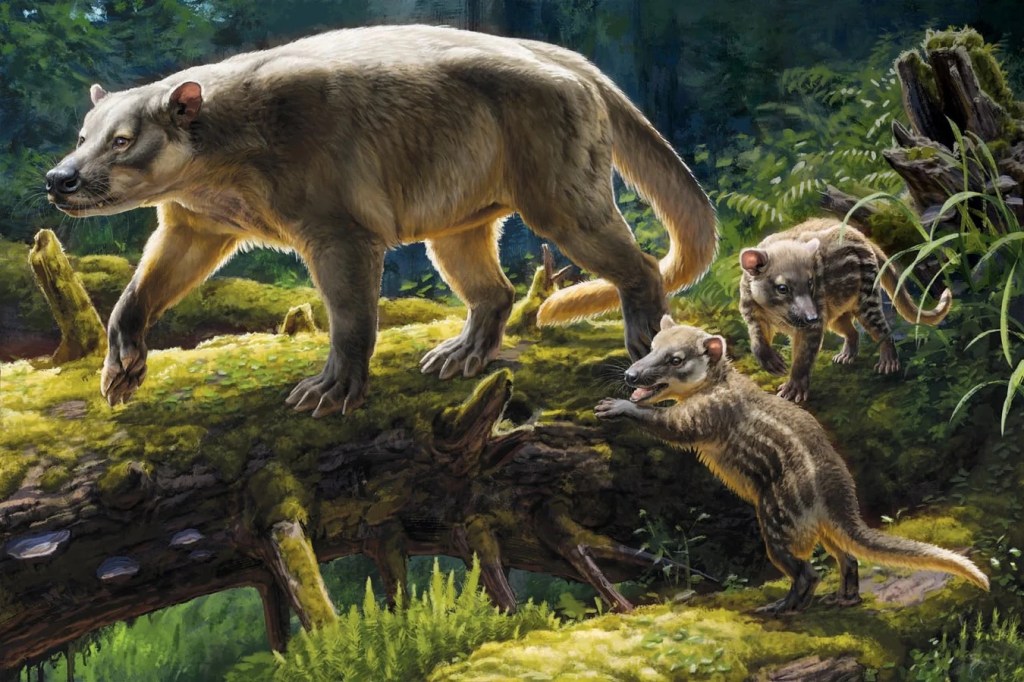
The furry Ectoconus and its young, post-apocalypse, 10 years after impact. They have emerged from their underground hideouts and now roam free. Suddenly those predators with teeth larger than steak knives have disappeared.

—————————-

Gandhinagar, Gujarat, India

10 Years After Impact

Shocking as the immediate aftereffects of the impact had been, the devastation is not total. There are a few places, on the other end of the earth, where the hardy have made it through. That includes present day Gandhinagar in the Indian state of Gujarat, 9500 miles from impact.

Even at the impact site, although the Chicxulub asteroid buried itself deep into bedrock, outside the outer ring of the crater even a thin layer of soil was enough to protect creatures that had their living rooms burrowed underground.

Soil is an excellent insulator. Wet soil, even more so. Incessant rains had been the norm prior to impact, ensuring a 10-metre thick layer of wet earth everywhere. Even at their most intense (450°C), the worldwide Paleocene fires have not been able to reach deeper than a few inches under.

It is almost as if Providence had prepared the little creatures that lived beneath the soil, for survival.

—————————-

The Ectoconus has always been an accomplished digger. Prior to impact, her burrow had been at the edge of an Edmontosaurus hatchery and hatching season was like a month-long thanksgiving dinner. She had been born here in this burrow, one of the many pups of the reddish-white, dappled, furry, wolf-sized mammals.

Unlike most mammals up to this time, she hadn’t been born from an egg. She had developed inside her mother alongside ten other siblings and had emerged through her mother’s vulva at birth. She and her brothers and sisters had immediately started suckling from pinhole-sized openings in their mom’s tummy.

The togetherness with her siblings during the time she had spent inside her mom’s womb, the furry warmth of her mom’s body now snoozing next to her, the cuddling…… it had felt heady, it had soothed, made her feel secure.

The Ectoconus didn’t know it then, as she lay cuddled up against her mom and her siblings, but she would feel a new emotion that went deeper than raw survival – intimacy – affection, in its paleogenic format.

It is entirely possible that cuddling gave mammals an evolutionary edge. The experience of the shared warmth helped the Ectoconus become a mindful parent, more secure than the great carnivorous reptiles who could never get off the savage “eat or be eaten” bandwagon, trigger-happy lizards who murdered their offspring over a greater portion of lunch and then ate them too. To the great reptiles the word “mindfulness” would forever remain alien.

In the new world, 10 years from impact, intimacy and survival are now intertwined.

—————————-

She and her siblings didn’t stick around with their Mom for long, though. When they grew swift and sturdy enough to be able to catch their own food, their Mom drove them out of the burrow, just as she had done with her previous litters.

There were no hard feelings. Evolution has taught them to strike out on their own, gain their own sexual partners, sometimes from other families that looked a bit different, their genes intermingling and mutating through generations.

As a teen, prior to impact, the Ectoconus recalls stealing up on the Edmontosaurus hatchery with her siblings at night and making off with an egg, pushing, rolling it the short distance to the burrow. The egg was delicious. Just one was enough to last a few days of fine dining.

The last egg-snatching foray had been wildly traumatic though, when her bro got squished beneath the feet of a herd of unwary hadrosaurs.

Her brother’s passing has done nothing to her psyche. It is still early for the new sensation of affection that she has developed toward her siblings to completely trump survival at all costs, a maxim that has stood her in good stead so far. It will be millions of years before her kind develops into a domesticated canine that is able to feel love, loss, emotions that we recognize. Her brother’s passing was just one of those things she has learned to live with, an occupational hazard, the loss of a foraging partner and nothing more.

It has been a while since the Ectoconus and her litter have had a taste of those Edmontosaurus eggs. Where the fuck were they gone to? She doesn’t know that non-avian dinosaurs like the Edmontosaurus are now all but extinct. Oh well, life goes on, we’ll find something else, she sighs.

———————————-

Meanwhile, the cold is very gradually loosening its grip on the planet. The dust has settled. Years of darkness from the airborne soot are now a thing of the past. Finally, sunlight is shining through once again.

The once fire-scarred landscape has been transformed. Those tall mesocyparis (ancestors of conifers) and giant ferns, charred skeletons after impact, have blended into the blackened soil and are no longer recognizable. It is as if they had never existed.

9500 miles from impact, Gandhinagar is no longer the steaming hot rain forest. Plants that had learned to live in low-light conditions, prior to impact, are blossoming everywhere. They are the plants that had lived, pre-impact, in the perpetual shade of the giant ficus benghalensis.

66 million years a from now, a genetic descendant of the ficus, the great banyan tree, will be revered and held sacred in India. The purple Hindu God, Krishna, will wax eloquent on how each leaf of the banyan is a hymn from the vedas. The founder of Buddhism, Gautama Buddha will spend years meditating and finally find enlightenment under it.

Obviously under such divine backing of multiple gods and religions, the ficus will survive the ravages of evolution and grow into sturdy behemoths that will live hundreds of years. Those plants that will disappear forever are the large angiosperms, huge flowering plants with gaudy flowers that had petals a metre in length, vegetation props from some dystopian sci-fi movie set.
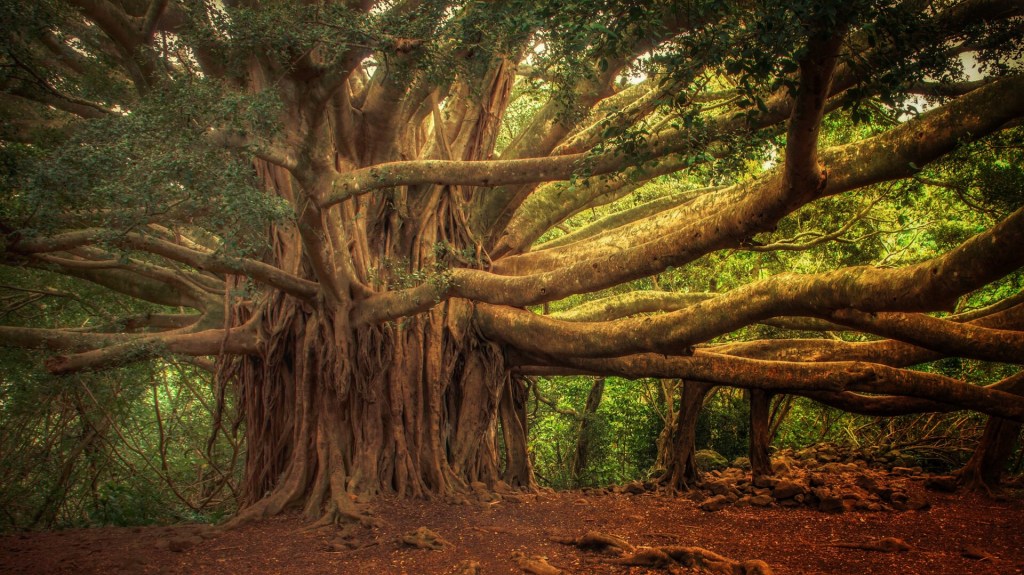
The Ficus Benghalensis (great banyan tree). This one, in Bodh Gaya, a village in the Indian province of Bihar, is thought to be 500+ years old.

—————————-

Even the ferns are smaller now, little plants, plush green, swaying in the breeze. Suddenly a fluttering feathered creature brushes past one of the ferns, sprinkling dew over its plumage.

It is a bird. Not one of those huge grotesque creatures whose wing-spans were metres long. Pre-impact, they had terrorized and now they were gone forever. This one eats food that is small in size – seeds, berries and insects. Evolution recognized that teeth are now redundant. It installed a gizzard and reshaped the bird’s mouth into a beak.

This bird is a 10-inch long feathered avian dinosaur, one of a few that have survived. It has no idea what saved it from the impact and its aftermath. Just 10 years prior, it had been an insignificant member of a much larger avian world with the terrifyingly vicious 40-ft wing-span Quetzalcoatlus on top of the avian food-chain.

Hoots, squawks, squeaks, tweets and gurgles had rung in this feathered little creature’s ears, a veritable orchestra of cacophony, for millions of years. And now, those familiar sounds are gone.

An omnivore, surviving on insects and bugs, as well as seeds that it swallows and then grinds in its gizzard, the bird had been a misfit in the pre-impact world. The larger, more grotesque avian dinosaurs, now gone, had hunted, attacked, clawed, bitten, chewed and ripped their way through life, while this tiny thing had stayed hidden under rocky overhangs and burrows.

Look who is laughing now? Feathered birds are the greatest success story of evolution, one with the humblest of beginnings, like this little creature that had lived like an afterthought, pre-impact. It will have a name – 66 million years from now – when a strange, highly intelligent mammal that will somehow walk on it’s two hind legs and find out how to fly on giant machines, will give it a name -> the Archaeopteryx.

———————————

Of the great reptiles all that remain a decade after impact are bits of charred bones, with little pieces of shredded dry skin still clinging on to them. Their innards, soft tissue, are long gone, disintegrated and dissolved into the soil. Under water, the humongous plesiosaurs have been replaced by smaller, 10-ft long reptiles, ancestors of crocodiles.

The Compsemys, a foot-long ancestor of the turtle, is a sluggish and dim-witted herbivore that minds its own business, but it has survived. At the time of impact, it had dived down and stayed down for 40 minutes without having to rise for oxygen. In fact it stayed submerged longer than that, the cloaca in its rear having special blood vessels that absorb oxygen from the water and replenish its oxygen supply, extending its ability to remain under water for an hour more, precious time that has saved its way of life.

Another hardy survivor is the caterpillar. Yeah, the tiny little Lepidopteran, the only genus that begins with an egg and gradually transforms into a winged insect, developing along the way into a larva(caterpillar), then a pupa(chrysalis) and finally the adult insect. It lives on a salads-only diet – green leaves. Time to time, it will be snapped up by the beak of an avian dinosaur and swallowed whole, but its sheer numbers will ensure its survival. In 66 millions years, it will be a member of genus that forms over 15% of all living creatures on earth.

—————————

If there is one clear message sent through fossils dug up, it is that our existence is due to sheer accident and not religious mumbo jumbo. Happenstance provides the raw material for natural selection to choose a certain direction, to decide which species will survive and which won’t.

The next time an evangelist of any faith waxes eloquent on how God created us, don’t forget to tell him he is full of shit.

You and I are here by sheer chance. 66 million years ago, a 10 trillion-ton rock, one of millions of such rocks that form a swirling cocoon around the Solar System called the Oort Cloud, began an erratic, blundering, drunken journey in a completely random direction, intermittently pushed and pulled by planets, moons and other space debris in its way. 

While passing Jupiter, the tug-of-war between the Sun and the large planet broke the rock into several pieces. The largest piece, a 2.5 trillion ton 7-mile wide iridium-rich rock, continued on until it just happened to slam into the earth.

The rock had travelled 10 trillion miles and taken 1500 years to reach its destination. The non-avian dinosaurs, who had been around for 185 million years when the rock struck, perished, ceding further evolution of life on earth to the mammals and the birds.

We, the Homo Sapiens, have been around for just 300000 years. That is 0.16% of the time that the dinosaurs spent on earth. In that short period of time, we have transformed into the lords, completely dominating over every other living creature.

The fact that we are the lords is a fluke – the accidental extinction of non-avian dinosaurs, from the accidental impact of a rock. There is absolutely nothing divine about it. If there is an entity called God who had created us, then surely he is also the one who has provided us with the intellect to delve far into the distant past and figure out most of everything that has happened so far. Why would he equip us thus? And having given us our intellect, surely he would also make it easy for us to find other intelligent forms of alien life?

Most puzzling of all, why would God make a rock amble through space for 1500 years and then crash into our planet so we could evolve through the next 66 million years into what we are today, when all he had to do was say it?

Why would God create a thousand million oxymorons???

—————————-

While walking to lunch with colleagues, discussing the possibility of there being intelligent life elsewhere in the universe, Enrico Fermi, the Italian-American physicist and Nobel Laureate, is reported to have blurted out, “But where is everybody?” 

If there is intelligent life elsewhere in the universe, where is it? Where are the damn aliens? If evolution of intelligent life was so easy, surely they would have come calling by now? History however has repeatedly shown us that nothing at all is impossible.

A great practician of logic, Fermi also acknowledged that purely on a statistical basis, the chances that there are advanced extra-terrestrial life forms out there are very high. This is the Fermi Paradox, the duel between the lack of conclusive evidence of advanced extraterrestrial life and the apparently high likelihood of its existence.

But I think we are unique, one of a kind created by sheer chance, by rock hitting rock in a distant past. Just because there are an unimaginable number of star systems in the universe, that does not necessarily mean that there must be other intelligent beings elsewhere.

We are unique in more ways than one. Most star systems are binary star systems (ie : two stars orbiting each other). Except our’s.

——————————

The Chicxulub asteroid impact was like nothing that had come before or has come since. Had that rock missed the earth altogether or maybe just grazed it, our planet’s history would surely have been spectacularly different. We may never have evolved at all. Maybe new strains of monster dinosaurs would be strutting around right this minute, killing on a whim anything that crossed their path.

Our continued survival therefore is not assured. We are hardy little critters but we have to learn to live like there will be no tomorrow.

Share this:

  • Click to share on X (Opens in new window) X
  • Click to share on WhatsApp (Opens in new window) WhatsApp
  • Click to share on Facebook (Opens in new window) Facebook
  • Click to email a link to a friend (Opens in new window) Email
  • Click to print (Opens in new window) Print
  • Click to share on Tumblr (Opens in new window) Tumblr
  • Click to share on Reddit (Opens in new window) Reddit
  • Click to share on Pinterest (Opens in new window) Pinterest
  • Click to share on LinkedIn (Opens in new window) LinkedIn
  • Click to share on Pocket (Opens in new window) Pocket
Like Loading...

The Cretaceous–Paleogene Extinction Event – Episode : 3 – Impact

06 Thursday Jun 2024

Posted by spunkybong in Asteroid Chicxulub, Uncategorized

≈ Leave a comment

Tags

asteroid, Chicxulub, dinosaurs, extinction level event, impact crater

Artist’s impression of the Chicxulub crater

—————————-

Frenchman River Valley, Saskatchewan, Canada

66,050,000 BC (+\-500,000)

If a main battle tank were to suddenly come alive, one could mistake it for an Ankylosaurus. Rows of segmented armour plates (scutes) cover her back. Hard spikes point outward from the sides of her belly and at the very end of her tail is a bony knob that acts like a sledgehammer, to smash the skull of a T-Rex should it mistake her for lunch. Even her eyelids are armored.

Including her tail, the Ankylosaurus is 40ft long and weighs 15 tons, fully grown. Because of her great bulk, she can run at a max speed of 6 mph only but that is hardly a disadvantage, given that other dinosaurs (including Scotty, the T-Rex) don’t like to mess with her.

A T-Rex loses teeth as its head gets a battering from an Ankylosaurus’ tail knob. Ankylosaurus is “fused lizard” in Greek. Apt, because she is a distant ancestor of the crocodile.

———————-

The Ankylosaurus has sensed that something is very wrong. Her unease isn’t caused by the approach of a hungry predator. All of a sudden, the ground is rumbling and shifting, like at any moment she might be yanked off her hoofed feet.

Moments earlier the beast had stooped to drink from the edge of a lake, her feet firmly planted on a huge slab of rock that had slanted into the water, like a boat ramp. Dinosaurs know enough not to wade into the water. The lake has no bottom, only a thick ooze of quicksand that swallows anything that falls in to it.

The rock is covered with slippery moss and now it is moving and shuddering, leaving the Ankylosaurus trying desperately to back up. Slipping and sliding she barely makes it out, hooded eyes staring up skyward. “What the fuck just happened?” they seem to say.

Behind the Ankylosaurus, a sudden rush of wind joins the heaving ground to set the trees swaying, performing a macabre dance. A giant Metasequoia leans drunkenly forward at an angle, causing a roosting pterosaur to scramble to take to the sky, squawking in annoyance, its 20ft wings grasping at the air, desperately seeking lift. For a moment it looks as if the huge bird won’t make it but it eventually does.

Then, suddenly the shaking stops. The metasequoia comes back up almost to its original erect bearing and everything goes still, eerily quiet. It is as if nothing at all had been amiss.

The Ankylosaurus freezes, unable to make anything out of what just happened. Nothing in the past 20 years that she has been alive has prepared her for this. She stands stock still and waits. The fact, that 2000 miles to the south a rock has slammed into the earth, is a scenario totally alien, completely incomprehensible, to her.

Frenchman River Valley used to be a noisy place, filled with hoots, squawks, roars, hisses and the thumping of huge hooves, but now there is complete silence. All the inhabitants of French River Valley, the herbivores, the carnivores, the mammals and the reptiles, have frozen in place. Every living being is holding its breath.

The second tremor is far stronger. The slab that the Ankylosaurus had backed up on lifts up suddenly with such massive force that the great beast is flung 50ft into the air like a rag doll. Since the slab had slanted into the lake, the beast does a parabolic arc through the air and plunges into the water with a mighty splash. She flails around with her powerful tail and the more she thrashes about, the faster the quicksand swallows her. She tries desperately, right up until her head disappears under.

The tremors – seismic waves – are now coming in pulses, each stronger than its predecessor, showing no signs of tapering off. All around, giant conifers have been flattened. The nearby inland lake has breached, flooding an area the size of New York State. In 66 million years, all that will remain of the lake is the Frenchman River.

The Chicxulub ELE has claimed its first Canadian victim, 2000 miles to the north, in what is today, Saskatchewan.

—————————-

Across the expanse of water now known as the Atlantic Ocean, far to the north-east is an archipelago in the North Sea. 66 million years from now, it will form a part of the European mainland and be known as Norway. It will no longer be hot, dank and fetid and the marshy flatlands will turn into breathtaking snowbound fjords, swept by icy chill winds.

But today it is just a chain of islands, 360 miles north of present-day Russia and the Russian mainland is currently separated from Europe by a vast 150-mile wide shallow sea that is at places only 50 fathoms deep.

Under the waters, away from the oppressive heat, a gigantic Pliosaurus is steadily rising upward to the surface to catch a gulp of air. Like Scotty, the T-Rex, this beast too is an equal-opportunity predator. It devours anything alive that is dumb enough to swim by. Just an hour back, it had grabbed a passing 1-ton, 14-foot plesiosaur, a Morturneria, by its neck and gorged on its thighs.

Sated for the moment, the Pliosauraus powers his way up until his neck breaks surface. Sheets of water cascade from the enormous head down its neck. Rippling waves spread out like as if a ballistic missile SSBN has surfaced. The sun is low over the horizon, a dim ball of light, glowing red.

All of a sudden something plops into the water, something really hot, because it causes hissing steam to rise immediately. The strike causes a mini-waterspout, so fast was the object’s velocity. The ripple hasn’t died down when another hits. Then another and another, until the waters around the pliosaurus’ head are sizzling and churning, as an acrid smoke begins to choke his breathing and block his sense of smell.

Soon it is raining red hot lumps all around, turning the sea into a hissy, choppy cauldron of death.

One thing dinosaurs aren’t is smart. Instead of diving, the Pliosaurus treads water, transfixed, a deer caught in the headlights. It is a matter of time, before one refrigerator-sized lump hits him square between the large mirthless grey eyes. The effect is spectacular. One minute there is a head attached to a neck and the next, the air is saturated with red-white vapour, millions of tiny pieces of brain, bone and tissue.

The headless Plesiosaur floats away, bobbing furiously in the violently churning waters. By now the ambient water temperature has escalated from 39°C to 52°C. The air has turned into a haze of steam, visibility down to near zero. The sun, still above the horizon, is no longer visible, except for a diffused patch of light in the west.

The Chicxulub ELE has claimed its first Eurasian victim, in another continent, 6000 miles from ground zero.

——————————-

No two impacts produce exactly the same damage. The impactor’s size and speed, the angle of incidence at which it hits, the environment it strikes, all these decide the extent of damage an asteroid can cause.

The Chicxulub asteroid had the worst of all the above circumstances. It came in at 72000 miles per hour, a streak of glowing red light, too fast for the eye to comprehend. It wasn’t a vertical impact. The 7-mile wide rock rammed home, slanted at 45°. One moment everything was as it had always been and the next, this spot on the earth’s skin burst open like a popped pimple.

The force of the impact was so great that quantifying it, giving it a value in teratonnes and zettajoules would border on the ridiculous. There is simply no way anyone can imagine the sheer magnitude of the strike. Not since the formation of the early earth had there been an impact like this one-in-a-million random event, this culmination of a series of random events.

The asteroid hit the earth’s crust, in the shallow continental shelf of what is now the Gulf of Mexico, it’s force driving it 12 miles deep melting and vaporizing stone and rock and ejecting the debris 70 miles into the upper layers of the atmosphere. Like a water droplet hitting the surface of a still pond, the rock created a circular ridge which fell back, creating a middle peak at the centre of the strike spot. And then, the middle peak collapsed, leaving a bowl shaped crater 186 miles in diameter.

All this, within the first 5 minutes.

All that force had to go somewhere and it did, in the form of repeated waves of shock, inadvertently announcing the arrival of the rock to the world. Several hours passed, as repeated 300ft-high super tsunami waves hit the Yucatan coastline, tossing huge dinosaurs around like little plastic toy figures.

————————————-

All through the billions of years of its existence, the earth has been the target of numerous asteroid impacts. The large number of impact craters (some easily recognizable by sight and others through imaging techniques) stand testament to this.

Of all the direct hits that the earth received, the Chicxulub crater in Mexico’s Yucatan Peninsula is estimated to be the largest and most devastating, at a whopping 186 miles in diameter.

There have been near-misses too. In 2013, the 30-metre wide Duende passed within 17240 miles of us, far closer than some geostationary satellites. It it had hit, it would have delivered a forced equal to that of a 4.8-Megaton atom bomb. That would be the equivalent of 320 Hiroshima detonations all at once and it could have taken out, not only Hiroshima, but also Tokyo and all the other big cities in the 88000 sq.mile Honshu Island, had it been a direct hit.

—————————-

Among identified asteroids that will either actually hit or be really close is Apophis, a 370-metre diameter chunk of rock that is still 180 million miles from us, right now somewhere in the constellation of Taurus.

In 2029, while bypassing the earth, Apophis will go through what is known as a gravitational keyhole, which in layman’s terms is a narrow window created by the earth’s gravitation that deflects the path of an asteroid just enough to ensure that it will hit the earth the next time it comes around the sun. For Apophis, this window is just 500 miles wide.

Then, in 2036, Apophis will be back and this time, as per present calculations, slam into us with the force of a 37-Megaton thermo-nuclear bomb. It will not be an Extinction Level Event (ELE) but wherever it strikes it will instantly wipe out everything within a 1000-mile radius.

My son – and millions of sons and daughters – will be 36 in 2036.

———————————

Fortunately, no ELEs are expected for the next 100 years. Whenever a future extinction level event does become certain, I wonder what life will be like, in the months before impact…..

Since there will be no place of safety to escape to – other than the ISS, which itself will be a short respite – will humans realize the futility of maintaining societal structures, laws, norms, ethics, etiquette, morality, virtue? Will they turn into animals and simply do what they feel like? Would I be able to make Scarlett Johanssen say yes? Will organized religion cease to exist? Will the Abbess cry out to the Bishop, “To hell with Jesus, fuck me anywhere, holy father!”

I’ll probably be dead long before any abbess says those words but I’d still like to know, dammit.

Or…..

Would governments ensure citizens are blissfully unaware untill the moment they see the enormous flash turn night into day and stare at the 200-metre high tsunami bearing down on them at 150 mph?

I think so, yes, most definitely. Government(s) have a good argument for not divulging this type of information. The panic, rioting and general breakdown of society as we know it will hinder any plans that are in place to protect what, if anything, can be protected and that includes a list of people I am most likely not going to be on.

One way to absolutely ensure that I am prepared for the end is to treat every day as if it is my last. Sooner or later it will happen anyway, ELE or no ELE.

Share this:

  • Click to share on X (Opens in new window) X
  • Click to share on WhatsApp (Opens in new window) WhatsApp
  • Click to share on Facebook (Opens in new window) Facebook
  • Click to email a link to a friend (Opens in new window) Email
  • Click to print (Opens in new window) Print
  • Click to share on Tumblr (Opens in new window) Tumblr
  • Click to share on Reddit (Opens in new window) Reddit
  • Click to share on Pinterest (Opens in new window) Pinterest
  • Click to share on LinkedIn (Opens in new window) LinkedIn
  • Click to share on Pocket (Opens in new window) Pocket
Like Loading...

Blog Stats

  • 70,354 hits

© Achyut Dutt 2013

Meta

  • Create account
  • Log in
  • Entries feed
  • Comments feed
  • WordPress.com

Recent Posts

  • Belaya Roza (Prequel)
  • Oh my God, those bulbous heads are here !!
  • The Bio-Hazard called Deep Space [Part-1]
  • Oh my God, they’re watching us on Pornhub!!! [Part-1]
  • Coveting thy neighbour [Part-2] – Trashing the 9th Commandment
  • Coveting thy neighbour [Part-1] – The Present
  • The godmens’ godman
  • Dressed to Kill – The Black Widows of the Caucasus
  • Kuzkina Tetya [Part-1] – A souring Bromance
  • Kuzkina Tetya [Part-2] – The Bear
  • My Tryst with Betty Grable
  • 4th July – The Normality of the Abnormal
  • La Sexie Folie
  • Want a Halo Hoop?
  • 18 Wheels – A Tribute to Truckers
  • Paanwala
  • Luchnyk Khalifa [Part-1] – The Archer
  • A Beedi in a Storm
  • The first “First Man” [Part-1]
  • Beheading…. Sigh, the Lord has His ways
  • The Hunt [Final Part]
  • The Hunt [Part-7]
  • The Hunt [Part-6]
  • The Hunt [Part-5]
  • The Hunt [Part-4]
  • The Hunt [Part-3]
  • Fierté Montreal – Haj, for Gay Folks
  • The Hunt [Part-2]
  • The Hunt [Part-1]
  • Kuzkina Tetya [Part-4]
  • Kuzkina Tetya [Part-3]
  • Kuzkina Tetya [Part-2]
  • The Main
  • Spilt [Part-2]
  • Spilt [Part-1]
  • Hillbilly Eulogy
  • Illusionist
  • Autocracy, Inc. – Not a review
  • The Killing of the Little Giant [Part-2]
  • The Killing of the Little Giant [Part-1]
  • I was stoned but didn’t miss it
  • Getting Older Without Getting Old
  • The right to bare
  • Fucking with the 7th Commandment
  • The Cretaceous–Paleogene Extinction Event – Episode : 5 – 10 years after Impact
  • E Pluribus Multis
  • The Cretaceous–Paleogene Extinction Event – Episode : 4 – The Day After
  • The Cretaceous–Paleogene Extinction Event – Episode : 3 – Impact
  • Jamai Shashti
  • Charlie-Class

Top Posts & Pages

The first “First Man” [Part-1]
Seeking comfort in inanity
You've come a long way, baby
Mithridatus VI - Hannibal of the East (Part-1)
Belaya Roza (Prequel)
Dressed to Kill - The Black Widows of the Caucasus
Just imagine you're Hank the 8th

Enter your email address to follow this blog and receive notifications of new posts by email.

Join 99 other subscribers

© Achyut Dutt 2013

Blog Stats

  • 70,354 hits

Meta

  • Create account
  • Log in
  • Entries feed
  • Comments feed
  • WordPress.com

Enter your email address to follow this blog and receive notifications of new posts by email.

Join 99 other subscribers

Recent Posts

  • Belaya Roza (Prequel)
  • Oh my God, those bulbous heads are here !!
  • The Bio-Hazard called Deep Space [Part-1]
  • Oh my God, they’re watching us on Pornhub!!! [Part-1]
  • Coveting thy neighbour [Part-2] – Trashing the 9th Commandment
  • Coveting thy neighbour [Part-1] – The Present
  • The godmens’ godman
  • Dressed to Kill – The Black Widows of the Caucasus
  • Kuzkina Tetya [Part-1] – A souring Bromance
  • Kuzkina Tetya [Part-2] – The Bear
  • My Tryst with Betty Grable
  • 4th July – The Normality of the Abnormal
  • La Sexie Folie
  • Want a Halo Hoop?
  • 18 Wheels – A Tribute to Truckers
  • Paanwala
  • Luchnyk Khalifa [Part-1] – The Archer
  • A Beedi in a Storm
  • The first “First Man” [Part-1]
  • Beheading…. Sigh, the Lord has His ways
  • The Hunt [Final Part]
  • The Hunt [Part-7]
  • The Hunt [Part-6]
  • The Hunt [Part-5]
  • The Hunt [Part-4]
  • The Hunt [Part-3]
  • Fierté Montreal – Haj, for Gay Folks
  • The Hunt [Part-2]
  • The Hunt [Part-1]
  • Kuzkina Tetya [Part-4]
  • Kuzkina Tetya [Part-3]
  • Kuzkina Tetya [Part-2]
  • The Main
  • Spilt [Part-2]
  • Spilt [Part-1]
  • Hillbilly Eulogy
  • Illusionist
  • Autocracy, Inc. – Not a review
  • The Killing of the Little Giant [Part-2]
  • The Killing of the Little Giant [Part-1]
  • I was stoned but didn’t miss it
  • Getting Older Without Getting Old
  • The right to bare
  • Fucking with the 7th Commandment
  • The Cretaceous–Paleogene Extinction Event – Episode : 5 – 10 years after Impact
  • E Pluribus Multis
  • The Cretaceous–Paleogene Extinction Event – Episode : 4 – The Day After
  • The Cretaceous–Paleogene Extinction Event – Episode : 3 – Impact
  • Jamai Shashti
  • Charlie-Class

Top Posts & Pages

The first “First Man” [Part-1]
Seeking comfort in inanity
You've come a long way, baby
Mithridatus VI - Hannibal of the East (Part-1)
Belaya Roza (Prequel)
Dressed to Kill - The Black Widows of the Caucasus
Just imagine you're Hank the 8th

https://www.facebook.com/profile.php?id=61550932467326

Create a free website or blog at WordPress.com.

Privacy & Cookies: This site uses cookies. By continuing to use this website, you agree to their use.
To find out more, including how to control cookies, see here: Cookie Policy
  • Subscribe Subscribed
    • Spunkypedia
    • Join 99 other subscribers
    • Already have a WordPress.com account? Log in now.
    • Spunkypedia
    • Subscribe Subscribed
    • Sign up
    • Log in
    • Report this content
    • View site in Reader
    • Manage subscriptions
    • Collapse this bar
 

Loading Comments...
 

    %d