
—————————-
Gandhinagar, Gujarat, India
10 Years After Impact
Shocking as the immediate aftereffects of the impact had been, the devastation is not total. There are a few places, on the other end of the earth, where the hardy have made it through. That includes present day Gandhinagar in the Indian state of Gujarat, 9500 miles from impact.
Even at the impact site, although the Chicxulub asteroid buried itself deep into bedrock, outside the outer ring of the crater even a thin layer of soil was enough to protect creatures that had their living rooms burrowed underground.
Soil is an excellent insulator. Wet soil, even more so. Incessant rains had been the norm prior to impact, ensuring a 10-metre thick layer of wet earth everywhere. Even at their most intense (450°C), the worldwide Paleocene fires have not been able to reach deeper than a few inches under.
It is almost as if Providence had prepared the little creatures that lived beneath the soil, for survival.
—————————-
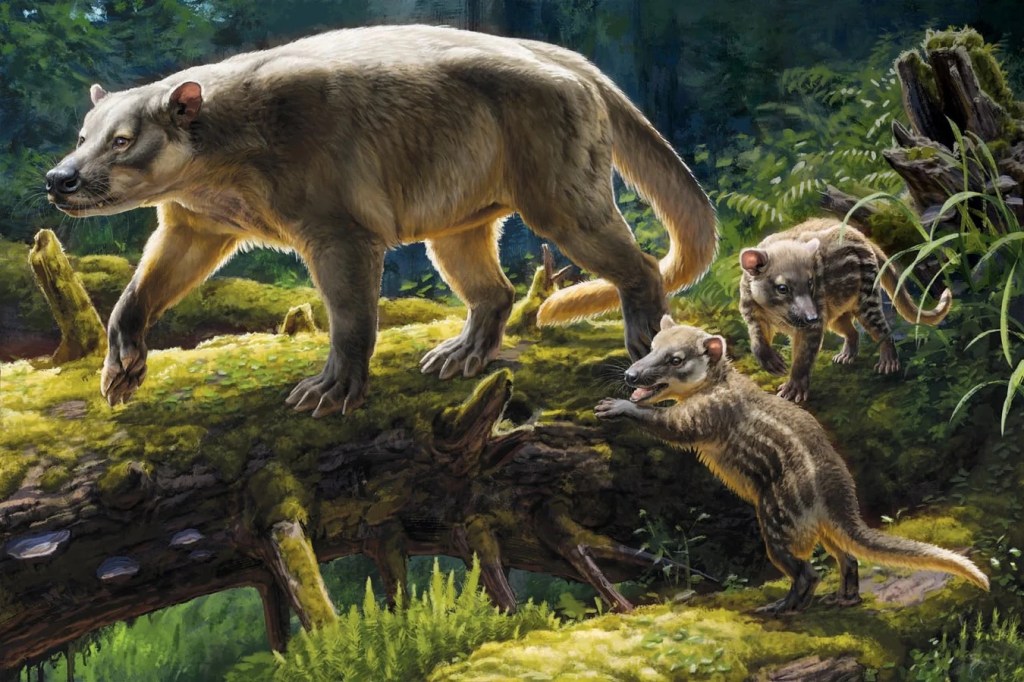
The Ectoconus has always been an accomplished digger. Prior to impact, her burrow had been at the edge of an Edmontosaurus hatchery and hatching season was like a month-long thanksgiving dinner. She had been born here in this burrow, one of the many pups of the reddish-white, dappled, furry, wolf-sized mammals.
Unlike most mammals up to this time, she hadn’t been born from an egg. She had developed inside her mother alongside ten other siblings and had emerged through her mother’s vulva at birth. She and her brothers and sisters had immediately started suckling from pinhole-sized openings in their mom’s tummy.
The togetherness with her siblings during the time she had spent inside her mom’s womb, the furry warmth of her mom’s body now snoozing next to her, the cuddling…… it had felt heady, it had soothed, made her feel secure.
The Ectoconus didn’t know it then, as she lay cuddled up against her mom and her siblings, but she would feel a new emotion that went deeper than raw survival – intimacy – affection, in its paleogenic format.
It is entirely possible that cuddling gave mammals an evolutionary edge. The experience of the shared warmth helped the Ectoconus become a mindful parent, more secure than the great carnivorous reptiles who could never get off the savage “eat or be eaten” bandwagon, trigger-happy lizards who murdered their offspring over a greater portion of lunch and then ate them too. To the great reptiles the word “mindfulness” would forever remain alien.
In the new world, 10 years from impact, intimacy and survival are now intertwined.
—————————-
She and her siblings didn’t stick around with their Mom for long, though. When they grew swift and sturdy enough to be able to catch their own food, their Mom drove them out of the burrow, just as she had done with her previous litters.
There were no hard feelings. Evolution has taught them to strike out on their own, gain their own sexual partners, sometimes from other families that looked a bit different, their genes intermingling and mutating through generations.
As a teen, prior to impact, the Ectoconus recalls stealing up on the Edmontosaurus hatchery with her siblings at night and making off with an egg, pushing, rolling it the short distance to the burrow. The egg was delicious. Just one was enough to last a few days of fine dining.
The last egg-snatching foray had been wildly traumatic though, when her bro got squished beneath the feet of a herd of unwary hadrosaurs.
Her brother’s passing has done nothing to her psyche. It is still early for the new sensation of affection that she has developed toward her siblings to completely trump survival at all costs, a maxim that has stood her in good stead so far. It will be millions of years before her kind develops into a domesticated canine that is able to feel love, loss, emotions that we recognize. Her brother’s passing was just one of those things she has learned to live with, an occupational hazard, the loss of a foraging partner and nothing more.
It has been a while since the Ectoconus and her litter have had a taste of those Edmontosaurus eggs. Where the fuck were they gone to? She doesn’t know that non-avian dinosaurs like the Edmontosaurus are now all but extinct. Oh well, life goes on, we’ll find something else, she sighs.
———————————-
Meanwhile, the cold is very gradually loosening its grip on the planet. The dust has settled. Years of darkness from the airborne soot are now a thing of the past. Finally, sunlight is shining through once again.
The once fire-scarred landscape has been transformed. Those tall mesocyparis (ancestors of conifers) and giant ferns, charred skeletons after impact, have blended into the blackened soil and are no longer recognizable. It is as if they had never existed.
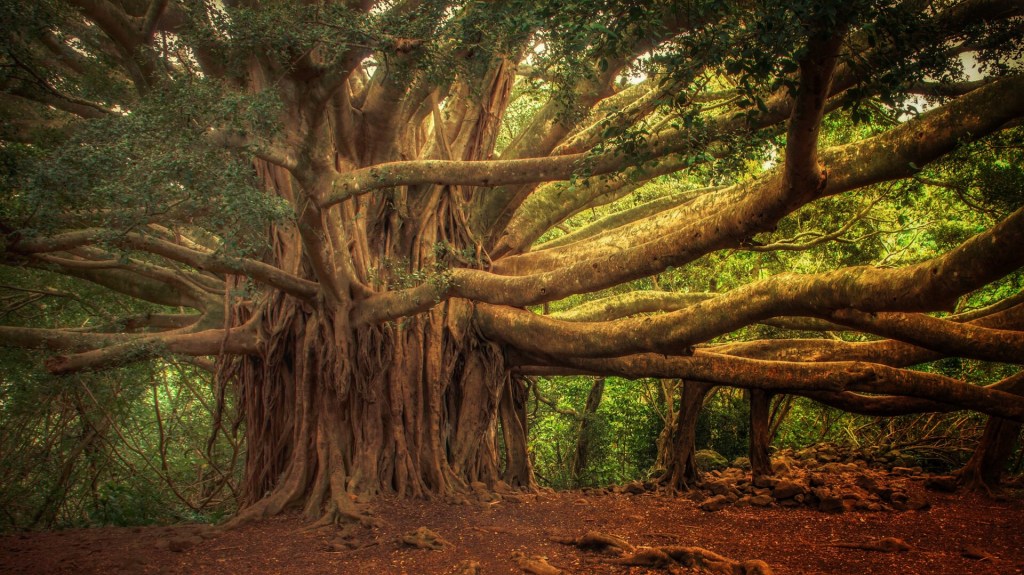
9500 miles from impact, Gandhinagar is no longer the steaming hot rain forest. Plants that had learned to live in low-light conditions, prior to impact, are blossoming everywhere. They are the plants that had lived, pre-impact, in the perpetual shade of the giant ficus benghalensis.
66 million years a from now, a genetic descendant of the ficus, the great banyan tree, will be revered and held sacred in India. The purple Hindu God, Krishna, will wax eloquent on how each leaf of the banyan is a hymn from the vedas. The founder of Buddhism, Gautama Buddha will spend years meditating and finally find enlightenment under it.
Obviously under such divine backing of multiple gods and religions, the ficus will survive the ravages of evolution and grow into sturdy behemoths that will live hundreds of years. Those plants that will disappear forever are the large angiosperms, huge flowering plants with gaudy flowers that had petals a metre in length, vegetation props from some dystopian sci-fi movie set.
—————————-
Even the ferns are smaller now, little plants, plush green, swaying in the breeze. Suddenly a fluttering feathered creature brushes past one of the ferns, sprinkling dew over its plumage.
It is a bird. Not one of those huge grotesque creatures whose wing-spans were metres long. Pre-impact, they had terrorized and now they were gone forever. This one eats food that is small in size – seeds, berries and insects. Evolution recognized that teeth are now redundant. It installed a gizzard and reshaped the bird’s mouth into a beak.
This bird is a 10-inch long feathered avian dinosaur, one of a few that have survived. It has no idea what saved it from the impact and its aftermath. Just 10 years prior, it had been an insignificant member of a much larger avian world with the terrifyingly vicious 40-ft wing-span Quetzalcoatlus on top of the avian food-chain.
Hoots, squawks, squeaks, tweets and gurgles had rung in this feathered little creature’s ears, a veritable orchestra of cacophony, for millions of years. And now, those familiar sounds are gone.
An omnivore, surviving on insects and bugs, as well as seeds that it swallows and then grinds in its gizzard, the bird had been a misfit in the pre-impact world. The larger, more grotesque avian dinosaurs, now gone, had hunted, attacked, clawed, bitten, chewed and ripped their way through life, while this tiny thing had stayed hidden under rocky overhangs and burrows.
Look who is laughing now? Feathered birds are the greatest success story of evolution, one with the humblest of beginnings, like this little creature that had lived like an afterthought, pre-impact. It will have a name – 66 million years from now – when a strange, highly intelligent mammal that will somehow walk on it’s two hind legs and find out how to fly on giant machines, will give it a name -> the Archaeopteryx.
———————————
Of the great reptiles all that remain a decade after impact are bits of charred bones, with little pieces of shredded dry skin still clinging on to them. Their innards, soft tissue, are long gone, disintegrated and dissolved into the soil. Under water, the humongous plesiosaurs have been replaced by smaller, 10-ft long reptiles, ancestors of crocodiles.
The Compsemys, a foot-long ancestor of the turtle, is a sluggish and dim-witted herbivore that minds its own business, but it has survived. At the time of impact, it had dived down and stayed down for 40 minutes without having to rise for oxygen. In fact it stayed submerged longer than that, the cloaca in its rear having special blood vessels that absorb oxygen from the water and replenish its oxygen supply, extending its ability to remain under water for an hour more, precious time that has saved its way of life.
Another hardy survivor is the caterpillar. Yeah, the tiny little Lepidopteran, the only genus that begins with an egg and gradually transforms into a winged insect, developing along the way into a larva(caterpillar), then a pupa(chrysalis) and finally the adult insect. It lives on a salads-only diet – green leaves. Time to time, it will be snapped up by the beak of an avian dinosaur and swallowed whole, but its sheer numbers will ensure its survival. In 66 millions years, it will be a member of genus that forms over 15% of all living creatures on earth.
—————————
If there is one clear message sent through fossils dug up, it is that our existence is due to sheer accident and not religious mumbo jumbo. Happenstance provides the raw material for natural selection to choose a certain direction, to decide which species will survive and which won’t.
The next time an evangelist of any faith waxes eloquent on how God created us, don’t forget to tell him he is full of shit.
You and I are here by sheer chance. 66 million years ago, a 10 trillion-ton rock, one of millions of such rocks that form a swirling cocoon around the Solar System called the Oort Cloud, began an erratic, blundering, drunken journey in a completely random direction, intermittently pushed and pulled by planets, moons and other space debris in its way.
While passing Jupiter, the tug-of-war between the Sun and the large planet broke the rock into several pieces. The largest piece, a 2.5 trillion ton 7-mile wide iridium-rich rock, continued on until it just happened to slam into the earth.
The rock had travelled 10 trillion miles and taken 1500 years to reach its destination. The non-avian dinosaurs, who had been around for 185 million years when the rock struck, perished, ceding further evolution of life on earth to the mammals and the birds.
We, the Homo Sapiens, have been around for just 300000 years. That is 0.16% of the time that the dinosaurs spent on earth. In that short period of time, we have transformed into the lords, completely dominating over every other living creature.
The fact that we are the lords is a fluke – the accidental extinction of non-avian dinosaurs, from the accidental impact of a rock. There is absolutely nothing divine about it. If there is an entity called God who had created us, then surely he is also the one who has provided us with the intellect to delve far into the distant past and figure out most of everything that has happened so far. Why would he equip us thus? And having given us our intellect, surely he would also make it easy for us to find other intelligent forms of alien life?
Most puzzling of all, why would God make a rock amble through space for 1500 years and then crash into our planet so we could evolve through the next 66 million years into what we are today, when all he had to do was say it?
Why would God create a thousand million oxymorons???
—————————-
While walking to lunch with colleagues, discussing the possibility of there being intelligent life elsewhere in the universe, Enrico Fermi, the Italian-American physicist and Nobel Laureate, is reported to have blurted out, “But where is everybody?”
If there is intelligent life elsewhere in the universe, where is it? Where are the damn aliens? If evolution of intelligent life was so easy, surely they would have come calling by now? History however has repeatedly shown us that nothing at all is impossible.
A great practician of logic, Fermi also acknowledged that purely on a statistical basis, the chances that there are advanced extra-terrestrial life forms out there are very high. This is the Fermi Paradox, the duel between the lack of conclusive evidence of advanced extraterrestrial life and the apparently high likelihood of its existence.
But I think we are unique, one of a kind created by sheer chance, by rock hitting rock in a distant past. Just because there are an unimaginable number of star systems in the universe, that does not necessarily mean that there must be other intelligent beings elsewhere.
We are unique in more ways than one. Most star systems are binary star systems (ie : two stars orbiting each other). Except our’s.
——————————
The Chicxulub asteroid impact was like nothing that had come before or has come since. Had that rock missed the earth altogether or maybe just grazed it, our planet’s history would surely have been spectacularly different. We may never have evolved at all. Maybe new strains of monster dinosaurs would be strutting around right this minute, killing on a whim anything that crossed their path.
Our continued survival therefore is not assured. We are hardy little critters but we have to learn to live like there will be no tomorrow.


A wonderful read. It’s almost like being there, so many millions of years ago….
LikeLike
Thank you, Dadi!
LikeLike