
—————————————————
Tashkent
Uzbekistan Soviet Socialist Republic
January 1966
The talks had been an unmitigated success, a result of having the host on his side.
The banquet that followed had dragged on, giving the little man just three hours to sleep, which had been fitful. His personal physician had given him a mild sedative, but it hadn’t worked, leaving him drawn and fatigued.
All of a sudden, he was reminded of the day, twenty four years prior, during the Quit India Movement, when he had been granted parole by the Brits to visit his dying daughter. He could not save her in the end, as the drugs required were too expensive. There were many who had been ready to offer financial support but that had always been anathema to him.
Besides rock-solid integrity, inside that tiny five foot frame, lay an iron will and a keen mind that understood political strategy and that evening at Tashkent, it had prevailed. He was relieved at finally bringing the curtain down on a very nasty month-long conflict that had begun with 33000 Pakistani troops charging across the Line of Control, unprovoked, dressed as Kashmiri locals.
By the time the talks had begun, Indian troops had pushed back and occupied over 1800 sq. kms of Pakistani territory and Pakistan was suing for peace.
————————————
The conflict had been a glaring display of an unequal match in terms of armaments. While India fought with outdated British-made Folland Gnat jet fighters and aging World War-2 M4 Sherman tanks, Pakistan was flush with state of the art F86 Sabre jets, F104 Starfighters and spanking new M48 Patton tanks that the US had so generously given away, under the false pretext of a fight against communism.
Those 48 days of conflict, the Chinese – strategic partners to Pakistan – had tried to stir up trouble in the north-eastern borders of India, bringing up imagined border disputes, so that Indian military resources would be stretched, diverted away from the west, where the conflict with Pakistan was raging. But with Soviet backing, the little man had told the Chinese that they could go fuck themselves and they probably did follow his advice, because they withdrew tamely and nothing further was heard from them.
By the time, the ceasefire talks came around, the conflict had claimed 8000 lives, destroyed infrastructure and consumed armaments worth over $100 million, funds that either nation could ill afford at that point in time.
The provocateur, Pakistani dictator Field Marshal Mohammad Ayub Khan, didn’t have to worry though. Over the years, he and his generals had received millions for letting America set up bases in their territory and from those bases, run blatantly illegal covert, high-altitude U2 reconnaissance flights operated by the CIA over the Soviet Union.
The Americans were behind him.
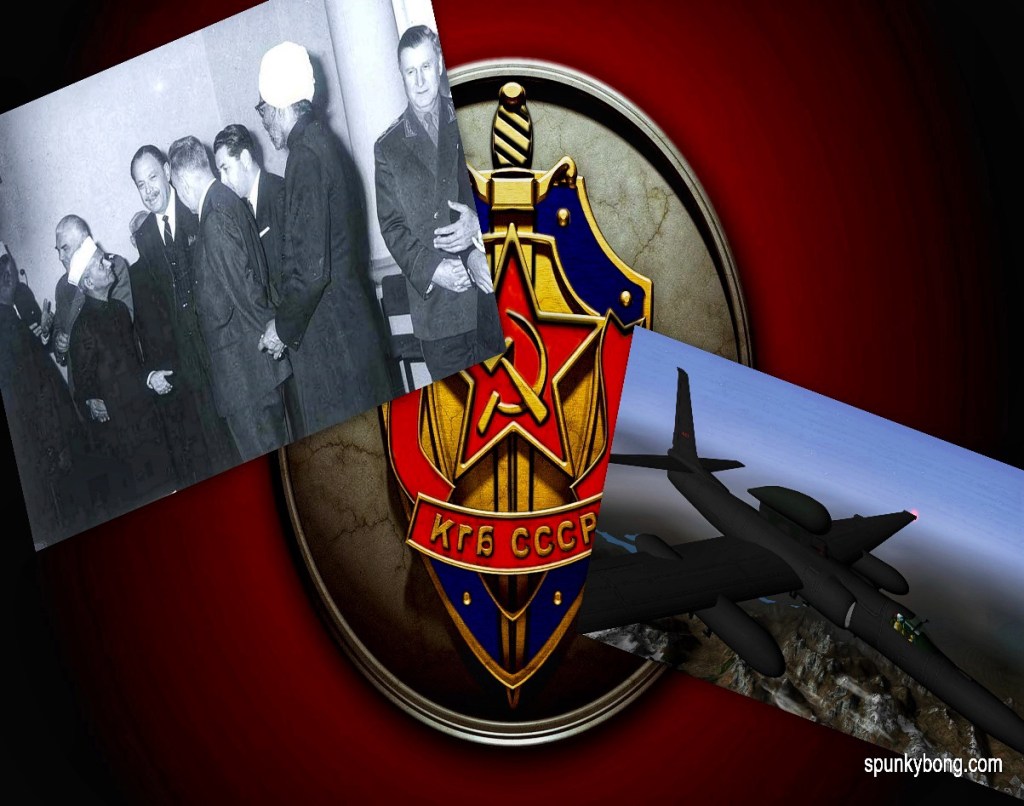
At Tashkent that day, the Soviets were the hosts, the peacemakers. They were ostensibly non-partisan but the little man knew whose side they were really on, thanks to a captured American U2 pilot named Francis Gary Powers……
Five years prior, Gary Powers had taken off from an American air base at Badaber, near the Afghan border, that the Pakistanis had allowed the US to build to be able to launch high-altitude reconnaissance missions over the USSR. The U2, a long, slim aircraft developed by Lockheed specially for the CIA, could cruise at 70000 ft, a height that the US believed the Soviet surface-to-air missiles of the day did not have the capability to reach.
The Americans were wrong and Powers’s aircraft was hit. He bailed out and was captured alive. Too chicken to swallow his cyanide capsule, Powers spilled the beans on Russian national TV that was then copied and broadcast over every news channel known to mankind. (He was later on freed in a prisoner exchange).
The Russians now hated the Pakistanis for colluding with the US in facilitating the U2 fights and the violation of sovereign Soviet airspace.
The KGB had an Arabesque mindset. Retribution would come. It was a matter of time.
But here and now in Tashkent, it was time for kiss and make up…..
————————————-
At the negotiating table, in the grand conference hall of the majestic Senate House of Uzbekistan, the Pakistani leader, his territory in Indian control and his back against the wall, had tried to bring out even the pettiest gripe on to the table until the very last minute and the diminutive Indian had adroitly swatted them aside with his firm but gentle tone that even the Soviet Premier, Alexei Kosygin had come to respect.
The little man had made the Pathan seem like a boorish imbecile. It had been a spectacular bit of statesmanship that left the Pakistani side with only a fraction of their original demands met. Years later, after the cold war had officially ended, Yuri Gorshkov – then a 27-year old aide to the Soviet Premier, would recall in an interview with Time Magazine, the awe with which he had witnessed a barely five foot high fragile pipsqueak of a man take down a six foot three inch ex-Sandhurst Pathan Field Marshal.
Later, back in Pakistan, Tashkent would be seen as a defeat, by hardliners in the civilian government as well as the military establishment in Rawalpindi. The climb-down would be acknowledged by historians as the beginning of the end of the Field Marshal Mohammad Ayub Khan’s dictatorship.
——————————————
Just before the toast, at the banquet, there had been a bit of a bungle by the Soviet hosts. The little man was supposed to have been seated on the Soviet Premier’s right, while the Pakistani strongman’s place was to be on Kosygin’s left. This was significant because he was a vegetarian and required a different combination of cutlery.
It took only a few minutes for a scrambling, red-faced Russian Intourist head steward to set things right, amid some self-deprecating humor from the Russian head of state. By the time the toast was being proposed, the head steward had been replaced by another Intourist employee.
After the banquet, the little man had been driven to his dacha around 10 pm. For dinner that night, spinach and potato curry had been sent over from Ambassador Kaul’s house, but the little man had hardly touched it. He had asked Ram Nath, his personal valet, to bring him a glass of milk, something that he did before retiring every night.
Sometime around midnight, Ram Nath reported finding him struggling to get up from bed and reaching for the bedside lamp. Seeing the valet at door, he had requested a glass of water and told him to go get some sleep because he had to rise early to leave for Kabul. Ram Nath offered to sleep on the floor next to his bed but he told him it wasn’t necessary and that he could retire in his own room upstairs.
The assistants were packing the luggage a little after one in the morning when they suddenly saw the little man at the door. With great difficulty he said, “Where is doctor sahib?” He meant his personal physician, Dr R N Chugh. As he spoke, a racking cough convulsed him and they helped him back to bed. Jagan Nath gave him water and remarked: “Babuji, now you will be all right.”
As he lay back with a sigh, he no longer had the sense of disquiet on his face. Instead, he appeared unnaturally calm, his face having acquired a strange bluish tinge. Struck by his serenity, Ram Nath and Jagan Nath gazed down at him, as he folded his arms over his chest, exhaled and gradually grew still.
The little man, India’s second Prime Minister, Lal Bahadur Shastri, was no more.
———————————————
Ps : Watch out for Part-2 [Retribution]
 Spunkypedia
So eloquently narrated. I felt like a fly on the wall in the little big man’s room!
LikeLike
Thank you, Dadi!
LikeLike