
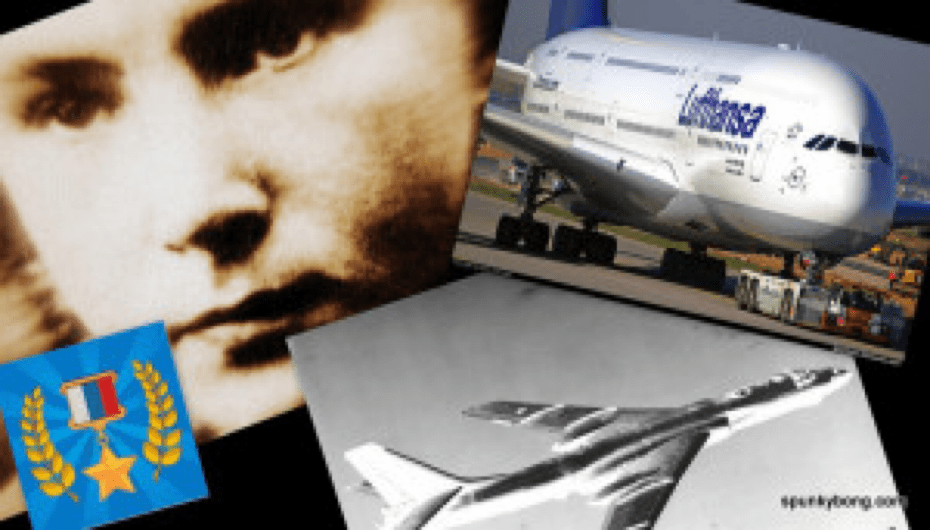
Domodedovo International Airport
Moscow, Russia
Autumn 2005
—————–
The A380’s 20-wheel main landing gear touched down first, followed in ten seconds by the nose wheels, as the jet that resembled a beluga whale settled it’s 600-ton bulk on the tarmac, still hurtling on at a nippy 220 knots.
Almost immediately, the reverse thrusters on the two in-board engines came on, muffling the diminishing whine of the two out-board turbines that had shut down. The sudden drag brought the large airliner to a halt, 50 metres short of the white stenciled outer markers at the end of the four km long runway.
—————————
52yr old Captain Tuz Strassner, ‘Ace’ to his crew, is in command of the giant jet tonight. Ace also happens to be the direct translation in English, of the Russian word ‘Tuz’. Why the Russian reference? Because Tuz was born in the medical hut of a Soviet strategic bomber base in an obscure town called Dnipro in the Ukrainian Soviet Socialist Republic.
There are still a good two hours to go before Tuz can have his hot shower and martini. An hour of briefing to the relief crew who will be taking over for the remaining leg – Moscow to Hong Kong. Another hour because his employers, Lufthansa, had messaged that the Airbus Service Rep at the Domodedovo would like a quick inspection of the on-board systems and fuel status and ask him questions on the overall flight performance, a procedure not uncommon for aircraft that are still within five years of introduction.
Strassner will have to turn in as soon as he checks into the Ramada Domodedovo. He has a fair amount of domestic travel scheduled for the next four days, which Lufthansa hadn’t hesitated to sanction, given the prestige involved.
More precisely, it will begin with a dawn flight in a Russian Air Force IL-76 to the eastern Ukrainian town of Dnipro, 900kms to the south. As a courtesy that is shown to a fellow pilot – and in this specific case, a show of respect – Strassner will be traveling in the cockpit jump seat.
During the next three days, Tuz Strassner will witness the exhuming of the remains of a woman at the Kraznopil’s’ke Cemetery in Dnipro and its transportation for re-interment at the Kremlin Wall Necropolis. She will be the only woman ever to receive such an honor. The re-interment will be preceded by a lavish medal ceremony, right next to the grave itself, where the woman will be bestowed posthumously, the nation’s highest military honor, Hero of the Russian Federation, by the hands of the Russian President, Vladimir Putin, himself. Later that evening, at a banquet in her memory, Capt. Tuz Strassner will be the guest of honor, seated at the same table as President Putin.
——————————
Tuz Strassner has never really met the woman being honored, having been prematurely extricated from her womb in the waning moments of her life. To be precise, an hour after she had belly landed her Tupolev-16 Badger, one bone-chilling May afternoon in 1960. The woman had been test-flying a newer version, the Tu-16KSR-2, a high-altitude launch platform for future strategic warheads. The TU-16 usually has a crew of six, but that day, there were only two.
————————-
Unbeknownst to the woman, approximately an hour prior, another aircraft had taken to the skies, this one from the US Air Force base at Badaber, outside Peshawar, in Pakistan.
Painted jet black with a non-reflective varnish, with no windows or markings to distinguish it, the grotesquely long and ungainly plane resembled a reluctant albatross with a very long wingspan.
The plane was a U-2, an unarmed, high altitude reconnaissance aircraft, developed by the American defense contractor, Lockheed. It was owned and operated by the US Central Intelligence Agency. The plane was not designed for combat and carried no munitions, because at that time the Americans believed that no Soviet aircraft or ordnance was capable of intercepting it at 70000 ft.

The Lockeed U-2. Designed and built for aerial reconnaissance, first introduced in 1956. Its 70000ft cruising altitude made it untouchable by Soviet ground to air missiles. It could not be shot down by Soviet jets because at that time, they couldn’t fly anywhere near that high.
——————————
The U-2 had arrived at Badaber a month prior, disassembled in pieces, inside the belly of a USAF C-134 aircraft. The pointy fuselage and the 60-ft long wings had been separately draped in white sheets so no one could get a glimpse. The hanger where it was assembled was out-of-bounds to the Pakistani hosts and everyone else except the ten Americans who would assemble it, including it’s pilot, a dude named Captain Francis Gary Powers.
There were strict protocols, as to who had a need to know. All elements of the U-2 program (then run by the CIA) were Sensitive Compartmentalized Information (SCI). None of the locals, other than these 10 men at Badaber and their masters 8000 miles away, had any clue about what the strange aircraft even looked like, until they saw it’s ungainly, lumbering take-off in the early dawn haze, a giant albatross with long drooping wings.
Gary Powers had been well chosen. He had learned to fly a plane before he could drive a car. His mission was to fly right across the USSR at 70000ft and click pictures of Soviets bases and radar sites with his ultra-high resolution Hycon, a camera that had been designed by a Harvard astronomer with help of Edwin Land, the inventor of the Polaroid camera.
The U-2 had wings so long that they sagged when the jet was parked on the strip. To keep the fuel-filled wings from tipping side to side on take-off, two mechanics had to run along side the jet, holding on to the tips as it taxied and during initial 100 yards of the take-off. It’s skin was paper thin, just 0.02 inches thick, to keep its weight down, which meant that the aircraft was extremely delicate.
The U-2 was not designed for speed. At an altitude of 70000, any enemy threat was perceived to be non-existent and so the 460-mph cruising speed. It was still a tricky beast to fly. If an untrained pilot flew the U-2 too slow, it could stall and if he flew it too fast, the wings could come off. Complicating this was the fact that what was too slow at one altitude was too fast at another height. The same complication happened when the weight of the jet gradually lessened as it burnt up fuel.
Taking off in the dawn haze, the U-2 climbed steadily and within twenty minutes, it had crossed into Soviet air space at 70000ft, an altitude so high that the curvature of the earth could be discerned clearly.
The Soviet Tu-16 Badger meanwhile completed it’s test parameters and was returning to base, a remote hub for strategic bombers in Soviet Ukrainian town of Dnipro, when it was directed to intercept the pencil-like sliver of an aircraft that was traversing Soviet airspace at 70000 ft and to bring it down with the Tupolev’s onboard KSR-2 missiles or it’s 23mm cannons.
However, when it became known that the Tu-16 was on a test flight and was not carrying any ordnance, she was directed to try and ram the intruder which she, after a quick tête-à-tête with her co-pilot, proceeded to do, knowing full well that they wouldn’t survive the collision.
The Tu-16’s newly extended service ceiling was just about 65000 ft, but that afternoon the woman couldn’t get it up beyond 59000ft.
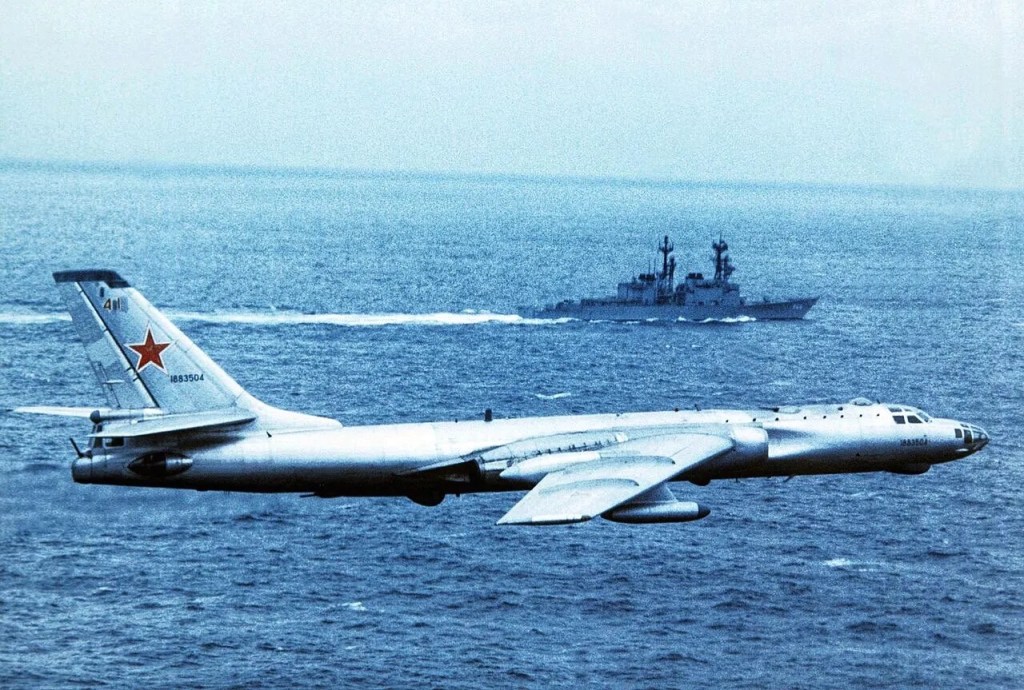
A Tu-16 ‘Badger’ keeping an eye on an American destroyer somewhere in the western Pacific. It is no longer in service but a Chinese-built licensed version, the Xian H-6, is in service as a strategic bomber.
——————————-
As the Tu-16 began its tortured climb, word came over the radio that the intruding aircraft had been brought down, by a barrage of newly developed ground based Dvina missiles and the world woke up to the news that the pilot, a 31yr old American by the name of Francis Gary Powers, had bailed out and was captured alive. He had failed to swallow the cyanide capsule he had been handed prior to leaving the US. I suppose he chickened and decided to take his chances.
Powers wasn’t executed. The Soviets saw him as a bargaining chip and a propaganda prop. After 2 years in a Soviet prison, he was exchanged for Rudolf Abel, a British-born nuclear scientist and Russian KGB agent, incarcerated in the US for being involved in the “hollow nickel case”. Abel had been nabbed with a hollowed out ‘nickel’ (5c coin) with a tiny coded message inside. Abel was later even more famous for handing the Soviets the secrets of the fission bomb on a platter.
As to Powers, after he was back in the US, he spent the rest of his life as a disgraced man, doing trivial flying jobs, shunned by the very folks for whom he almost lost his life. He died in 1977, when the helicopter he was flying for a TV news crew crashed.
Later, after 2 years in a Soviet prison, Powers was exchanged for Rudolf Abel, a British-born Russian KGB agent, incarcerated in the US for being involved in the “Hollow nickel case”. Abel had been nabbed with a hollowed out ‘nickel’ (5c coin) with a tiny coded message inside.
——————————-
As to the Badger, the stresses generated by the effort to attain the intercept altitude nearly tore it apart. The window on the far side of the young co-pilot, Leutnant Yuri Gorshkov, exploded from the pressure differential. Next, his seat belt tore off from the pull as he got squeezed and sucked through the jagged opening like a sausage, his screams choked by the -65degree celsius whiplash of the wind. All the hydraulics systems failed simultaneously thereafter, literally shutting down rudder and landing gear control. Fortunately the elevators still had mechanical override.
The woman, her temperament cooler than the icy environs of the cockpit, single handedly managed to bring the massive bomber down from the edge of the stratosphere and coasted it in, gently setting it down on it’s belly at Dnipro air base. She remained strapped in her seat while the plane hurtled down the tunnel of runway lights, out of control, slipping and sliding over the ice-slick tarmac. Swirls of stinging ice pellets whipped up from the tarmac, whistled in through the blown window and swished around the cockpit.
The big jet plowed through a radar shack and came to rest just feet away from a massive canal, it’s surface frozen but unstable from the spring thaw.
The woman sat slumped forward, motionless, as if peering down at something on the floor between her feet. It was her helmet, split in two. A small lead lined unit, situated just behind her seat, containing flight test-related instrumentation, had come loose in the impact and telescoped into her helmet with such force that the helmet had cracked open like a walnut and the lead lining of the box had smashed into her medula oblongata, crushing the back of her skull, the jolt breaking her neck at the same time.
That evening, the base hospital records showed the birth by Caesarian section of a sickly underweight boy. The baby was immediately stuffed into an incubator. The mother, who had by then succumbed to her injuries, was well known around the base.
The base personnel draped her ribbons and medals on top of her casket and there they lay, almost completely covering the lid, so extensive had been her accomplishments. Of these, the Order of the Red Banner, Order of the Red Star, Order of the Patriotic War were clearly visible.
As a mark of respect, the base personnel began calling the baby, “Tuz”.
—————————-
During a brief period of three and a half years, between 1942 and 1945, the woman had been known in the skies above the Eastern Front, by her call sign – ‘Belaya Roza’.
 Spunkypedia