“Whoever does not miss the Soviet Union has no heart. Whoever wants it back has no brain.”
– Vladimir Vladimirovich Putin, in the first flush of his Presidency, early 2000
————————————————
If you want to be a book collector and line the walls of your den with dark mahogany shelves filled with a thousand books like I do, you gotta plan the whole thing out so every book is neatly arranged and you can find any particular book in a hurry. I can’t stand messed up libraries with crammed shelves, piles of books on the floor, on coffee tables and couches that intellectuals have. Thank the sweet lord I am not an intellectual.
I can’t afford mahogany, so my shelves are Ikea, dirt cheap, easy ta assemble, durable and light weight. I don’t give a fuck about mahogany.
I have arranged my library in genres.
Rack-A is Crime, everything on crime – crime fiction whodunnits, true crime, serial murder, murder suicides, schizos and their tools of murder – guns, knives, poisons, etc. Trust me, if I wanted ta kill you, I easily could. But I need you alive, you’re the reader.
Did I mention I have an extensive porn collection? Besides crime, Rack-A also devotes significant shelf space to it. Squishy fantasy porn, like Nancy Friday and Anonymous, How-to books like ‘The Illustrated Kama Sutra’, ‘The ultimate guide to cunnilingus’ , ‘Sex after 60’, that kinda stuff. Then there are other visual aids such as old issues of Hustler and Oui. (Playboy and Penthouse are too staid for guys like me).
Rack-B has classics. Y’know, like Jane Austen, Dickens, Thomas Hardy and stuff. I haven’t read any and don’t intend ta. They are there for show, to make me look profound, but they’ll be leaving soon. I’ve been thinking it’s time to end the pretence and donate them all to Nova, the 2nd hand bookstore by the riverside. That way, I’ll have more shelf space for porn. I can’t wait ta have the 20-volume ‘Encyclopedia of Sex’ by Marquis de Sade which will go on half-price sale next Sunday and I can have the whole lot for twennie smackeroos. Gave them an advance too, I did. You won’t believe what this de Sade guy had been up to. I am just wondering how he got the time ta try out all that weird stuff if he was busy writing 5000 pages of weird stuff.
Rack-C has modern conflict – mainly World War-2, the Korean and Vietnam wars. And religion – translated texts of all the major religions. I like ta have a good guffaw once in a while and religion always does that to me. To have both, conflict and religion, on the same rack is appropriate.
Rack-D is a melange of bestsellers and my pet area of interest – Space.
Rack-E is going ta make me a millionaire. It has some painstakingly collected First Editions and antique books. I just found an O’Henry printed in 1905 in an ornate hard cover, it’s paper so fine that it crinkles when you touch it. I got that for 50¢. I’ll read it and when the time comes, I’ll sell it for five grand.
Of course, I have arranged security against any pilferage from Rack-E : my Peacemaker Colt, which can drill a hole into any thief and his twin brother. That is, if he indeed had a twin brother and they were standing in line, one after the other. I got the twin brother thing from the starting page of Alistair Maclean’s “When eight bells toll”. (I am anything but original).
Then there is a smaller rack that has encyclopedias, Nat Geo issues and compilations. One shelf on that rack is reserved for my reading knick knacks – pencil, sharpees, stickies and page markers, highlighters, Iphone/Ipad charging outlets and of course, the case for the Peacemaker Colt.
And a bowl of peanuts, just in case I am having a beer or a glass of wine and it needs cumpunee. And a tiny pocket flashlight, in case a peanut falls on the carpet and rolls in underneath a rack.
I am an organized son of a bitch.
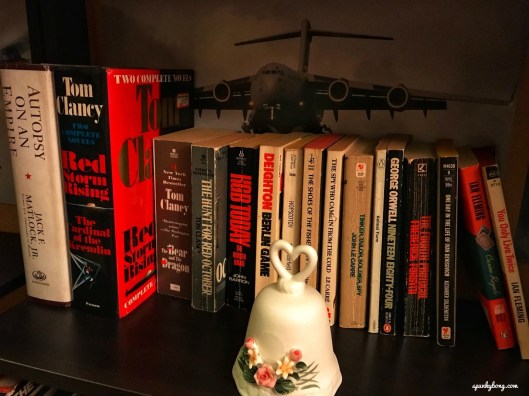
Oh, I forgot the one pictured above – my Soyúz Sovétskikh shelf, Rack-C. It has books on the Soviet Union. You have of course known the authors well – Le Carre : the genius of ‘understated, laid back’ spy fiction. Tom Clancy : the Republican wet dream gung-ho guy. Len Deighton, Brain Garfield and Fredrick Forsyth : ruthless evil. Solzenitsyn : fatigued suffering pooches. And Ian Fleming : the tongue-in-cheek – varying depictions of Сою́з Сове́тских Социалисти́ческих Респу́блик – Russian for USSR, a land that could have have attained genuine utopia, if basic human nature had not got in the way.
There are a couple of non-fiction reads too. “KGB Today”, an in-your-face piece of American Cold War propaganda by John Barron, who used to be a regular contributor to The Readers’ Digest, which was widely believed to be a propaganda publication of the US Government. If RT.com had been a print publication, it would be the Russian Federation’s Readers’ Digest. And there is “Autopsy of an Empire”, a blow-by-blow account of the fall of the Soviet Empire, by a former US ambassador to the Soviet Union.
Lumbering up menacingly over the ensemble, you discern an Illushyn IL-76 military transport aircraft. It looks as if it will be able to clear Deighton and Clancy by a hair’s breadth.
Actually I’m not sure if that is an IL-76. But then, DILLIGAS? (Do I Look Like I Give A Shit). I prefer DILLIGAF, though.
I have Fyodor Dostoyevsky’s “Crime and Punishment” but since it was pre-revolution, it is in the Classics shelf on Rack-A. Didn’t I mention I was organized? And I have watched Dr Zhivago too many times to want to read the book, so Boris, I can’t waste shelf space here for ya. Go ебать yourself, dasvidaniya.
———————————-
I am one of the lucky ones. I grew up in the early 1960s at a time when the Soviet Union was at it’s zenith. We lived in a tiny industrial town in India where the government was building an engineering behemoth that would manufacture heavy machinery for mining coal. It was a joint Indo-Soviet venture – the Soviets had thrown in financing and technical know-how and Indians had contributed the labor and the corrupt bureaucrats.
The place was crawling with Soviet experts in those days and they lived together in this massive compound of apartment blocks, known as the “Soviet Experts’ Hostels”. The compound had volleyball courts and a swimming pool that my brothers and I frequented. Often some matronly Russian woman sitting on a deck chair by the pool would beckon to us, give us a hug and hand us Russian-made cookies, with a grin through teeth that could never pass even the most primitive metal detector.
Through the prism of my 11-year old eyes, the Soviets seemed very friendly, often urging us to sit and watch their newsreels and TV with them. I watched Alexei Leonov live, painstakingly clamber out of the Voskhod-2 and float around and wave at the camera, his visor reflecting the white wisps of the earth’s upper atmosphere.
The Russians would welcome us into the movie theatre they had in the campus that was constantly running shoddily made Russian films made by SovExport, a propaganda arm of the Soviet Union. If you were a kid on his summer break and had run out of games to play, you went to a Soviet movie at the Experts’ Hostel.
All SovExport films was excruciatingly boring, besides being very amateurish. One that I remember watching had an old man pushing a wooden sled with a sick old woman in it, from the left side of the screen to the right, with the accompaniment of a 200-piece orchestra and a baritone chorus. He started on the left when the movie credits came on and we were hoping something would happen – like maybe a German Stuka would suddenly dive in and bomb the shit outa them or something. (That was the only time I remember hoping for the arrival of the Nazis).
But the man on the screen just kept plodding on, until he disappeared with the sled, beyond the right-hand edge of the screen, just prior to the intermission. There were actual Soviet off-duty personnel and family watching, their eyes glued to the screen. When I quizzed my Dad about it, he said watching those films was mandatory for the Soviet personnel (unless they wished to have cabbage soup, morning noon and night, in a Siberian gulag).
I watched a movie that had been based upon Tolstoy’s ‘War and Peace’. In the middle of a battle scene, all of a sudden a Lada drove by near the bottom right corner of the screen, right next to a van that was unloading klieg lights for the shooting. Not a single Russian eyelid batted at that. There were no groans, catcalls, derisive whistles, nothing. This was at a moment in our lives when we regularly went to watch finely crafted American blockbusters such as Sound of music, Battle of the Bulge and Von Ryan’s Express. Even my child’s brain could not help but laugh afterward at the Soviet movie making skills.
But heck, it was fun. It was a time when hegemony and building spheres of influence were paramount. The Soviet team of engineers and their families might have been ordered to ‘mingle with the natives’, but I did not see anything but spontaneity in their warmth. It was the Soviet Union’s “hearts and minds” exercise and as far as I was concerned, they were roaringly successful at it. While the Americans were busy mocking our politicians and laughing at our accent derisively, the Soviets were building bridges that are still standing today.
I don’t have any Soviet porn. I could spare some space for it in my porn shelf on Rack-B, in case you can lend me some. Maybe they did have a Thongus Kutyokokoff. I have to look into that.
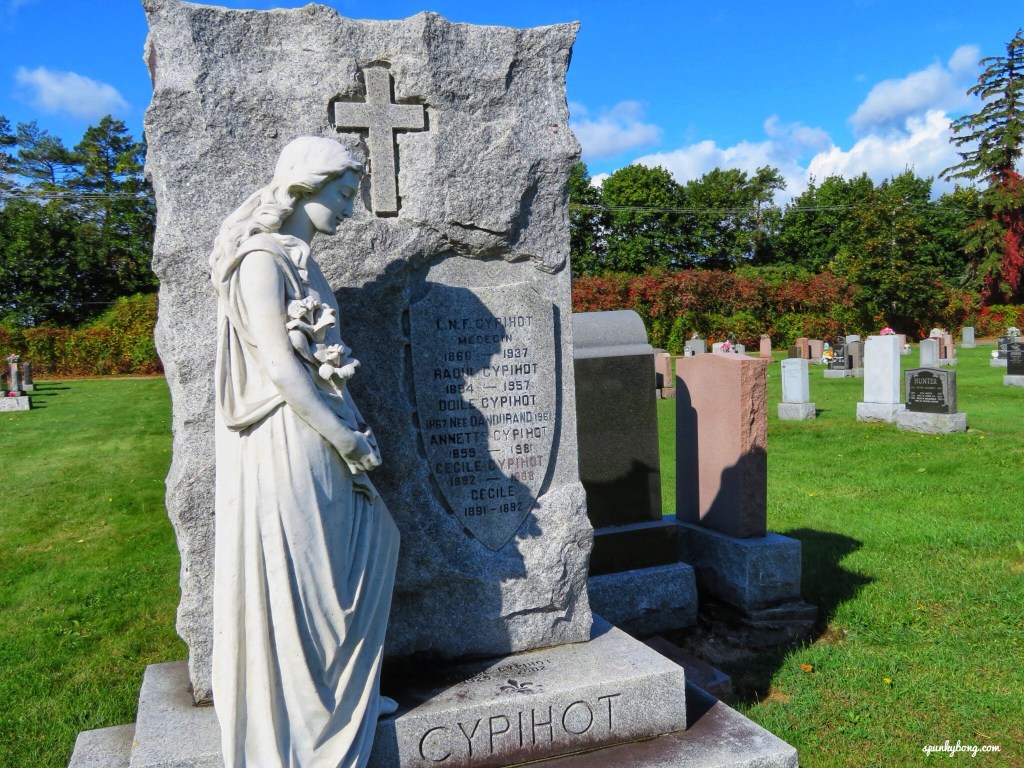
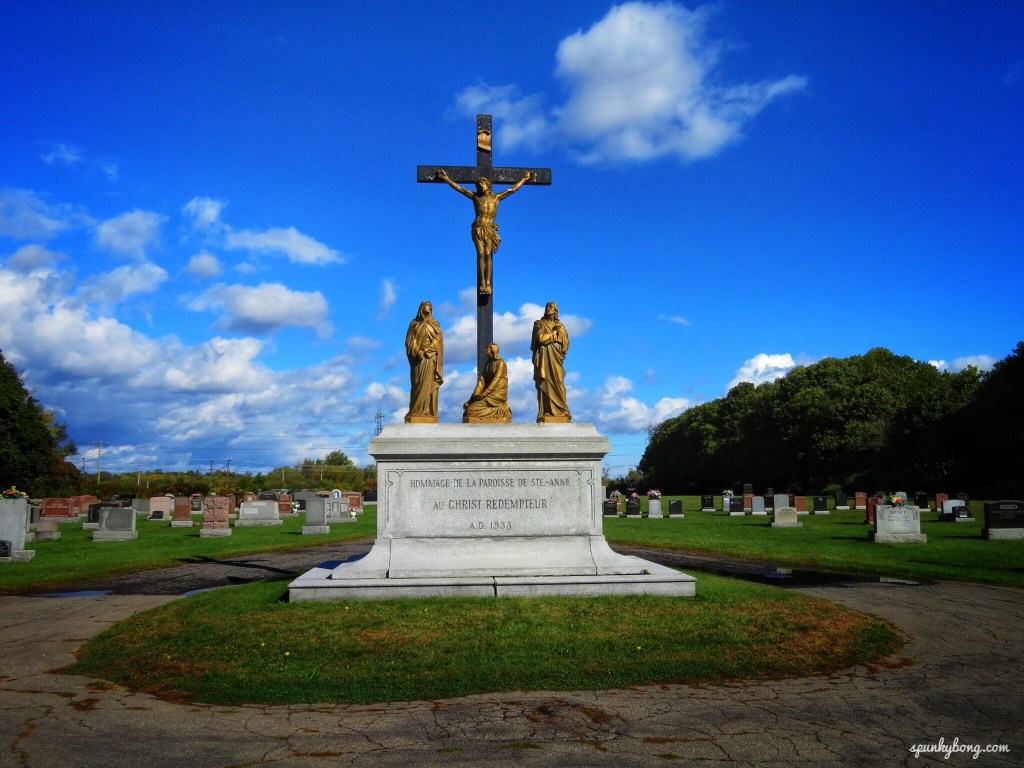
The Cimetière Sainte-Theodosie in Verchères, a village in QuebecThe Cimetière Saint Anne de Bellevue, Montreal West IslandThe Cimetière Sainte Madeleine, Rigaud The 18th Century Patrimoine L’Acadie Church and cemetery St Jean Sur RichelieuVerchèresRigaudSt Anne de Bellevue
————————————
Personally, I think being buried sucks. You occupy unnecessary space that could have been used more fruitfully, like maybe for a bistro or a bar. That’s where mourners gravitate to after a funeral anyway.
The Population Reference Bureau estimates that ever since our species began, 108 billion people have roamed the earth. If you exclude the 8 billion sods like you and me that are still alive, we have 100 billion dead. Of these, around 80 billion are estimated to have been buried through ritualistic funerals.
Now, I’m sure you won’t sue me if I said that an average corpse occupies an area of 6 sq.ft. That would make the area covered by corpses all over the world as on date to be a total of around 29000 sq.kms. Considering extra amenities, spacing, pathways, etc, the final figure could well be 112000 sq.kms.
Imagine 112000 sq.kms of prime real estate, usually at the heart of town, blocked by a bunch of skeletal remains. If you’re already dead, would you give a flying fuck what happened to your body, your tits, your dicky, the end of your alimentary canal? Nope, you wouldn’t. How would you? You’re dead, remember? And if you had MAGA cousins and uncles sharing the crypt, forget it, you’d want outa there.
If we carry on burying our dead, pretty soon there won’t be any place left to live in. You might have an address like, “Next to Plot:21, Row:16, St TiddlyTwat Cemetery”.
I believe the best thing is cremation. Your next of kin are left with just a tiny tiny urn of ashes. If they didn’t care much about you, they can leave you in the attic or if they did, they can tip it over, sprinkle it in their vegetable garden and grow mommy peppers. They could then put the urn ta use, like a flower pot or sumpn. Personally, I would contract with a Hollywood masseur ta massage me into Scarlett Johanssen’s jiggledipoos.
Then there is the pathos. I was in a cemetery in Pointe Claire that had neatly laid headstones, all of the exact same style and size. All around were exquisitely manicured lawns. I realized it was a Military cemetery.
I was ambling down the rows, looking for an angle to take photos from, when I came upon a middle-aged woman lying prostrate on her stomach, her head resting on a step in front of the headstone. Baskets of flowers, a bit wilted, were all around. She was alone and at that time of the day, the cemetery was deserted.
I figured it must be a week after the funeral, the visitations, the suppers and lunches spent with consoling friends and relatives and now at last she was by herself, to be with that one human being that had always mattered the most.
The woman’s head was tilted to one side, eyes unblinking, staring at me approaching. Staring but not noticing my presence. Her arms were wrapped around the headstone in an attempt at an embrace. A large butterfly fluttered in and landed on her hair but she didn’t seem to notice.
The epitaph was succinct, just like all the others there. It read….
B60 926 153
Cpl René G Fournier
Royal Canadian Armoured Corps
11 March 1997 – 20 September 2021
When the woman sensed that I was about to kneel, sit next to her, offer my condolences, her eyes blinked for the first time. With considerable effort, her lips formed a smile and she said in a whisper, “Mèrci, tout va bien” (Thank you, I’m fine)
It was an overwhelming sight, the grief all-pervading, unimaginable. I had taken a photo her prostrate body clutching the headstone while I was approaching, still at a distance from her, but I cannot bring myself to upload it here. It is just too personal. I would be betraying her. In fact I didn’t take any more photos that day, so touched was I. I have uploaded pics from other cemeteries instead.
——————————
The question is whether a graveyard is a place of solace, whether it is a place where one can feel connected and find closure, the way the woman thought it would bring her inner tranquility.
Is that the only way? Wouldn’t the dark and desolate environs of a cemetery be a grim reminder of tragedy and deter her from moving forward?
And what about the other elephant in the room, the environmental concerns with the chemicals used in preparation of the corpses. More than a million gallons of formaldehyde get into the soil every year, besides the menthol, the phenol and the glycerin. What would that do to the ground water?
And then there are traditions around the world, cultures that actually celebrate a death with wine, feasting and dance, like in New Orleans which has “Jazz funerals”. Before the funeral, the jazz band plays sombre music and after, it ramps up into rollicking dance music and has mourners having the time of their lives. You might have watched one in the start of the James Bond film, “Live and Let Die”.
I understand that for some, the idea of breaking into dance at a funeral might look repugnant but either way, we have to move on with our lives and let just the memories continue to console us and the best way is to not leave a physical trace and that can only be by cremation. A small urn of ashes does not reopen wounds.
People who cremate are happier than people who bury. How’s that for a slogan?
The only thing going for burials is the pristine beauty of cemeteries in Quebec – the lush green, the headstones and the epitaphs. And that’s why I have the urge to take graveyard photos.
Take a look at this excerpt of a sura fromthe Quran, Book of Muhammad, Verse 4 (47:4)…..
“…..Therefore, when ye meet the unbelievers in the battlefield, strike off their heads. Then when you have made wide slaughter among them, carefully tie up the remaining captives and render either generosity or demand ransom, until the war lays down its burdens…..”
Don’t challenge me on the accuracy of this translation. I have not read the Quran (and I don’t intend to). Like this one, there are reported to be numerous other places in the Quran where graphic exhortations of extreme violence against ‘non-believers’ are depicted.
It is said that a little knowledge about anything can be dangerous. Maybe so. I do have little knowledge of any organized religion, but the above excerpt does appear pretty graphic. It presents a picture of God urging men to kill in his name, exhorting the faithful to ‘strike off’ the heads of infidels on the battlefield.
The oft-repeated Islamic intonation, Bismillah ir rehman ir Rahim, means ‘In the name of God, the most beneficent, the most merciful’. Mercy is an act of forgiveness, shown to the wrong-doer.
I suppose that God likes to be picky about whom to shower his mercy on.
Then there is the ‘tie up the remaining captives’ bit, where you are left with a choice of either setting them free (‘render generosity’) or demanding a ransom for their release. In Islam’s eyes, both alternatives appear equally reasonable. Two very disparate choices – show mercy or cash in.
The practice of literally paying for a crime is Islamic law. If you are well-heeled and you kill a guy, you can get off the hook by simply paying his next-of-kin a court-mediated sum of money. It is considered as payment of damages.
On the other hand, if you happen to be an infidel who is broke and living inside a system that practices Islamic Shariah, you are history. You would be looking at parts of you being chopped off at best. Similarly, extracting a ransom for a captive infidel is also very legal.
Now let’s turn to the word ‘battlefield’. That could mean anything, not just those pre-arranged open grassy meadows ringed by tall trees, where battles were fought in ancient times. In ideological terms, an Islamist sees the whole world as a battlefield, where every human is involved, in a clear-cut for-us-or-against-us format, either a believer or an infidel.
And then there is the term ‘strike off their heads’. The tone implies doing something that will detach the head from the rest of the body. The human head being attached to the torso with bone, tissue and ligaments, the only way it can be struck off is by chopping it off at the neck, with an extremely sharp blade.
———————————
Beheading is mandated by other religions – Christianity, for one. Take a look at this beauty from the pages of the ‘holy’ Bible, where God commands King Saul to slay the Amelekites –
“Now go, attack the Amalekites and destroy all that belongs to them. Do not spare them. Put to death their men and women, children and infants, cattle and sheep, camels and donkeys….” – The Old Testament, Book of Samuel 15:3
Children and infants? Camels and donkeys? God sounds like an out-of-control Grand Knight of the KKK.
I did some digging and found that the Amalekites had attacked the Israelites in the wilderness where they had followed Moses right after he parted the Red Sea and escaped Egypt with his hordes. I did some more digging and found that the land Moses and his people were traversing had for centuries been the Amalekites’ land and quiet understandably they took the Israelites as invaders.
But they had to be annihilated all the same. We have all read right through primary school how the Israelites were God’s ‘chosen’ ones, remember? Though, chosen for what remains the question, given that Jews have had their shit kicked out of them all through history at some very exotic places, like Bergen Belsen.
————————-
Sure, in both cases, in Islam as well as Christianity, those exhortations from God to slaughter must have been in context with specific situations or aggravating circumstances. But those passages set a precedent.
Indeed, holy scriptures are nothing but that – thousands of pages of set precedents to follow. Holy scriptures urge us (or at least imply) to do those exact same violent acts if we find ourselves in what we perceive to be similar circumstances. They show the way and the method.
There is however a subtle difference between the two religious practices. To Christians, the term ‘beheading’ is a metaphor. Christians organize themselves far better, having technology on their side. Christians are the Elon Musks of religion. To them, slitting a throat here and decapitating a head there, is not cost-effective. Everything has to happen in a grand scale. A thousand years back they did pretty much the same thing, sitting on a thousand galloping horses and calling it a Crusade. Today they stand on aircraft carrier decks and sing ‘God bless America’ and call it a liberation.
—————————-
Then we had this prick who got himself the nickname Jihadi John. JJ was blown apart by a Hellfire missile fired from an MQ9 Reaper drone, in 2015. His got moniker, Jihadi, since he was an ISIS looney and John, since he was originally British.
From the tone of Jihadi John’s voice in those beheading videos that the ISIS released, he appeared to be relishing what he was doing. He had pedigree. I read somewhere that his Dad had been chums with Bin Laden and had had an active hand in the 1998 American Embassy bombings in Kenya. Junior was a rap artist before he was ‘born again’ and joined the ISIS.
And that makes me dislike Jihadi John even more. I hate rap music.
—————————
During the dark and middle ages, decapitation as a form of punishment was the rule rather than an exception. King Hank the 8th had particularly itchy fingers. He had two of his six wives beheaded, not because of any sense of jihad. He was sex addicted and wanted fresh p—sy all the time, that’s all.
If you are keen to learn more about King Henry VIII and his wives, just hit the link below:-
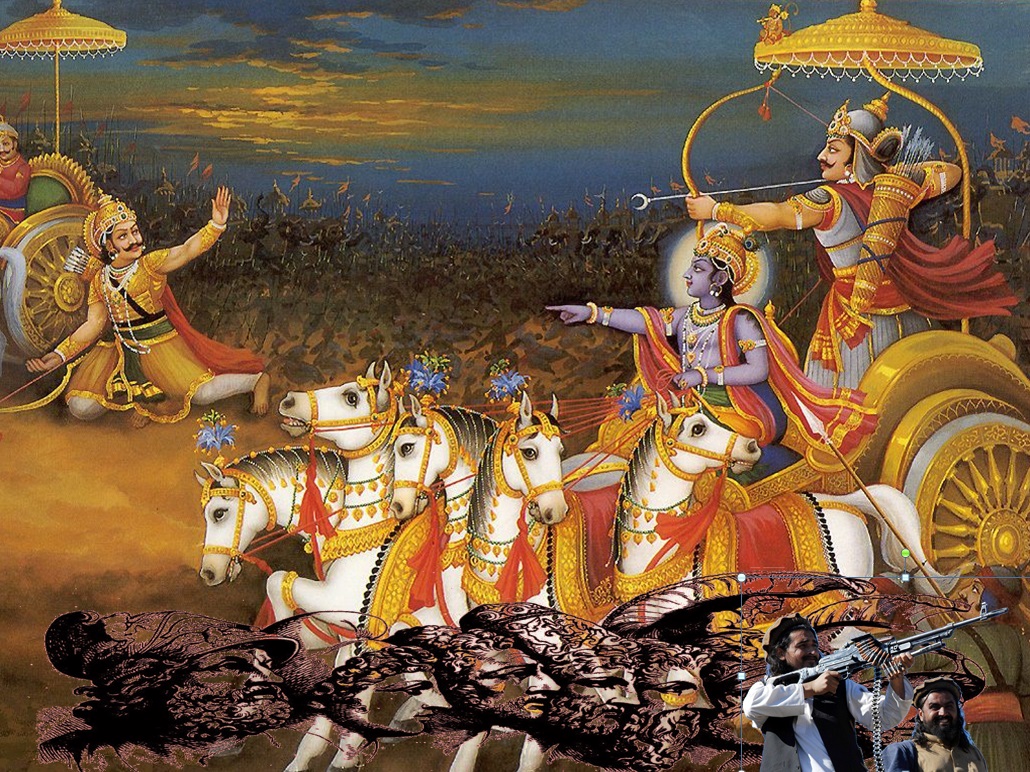
Decapitation has been a favored method of killing even in Hinduism, which Hindus hasten to assure us, is a pacifist religion. It even goes a step further – unlike Christianity and Islam where God only exhorts and then stands back, Hindu Gods are hands-on.
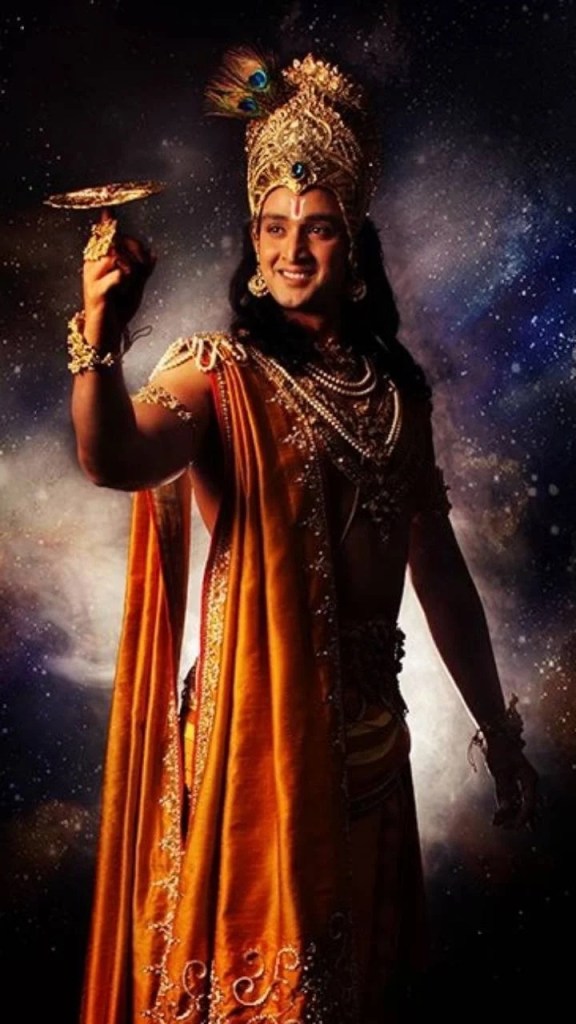
The James Bond of Hinduism, Lord Krishna, the most revered of all Hindu Gods, has his own version of the Walther PPK. It is a sparkling, spinning disc with 108 sharp teeth on its periphery.
Lord Krishna has the disc spinning on his index finger, locating it through a hole in the middle. Being an engineer, I’m guessing that the hole has a 3/8 inch countersink so it won’t just slide down his finger and lop off his other four fingers.
Lord K calls the disc the Sudershan Chakra and in the epic, Mahabharata, he is very liberal when using it on Hinduism’s version of the Amalekite infidels – the non-Vaishnavites. All he has ta do is swing his arm at the ‘bad’ guy and the Chakra whirs off in a wide arc, connecting with the poor sod’s neck and slicing it clean off.
Check out the spinning object on Lord Krishna’s right hand index finger. That’s his Sudarshan Chakra. (Image courtesy:Wikimedia)
Through all the mayhem that he causes, Lord Krishna never ever drops that beatific smile of his. In the above likeness, he appears to be saying, “I may be slicing and slashing but I’m really a nice guy”.
I suspect that the Chakra behaves like a boomerang, slices the bad guy’s head off and zips back to his finger, that is unless he has a secretary who is ready with a pouch of refills. Also since I have never seen amputated fingers on Lord Krishna, I must assume that the Chakra has a docking radar, like the one that the SpaceX Dragon uses, to dock at the ISS.
——————————
Beheading and letting the severed head fly off on a parabolic trajectory until gravity makes it hit the dirt and roll away ignominiously (and then picking it up and sticking it on top of a spike) is the ultimate symbol of triumph over an adversary.
Sunsets are beautiful, long drawn out affairs in India. The Almighty may have overlooked giving us mineral wealth, but sunsets over the sea? Boy, has he been more than generous with them. This evening outdid other evenings in sheer splendour. A red and orange glow set the western horizon on fire.
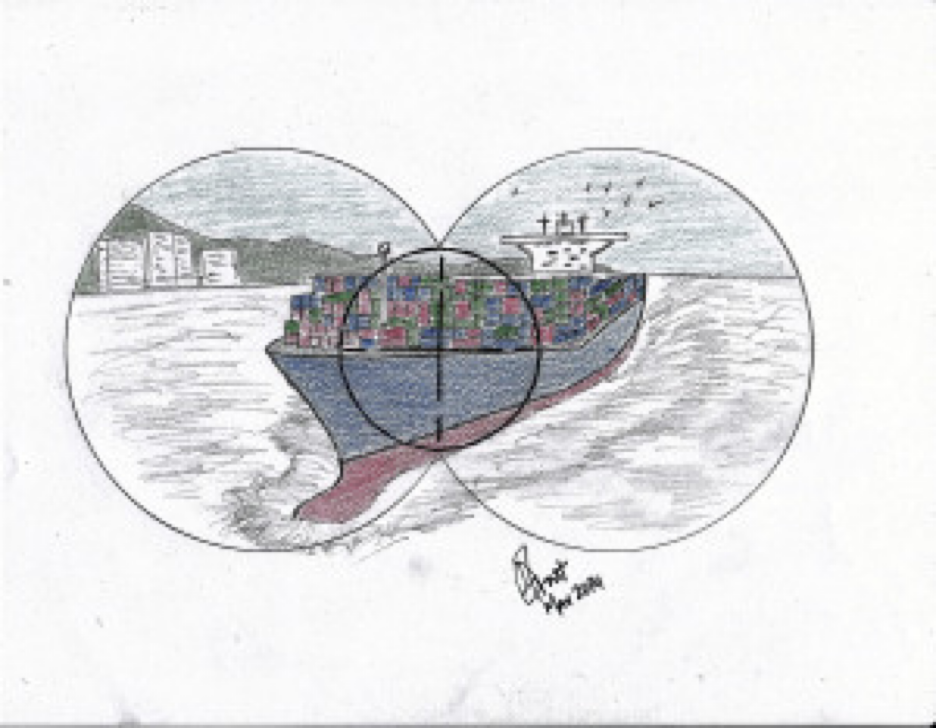
The Japanese container ship I had been following was barely visible now against the afterglow of the sunset. The Amaretsu Maru. I had read the name off the hull with my Oberwerk Ultra. The Oberwerk is mid-range stuff, still way above anything you might find off the shelf at Walmart. It is crystal clear at 5000 meters and the Back Bay is only 3.5 kms wide. The night vision is a bit grainy but still good if you know what you are looking for.
I couldn’t afford a Kowa. I used to pack one though, when I was Lt Commander on the Sindhudhanush. The Kowa could grab star light and enhance the image resolution, making the it seem like you were viewing something that was sitting right next to you in broad daylight. For my current hobby though, which happens to be ship gazing, the Oberwerk was doing just fine.
Twenty minutes prior, the Amaretsu had passed within ten cables of the sea wall on which I was perched (a cable is a nautical unit of distance and roughly equivalent to 185 meters). As I zoomed in on the vessel, I discerned around five or six tiny figures, crew members, leaning against the rail, amidships, dwarfed by the mountain of neatly stacked, multi-colored containers behind them. P&O NedLloyd, Hapag Lloyd, Maersk, COSCO; the containers were a jumble of brand names garishly painted over their rust-colored bases.
I wondered what the seamen were doing, standing there idly. In the Navy where I had been, there was no such thing as an idle seaman. Perhaps they were just taking a breather, after the extreme exhaustion of setting sail. Or perhaps they were catching the last sight of land for the next several months.
I know how that feels, the melancholy that sweeps through you when you watch people scurrying like tiny ants, around the wharf. You cling on till the very last minute, before the coastline disappears completely.
The Dhanush’s range had been virtually infinite. A nuclear powered sub is limited only by the periodic need for provisioning (food supplies, etc). Leaving shore in a sub is like severing an umbilical cord.
Maybe the guys at the rail were watching me and saying to each other,’ Will you just look at that lucky bastard now?’ But then, maybe they were just standing there and taking a long pee. I used to do that when I was on watch as a sub-lieutenant on the Nilgiri. Standing precariously over the raised parapet on which the stern rail was mounted, I would let loose and watch the stream disappear into the churning wake, turning the sea infinitesimally more acidic. Leonardo di Caprio would have done the pretty much the same thing at the bow rail, had Kate Winslet jumped before he arrived, I thought with a chuckle.
Amaretsu literally means ‘of the heavens’, an interesting name for an ocean-going vessel to have, I thought to myself, as I leaned back on my splayed palms on the concrete seawall. I was sitting facing the surf, my legs dangling over those oddly bulging star-shaped concrete blocks that were haphazardly placed in the sand, to break up the waves. The Colaba seawall was where I came and sat after I had my jog. I would sit there catching my breath, dripping sweat all over the concrete, letting the cool sea breeze hit me like a shock wave. Till six months back, I had company. Shanta. She came along most days, when she felt a bit better.
I ran while Shanta walked. Reaching way ahead of her, I would be sitting on the sea wall parapet long before she came trudging slowly up. We would sit on the concrete parapet and pass the Oberwerk back and forth between us. When it was my turn, I watched the ships and when she had the binoculars, she followed the gulls and the fishing skiffs. When we got bored looking, Shanta would take out some chutney sandwiches and we munched quietly, our arms round each other, like lovers on Marine Drive.
Sometimes, Shanta wanted to play ‘what’s the good word’. We would sit there thinking up words that only we recognized. We played the final game two days before Shanta went into Jaslok for the last time. It had been her turn to think of a word and she thought of ‘heaven’. I lost that turn, even after she kept bombarding me with a rush of clues, over and beyond the maximum three permitted. The last one had been an exasperated, ” Okay, you old mutt, it’s a place we’ll both go live in and have a ball, at some point in time. “
The Amaretsu Maru was a very large vessel. I figured it probably shoved aside a hundred thousand tons of the Arabian Sea as it battered and bludgeoned its way forward. And now it was gone, blended in with the dusk, swallowed up like Shanta, over the edge.
Off to the south-east, across the Back Bay, the Nhava Sheva Terminal of the Jawaharlal Nehru Port Trust, was ablaze with lights now, looking like some alien space port from a Ridley Scott sci-fi picture.
There used to be a time when lights were an ominous sight………..
———————————-
Navy Nagar Parade Ground Sea Wall
Wednesday 26th November, 2008 (19.00hrs)
As the tide sneaks in, I note that the sea has suddenly grown calmer. The waves that had been crashing on those star-shaped blocks below, are now jostling each other playfully. The horizon has darkened.
As if on cue, the vendors, their pushcarts, the pony rides and the balloons, have melted away into the lights of the city. It’s almost a sudden transformation. One minute the tiny beach is teeming and the next, it is desolate, ceding territory to the tide, if only for a short while.
Phosphorescent foam begins washing over the rocks, making them glitter. The sky had been overcast all evening and now suddenly even the winds are still. Had Wagner been here he would be writing a crescendo for the scene. The world seems to stand still. I usually don’t stay this late but today is special.
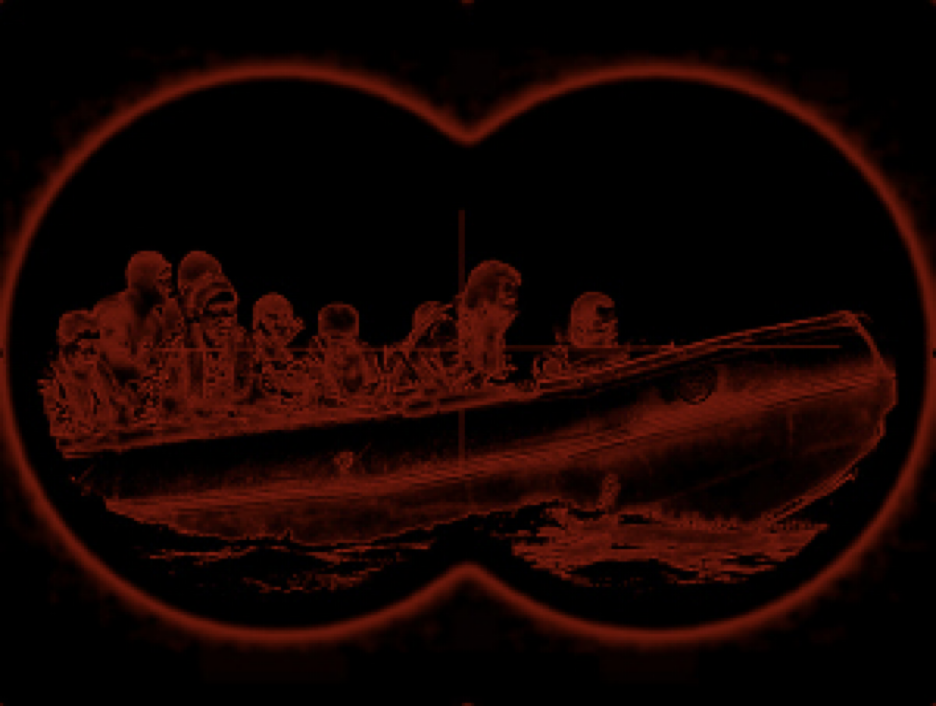
A light catches my eye. It had blinked on briefly some way beyond the surf, making me bring up the Oberwerk and train it in the general direction of the flash. Immediately the two speeding zodiacs fill my eyepiece. There are five of them in each, huddled forms, outlined in an eerie red glow by the night vision of the Oberwerk. Each man seems to be toting a bulky backpack. The two inflatables pitch and bounce on the waves, releasing bursts of spray as they hit the troughs and the crests, racing toward the little strip of sand that borders the jumble of the star-shaped blocks by the seawall. On their heading they’ll be beaching right about a hundred meters from where I am perched.
My conversation with Jimmy at the Navy Club last evening flashed back instantly. Commodore Jimmy Taraporewala, NDA roommate. Jimmy had on an overall that the members of his corps wear, with those shoulder patches depicting in graphic red and black, a crocodile lashing out with its tail. It was an insignia I was intimately familiar with, having worn it myself for six eventful years at MARCOS.
We were both nursing sodas, except that mine had a couple of fingers of McDovell Premium in it. Not needing much coaxing, Jimmy whispered, “We have a red alert, Krish. Something is about to happen.”
I looked up sharply, “Another landing?”
Jimmy nodded and then grimaced. “Those assholes at the IB have no clue. No news from our assets at the ISI. JCB and DNI are working on it non-stop. All Coast Guard vessels, as well as the Sindhukirti and Sindhuratna, have slipped their moorings. The Talwar and Trishul are on their way from the Maldives. We ourselves are at 5 minute readiness. But how can anyone patrol a two thousand mile coastline?”
I leaned forward, “Where did the tip-off originate?”
“The British GCHQ.” Jimmy stared at me and nodded, “ Of late, there has been more exchanges between us than you had in your time, Krish.”
“What about those Neptunes you just acquired? We have two now, don’t we? Put them on a permanent orbit over the west coast till this thing is over.” I was referring to the new Boeing P-8I Neptune reconnaissance aircraft that have just been inducted into the Navy.
“Boeing technicians are still sorting out some glitches with the Magnetic Anomaly Detectors in them,” Jimmy made a disgusted face and the conversation veered away to his son, Ronnie, who was passing out of the NDA in a week.
———————-
Back at the seawall, premonition made the hair at the nape of my neck stand rigid. I peered through the Oberwerk, at the huddled shapes on the zodiacs. Fishermen aren’t out so late and besides, they don’t gallivant around the Arabian Sea in zodiacs, I said to myself. They might have seen me, silhouetted against the street lights behind. I crossed my legs over the parapet, stowed the Oberwerk into my windcheater and quickly dropped down to the ground on all fours and began picking my way through the rubble on the side of the road in a crouching gait, in order to remain below the level of the parapet.
10 yards of knee-lacerating crawl brought me to a crack in the seawall where the cement had crumbled, forming a gap large enough to let a man through. It had probably been deliberately created just to have a short-cut to the asphalt, by those street urchins who beg around the beach during the day. I slid through the gap and started slithering down toward the sand, gingerly stepping over the star-shaped blocks, knowing they would be coated with moss and slippery as hell.
As I placed my foot in the squishy sand, I saw the silhouettes. The men had by now, run the boats onto the sand and begun getting out of their polyurethane suits. They seemed to be speaking and gesturing with each other but the steady shush of the waves drowned all sounds around. The one who was already out of his wetsuit and still bare-chested, was the first to sense my presence. In a single fluid motion, his right hand came up holding a handgun while he dropped to a crouch.
I had expected that. I raised my hand, palm outward and whispered,” Salaam, Bhaijan.” (Greetings to you, brother). He peeled off from the rest and came forward. The gun in his hand was a 9mm Luger and he brought it down, holding it loosely in his right hand, as he came to a halt a few feet from me. He was clean-shaven, diminutive and wiry and had piercing bright eyes that had no fear in them. A pro.
“Salaam,” said the man,” Do you have our stuff, janab?”
I nodded,” Its all in there.” I gestured toward the star-shaped blocks by the seawall.
“Aapki tareef?” (Who are you?), he looked up at me.
“Aftab”, I said, to which he nodded.
“Aur aap hain, janab…?” (And you?)
He turned his piercing gaze at me and said, “Babar”.
“Leh, usko samhal, Ajmal, “ the man named Babar barked and a wild-eyed guy who looked young enough to be a teenager, dropped what he was doing and made his way toward the blocks. I braced myself. The star shaped blocks were about 100 meters from where we were standing. The boy, Ajmal, would be gone maybe five minutes max. They had five minutes to realize I was lying. There was nothing there.
We waited, my hands on my waist, my right palm just inches away from the Glock34 that I always carried with me these days. Ex-special forces members are licensed to carry a hidden automatic weapon. The Glock had become a part of me, nestled in the small of my back, now hidden by the windcheater.
As the seconds ticked away, the man called Babar said,” Rana ne wapsi ki koi zikar kiya? (Did Rana mention the extraction plans?)”
“Rana?” I stared at the man, “Nahin, hamein Rana ne nahin bheja.” (Rana? I have no idea. Rana didn’t send me)
“To phir?” I could see the first flush of puzzlement in the man’s eyes, as the man called Babar straightened up and stared, “Kisney bheja?” (Then who sent you?)
“MARCOS,” the acronym, pronounced clearly, hung in the air for a split second. I had whispered it so softly that only Babar heard me.
Maybe it was fatigue brought on by the 50km ride on the zodiacs or the stress that any clandestine operation can bring on, I don’t know. But a split second can be a very long time in our business. Time enough to die.
The man called Babar was bringing his firing arm up when the Glock appeared almost by magic in my hand. It took another half millisecond for Babar to grow a third nipple, right between the other two. He collapsed in a heap and rolled over, staring up, squinting, his eyes trying to focus. Perhaps he had noticed a new star on the belt of Orion. A trickle of blood began seeping out of the corner of his lips and his nostrils, pulsating in step with the frantic thrashing of his dying heart.
Instantly the confined space in the beach was filled with the klicks and coughs of silenced automatic weapons erupting lethal fire. My forever faithful Glock did a lot of talking tonight. One of my rounds opened up the kid, Ajmal’s head like a melon. He kept walking a while, his body still believing it had a head, before it realized it didn’t and collapsed.
I dispatched the rest quite easily. These were dumb kids, just a bunch of miserable suckers, out for twisted glory. The last two dropped their weapons and tried to run into the waters. Maybe they wanted to swim all the way back to Karachi. They never had a chance. When you are up against the MARCOS, you never have a chance. We are trained to shoot by sense alone, in the dark. I picked them off pretty easily. Looking around at the carnage, I speed-dialed Jimmy.
As I proceeded to pick my way back up those rocks, I heard a groan. I turned to see the man named Babar and I walked over to him. The spit of sand around me had turned into a slaughterhouse. Babar’s chest heaved as he made an effort to speak and I brought my face closer. If he had any last words, I was curious to find out what they were.
Alas, the man named Babar disappointed me. He just uttered one word,” Gaddar” (traitor). His eyes gradually began taking on the glazed sightlessness of the dead and I decided to hurry him along. I brought my Glock up and pressed it against his forehead.
Before pressing up on the trigger I grinned. I wanted him to see me grin. And then I spoke clearly so the words would register in his dimming brain,” Here’s one for your janab Hafeez Sayeed, asshole.”
I had climbed back up onto the asphalt and was leaning against the parapet of the seawall when I heard the first wails of the sirens and the lights charging up Pilot Bundar Road.
“Twenty years after the opening shots of the Bosnian War were fired, former Bosnian Serb military commander, Ratko Mladic, is finally being tried by a United Nations War Crimes tribunal in the Hague, on 11 charges of crimes against humanity”
The 8pm CBS Evening news anchor, Scott Pelley’s words seemed to fade out, while another voice dovetailed in, his voice. His. Arjun Das’s. It said…“……I have this insane urge to hold you in my arms…”
Just a few meters away, in the hall, Sukumar sat sprawled in front of the TV as a 1995 video of Mladic flashed on, showing him inspecting a crack unit of the Serbian Army Special Forces, ‘the Scorpions’, on a rain-swept hillside just outside the eastern Bosnian town of Srebrenica, on the eve of the massacre.
Sukumar had his laptop open as usual, his fingers paused, to take in the news video. He turned and looked at Nandini who’d just dropped the soup spoon in the plate of pasta she’d prepared for Dharam. Her son was already seated, waiting.
“Mom! There’s soup all over my pasta!”
Damn! The tremor in her hands passed. She took a deep breath, steadied herself and started preparing a fresh helping.
As she ladled the pasta, Nandini raced back again, to the first time Arjun had unfriended her, on Facebook. Their first interaction, two months prior. He’d unfriended her just an hour after she’d accepted his invite. She was baffled and messaged him,” Hi, it’s your business of course but it’ll be nice to know why you unfriended me…”
“Hello”, came the reply, in measured tones,”I unfriended you because there’s just nothing on your page. No info, no wall, no photos, no friends list. You have friended me but denied me access to virtually everything. It’s demeaning and frankly, I don’t have time for this. This won’t work, thank you and good bye”.
Nonetheless, Nandini realized that her FB settings needed to be tweaked. She decided to reach out once again, a trait he later came to adore in her. She hurriedly replied,”So sorry about that. I didn’t know my settings were that way. Have fixed it now.” She sent him back an invitation without ado.
He accepted.
In the beginning she’d been reserved, hesitant about talking of herself. He was just an unknown strange man who wrote outrageously funny notes that made her burst into laughter. As the days went by though, the levee she’d hurriedly constructed, seemed to look like it was made with cotton candy. It soon started to dissolve. She began to be excited every time she saw his message waiting when she logged in. Oh, he had this wonderful old-world graciousness and oodles of charm and he made her feel so so good.
“Mom!…do you mind not staring into space with a spoonful of pasta, also in space? How about dropping it back to earth and my plate?”
Sukumar looked up..“If Mladic is actually pronounced Mladich, why can’t they just step up and add the ‘h’ to their names, for Christ’s sakes?” A top-knotch software brain, Sukumar couldn’t stand anything with hidden tones. Everything had to be either black or white for Sukumar Vittal Shyamrao. Zeros and ones. “Life, simplified,” would be the title of his book if he ever chose to write it. Painfully shy, perpetually immersed in solving knotty software issues, Nandini felt lucky if he said more than two words at the dinner table. Sometimes, when he suddenly broke into Telugu, that was a sign he was moved by something and maybe wanted to talk.
“What did he do?” Nandini was referring to Mladic in a desperate bid to stop her mind from sliding back into that crevasse which had suffocated her a minute ago and caused the soup spoon to slip from her fingers. Please, Sukumar, keep talking. Don’t stop. I don’t want to be alone with him anymore.
“What did he do?” Sukumar again, “He slaughtered eight thousand men, women and children in one night in a small picturesque mountain town in Bosnia. Right after he’d given the UN peacekeepers his word the day before that he wouldn’t go in. Mladic is the originator of the term, ‘ethnic cleansing’.”
“1995…hmmm…let’s see now, where was I then…” Dharam began, trying to establish his whereabouts at the time, almost 18 years ago, while shovelling pasta into his mouth. He was going to be 8 next March.
“You were a doddering old Mongolian sheperd with two billy goats and a horse, who’d just been to see his married daughter in Ulan Bator, darling,” Nandini wanted to play along. She smiled, rose, went over and engulfed him in one of those comprehensive all-season squeezes that only mothers can impart.
“Ugh,” Nandini made a mock grimace as she held her son tight, “Correction, you can’t be the sheperd, you must be one of the goats. You smell like them. To the showers right after supper, billy goat, and I won’t take no for an answer.”
Later, as she rinsed the dishes, Dharam and his Ipod having retired for the night, she heard the TV being turned off and felt the armchair in the hall creak. Slippered footsteps flopped up to her and stopped right next.
“Here, let me dry them”. Sukumar took a dish towel and reached for a plate. Nandini turned. The man standing next to her was tall, crew-cut, clean. A mild shadow of a beard covered his lower jaw. He looked solid, simple, honest, wholesome. Just as he’d been, the first time they’d met. She reached up and laid her head on his chest, the sobs breaking out, shaking her whole being. He dropped the cloth on the counter and just as her body went limp, he drew her up to him fiercely, till she was on the tips of her toes, her breath gasping upon his cheeks.
She tried to open her mouth, to speak through her sobs. To tell him. Everything. But he laid a finger gently on her lips with a ‘ssshhh’. Holding her close, by her shoulders, he placed one arm just below the round of her buttocks, lifting her off the floor effortlessly, while at the same time he advanced purposefully toward the stairs.
The First Editions rack in the library in my den downstairs. Oops, shouldn’ta disclosed the location. There are folks who could kill for my collection.
And those two fine ladies are Thelma and Louise on the middle shelf, with their beloved Chevy.
—————————–
First, set yourself up……
Prepare a private space in your home, a quiet little nook where you can be by yourself, preferably in the basement, away from pesky wimin who want you to mow the lawn or clean the laundry room.
Line the walls with book racks, just like you see ‘em in libraries. Categorize the shelves and maintain an Excel spreadsheet of all titles that you own, with columns showing the rack number and shelf number of each title. You must be able to tell if you actually own a title and if yes, what shelf/rack number its on.
Position an arm chair with deep cushions and a foot rest next to the shelves. And a coffee table with ‘dingar -dangar’ [roasted peanuts, dill-soaked cashew nuts and chocolate wafers]. And a bowl of bananas and apples, if you insist. A body can get hungry with all the reading, know what I mean?
Don’t forget the shelf within easy reach for stationery – pens, pencils, scissors, scotch tape, stickies, highlighters, erasers, notepads and cardboard page markers. Have an electric socket bar close by, to connect all your electronics. On a separate stand, leave enough space for your IPad, Iphone and Kleenex.
Have a set of high-quality wi-fi speakers. I recommend Sonos or Bose. Sometimes, one wishes to sweep aside his book, lay back, close his eyes and listen to ‘Addagio for Strings’. Or stock tips from ‘The Dividend Guy’ podcast. Or true crime, like “Cold Case Files”.
I woulda thrown in a well-stocked liquor cabinet but I stopped drinking. (I didn’t know when ta stop, couldn’t hold my liquor and I turned into a jerk when I drank). But you can have alcohol at hand, even a big-chested blonde from Jiggle City on your lap if you like. But listen, drinking and canoodling don’t go too well with serious reading, capische?
—————————————-
Now that you’re all set up, its time to collect First Editions, a hobby that is enriching in more ways than one. First, financially – I swear all those books are going to be worth a pila cash if I let them hibernate a while and sell ‘em in maybe 2050.
What? Of course I’ll be alive in twennie fifty. I’ll only be ninnie-fye by then and these days, that’s young-middle aged. I’m only concerned if the world is going ta still be around by then.
—————————————-
I have a JK Rowling that can easily go for a grand, right now if I sell it. I got her in pristine condition at Nova, the second hand book store by the river, for 25¢. Touching it is like running my fingers over Rowling herself. Selling it for a grand will be a 4000-fold return on investment if you know yore math. I got a Herman Wouk, some John Grishams, an RK Narayan, a few Walter Isaacsons , couple O’Henrys, a John Irving. Even a Sidney Sheldon, signed by Sid himself. All in mint condition.
I am looking for a Paul Gallico or maybe a Faulkner or a Wodehouse – early 20th century first printings. If anyone can meet me up with the owner of a hard cover ‘To kill a Mockingbird’ or ‘Screw it, Jeeves’, I’ll be eternally grateful.
Take it easy, there’s no ‘Screw it, Jeeves’. I made it up ta make you laf.
First editions are worthless if you don’t keep ‘em in good condition. To protect my stash, I have a climate controlled basement. Temp 10°C, humidity 35% and Gretchen Wilson. Yes, books love music, I swear they do. I reckoned first editions would go for country rock. Since Thelma and Louise are rednecks, I have ta play Gretchen Wilson’s Redneck woman in a continuous loop for them.
And I don’t collect paperback first editions. They aren’t majestic like hard covers. Besides, the two aforementioned wimin don’t like paperbacks.
Listen, everything in the previous two paragraphs was a lie actually. I just have First Editions on one book rack, that’s it. Thelma and Louise are finely crafted figurines I picked up at Nova, where I get my books.
——————————-
If you are interested to start collecting First Editions as a hobby, the first thing you got ta acquaint yourself with is the definition of ‘First Edition’ – it is the first printing of a title by a specific publisher. However, a popular title (a Rowling or a Grisham) may have multiple publishers – all of whom will naturally have their own first editions. In that case, the one that came out first is the official First Edition, a.k.a the ‘true first edition’.
If the initial print run of the first edition sells out and the publisher decides to produce another printing with the same typeset, no changes, the book is described as a first edition – second printing. On the other hand, if changes have been made by the author or the publisher (like updating the latest status of an event described in the first edition or adding a new chapter or a foreword), the book is then described as the second edition.
If you are a collector like me, you’ll go for the true first edition – ie: the very first printing of a title, the one that precedes all other first editions chronologically. So, open the copyright page and it will tell you the printing history. Assuming you have an average level of intellect (which you have, since you’re reading my blog), you’ll be able ta decipher the gobbledegook on the page.
So, a recap – just because you got a book brand new at your local Indigo outlet, it doesn’t necessarily mean it is a First Edition. You will have ta learn to recognize a First Edition and here’s how….
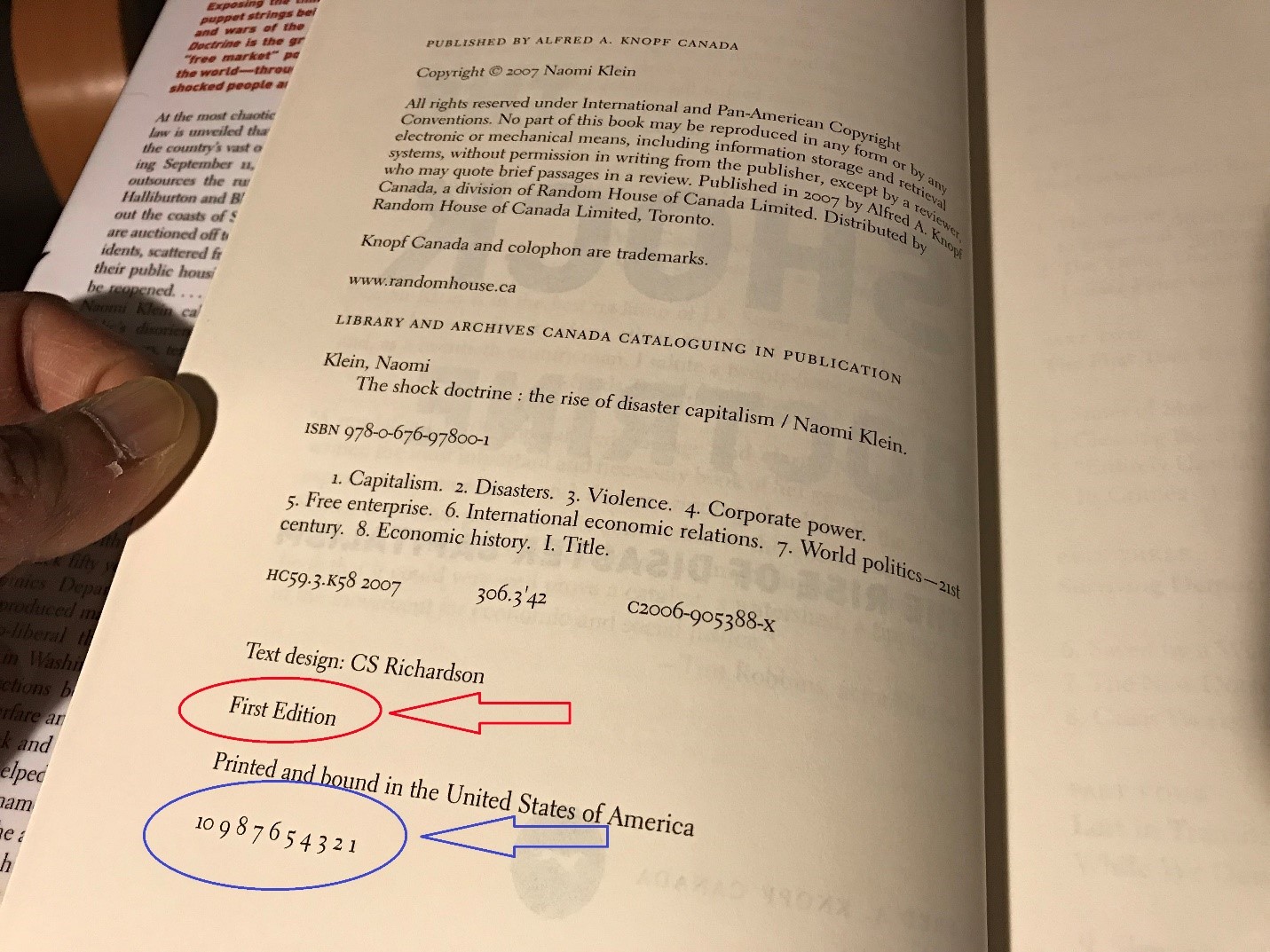
First of all, if you’re lucky the copyright page will mention the words ‘First edition’, like the Naomi Klein hard cover on her seminal work on ‘Disaster Capitalism’, a form of capitalism that takes advantage of natural or man-made disasters. An example that readily comes to mind is the free-for-all cash grab that followed Hurricane Katrina in the southern US in 2005 during the “reign of error” of George (Dubya) Bush.…
If you see ‘First printing’, instead of ‘First edition”, it’s the same thing.
Sometimes, you won’t find any of these terms on the copyright page. No problem, look for the ‘number line’. It is a series of numbers that usually appears at the bottom of the page. If the line begins or ends with a ‘1’, it’s a first edition.
————————–
Other times the number line is preceded by the term ‘First edition’, but be careful because some publishers leave on the words ‘first edition’ even when the book is in its third printing and that fact is reflected in the ‘3’ in this number line….
First edition
3 4 5 6 7 8 9 10
The following sequence is supposed to be on a book that is in it’s 2nd printing (the ‘2’ at the end) and has come out in 1975 (the ‘75’ in front) …..
75 76 77 78 79 10 9 8 7 6 5 4 3 2
What do you do if neither the ‘First edition’ nor the number line appears on the copyright page? Relax, read on….
In many cases, you may not see either the number line, or the ‘First edition’ mentioned on the copyright page. Not a problem, just check if the copyright date and the printing date match up, like it does above, in the copyright page for astronaut, Scott Kelly’s ‘Endurance’, about his 340-day saga aboard the International Space Station.
——————————–
The second most important thing to remember about first editions is that they have got to be looked after, since their value is directly dependent on their condition, unless you happen to have an ancient original…..
Certain first editions can’t be found in mint condition. In those cases, their archaeological value trumps everything. Like the 2700-year old Dead Sea Scrolls that the ancient Jewish sect, the Essenes, produced and secreted for posterity inside earthenware jars in caves around the Dead Sea. Since they didn’t have printing presses or xerox back then, they must be first editions.
The most valuable part of a first edition hard cover is it’s dust jacket. A dust jacket is 90% of the value of a first edition. So, don’t be a shmuck and fuck it up, like dropping coffee on it or jotting down your grocery list or something. Make sure there are no stickers or handwritten markings on it either.
Libraries usually use mylar dust jacket covers to protect dust jackets. I use Brodart™ dust jacket covers for all my first editions and other hard covers that I specially treasure.
————————————
Unfortunately I don’t own any signed first editions. That Sydney Sheldon I spoke about earlier is a signed first edition but the signature is a print, not an original signature by the author’s own hand.
Original hand signed first editions are serious cash – maybe 10, 20 times the value of an unsigned first edition. I have decided to begin frequenting book signings. To that end, I have created an account on Chapters.com. If you are a collector, make sure you get a photo taken with the author signing your copy. It’s not incontrovertible proof but it is still valuable circumstantial evidence that the signature on the book is authentic.
In case you think it’s crazy to collect books, even first editions, remember vinyl records? They are back with a bang. I was such a schmuck to throw away my LPs and my Garrard record changer. We humans are nuts – we don’t care about stuff when we buy them new, but we go ape shit for them when they are vintage.
I could kill myself for chucking out my illustrated hard cover of Vatsyayana’s Kama Sutra after its pages got sorta kinda crinkly and brittle with all the dried DNA I had inadvertently splashed on it. Imagine how priceless that Kama Sutra could have been by maybe 2850AD. Forensic archaeologists would be creaming over the ancient life form they detected on it.
“Hold thee my sword, while I do run upon it. Wilt thou, Strato?” – Brutus, defeated at Philippi by the forces of Octavian and Mark Anthony, to his loyal servant Strato (from Shakespeare’s “Julius Caesar”)
I’m 68 and I can see myself approaching the point where one asks himself, “Is this all there is to it?”
I would like to plan well ahead and be able to choose the way I wish to die.
I have the modus operandi down to a T. Its my Glock17. I keep it cleaned and oiled at all times, tucked away in a recess in the wall behind the dryer. Once every six months, I replace the rounds with fresh ones after a stint at the range. It’s a semi-automatic, loaded, with the safety off. I don’t even have to cock it. All I have ta do is press the muzzle to my temple and squeeze the trigger. One round will end it all. Quick and painless.
I want to be cremated, nice and easy. No wake, no funeral, no eulogies, no signs left of my existence except for a fistfula ash. I would like there to be a party though, with topless waitresses, so scantily dressed that you can count the cotton molecules in the fingers of yore hand.
————————-
One way I won’t want to go is by running myself through with a knife or sword to my stumik. Man, that’s a slow, excruciating way ta die. The blade will slice effortlessly into my small intestines and if I twist it this way and that, it will tear apart my spleen, liver and kidneys, causing massive internal hemorrhaging. If the blade didn’t find my abdominal aorta, it’ll take me a long long time to die.
Only schmucks want to run themselves through.
———————-
It was different in ancient Rome, however. If you were a military commander facing defeat, you’d probably be looking at running yourself through as a viable option.
In the case of Marcus Junius Brutus (the ‘et tu Brute’ guy), this was 43BC and he believed it was the only honorable thing left to do. His forces had just been routed in the Battle of Phillipi.
Running through, impaling oneself by his own sword or spear, conveyed a sense of chivalry and was regarded as the signature of a true hero in a world that hated pussies. Not killing oneself, trying to make a run for it, would make the vanquished seem cowardly. He would be derided and shunned and that was just about the worst thing that could happen to a man at the time.
Either you won or died in battle. There was no third ground.
So, there was Brutus in 43BC, reclining inside a tent outside the Macedonian town of Phillipi, defeated. His comrade-in-arms, Cassius, had already taken his own life by, you guessed it, ordering his personal slave to run him through. A year had passed since the two, Brutus and Cassius along with others, had murdered Julius Caesar.
Brutus tried one last thrust. He combined his and Cassius’ forces and tried to fight the Triumvirate (Octavian, Mark Anthony and Lepidus) but he failed. Now his ass was grass and the choices were limited. He could gather a legion and a hundred slaves and flee east to some far flung province like Parthia (present day Iran) with very fragile Roman control. Or he could stay put and face Roman justice for capital murder – execution.
Today, executions in most of the developed world are humane. They could be by lethal injection, electrocution, hanging, the gas chamber or a firing squad, but they all have one thing in common – death comes in seconds. One minute you’re there and the next, you’re gone. Within the hour, you are in an unmarked prison cemetery plot and in a year you’ll be raising the daisies.
By contrast, ancient Roman methods of execution were exotic. They could chop you up alive, a little at a time. They could make you sit on the tip of a sharpened wooden stake that was stuck vertically in the ground and let gravity do the rest while they eagerly waited to see it appear out of your mouth. They could prise your jaws open and pour molten lead down your throat.
They could crucify you. It’d you a week to die, give or take. Crucifixions were slow – five to seven days of starvation combined with the unbelievable agony of being nailed to a cross, your weight trying to tear flesh at the nails. Do you think Jesus or Spartacus would be the heroes that they are today, if they had simply been poisoned? Naaah.
Or they could simply tie your extremities to two horses facing in opposite directions and mercilessly whip ‘em till they tore you apart, at the weakest spot – your waist.
Running through was a dream compared to the above.
—————————-
Which brings us back to Shakespeare and Brutus’s suicide. Sure enough for his slow and painful demise, Brutus was lionized even by his vanquishers. After Strato broke the news of Brutus’ suicide, Mark Anthony was all teared up and had this to say –
“…His life was gentle, and the elements So mix’d in him that Nature might stand up And say to all the world,”This was a man.”
Octavian – later to be Rome’s first emperor, Augustus/Octavius – didn’t want to be outdone by Mark Anthony’s eloquence, so he held forth….
“…With all respects and rights of burial. Within my tent his bones tonight shall lie. Most like a soldier, order’d honorably…”
If instead, Brutus had swigged down some hemlock and croaked, the very same Octavian would have said derisively, “Chuck the SOB into the Tiber and lets get the hell outa here. I don’t want to be late for tonight’s orgy. Those broads I got from my Macedonian campaign can really give head.”
What’s with this hullabaloo about the most honorable way to die? If you’re dead, you’re dead, that’s it. Beats me why you would give a fuck how the rest of the world saw you based upon the way you died.
——————————-
Getting back to Shakespeare’s penchant for gore, his work is replete with mayhem and that’s because Elizabethan audiences reveled in gore. While a good comedy once in a while didn’t do any harm, the 16th century English folk overwhelmingly went for treachery, debauchery, deceit and fountains of blood.
Violence was the primary reason why Billy Shakes became so famous.
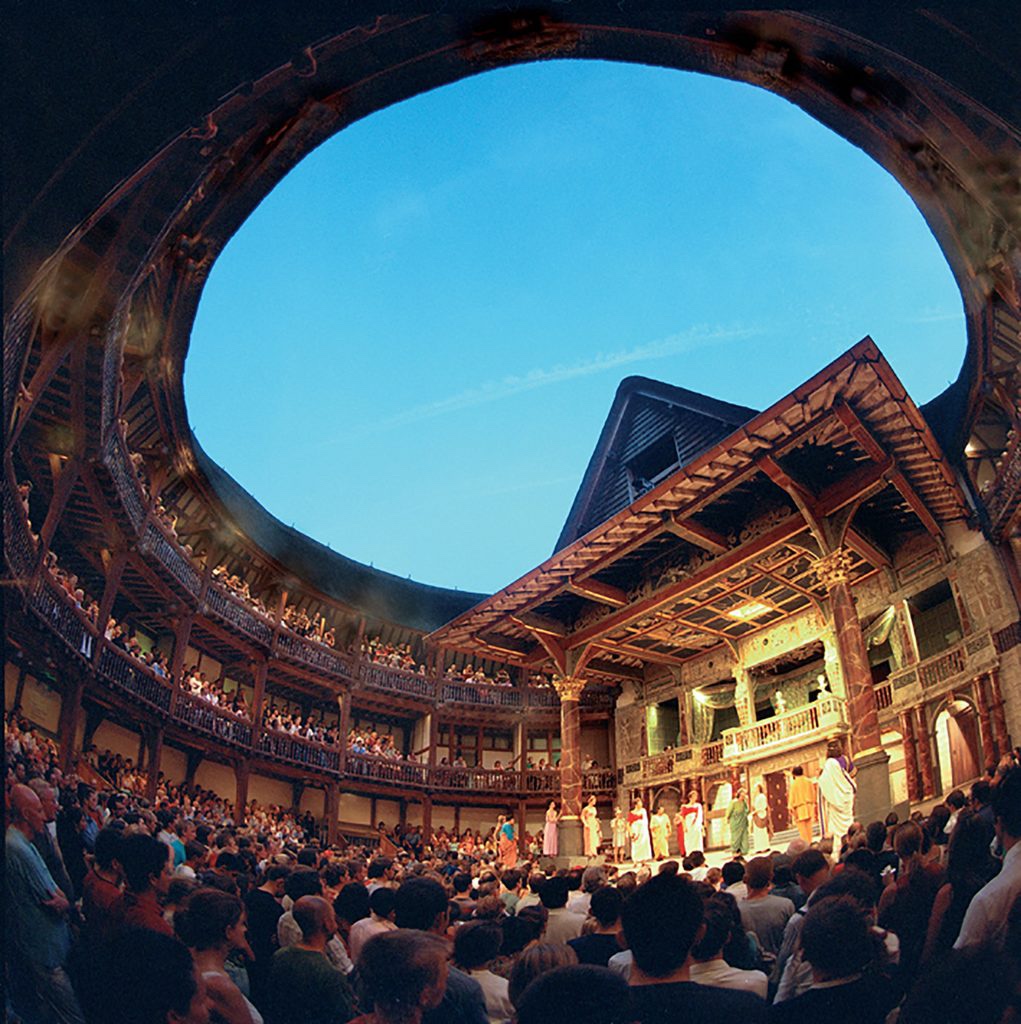
Elizabethan audiences loved the shocking drama. The blood had to be realistic and so the theatre management at “The Globe” had a small barn at the back where they kept sheep, lotsa sheep. Every two consecutive renderings, one was slaughtered and its blood, heart, lungs, liver, etc were used as props for the mayhem in the plot. When the props began to stink, they simply went ahead and killed another sheep.
The present-day Globe Theatre, London. This is a replica, the original having burned down in 1613.
————————-
Realism drove the theatre producers to even use actual human beings sometimes, I’m not kidding. In Thomas Kyd’s ‘The Spanish Tragedy’ (a sorta Andrew Lloyd Webber of gore), which had several gruesome revenge killings on opening night, they needed an actual human being to be strung up from a tree branch and hanged, so they simply got a condemned prisoner from the Tower to do the act.
The play became a overnight rage. Soon they were running outa fresh bodies, so the Queen’s dragoons began picking up random folks right off the streets who looked even remotely suspicious of any wrongdoing. Trials were fast-tracked and the death sentences confirmed, so they could act in Thomas Kyd’s play that very evening, even though it was going to be a one night stand. Since at least some of the sods really were criminals, the law and order situation in and around London improved drastically.
————-
Some of Shakespeare’s most violent plays were by far the most popular. Titus Andronicus – Billy’s first and most violent tragedy – was a huge success at The Globe. Touring troupes fell over each other, wanting to play Titus Andronicus. In the play, two of the characters were baked in a pie……. literally……
Titus had the Roman emperor-to-be, Saturninus and his wife, Tamora, over for dinner and after the horses of the ovaries had been cleared away, Titus revealed that the meat pie the couple had just devoured was actually what remained of their two sons, Demetrius and Chiron. While they were in a state of shock, Titus butchered Tamora with a carving knife and in return, was killed by Saturninus right after.
Titus had to be stupid. If I was going to tell you I just baked your kids in a pie, I’d make sure I had back-up. Titus had justification for the pie though. The duo had raped and mutilated his only daughter, Lavinia and he had had to honor-kill her after he found out, ‘to spare her the shame’. Boohoo. And then, Titus’s son, Lucius, nabbed Tamora’s Moor lover boy, Aaron and had him buried in the desert sand upto his chin and left to starve ta death.
And you thought ‘Friday the 13th’ was horrifying.
Billy Shakes was particularly gruesome in Hamlet – when King Hamlet (Hamlet’s dad) was napping in his orchard, his treacherous bro Claudius, poured a ‘leperous distillment’ into his ear. The poison curdled his blood and caused his skin to develop horrible sores. The King died in his garden, hideously disfigured, a victim of his brother’s treachery.
I am imagining The Globe issuing a casting notice, a job ad, announcing…. ‘Actor wanted, to play King Hamlet. Must bring his own vial of henbane and dropper and don’t forget the down-payment on casket…’
And then there was that shmuck, Polonius, newly crowned King Claudius’s trusted aide. Acting on the orders of Claudius, Polonius hid behind the drapes in Queen Gertrude’s chambers, to eavesdrop on her conversation with Hamlet, whom Claudius suspected of plotting to overthrow him. Polonius however had this fatal habit of almost all of Willy Shakes’ characters – he constantly talked to himself.
Thus, while Hamlet spoke with his mom, Polonius had this running commentary going with himself, in a sort of a low mumble. Alas, the mumble wasn’t low enough – Hamlet overheard him and drove his sword through the tapestry, killing the shmuck.
If you wanted to play Polonius and at the same time had a desire to come out of the show alive, you had to have fast reflexes because you had only a microsecond from the time the sword emerged through the drapes and entered your gut.
Ophelia, driven insane by Hamlet’s murder of her beloved father, Polonius, plunged from a tree branch into the current below. Actually she slipped and didn’t know how to swim. But Elizabethan England would have labelled her a nitwit, so Billy Shakes wrote it in as a suicide.
That’s nothing. In Macbeth, Lady McDuff was chased across the stage at the Globe and slaughtered when she jumped off and fell into the arms of the ladies in the front row, splattering them with gore. It was so real that….it was real. Even for a million quid nobody wanted to play Lady McDuff in those days.
Willy Shakes really knew how to keep audiences titillated, with ingenious new ways in which to die. He was the 16th Century version of Quentin Tarantino.
If you were to believe everything Willy wrote, you would be a regular at the friendly neighborhood pharmacist in those days, shopping for a pitcher of concentrated hemlock. And its antidote of course. You would be a shmuck not to order the antidote and keep a vial chained safely to your waist, just in case somebody in your household poisoned you.
Antidotes those days were even more valuable than gold and silver. Look at today’s cyber-security stocks, Christ’s sakes, I have been saving up for a year to buy Crowdstrike, Palo Alto and Zscaler.
You think I am kidding about what went on in the Globe? Google it if you like. By the way, the Globe Theatre still exists. The original Globe Theatre, built in 1599, burned to the ground in 1613, was rebuilt but demolished in 1644. The modern Globe Theatre is said to a perfect replica of the original 1599 construction.
—————-
According to Willy, Mark Anthony and Cassius too ran themselves through. For different reasons of course. Cassius, for being Brutus’ defeated co-conspirator and Mark Anthony, for losing the power struggle with Octavian.
Cassius handed his loyal Parthian slave, Pindarus, the very sword with which he had stabbed Caesar. He then commanded, John Gielgud-style, “Now with this good sword, that ran through Caesar’s bowels, search this bosom…. And when my face is covered, as ‘tis now, guide thou the sword.” Pindarus later made his escape to some place Willy Shakes doesn’t mention in his play. Slaves didn’t count for much of a mention in 16th Century England. In forcing a slave to murder him, Cassius selfishly put Pindarus’ life in danger. If captured I shudder to think what would have been done to him.
Mark Anthony ran himself through alone, duped into believing that the love of his life, Cleopatra had already taken her life. She was in fact alive when his corpse was brought into her inner sanctum and laid to rest in her arms, under the orders of Octavian. At this point, the despondent Cleopatra shoved her hand inside a basket of dates that had an asp placed inside on her orders. Mark Anthony had been popular with Cleopatra’s generals and might easily have been able to commandeer a fast galley and a few slaves and skip to the friendly kingdom of Kush (present-day Sudan) to the south. But the schmuck that he was, Mark Anthony chose to run himself through.
———————
Shakespearean plots were always very complex, with rivalries and deceit, temporary alliances and treachery, cowardice and chivalry – all woven inside a huge cauldron of blood and gore. One moment you see two characters thick as thieves and after a coupla acts they are at each other’s throats.
Other than his Titus Andronicus, which was fiction, all of Shakespeare’s tragedies were based on history. If Billy Shakes had been alive in the present day, he would surely have found in Afghanistan the perfect fodder for a tragedy. The buddy movie of the American and the Taliban raising toasts in sunny Doha and then the treachery of the Americans, leaving their faithful Afghan fixers at the mercy of the Taliban.
Oh yeah, there’s a Shakespearean zigadoo in everything today. Take a look at who was fighting whom in Syria just a while back….
Bashar Assad was trying to put down an armed insurrection, with the help of his Shiite friends, Iran and and the Lebanese Hezbollah and his long-term ally and benefactor – Russia. The Americans were arming the rebels and drawing “red lines” against Assad, while they were also paying Assad to let them rent off-site real estate for torture and rendition in the so-called ‘war on terror’. The Israelis were, time to time, bombing Assad’s ammo dumps and all the while, making nice with Putin. And all this time Bashar was keeping alive a hope he would one day be back in America’s good books and be able to get his hands on all the frozen assets. All this, when at home Assad was playing a devoted husband with a British born prim and propah Syrian wife who liked to show off her Oxford accent and her pearls.
And all of them, the Syrians, the Americans, the Russians, the Israelis, the Iranians, the ships, the shoes, the sealing wax, the cabbages and the kings – they were all fighting the ISIS.
“Every day, as we walk through our lives, we notice evil and good living side by side. That’s the nature of life” – The Dalai Llama
————————————
“He that is without sin, let him cast the first stone” – Jesus.H.Christ with the scribes and pharisees, in the Gospel according to Jack. – painting by Philippe de Champaigne (~1670) ————————————
The Dalai Llama’s words in the blurb above the image seem to imply that the forces of evil are just as powerful as those of good. I happen to agree. History supports that view too. But coming from the Dalai Llama – the very custodian of his faith, it is an admission that God is not the only Sheriff in town.
James Irwin, the Lunar Module Pilot for the 1971 Apollo-15 mission to the moon, reported that while he was on his 18-hour sojourn on the surface of the moon, he felt the “presence” of God around him, coaxing, encouraging, guiding, reassuring him. I won’t make a snide remark about the presence. Irwin held a Master’s Degree in Aerospace Engineering. If he says he felt something, then he felt something.
On touching down at the bottom of the 36000-ft deep ‘Challenger Deep’ in the Marianas Trench, the deepest spot on Earth, the Oscar-winning movie director, James Cameron felt surreal as he looked out on the desolate landscape of the ocean bottom. Although he was completely isolated from human civilization, he says he felt a spiritual presence. I won’t sneer. Cameron is my favourite movie director. If he felt creepy, he felt creepy.
Maybe God does appear in extreme places, but here’s the thing – I don’t want to be only in life-threatening places, to feel His presence. If he wants me to believe he definitely exists, he has to appear while I’m having a beer by the riverside or taking a shower or watching porn or something. Otherwise, I am an atheist and an agnostic rolled in one. As an agnostic I don’t know for sure if God exists and at the same time as an atheist, I don’t believe he does.
I am starting on Aldous Huxley’s Point counter point and I found this terrific quote on one of the first few pages, a statement that protagonist’s brother-in-law makes while arguing that one cannot believe in things that one cannot rationalize as true within oneself – “If you have never had a spiritual experience, it is folly to believe in God. You might as well believe in the excellence of oysters, when you can’t eat them without being sick…” Well, I have never tasted oysters, so there.
But I do agree with the idea of good and evil and I do think they exist together at the same time. Like in Superman comics, there is a “Bizarre God” at the other end of town where everything is the opposite of everything on this side. Good is evil and evil is good. Each and every one of us is born with a season pass for both sides and we use it to bounce back and forth every day, every moment.
————————
Even Jesus seemed to agree. According to the Book of John (8:3-7) in the New Testament, the scribes and the pharisees – those early Jewish zealots – they hated Jesus. He was slowly usurping their power over the Jewish people with his straight talk. So, even though he made sense when he spoke, the establishment had had it with him and wanted him gone. They would be given their wish with his crucifixion in the end, but in the initial days they tried to trip him up with their semantics.
One day, these men gathered a crowd and dragged a woman accused of adultery up to Jesus. They threw her to the ground in front of him and asked what should be done with her, while reminding Jesus that in the Torah (there was no Bible then) God, through his spokesman – Moses, had ordered that women who committed adultery be stoned to death.
The zealots had no idea who they were dealing with. Jesus stared at them, haughty yet serene, and said in response, “He that is without sin among you, let him first cast a stone on her…”
Jesus’s response was an indirect admission – that there could be in the crowd those that have sinned. That was exactly what the Dalai Llama must have meant. Once again, I completely agree.
The proposed punishment for adultery that the woman faced was an unimaginably brutal one. As per practice, she was to be buried vertically in the ground with only her head sticking out. Her punishment was meant to be by public participation, so from then until she had breathed her last, it was going to be a barbaric free for all. Anyone in the crowd could pick up a stone or a brick and hit her with it. From all sides her head would be battered by rocks at 70-80 miles per hour, slamming into her face, her ears, her lips, splitting, crushing, cracking, giving her no chance to defend herself. After a while she would be knocked unconscious and finally, after a half hour of agony, she would die.
Man, that is a truly horrific way to die. And all because she, a married woman, had let a married man fuck her.
Now consider this – Jesus didn’t protest the barbaric modus operandi of the sentence, stoning. Neither was he in the least perturbed that no one had thought of punishing the man who had been the other half of the adulterous union. We know full well that usually it is the man who makes the first move in an adulterous relationship. Yet, the Bible doesn’t even mention the son of a bitch.
Jesus was not concerned about the adulterer either. Being fair in meting out justice didn’t seem to occur to the messiah at all. Even the Bible, written much later after the dust had settled, doesn’t bother with the man. Some holy book.
Here is something else to consider about Jesus’s response…. it implied that, had there been a man in the gathered crowd who (deceitfully or otherwise) simply stated that he was free from sin then he, Jesus, was okay with that person stoning the woman to death.
Jeeze, some messiah!! Some God!!
This is the same God who demanded that the virgin Mary bear Jesus. As written in the Book of Luke, the story goes that one day the archangel, Gabriel (one of the three heavies who enforced God’s bidding) appeared before a random destitute woman named Mary, a virgin living in Nazareth and told her that soon she would bear a male baby with the power of the Holy Spirit whom she should name “Jesus”.
It was a command, not a request. Gabriel grandiosely told Mary that she had “found favor with God”
Maybe she didn’t want a baby, but God didn’t care about her feelings about it. He was about to unleash upon the poor folk of the Levant a faith that didn’t give a flying fuck about women’s rights. The illiterate star struck hillbilly woman, thrilled that she had been conferred such an “honor”, responded, “Behold, I am the handmaid of the Lord; let it be to me according to your word.”
Yeah, it is in fact a “Handmaid’s Tale”. Behold indeed. Behold a faith that has more priests who fuck little kids than any others in the universe.
———————————-
Let’s take this a bit further a closer look at the Book of Job…..
The Book of Job is a chapter in the Old Testament that is probably the most profound of all books in the Bible. It is the story of Job, a prosperous landowner and farmer in the ‘land of Uz’ which I am guessing must have been somewhere in the Fertile Crescent, a crescent-shaped swath of land that covers present-day Syria, Iraq, Israel, Lebanon and Palestine.
Job was something of a model citizen, a pious keeper of the faith. There must have been many who were equally virtuous, maybe living in China or Peru. Or Timbuktu. But God had for some unknown reason zeroed in on Job and showered him with all the riches – fertile lands to grow corn and barley, a thousand head of prime cattle, a hundred sheep and a family of seven strong sons and three beautiful daughters. Consequently, Job was wealthier than most.
Mind you, the Bible takes great pains to make it clear that God had given Job all his wealth and not that he had toiled for it. Though he was a hard-working man, Job had not earned his wealth through hard work, but as God’s reward for his blind devotion.
If you are a schmuck, you’ll ask – why this favoritism toward Job? But if you are a true Christian, you won’t question God’s actions. You’ll sagely shake your head side to side and speak the dictum of every evangelical Christian nut job – “The Almighty God has his ways. It’s not for us to question Him”.
————————-
Anyway, the story goes that as Job kept on getting richer, one day the Satan appeared before God and said, “Have you seen what’s going on down on earth, the sinful things that people are engaging in?”
God replied, “You’re always bitching about the bad stuff. See how Job lives his life, as a pure moral human being”.
Being well aware of Job’s special status, the Satan said, “Of course Job will be pious and obedient. You made it worth his while. Take away all that you have given him and then see how long he remains your obedient servant”.
So, God took the challenge and within the wink of an eye Job had lost everything. The next day, while Job’s sons and daughters were feasting at home, God sent a wind that rushed in and destroyed the house, killing all of them. Then, a bolt of lightning streaked down and torched all his lands and livestock.
And then God did a curious thing. He handed Job over to the Satan. Instantly Job was inflicted by a dreadful disease and large puss-filled boils appeared all over his body and he lay dying unable to move, writhing in pain.
Job wanted to scream, “Why, God, why?” But he knew a good thing when he saw one. He did a Paul Manafort (maybe Michael Flynn). He decided to keep his mouth shut and ride it out.
Turns out, Job was right. In recognition of his loyalty, God snatched him back and restored all his possessions, his family and his health to him, this time with fourteen thousand sheep, a thousand yoke of oxen and a thousand mules. He also gave Job a new set of sons stronger than the ones that He had had murdered and three new daughters more beautiful than all the women in the world.
What kind of God would bring such havoc to a moral and devout man, just so He could win a bet with the Satan? Why did the first set of sons and daughters, the first set of livestock have to die? How could God be a just God if so many innocents were punished for nothing?
I’ll say it again – Jeeze, some God.
————————————
To blind believers, the moral of the Book of Job is – whatever happens to you, keep your mouth shut and bear it.
In his book “When bad things happen to good people”, Harold Kushner urges the reader to consider three possibilities…(1) God is all powerful and nothing happens without his will, (2) God is just and the evil are punished while the good prosper and (3) Job is a good person.
As long as Job is healthy and wealthy, we can believe all three premises to be true. But if Job suffers, one or more of the three propositions don’t make sense. If God is both, just and all-powerful, then Job is a sinner, which is not true because he isn’t. If Job is a good person and still gets punished, then God is not just. If it was not God who made Job suffer, then God is not all-powerful.
Therefore, says Kushner, the Book of Job is an argument over which of the three propositions we are prepared to sacrifice, in order to keep on believing the other two.
—————————
I’m done with Job and now let’s get back to the Book of John in the New Testament and the part about the adulterous woman…..
No one came forward to cast that first stone and so the woman was set free.
Now here’s the thing – the Bible doesn’t dwell upon what happened next. Did the woman say “Phew, that was close” and then return home and beg her husband for forgiveness? Or did she run back to her adulterous fuck friend with a new-found confidence from the fact that nobody could touch her now?
Anyway, whatever happened to that woman afterward has never been recorded and now, more than two thousand years later, we still have no idea.
But we sure can tell what will happen to a young adulteress like her, today…….Nothing.
They won’t even bother to arrest her. Today the same woman can sit on her haunches “in the middle of 5th Avenue” and blow someone and all she’ll get is a ticket for blocking traffic and public indecency. Courts in most progressive democracies no longer recognize adultery as a criminal offence, citing personal liberty which is enshrined in their constitutions.
We have come a long way, baby. Today the prevailing ethos on adultery is – if two people want to fuck, it may not look nice but it is their choice. I believe that is how adultery should be viewed – disgusting, distasteful, debauched, but not illegal.
Lets not depend upon only one kind of justice – the divine kind.
In the midst of the battle of Kurukhshetra, Karna has a flat tyre and guess what he does? He asks the enemy (Arjun and his charioteer, the divine Lord Krishna, purplish-blue, with the halo on the side of his head), to wait while he fixed his chariot.
Guess what happened then? Well, you have to read this piece to find out…
In the great epic, Mahabharata, when a defenceless Karna’s chariot wheel got mired in the mud in the middle of the battle of Kurukhshetra, he tried desperately to extricate it, but failed. Noting that the Pandava hero, Arjuna, was gaining on him and getting ready to slay him, Karna asked him to hold his fire and give him a hand.
Coming to an adversary’s assistance in those days was a component of what was known as battlefield etiquette, which required that when a fighter had been placed unwittingly in a position of disadvantage, his antagonist had to hold further fire until he had recovered and the playing field had been leveled. Something similar plays out in boxing today – punching a fallen opponent is against the rules.
Back in 5561BC (the date that vedic scholars think the Battle of Kurukshetra happened), battlefield etiquette was a very important component of the chivalry.
——————————–
In fact, battlefield etiquette was common all over the ancient world. In Homer’s epic, Iliad, the Mycenaean fighter, Ajax the Greater, chucked a huge stone at the Trojan hero, Hector, with such force that it dislodged Hector’s helmet and crushed his horse. Since he was still mounted on his own steed and had his helmet on, Ajax deemed it unfair to continue. He dismounted and paused to let Hector collect himself, a decision that would cost Ajax his life. Hector recovered his balance and strength in the brief interlude and they fought fiercely hand to hand, until Ajax was killed by a glancing blow from the haft of Hector’s sword.
In today’s world, Ajax would be derided as a stupid sucker. But not in 850BC Troy. Ajax was elevated posthumously to the pinnacle of chivalry and spoken of with adulation and awe by both, the Mycenaeans and the Trojans.
——————————-
But I digress… Getting back to the Mahabharata, on hearing Karna’s plea for help, Arjuna immediately rose to get off his chariot and give Karna a hand, when all of a sudden Arjun’s charioteer, revered Lord Krishna (who was at once Arjun’s master and servant), stopped him.
Instead of commending Arjun’s sense of chivalry, Lord Krishna reminded him that Karna was on the side of the bad guys and that it is not against battlefield etiquette to kill a man who has supported evil all his life. Arjuna lamely turned back, took aim and killed Karna.
What do y’know. Under his beatific smile, Lord Krishna was calculating, machiavellian. Not the first time that a God turned out less than godly. Remember the Christian God who ordered Abraham to slaughter his innocent son, Isaac, for no reason other than to prove his faithfulness to the Satan?
Go ahead, call me blasphemous if you will, for taunting the Hindus and the Christians at the same time. In actual fact, I want to believe in religion. I want to believe in what others believe. But I am me and I can’t believe, unless it makes sense.
—————————-
No thanks to Lord Krishna, battlefield etiquette still makes its presence felt – albeit sporadically – in the unlikeliest of places……..
Spring, 2009
A hamlet, 20 miles south of Spin Boldak, Afghanistan.
The night had been so brilliantly moonlit, it was almost like day. The hamlet they had surrounded was bathed in a diffused glow. They would have waited for the next new moon but there was no time.
Abu Salam was leading a TTP (Tehrik-e-Taliban Pakistan) squad that had bivouacked for the night in the bushes surrounding the cluster of adobe huts, just north of the border with Pakistan. The hamlet was nestled inside a cleared circle on a vast terrain covered by a dense thicket of waist-high shrubs that seemed ideal for concealment from a ground-based adversary, but completely exposed to an aerial attack by fixed-wing ground attack aircraft like AC-130 gunships and A-10 Warthogs or even choppers like the Apache or Black Hawk.
There was big game tonight and the Emir, Baitullah Mehsud himself, was by his side, toting a Stinger missile launcher to deter aerial support interference. The Stinger’s dull black mat finish hadn’t been scratched yet. Although it was an older version that Raytheon had stopped making a long time back, it was still brand new. It had been stowed away unused, in an Islamabad warehouse operated by Pakistan’s intelligence agency, the ISI and remained there after the Soviets had left Afghanistan.
The Stinger was a remnant of American largesse of the 80s and today it would be used to kill Americans. Salam smiled grimly at the irony.
————————–
Inside the hamlet were two dwellings – one, a large square adobe home with a courtyard in it’s middle and the other a small outhouse which had three Delta Force operatives from the US Special Operations Command and an Afghan interpreter in it.
The insurgents lay there, forming a neat circle round the hamlet, a battle-hardened TTP fighter every five yards or so. The fight with the Russians and the training from the ISI had taught them discipline. The Americans inside that outhouse might have drawn some consolation from the fact that they were about to be annihilated by a fighting force that paralleled their own professionalism. What this bunch didn’t have, in terms of equipment and technology, they made up for in their commitment to a cause, albeit, a crooked hijacked cause.
The owner of the compound, a grizzled Pashtun warlord who had fought the Soviets with Salam, had been a notoriously fickle-minded guy who had first decided to side with the Americans on receipt of a bagful of $100 bills and then, after taking the money, he had changed his mind. The Delta Force team had been dispatched along with an interpreter with orders to either get him back on their side or finish him off. The wily Pashtun had gotten word and contacted the TTP.
As Abu Salam felt the discomfort of the ground – still hard and cold from the winter, two of the Americans came out of the outhouse and started walking toward the bushes, possibly to take a leak. That’s when all hell broke loose. 7.62mm rounds began spewing out from the fanatics’ AK47s and the two Americans crumpled to the ground.
What followed was the moment that Abu Salam recognized why the Emir deserved to be called – the Emir.
The two fallen Americans had momentarily stopped moving and a deafening silence had set in and as Salam stared at the scene below, suddenly a third American emerged from the outhouse. He walked resolutely toward his fallen comrades, his steps unhurried, as if he was on an evening stroll. He reached one of the prone Americans, the one closest to him. He calmly slung him over his shoulders, hefted him with a huge shrug and started back toward the lee side of the outhouse. He was a target that begged to be taken down.
For a moment, Abu Salam’s Talib colleagues, including the Emir, were dumbfounded by the bravado. By the time they could gather their wits, the American had disappeared behind the adobe wall of the outhouse.
The Talib weren’t even done releasing the breaths they had been holding, when the shape appeared once again.
This time, the American walked in an even more measured pace, covering ground the way only someone who believed completely in himself would. As he advanced toward his fallen comrade, the Talib gaped, their faces aghast and their mouths hanging open in astonishment.
One fighter – no one knows for sure who – let out a burst. The American stumbled and fell. He still had a few yards to cover, but that was when the Emir let out one single shout – wadrega! (stop!)
As the firing fell silent, the Talib gunmen watched astounded as the American, mortally wounded, started crawling toward his buddy. Their eyes unbelieving, they watched him reach his pal and come to rest right next, his one good arm now engulfing his friend in a hug.
Abu Salam raised his AK to finish the infidel off, but suddenly he felt the muzzle shoved aside. It was the Emir.
‘Enough,’ said Baitullah Mehsud, ‘Don’t ever forget. We are all fighters and this is a brave one. Let him choose his time to die.’
After waiting a while, the Talib cautiously climbed down from their perch and approached the two fallen Delta Force men lying there in that macabre embrace. The Emir reached down and held his finger under the American’s nose, the one who had come out to help his fallen comrades. Mehsud felt his breath coming out in short ragged bursts. Given the extent of his wounds, he estimated the soldier had only seconds.
“Leave them alone,” said the Emir, “Give the infidels the chance to take him away. He has earned the right. We shall return, for another fight, another day…”
Then, as he turned to rise, the Emir’s eyes fell on the dog tag on the still breathing American. He stared at it a while and then stooped and removed it from the American’s neck. It said –
Giovanni F. Ricci
697-012-8326
RH Negative
Catholic
—————————
Today that dog tag rests inside a beautifully hand crafted teak and glass jewelry box on top of a TV cabinet in a small town called Lawrence, mid-way between Topeka and Kansas City in the United States. It is the home of an elderly couple. Somehow it had found its way from a dusty Afghan hamlet, via an Islamabad army installation and then finally to America on a C130 Hercules transport aircraft that had taken off from Shamsi Air Force Base , in Baluchistan, 12 time zones to the east.
Next to the jewelry box is another piece of metal attached to a gold-braided silk tape. It is the Congressional Medal of Honour, America’s highest military award for bravery in the battlefield. How the presidential citation had been so accurate, given that there were no witnesses, remains a mystery till this day.
The Santuaro di Santa Maria di Polsi is a Catholic sanctuary in the heart of the Aspromonte mountain range that runs north to south along the middle of the toe of Italy, near San Luca in Calabria. Founded by Roger II, King of Sicily in 1144, the church and monastery are situated in a spectacular setting at the bottom of a gorge that is surrounded by high mountains on the east side of the 6000ft Mont Alto, the highest peak of the Aspromonte.
Like other pilgrimage destinations, such as the Haj for Muslims or Amarnath and Sabrimalai for Hindus in India, the inflicting of fatigue and pain upon the pilgrim is considered essential, in order to give him a sense of having ‘earned’ the right to spirituality. Somehow, kneeling in the corner of your prayer room at home isn’t the same thing. This is in spite of the widespread belief that God is omnipresent and is not necessarily found only in Jerusalem or Mecca or Sabrimalai.
Like the abovementioned pilgrimage destinations, the Polsi sanctuary too is difficult to access and cannot be reached by mechanised transport. The pilgrims, like any others around the world, feel that they have to trudge up to have a glimpse of the Santa Maria and bask in the momentary reflected piety. I have never understood this, but then I am not a religious man.
In September every year, around 200 leading members of arguably the most powerful organized crime group in the world, join the pilgrims in the long hike up the Aspromonte mountains, ostensibly to visit the sanctuary and express their devotion to the Virgin Mary.
I say ‘ostensibly’ because the real reason for their pilgrimage is not devotion, but to have a tête-a-tête. Since the 1950s, the chiefs of the locali have been meeting there during the September Feast. These annual get-togethers, known as the crimine, have traditionally served as a forum to discuss future strategies and settle disputes, under the auspices of the Catholic church.
In those days, the Catholic Church was as involved in hosting and laundering money for the Mafioso as it’s priests were, in fucking little boys and girls.
————————————————-
A 100 miles to the north, is a sleepy town called Cosenza that is bathed year round in bright sunlight. In January, with clear, azure-blue skies and a balmy 15°, Cosenza could well have been a tourists’ paradise.
One such day in January 2014, brought to the world an unspeakable horror that the locals are still trying put behind them and move on……
For 3-year-old Nicola “Coco” Campolongo, it had promised to be an exciting day. Coco had just been strapped into the car-seat in the back of the 8-year old Fiat Punto by his grandfather, Guiseppe Iannicelli, who drove while his Moroccan companion, 27-year-old Ibtissa Taoussa, sat in the front passenger seat. Taoussa was ‘Aunt Betty’ for Coco.
As the tiny car negotiated the busy thoroughfare, Coco’s head constantly swivelled round and round, as every child’s does, when he’s being taken on an outing. When he noticed a motorcycle keeping pace just inches away to his right, he gazed out at it in awe. The bike was one of those heavy Yamaha racing motorcycles.
Sitting astride were two men, dressed in leather from head to toe, with black helmets, their visors pulled down. When the man riding pillion turned his head to look at him, Coco waved wildly at the man and he even waved back. The motorcycle then speeded up, overtaking the Fiat and positioning itself in front. It remained there till the next intersection, where the bike came to a sudden halt, even though the light had turned green.
The old man was slow in reacting. He slammed on the brakes and fought to bring the skidding Fiat to a halt, barely managing to stop inches away from the tail lights of the Yamaha.
As the pillion rider twisted his torso, this time completely around facing the Fiat, the old man growled something in Calabrese that, roughly translated, meant, “Get the f—k out of my face, ars—le.” Grandpa Joe was a man with a mercurial temper.
The two seconds that the pillion rider took to unzip his jacket front and draw out a Beretta 7.62mm automatic would have been enough for a younger man to immediately put the car in gear and ram the motorbike, possibly run the two riders over and make his escape. Even if it had taken three seconds instead of two, he would probably have still made it, since the pillion rider would be too startled to aim accurately.
But Coco’s nonnino was old, no longer that murderous young button man with a leopard’s instinct for survival as he had once been. He just stared dumbly ahead till a third eye appeared in the center of his forehead. Immediately, the aged drug trafficker slumped forward on the wheel, pressing the horn down, setting it off.
The traffic around the two parked vehicles began to scatter and passersby did what this town had trained them since childhood for – they dived for cover. Just as well, because the pillion rider got off the bike and ambled over to the passenger side and peered in for just a second, before he brought the gun up once more and shot the terrified moll too, right between her eyes, at point blank range, the gun’s muzzle hitting the woman’s forehead before the round exited in a fiery flash.
Coco was beside himself by now, hopping up and down, restrained by his car seat, unable to comprehend what was unfolding in front of his eyes. He kept repeating, “Nonnino! Nonnino!” over and over.
The pillion rider didn’t get back on the bike. Instead, he strolled round to the rear of the hatchback and stood there for a while, not moving, his head swiveling around till he was satisfied there was no emerging threat. There couldn’t be. The outfit that he worked for owned this town.
Stretching out his right arm, he brought the Beretta up one last time, it’s muzzle bumping against the rear window of the car, six inches from the back of little Coco’s head. His expression impassive, the hit-man fired two shots in quick succession and Coco’s head exploded like a melon. The toddler slumped forward, his upper torso hanging in front, restrained by the car seat’s harness.
In the deathly silence that followed, the pillion rider casually walked over to the driver side, opened the door, dragged Iannicelli’s corpse out onto the pavement and out back, opened the trunk and stuffed it in. The bike revved up, the Fiat’s engine fired and the two-vehicle convoy began moving forward unhurriedly. At the next corner they took a sharp left and disappeared from view.
Iannicelli had been a convict on nocturnal payrole and when he didn’t call in for a couple of days, the cops went looking for him. Then, a few days later, a hunter spotted the burnt-out skeleton of a small hatchback inside the compound of a derelict building at the edge of town and alerted the police who discovered the macabre scene inside.
There was a body in the trunk, charred beyond recognition and another in the front passenger seat, similarly cooked. In the back seat, the investigators found the charred remains of a tiny body, still strapped to a blackened car-seat, unrecognizable as the remains of a human being.
A shiny 50-eurocent coin was found on the roof of the burnt-out car, a known custom of the criminal group that owned the town, a message that meant that it was a vendetta for an unpaid drug debt.
——————————-
Welcome to the world of the ‘Ndrangheta, the deadliest organized crime group in the world, with annual revenues from drug trafficking and murder of over $80 billion, a tidy sum which also happens to equal 3.5% of Italy’s GDP and double that of the auto behemoth, Fiat.
Guiseppe Iannicelli had been a card carrying member of the ‘Ndrangheta. Till he ran afoul, trying to make a drug sale on his own, without sharing the proceeds with his bosses, a capital offense to the ‘Ndrangheta. He too made those knee breaking pilgrimages to the Santuaro di Santa Maria di Polsi Catholic sanctuary in the hope that his Catholic God would choose to be on his side. Obviously he had been misled.
‘Ndrangheta tattoos. You gotta have ‘em if you’re going to be one of them. Like the Japanese Yakuza.
Maybe it is the apostrophe in front of the name, but it sends a chill down my spine.
Coco was not the only child collateral damage. Clockwise from Coco, blue-eyed three-year-old Domenico Petruzelli didn’t know his mum’s boyfriend was a ‘Ndrangheta goon. One day in March 2014, hitmen forced the family car off the road and opened fire with machine guns. Domenico died instantly, in a hail of bullets. Valentina Terracciano, just two, was killed in 2000, in a machinegun crossfire which raked a flower shop in Pollena Trocchia, near Naples. The store belonged to her uncle, a Camorra member and the real target. Claudio Domino, 11, was shot in the forehead because he was witness to a murder, in Palermo, Sicily. Annalisa Durante, 14, was a bystander used as a human shield in a clash between two rival Naples clans in 2004. She was fatally shot in the back of the head.
In the last decade alone, over 80 children and some 800 innocent bystanders have fallen for being at the wrong place at the wrong time.
In a way, Coco Campolongo never had a chance; at least not at leading a normal life. Born into a family of drug pushers in ground zero of ‘Ndrangheta territory in southern Italy, the only occasion when the toddler had seen his parents was when someone found the time to take him to visit them in prison.
—————————————
Naturally there were cries of horrified indignation at the killing of Coco. Even for a country that has numbed itself to willful blindness at organized crime hits, the deliberate murder of a 3-year old looked like it was going to be a tipping point. From his pulpit, Pope Francis cried, “How could anyone kill an innocent little boy of just three years in this way?”
Then, as if to square things up, to show the world that evil always loses in the end and to thereby reaffirm the ‘law of conservation of spiritual entropy’, Pope Francis confirmed gravely that the child would surely go to heaven. He must know. After all, he is believed by Catholic suckers all over the world to be God’s own rep on earth.
The Pope went even further. “You, the mafia, are hereby excommunicated from the Catholic Church”, he announced, even though excommunication from the Catholic Church is a lengthy bureaucratic process and cannot be carried out by an single announcement. Still, the Pope put every bishop in Italy on notice. Henceforth, no mafia money should be accepted as donations and no mafia sponsors shall be sought for spring festivals like the Pasqua Processiones (Easter processions) that are organized every year by the church and sponsored by mafia money.
Two decades back, when the old Mustache Petes ruled the Italian organized crime syndicates, the Pope’s excommunication of organized crime members would have been a body blow to the mobsters. That’s because these guys, besides being very devout Catholics themselves, believed that they depended upon the goodwill of the hoi-polloi in order to thrive. You couldn’t run an illegal loan sharking operation or a protection racket if the folk who needed those services didn’t trust you.
The Catholic Church had it’s fingers on the goodwill switch and the power to negate that trust. It provided the Italian organized crime syndicates with an umbrella of legitimacy that made these monsters look warm and fuzzy in the eyes of the common folk. Bishops and cardinals were in the payroll of at least one of the four main crime groups.
As a religious institution, the Catholic Church was dirty to the core.
Except for John Paul-1, the Pontiffs who came before Francis either never did consider breaking with the Mafia a priority or were themselves in league with organized crime. Indeed, some Popes, like the 15th Century Borgias, were heads of their own crime syndicates, no kidding.
—————————-
There was another thing that the Catholic Church customized for the conscience of the mobster – the confessional. It was and still is a most ridiculous farce, a very convenient way to shrug off the burden of one’s sins. The confessional is where the Catholic priest takes the confessor’s sins upon himself, like Jesus Christ once did, though the justice behind it escapes me to this day.
And it is safe too. Like with a doctor, a statement made in a confessional to a priest is protected under most privacy laws and inadmissible in any court of law. You murder someone and then go to your priest and confess and you walk away, feeling cleansed. In exchange for a sham mea culpa, the priest helps you cut a deal, with the Catholic God.
Where is the penance, the repentance?
The priest doesn’t really give a damn. Years of listening to all sorts of sin every day have hardened him, made him immune to tales of sin. He himself has either done those things that he hears through the partition or at least fantasized doing them. A priest is human too, he forgets about your confession the moment your ass is out the door, gets himself a beer with the fiver you left in the donation box and goes back to the choirboy in his bedroom. You got a clean slate, the priest got his beer money and boy and the god of the Catholics is appeased. Who gives a shit what you did to a guy who deserved to get whacked anyway?
——————————
The times however have changed, even for the ‘Ndrangheta. An Ndranghetisti today doesn’t give a flying fuck about image or trust or how the common Calabrian Joe feels about the brutal way it conducts it’s business. While earlier, the killing of family members of a marked man or innocent bystanders was a strict no-no, little Coco is a stark reminder that the rules have changed, that there are no longer any rules. The stakes are just too high now. Nine out of ten sachets of Columbian cocaine that change hands in Europe, a market work $80 billion, come from the ‘Ndrangheta.
It is debatable if there is anyone that ‘Ndrangheta would hesitate to harm. Probably there is only one man – the Pope, but that is no longer a sure thing. The same goes for the other three crime syndicates that together virtually own Italy – the Sicilian Costa Nostra, the Sacra Corona Unita of Apulia and the Camorra from Naples.
—————————————-
It is not as if the Pope has always been above the organized crime’s reach…….
Shortly after 5am on September 28, 1978, just 33 days after his election as Pope, John Paul-1 was found dead by a nun who had brought him his morning coffee. Simple at heart and charged with a burning desire to rid the Vatican of it’s links to organized crime and usher the Catholic Church out of it’s criminal ways into a path of true spirituality, he was known to the world as the ‘Smiling Pope’.
It is widely believed that the coffee he was handed was laced with strychnine and that he was assassinated by one of his own senior staff, for trying to reform the mafia-ridden Vatican Bank which had turned itself into a money laundering enterprise for the Italian organized crime syndicates. It is not known as to which one of the four syndicates was responsible for the killing.
————————————————-
The safety net of religion and it’s nexus with organized crime is not restricted to just the Italian organized crime.
When he was declared a global terrorist by the US, his hosts (Pakistan) used the opportunity to tighten the screws on Indian-born Dawood Ibraham. Still alive and ever prospering, he is no.3 in the Forbes list of the world’s ten most dangerous criminals and has a personal net worth of $50 billion.
After he was found to be directly responsible for the series of powerful bomb blasts that killed 350 and injured over 1200, in Mumbai in 1993, the US moved to tag him as a wanted terrorist and the pressure on Pakistan to cough him up grew. Ibrahim, by then ensconced in a tony Karachi colony, realized it was now a matter of time before he became, to the Pakistani establishment, expendable.
But this is where his astuteness came into play. He knew before anyone else that Pakistan was soon going to be overrun by religiosity of the most virulent kind – Islamic fundamentalism.
In his early avatar in India, Dawood Ibrahim was known to be a secular mob boss, with a right-hand man who was a Hindu named Chota Rajan, but he decided to get a make-over and take refuge in religion. He began distributing largesse in the form of millions, to rogue Pakistani terrorist outfits like the Markaz-ud Dawa, the front organisation of Lashkar-e-Tayyeba, fuelling their gargantuan growth, laundering their funds from his bases in Europe and Southeast Asia, gaining their support and through them, the assurance of sanctuary by the equally rogue Pakistani intelligence agency, the ISI.
——————————————
Dawood Ibrahim’s generosity toward the terrorists changed the dynamics of Pakistan’s politics and ensured that he would never be touched. Today, he continues to lead a brazen existence amid opulence, in an elite neighborhood of the Pakistani city of Karachi, where he is known simply as ‘Sultan Shah’. He lives inside a heavily guarded compound that goes by the name of ‘White House’ and has five single-storied bungalows in it.
Inside the sprawling White House complex, Dawood is reported to have built his very own mosque, where he takes time every afternoon, to read from the Quran, his visage suitably grave and penitent. He too has found sanctuary in religion. Ibrahim even conducts conferences inside that mosque, planning hits and drug shipments, the holy environs of the mosque imparting some kind of legitimacy to his nefarious mindset. Just like the church does, for the ‘Ndranghetisti.
——————————————————
When he was controlling all the madka (numbers) rackets in the 70s, the Mumbai underworld don, Varadaraja Mudaliar (1926-1988), known to everyone as Vardhabhai, once caught one of his numbers runners cheating on a customer who had put the equivalent of 10¢ on a winning combination. It would have paid the guy off – $ 250.
Before he had the runner tossed out of the 20th floor of the Oberoi Trident Hotel in Nariman Point, Vardhabhai is reported to have told the man, “ On your way down, I want you to keep repeating ‘trust’, ‘trust’, ‘trust’.”
The don didn’t give a flying fuck about the customer who had lost his winnings, though he did make sure that the man was reimbursed in full. He just wanted to send out a message to all those poor sods, those daily-wage laborers who paid into the system, in nickels and dimes, hoping for a windfall. A message that the madka racket was a fair one and there was always a chance they would hit the jackpot if they kept playing and if a runner should cheat them, they’d be reimbursed their winnings, come what may.
Mudaliar, was an extremely pious man. He was never seen without those thick vibhuti lines on his forehead, made from sacred ash from holy wood burnt according to vedic rituals. Like Dawood and his backyard mosque, Vardhabhai too had a massive temple inside his compound.
Mudaliar liked to hedge his bets as regards his relationship with the Almighty. He made it a point to visit the dargah of Bismillah Shah Baba in Mumbai often, to offer food to the poor, an essentially Muslim ritual. Being on the right side of the every God mattered to Vardhabhai.
Likewise, Haji Mastan Mirza, another legendary don and a contemporary of Mudaliar, derived his name ‘Haji’ from the frequent Haj pilgrimages that he undertook, to cleanse himself of his sins.
——————————————————
For the criminal mind, immersion into religion is like a catharsis that he has to go through, in order to be able to live the life that he lives. It is much like biting into a twist of a lime after a shot of tequila, to take away the taste.
Monasteries and churches like the one in Polsi, dot the hills and dales of Calabria. Understandable. Like the deadly lupara, the Calabrian version of a sawed-off shotgun, religion too is an essential accessory. The Catholic Church secures his soul. Albeit, for a generous donation. Monks got ta eat, right?
In Mario Puzo’s book, The Godfather, terrified that he might go to hell for all his black deeds, Don Vito Corleone’s lifelong friend and consigliere, Genco Abandando, cries out from his death bed to the Don, “ Stay with me, Godfather. Help me meet death. If he sees you, he will be frightened and leave me in peace. You can say a word, pull a few strings, eh? We’ll outwit that bastard as we outwitted all those others.” Deep inside, he must have realized that all the thousands that he gave away as donations to churches and charities were probably not going to help now.
Whom did Genco Abandando refer to as “the bastard”, I wonder. Was it God or the Satan?