Spunkypedia

~ – There’s always something to write about

Spunkypedia

Author Archives: spunkybong

The Hunt [Part-2]

06 Wednesday Nov 2024

Posted by spunkybong in Uncategorized

≈ 3 Comments

Tags

broad head, crossbow, Lapua, tenpoint Vapor

Arctic wolves are the ultimate predators. Large, almost the size of an adolescent tiger, turquoise blue eyes and fluffy white fur make them exceedingly cuddly, but I would have ta call you a richardhead if you tried to cuddle them.

The startling eyes and the fluff hide an ethos that is emotionless, cold and entirely self-serving. In the environment they inhabit, being Darwinian means the difference between life and death. They are relentless.

If a pack of arctic wolves find you at lunchtime, they will not stop until you are dead. They’ll form a gradually tightening circle around you, starting with a radius of around twenty feet and they’ll steadily close in. When that radius becomes zero, that will be when they have leapt up at you and begun tearing you apart.

The difference between a 500kg grizzly and a pack of arctic wolves is that the bear will kill you because its pea brain tells it you are somehow a threat. Arctic wolves will see you as the day’s lunch, period.

This is wolf country and again, at the cost of repeating myself, you really need to be hunting in a group so that there are others looking out for you. That is, if you wish to come out in one piece.

Alone or even in twos, arctic wolves just might leave you be and slink away if it isn’t meal time, but then they are rarely in twos and almost never alone. Arctic wolves hunt in packs that sometimes number ten plus.

Panicked, you will of course fight back, maybe shoot wildly at ‘em. Go ahead – you might kill a couple and even grievously injure a few more, but they’ll keep coming at you, in a crouching creep, their pace unhurried. Desperate, you will empty your magazine into them and they’ll still be coming at you, only now their jaws will be slightly open and lips pulled way back, baring large jagged teeth, low snarls escaping through large canines. There is no way you’ll have any time ta reload.

In comparison, arctic coyotes (slightly smaller in size, around the same girth as a German Shepherd), don’t forage in such large packs and most likely can be easily shooed away, with just a flashlight, a loud hailer or a shot into the air. Coyotes turn dangerous only when they sense that you are somehow incapacitated, unable to defend yourself – maybe injured.

Coyotes are cowardly and nasty, while wolves are majestic and brutal.

An arctic wolf is an apex predator, like a lion or an eagle or a great white (or a T-Rex during the Cretaceous age). Nothing precedes it in the food chain of it’s environment. Except humans of course. We are nature’s ultimate apex predator, regardless of the environment.

There, now you’ll know a wolf or a coyote when you see one, won’t you? Just don’t be around them when it is supper time. When they are hungry, they don’t give a flying fuck if they like the taste of your flesh or they don’t. They’ll tear you apart anyway.

———————————

Remember I started this series with caribou? Caribou are easy prey – usually oblivious to the danger a hunter poses them. The herds are so close packed, you could close your eyes and squeeze off four shots and you’d have four carcasses on your hands in no time.

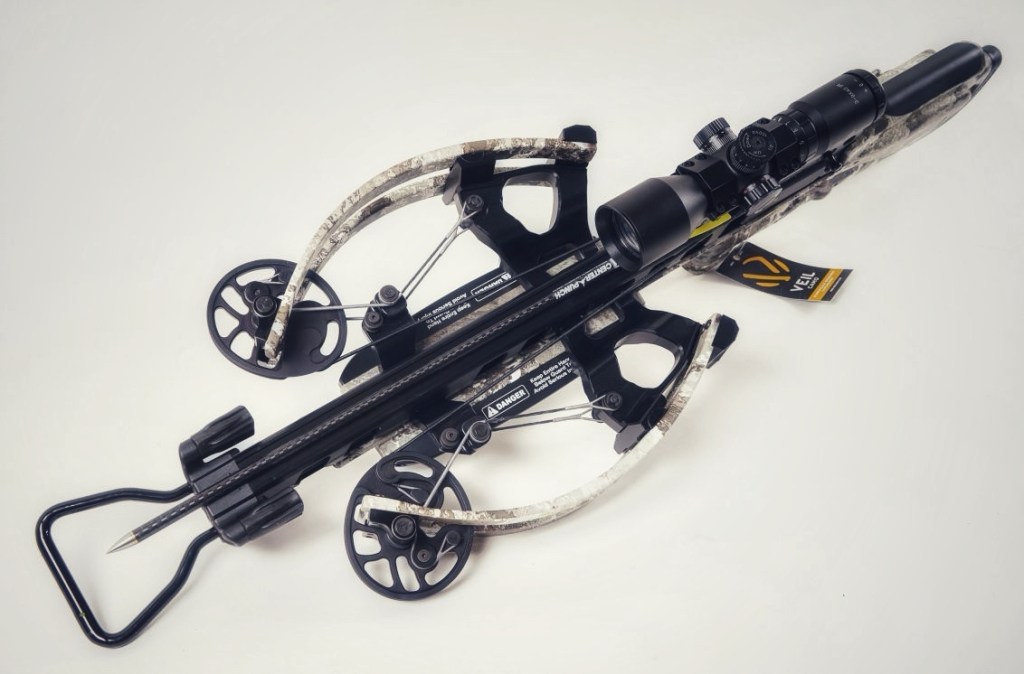
But an easy kill spoils the fun of the chase. So you have left your Lapua behind in the shack and brought the TenPoint Vapor, a baby that is similar to the one shown in the image below. The Vapor fell into your lap literally, when your neighbor, Sam, gave up hunting last summer due to his advancing years. Priced at over three grand brand new, he had agreed to part with it for five hundred quid, along with the bolts (arrows) and accessories.

You had joined a shooting range in Brossard, to calibrate the scope and practice “sighting in”. An arrow from a crossbow follows, not a straight line, but a discernible parabolic path and it is important to “cant” (tilt) the aim of the bow in order to hit the target. The need to cant becomes more and more pressing as the distance to the target increases. The crossbow has a sight that helps you in the sighting-in process, but it needs to be calibrated, just like in sniper rifles.

You have of course heard of a branch of physics called “ballistics” that a 16th century Italian professor at Pisa by the name of Galileo Galilei first propounded. The tax-payer funded Yale degree in theoretical physics has ensured that.

The instructor at the Brossard crossbow range had been impressed by your talent. You were a natural, he said.

At a draw weight of 200lbs – the draw weight being the force with which a crossbow propels the arrow forward – the Vapor can kill a moose at 60 yards. When you squeeze the trigger, the latch releases the arrow with a ‘thung!’ The arrow leaps out in a hazy blurr, covering the 60 yards in slightly less than a second. If you get the moose in the neck or even the upper torso, it will pass right through and bury itself in the snow, upto the fletching (the rear fins).

You have chosen your arrows judiciously – Carbon Express – the very best brand in carbon fibre technology – slick, light weight, flexible, unbreakable. At $50 a pop, it is worth every penny, but you got ta practice so you don’t end up shooting it into stone, shattering the broad head.

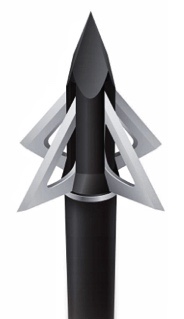
Yes, the broad head, the business end of the bolt. You have also chosen the broad heads judiciously. They are 125-grain SlickTrick Magnums, blue titanium arrowheads with jagged flanks which look like props from the Lord of the Rings fantasies and slice into bones, arteries and tissue like they were made out of butter.

Some other stuff you have learned over the years, since the Vapor came into your possession – you got yourself an arm rest that you can either stick into the trunk of a tree or upright into the snow. Your TenPoint Vapor is almost as heavy as your Lapua[see Part-1] and if you want to hit the target, you have to have a steady aim, which requires you to rest your arm for the shot.

A typical SlickTrick Magnum bad guy broadhead

——————-

Now, where were we. Oh yes, you are around fifty feet from the herd and the caribou appear to be milling around, doing nothing in particular. You can almost hear a ‘Hey, Curly, what you doon tonight, its Friday, lets go get some lichens.’ And the one next to him says, ‘I’m a strictly sedges and shrubs guy, Larry. Besides, I’m hopin’ Tina’ll let me hump her tanight. Its mating season for C’s sakes, I keep tellin’ her.’

You may be close but you still have to be able to kill. That is another golden rule in hunting – be sure you have lined up a shot that will kill. A true hunter isn’t supposed to be a sadist. Caribou don’t go down nice and easy. An injured caribou will start running, the blood pumping out of the wound in spurts that keep pace with the beating of its heart. It will run till it drops dead and that can be five kilometers from where he got hit.

Another cardinal rule – don’t run after a wounded caribou. First of all, running in ankle deep snow isn’t easy and the caribou will outrun you anyway. Second, if this is bear or wolf country (which it normally is), you won’t see one coming, so absorbed you’ll be, trying not to trip over a stone hidden under the snow. Bears and wolves just love to see fear in the prey and they interpret running as a sign of fear. Soon you, the hunter, will be the hunted and you’ll be running for your life.

You have ta take it easy and follow the trail. You cannot miss the crimson of fresh blood on pristine white snow, so you carefully begin to follow the trail of blood, while keeping your senses alert, taking a frequent glance over your shoulder to make sure there are no carnivores behind you.

If you were hunting with a crossbow, it won’t be much use as a defensive weapon, so you always tuck a handgun in the breast pocket of your hunting jacket before you leave the shack in the morning. It is a Glock 34 – nice and tidy, should do just fine. When you are looking around for the downed caribou, you will take it out, arm it and hold it in your hand as you walk. Anyway, if the caribou is still alive when you find him, you’ll need the Glock ta despatch him with a round in the head. You take no chances and you don’t get antsy.

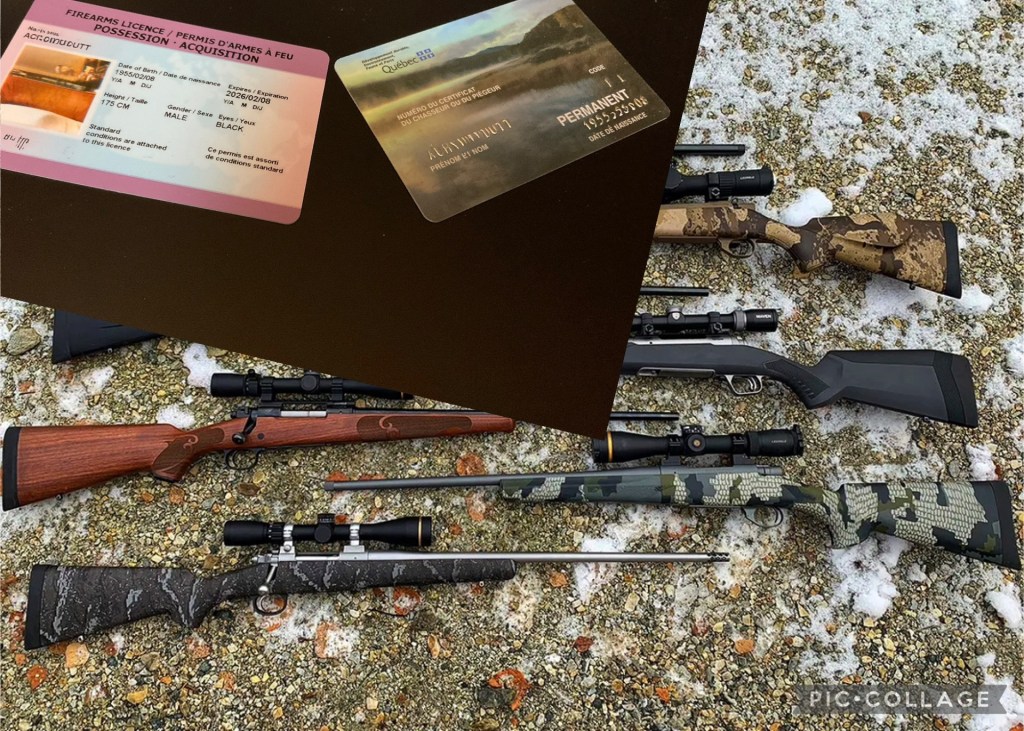
You are of course well aware that hunting with a handgun is illegal. You get caught and you have had it. The penalties are huge. You will definitely lose your hunting and gun licenses, besides being fined in the vicinity of five grand, give or take. But heck, this is desolate country and almost certainly there’s not a soul anywhere within five miles of you, no game wardens or forest rangers around these parts. You got ta look out for yourself.

There is another reason why you need ta take it easy and stay alert, though it doesn’t apply to you so far up north. But if you were in the wild down south of the 45th parallel, it would. During moose or deer season, the forests of southern and eastern Quebec are crawling with hunters, especially the government-owned lands where hunting is free and you don’t have to pay the landlord ta hunt. Another hunter, maybe one of those redneck Rambo-like guys who tote a pint of Jack Daniels in their jacket pocket that they are constantly swigging from, could mistake you for a fleeing whitetail if you were running and you might suddenly watch a third nipple appear in the middle of your chest. That could be the last thing you ever saw.

You love nipples, but three nipples? That is crowd.

———————————-

Listen, what did I tell you in Part-1? Relax and wait for the next part. I’ll post it once I get my thoughts together, know what I mean? Till then, take it easy.

Share this:

  • Share on X (Opens in new window) X
  • Share on WhatsApp (Opens in new window) WhatsApp
  • Share on Facebook (Opens in new window) Facebook
  • Email a link to a friend (Opens in new window) Email
  • Print (Opens in new window) Print
  • Share on Tumblr (Opens in new window) Tumblr
  • Share on Reddit (Opens in new window) Reddit
  • Share on Pinterest (Opens in new window) Pinterest
  • Share on LinkedIn (Opens in new window) LinkedIn
Like Loading...

The Hunt [Part-1]

04 Monday Nov 2024

Posted by spunkybong in Uncategorized

≈ Leave a comment

Tags

caribou, hunting

North American Caribou

———————

There is this general lack of interest in hunting caribou.

There’s the cost and effort to get up there and face the -30° cold. Then, they are too damned easy to kill. They are always in close-packed herds of 1000+ beasts, bumping, pushing asnd shoving at each other, horns locking every now and then. There must be a lot of caribounese for “watch it , asshole” or “oops, was that yore butt?” or “stop steppin’ on my hooves, richardhead”.

So just aim anywhere into the herd and you’ll get at least one and it is over. Pretty quick, you have your permitted kill. The caribou are devoid of emotion and they’ll make it easy for you. They’ll keep moving without a glance at their fallen herd mate, like nothing happened. Even if it was a mother.

The thrill of the chase, the tracking, the stalking, the camaraderie with your hunting partner (the sex, if your partner is female), those are experiences you won’t have, hunting caribou.

That’s another thing – don’t ever hunt without a partner, if you want to get back safe. Lone hunters are the ultimate thrill seekers. Unfortunately you are one of them.

All’s fair in love, war and the wilderness. They are all unforgiving.

When you are in a group, there’s the booze-filled revelry after the hunt as dusk falls and the mandated hunting hours are over for the day. Dancing drunkenly by the fire, swapping stories of earlier hunts, like how you got that 16-pointer right between the eyes last fall, those are the very reason why you hunt and with caribou, they are absent.

——————————

Now about you. Years as a sniper with the SOAS, (Canadian equivalent of the Delta Force), have made you a very patient man. You are capable of lying still without moving a hair, for hours at a stretch, melting into the scenery, like an inanimate object would. That is one of the basic skills you have learned in the military.

After retirement, as per tradition, they let you keep your Lapua-338 Magnum and the Nikon Monarch scope and you found no cause to upgrade. At 5000 feet, the Lapua can put an 8.58mm round right between the eyes of a whitetail if he is facing you. The deer won’t know what hit him. If you are situated to the side, you’ll aim for his neck or the side of his head. Either way, he is going down.

But you’re not here for whitetail – they don’t venture this far north. You are after caribou and this isn’t exactly gun country. In the sub-zero environment and a windchill in the minus forties, a gun is virtually useless. Your frozen fingers will take forever to reload.

Then there’s the other possibility….the caribou roam in herds and a gun shot can start a stampede. You don’t want to die, crushed under the hooves of a thousand 200-pounders.

A cross-bow, on the other hand, won’t start a stampede and therefore you have brought your TenPoint Vapor – lethal at 60 yards. The range seems little but won’t be a problem since the caribou don’t mind it if you get real close. They are fucking dumb.

The TenPoint Vapor 470

You don’t want to end this too quickly and so you wait, with the TenPoint’s string stretched taut, it’s two limbs bent and held back by the latch. The last time you used this mother, the bolt had gone right through the left shoulder of the moose and exited the right shoulder, not forgetting to bore a neat hole through her heart on the way. The arrow had gone on flying through the air and buried itself upto the fletching, in the ground, 20-feet from where the beast fell.

————————

Let me give you a brief about the caribou. The word caribou (like ‘deer’) doesn’t have a plural. A hundred stupid caribous are still ‘caribou’. A close cousin of the more popularly known reindeer, the caribou has the same magnificent antlers but is larger and heavier.

The other basic difference is that while the reindeer can be domesticated, the caribou cannot. You won’t see any pet caribou but go up north and nearly everybody has a pet reindeer or two. It is interesting that, while the caribou’s grey-white pelt is a perfect camouflage against the snow, the reindeer has a much darker, more brownish hide. Perhaps nature saw this and decided to make the reindeer easier to be domesticated and thus, protected.

Aside from that, the two sub-species of the rangifer family share the same habitat – regions of the world situated above the 60th parallel. Weighing in at around 250lb, the caribou is way smaller than the moose (at 1500lb), but still larger than the North American whitetail deer (at 150lb). (More about moose and the whitetails in Part-2).

There are other differences – unlike the moose or the whitetail, caribou roam in large, tight herds of sometimes thousands. And like any beasts that live in a herd, they are way dumber – misled by the faux security in numbers. It makes them easier to kill than moose or deer. The only thing that seems to keep them from being hunted with the same gusto as the whitetail and the moose is their habitat – an environment that is hostile and forbidding for us humans. We have gotten too used to our creature comforts. Today’s hunter doesn’t want to fuck around in the -40℃ cold and face the very real possibility of losing the tips of his fingers, toes, ears and nose from frostbite, when he can just drive an hour east of Montreal and get to kill a nice juicy whitetail and be back by sundown.

————————

The hunt

This is the Canadian Tundra and here September is late fall. Your Casio Rangeman says its 2pm and the temp is -20 with wind chill. By the end of November it will have crossed -50. You have been outside the shack two hours and already the tips of your fingers and toes are numb and you are beginning to lose feeling in your feet, even with all your fancy gear on. That is a sign that you don’t have much time left, before you have to get back inside the truck, which is of course idling.

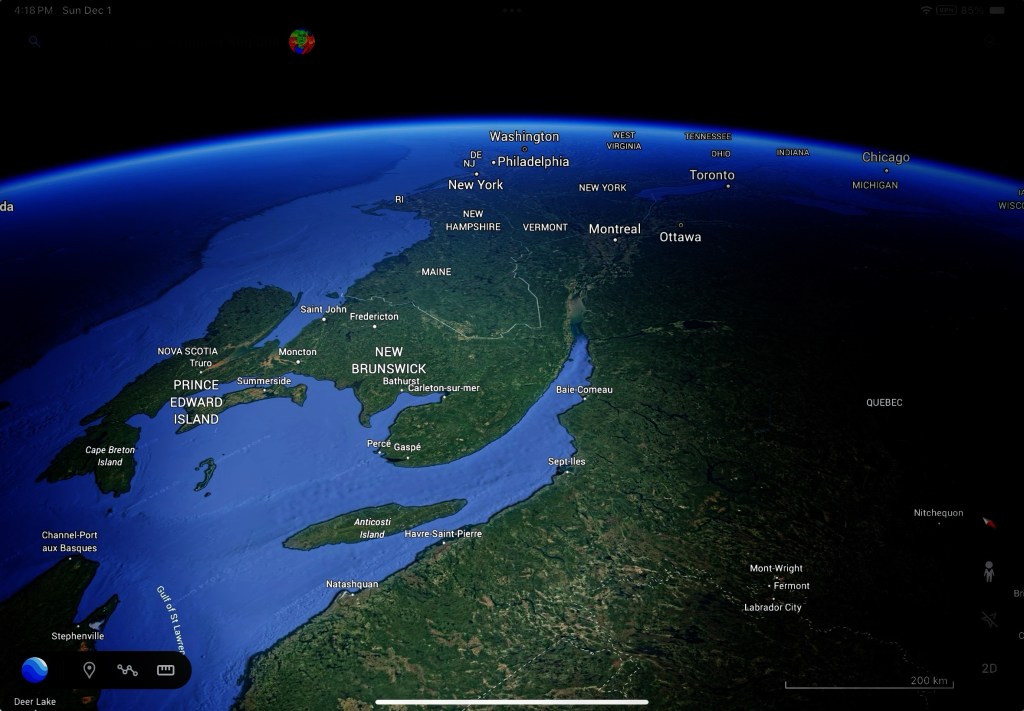
You are 20 miles south of Whapmagoostui, a Cree village (population : 20), at the edge of James Bay, the little spit of water which makes the 500,000 sq.mile Hudson Bay look like it is sticking its tongue out at the rest of Canada.

Tundra Adventures, the outfitters at the nearest town, Kujjuarapik, had provided the private charter flight to haul you from Gaspé, where you’d left your own Ford150 at the Auberge sous les Arbres hotel. For 6,000 smackeroos you got a fully stocked shack, a skiddoo (snow mobile), a Toyota Tundra with 100 free gallons of gas (ten bucks a gallon thereafter), a satellite phone and an insurance policy (subject to having a valid driving permit and gun and hunting license). It also covers a free airlift to the nearest emergency ward, wherever that might be. Of course, you would have to be able to get your frozen fingers to reach for the phone. Frostbite and hypothermia are unforgiving to fingers.

It was a scary flight, on a Pilatus PC-12 with a single Pratt and Whitney PT-6 turbo-prop. Scary only because of the forbidding sight of the terrain 12000 feet below – sapphire blue lakes and snowy white pines, little patches amid a horizon to horizon expanse of white nothingness. If your plane went down in there and you survived the crash, you were a dead man, for sure. Even a satellite phone might not save your ass in time.

There had been six others in the charter flight, four hunters just as insane as you and two local Cree businessmen. Those four were hardened arctic hunters – thrill seekers who have done this multiple times and got a kick out of – as did the American alpinist, Dave Hahn, who went back to the Everest fifteen times between 1999 and 2013. The four have always hunted in a group, but you were alone. Lone Daniel Boones aren’t unheard of, but still they command a certain respect in the tribe and the four admired your spirit for that reason.

You are of course stupid to be alone. The Tundra is singularly unforgiving toward folks who venture out into the wilderness alone. The chances of you making it back in one piece, not frost-bitten and not bear-mauled, are less than four in ten when you’re alone. You won’t hear a North American black bear coming until it is lightening your weight, removing pieces of skin and flesh off your back. Don’t worry, he won’t eat you. He just wants to maul you to death, that’s all.

Or say your Toyota Tundra broke down on the hard-packed ice a hundred miles from Whapma-whatchamacallit. Or maybe you just switched off the ignition for a few minutes, inadvertently. In the Tundra you don’t switch off the ignition. From the time the outfitters handed over the truck to you, right up until you hand it back to ‘em three days later, the engine will be running, non-stop. You just have to keep gassing it up, time to time.

But it can happen – the Toyota is a machine after all – and when it does pack up, that is another way to die in the Tundra. For that reason, Caribou hunting is always done in groups of at least four, in two trucks.

Besides, you are permitted by law, four caribou per person and caribou are dumbos who move around in tight herds and unlike the whitetails and the moose, they don’t appear to be concerned that they might get shot at.

You’ll get your four kills within the first half hour, easy. But if you are alone, what are you going to do, carry them all on your back all the way to the truck? And if you try picking them up and lugging them one at a time to the truck –  when you’re back for the second caribou, there’ll be just blotches of blood left on the snow and a pack of arctic wolves as a welcoming committee.

But then you are just that – a loner – and you are prepared to face the challenges that come with being one. Heck, there’s no one waiting back home, so you really don’t give a crap about this living on the edge thing that you seemed to have embraced ever since you got your honorable discharge.

—————————

Watch out for Part-2. What? You don’t give a shit? Relax, listen, you are missing the enlightenment of a lifetime if you don’t subscribe to my blog.

Share this:

  • Share on X (Opens in new window) X
  • Share on WhatsApp (Opens in new window) WhatsApp
  • Share on Facebook (Opens in new window) Facebook
  • Email a link to a friend (Opens in new window) Email
  • Print (Opens in new window) Print
  • Share on Tumblr (Opens in new window) Tumblr
  • Share on Reddit (Opens in new window) Reddit
  • Share on Pinterest (Opens in new window) Pinterest
  • Share on LinkedIn (Opens in new window) LinkedIn
Like Loading...

Kuzkina Tetya [Part-4]

29 Tuesday Oct 2024

Posted by spunkybong in Uncategorized

≈ 2 Comments

Tags

F86, high g barrel roll, Korean War, mig15

The legendary ice hockey player, Wayne Gretzky, was once asked what his secret to connecting with a speeding puck every time was, to which he famously replied that the trick was not only to be able to see the puck right then, but also to anticipate where it would be next. If Gretzky had been a charged particle, he would have defied Heisenberg’s uncertainty principle.

To Lt. Zhao Baotung (Zao Bao to his schwarm-mates), Wayne Gretzky’s mantra was very much his own, except that it was which way an F86 Sabre would roll that he anticipated.

By early 1952, Mig Alley had turned into an ugly slug-fest. That earlier understanding (the don’t-ever-cross-the-Yalu rule) had frayed at the edges. Incursions were becoming more and more frequent and brazen. One day a bunch of Migs was chasing a hapless limping F86 across the line and the next, it was the F86s screeching into Manchuria in hot pursuit.

When, on one single day, nine schwarms of 36 Migs crossed the Yalu and massacred a flight of 12 slow-moving B-29s, General Curtis LeMay, head of the US Strategic Air Command, reportedly thumped his table in anger and screamed at his aides, “That’s it! To hell with the Yalu. Go in and get those gook bastards!”

Yep, to the Yanks, anyone with slit eyes was a “gook”.

The gloves were now off. Jets began chasing each other across the Yalu regularly. The Americans, worried that an intact F86 might fall into commie hands, planned incursions into Chinese airspace with only their best pilots to carry out across-the-Yalu raids. Those raids came to be known as Maple Specials (because they were anything but sweet and easy).

It was one such Maple Special that Zao Bao’s Mig along with his three other buddies in the schwarm had chanced upon that day. (If you have been paying attention to the earlier episodes of this series, a ‘schwarm’ is a tight 4-aircraft attack group).

Zao Bao had managed to glue himself to the tail of an F86, 37000 feet over the Yalu, when the American pilot yelled into his mouthpiece,” That’s it I’m Winchester”.

‘Being or going Winchester’ was a term American pilots used, to mean running out of ammo, a life-threatening situation requiring an immediate drop-out and return to base. Likewise, ‘I’m Bingo’ meant that a pilot had just enough gas to get back home.

“Roger that, see you at dinner, Mitty, watch out, Bogey right behind……..&%$@!!” crackled his wingman, Yanky Doodle and the headset went silent as his words got cut off suddenly. The American turned sharply just in time to see a fireball where his wingman had just disintegrated.

‘Mitty’ was short for Yosemite Sam, the bushy bearded, glowering but lovable Disney cartoon character, that was emblazoned on both sides of the his F86, below the canopy. Fuselage art was freely permitted those days, no restrictions. Some had May West’s bust or Marilyn Monroe’s butt painted on their aircraft.

There are tighter controls now. A 2015 US Air Force memorandum states that “nose and fuselage art must be distinctive, symbolic, gender neutral, intended to enhance unit pride, designed in good taste. Furthermore, it must not contravene copyright and trademark laws”.

That’s political correctness to you.

Almost every WW2 & Korean War American fighter and dive bomber had nose and fuselage art. Usually women in bikinis or snarling shark teeth. Click on pic if you wanna see larger boobies

———————————-

Zao Bao came up behind the F86 he had engaged and dove with it, his altimeter needle winding down so fast, it looked like it would produce its own sonic boom. With 15 dogfights already under his belt, the young Chinese was well aware that F86s could dive faster and come out of a dive more quickly.

“He’ll go into a roll right about now”, Zao Bao said to himself and sure enough, the American rolled into a tight banking curve, climbing and rolling over 360°, his maneuver slowing him down suddenly in an effort to get the Mig to overshoot and come up in front, turning him from the pursuer to the pursued.

Americans call the maneuver a High G Barrel Roll.

The High G Barrel Roll. Blue – Pursued, Red – Pursuer. Note how Red starts off chasing Blue and then after they come out of the roll, Blue is chasing Red.

————————

An inexperienced pursuer would indeed have moved forward, but the Wayne Gretzky in Lt Baotung had sensed which way the F86 was going and had already begun going into a roll of his own so he stayed locked on, behind the American. To anyone watching from the ground, the two jets might have seemed like a team in an aerobatics display.

The American finished his maneuver and leveled out at 1000 feet, praying that he wouldn’t smash into some stupid hillock or some other obstruction. Fortunately this was Mig Alley, close to the estuary of the Yalu and the terrain was bushy but flat. The American quickly turned east, lucky to be alive, yelling out to no one in particular, “Phew! That was close!”

Hardly had the Yank done breathing out those words when he felt hot Chinese breath on the nape of his neck. 50 rounds punctured the control surfaces of the swept-back wings and then again somewhere in the rear of the F86.

Immediately after the second cannon burst, the controls of the F86 began feeling sluggish and heavy and the instrument panel lit up. Besides its wings, the F86 had suffered damage to its vertical stabilizer (the fin you see sticking up at the rear end of a plane).

His wingman, Doodle, was gone. In aerial combat, losing your wingman is like a death sentence. The wingman flies slightly behind, to the left or right and watches your back. The American also realized that he had strayed. When you’re doing 1000 feet every second, it’s easy to get disoriented and stray. He was on his own.

Then, something made the American pilot turn his head for a micro-second to the right. The Mig had crept up on him, unseen. It kept pace at barely 50 feet, wing tip to wing tip, slightly above and very close, so close that the American could count the rivets on the Mig’s underbelly. He noticed another thing. On its side just below the cockpit, at a location similar to where his Yosemite Sam was, the Mig had an insignia. It was a red star with blue jagged lighting flashes all around.

There was no space to dive and he could never beat the Mig in a climb. A gradual change in terrain precluded any sudden turns at his height. The American knew he was cornered.

There was no more panic, just resignation. As this thought raced through his mind, movement to the right caught his eye and made him turn to identify the new threat. It was his new found pal, the Mig, which had now moved a couple of hundred feet away, waggling his wings in smooth 20 ̊ arcs.

Between hostile aircraft, wing-waggling is a universally known signal – follow me.

In spite of himself, the American felt a surge of relief. His first thought was that he was not going to die, only be captured alive with his F86 intact. And then, just as soon, a picture invaded his brain – he saw his father, Medal-of-Honor awardee Rear Admiral Jimmy Higgins, ramrod straight on the bridge of his 45000 ton flagship, the USS Missouri, five miles off North Korea’s eastern coast, pounding Chongjin with its 8” guns right at that very minute.

And he knew what he had to do. In one fluid motion, he reached for the throttle and floored the flaps. Then, in defiance, he raised his right hand, his middle finger sticking straight up from a balled fist. If Baotung had been American, he might have guessed the message that the gesture sent.

Devoid of ammo, remaining gas not enough to get it home, the F86 rolled over and then plunged toward the terrain below, making contact within seconds and bursting into a ball of flame.

For the first time, Lt. Zhao Baotung was left gaping. He executed a tight circle, just to make sure the American hadn’t bailed out, even though he was certain that the crash had been deliberate. He would have done exactly the same thing under similar circumstances.

There was no sign of a parachute. The Chinese pushed the throttle forward and streaked up into the sky with a thunderous roar, disappearing into a bank of clouds in a minute.

The flight back to Antung was uneventful. The dogfight had long waned, the way tornadoes form, wreak havoc and then just dissipate away into nothingness. The skies were once again turquoise and did not afford any hint of the pandemonium in the preceding half hour.

Including the F86 that day, Zao Bao now had 9 confirmed kills and was officially an ace, the youngest to become one, in the Chinese Air Force.

And the American…. Fighter pilots are a fraternity, friend or foe. Zao Bao only felt sadness at the loss of the American’s life and yes, admiration at his sacrifice. In a corner of his mind he strangely hoped that the pilot would be posthumously decorated, chances of which were slim since none of his compatriots, including his wingman, had been around to witness the pursuit, the wing waggles and the subsequent crash.

“It’s a life we have chosen,” he said out aloud to no one in particular, as he set course for home.

————————————

Lt. Zhao Baotung would say those words one more time, 17 years later, this time as Da Xiao (Commodore) Zhao Baotung, head of Beijing Military Division’s air defense command, based at the Tongxian Air Field.

In fact those were the last words that Zao Bao would ever speak, as his Chengdu J-7 fighter closed in on the advancing Tu-95 Bear at two and a half times the speed of sound.

Out of ammunition, there was one last weapon remaining – the fighter itself, a 5-ton supersonic projectile ……

—————————————

I have a problem. I have no idea how to end this series, which seems to have gotten a life of it’s own and won’t let up. I wasn’t even born in that period. Never met a Korean even. Except Kim, the depanneur owner round the corner from where we live. He escaped from North Korea four decades back and still jumps if you come up behind him unnoticed.

Besides, I am tiring of it. I always get sick of things and abandon them, a trait that will never make me a successful writer. The best selling novelist, Arthur Hailey, took two years on an average to do his research and another year to set the collected material down on paper and publish one novel. I don’t have the patience.

Should I somehow set off Kuzkina Tetya or should she settle down in some obscure Chinese paddy field north of Beijing, where she breaks up and contaminates a large swathe of land and generations of Chinese are born looking like mutant ninja turtles who then proceed to migrate to other parts of the world and have sex and by the end of the millennium, the world is uniformly ninja turtl-ish??

———————————————–

Like I said, in story-telling, the possibilities are infinite.

Don’t wait up for Part-5.

Toodle-oo.

Share this:

  • Share on X (Opens in new window) X
  • Share on WhatsApp (Opens in new window) WhatsApp
  • Share on Facebook (Opens in new window) Facebook
  • Email a link to a friend (Opens in new window) Email
  • Print (Opens in new window) Print
  • Share on Tumblr (Opens in new window) Tumblr
  • Share on Reddit (Opens in new window) Reddit
  • Share on Pinterest (Opens in new window) Pinterest
  • Share on LinkedIn (Opens in new window) LinkedIn
Like Loading...

Kuzkina Tetya [Part-3]

10 Thursday Oct 2024

Posted by spunkybong in Uncategorized

≈ Leave a comment

———————————————————

Mig Alley

North Korea – China border

March 1952

————————-

You are probably wondering why the story has suddenly moved to the Korean peninsula.

Listen, this blog is mine and I can take the story anywhere I please, capisce? Just bear with me and you’ll see the connection at some point in the future.

—————————

When the Korean War began in 1950, the North Koreans didn’t have an air force worth its name. Their bosom pals, the Chinese, did but they could not have done much to help since they themselves had a pitiful air force consisting of hand-me-down Yak1s, Mig-2s&3s and assorted other World War II planes that the Soviets had been about to mothball.

Besides, China was itself a paraplegic in 1950, decimated and sucked dry by decades of brutal Japanese occupation.

As to the other communist nation that could have helped, Stalin’s Russia, it was still reeling from the devastation of the Second World War and just beginning to gather its shit together, ill-prepared to provide the North Koreans with any significant support.

North Korea was wide open.

Those days, victory depended solely on air power and America had overwhelming superiority there. Could America have moved in and delivered the coup de grace, bombed Kim Il Sung’s communist dictatorship back to stone age, united Korea into one vibrant democracy that is today’s South Korea and built a permanent presence right at the communists’ doorstep? Did it overestimate the USSR/China’s military capability at that moment? Did America chicken out? I think that it did.

America had no reason to be so apprehensive about a Soviet counter strike.

Yes, a Nazi son-of-a-bitch theoretical physicist named Klaus Fuchs, had recently been saved from the Nuremberg noose and pampered by the US. Yes, he had been put to work on the atom bomb in the Manhattan Project and yes, he had defected and shown the Russians how to build an atom bomb and they had tested their first device in 1949.

But the Soviets were yet to build a reliable nuclear inventory. My bet is that uniting the two Koreas would have been a cakewalk for America if they hadn’t chickened.

The 500BC Chinese military strategist, Sun Tzu, has written that it is necessary to have an intelligence apparatus that has the means to assess the capability of the enemy. Israel’s Mossad and Aman have proved that. America’s intelligence agencies failed to accurately gauge the Soviet/Chinese preparedness and therefore we now have to live with two nations, North and South Korea, both nuclear-armed in an antsy truce, divided by a deadly DMZ on the 38th parallel.

——————————-

There is one country that profited hugely from the Second World War – The United States of America.

For America the Second World War turned out to be a boon which saw unparalleled economic prosperity, of the kind that is especially reserved for nations that fight wars in other lands far from their own.

Let’s get a sense of how the America that we know today became the America that we know today……

Before Pearl Harbour, the US was a peacenik nation, happy not to interfere in the conflicts of others, reasonably secure from cross-border invasions by two great oceans on either side and two friendly nations, Canada and Mexico, to the north and south.

Pearl Harbour changed everything. In the words of Franklin Roosevelt, it “awoke a sleeping giant”.

Between 1941 and 1945 the US government signed $175 billion (USD 4 trillion today) worth of prime defence contracts, 25% of which went to just seven companies – Boeing, Lockheed, North American, Grumman, GM, Ford and Chrysler. Between them, they provided the flying machines, the tanks, artillery, jeeps, trucks and armoured vehicles that were required for the war.

American industry provided almost two-thirds of all the Allied military equipment produced during the war: 297,000 aircraft, 193,000 artillery pieces, 86,000 tanks and 2,000,000 armoured personnel carriers and trucks. 

In four years, American industrial production, already the world’s largest, doubled in size.

Numerous large American corporations, that were making cars and trucks, home appliances, toys and other products for peacetime use, switched and transitioned swiftly to wartime production. Ford Motor Company began producing B24 Liberators, 18200 of which were built in the period 1940-1944. In addition to aircraft, Ford plants built 277,896 vehicles (tanks, armored cars and GPW (General Purpose Willys – reconnaissance vehicles known as Willys Jeeps). Chrysler’s wartime production included trucks, tanks, aircraft parts, guns, ammunition, rockets and bombs. GM’s Chevy specialized in all kinds of trucks, aircraft engines and artillery shells. Buick produced the M18 Hellcat tank destroyers and supplied radial engines for Boeing B-17s and B-24s, Douglas C-47s and C-54s. Alcoa, the aluminum giant, switched to airplane fuselages. The Lionel Toy Train Co. began making aircraft parts. Mattatuck, a nail manufacturer, switched to producing machine gun magazines and ammo.

Then there were large shipyards and steel companies such as Bethlehem Steel, Newport Shipyard, Norfolk Dry Dock and New York Naval Shipyard who churned out battleships and submarines by the dozen. By January 1945, the US Navy had 61,045 ocean-going vessels including 23 battleships, over 100 aircraft carriers, 59 cruisers, 425 destroyers, 400 destroyer-escorts, 237 submarines and 54,000 landing craft and assault ships. Plus 37,000 planes.

All of these armaments were built at American factories that were never touched by aerial bombardment.

Before the Second World War, America was a nation ravaged by depression, with a 40% rate of unemployment. By 1950, 5 years after the war, that America was unrecognizable. Those same factories kept on humming with activity, quickly switching back to peacetime production of consumer goods and reconstruction materials.

Every European nation needed household appliances, cars, washing machines, radios, medicine, movies, food, concrete, cement, steel and everything else. Europe’s industrial sector had been flattened and there was a virtual monopoly named America, ready to sell. The Europeans stood in a queue, hungry to rebuild.

America’s employment and household incomes skyrocketted. Every home now had a car, a TV and a front lawn and every man, a job.

America had just discovered that it loved making war.

America had also realized that war was good business. The $175 billion had paid off.

And that is how, in the initial stages of the Korean War, American P51 Mustangs, F80s and F86 Sabre jets (and later on, F100s and F104s) came to own the skies over North Korea.

The term ‘Shock and awe’ would be an understatement. Bridges, railway sidings, workshops, army barracks, civilian settlements, large built-up areas…nothing was spared. North Korean ground forces were clobbered, bombed and strafed mercilessly. It was a turkey shoot.

————————————

Then, suddenly the tide turned. Strange things began happening. Pilots in the F86s started engaging a new kind of hostile jet fighters that looked a lot like their own F86 Sabres, but were heavier armed and could climb faster. They would appear out of nowhere in tight boxes of four that came to be known as a ‘swarm’. Frequently a swarm would zoom right through, above and below a formation of F86s, leaving the Americans gaping, like ‘What the…&???? What were those?’

At first, some imagined them to be rogue American pilots in aircraft that had either been stolen or reverse engineered from the F86s. Given that the F86 Sabre was just a year into service then, the appearance of enemy hardware that strongly resembled and even outperformed F86s, was disquieting to the Americans.

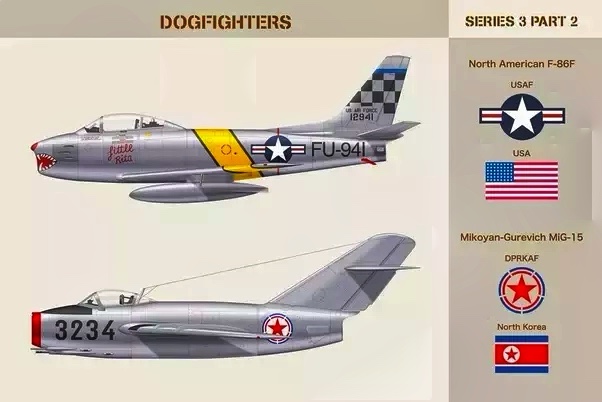
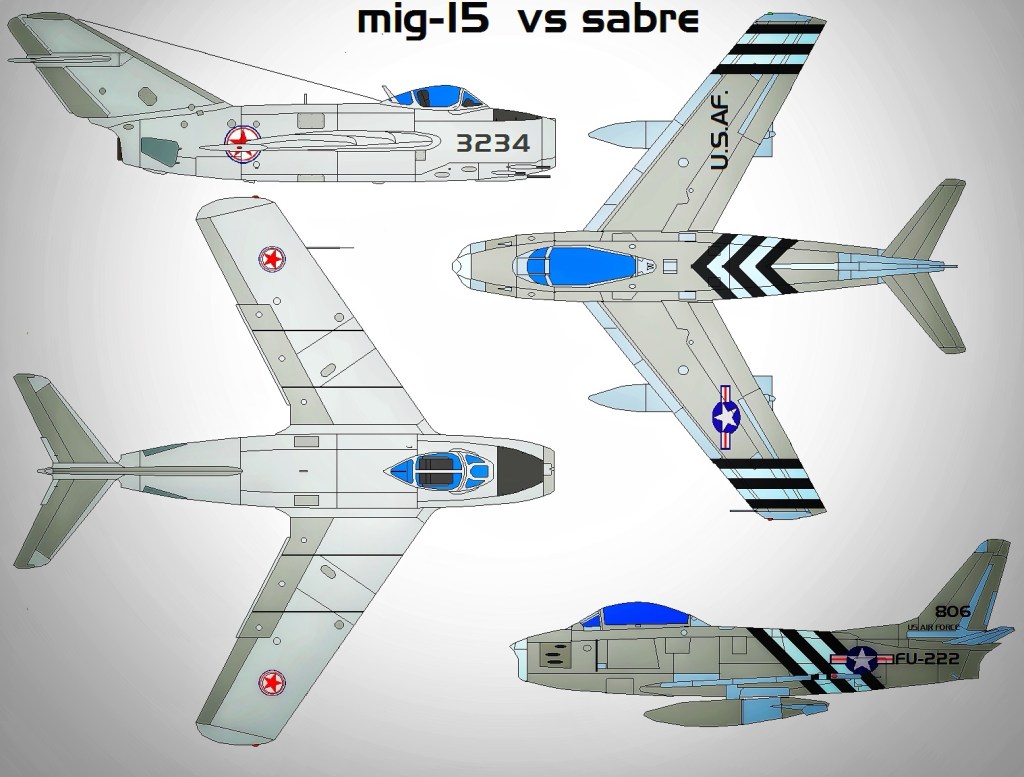
Those “freaky fighters” were the newly developed Soviet Mig-15. In all 18000 were built. NATO gave the fighter the code name “Fagot”, a sobriquet that was meant to be a denigration that soon looked undeserved.

Quickly the American supremacy over the North Korean skies disappeared. The Americans were now fighting the North Koreans as equals. Only, these were not North Koreans actually. They were Soviet and a handful of Chinese pilots in Mig-15 jet fighters that had been loaned by the Soviets to the Chinese.

Mig-15s just happened to look a lot like the F86s.

—————————-

As per the mandates of the farce that we all now know as the UN, it was important to maintain the illusion that the North and the South Koreans were fighting each other and not the Soviets & the Chinese, against the US & UK. These were nuclear powers at a time when the rules of nuclear engagement had not even begun to be written. Nuclear holocaust was just a trigger-happy pinkie away. Neither side wanted to risk expanding the war beyond the Korean peninsula.

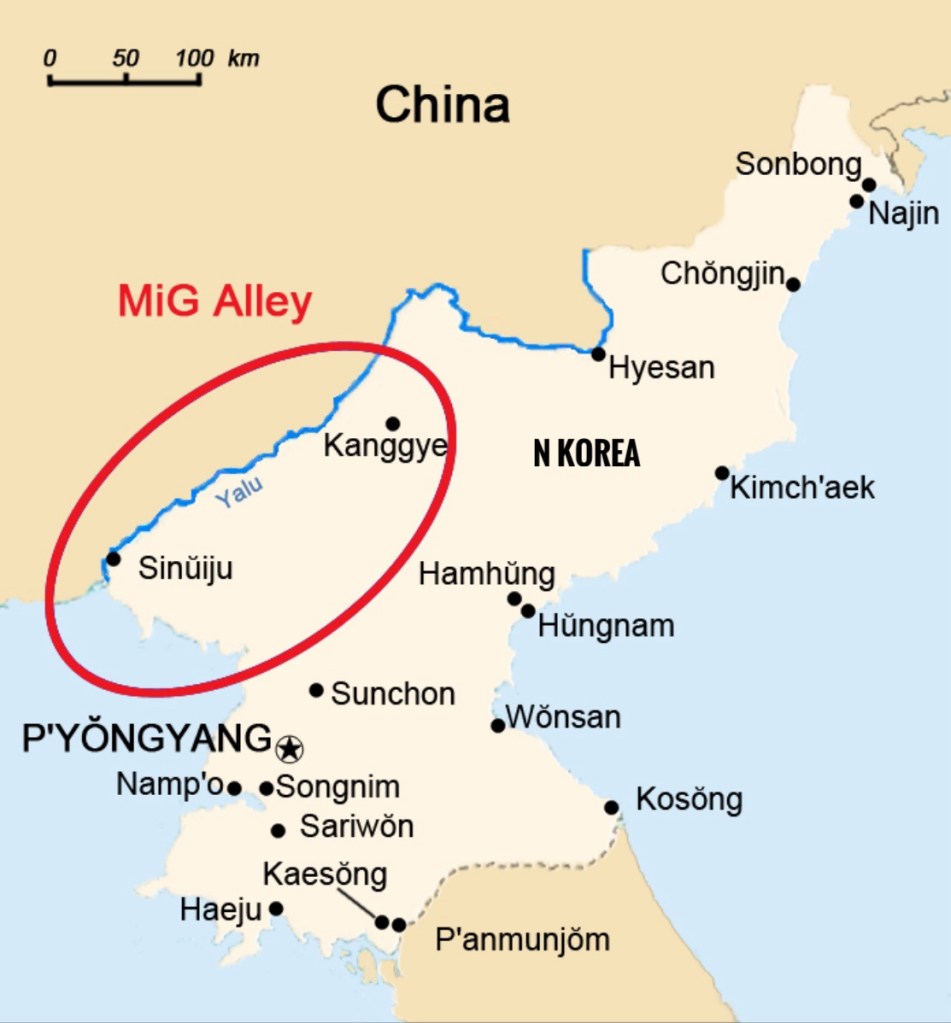
The Mig-15s and the F86s engaged in dogfights and skirmishes mainly along a stretch of the border between North Korea and China where the Yalu River empties out into the Yellow Sea. The Migs launched from Antung Air Field, close to the border on the Chinese side and the Americans, from Kimpo and Suwon, 350kms away, in South Korea. 

The stretch of the border, where the two sides slugged it out 30000 feet above the ground, came to be known among the US pilots as Mig Alley. (Check out the box shown in the top of this piece).

Since the Americans had a greater distance to cover, they came to the party, equipped with drop-tanks and were therefore heavier and slower, a distinct disadvantage, especially when trying to maneuver or climb out of a tight situation. On the plus side, the American pilots were better trained and the F86 Sabres were more user-friendly and comfy, with heated cockpits that was spacious and a large bubble canopy that afforded the pilot a panoramic view.

But by far the greatest advantage that the Americans had was the invention of the G-suit, a sterling example of American ingenuity. The G-suit was a set of inflatable bladders that connected with a compressed air outlet inside the cockpit. Let me explain…..

G-forces bear upon a human body in motion, during sudden accelerations or decelerations or vector changes (ie: change in direction of motion). The more abrupt the change, the more severe is the effect on the human body. You may have noticed how your body gets shoved forward when you are driving and have to brake suddenly. Or how you feel the securing straps bite into your chest when you are on a monster roller coaster that has begun its downward plunge. In both cases, the force that impacts your body is known as the G-Force.

The internationally accepted unit of acceleration caused by gravity is “1G”. In metric units, it is equivalent to the weight of 9.81 Newtons of force per one kilogram of mass.

Imagine you are a F86-Sabre pilot coming out of a dive to get away from a Mig tailing you. You are pulling more than 6-7Gs. At that vector change, blood fails to reach your brain and your eyes, preferring to remain around your ankles. You develop tunnel vision and black out within minutes. Not a good situation to be in when the ground is rushing up at you at twice the speed of sound.

A fighter pilot’s G-suit bladders inflate and squeeze tight against the lower body parts, preventing blood from going down, allowing it to circulate to the brain. The Mig pilots didn’t have G-suits and many Migs were lost in dives or tight maneuvers, without a single shot being fired. To the Sabre pilots, this was a huge advantage.

—————————-

The most severe recorded case of G-force death was that of Princess Diana when her limo slammed into a Paris tunnel entrance at 70 mph. Without her seatbelt on, her body experienced a sudden deceleration, relative to her heart, that had the force of 70Gs. If we assume she weighed around 80kgs, that would have been a force of nearly one metric tonne. In that instant it tore her pulmonary artery, a condition that was impossible to survive. Had she worn her seat belt, the deceleration would be around 30Gs and she might have had broken ribs but would most likely have survived.

———————————

A Mig-Sabre party in Mig Alley usually lasted only 20-30 minutes max. But that half-hour looked like the Battle of Britain, the famous 1941 air battle for Britain’s skies where hundreds of British Spitfires and Mosquitos buzzed around hundreds of German Messershmitts and Stukas inside a restricted airspace of maybe one or two city blocks, often colliding with each other and breaking apart in mid-air.

In the Korean skies, at one point in the spring of 1951, a dogfight recorded 50 Mig-15s, 48 B-29s and 54 F86s at the same time, zipping around inside an airspace that resembled a box with sides just 10kms long.

Mig Alley saw the dawn of a new kind of air warfare – aerial dogfights with jets zipping around at 600mph. Soon pilots on both sides realized that they needed far swifter reflexes in order to come out of a dogfight unscathed.

Dogfights create aces and within weeks of the arrival of the Mig15s and the start of the aerial skirmishes, Mig Alley began producing aces among the American pilots.

————————————

Aces were being born on the Chinese/Soviet side as well. A wiry young 23-year old Chinese, the eldest of three children of a carpenter from Anshan in the far eastern province of Liaoning, became the first Chinese ace of the Korean War.

That Chinese ace was Flight Lt. Zhao Baotong, Zao Bao to his mates in the 4-aircraft Mig-15 schwarm that he lead.

In case you are still wondering what all this has to do with Babayev, his Tu-95 and his bombing run, take it easy, Part-4 is coming soon.

Share this:

  • Share on X (Opens in new window) X
  • Share on WhatsApp (Opens in new window) WhatsApp
  • Share on Facebook (Opens in new window) Facebook
  • Email a link to a friend (Opens in new window) Email
  • Print (Opens in new window) Print
  • Share on Tumblr (Opens in new window) Tumblr
  • Share on Reddit (Opens in new window) Reddit
  • Share on Pinterest (Opens in new window) Pinterest
  • Share on LinkedIn (Opens in new window) LinkedIn
Like Loading...

Kuzkina Tetya [Part-2]

02 Wednesday Oct 2024

Posted by spunkybong in Uncategorized

≈ 3 Comments

Tags

kuzkina mat, Sino-Soviet split, thermonuclear bomb, tsar bomba

Tu-95 Strategic Bomber

Dal’naya Aviatsiya

Irkutsk, USSR

Tuesday, August 19, 1969 – 02:15 hrs

———————————————–

Before we go any further, a background first.

In the first 5-8 years after the Second World War, China and the USSR became close allies.

The balance wasn’t an equal one, though. China, then an underdeveloped agriculture-based nation, needed the Soviets more than the Soviets needed China. Had it not been for Soviet-supplied World War-2 surplus Il-2s, Mig-1s, Mig-3s and T-34 tanks, Mao-Tse-Dong would never have succeeded in banishing Chiang-Kai-Shek and his anti-communist nationalist forces to Taiwan.

In 1950, the two communist powers publicly demonstrated their closeness, when they signed the Sino-Soviet Treaty of Friendship, Alliance and Mutual Assistance. At its core, it was a security pact against foreign aggressions as well as an agreement for political, economic and diplomatic cooperation (aka assured Soviet economic aid).

With the signing of the new friendship treaty, Soviet largesse poured in, this time in the form of economic and military-industrial aid. Within a decade, the Chinese were making their own versions of Migs and Yaks.

Then, all of a sudden in 1953, just when the bromance was blossoming, Stalin died and Nikita Khrushchev, a vastly different personality, took over. Unlike Stalin, Khrushchev was a bit like an earlier version of Gorbachev – a peacenik-glasnost type, more Marxist than Stalinist.

When Khrushchev, in 1956, publicly denounced Stalin – an action once considered unthinkable – China’s Mao-Tse-Dong realized he could no longer take Soviet support for granted. The Khrushchev openness could infect Chinese politics as well and threaten his grip on power. Mao wanted to remain hardcore, with his absolute power and his Leninist scorched-earth ideology intact.

Mao’s growing antagonism was cemented in 1956, when the Soviets invaded Hungary to crush an anti-communist rebellion. Mao feared the same thing could happen to China. Helpless without sufficient military might, constantly pressured to obey Soviet dominance in the communist bloc and paranoid that the Soviets could invade China and annex it with ease, Mao began devising a long term plan that would maintain the USSR’s standing as an ally but ensure a partnership that was more equal. He announced the “Great Leap Forward”, a hurricane-speed action plan to modernize China from an agrarian to an industrial economy.

Turns out, Mao’s great leap was an unmitigated disaster. Having already purged the “intellectual class”, he had no brain power available to carry his megalomania forward. The pulling of manpower from the farms to the industry devastated China’s agricultural output, causing a famine the world had never witnessed. Millions starved to death.

Sensing the sudden Chinese coldness, the Soviets began to withdraw their industrial and military experts and aid to China reduced to a trickle. Along a parallel track, Khrushchev initiated a series of moves that would later come to be known as Détente, a period of relaxation of strained relations, with the US.

It was at this point that fate decided to take matters into its own hands once again.

———————————-

The 39-member Presidium of the Supreme Soviet, the highest body of Soviet State Authority, removed Nikita Khrushchev. Obviously, like Mao, the members of the Presidium too thought that Khrushchev was moving the USSR toward too much openness, too quickly.

Unlike in earlier cases, Khrushchev’s life was spared. He was told to henceforth shut the fuck up and relegated to a comfortable dacha outside Moscow, to spend the rest of his life in retirement.

Once again a Stalin-like hardliner took over, a guy called Leonid Brezhnev, not as foaming-in-the-mouth as Mao but close enough. Bezhnev’s ascent however didn’t help to lessen Mao’s paranoia, since the Soviets decided to continue on with the détente process with the US.

The mutual mistrust between the Soviets and China gradually led to sporadic border skirmishes that flared up with increasing frequency, until it began to appear like the beginning of a much wider, possibly nuclear, Sino-Soviet war.

—————————

Now that you have the back story, let’s continue with the flight of the Tu-95 Bear……

The passenger on board the Bear, Kuzkina Tetya, was so named after her illustrious twin, Kuzkina Mat, who had made a similar one-way flight eight years prior. Kuzkina Mat had been a test.

Some say Kuzkina Mat was given her name by none other than Nikita Khrushchev.

The story goes that when the Americans tested what was for them, their most powerful thermonuclear device – an H-Bomb that was code-named Castle Bravo and had an yield of 15 megatons, the Soviets gave it a name of their own – ‘Kuzka’, a derogatory reference commonly used in Russia those days, roughly translated in English as ‘pipsqueak’.

Khrushchev is reported to have sneered at the American ambassador derisively at a meeting during the 1961 May-1st celebrations, “My obirayemsya pokazat’ im Kuz’kina mat!” (That’s it? 15 Megatons? Well, soon we are going to show you Kuzka’s mother).

And Kuzka’s mother she certainly turned out to be. Kuzkina Mat had the explosive power equivalent to the simultaneous explosion of 58 million tons of TNT. That was ten times the power of all the bombs dropped in the Second World War. Her mushroom cloud was 64 kms high and 40 kms in diameter and her shockwave travelling round the earth three times, breaking windows, cracking foundations as far as Marseilles.

Over the years, Kuzkina Mat also got to be called by many other names, including Tsar Bomba and Big Ivan.

In comparison, Kuzkina Tetya, though only slightly larger in size and weight, was going to be infinitely more destructive. It had been rated at 105 Megatons.

—————————————

The tower broke in over the whine of the Kuznetsovs, the voice over the radio sounding disembodied and almost casual, “Eto dvizheniye. Tetya Dobycha Kuz’kina yedet priyatno i legko, Polkovnik . Udachi.” (It’s a go. Drop Kuzka’s Aunt off and get the hell out of there, Colonel. She has bad breath. Good luck).

Babayev chuckled. “Spasibo , derzhat’ vodku okhlazhdennoy (Thank you, I am not the one who’s going to kiss her ass. Just keep the vodka chilled and stop worrying about us),” he said, as his right hand tightened its grip over the throttle lever and slid it forward while at the same time, his foot came off the brakes.

The Tu-95 heaved and then swerved momentarily, as though it was caught by surprise. It’s nose veered off the median line for a moment, before it regained its heading and charged down the asphalt, slowly accelerating as it raced toward the other end of the runway.

120 knots…130…140…150… the massive bomber labored to reach the magic figure – 200 knots, while the far-end perimeter fence and the south-side guard tower dead ahead, rushed forward to embrace it.

“If we are going by road, don’t you think we ought to slow down a bit, Boss?” Illya was known in the base for his understatements and his wry humor.

Babayev grinned, “Hang on, Illya, the Bear can fly us to the moon if she wants to. Here we go.”

(A Soviet pilot would never refer to his plane by it’s Nato call sign, in this case ‘Bear’ for the Tu-95. This is just a fictionalization of real events).

The bomber staggered up into the air, the four Kuznetsovs screaming on full throttle. As soon as he felt it leave the asphalt, Babayev retracted the landing gear, afraid it might snag against the perimeter fence otherwise. The belly of the Bear cleared the fence with only a few meters to spare.

Thankfully, the land around the base had been razed flat, so there was no possibility of hitting a tree or a phone line.

Once off the ground the Tu-95 labored on, at a 20° tilt until it leveled off finally at 37000 feet, its nose pointing southward. After a while, everything went black as the world’s largest fresh water lake, the Baikal, slid by 7 miles below.

Once over Mongolia, the bomber would gain a further mile up before settling at 42000 feet. Thirty minutes out, the Bear made a slight course change to south-easterly as it entered Mongolian airspace and continued speeding along like a silver dart, eight miles above the barren steppes. It was going to be a nice two and half hour flight.

The last one and quarter hour would be inside Chinese airspace.

————————-

The Bear was not alone. There were four others, strategic bombers all –  two Badgers(Tu-16s) and two Blinkers(Tu-22s). Like the Bear, they were sneaking into Chinese airspace from different directions that very minute. The first Tu-16 had launched from the 444th Heavy Bombardment Wing at Spassk-Dalniy close to the China’s eastern border with the USSR and the second had scrambled from the 326th, Vozdvizhenka, a few hundred kms east of Spassk-Dalniy. The Blinkers had taken off from the 303rd at Zavitinsk in the Amur Oblast, directly north of the Mongolian capital, Ulan Bator.

Like the Bear, the Badgers and the Blinkers too had passengers with deadly intent, devices similar in design to Tetya but considerably smaller in weight and yield – around 8 Megatons each. 8 Megatons isn’t puny exactly. 8 Megatons can wipe out a large metropolis like Mumbai and its suburbs.

Like Kuzkina Tetya, the others had names too. Sestra was going to hit a plutonium extraction facility in Guangyuanand. Dyadya would vaporize a warhead assembly plant at Harbin. Devushka would obliterate the Heiping Gas Diffusion Plant with it’s adjoining experimental reactor, while Babushka annihilated Chengdu, home of China’s gas centrifuges that spun at 30000 rpm, enriching uranium to 98% weapons-grade purity.

Hopefully, Babushka’s blast and fallout would lay waste to even the Chinese state-owned Chengdu Aircraft Industry which had painstakingly reverse-engineered the Chengdu J-7, a replica of the legendary Mig-21 jet fighter-interceptor, a squadron of which the Soviets themselves had gifted the Chinese just two years prior.

———————————

And now about Kuzkina Tetya herself, the device that Col. Babayev and his crew were babysitting to target. It was a classic three-stage Teller–Ulam design, using a fission bomb primary to compress a thermonuclear secondary, as in most H-bombs, and then using the energy from the resulting explosion to compress a much larger third thermonuclear stage.

Tetya was not an identical twin to her elder sis, actually. Kuzkina Mat had only one third stage while Tetya had in total eight third stages, that would go off one behind the other, the intervals of course being in pico-seconds. It was going to be one big party for those frenzied neutrons.

Tetya would detonate in the atmosphere just as her predecessor had done, 2 miles above the earth, but that’s where the similarity would end…..

The 1961 detonation of Kuzkina Mat had a 58 Megaton yield. It been a test, planned over unpopulated Soviet territory, a barren ice-bound archipelago called Novaya Semlya, way above the Arctic Circle. Even then, concern over the fallout and the ecological damage to whole swathes of the Russian far north, had prompted the Soviets to install lead tampers at the second and third fusion stages.

The lead tampers restricted the flow of neutrons and thus inhibited both, her destructive power and radioactive fallout. They were kind of like a tranquilizer to a hyperactive kid suffering from ADHD. The inhibited detonation also gave the crew of the delivery bomber a fighting chance to get away far enough to be able to survive the shock wave.

In comparison, Kuzkina Tetya had a design yield of 105 Megatons and no lead tampers. It would explode over the heads of 12 million living, breathing souls going about their daily lives directly below, in one of the world’s most populous cities – China’s capital, Beijing.

Kuzkina Tetya did not need to be inhibited by lead tampers. She had U-238 fusion accelerators instead, that would do to the fusion reaction what anabolic steroids do to an athlete’s testosterone level. She was set to produce the same energy as a 500-meter asteroid slamming into the earth at 20 kms/second. To anyone with a seismometer within a 500 mile radius of ground zero, the resultant tremor would register 9.4 on the Richter scale.The energy released would be equal to 1.8% of the power output of the Sun.

All told, Tetya would be directly responsible for the deaths of 40-50 million Chinese, 12 million of whom, Beijing city folk, would be instantly vaporized, while the rest would die very slow and painful deaths from radiation sickness.

Tetya’s estimated yield of 105 megatons would equal the detonation of all the explosives that had ever been produced since 492AD, when a short beady-eyed Chinese alchemist discovered that saltpeter burned with explosive force and decided to find out if he could turn it into an offensive weapon, thus stumbling into gunpowder. (I was just kidding about the short and beady-eyed. No one ever recorded what the alchemist looked like. Before he blew himself up.)

Released from 42000 feet, Tetya was programmed to detonate the moment she fell through 11000 feet. It was not going to be a free fall. She would be slowed down by a massive 1½ ton parachute, in order to give the Bear hopefully sufficient time to make it to where it would not get knocked out of the sky by the shock-wave.

Not that that mattered. The Bear (and everything inside it), was expendable, a fact that Col. Anton Babayev and his crew knew well. It was a life they had chosen, drenched in adrenalin and patriotism.

A song hovered in the periphery of Babayev’s mind, one that his late father and his comrades used to sing as they scurried out into open ground between burnt-out shells of tenements in Stalingrad 1942, in order to draw fire so that the Wehrmacht sniper’s position would be revealed……

His chest swelling with pride, Babayev sang out as loudly as he could, “Rodina-Mat zovyot! Vse za Rodinu!” – The motherland calls! Everything for the motherland!

(Watch out for Part-3)

Share this:

  • Share on X (Opens in new window) X
  • Share on WhatsApp (Opens in new window) WhatsApp
  • Share on Facebook (Opens in new window) Facebook
  • Email a link to a friend (Opens in new window) Email
  • Print (Opens in new window) Print
  • Share on Tumblr (Opens in new window) Tumblr
  • Share on Reddit (Opens in new window) Reddit
  • Share on Pinterest (Opens in new window) Pinterest
  • Share on LinkedIn (Opens in new window) LinkedIn
Like Loading...

The Main

31 Saturday Aug 2024

Posted by spunkybong in Uncategorized

≈ 2 Comments

Boulevard Saint-Laurent, Montreal. Otherwise known as simply “The Main”

———————————

A street like this never sleeps. The bars hum till three in the morning and after that it is the turn of the all-night cafés. They are waiting for the drunks and the late revellers who will stagger in for a coffee, a burger or a shish taouk.

Around 3am, those cafés switch the food below the counters with stuff that was put away because it had gone stale. Even the shish taouk is taken off and replaced with an older, skinnier one that had been tucked away inside a mammoth walk-in fridge.

All the stale food is commonly known around this part of town as the 3 o’clock junk. A drunk wolfing down a shish taouk that was spinning on it’s stand two days back and has just started to smell, won’t know the difference anyway.

Lesson-1 : Post-3am, never eat anything in a café on The Main, unless you want to get into an intimate relationship with a lady named Salmonella.

———————————-

Every metropolis has one street like this one, deep in its downtown core. If you happen to be flying in low, you will recognize it very easily. It is invariably the brightest string of lights. It isn’t the biggest street in Montreal, mind you. That honor would go to Sherbrooke Street or Sainte Catherine Street. But it is the liveliest, no question about it.

Welcome to Blvd St. Laurent in downtown Montreal – pronounced ‘Boolvah Sang Lawrang’ in French-speaking Quebec.

You needn’t bother with the pronunciation – no one calls it Blvd St. Laurent anyway. A street like this one will always have a more identifiable moniker, like ‘The Strip’ in Las Vegas. Everybody calls Bengaluru’s MG Road ‘Main Street’ and Kolkata’s Mother Teresa Sarani is unrecognizable because you and I know it as ‘Park Street’.

Likewise, Blvd St. Laurent is known to Montrealers as The Main and it is a boolvah. The French Quebecois fuck with your mind constantly. They put consonants at the end of words and mandate you not to pronounce them.

The only redeeming feature about the Quebecois is their women – the Quebecois girls that The Main is always teeming with. Audaciously forward and precocious, they can lead you right up to the edge until all that remains is your choice – whether to end the evening in her bed or just turn around and go home. I have lost track of the number of times when I ……. just turned around and went home.

———————————

Everything is available on this stretch of glitter – for a price. Whether you’re looking for a gun or a gal, some weed or ecstasy, a haircut or a hamburger or sex in the guise of a full-body massage, this length of asphalt has all these and more.

Every waiter and bartender along this street is a drug trafficker if you need to get high. And a pimp, in case you are horny. These gents have none of the furtive looks and the whispered directions to the alley out back, spoken in a hiss through the corner of the mouth. You come to expect that in my country of birth, India.

Not here. This is the west. Here, everything is hanging out there in the open. You want to fuck, do some coke or buy some weed – you do all these things proudly. Folks here have eyelids that are unbattable. The police precinct that covers this street is reported to be ‘on the pad’. You are better protected from a mugger or purse-snatcher on this street than anywhere else in the city.

The Main is a hybrid, between Kolkata’s Park Street and Free School Street. Except for the graffiti and the murals. Nothing in Kolkata matches the wall art you find on The Main. The talent is simply awesome, at once gaudy and then beautiful. Business owners with building walls facing out, gladly pay for the scaffolding and the paint and let amateur painters go to town on them.

—————————–

At the corner of The Main and Des Pins, was a Lebanese shish touk joint called Falafel, run by an Armenian named Ben, where I manned the counter for a whole year back in 2002. I said ‘was’ because I don’t see it there anymore. Restaurants have a short life span on The Main.

Falafel was like a half-way house for new immigrants with degrees who hadn’t yet found a position in their field of work and who – like me – had run out of cash. You slogged a bruising 8-hour shift, rubbing shoulders with more PhDs and medical doctors from all over the third world than you would find even in Johns Hopkins.

No, that is an exaggeration but there was more enlightened conversation and wit in there at Falafel than the College Street Coffee House in Kolkata.

Ben himself had been a respected metallurgist in Yerevan before he came to Canada and started out as a dishwasher in Falafel while he looked around for a job. Then 9/11 happened and the slump hit Montreal hard, this city being the Canadian hub of the aerospace industry. Jobs vanished overnight and Ben quickly realized he was going to be there at Falafel for a long while.

The slump however proved to be a blessing for Ben. The owner of Falafel, an old Tunisian guy, had made some risky investments in the stock market that left him deeply in debt, following the stock market crash that followed 9/11. Falafel went into receivership and Ben took out a bank loan, bought the owner out for a song and took over the joint.

The other day I was out on a jaunt in this part of town, taking photos of the murals that cover every inch of every building wall on The Main and gathering masala for this blog post. I wanted to breathe the air before I wrote. To my dismay I found that the joint where Falafel stood had been boarded up, sold to a high-end eyeware retail outlet called Harry Toulch. Instantly I felt a pang of nostalgia.

I remembered the last time I was there, in 2014.

I had ordered a shish taouk and was sipping a coffee, staring at the crowd milling at the counter, one that I had manned for a year once. Ben came and sat with me for a while sharing the usual gossip about what the rest of guys were up to, who had got a job in his field and where, that sort of thing. Ben soon had to zip back behind the counter.

That’s when I spotted a disheveled guy with a backpack at the entrance. He was leaning against the handrail and scoping the joint with furtive eyes. I knew him well – that was Nick, the fence. He was thinner and paler than the last time I had seen him, more than a decade back when I was employed there.

Nick’s eyes fell on me and he slouched over, ‘Hey man, where you bin?’ He looked me over with watery eyes that danced around incessantly, the mark of a regular drug user. You had to watch it with Nick.

“Need a Mac, an SLR, man? I got a Nikon1000, brand noo. How about an Iphone?” He unzipped his backpack halfway and I was looking at a pile of cellphones, laptops and cameras in there. For guys like Nick, there is only one way things usually go – in a back alley with knife in the gut.

I shook my head and tried out my street tone,” Ah doan have no dough, Nick. Maybe some other tam?”

“Suit yoreself. dude, but I could give you a great deal. Pick any SLR for twennie. Here, take this Iphone, 64 gigs, brand noo, man. Only thuree dahlars.” He quickly realized I wasn’t buying and he zipped up and went back to standing by the doorway, so he could make a quick exit in case a cop happened by. Nick was the son of a low-level associate in the Rizutto outfight and therefore no one messed with him. Even Ben had better sense than to ask him not to loiter at the entrance.

Falafel was a part of my life in 2002 but during my 2014 visit it felt like another universe, even more difficult it is now after more than two decades, to imagine I had actually spent eight hours a day there. For a brief moment of one year, I was washing dishes, manning counters, mopping the floor, cleaning toilets and I was being cursed at viciously by junkies, prostitutes, teenage drug addicts, fences and Mafioso.

No, let me make a correction there. The mafioso were well mannered and polite and they invariably asked for the bill even though I was under strict instructions not to charge them and they already knew that.

For a year I was in the middle of the madness known as The Main. Every moment of that one year, I was like ‘is this really happening to me?

——————————

There were some fleeting moments too, that are etched in my heart – moments when I crossed paths with living, breathing, vulnerable folks during that graveyard shift. One such moment that I decided to chronicle is in the blog post titled Turning the corner. I hope you will enjoy reading it.

The other lovely moments were those murals I mentioned earlier, if you have been paying attention. I have appended below some photos of the murals of the Main.

In the south, The Main ends up at Chinatown, a most interesting place that I have reserved for another blog piece when I have the time.

In the north, The Main reaches into Little Italy, an area that I am not very familiar with, even though I have been there a few times and found that it could be quite inviting, if you happen to dig Italian food.

Otherwise, Little Italy seems too wrapped up in itself and it’s own.

Besides, I never did develop an affinity for Italians – after the Almighty Lord stopped making any more Lorens, Cardinales and Lollobrigidas.

———————————

The murals of The Main

———————————-

Share this:

  • Share on X (Opens in new window) X
  • Share on WhatsApp (Opens in new window) WhatsApp
  • Share on Facebook (Opens in new window) Facebook
  • Email a link to a friend (Opens in new window) Email
  • Print (Opens in new window) Print
  • Share on Tumblr (Opens in new window) Tumblr
  • Share on Reddit (Opens in new window) Reddit
  • Share on Pinterest (Opens in new window) Pinterest
  • Share on LinkedIn (Opens in new window) LinkedIn
Like Loading...

Spilt [Part-2]

22 Thursday Aug 2024

Posted by spunkybong in Uncategorized

≈ Leave a comment

Tags

eco-system, Exxon Valdez, oil spill

The fateful lane change by an inebriated captain

When the Exxon Valdez identified floating ice ahead, it followed procedure. It sought and received clearance to leave the south-bound(west) lane and enter the north-bound(east) lane.

At no time, however, did the vessel report or seek clearance to cross even the inbound lane entirely and deviate further east. Which is exactly what the tanker did.

Three hours after departing the oil terminal, the Exxon Valdez cut right through the inbound lane and headed straight for Bligh Island Reef, where it ran aground, tearing a large ugly gash in the hull below the waterline and rupturing 8 of it’s 11 tanks.

The tanker came to rest facing roughly southwest, its hull stuck on a sharp pinnacle of Bligh Reef. At the time, it was fully loaded, with 53 million gallons of crude. Within the first three hours, 5.8 million gallons had gushed out of the tanker.

The nightmare had begun.

Until the Exxon Valdez piled onto Bligh Reef, the system designed to carry 2 million barrels of North Slope oil to West Coast and Gulf Coast markets daily had worked perfectly, perhaps too well. At least partly because of the success of the Valdez tanker trade, a general complacency had come to permeate the operation and oversight of the entire system. That complacency was shattered when the Exxon Valdez ran aground.

No human lives were lost as a direct result of the disaster, though four deaths were associated with the cleanup effort that followed. Indirectly, however, the human and natural losses were immeasurable – to fisheries, subsistence livelihoods, tourism and wildlife.

The most concerning loss was the sense that something sacred in the environmentally unspoiled landscape of Prince William Sound and the waters of Alaska had been defiled.

——————————-

When disaster struck, Hazelwood had been below deck, leaving the Third Mate, Gregory Cousins, at the helm. There are reports that the presence of a comely female lookout on the bridge distracted Cousins, who had been trying to get into her pants from the very start of the voyage.

Capt. Hazelwood felt a sudden shudder and rushed to the bridge as the ship came to rest, pierced through, like a grotesque kabob on a shiek. Third Mate, Cousins, had immediately throttled the tanker down to idling.

In an effort to dislodge the vessel from the rock, the captain ordered the engine back on and “full ahead”, simultaneously issuing a series of rudder commands, not knowing the extent of the damage fully and apparently not aware how close he was, to tearing the tanker apart from the stress generated by the full throttle.

If the tanker had broken apart and sunk, the crew wouldn’t last even a minute in the icy waters of the sound. Nonetheless, Hazelwood kept the engine running until 1:41 a.m., when he finally abandoned efforts to get the vessel off the reef.

This super tanker had a schmuck in charge.

By the time the oil had stopped flowing, nearly 11 million gallons had leaked out, contaminating 1,300 miles of shoreline and stretching over 470 miles from the crash site. A combination of Bligh Reef’s remote location (accessible only by boat or helicopter) and a lack of preparedness – by way of oil skimming equipment and effective chemical dispersants – made a speedy response difficult.

At its peak, the clean-up effort involved more than 11,000 people and 1,000 vessels. Workers skimmed oil from the ocean’s surface and had to hose down goo-covered birds staggering around on the beaches.

Now, that’s what I call a gash
The fast-spreading oil proved deadly for wildlife in the region. More than 250,000 seabirds, countless salmon, herrings and their eggs, 300 harbour seals, 250 bald eagles, 22 killer whales, 2800 sea otters and seals perished as a result. Experts estimate that nearly 25,000 gallons of crude eluded cleanup crews and some wildlife habitats are still years away from full recovery. (Image courtesy:Wikimedia)
The extent of the Exxon Valdez spill, considered the US’s second biggest environmental catastrophe, after Three Mile Island.

————————————

In the immediate aftermath, the town of Valdez took on the look of a boom town, swelling to eight times its normal size by the summer of 1989, as hundreds of clean-up crew and volunteers poured in.

The skipper of  the Exxon Valdez, Capt. Joe Hazelwood, was eventually acquitted of felony criminal negligence by an Alaska jury despite evidence of alcohol in his bloodstream at the time of the accident.

In a civil case, Exxon was hit with a $5 billion civil judgment for its role in the accident. For Exxon, the amount was piddly and yet, the suit was later settled in 1991 for a mere $900 million with the active connivance of a bunch of corrupt Alaska lawmakers and a business-friendly US Supreme Court that was on the take from big business long before Samuel Alito and Clarence Thomas came along and showed the world how corrupt the US Supreme Court really is.

$900 million was chump change for a company with an annual revenue of $130 billion in 1991.

For the Alaskan communities devastated by the spill, the reduced verdict was insulting. In August 1993, feeling cheated after four years of calling for action on addressing the environmental impact, a group of fishermen sailed off to begin a blockade of the 800-metre wide neck of the inlet, the Valdez Narrows, which all tankers must pass through.

The US Federal Government was left with no alternative but to step in quick. The blockade was called off after Clinton’s Interior Secretary, Bruce Babbit, promised to release $5 million of the Exxon Valdez Oil Spill restoration funds for studies of the effects of the spill on the ecosystem around Prince William Sound, which began in the following year.

The Valdez Oil Terminal has 18 oil storage tanks capable of holding 7.2 million barrels of crude at any given time. That would be the equivalent of around 5 supertanker-loads, or in other words two-three days of normal terminal operations. The blockade lasted three days and kept seven tankers waiting, while the Alyeska Pipeline continued to pump the oil into the terminal, bringing the enormous portside storage tanks perilously close to overflow levels.

——————————-

Exactly 35 years on, Prince William Sound has regained its pristine beauty. Crystal blue waters have once again replaced the thick black goo.

Geologists have reported the burgeoning of new flora and fauna that take one’s breath away. It is as if nothing ever happened. Fisheries are booming and in summer, thousands of tourists rush in to watch those magnificent whales leap straight out of the water as if they were circus artists, paid to put on a show.

As for the oil, more of it is being loaded on tankers today at the Valdez Terminal than ever before. From one berth handling a single tanker and a turnaround time of two days, now two berths handle a tanker each in a turnaround time of one day, a 400% increase in traffic.

————————————-

In the immediate aftermath of any event, there will always be some winners. The Exxon Valdez oil spill had a few and they were the hotel and Bed & Breakfast owners, fully booked with 39000 out-of-towners. Now after three decades, those accommodations have expanded and the town teems with Holiday-Inns and Best Westerns and feels more like a resort town than an oil terminal.

On the face of it, in the long term everybody, including the eco-system, appears to have won.

How long will Prince William Sound hold onto its win?

Share this:

  • Share on X (Opens in new window) X
  • Share on WhatsApp (Opens in new window) WhatsApp
  • Share on Facebook (Opens in new window) Facebook
  • Email a link to a friend (Opens in new window) Email
  • Print (Opens in new window) Print
  • Share on Tumblr (Opens in new window) Tumblr
  • Share on Reddit (Opens in new window) Reddit
  • Share on Pinterest (Opens in new window) Pinterest
  • Share on LinkedIn (Opens in new window) LinkedIn
Like Loading...

Spilt [Part-1]

20 Tuesday Aug 2024

Posted by spunkybong in Uncategorized

≈ Leave a comment

Tags

eco disaster, Exxon Valdez, oil spills

“Prince William Sound, Alaska, March 1989 – Definitely not the right time and place to be born a baby seal” This is an authentic Spunkybong quote

Valdez, Alaska

In 1790, the Spanish explorer Salvador Fidalgo, became the first European to navigate up the Gulf of Alaska and sail into the Prince William Sound, a 100 sq.km body of water that is punctured on all sides by a maze of fjords (the Americans call them inlets).

One of those inlets, the largest one, intrigued Fidalgo. Spellbound by the pristine natural beauty, he decided to check it out. He ventured in, gingerly tip-toeing his galleon up through an 800-meter wide channel into a tiny little oval bay just above the 60th parallel.

An experienced sailor, Fidalgo immediately sensed that the bay had all the characteristics of a first-class port. He had his men build a tiny settlement on one side of the bay and then, displaying the characteristics similar to that of a Trump cabinet member, Fidalgo named the settlement Valdez, after his boss, the then Spanish Navy Chief, Antonio Valdez.

Name anything after my boss? You have to be kidding me. I would have named it after a woman, maybe call it Scarlett’s Inlet, after Scarlett Johanssen. I have a yen for Scarlett Johanssen. She has her chatra chaya (Indian for ubiquitous presence) all over this august blog. 

But this is not about Scarlett Johanssen. Please, don’t waylay my brilliant mind. She troubles me enough as it is.

It is not known if Fidalgo got promoted to admiral for his ass-licking or not. Most likely he didn’t survive the voyage. Explorations those days were singularly one-way, with the chances of making it back – 80/20 against. Death could happen as a result of something as piddly as catching the flu. If as an explorer, you lived to be 50, it was an achievement.

——————————-

A scam to lure prospectors away from the regular Klondike gold rush trail in the 1890s, led the tiny settlement that Fidalgo had founded a century earlier, to turn into a boom town, if only for a while. The scammers, a bunch of steamship tycoons, promoted the Valdez Glacier Trail as a better route for prospectors to reach the gold fields and discover new ones in the Copper River country of interior Alaska, than the existing trail through the narrow glaciated valley named Skagway in the Alaska panhandle, a hundred miles to the south-east.

The prospectors who believed the sales talk soon found that they had been deceived. The trail was twice as long and steep, as reported and many of them contracted scurvy (a severe vitamin-C deficiency) and perished during the long, dark winter, without adequate supplies.

As expected, word spread and soon the town of Valdez went from boom to bust and began looking like the sister city to Tombstone when in 1867, the US purchased Alaska from Russia for $7.2 million which promptly disappeared into Tzar Alexander’s deep pockets .

That sum is $500 million in 2024 dollars. Even in present-day terms, a paltry amount, for an oil-rich region. Talk about selling short. 

Of course, Putin’s current Soviet hegemony-envy won’t make him demand Alaska back.

—————————

A century prior, early Russian fishermen and explorers had been noting oil seepages along the coast at Iniskin Bay and Cold Bay on the Alaska Peninsula, but they had made no attempt to do anything about the finds, not realizing the worth of the thick goo that bubbled up to the surface.

The first oil claims were filed in the 1890s, well after Russia handed Alaska over to the US. The first well was drilled in 1898.

Thereafter, the work of building infrastructure began. The Richardson Highway was constructed in 1899, connecting Valdez to another fast growing town called Fairbanks, a transportation hub that behaved somewhat like Mount Everest Base Camp, from where early prospectors would spread out into the interior. Fairbanks today is Alaska’s third largest city.

Discovery of massive oil reserves at Prudhoe Bay on the Beaufort Sea followed in the late 1960s. As production skyrocketed, it became necessary to build a pipeline and the Alyeska Pipeline Service Company happened. Built around 1974-77, the Alyeska Pipeline transports crude from the North Slope/Prudhoe Bay area, through an 800-mile long, 48-inch diameter pipe that traverses terrain that is unimaginably rugged, piercing through 5000-foot high mountain passes that are etched into the Brooks, Alaska and Chugach ranges.

The pipeline levels out at the Valdez Marine Terminal, where it unloads the crude into 18 enormous storage tanks, capable of holding 7.2 million barrels of crude at any given time.

Today, with a railhead, highway and its deep water, ice-free port, Valdez has established itself as the primary overland supply route from the interior of Alaska. Along with Valdez, the state of Alaska has prospered too, it’s cut from the sale of oil making it the only US state that has neither a personal income tax nor any sales tax.

Oil is not all that there is, at this joint. Valdez is well known for a burgeoning tourism industry, with cruise ships berthing and disgorging folk visiting from as far as India, to take in the stark and pristine snowy slopes, frolicking sperm whales, Kodiak bears and caribou.

I would like to drop in there but, at $15000 a pop minimum for a ticket in steerage, I think sitting in my basement and saving up for my first Lamborghini and making believe is just fine for now. 

Scarlett Johanssen loves Lamborghinis. Ugh, there I go again. Scarlett this, Scarlett that. Sigh.

Although Valdez’s population has never exceeded 4000 souls, during a short period of a year starting March 1989, it reached 35,000.

What follows is the story of what caused the 1989 population explosion in Valdez……

———————————————————

Oil tankers come in different categories, based upon tonnage. You start with the handysize (20-30,000 DWT). Still larger, are the handymax (~ 45,000 DWT), and then you have the panamax (50-80,000 DWT). Aframax (80 – 120,000 DWT), are medium haul tankers, while the suezmax (120-180,000 DWT) are tankers that can manage to get through the Suez Canal without their keels scraping the bottom.

And then of course there are supertankers – the Very Large Crude Carriers(VLCCs, 180-320,000 DWT) and the Ultra Large Crude Carriers(ULCCs, 320-570,000 DWT. 

In case the acronym ‘DWT’ is unfamiliar to you, it stands for Dead Weight Ton – the maximum weight that a vessel is designed to safely carry, including cargo, fuel, fresh water, ballast water, provisions, passengers and crew. In short, everything on the vessel.

Earlier, the ‘Ton’ was the British long ton, but now it is the metric tonne (1000kgs).

In order to have an easy visual means to confirm if a vessel is conforming to its rated DWT, it’s hull is painted with two contrasting colours and the border is the “Plimsoll Line”, which is the recommended water level of the sea when the vessel is fully loaded. The photo below says that this vessel can still carry more load.

———————————-

Usually, a VLCC or ULCC waits out at sea while smaller vessels, such as the handymax or panamax tankers ferry the oil out to and from the supertanker. Time consuming and expensive but this is more cost effective than dredging the bloody sea bottom from open sea to the bloody terminal so that the bloody channel can accommodate the enormous 90-foot draft of these bloody behemoths. Thankfully, the waters at the bloody Valdez-Alyeska Oil Terminal and all the way out through to the Pacific are naturally bloody deep and therefore there is no necessity to transfer the bloody crude by bloody handymaxes.

Presently the world’s largest super tanker (ULCC) is the 451585 DWT Dawoo-built SA Oceania. It is 390 metres long and needs a radius of at least 25kms to turn around and go the other way.

The Exxon Valdez was one such supertanker too. Though a tad smaller than the Oceania, it was a 1000-foot long, 215,000 DWT VLCC. It was still very large, approximately the size of a Nimitz-Class nuclear-powered aircraft carrier, it’s deck longer than three football fields, it’s two anchors weighing 15 tons each. All that hardware was operated by a crew of just 19 plus it’s skipper, Capt. Joe Hazelwood.

They must have gotten awful lonesome in there.

The 215000 DWT Exxon Valdez

———————————

The tanker’s run usually started at the Valdez Oil Terminal at Port Valdez in Alaska where it would pick up 1.3 million barrels of North Slope crude and then sail two thousand nautical miles down the Pacific coast and unload it’s cargo at Long Beach, California, bound for the Exxon refinery, situated in nearby Torrance. 

Except for the extremely tricky entry and exit through the 800-metre wide neck of Prince William Sound, this was supposed to be a milk run. The Exxon Valdez had done this multiple times before.

The tanker had arrived at the terminal the previous day, March 22, 1989. It had been empty when it berthed. Well, not exactly. Tankers are never really empty, as they would then become top-heavy and tip over, like Pierette, the cashier at Le Faubourg, the cafeteria at my employers.

Pierette’s centre of gravity is situated just below her neck, distributed evenly between two immense mountains that have tiny but easily discernible lighthouses in front. Had she not been endowed with an ample bottom too, Pierette would surely have tipped over.

Likewise, tankers must be bottom-heavy at all times and so, when they’re not carrying oil, they carry water in ballast tanks instead.

The average tanker turnaround time at the Valdez Terminal is around 24 hours. Given the daily cost of operating a tanker like the Exxon Valdez, pegged at around $22000, the berthing, offloading ballast water, loading crude and de-berthing takes place non-stop. 

On the morning of March 23, the Exxon Valdez began loading crude on schedule, its massive Sulzer pumps gradually increasing the flow up to 100,000 barrels an hour by 5:30 a.m. By around 6pm that evening it would be filled to the brim.

By the time it set sail, the supertanker would have 53 million gallons (1.26 million barrels) of crude sloshing around in its 11 tanks. A barrel of oil (42gallons), when refined, produces roughly 19 gallons of gasoline, or 72 litres. Exxon Valdez had on her, the equivalent of 91 million litres of gas, enough to top up the tanks in 2 million cars. 

I love spewing cool math. Heh.

On the morning of March 23, while the massive pumps grumbled and swooshed, Capt. Hazelwood and two other officers went into town, where they spent most of the day conducting the ship’s business and shopping. They spent considerable time in at least two Valdez bars. Testimony indicated Hazelwood downed quite a few drinks late that afternoon. They were back on board by 8.30pm.

Shortly after 9, the Exxon Valdez slipped its last mooring line, while two tugboats began maneuvering it away from the wharf, much like two sophomores trying to urge the hulking high school quarterback onto the dance floor.  By the time the tanker was clear of the dock at 9:21 pm, the sun had already set an hour back.

Once it was a cable length away, the tugs began towing the massive supertanker, backward through the Valdez Narrows channel into the much broader Valdez Arm fjord. The Exxon Valdez needed a radius of around 10 kms to turn and face the other way and there wasn’t enough space in the Port Valdez Bay with adequate depth to allow a safe turnaround. That is why the backward tow.

While the Valdez Narrows is strictly one-way traffic for all vessels above 20000 DWT, the Valdez Arm fjord isn’t. For these massive vessels to transit the entire fjord safely there is an elaborate Traffic Separation Scheme (TSS) set in place by the NTSB, which does just that – separate the incoming and outgoing tankers in Prince William Sound and at the same time, ensure that they are always in clear and deep waters during their transit. The TSS consists of inbound and outbound lanes, with a half-mile-wide separation zone between them. Large, colored buoys equipped with powerful fog lights, as well as Inertial Navigation Systems, mark out these corridors quite clearly.

At the mouth of the fjord, the harbor pilot, a skilled mariner who guides incoming and outgoing ships to and from port, bade farewell and shinnied down a precarious 40-ft ladder till he finally let go and leapt nimbly onto a pilot boat that had appeared out of the dusk to take him back to shore.

Immediately there was a perceptible change in the thrumming of the gigantic tanker’s single 32000 hp Wartsila Diesel engine as it came awake. Deep down below, it’s eight 1½-meter diameter pistons began their synchronized 2rpm dance and the tanker crept carefully forward, it’s bow pointing directly out toward the open waters of the Prince William Sound, with the Bligh Island at a distance to the left.

Another six hours and the Exxon Valdez would be in the Pacific.

Small icebergs from the nearby Columbia Glacier occasionally enter the traffic lanes, especially during the spring thaw, when huge seracs come loose and tumble down into the waters, breaking up into bungalow or tractor-trailer sized pieces and bob up and down merrily. Hit hard, they might pierce a hull but, if pushed gently, they bob out of the way with an, “okay, okay, I’m goin’, no need ta be rude’.  

Captains have the choice of slowing down to gently shove them aside and proceeding or jumping lanes if the traffic permits. Usually they decide to take a detour and that’s because slowing down a supertanker takes miles. An Exxon Valdez would need 15 kms to come to a complete halt.

Any deviation from the lane however, has to be cleared by the Valdez Traffic Center. Once cleared, it would mean that a tanker could leave the lane it was in, cross the separation zone and if necessary, enter the eastern, inbound lane to avoid the floating ice. These protocols have been normal and until the night of March 23, 1989, tankers had safely transited Prince William Sound more than 8,700 times, frequently jumping lanes, in the 12 years since oil began flowing through the Alyeska pipeline.

There was little reason to suspect impending disaster. The Valdez tanker traffic had had an unblemished, accident-free record till then, a record that was about to be shattered that night.

As the Exxon Valdez exited the Valdez Arm inlet, scattered icebergs were spotted by the tanker’s radar, that were large enough to make Hazelwood decide to take a detour in order to avoid hitting them when the tanker entered Prince William Sound.

While a detour was considered du jour, Hazelwood went way beyond what the detour regulations mandated. The tanker crossed completed over into the inbound lane and went on crossing that lane, an action specifically forbidden.

————————————

Listen, I need a beer, I get thirsty writing. So, hang in there. Part-2 will be along as soon as I have taken on some beer ballast.

Share this:

  • Share on X (Opens in new window) X
  • Share on WhatsApp (Opens in new window) WhatsApp
  • Share on Facebook (Opens in new window) Facebook
  • Email a link to a friend (Opens in new window) Email
  • Print (Opens in new window) Print
  • Share on Tumblr (Opens in new window) Tumblr
  • Share on Reddit (Opens in new window) Reddit
  • Share on Pinterest (Opens in new window) Pinterest
  • Share on LinkedIn (Opens in new window) LinkedIn
Like Loading...

Hillbilly Eulogy

19 Monday Aug 2024

Posted by spunkybong in Uncategorized

≈ 2 Comments

Tags

farmer, quebec

I’d just driven through a tiny village called Ste-Calixte de Kilkenny in the Laurentides region of Quebec, around 150kms from Montreal.

I was doing a sedate one-twennie, Booby (my Honda Civic), hardly even twitching, so perfectly surfaced is the Autoroute 335. You could easily doze off at the wheel and stray over the deliberately knurled band that runs parallel to the asphalt, created to make a vehicle wobble and jerk the driver awake. 

Always give your car a name. You might think they are inanimate objects but they aren’t. In the case of a sedan, it has got to be a female name. So, my ‘Booby’.

I looked around lazily at the rolling countryside as I drove, half expecting to see farm women without bras, with sweaty armpits, their sweaty aureoli making their presence felt through their blouses. That’s from my time driving from Nagercoil to Cochin in India, back in the 1980s. Those Malayali farm girls were something else, I tell you. They were always in groups of six-seven voluptuous wenches, their butts swaying as they bopped along the side of the NH66 in single file, loads of kindling balanced on their heads.

Aureoli, no thats not a kinda pasta. That’s plural for aureoles, the light purplish annular patches round the nipples, sometimes with a few strands of hair growing on ‘em. Purplish for south Asians and pinkish for whites. I guess ‘aureoli’ is good English, but I’m not sure. Since every woman has two on her, around her nipples, it stands to reason that an aureole must have a plural, no? 

Now listen to me, I am a misogynist, okay? Just sex-starved connoisseur. Aren’t we all, at 70? It’s the time in our lives when the words from the women you live with, like….“Is that all you think about”, become a perpetually playing gif in our ears.

Hell, that’s all we 70ers think of, morning, noon and fookin night, okay? Get a life.

——————————

Dusk wasn’t far off and I wanted to get home before it got really dark. I began speeding up a bit when a pick-up truck careered by me going the opposite way, kicking up a cloud of dust and gravel from the side of the road. For an instant, visibility in front turned to zero and I didn’t see the metallic object, the size of a small suitcase, fall off the back of the truck onto the middle of the asphalt. Before I could react, my front left tire went over it with a sickening crunch.

I immediately knew that I’d be lucky if it was just a flat.

It wasn’t just a flat. It was a flat with a badly bent rim that had taken the shape of the Bengali number ‘5’, that looks like this -> ৫.

I groaned and then, quickly suppressed it. We Bongs are known to rise to any unforeseen debacle with a song. We hum loudly in moments of stress. I remember my father on Platform#3 of Durgapur Railway Station, at 9pm, watching the Delhi-Kalka Mail diminishing in size over the horizon, with us kids by his side. We’d just missed it. He broke into “Don’t go away, the night is still young”. A rickety rickshaw had taken us back home that night.

I picked a hum that was suitable for the job ahead. It couldn’t be too fast-paced, as then it would take my breath away and sap my energy. I had a wheel to change. A hard physical task by any standards. I was tired and grimy from all the dust, so I settled on an old one by Rabindranath Tagore, ‘Why didn’t I use my tears to tamp down the dust?’

As my humming auto-selected its frequency and amplitude, I opened the trunk. And I gaped. The insides of the trunk had been swept clean. There was no spare tire, no tools, nothing. Even the rechargeable flashlight was gone, along with my tennis bag, the first-aid kit and the spare blanket. It’s then that I noticed that the paint had come off around the trunk keyhole, with multiple deep scratches, a clear sign of unauthorized entry.

———————————-

There was a culvert by the side and I sat down to take stock, while I looked around, drawing in deep breaths. I do this when I’m trying to calm myself. This was real back country, raw and beautiful, so flat and desolate that you could easily discern the curvature of the earth. 

No, that can’t be. You can’t easily make out the earth’s curvature from below 65000ft. Sorry, got carried away.

For a while, I couldn’t help but stare in awe at the countryside. It was gorgeous. Manicured fields, rolling from horizon to horizon, rich with corn, the stalks swaying drunkenly in the breeze, bursting to be harvested. In the distance, stood white farm houses and barns with lipstick red roofs, stainless steel grain silos glinting in the setting sun. Neatly bundled bales of hay stood at equal distances, ready to be carted away. A massive harvester lay still at the far end, like a slumbering diplodocus, by the edge of a thick pine forest which went all the way round the perimeter of the farm.

The air was so fresh, any carbon monoxide molecules loitering around would receive minority benefits if they applied to the Canadian government.

The farmhouse/barn complex had a beautiful fence all around. The roof bristled with satellite dishes and antennae. Several fancy cars were standing by. Nearby, there were clusters of other farm buildings and grain silos. Canadian farmers, especially the big ones, do really well for themselves these days, with all the subsidies and all.

With satellite TV and every amenity available close by, rural settlements like this one have now turned into mini urban centers. Lifestyles of rural folk now closely resemble city dwellers, the only difference being that if you want to visit your neighbor, you have to drive there. 

I gazed at the surreal scenery. All that was missing was one of those once-ubiquitous church spires. Church attendance has definitely seen a decline in Quebec over the past two decades, with recurring revelations of skulduggery and pedophilia among catholic priests. Nevertheless, it felt like I was inside a picture postcard.

That a haggard looking, bald, blarney-writing Bengali would be found sitting on a culvert next to a cornfield in Quebec, humming Rabindra Sangeet, now that is globalization.

Be that as it may, I kept my humming volume down. Even the corn have ears, they say. Corn have ears, ears of corn. I giggled at the play on words, then immediately grew serious at the thought that I could perish here and never be found until I was dug up in 5879AD, mummified by the freezing cold of some intervening ice-age. I could be the next Otzi, the guy who was found in 1991 mummified, on the Austrian Alps, 5500 years after being jabbed multiple times by a spear-like weapon from behind.

They would give me a name too. Maybe ‘LR2025’. (LR for ‘Limp Richard’), so named because they would determine that I’d most probably died of too much sex. I would be researched and written about extensively. Pretty research assistants would be asked to stay back late only to be shtupped by their project guides right next to me. Kinky female PhDs who liked to make it with mummies would hover over me, orgasms rolling like thunder through them. 

As I sat there, my hopes of surviving the night diminishing, I thought I heard a deep rumble. It sounded like that baritone voice on Mount Sinai, in 1379BC that had spoken to a guy called Moe and given him a list of ten things that we aren’t supposed to do.

I must be hallucinating, I thought and then began having more immediate concerns. I didn’t even know how to build a bloody fire with sticks. How long would it take for me to freeze to death? Will I be able to live off the land like those special forces guys? Maybe I could eat the corn. Wish it was a chicpea plantation and not corn. Chicpeas make you pass wind. Like Chernobyl, the smell would carry and soon folks in that farm house over there, would come out to investigate.


Another noise cut in. An approaching tractor, with 2 pink-cheeked guys, one around my age, a grizzled Edward G. Robinson look-alike, redneck written all over. And the other, not a day older than 10. The tractor eased to a halt and for what seemed like an eternity, both regarded me, their faces deadpan, except for the raised eyebrows. These parts, folks don’t get to see very many brown humans.

“Besoin d’aide?”(need any help?) Edward G. grunted. Macaulay huddled close to Grandpa and peeped out from under his massive arms.

They gave me a lift between bales of hay on the trailer behind, to the village mechanic and made him spare a wheel, on the old man’s word that it’d be duly returned at a later date. I jotted down the mechanic’s phone number. The two then drove me back to Booby and helped me fix the wheel on her.

Everything happened at a leisurely pace, without the exchange of more than five words. They looked like they had all the time in the world. They never once asked me where I was from. It didn’t concern them. Macaulay Culkin gestured at my watch. “Quel heure est il?” (What time is it?), he asked. Before I could reply, his grandpa grunted something which, in English, roughly meant, “Who gives a shit?”

All in all the two spent a good two hours on my car. The boy must have been tired and hungry, but he never once showed it. He pranced around while his Grandpa and I attended to Booby. 

Finally it was fixed and as they got back on the tractor and Eddy G started the engine, I held out to the boy the box of Nerf Longstrike-60 plus 50 sponge bullets that I was going to surprise my son with. His eyes popped and he glanced toward his grandfather, who nodded. He grabbed the box with a ‘Mèrci’ and immediately started taking off the wrapping. The tractor leapt forward and was soon out of sight.

It was quite dark by now. I decided to go sit on that culvert for a while and breathe in the quiet freshness all around. With grimy fingers, I took out my packet of Du Maurier and lit one. I have quit smoking since, but I still remember how the first drag after a bit of manual labor feels. Just great. And so it did, the smoke curling up in the still air, until I chucked the butt into the cornfield.

Far to the west, there was still a faint afterglow. Left behind by the sun. It resembled the one inside me. Left behind by two hillbillies.

Share this:

  • Share on X (Opens in new window) X
  • Share on WhatsApp (Opens in new window) WhatsApp
  • Share on Facebook (Opens in new window) Facebook
  • Email a link to a friend (Opens in new window) Email
  • Print (Opens in new window) Print
  • Share on Tumblr (Opens in new window) Tumblr
  • Share on Reddit (Opens in new window) Reddit
  • Share on Pinterest (Opens in new window) Pinterest
  • Share on LinkedIn (Opens in new window) LinkedIn
Like Loading...

Illusionist

15 Thursday Aug 2024

Posted by spunkybong in Uncategorized

≈ 2 Comments

When I was in engineering school in Chennai, an older cousin dropped in from Kolkata, her ultimate destination – Sathya Sai Baba’s Ashram at Puttaparthi, a small town that was a 9-hour bus ride to the west.

My cousin, Runadidi, was to Sathya Sai Baba, what rednecks are to Donald Trump – sold, lock stock and barrel on him. Runadi insisted that I accompany her and because my college was on a one-week spring break and also since I wanted to experience the sight and sounds of a weirdo god-man first hand, I tagged along.

Back in the early 1970s, Puttaparthi was about as remote as Novaya Zemlya is, to a Muscovite. Folks visited Puttaparthi only when they had issues that they could no longer deal with – mainly health related issues that they had given up trying to fix medically and were at their wits’ end. Tales of the Sathya Sai Baba miraculously curing folks of life threatening ailments just by the wave of a hand, some holy ash, a cheap trinket that he magically materialized out of thin air and crappy mumbo-jumbo, these were legion in those days.

Little is known about Sathya Sai Baba’s past, except for the hagiography -mostly fable, that turned him into a superhero – that has sprung up around him over the decades. Wikipedia says…

——————————-

“As a child, he was unusually intelligent and charitable, though not necessarily academically inclined, as his interests were of a more spiritual nature. He was uncommonly talented in devotional music, dance and drama. From a young age, he was alleged to have been capable of materializing objects such as food and sweets, rings and watches, out of thin air.”

—————————————

When we visited Puttaparthi, it was little more than a village, albeit a neat, well-organized village. The internet tells me that today Puttaparthi boasts a shiny planetarium and a sprawling ‘super-speciality’ hospital.

I saw the pics of the hospital on google images – it looks like a multi-tiered wedding cake. The hospital treats patients for free, so who are we to complain. Besides that, there is a college, a music school and immaculate colorful schools and playgrounds, everything free and all financed by the Sai Baba Organization.

Luxury apartment buildings have sprung up on land that was covered with ramshackle mud huts just a few decades prior. A state of the art airport caters to wealthier devotees who fly in on their business jets.

Today, 10 to 50 million people worship Sathya Sai Baba as God incarnate. They stream into Puttaparthi from six continents, finding lodgings in one of the ashram’s myriads of guesthouses and hostels – some really snazzy, with jacuzzis and air-conditioning. Those are smart infrastructural investments made by the Sathya Sai Organization, that ensure a steady inflow of hard currency donations, running into millions.

The largest single donation is reported to be $20 million, from the founder of Hard Rock Café. I guess even billionaires can be schmucks.

In 1975, the Sathya Sai Organization’s cash reserves were $5 billion.

Sathya Sai Baba is raising the daisies but his brainchild, the Sathya Sai Organisation, is a multi-billion dollar financial juggernaut that has 1500 branches all over the world and millions of followers, many of them whole families who have migrated from the west, with kids in tow, after cashing in every last nickel and dime they owned and bringing it with them.

—————————————

While “His Holiness” was alive, some of his followers (usually young boys) suddenly found themselves bestowed with extra attention from the guru. You know where this leading, right? Yeah, Sathya Sai Baba had a sinister secret, known only to his close associates – a wholly human craving for the bodies of pre-teen boys. The evidence is strong that Sai Baba frequently used his power to get inside their pants, fondling young penises and rendering to them what came to be his signature obsession – divine blow jobs.

I hasten to add that these are claims made by ex-devotees that have never been proven. Neither has His Holiness ever been charged with any sexual wrongdoing. But the body of testimony is so vast and instances in contemporary history of powerful godmen having their way with innocent followers are so many, I am convinced there was not just some smoke but fire too.

The reason why Sai Baba was never investigated, let along charged is quite clearly his political connections.  Sathya Sai Baba was hobnobbing with senior politicians – including some prime ministers – all his life. At the local level, the Sai Baba Organization has always had most of the top officials of the local state and district bureaucracy in it’s deep pockets. The SSO is their ticket to rich lifestyles that their meagre government salaries could never afford.

And then of course there is all that charity – hospitals, schools, colleges, playgrounds, libraries, bore-wells for drinking water, cisterns for water storage, public toilets – Sathya Sai Baba was untouchable, the populace loved him and anyone who attempted to even think of arresting such a guy would be signing his death warrant.

But I digress…..

————————————

Runadi and I rested ourselves in a guesthouse upon arrival that evening and at sunrise the next morning, we presented ourselves at the vast Prasanthi Nilayam (abode of peace) mandir and lecture hall that the brochure said could easily seat 15000. This is where the Holy Swami would deliver another one of his divine homilies.

We spent an hour waiting in a line and another hour sitting cross-legged amid thousands of other worshipers on the marble floor of the terrace outside. The hall was already packed and we would have to watch him from the terrace. Through the large doors, we could see as many foreigners in the hall, as there were Indians. Half of all the staff were white men and women, walking around barefoot, in simple white sarees and kurta-pyjamas. Dozens of chandeliers hung from the ceiling, which was garishly decorated with gold, pink and yellow.

An aisle bisected the hall, cutting right through to the stage and that’s when I noticed that it was gender segregated, with women to the right and men to the left. Runadi and I were at the door, just outside the hall, where the rule apparently didn’t apply. Behind the stage, at the far end, I noticed a door but it was only in the late 1990s that I began reading about what went on behind that door. It was His Holiness’s private ‘sexual healing’ room, probably the place where he molested those young boys.

—————————————-

Runadi and I were beginning to get bored when an electric charge ran through the crowd. Immediately necks craned to catch a glimpse of the guru.

Sathya Sai Baba appeared through the door of the back room – a stocky guy with a broad smile and that ridiculous Jimi Hendrix afro cut and his customary floor-length ochre robe. He waved as he walked down the aisle, pausing first on the women’s side and then on the men’s side and back again, taking turns, readily accepting what looked like slips of paper (probably pleas and petitions) that were being feverishly stuffed into his hands which he passed on to an aide following him.

I turned to glance at Runadi and she was gone, her eyes glazed over, chest heaving as if she was short of breath, pretty face glistening with sweat.

———————————-

The instant he began to speak, I felt like throwing up. He spoke in English. He was no schmuck – most of the suckers gathered there were white-skinned.

His Holiness, Sathya Sai Baba’s voice had a gravelly texture, his south Indian  accent laughably cringe-worthy. “Gaaad louse you. He louse yeevarybaaddy,” he proclaimed, to ecstatic cheers. The blondes in the audience didn’t care if they understood a word or they didn’t.

The lecture itself was a simple one. Aside from stressing on strict vegetarianism, Sai Baba didn’t appear to subscribe to any specific ideology. His words seemed flowery and vague, combining the symbolism of Hindu mythology with a dash of the Buddhist belief about all that transcending-worldly-desire crap. He added to that a table spoonful of charity that the Abrahamic faiths espouse and he had a winning brew.

Most of all, the guy sounded so corny. Here are some of his quotes that I’m definite he spouted that day….

——————————————–

God is the Seed, The Universe is the Tree, Impulses and passions are the branches, Intelligence is the flower, Pure Consciousness is the fruit, Love is the sweetness in the fruit. 

Man’s many desires are like the small metal coins he carries about in his pocket. The more he has the more they weight him down. 

Love all. Serve all. Help ever. Hurt never. 

Every experience is a lesson. Every loss is a gain. 

Without God, life is like a school without a teacher. It is a wire with no current passing through it; it is a body with no soul.

———————————————-

No kidding. That is supposed to be profound? Frankly, His Holiness needed a better quote writer.

In fact, a brochure we had been handed confirmed my impressions of the lack of an ideology. It stated that, ‘there is no new path that His Holiness is preaching, no new order that He has created. There is no new religion that He has come to add or a particular philosophy that He recommends. His message is unique and simple – that of love and compassion’. (Love – in very broad terms, I presume).

I admit that I found the vagueness of his message rather refreshing. His chatty tone seemed like he didn’t aspire to be anything but being like just one of us, warts and all. Judging by the prosperity that the Sathya Sai Organization has seen, that style has obviously worked. Today, followers of the Bhagwan are the most fanatical anywhere. They see his hidden hand in everything that happens on earth.

Behind me, a woman wailed and I turned – she was white, maybe around 30. Her eyes had a maniacal shine and her whole torso rocked back and forth ecstatically. Spittle dribbled from the corner of her lips. She was pretty but she looked as if she had stopped taking care of her physical appearance. Man, the woman really was out of it.

Disgusted, I tuned out and waited gamely by Runadi’s side while she stared at the charlatan, mesmerized. She didn’t look much different from that woman, except for the rocking and the spittle dribble part. Ugh, I couldn’t wait to be some place else.

Such zombie-like followers in that ashram were in plenty that day. Stories of brainwashed believers of Sathya Sai Baba are legion if you care to check the internet – an American schmuck named Leland says that His Holiness came to him in the guise of a Tijuana (Mexico) traffic cop and then later on as a Japanese airline stewardess. An Argentinian woman gave up her Buenos Aires apartment and her medical practice after ‘Baba’ summoned her in her dreams. A wheelchair-bound cancer patient from Amsterdam – abandoned by her husband and living with friends who were Sai Baba devotees – saw a vision of the guru beckoning her. One day her friends surprised her with a ticket to India and she took off and remained in Puttaparthi till she ultimately succumbed to her illness.

They say she died with a smile on her face.

Ultimately they all (barring a few hundred disgruntled, sexually molested ex-devotees) got what they were looking for. Maybe I am the sucker here, but if I wanted a blow job, a pot-bellied guy in an afro-cut and an atrocious accent is the last person on earth I’d go to.

—————————————–

I don’t remember exactly how long the lecture went but when I came to, Runadi was shaking me. Our muscles creaking, we rose from the cramped cross-legged position by the door. Folks were crowding around the main aisle that led down from the podium, watching rapt, as His Holiness slowly made his way toward the exit. Runadi and I just happened to be standing right by it. Great!

Then as the Sathya Sai Baba neared us, something amazing happened.  He came to a halt right in front of Runadi and waved his arm around to signal to everyone to pipe down. He brought his gaze down and gestured toward Runadi’s tummy and told her, “Don’t worry, it’ll all go away in a few weeks and you will feel like new once again….”

Funny, even I found the voice strangely clear and reassuring, like he knew what he was talking about. The words were carefully vague – you could look at anyone who obviously looked stressed out and say those words, but Runadi was clearly moved. There she stood, shaking, tears streaming down her face. I didn’t know in what context he was saying she would be fine. Fine from what?

I didn’t know anything was wrong with Runadi, but that’s because I came to know of it only later that evening –

Runadi, though just 27 then, had very severe ulcers that had all but eaten away at her innards, thanks to years of eating very spicy food laced with hot chillies. I mean, she couldn’t eat if you didn’t put a bowl filled with those lethal red chillies right next to her thali. She said she had given it up and sought treatment but the damage to her stomach wall had been too extensive. This trip was a desperate last ditch effort to try and seek help from the supernatural.

A month after that visit to Puttaparthi, I got a postcard from Runadi and in it she was ecstatic. After nearly a decade of pain and suffering and blood oozing out of her bowels, her tests now showed perfectly healthy tissue, instead of bleeding ulcers. Her doc was amazed that recovery had been so complete and swift.

I am a man of science and I dismiss anything that cannot be explained by science. Runadi’s recovery was nothing short of a miracle and I am convinced that Sathya Sai Baba had something to do with it, though I have no idea how.

So, there you go – child molester to some and savior to others. Take your pick. But if he could heel just by a glance, isn’t building a superspeciality hospital an oxymoron?

——————————————-

Runadi’s ulcers had undergone what medical science calls remission, a phenomenon that is described as the spontaneous disappearance of the symptoms of an ailment that is not fully understood by medical science. Through history, medically documented cases of remission are legion. Cancers have been known to have set in and then mysteriously disappear.

The first known cases of remission were recorded by the disciples of a certain carpenter named Jesus H. Christ. Of course, in Greek and Hindu mythology almost nothing can be explained through science. Gods and Goddesses routinely went a step further than just making ailments disappear – they made their surrogates immortal. But I am done with all that nonsensical mumbo jumbo.

Today, there is even a branch of science known as neurotheology (a.k.a spiritual neuroscience) – the study into the possibility of a neurological basis for not only the role of spirituality in health, but any subjective experience that cannot be explained by objective scientific observation afforded by pure science. It says that if a disease afflicted person believes strongly enough that he’ll get better, he actually will.

In Runadi’s case, I am certain that the chance meeting she had with Sathya Sai Baba convinced her that he had appeared before her for a purpose and that she could heal and that was entirely sufficient to completely cure her.

——————————

I am thinking of doing a PhD in neurotheology. That way I can convert a date with Scarlett Johanssen from being a merely subjective fantasy to an objective negligée clad reality.

Share this:

  • Share on X (Opens in new window) X
  • Share on WhatsApp (Opens in new window) WhatsApp
  • Share on Facebook (Opens in new window) Facebook
  • Email a link to a friend (Opens in new window) Email
  • Print (Opens in new window) Print
  • Share on Tumblr (Opens in new window) Tumblr
  • Share on Reddit (Opens in new window) Reddit
  • Share on Pinterest (Opens in new window) Pinterest
  • Share on LinkedIn (Opens in new window) LinkedIn
Like Loading...
← Older posts
Newer posts →

Blog Stats

  • 72,614 hits

© Achyut Dutt 2013

Meta

  • Create account
  • Log in
  • Entries feed
  • Comments feed
  • WordPress.com

Recent Posts

  • Belaya Roza [Part-4]
  • Belaya Roza [Part-3]
  • Belaya Roza [Part-2]
  • Belaya Roza (Prequel)
  • Oh my God, those bulbous heads are here !!
  • The Bio-Hazard called Deep Space [Part-1]
  • Oh my God, they’re watching us on Pornhub!!! [Part-1]
  • Coveting thy neighbour [Part-2] – Trashing the 9th Commandment
  • Coveting thy neighbour [Part-1] – The Present
  • The godmens’ godman
  • Dressed to Kill – The Black Widows of the Caucasus
  • Kuzkina Tetya [Part-1] – A souring Bromance
  • Kuzkina Tetya [Part-2] – The Bear
  • My Tryst with Betty Grable
  • 4th July – The Normality of the Abnormal
  • La Sexie Folie
  • Want a Halo Hoop?
  • 18 Wheels – A Tribute to Truckers
  • Paanwala
  • Luchnyk Khalifa [Part-1] – The Archer
  • A Beedi in a Storm
  • The first “First Man” [Part-1]
  • Beheading…. Sigh, the Lord has His ways
  • The Hunt [Final Part]
  • The Hunt [Part-7]
  • The Hunt [Part-6]
  • The Hunt [Part-5]
  • The Hunt [Part-4]
  • The Hunt [Part-3]
  • Fierté Montreal – Haj, for Gay Folks
  • The Hunt [Part-2]
  • The Hunt [Part-1]
  • Kuzkina Tetya [Part-4]
  • Kuzkina Tetya [Part-3]
  • Kuzkina Tetya [Part-2]
  • The Main
  • Spilt [Part-2]
  • Spilt [Part-1]
  • Hillbilly Eulogy
  • Illusionist
  • Autocracy, Inc. – Not a review
  • The Killing of the Little Giant [Part-2]
  • The Killing of the Little Giant [Part-1]
  • I was stoned but didn’t miss it
  • Getting Older Without Getting Old
  • The right to bare
  • Fucking with the 7th Commandment
  • The Cretaceous–Paleogene Extinction Event – Episode : 5 – 10 years after Impact
  • E Pluribus Multis
  • The Cretaceous–Paleogene Extinction Event – Episode : 4 – The Day After

Top Posts & Pages

The Erastes, the Eromenos and the Pathikos
My first smoocherooney
Paanwala
The Cretaceous–Paleogene Extinction Event - Episode : 5 - 10 years after Impact

Enter your email address to follow this blog and receive notifications of new posts by email.

Join 100 other subscribers

© Achyut Dutt 2013

Blog Stats

  • 72,614 hits

Meta

  • Create account
  • Log in
  • Entries feed
  • Comments feed
  • WordPress.com

Enter your email address to follow this blog and receive notifications of new posts by email.

Join 100 other subscribers

Recent Posts

  • Belaya Roza [Part-4]
  • Belaya Roza [Part-3]
  • Belaya Roza [Part-2]
  • Belaya Roza (Prequel)
  • Oh my God, those bulbous heads are here !!
  • The Bio-Hazard called Deep Space [Part-1]
  • Oh my God, they’re watching us on Pornhub!!! [Part-1]
  • Coveting thy neighbour [Part-2] – Trashing the 9th Commandment
  • Coveting thy neighbour [Part-1] – The Present
  • The godmens’ godman
  • Dressed to Kill – The Black Widows of the Caucasus
  • Kuzkina Tetya [Part-1] – A souring Bromance
  • Kuzkina Tetya [Part-2] – The Bear
  • My Tryst with Betty Grable
  • 4th July – The Normality of the Abnormal
  • La Sexie Folie
  • Want a Halo Hoop?
  • 18 Wheels – A Tribute to Truckers
  • Paanwala
  • Luchnyk Khalifa [Part-1] – The Archer
  • A Beedi in a Storm
  • The first “First Man” [Part-1]
  • Beheading…. Sigh, the Lord has His ways
  • The Hunt [Final Part]
  • The Hunt [Part-7]
  • The Hunt [Part-6]
  • The Hunt [Part-5]
  • The Hunt [Part-4]
  • The Hunt [Part-3]
  • Fierté Montreal – Haj, for Gay Folks
  • The Hunt [Part-2]
  • The Hunt [Part-1]
  • Kuzkina Tetya [Part-4]
  • Kuzkina Tetya [Part-3]
  • Kuzkina Tetya [Part-2]
  • The Main
  • Spilt [Part-2]
  • Spilt [Part-1]
  • Hillbilly Eulogy
  • Illusionist
  • Autocracy, Inc. – Not a review
  • The Killing of the Little Giant [Part-2]
  • The Killing of the Little Giant [Part-1]
  • I was stoned but didn’t miss it
  • Getting Older Without Getting Old
  • The right to bare
  • Fucking with the 7th Commandment
  • The Cretaceous–Paleogene Extinction Event – Episode : 5 – 10 years after Impact
  • E Pluribus Multis
  • The Cretaceous–Paleogene Extinction Event – Episode : 4 – The Day After

Top Posts & Pages

The Erastes, the Eromenos and the Pathikos
My first smoocherooney
Paanwala
The Cretaceous–Paleogene Extinction Event - Episode : 5 - 10 years after Impact

https://www.facebook.com/profile.php?id=61550932467326

Blog at WordPress.com.

Privacy & Cookies: This site uses cookies. By continuing to use this website, you agree to their use.
To find out more, including how to control cookies, see here: Cookie Policy
  • Subscribe Subscribed
    • Spunkypedia
    • Join 100 other subscribers
    • Already have a WordPress.com account? Log in now.
    • Spunkypedia
    • Subscribe Subscribed
    • Sign up
    • Log in
    • Report this content
    • View site in Reader
    • Manage subscriptions
    • Collapse this bar

Loading Comments...

    %d