
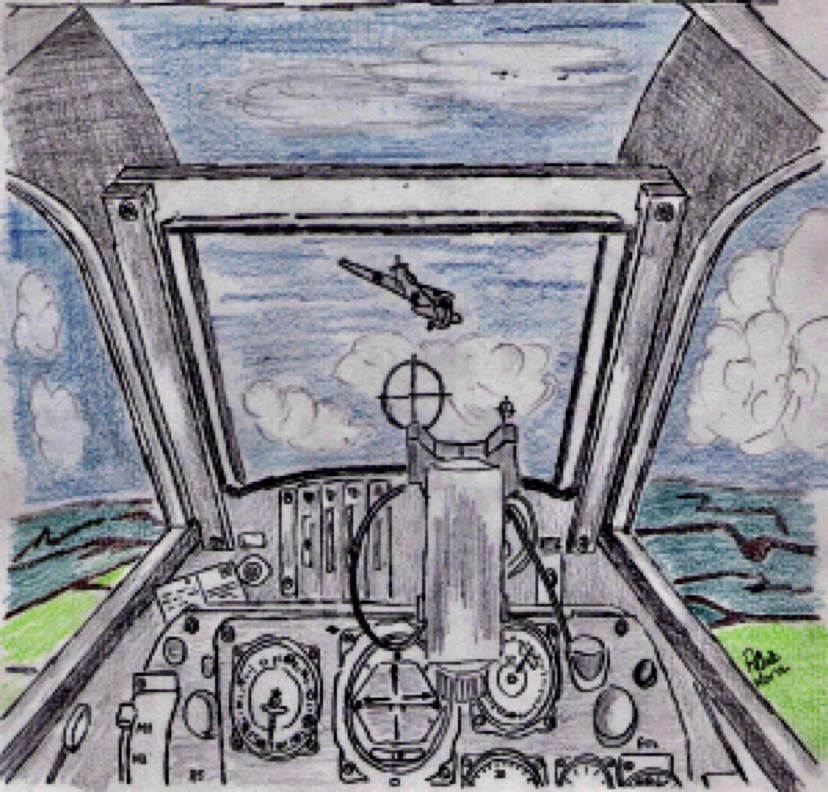
Jagdgeschwader52 (Luftwaffe Fighter Wing52),
Somewhere near Кривий Ріг (Kryvyi Rih),
Dnipropetrovsk Oblast, Ukrainian Soviet Socialist Republic,
1942-43
————————-
I confess, I noticed something missing in this series – a Part-2. At my age it is easy to miss things. You can’t sue me, it’s my blog and I can do whatever I like. So here it is……
————————
By 1943, the Nazis began to realize that they no longer had the world by its hoden. In the east, Operation Barbarossa was turning into a disaster and in the west, the Hitler-Mussolini axis had lost control over North Africa and the Mediterranean. All over Europe partisans, trained by the Allies, were wreaking havoc on German railroads and bridges, turning logistics into a nightmare.
The Luftwaffe however still remained a formidable force in the skies over Europe. Newer and faster airplanes were being developed and tested at a frenetic pace, using technologies that were way ahead of anything that the Allies had. At the Bayerische Flugzeugwerke (BFW – Bavarian Aircraft Works), the development of souped-up versions of the Messerschmitt bf 109 fighter was advancing rapidly, under it’s brilliant designer, Nazi sympathizer Wilhelm ‘Willy’ Messerschmitt.
German technological ingenuity was the engine and slave labor, the wheels.
————————
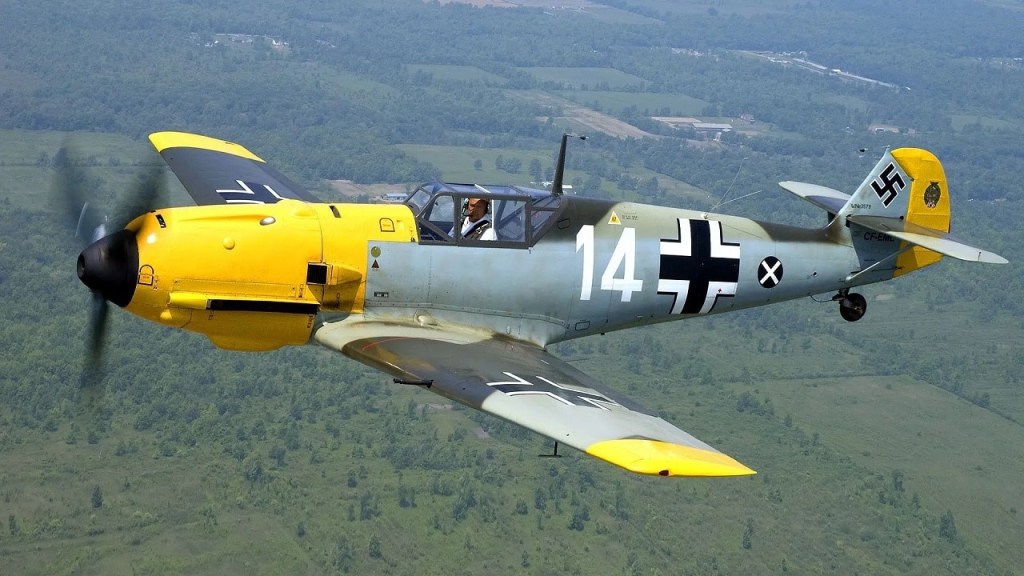
By 1943, it had evolved into the most versatile fighter of the day.
By the end of World War II, 34000 Me-109s had beeen produced, second only to the Soviet Ilyushin IL-2 (36200) and way ahead of the British Supermarine Spitfire (20350) or the American P51 Mustang (15500).
———————
In 1943, there was no separate category called “test pilots”, neither were there any test pilot schools. The operational pilots were flying hundreds of sorties every day, buzzing around at speeds as slow as 100mph to dive speeds exceeding 500mph, along with ten to fifteen other aircraft, friend and foe, missing each other by inches.
And all that chaotic blur of speed usually happened inside a pocket-sized air space the size of just one city block.
The test conditions were right there and the fighters got tested in real time. Every pilot was a test pilot and flight data collection was just the pilot’s word of mouth in the debriefing, after.
It would be a decade and the war would be over before the first flight data recorder was installed in an aircraft.
At the JG52, a forward German air base 900kms west of Stalingrad, the number of Messerschmitt engineers and technicians almost equalled air force personnel. In the early days of Operation Barbarossa, they were regular attendees at pilot debriefings, especially the day Oberst Kurt Strassner inadvertantly performed the ‘Stall und Tauchen’ a dangerous, gravity-defying maneuver, aimed at getting behind an enemy fighter in a dog fight.
Decades later, Strassner’s aerobatics would become well known among jet fighter pilots as the Pugachev Cobra, named after Soviet test pilot, Victor Pugachev.
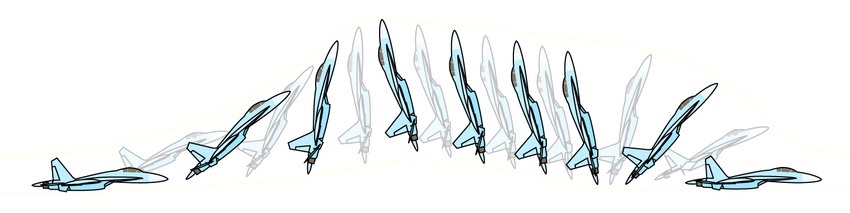
Here’s a YouTube video on how a Pugachev Cobra works. You pitch the jet’s nose up sharply, its belly facing forward, abruptly braking speed. Then, when you have fallen behind the enemy pilot who was chasing you, you straighten out and begin chasing him. Simple.
Actually no, not simple. The Pugachev Cobra needs a special kind of airframe design that can withstand the high G-forces of a sudden braking.
https://youtu.be/OCtmtUFXTMs?si=hDzST1VCbe2vZ48K
But lets not get ahead of ourselves…..
The period between 1914 and 1950 was the age of aerial ‘dogfights’, skirmishes in the air between enemy fighters. Anyone who has been a Biggles fan knows what a dogfight is.
If you were in a dogfight and you had a ‘hun’ on your tail, you would want to have him in front of you, instead of behind you, so that you could drill him full of holes with your wing mounted 23mm canons.
If you were unimaginative, you’d make a tight 360-degree turn to try to come up behind him, but the hun was not going to be sitting there twiddling his thumbs while you turned around. He was going to stick with you real close, so close that if you farted he would be able to smell it.
——————————
Pardon the mention of farting. I took that from the Lawrence Sanders character, detective Edward X Delaney, exhorting a colleague to stick real close to a ‘perp’ he was following.
I go off-script sometimes but what are you going to do? It’s my blog.
Now, let’s get back to the yarn, shall we?
——————————-
The 360-degree turn you made to get behind the hun was only going to get you dizzy and not behind him.
But if you thought outside the box you’d do the Pugachev Cobra. To understand this one needs to first understand the Soviet ethos……..
With the advent of the jet age, fighter to fighter mid-air engagements (ie:dogfights) became passé, due to the high speeds and the heat seeking/laser guided smart ordnance that no longer needed sighting on cross-hairs. While the Americans understood this, somehow the Soviets never did and they kept building fighters with extremely high maneuverability, ideal for a Pugachev Cobra.
Remember the guy I mentioned earlier – Viktor Pugachev? He first performed the stunt at the Paris Air Show in 1989 in a Sukhoi-27 Flanker.
———————————-
Imagine you are a Russian test pilot and it is the 1970s, the Cold War is at its height. You are in a Sukhoi-27, approaching American air space somewhere over the Bering Strait. You are in complete radio silence with base.
The Aleutians West island chain swings into view over the horizon and suddenly you have company. Two American F18 Hornets have appeared as if by magic, on either side. They had launched off the 92600-ton, Nimitz-class aircraft carrier, the USS Carl Vinson, that is patrolling the northern waters, shepherding a sizable part of the US Pacific fleet, like a mother hen and her chicks.
The Hornet to your left lets loose around 250 rounds in a short burst from its nose-mounted 6-barrel 20mm rotary canon. The burst is not aimed at you. It is a warning, followed by the standard “You are violating American ADIZ, please turn around immediately.”
——————————-
An Air Defense Identification Zone (ADIZ) is a region of airspace in which a country tries to identify, locate and control approaching aircraft in the interest of its own national security. The ADIZ is declared unilaterally by that country and may extend beyond its territorial waters, to give the country more time to respond to possibly hostile intruder aircraft.
The concept of an ADIZ is not defined in any international treaty and is not recognized by any international body. Any country can arbitrarily fix its own ADIZ.
———————————
Back to the story….
You are unfazed by the burst from the Hornet’s nose mounted 20mm canon. You do not break radio silence.
To your right, in the distance, you can just manage to make out a gaggle of F-14 Tomcats, also from the Carl Vinson, keeping pace, making no move to get closer, confident that their cousins – the Hornets – will take care of you.
You don’t panic and yell to base. You continue to maintain radio silence. Your orders are pretty much carte blanche. It’s your play.
Next, the Hornet on your right sidles up close so you can see the pilot’s eyeballs. He waggles his wings. That’s the same as saying,” You don’t belong here, get the fuck out.”
You had expected the attention. Your incursion into US air space was not accidental and your mission was very specific – to test the Su-27’s super-maneuverability against a real adversary.
The Aleutians are now clearly discernible. You decide it is time to rock and roll, to give the two Americans some goose bumps.
You dive from 39000ft. You dive because, for what you are about to carry out, you need more air.
Normally, if you fall out of an airplane accidentally at 39000 ft, you’ll take 180 seconds (3 minutes, give or take) to hit the ground and look like a giant had just dropped a bowl of blender-mashed fruit salad in yoghurt all over the landscape.
But you are not falling out of a plane accidentally. You are in a highly maneuverable fighter jet and you are diving, your altimeter rapidly unspooling, your pressure suit keeping you from losing consciousness, untill you level off at 1000 ft.
The dive takes just 15 seconds.
At 1000 ft the Pacific seems a lighter blue and its expanse, endless. The Aleutians are no longer visible over the horizon. The dive has taken you over the speed of sound so when you level off, you throttle back to around 300knots.
Meanwhile, the F18s are still on your tail, their AIM-7 Sparrow missiles now armed and waiting to relish what they think will be a turkey shoot.
You don’t panic. This is the life you have chosen, to be a test pilot. This is a test and at the same time it is real. The F18’s canon burst is real and the American’s malice is real.
There you are now, level at 1000 feet above the Pacific Ocean. At that height the surface of the Pacific is a blur. Since such encounters never ever develop into hostilities, the Americans are simply tagging along, not fully prepared for what is about to happen.
All of a sudden, you break to 200knots. This is a necessary requirement that prevents your bird from breaking apart when you do the Cobra. Unprepared, the Yanks on either side rush up toward you, relative speeds closing the gap. You bring your elevators up full and pull up the nose sharply until your angle of attack has gone beyond even 90°, to about 110°. Momentum forces the Sukhoi to continue flying straight, it’s afterburners now slightly ahead of it’s nose. You hold this position for just a few seconds.
Before they can mouth the words ‘what the fuck..’ the two F18s whiz past and drive themselves into the sea, but not before the pilots have managed to bail out.
No worries, the pilots have the latest homing devices and will be picked up.
Meanwhile, your airspeed has been dropping, so you quickly level your elevators and throttle up, avoiding a stall. The nose falls back and the Sukhoi continues on it’s level flight, picking up speed and altitude as it goes. You turned around in a tight arc and get the hell out of the US ADIZ.
You switch on your radio, a chuckle now playing on your lips, the chuckle turning into a full-blown guffaw for the benefit of the seething Americans back on the Carl Vinson.
Barely able to contain your laughter, you shout into your mouthpiece,” U vas khoroshay den?” (Did you have a nice day?)
——————————————–
Getting back to my WW2 story, dogfights were not always about speed and bravado. They were about guile and nerve. And those, Luftwaffe Oberst Kurt Strassner had oodles of.
In the age of aerial dogfights with piston-engined fighters, pilots were warned to recognize by sight, the aces of other side, by the call signs that were painted across their fuselages. If you happened to spot an ace in the pack, you had two choices. Cut and run for the cover or face the ace if you were an ace yourself.
Strassner had never run, even in the early days, when he hadn’t been an ace.
The Russian driving the Mig2 that had strayed into Strassner’s path however, was no ace. He was a 19 year old rookie, Igor Kinsky of the 73rd Air Force Guards Regiment. Given the inferior training and aircraft design of the Soviets in those early days of the war, young Igor had been told to not be a hero and beat it if he ever came across a German ace and in doing so, to live and fight another day. This he strove to do, soon as he recognized the Cobra sign under Strassner’s canopy.
Wearing a skull cap with shades developed by Messerschmitt, that were supposed to cut off glare from the sun completely, Strassner chased the young Igor’s Mig2 out over the Inhulets river. When he realized that the Messerschmitt was glued to his tail, the kid panicked. The Mig2 suddenly began a reckless dive from 18000ft, straight down at the blue waters below and Strassner gave immediate chase.
As the altimeter needle whirred down, Strassner realized he wasn’t alone. Neat staccato stitches suddenly appeared just above his right wing tip and the Me109 shuddered. A quick glance back up told him that he’d suddenly been joined by two Yak-1bs who had dropped out of the sun and were closing in on him. The so-called glare-proof goggles hadn’t helped after all. He hadn’t seen them, with the glare of the sun in the background.
When they had taken off earlier in the afternoon, the German wolf pack had four ‘schwarms’ of two ‘rotten’ each, sixteen planes in all. The Mig2 had drawn him way out and away from the main battle. Was he the patsy? Was it a trap, he wondered, but decided to go through with the chase anyway. At some point, he began wondering where his wingman, Dieter was, when the Yak that was following right behind, suddenly disintegrated in a spectacular blast leaving zero possibility of a bail-out.
Strassner hoped the second Yak would be destroyed by the debris, since it had been following close behind, but that was not to be. The second Yak was nimble and it had been so close behind that the ball of flame and splinters hadn’t had time to expand. A quick practised tug on the stick by the Soviet pilot and the second Yak had passed the explosion unscathed.
Dieter however didn’t survive the kill. His Messerschmitt had been behind the second Yak but not too close. It ran straight into the expanding debris cloud and blew itself apart, peppered by the lethal shrapnel from the first Yak, the ball of flame just growing bigger in size and blending into the bigger one left behind by the blown-up Yak.
Strassner was on his own now. Except for the nimble second Yak of course, which was keeping pace five hundred yards directly behind and above. He knew he was moments away from being chewed into bits by the Russian’s 23mm Shvak canons and he had to think of something quick. The blue waters of the Inhulets were rushing up at him at 400knots and he had to bottom out at 1000ft.
The Yak, still hanging on, got ready to blast the Me109, now that both were flying level. It’s right cannon had just started to speak, when the Messershmitt did something strange. It lifted it’s nose up, so suddenly that the fighter was pointed almost vertically and maybe even a bit on the other side, on it’s back. It’s speed broke sharply as it almost flipped over, while continuing to fly level.
The Yak had just a second to dodge the suddenly slowed German. It flashed past and zoomed on ahead, pretty sure that the Me109 would stall and probably crash. The Yak kept going and did a curving loop, shooting up straight, but this time it had the Messershmitt on it’s tail and now the German looked like he was stuck on the Yak with glue.
A vast approaching cloud bank and a look at his fuel gauge made Strassner abandon the chase, drop down and skim across the waters back to base. He saw no further sign of the Yak but something told him that it was not the last he’d seen of Russian. The doggedness, the nimble dodging, the tight loop, these were all hallmarks of an ace.
But there had been something else. Something that had caught his eye as the Russian fighter had hurtled past him, not even 50 yards to his right.
Nestled within a large painted white rose, emblazoned against the Soviet-grey of fuselage just below the canopy, were the words ‘белая роза’ (‘Belaya Roza’)
In Russian, it meant “White Rose”.


This reminds me of Tom Clancy! As good, if not better!! Keep going. Looking forward to more!!
LikeLike
Thanks, Dadi!
LikeLike