
“I wanted to do something nice for her. She had so little time left to live.”
– Dr. Vladimir Yazdovsky, the lead scientist for the Soviet space dog program, recalling with remorse the evening when he took Laika home to play with his children and have a hearty meal, on the eve of her historic space flight. As the technology to enable survival during re-entry had not yet been developed, Laika’s survival was not expected.
——————————-
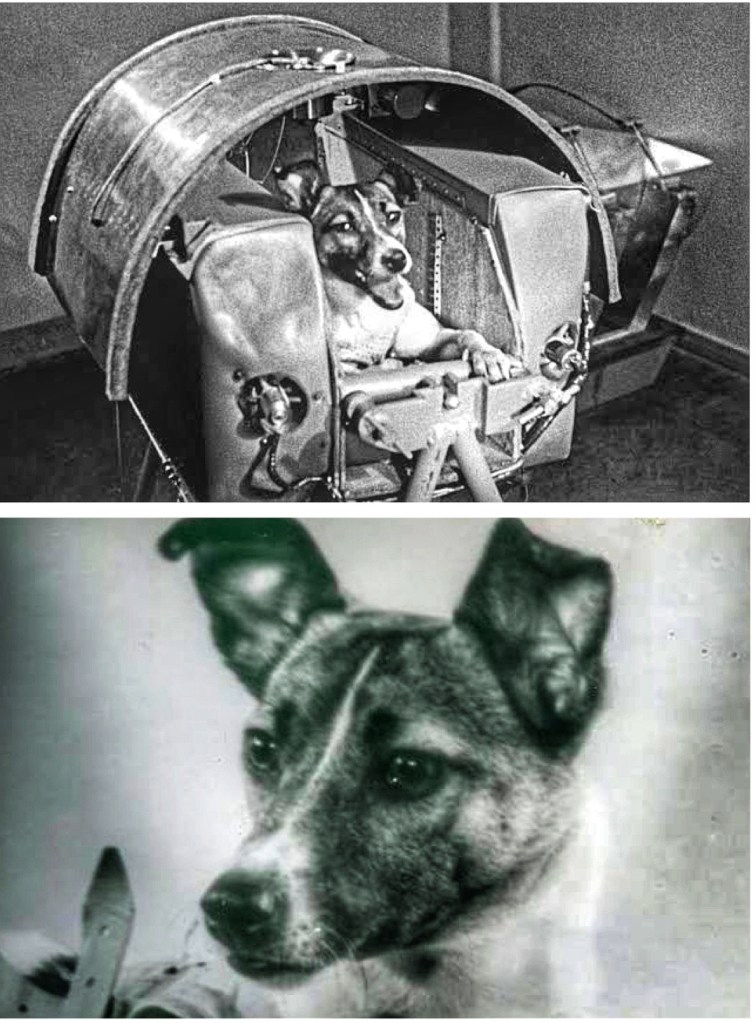
A quiet and obedient part-husky and part-terrier, Laika had been a stray mongrel snatched from the Moscow streets and trained to fly into space in 1957. The Soviet space program exclusively used stray mutts because they believed life on the harsh streets made the dogs mentally tougher and more adaptable to training.
As the technology to re-enter the atmosphere had not yet been developed, Laika’s survival was never expected. She died by overheating hours into the flight, on the craft’s fourth orbit.
Laika had not been permitted the option to choose whether she wanted to be incinerated on reentry or not.
Dr Yazdovsky recounted years later that he never got over the look in Laika’s trustful, all-understanding eyes as the hatch closed, minutes before launch. According to him, her intelligence and sense of intuition were uncanny.
Laika’s journey proved that life could survive in the weightlessness of space, forever changing how we look at the stars.
——————————-
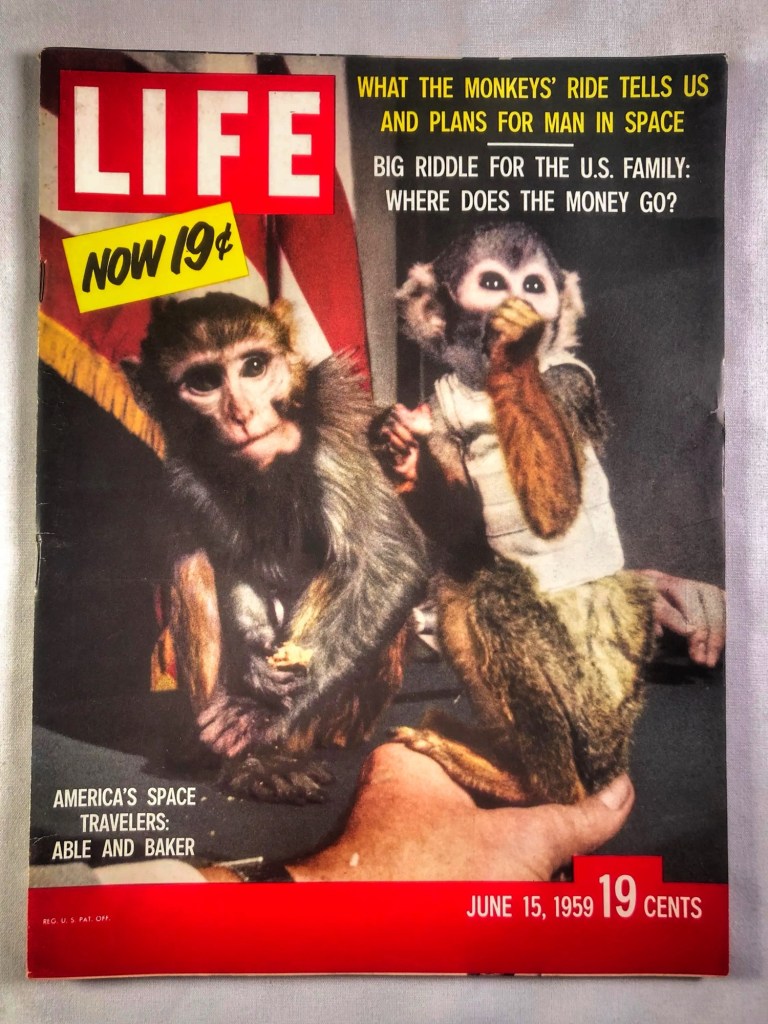
Miss Baker (right) | Squirrel Monkey | Weight 1lb | Born : Iquitos(Peru) 1957 | Died : Alabama[US] 1959 Heart failure
May 25th, 1959, is a date that Commander John Guion (Retd.) will not forget in a hurry.
Despite a favorable forecast, the winds had turned nasty. It was not raining though and so visibility was not too bad. The skies remained overcast with a thick nimbus cloud cover, the ceiling just 2000 ft.
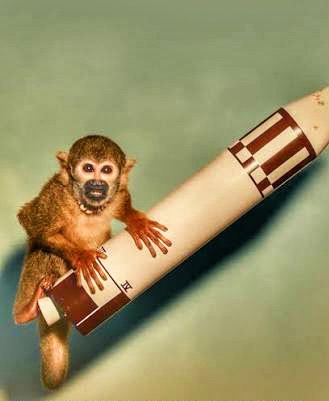
The drop zone was still 30 minutes ahead, around 150 kms north-east of Antigua in the West Indies, where the hardy tug had a date, with two young ladies. One was a Rhesus monkey named Miss Able and the other, much tinier, almost pocket sized, a squirrel monkey, Miss Baker – the world’s first two living creatures to return from space alive.
The vessel reached the rendezvous coordinates on schedule and waited, its decks heaving perilously, spray hitting the plexi-glass of the bridge, momentarily blinding the men standing behind, making them flinch involuntarily with every splash. Heavy-duty windshield wipers worked incessantly, to clear the glass and restore visibility.
Then, as if by some divine intervention, the seas subsided and the vessel’s pitch and yaw settled to just around 10 degrees to the vertical. Suddenly a section of the thick cloud cover lit up in a flash and an object emerged approximately 500 yards to the port, suspended from three billowing parachutes. Despite the breaking provided by the chutes, it slammed into the sea, kicking up a towering wall of spray which soon subsided and the object settled, bobbing up and down in the swells.
As soon as the frogmen attached the winch cable to the eye-bolt on the side of the capsule, it lifted off the water and started swinging in dangerously wide arcs, once even slamming against the hull with a nasty crack. Cmdr. Guion hoped that the furry astronauts inside were adequately padded up.
The capsule was set down gently on the deck and it was time to meet the girls. A technician connected the capsule’s power supply with an external cable and looked at his telemetry console and immediately his face broke into a wide grin.
“They’re alive!” he screamed at the top of his voice and a loud cheer rose from the deck. The back cover was hurriedly opened and a Nasa engineer reached in and brought out Miss Baker first and then Miss Able.
While Able seemed a bit subdued, shaking hands with her minder a bit too formally, Baker jumped into her handler’s arms for a cuddle, chattering away in glee.
Deep inside the bowels of the Kiowa the following words went out over the teletype….. “Able & Baker perfect, no injuries or other difficulties….” The tug then turned around and headed back to its Guantanamo Bay base.
All through their training, Able and Baker had been found to be smart, quick thinking, upbeat. While Able was a bit quieter, Baker was playful. Like Laila, they too hadn’t known what their life choices were. They had loved being pampered by their human handlers trusted them implicitly.
——————————
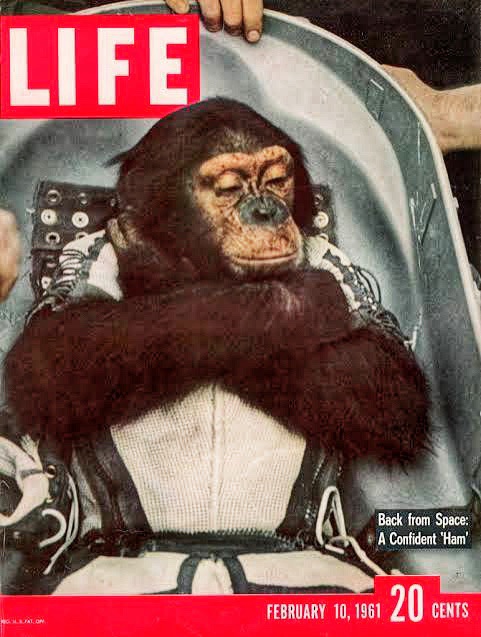
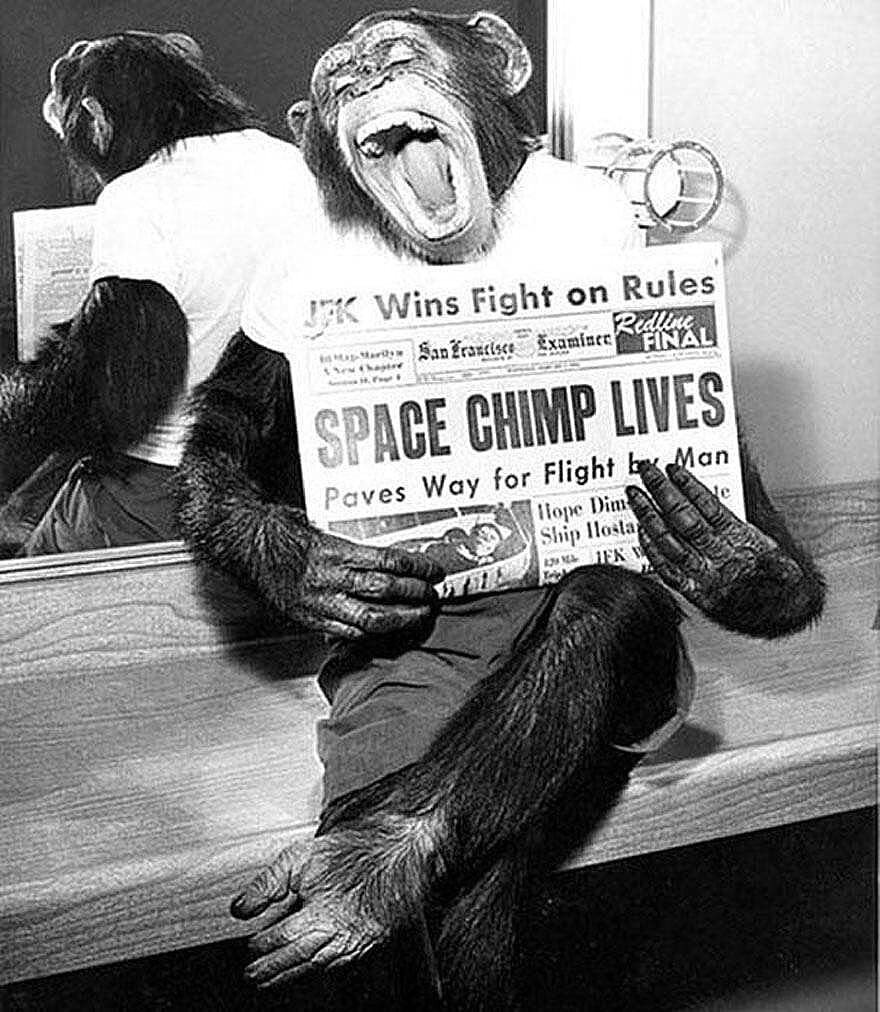
On January 31, 1961, Ham, whose name was an acronym for Holloman Aero Med, became the first chimpanzee in space, aboard the Mercury Redstone rocket on a sub-orbital flight very similar to Alan Shepard’s. He had been snatched from his mother in Camaroon, West Africa, where he was born July 1957.
Ham performed exceptionally during his flight and splashed down in the Atlantic 60 miles from the recovery ship. He experienced a total of 6.6 minutes of weightlessness during a 16.5-minute flight. A post-flight medical examination found Ham to be slightly fatigued and dehydrated, but in good shape otherwise.
Ham’s mission paved the way for the successful launch of America’s first human astronaut, Alan B. Shepard, Jr., on May 5, 1961. Upon his death on January 17, 1983, Ham was laid to rest in front of the International Space Hall of Fame in Alamogordo, New Mexico.
————
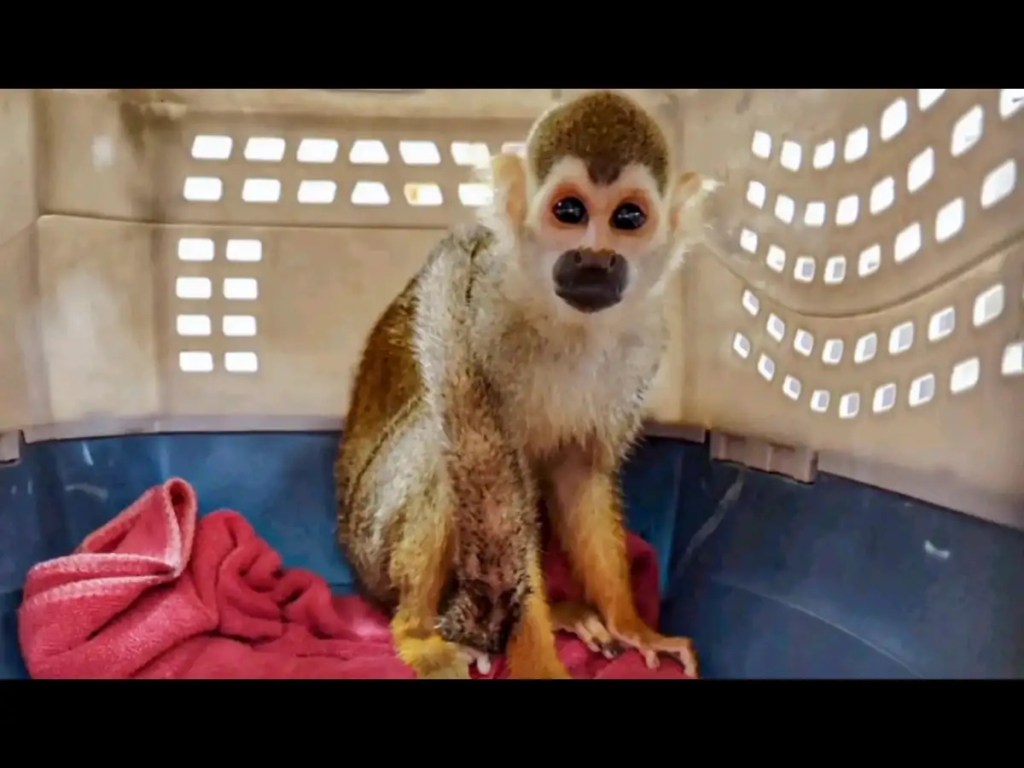
Goliath weighed less than a carton of milk and stood just six inches tall. But he became a space icon long before the world had heard the name ‘Neil Armstrong’. It was a journey that he neither wanted nor understood. A squirrel monkey like him would be content to climb the forest canopy looking for grasshoppers and caterpillars.
Yet, on 10 November 1961, Goliath found himself strapped inside a metal container and launched from Cape Canaveral in an Atlas E rocket.
Goliath’s odyssey was a short one. 35 seconds into flight, the rocket veered violently off course and exploded, killing him instantly.
————
Three weeks after Goliath, Enos became the first chimp to orbit the earth, on November 29, 1961, aboard a Mercury Atlas rocket. He did two orbits and was recovered safely in good overall health. Enos paved the way two months later for American, John Glenn’s orbital flight on February 20, 1962.
Like Ham and the others, Goliath and Enos did not have the ability to make life choices.
————
Félicette was the first cat launched into space in October 1963, from the Algerian Sahara, on a French Veronique rocket. Félicette did a sub-orbital flight and was successfully retrieved alive after a parachute descent. Then, two months post-flight, researchers put her to sleep just because they wanted to perform a post-mortem autopsy.
While the French people rejoiced at Félicette’s feat, no one mourned her murder for the sake of science. When one considers the fact that given the choice, a cat will almost certainly choose to live on, what happened to Félicette was murder, no question about it.
————
Back in the Soviet Union, the dogs Veterok (“Breeze”) and Ugoyok (“Little Piece Of Coal”) were launched aboard a Kosmos 110 by the Soviet Union on February 22, 1966. The flight was an evaluation of prolonged effects during space travel of radiation from the Van Allen Belts, on animals. They landed back on 16 March, weak from muscle atrophy, making it a 22-day space flight, a duration that stood as a record until June 1974, when humans surpassed it on Skylab2. Both dogs recovered, lived out long lives and even had healthy offspring. The two intrepid canines proved that humans can recover their health after slightly longer duration space flights without significant long-term damage to their bodies.
————
Dogs, cats, rats, rabbits, turtles, spiders, ants, bees, fungi, you name it and humans have launched them into space. The few that returned alive and adjusted well afterward, have sometimes been honored with fancy gravestones and memorials.
There are no such memorials for the millions of animals we kill for meat every day, even though it is a scientifically proven fact that we do not need meat to sustain our physical or mental health and longevity, a fact that hundreds of millions of vegetarians around the world prove everyday beyond any doubt.
——————————-
Those inside Apollo 1, the Challenger and Columbia shuttles and the cosmonauts in Soyuz 1 & 11, these men and women knew the odds and had been free to make their choices to go to space.
Laika and the others hadn’t been afforded that choice.
What would the Gods of the various religions of the world have to say about that? Killing random animals en masse for the sake of space exploration or for our sustenance or sport? Would the Gods deem the wanton killing spree moral?
Just as a 50BC Roman Consul would say when he presented his wife with a sturdy well-hung Nubian on her birthday, maybe the Gods would say to Wernher von Braun, “Aww don’t worry about it, we created them for your’s to do what you like.”
If we even remove morality from the debate, has the industrial scale killing of animals for the ultimate goal of long-duration space flight been worth it, even for the longterm security of mankind?
We cannot even predict when the next pandemic will strike after it is allowed to escape some government biological weapon lab. Or when the 5-mile diameter super-volcano magma chamber beneath the Yellowstone National Park will blow and bring in a decades-long worldwide winter and mini ice age. The next near-earth asteroid, far bigger than Chicxulub, might wipe us out completely.
Yet here we are, our leaders squabbling with each other over inconsequential pieces of land, spewing hate, kicking the proverbial can down the road, seeking the blessings of our religious myths and their fantasy Gods, instead of mounting a united worldwide response to address those extinction level events that are waiting to happen.
Exploration within our planet and its orbital space is one thing and it is necessary to intimately know our own home and its moon because they both have a strong influence on our lives. But exploration to live permanently on another piece of rock that takes 18 months to reach, whose very soil is so toxic that it can alter our cellular structures and DNA, where one just has to stand on his own two feet to get himself killed by deadly cosmic radiation, a trip that is a billion times more hazardous than going to the moon? Is it worth the time and expense right now?
Scott Solomon, in his book “Becoming Martian” thinks that human beings will be able to settle on distant planets and gradually adapt to their alien environments, that our physiologies (our cells) will mutate, adapt and evolve. Maybe so, but history shows that physiologies of living beings do not reconfigure overnight. That adaptation is called evolution and could take hundreds of thousands, if not millions of years.
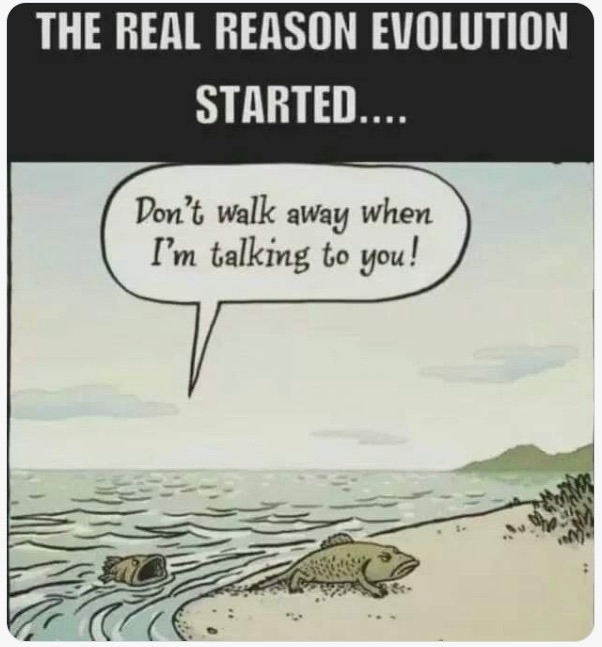
Even at an optimistic 100000 years, should we be concerned today about things that will take so long to happen??? Isn’t there a distinct possibility we might go extinct by then?
Maybe Dr Yazdovsky had more than just a twinge of regret that evening, in 1957, when he brought Laika home. Maybe he thought of driving her outside Baikonur and turning her loose, hiding her, anything so she missed that flight.
—————————
I say we don’t give a flying fuck about going to Mars. Elon Musk is a nut job. I say fuck him.

