E Pluribus Multis

Most people believe that good governance leads to harmony. It may, but only temporarily. In the end, good governance always lays itself bare to conflict.” – Noccolò Machiavelli

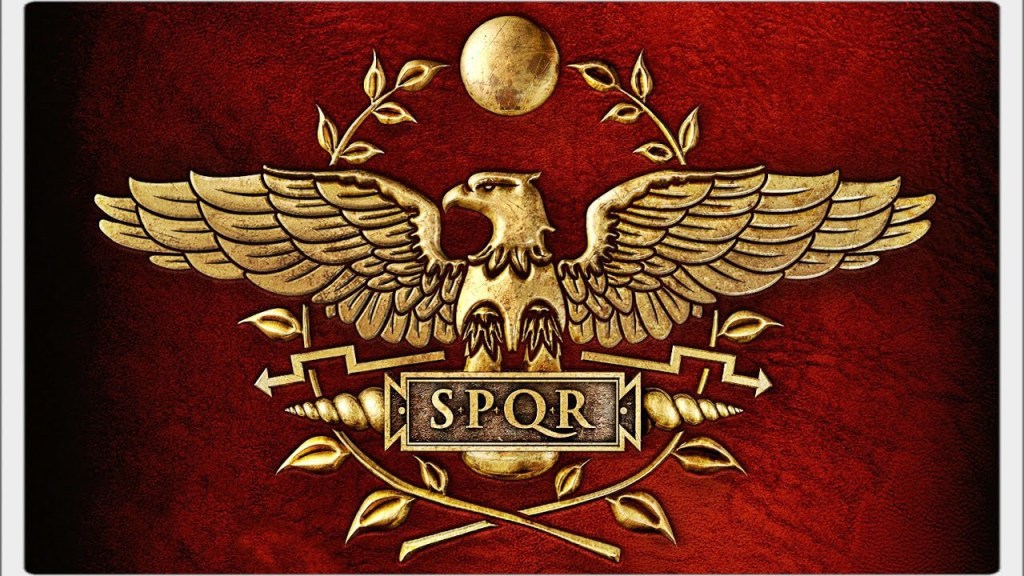
SPQR – Senatus Populus Que Romanus (The Senate and the People of Rome). If you were living in ancient Rome, you would find this acronym everywhere – on triumphal arches, battle standards, coins, ceremonial banners, you name it and they had it there. It was their version of a Coat of Arms. As to the words, for the Romans it was natural to use Latin.

E PLURIBUS UNUM (Out of many, one). This gobbledygook is found everywhere in America.

Both the above standards depict an eagle, the universal symbol of a predator. Now check out the two Latin phrases above…..

The ancient Roman one, Senatus Populus Que Romanus, is simply an announcement of identification.

The real Roman motto is festina lente [make haste, slowly], used by Augustus, the first Roman Emperor, on his standards and coins. Throughout his long reign Augustus had this one motto. He emphasized it to his generals and thought it so important that he had coins minted with an image symbolizing it. “The fastest way to get something done is to do it right the first time. Especially when you’re feeling the crunch, take your time”, he exhorted.

To defeat the combined militaries of Cleopatra and Mark Anthony, Augustus waited patiently for the right moment to invade and annex Egypt and finish the two lovers off.

Augustus’s advice is backed up by today’s science. InThinking Fast and Slow”, Daniel Kahneman, the Nobel Prize-winning psychologist, described two schools for thought. School-1 is fast and emotional and relies on stereotypes. School-2 is slow and difficult and relies on calculation. The more you hurry – and even more importantly, the more you feel that you are hurried – the more you rely on School-1. There are situations when you need to do that, but most of the time, you’ll be far better served taking your time, thinking your way through a crisis than letting your emotions govern your decisions.

Festina lente is both, paradoxical and an oxymoron. How can we make haste slowly? How can we go faster by going slower? Many of the deep human realities at first do seem counterintuitive and this is one of them. We have all heard that the greatest person will be the servant of all, and that those who humble themselves will be exalted and those who exalt themselves will be humbled, or that pride goes before a fall, etc, etc, etc.

All in all, the Roman motto has weight.

A section of an ancient Roman bas relief, c 50AD

—————————

The other motto, the American one, E pluribus unum [Out of many, one] is a pompous piece introduced in the late 18th Century, hundreds of years after Latin had receded into obscurity.

What the fuck is wrong with saying it in plain English?? Why not simply say something like, “Prosperity in unity” or some other similar crap? But no, it has to be in Latin, a faux effort to sound profound. In today’s context, when billionaires control 70% of America’s wealth, it sounds phony as hell too.

One can’t blame the Americans alone for being pretentious. Look at my land of birth, India’s motto, Satyameva Jayate [Truth alone triumphs], delivered in Sanskrit, a language so obsolete that the Last Supper was actually centuries into the future when it was in vogue. The last time any Indian man-on-the street spoke Sanskrit as a matter of course was around 600AD.

The dash of Sanskrit in the Indian motto is meant to make it appear deep and profound, when in reality it is just another pompous piece of schlep to be regurgitated on occasions like the Independence Day, very very far from any desire for truth, in a country hijacked by a cabal of rich businessmen and organized crime capo-turned politicians, pandering to a barely literate tea shop owner living out his right-wing fantasies.

—————————-

Let’s leave India and get back to Rome…..

When it came into existence – circa 800BC – it was just a small town that was little more than a village, population 150, by the banks of a river that was little more than a stream that one could easily wade across, somewhere in middle Italy.

The village didn’t begin with any grand plans of being an empire, but in the course of a thousand years, it would stretch through three continents and secure within its borders the lives of roughly 100 million free citizens and 30 million slaves.

And the stream never imagined that resourcefulness and engineering would divert nearby streams to join its flow, turning it into what is today the turbulent Tiber.

By the time it grew to it’s mightiest in 200AD, the Roman Empire would be constantly fighting wars of conquest and quelling rebellion in it’s distant outposts, expending in today’s dollars – trillions, in order to sustain it’s hegemony.

And all the while that the Roman legions were conquering distant lands, back home tax collectors, judges, senators, policemen, firefighters, medicine men, carpenters, builders, farmers, accountants, poets and historians – they would be going about their orderly lives, free Roman citizens, blissfully comfortable in the thought that those wars could never touch them. This should sound familiar to any American.

It wasn’t really a picture of harmony though – by today’s standards. Ancient Rome was in a state of ‘controlled barbarism’. Rich businessmen sponsored ‘Munera’, reality shows held live in vast amphitheaters where on weekends, citizens brought their wives (and some even their children) to watch hand-picked slaves slash, bludgeon and stomp each other to death.

A vastly different version of morality reigned in 1st Century AD Rome. If you were a Roman housewife, you could have your domestic Nubian slave bludgeoned to death for the slightest of infractions. If you didn’t like the looks of your new born female child, you could say it had a curse that had to be exterminated. And then, you proceeded to smash her head against the stable door and threw her little corpse into the rubbish heap, no questions asked.

If you were a plebeian (commoner) and to your dismay your friendly neighborhood quaestor (Senator) took a fancy to your nubile teenage daughter, you had a choice – to either let him take her away, never to be seen again, in exchange for a tip of ten talents and a job in his stables or to face the prospect of hard labor in the arsenic-laced gold mines outside town.

Your daughter got raped either way.

That was civilization 1.0, oh yeah.

————————-

While the citizens within the walls of Rome lived their lives in that quasi-barbaric state of peace, it was quite another world outside. Around the fringes of the Empire was a very violent environment of treacherous mini-empires and rogue city states that were perpetually squabbling and then forming alliances with the intention of marching on Rome and burning it down to the ground.

Invasions and conquests in those days were quite ‘comprehensive’, designed to ensure that the invader wouldn’t get any more trouble from the invaded. If you were a Roman legionnaire, you didn’t just put an arrow through the invaded guy and loot his livestock. You wiped him off the face of the earth. You burned his cities and temples down. You raped his women and then killed them. You threw his children into large burning pits. You took the able-bodied as slaves and worked them to their deaths building your monuments and aqueducts.

For the leaders of the conquered lands who refused to fall in line, you reserved the worst possible fate – you had hot molten lead poured down their throats……alive.

Oh yeah, it was a brutal world. The bloodshed – if it were to happen today – would leave every man, woman and child in the conquered territories with Stage-5 PTSD, while turning most of them into paranoid schizophrenics. And in turn, those invading troops would be suicidal wrecks suffering from acute moral injury.

It speaks to the adaptability of the human psyche that that hasn’t happened. Rome still exists, at the heart of a mediocre but stable European nation, in the midst of a continent of stable, prosperous democracies, none of whom suffer from any consequences of two thousand years of invasions.

Amazing how things haven’t gone south long term, no?

—————————-

The analogies between ancient Rome and present day America are startling. Just for fun, let’s compare the two at the height of their hegemony – Rome in 200AD : An empire that stretched from The Azores(east Atlantic) in the west to the mouth of the Tigris(Iraq) in the east and Scotland in the north to Nubia(Sudan) in the south, with 20% of the world’s population as its subjects. And America in the present day, virtually unchallenged, 800 military bases grasping the earth in a stranglehold……

The similarities between the two are striking. Rome started in the 9th Century BC as a lawless haven for the indigents and the unwanted from nearby Carthago, Neapolis and Syracusa. Likewise, America began with the puritans and exiles who came over because they were universally considered assholes and unwanted in Britain. Both started with the dregs, disenfranchised jetsam and flotsam.

Romans went about their daily lives in Rome, oblivious to the suffering their militaries caused in distant lands and so do Americans today.

————————-

Even the mysteries behind the rise of Rome and America mirror each other. How did a small village in central Italy manage to grow into a 4-million square mile empire, bigger in area than Europe? Likewise, how did a little village named Jamestown on the banks of the Powhatan, Virginia (which in fact marked the start of the British Empire) ultimately grow into the world’s most powerful nation? Exactly what is it that set the two apart from the rest?

Romans and Americans have always had an overblown, almost cringeworthy, sense of nationalism. Like Americans today, Romans thought that the sun rose and set with them and that they had a God-given right to dominate and rule over the rest of the world. Philosopher-Emperor, Marcus Aurelius, once exhorted his citizens thus……, “When you arise in the morning, think of what a precious privilege it is to be alive as a Roman – to breathe, to think, to enjoy, to love and to conquer, as a Roman.”

If you are American, you’ll hear similar bullshit from every American President – “Shining city on a hill”, “Greatest nation on earth”, etc. Every balcony, in every small town, must fly the Stars and Stripes. Every school child must memorize the ‘oath of allegiance’ at least once a day. Every speech must end with “God bless America”.

If you are an American, at least once in your lifetime, you’ll hear an American leader deliver shitty eulogies that include the words… “those brave men and women in uniform who are fighting all around the world to keep Americans safe…”.

God, how I despise those phoney words!!! Question what those brave men and women are doing all around the world and exactly how that keeps Americans safe and you will be labelled “Un-American”.

Then, when those brave Americans return home to civilian life, despairing husks, left to fend for themselves, trying desperately to survive PTSD, you will treat them like pariahs.

——————————-

Will America too fade away like Rome and barely exist, a shadow of its former self, another mediocre developed nation, struggling to stay economically afloat?

Quite possibly yes, because American leaders do not believe in Augustus’ festina lente. For America, everything must happen on steroids.

Remember Britain and “Rule, Britannia, rule the waves, Britons shall never be slaves”???? That Britain now has a per capita GDP less than that America’s poorest state, Louisiana.

————————-

The Cretaceous–Paleogene Extinction Event – Episode : 4 – The Day After

Frenchman River Valley, Saskatchewan, Canada

66,050,000 BC (+/-500,000)

The day after impact

————————-

There was no dawn this morning. Since last night, a black shroud has covered Frenchman River Valley, as microscopic silica dust from pulverized rock hangs in the air, along with soot from the planet wide conflagration that even the usually fire-retardant plants cannot withstand.

It is a world you wouldn’t want to live in. Giant carcasses are strewn everywhere. The shaking, the 200 mph winds, those have died down. There is a roar but it is not the roar of those huge carnivores. They are all dead. The noise is from the fires.

It is the morning after the impact and it is the officially recognized end of the Mesozoic Era of the great reptiles and the beginning of the Cenozoic Era, a.k.a the Age of the Mammals.

As of this moment we are living in the Cenozoic Era.

All over the world, there are fallen trees everywhere, burnt to charcoal. Massive dinosaur carcasses are strewn around, carnivores and herbivores, not squabbling, no longer fighting for dominance, finally at peace with each other in death, the flesh beneath their scales burnt beyond recognition.

Death had rained down yesterday, in the form of ejecta debris that had been thrown up by the impact into the mesosphere, the very edge of the atmosphere 60 miles up. The debris had re-entered the atmosphere, hurtling back at the speed of a bullet, big school bus-sized chunks of molten, burning rock that together made the air itself catch fire, let alone the vegetation. In hours the whole surface of the earth was engulfed in flames.

Today those flames are still relentless, still burning, even after 24 hours. Anything and everything, no matter how wet or how fire retardant it is, is burning with an intensity that has no precedent. The temperature of the ambient, all around, is 350°C and rising.

The only species that seem to have a chance of survival are the mammals and the birds, who have always lived and bred in shelters underground or hidden under rocky overhangs, away from the elements, hidden from predators.

——————————-

The impact has released over a million tons of fine black soot in the atmosphere which will block out the sun completely for the next 2 years, halting photosynthesis.

Research suggests that ecosystems can recover after a period of darkness of up to 150 days. However, after over 200 days, some species will start going extinct. A darkness interval of 650 to 700 days, will wipe out 80% of all species. 2 years and we are looking at a near total extinction level.

Next, the oceans will start chilling due to the lack of the sun’s heat, by 10°C every six months. The oceans will gradually freeze and over the next 100 years, a full-blown ice-age will set in, but it will be gradual, allowing some of the still living species to adapt to the cold and wiping out the remaining life forms that could not make the transition, like the dinosaurs.

The species that will adapt and will do so spectacularly, are the furry mammals and birds. Yeah, the same hardy little furry beasts that survived the impact. They will manage to survive the extreme cold. It is almost as if they had foreseen the future and have deliberately grown fur coats for exactly this eventuality!

Like the mammals and the birds, the other survivors of this catastrophe will be those that, by sheer accident, have the traits, the DNA that will allow them to survive. They are not the largest nor are they the deadliest. Many of them are commonplace, mundane little animals found almost everywhere.

It is an irony that the tiniest and the most defenceless living beings will get through this calamity, not the ones on top of the food chain – the massive reptiles who liked to live and roam out on the open ground, arrogant, unafraid. Now, all over the surface of the earth, that open ground is nothing but a mess of dry skeletal remains of vegetation turned to charcoal, sizzling and burning at 400°C.

Whoever coined the aphorism, “the meek shall inherit the earth” certainly didn’t have dinosaur extinction on his mind. It is true however. It is true not only this time but has also been true in all four previous extinction events.

Isn’t evolution amazing? It makes one almost begin to believe that there might be a divine design behind all this.

Unlike the other Extinction Level Events (ELEs) that came before, where the destruction was gradual, the last one spread over a million years give or take, this one is a catastrophe compressed into one day. In the blink of an eye, it is exit stage left for the dinosaurs and entry stage right for the furry mammals and birds.

As much as we love dinosaurs, enshrining them in museums, bringing them back to life in films, reading about them in comic books as children, holding them in awe, we know that we exist only because they ceded the evolutionary centre stage to our ancestors.

We owe them a debt.

———————————

There are few questions that grip us as breathtakingly as the story of us, as a civilization and as a species. How did the earth come to be? How did it evolve and change over time?

In a recurring dream, I see myself walking down the aisle of a gigantic cosmic library. As I walk, I run my fingers over the rows of books chronicling the history of the universe.

The rows of books and the number of volumes in them stretch on and on into infinity and I seem to possess eternal life. Millenia pass as I walk the aisles, my fingers brushing against each book.

After what seems like eons, at the very last shelf, my hand slaps against one book that appears to jut out just a wee bit. It is in a forgotten, dusty corner that few visit.

In my dream, I pause, pull the book out and go sit at a table and begin reading. The first chapter is about our solar system’s birth, the next on the collision with another smaller object that produced the moon. The next few chapters are about how the earth cools and life emerges.

I eventually come upon the chapter on the emergence of humanity. If each chapter represents 100 million years, we humans don’t appear until Chapter 45. In the final page of that chapter, we progress from hunter-gatherers to intelligent beings capable of complicated analysis.

In that last page of Chapter 45, we develop science, art and culture; war, unrest and famine; organized settlements, organized agriculture and organized government; religion, oppression, bigotry and migration and finally, our own morality, truth and deceit.

The rest of the pages of this book of earth are blank, yet to be written. The story has finally reached us here; today; now.

When I try to turn the first blank page, the dream ends and I am awake, but I realize that the story will not end here. There should be another 10 chapters still waiting to be written, another 1 billion years, before all life on earth ceases to exist, incinerated by a depleted, bloating sun that is inexorably turning red, growing more and more massive.

Throughout recorded history, our Sun has nurtured us, given us the will to live and prosper and now it is turning against us. Sudden flares are shooting out unannounced, penetrating what is left of our mesosphere. The Sun has already gobbled up Mercury and Venus, it’s surface now so close that had there been a self-nourishing, heat resistant survivor looking up at the sky, 80% of his sight will be blocked by the flaming giant.

This will be the final Extinction Level Event.

The story of the earth will not end even then. There will still be 40 chapters left to the book, another 4 billion years before our earth, now an arid, lifeless, smouldering rock, ceases to exist, completely engulfed by a red giant sun, vaporized and ionized, shredded into the very fragments it had been built from.

Start to finish is an estimated time frame of 10 billion years, of which 4.5 billion years are already in the past and life has blossomed on earth for 3.7 of those 4.5 billion years.

After life appeared on earth, there have probably been many ELEs but current research has recorded with certainty only two so far where 95% of all species disappeared – the first was the Permian-Triassic Event, 252 million years ago, triggered by a chain of super volcanos in what is now Siberia. And the second was the one this series is all about – the Cretaceous-Paleogene Event, 66 million years back, caused by the impact with a killer asteroid.

Assuming that a future 95% extinction ELE will probably wipe us humans out, how many more ELEs do we have in the future, before we face the one with our doom in it? How will the remaining chapters be written? How will it all end?

Or will we be among the lucky 5%, progressing, multiplying and evolving if not on earth, then on another planet, in another solar system?

———————————-

The Cretaceous–Paleogene Extinction Event – Episode : 3 – Impact

Tags

, , , ,

Artist’s impression of the Chicxulub crater

—————————-

Frenchman River Valley, Saskatchewan, Canada

66,050,000 BC (+\-500,000)

If a main battle tank were to suddenly come alive, one could mistake it for an Ankylosaurus. Rows of segmented armour plates (scutes) cover her back. Hard spikes point outward from the sides of her belly and at the very end of her tail is a bony knob that acts like a sledgehammer, to smash the skull of a T-Rex should it mistake her for lunch. Even her eyelids are armored.

Including her tail, the Ankylosaurus is 40ft long and weighs 15 tons, fully grown. Because of her great bulk, she can run at a max speed of 6 mph only but that is hardly a disadvantage, given that other dinosaurs (including Scotty, the T-Rex) don’t like to mess with her.

A T-Rex loses teeth as its head gets a battering from an Ankylosaurus’ tail knob. Ankylosaurus is “fused lizard” in Greek. Apt, because she is a distant ancestor of the crocodile.

———————-

The Ankylosaurus has sensed that something is very wrong. Her unease isn’t caused by the approach of a hungry predator. All of a sudden, the ground is rumbling and shifting, like at any moment she might be yanked off her hoofed feet.

Moments earlier the beast had stooped to drink from the edge of a lake, her feet firmly planted on a huge slab of rock that had slanted into the water, like a boat ramp. Dinosaurs know enough not to wade into the water. The lake has no bottom, only a thick ooze of quicksand that swallows anything that falls in to it.

The rock is covered with slippery moss and now it is moving and shuddering, leaving the Ankylosaurus trying desperately to back up. Slipping and sliding she barely makes it out, hooded eyes staring up skyward. “What the fuck just happened?” they seem to say.

Behind the Ankylosaurus, a sudden rush of wind joins the heaving ground to set the trees swaying, performing a macabre dance. A giant Metasequoia leans drunkenly forward at an angle, causing a roosting pterosaur to scramble to take to the sky, squawking in annoyance, its 20ft wings grasping at the air, desperately seeking lift. For a moment it looks as if the huge bird won’t make it but it eventually does.

Then, suddenly the shaking stops. The metasequoia comes back up almost to its original erect bearing and everything goes still, eerily quiet. It is as if nothing at all had been amiss.

The Ankylosaurus freezes, unable to make anything out of what just happened. Nothing in the past 20 years that she has been alive has prepared her for this. She stands stock still and waits. The fact, that 2000 miles to the south a rock has slammed into the earth, is a scenario totally alien, completely incomprehensible, to her.

Frenchman River Valley used to be a noisy place, filled with hoots, squawks, roars, hisses and the thumping of huge hooves, but now there is complete silence. All the inhabitants of French River Valley, the herbivores, the carnivores, the mammals and the reptiles, have frozen in place. Every living being is holding its breath.

The second tremor is far stronger. The slab that the Ankylosaurus had backed up on lifts up suddenly with such massive force that the great beast is flung 50ft into the air like a rag doll. Since the slab had slanted into the lake, the beast does a parabolic arc through the air and plunges into the water with a mighty splash. She flails around with her powerful tail and the more she thrashes about, the faster the quicksand swallows her. She tries desperately, right up until her head disappears under.

The tremors – seismic waves – are now coming in pulses, each stronger than its predecessor, showing no signs of tapering off. All around, giant conifers have been flattened. The nearby inland lake has breached, flooding an area the size of New York State. In 66 million years, all that will remain of the lake is the Frenchman River.

The Chicxulub ELE has claimed its first Canadian victim, 2000 miles to the north, in what is today, Saskatchewan.

—————————-

Across the expanse of water now known as the Atlantic Ocean, far to the north-east is an archipelago in the North Sea. 66 million years from now, it will form a part of the European mainland and be known as Norway. It will no longer be hot, dank and fetid and the marshy flatlands will turn into breathtaking snowbound fjords, swept by icy chill winds.

But today it is just a chain of islands, 360 miles north of present-day Russia and the Russian mainland is currently separated from Europe by a vast 150-mile wide shallow sea that is at places only 50 fathoms deep.

Under the waters, away from the oppressive heat, a gigantic Pliosaurus is steadily rising upward to the surface to catch a gulp of air. Like Scotty, the T-Rex, this beast too is an equal-opportunity predator. It devours anything alive that is dumb enough to swim by. Just an hour back, it had grabbed a passing 1-ton, 14-foot plesiosaur, a Morturneria, by its neck and gorged on its thighs.

Sated for the moment, the Pliosauraus powers his way up until his neck breaks surface. Sheets of water cascade from the enormous head down its neck. Rippling waves spread out like as if a ballistic missile SSBN has surfaced. The sun is low over the horizon, a dim ball of light, glowing red.

All of a sudden something plops into the water, something really hot, because it causes hissing steam to rise immediately. The strike causes a mini-waterspout, so fast was the object’s velocity. The ripple hasn’t died down when another hits. Then another and another, until the waters around the pliosaurus’ head are sizzling and churning, as an acrid smoke begins to choke his breathing and block his sense of smell.

Soon it is raining red hot lumps all around, turning the sea into a hissy, choppy cauldron of death.

One thing dinosaurs aren’t is smart. Instead of diving, the Pliosaurus treads water, transfixed, a deer caught in the headlights. It is a matter of time, before one refrigerator-sized lump hits him square between the large mirthless grey eyes. The effect is spectacular. One minute there is a head attached to a neck and the next, the air is saturated with red-white vapour, millions of tiny pieces of brain, bone and tissue.

The headless Plesiosaur floats away, bobbing furiously in the violently churning waters. By now the ambient water temperature has escalated from 39°C to 52°C. The air has turned into a haze of steam, visibility down to near zero. The sun, still above the horizon, is no longer visible, except for a diffused patch of light in the west.

The Chicxulub ELE has claimed its first Eurasian victim, in another continent, 6000 miles from ground zero.

——————————-

No two impacts produce exactly the same damage. The impactor’s size and speed, the angle of incidence at which it hits, the environment it strikes, all these decide the extent of damage an asteroid can cause.

The Chicxulub asteroid had the worst of all the above circumstances. It came in at 72000 miles per hour, a streak of glowing red light, too fast for the eye to comprehend. It wasn’t a vertical impact. The 7-mile wide rock rammed home, slanted at 45°. One moment everything was as it had always been and the next, this spot on the earth’s skin burst open like a popped pimple.

The force of the impact was so great that quantifying it, giving it a value in teratonnes and zettajoules would border on the ridiculous. There is simply no way anyone can imagine the sheer magnitude of the strike. Not since the formation of the early earth had there been an impact like this one-in-a-million random event, this culmination of a series of random events.

The asteroid hit the earth’s crust, in the shallow continental shelf of what is now the Gulf of Mexico, it’s force driving it 12 miles deep melting and vaporizing stone and rock and ejecting the debris 70 miles into the upper layers of the atmosphere. Like a water droplet hitting the surface of a still pond, the rock created a circular ridge which fell back, creating a middle peak at the centre of the strike spot. And then, the middle peak collapsed, leaving a bowl shaped crater 186 miles in diameter.

All this, within the first 5 minutes.

All that force had to go somewhere and it did, in the form of repeated waves of shock, inadvertently announcing the arrival of the rock to the world. Several hours passed, as repeated 300ft-high super tsunami waves hit the Yucatan coastline, tossing huge dinosaurs around like little plastic toy figures.

————————————-

All through the billions of years of its existence, the earth has been the target of numerous asteroid impacts. The large number of impact craters (some easily recognizable by sight and others through imaging techniques) stand testament to this.

Of all the direct hits that the earth received, the Chicxulub crater in Mexico’s Yucatan Peninsula is estimated to be the largest and most devastating, at a whopping 186 miles in diameter.

There have been near-misses too. In 2013, the 30-metre wide Duende passed within 17240 miles of us, far closer than some geostationary satellites. It it had hit, it would have delivered a forced equal to that of a 4.8-Megaton atom bomb. That would be the equivalent of 320 Hiroshima detonations all at once and it could have taken out, not only Hiroshima, but also Tokyo and all the other big cities in the 88000 sq.mile Honshu Island, had it been a direct hit.

—————————-

Among identified asteroids that will either actually hit or be really close is Apophis, a 370-metre diameter chunk of rock that is still 180 million miles from us, right now somewhere in the constellation of Taurus.

In 2029, while bypassing the earth, Apophis will go through what is known as a gravitational keyhole, which in layman’s terms is a narrow window created by the earth’s gravitation that deflects the path of an asteroid just enough to ensure that it will hit the earth the next time it comes around the sun. For Apophis, this window is just 500 miles wide.

Then, in 2036, Apophis will be back and this time, as per present calculations, slam into us with the force of a 37-Megaton thermo-nuclear bomb. It will not be an Extinction Level Event (ELE) but wherever it strikes it will instantly wipe out everything within a 1000-mile radius.

My son – and millions of sons and daughters – will be 36 in 2036.

———————————

Fortunately, no ELEs are expected for the next 100 years. Whenever a future extinction level event does become certain, I wonder what life will be like, in the months before impact…..

Since there will be no place of safety to escape to – other than the ISS, which itself will be a short respite – will humans realize the futility of maintaining societal structures, laws, norms, ethics, etiquette, morality, virtue? Will they turn into animals and simply do what they feel like? Would I be able to make Scarlett Johanssen say yes? Will organized religion cease to exist? Will the Abbess cry out to the Bishop, “To hell with Jesus, fuck me anywhere, holy father!”

I’ll probably be dead long before any abbess says those words but I’d still like to know, dammit.

Or…..

Would governments ensure citizens are blissfully unaware untill the moment they see the enormous flash turn night into day and stare at the 200-metre high tsunami bearing down on them at 150 mph?

I think so, yes, most definitely. Government(s) have a good argument for not divulging this type of information. The panic, rioting and general breakdown of society as we know it will hinder any plans that are in place to protect what, if anything, can be protected and that includes a list of people I am most likely not going to be on.

One way to absolutely ensure that I am prepared for the end is to treat every day as if it is my last. Sooner or later it will happen anyway, ELE or no ELE.

Jamai Shashti

I can’t eat anything that has a mother” – Fred Rogers(1928-2003), of “Mister Rogers’ neighborhood”, on being asked by a reporter why he chose to be a vegetarian.


If you are married to a Bengali woman then in just a couple of weeks, you are in for the time of your life. 8th June is “Jamai Shashti”, the day when sons-in-law are feted and feasted. You get invited to your in-laws’ and they mollycoddle you and stuff you with sweetmeats and you come back home loaded with presents.

In a horrendously patriarchal society, the Jamai (Bengali for ‘son-in-law’) is like God on earth.

With me, Jamai Shashti has been different. If I said anything about Jamai Shashti to my mum-in-law, she wouldn’t know what the hell I was talking about. She’s Iranian, a dear woman who brought up a small army, five kids, one of whom was lassoed and reeled in by this Bengali cowboy – yours truly. At the time of writing this, she remains lassoed proper.

On WhatsApp, weekends, my mum-in-law chatters away, bubbling with news and repeatedly asking after my welfare.

“Salaam, jan!! Holé shomo khubé?” (Hello dear, how are you?).

“Mèrci, mamanjan, man khubam. Shomo khubee? Aghajan khubé?” (Thank you, Maman, I’m fine. How are you and father?)

That’s where my Farsi begins showing cracks in it’s foundations and while Maman chatters on, I look around helplessly for Farah and wait for her to come over and translate. While I’m waiting, I catch some familiar snatches like ‘love you very much’, ‘waiting to see you in Iran’, ‘look after your health’, ‘don’t work too hard’. Its the sort of thing that parents say to you.

After our son was born back in 2000, Maman came over to India to lend a hand. She stayed a month and we have no idea what we would have done without her.

All the while that she was there, my Maman never once asked to be taken out sight seeing, go shopping or anything else. Neither did I make an effort to spend time with her, find out if she needed anything. It was as if spending thousands, travelling thousands of miles, leaving her own family behind for a month and coming only to cook, scrub, wash and clean, morning, noon and night ….it was as if that was a duty, something that had been expected of her.

The baby, the grandson, for whom Maman had come to toil that hot summer in 2000, that baby is today a man, a loving, affectionate, dutiful son that a father wouldn’t expect in his wildest dreams.

——————————

On the day Maman left, I accompanied her in the Deccan Queen Express to Mumbai for her Iran Air flight back, while Farah stayed home with our baby son.

We boarded, she huddled at a window seat, with the tip of her nose touching the window glass. She stared out the window at the countryside rolling by and I sat next to her with an issue of Time Magazine that I’d picked up at the AH Wheeler’s and listlessly leafed through it.

There was this sudden realization of an enormous vacuum within me. That morning even Joel Stein’s irreverently funny column, which was on the Tech bubble, couldn’t make me burst into laughter and I wasn’t even an investor.

Soon the DQ cleared the Lonavala station, clattered over multiple track changes and finally settled on one as we ran lickety split into the Western Ghats.

At one point, the coach suddenly swayed a bit more vehemently than normal. My shoulder bumped into Maman’s. Turning to apologize, I saw she was quietly crying. I reached around and held her gently by her tiny shoulders. She turned, sighed and rested her head on my arm, the tears now rolling down both cheeks.

“Thank you for everything, Maman,” I said to her softly. Even though she doesn’t speak a word of English, she nodded.

Maman’s head was still nestled on my shoulder when the DQ sallied into Dadar Central. We took a cab to Sahar, reaching there just when they were announcing check-in and security for the Iran Air flight. It was on time.

Those days, if you were seeing someone off at Mumbai’s Sahar International Airport, you couldn’t go in. The entrance tickets for visitors had been cancelled. You had to say your goodbyes from behind a barrier at the entrance to the departures area.

Maman had come to India with just one small bag. This she loaded o nto a trolley and started toward the Iran Air counters. I don’t usually do this but I tarried. I craned my neck to catch a last glimpse of the small, dear, scarfed woman as she disappeared round the corner of the hall with a pause and a wave.

This is a grateful Jamai’s tribute to that most precious lady…….

“Mamanjan, shomo doos daram!”


Charlie-Class

INS Chakra

—————-

The Strait of Malacca

*****************

February, 1988

*****************  

For even a seasoned nuclear submariner, navigating the Sea of Japan is a scary experience. These are the busiest waters of the world’s oceans.

Busy, with regard to submarine traffic.

To a sonar technician hunched over his console, headphones glued to his ears, this part of the Pacific Ocean feels like a blue-water version of Times Square in New York, if one could draw an analogy.

Aside from the Russians, the Chinese, the Koreans and the Japanese (who have the right to be there since it is their backyard), this part of the world’s oceans plays host also to US subs of all types, from Los Angeles-Class nuclear attack subs to 19000-ton Ohio-Class ballistic missile SSBNs, under the US’s Submarine Force Pacific (SUBPAC).

The ‘traffic congestion’ has steadily gotten worse. You can find every class of sub there is. Ballistic missile subs, hunter-killer attack subs, cruise missile subs, diesel-electric subs, you name it and the Sea of Japan has it snooping around somewhere in its murky depths, armed to the teeth.  

The combined firepower under the surface is frightening and the chances of a sleep-deprived sonar technician bungling distances inside that opaque soup, are hair-trigger. If you are just passing through in peace, you will need to make a lot of noise so everybody knows exactly who and where you are and leave you alone. Switch off your active sonar and you are asking for trouble.

Besides the possibility of collisions with other subs, there is always the danger of hitting “seamounts”, undersea mountains that rise up many thousands of feet from the ocean floor.

———————-

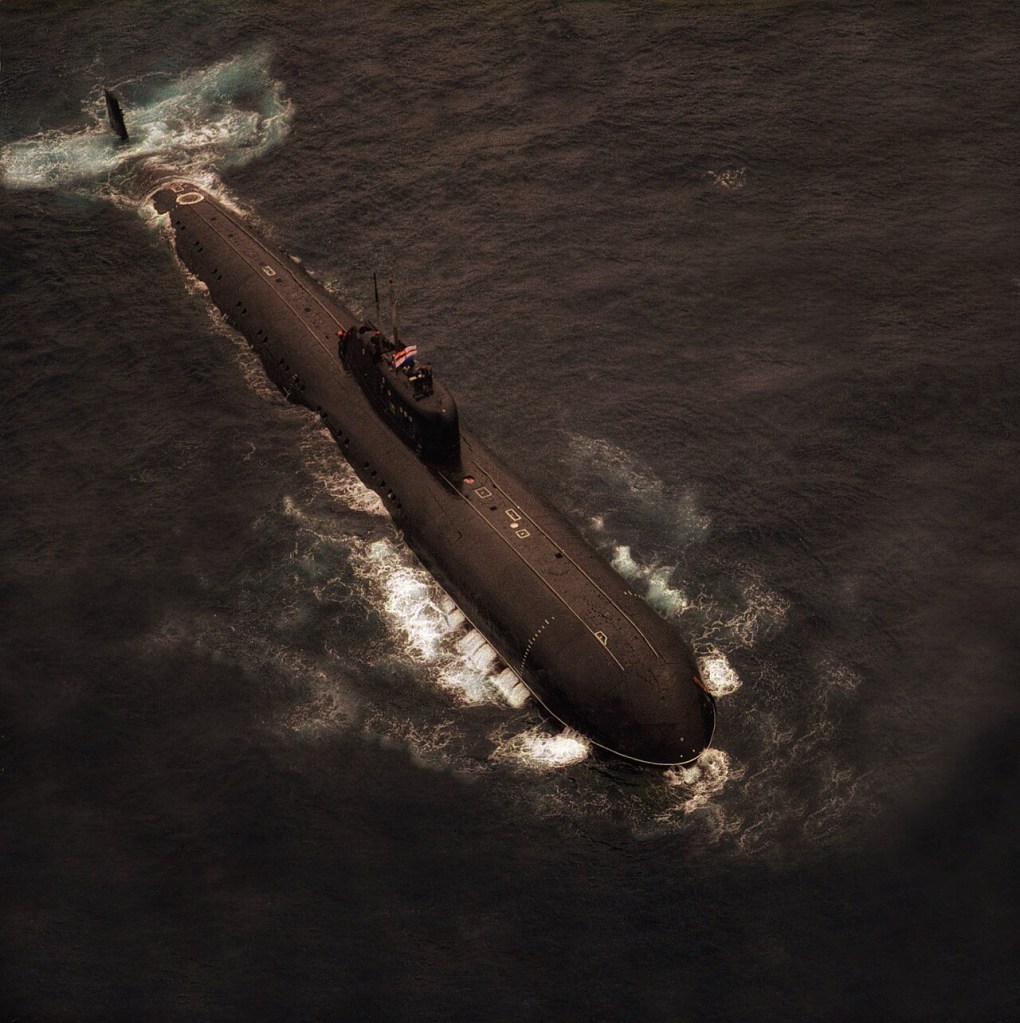
Tonight there is another prowler, a 6000-ton nuclear ballistic missile sub that had begun its service life in the Soviet nuclear fleet 20 years prior. At that time it had a no-frills name, ‘K-43’.

K-43 now has new name – INS Chakra – on a 3-year lease to India.

India is not actively engaged in the Sea of Japan and therefore the sub is making damned sure it isn’t deliberately quiet. It is doing a steady 22 knots, occasionally rising to periscope depth, to take a quick look-see and then diving back into the surreal haze.

Somewhere along, a Chinese Jin-Class SSBN had latched on and doggedly kept pace at 1500 meters, joined a day later on the surface by a North Korean OSA-1 missile frigate. Every time the Chakra came up to periscope depth, so did the Chinese.

It looked as though the roadside romeos were out eyeballing the new bride, while she was being carried in her palki through their mohalla.

The Indians could have taken evasive action of course, just to test the Chinese’s nerves, they could have dove deeper, maybe right down to the sub’s test depth, to see how far he would dare, but they didn’t take any chances.

———————-

Let me explain the diving depths on a sub. Depth ratings are the measure of a submarine’s ability to operate underwater, limited only by the strength of it’s hull. The pressure of the water outside increases by around one atmosphere, when you go down every ten meters. The deeper you plan to go, the stronger your hull must be.

The Test Depth – approximately 500 meters – is the maximum depth at which a submarine is permitted to operate under normal peacetime conditions and is roughly 80% of the Design depth. Your next-of-kin can sue the manufacturer or your country’s Navy if the sub implodes above the test depth.

The Design Depth – usually around 600 meters – is the maximum depth listed in the submarine designer’s manual, where it says that the designer cannot be held responsible for any hull implosions below this depth.

The Never-Exceed Depth – 700 meters, give or take – is the maximum depth beyond which a submarine is not allowed to operate under any circumstances. Beyond this depth, the hull’s integrity begins to be compromised. The welds start to give very very gradually, in microscopic increments, unknown and unseen.

The never-exceed depth is the very edge of the safe depth for the sub, beyond which you might have just enough time to recite the Lord’s prayer if you happen to know it by heart. Beyond this depth, you might but you are not likely to survive.

The Crush Depth – roughly 800 meters – is the depth at which it is certain that a submarine’s hull will collapse due to excessive pressure. Being a calculated depth, the crush depth is not always accurate. Submarines have been known to have survived even deeper and have risen, unscathed. But you don’t want to go there unless you are losing ballast and the torpedo tube hatches are breached or you are just plain suicidal.

The crush depth is also the point at which you start wishing you were a whale…….

A whale can withstand pressures of 200 atmospheres or more, easily. That is because its body is flexible, it’s ribs bound by loose, bendable cartilage, which allows the rib cage to collapse under pressure. The whale’s lungs too collapse safely as it dives. When it’s lungs collapse in a controlled manner, the air inside them is compressed, thus maintaining a balance between the inside and outside pressure. Sperm whales have been seen diving up to 2200 meters without breaking into a sweat. They have to go down to those depths to get at those yummy giant squid who live there.

The depth figures quoted above are approximate and refer to 6000-ton Charlie Class nuclear subs like the Chakra. If you dive and implode at 400 meters, I shall not be held responsible. The Soviets were never great at quality control.

If the sub does implode under the pressure, you will die, no question about it. Even though the human body itself is essentially water and virtually incompressible, it has too many cavities that won’t stand the pressure. The water will crush your rib cage and squish out your lungs and all the veins and arteries inside your body. Your bones will swiftly develop aseptic bone necrosis and your capillaries will fail. If the water is gradually breaching the vessel, one bulkhead at a time, the pressure on you will build up over 15 to 20 seconds. They say that your eyes will recede, the sockets having turned literally inside out after 7 seconds. A second or two later, your ear drums will implode. Air at sixty atmospheres will force its way through your rectum into your intestines stretching and blowing them apart, leaving a mess within that resembles fruit salad with papaya in it.

All in all, it will be a horrible way to die.

————————-

Soon after the Chakra exited the Sea of Japan and sailed into the South China Sea, the North Korean melted away, but the Chinese SSBN hung on. Two days from the Strait of Malacca, a Vietnamese Sigma-class corvette fell in but winked off after a while. Ten hours after it finally exited the strait and entered the Andaman Sea, the INS Dunagiri appeared over the western horizon, took a wide circle and joined escort for the home stretch to Vizag (Visakhapatnam, Indian Navy’s submarine home base).

A constant fixture whenever the Chakra rose to periscope depth was a P3-Orion, flying high above, in figures of eight. Alternating between its outer and inner engines, the 4-engined turbo-prop driven P3 can remain in the air for over 18 hours at a stretch, filming, eves-dropping, jamming and generally snooping around. And if its tanks are topped up by a KC-135 Stratotanker and has a relief crew, it can fly on non-stop for 36 hours, covering over 20000 kms.

Anyway, P3 or no P3, it was calm and sunny on the surface and the Indian Captain gave the order to surface again. Ventilation, even inside a snazzy new nuclear-powered sub, sucks. After a week you’ll be smelling nothing but dirty socks and farts. The chance to open the hatch and take a stroll outside is gold-plated. Everybody trooped up in turns, including Sasha Karimov and his crew.

Instead of utilizing the time stretching their legs, the Russians took turns jumping up and down, showing the large reconnaissance plane their middle fingers, while Karimov looked on indulgently and laughed. The ever-frisky reactor room technician, Senior Matrose, Ilya Suslov, even pulled his pants down and waved his sizable broggly at the plane. At 10000ft, the high-res cameras on the P3 must have recognized an adult commie penis being brandished at it.

The P3 stayed a long while. The Indians assumed it was an American out of the US military base in Subic Bay, Philippines(¹). Later on, the Dunagiri confirmed that the Orion had actually been an Australian from their TUDM Butterworth air base, off Penang.

The dogged pursuit from the Chinese SSGN and the tenacious shadowing of the P-3 were quite understandable. India’s acquiring a nuclear powered submarine was indeed a game-changing event and deserving of the attention. It was not surprising at all, considering the fact that never before had one nation leased out, not only a nuclear-powered submarine but also the technology, to another nation, with very few strings attached.

As a result of this trust, India is now only the sixth nation after the US, UK, Russia, China and France, to indigenously build nuclear submarines. At the time of writing this, it has already commissioned two of these subs and a third is on its sea trials – the Arihant Class nuclear ballistic missile submarine (SSBN).

—————————

Some nations see nuclear-powered submarines as their sole private reserve. India’s acquiring the Chakra was seen with alarm by them. It is a matter of record that the US President, Ronald Reagan, tried his damnedest to scupper the lease deal.

The US objections arose at a time of glasnost and perestroika, when it was becoming apparent that the Soviet Union was going to implode. There were many in high places at the Kremlin who were already busy putting spit and polish on their democratic credentials and checking on interest rates at banks on Cayman Islands and Zurich. At one point Kremlin seemed ready to back out and even barred the Indian naval personnel from boarding the sub.

That’s when India’s Rajiv Gandhi proved he had more than a bit of his mother, Indira Gandhi, in him. He personally moved Mikhail Gorbachev to re-engage and India finally got the Chakra.

Once the lease was a go, the international media began calling India “an emerging superpower”, “the new oriental bully”, “dark horse to watch” and so on.

That was perhaps the first time that India’s middle finger was up and waving saucily. Boy, did I feel proud.

—————————-

As the Chakra entered the Bay of Bengal, the Captain received an eyes only burst transmission from an IAF Beriev A-50 that had appeared four hours prior and was patiently circling overhead, at 41000ft (The P3 had realized it was by now too far from base and had turned back). The Beriev is basically a modified Russian IL-76 with Israeli Early Warning and Control Technology installed in it. The transmission was patched through by the Dunagiri.

A burst transmission is a spit of an encrypted digital recording that has been speeded up till it is only a fraction of a second long, like when you fast forward a video cassette. Instead of a two-hour long movie, the fast forwarded video tape zips through in around fifteen seconds. A burst transmission is more than a thousand times faster than even that.

At the other end, the receiving sub sends up a buoy with a receptor which catches the transmission and relays it down to the sub, where it is slowed down and decoded. The buoy is necessary because normal radio transmissions don’t travel easily through good conductors like salt water, unless they are very low frequency.

The message said that brass would be there at Vizag, to greet the sub. C-in-C, FOC-in-C East, FOCEF, the Soviet ambassador, Victor Isakov and submarine chief, Commodore Rajaram (Rambo) Desai – COMCOS(E). And the Minister of Defence, the honorable K.C.Pant. And the Prime Minister, the right honorable Rajiv Gandhi.

———————————

(¹) The Americans relinquished Subic Bay in 1992

The Bio-Hazard called “Deep Space” [Part-2]

“What is the next thing that can kill me?” Should be a constant question on every astronaut’s mind during a mission – Chris Hadfield, Canadian astronaut & ex-Commander of the ISS, in his book, “An astronaut’s guide to life on earth”

——————————

If you spin a bucket of water around your head fast enough, the water will never spill out. You have created a force to make the water remain where it is, inside the bucket, a force known as centripetal force. The same force, also called gravity, makes the earth go around the sun and the moon around the earth. It is the same physics.

Like the bucket of water, if you could make a spacecraft spin around its axis, you could walk along its inside walls with your feet rooted firmly, creating an artificial gravity and eliminating the risks of the debilitating physiological changes in your body touched upon earlier in Part-1.

For the spin-induced gravity to be practicable however, the spin speed & the radius of the spin have to be optimal. To replicate earth’s gravity, you are therefore looking at a very large tubular ring-like space craft, much like the one in Arthur C. Clarke’s “2001 – A space odyssey”. Engineering, transporting in bits and assembling such a spaceship in space has not yet been attempted, given the costs involved.

Such a rotating spacecraft will be able to vary that artificial gravity merely by changing its speed of rotation. There could a day in space, when you could tune your gravity through 9am-to-5pm, like adjusting a thermostat. You might spend your workday in microgravity. Then you might go for a jog or just rest in 1g. Maybe as you age and your joints start aching, you move to rooms in 0.75 g, where gravity is tempered just enough to put the spring back in your step. Senior living, in space.

Artificial gravity is still a fantasy, but one that is necessary. Till then, getting to Mars and back will most likely require living in microgravity for more than a year. This raises physical concerns: Will those astronauts be able to stand up when they arrive at Mars, whose gravity is one-third the earth’s? If they can stand, will they pass out? If they pass out, will they break a bone? And if they break a bone over there, will it heal as it would on Earth? 

—————————-

The first attempt, specifically designed to learn what could happen to a human body on a long duration mission to Mars, was made with American Navy Pilot and astronaut Scott Kelly, on the ISS.

The mission was a double whammy. Scott has an identical twin brother, Mark Kelly, a retired astronaut and now a Democratic Party senator from Arizona. While Scott Kelly went to space, a close genetic replica of him stayed behind. When he returned, researchers were able to compare the two men at a molecular level to see what had changed in Scott but not in Mark.

Scott and Mark Kelly as US Navy fighter pilots
Mark and Scott Kelly as NASA astronauts. Both flew four missions each to the ISS but while Scott stayed in space a total of 520 days (one mission lasting almost a year), Mark did just 54 days in space. At the end of his super long mission, Scott was two inches taller than Mark, a condition with his spinal discs that subsided over time and eventually brought him down to his original height.

———————————-

Space appeared to remodel Scott Kelly in subtle but significant ways. He suffered a small amount of DNA damage, believed to be caused by radiation exposure. Changes in genes are heritable, a feature that helps humans and other creatures pass on adaptations of themselves to their descendants.

Fortunately, as in the case of his spinal disc, these alterations reverted back nearly to their baseline state after Scott’s return, giving scientists a sense of which genes might be most impacted by lengthier stays in space. 

One of the most puzzling changes researchers observed was in Scott Kelly’s gut microbiome, the bacteria, fungi and viruses that live in the digestive tract. Their proportions in relation to one another had changed dramatically, probably because of all that freeze-dried, pre-cooked space food Scott ate. On long space flights, these changes affect digestion, metabolism and thus, immunity. Reduced immunity can be especially dangerous in space, where microgravity can make bacteria more resistant to antibiotics and more likely to cause serious infections.

Then there were the blood clots. Scientists once thought blood clots were unlikely to occur in the absence of Earth’s gravity and then one happened. In a 2019 study, an international group of researchers reported that the blood flow in the jugular veins of six of 11 ISS crew membersthey monitored had, by around Day 50 in space, either stagnated or reversed direction and one of the six had a potentially fatal thrombosis with no symptoms. Luckily, physicians had already stocked the ISS with a 40-day emergency supply of anticoagulants, just in case. 

———————————-

Space-medicine experts are adept at imagining dire situations. What if an astronaut develops appendicitis? If we go to Mars, you can’t pull a U-turn. Do you send a surgeon? What if the surgeon is the one who gets appendicitis? In 1961, a 27-year-old Soviet doctor, Leonid Rogozov, had to give himself an appendectomy at a base that he and a team of 11 others built in Antarctica. He did it by feel, after finding the inverted images in a mirror disorienting. Within two hours, he had removed the infected organ and sutured himself up. A helpful colleague snapped photographs for posterity

Space however, has major drawbacks. It is an environment in which doctors may be called upon to perform medical procedures with limited supplies of tools and support staff. Dr McCoy on the original “Star Trek” had a snazzy surgical suite. In reality, it costs over $10,000 per pound to put a payload into orbit, and anything that goes on the spacecraft must earn its place at the expense of something else. There’s a defibrillator and a portable ultrasound on the ISS, not much else.

Besides, major surgery could result in the patient’s insides floating out. Even giving injections in space requires comprehensive planning. In Antarctica, Rogozov could at least give himself Novocain shots as local anesthesia. In space, getting liquid into a syringe is complicated.

———————————

One of the weird traits we humans are born with is that the moment we find ourselves in a new environment — say, a mountain peak, an airplane toilet, a hot air balloon or the Everest Base Camp — we feel compelled to find out what will happen if we have sex there.

So it is on a trip in space. On a long duration mission, it is very likely that astronauts will feel horny and want to fuck at some point, either during the journey or at the destination. They might even get pregnant and have a baby in space. NASA does not yet have any guidelines that might become necessary to enforce for long duration space flight.

Should space travelers choose abstinence until NASA officially declares space sex safe?

More pertinently, is it possible that sexual intercourse has already happened in space and we don’t know it? Fewer than 700 people (men and women) have flown to space so far and we all know who they are. Sunita Williams has been a NASA astronaut and veteran of 608 days in space, two of them each almost 10 months long. There must have been days when she had been alone with just one hunky cosmonaut in the Russian module, while the other short-duration crews were being rotated. Could they have shtupped then? Nyet? Alas, we’ll never know.

It would be fun to learn that she did, though. I am imagining globules of semen escaping the telephone booth-sized sleep pod and floating around in the ISS, while the Capcom in Mission Control and the Glavni at the Russian TsUP (Mission Control Center) watch and chuckle in amusement.

But seriously, we do know some basics. There are good indications that sexual erection and lubrication are not inhibited in space and that microgravity does not subject contraceptives to leave any side effects. Behavioral scientists are, however, concerned about the morning-after crew dynamics. Could romance and/or adultery blossom aboard a spacecraft to Mars or Jupiter? Theoretically, of course it could.

——————————

What about the effects of loneliness and isolation in space on our psych and our health? Certainly these are expected to be more significant, the longer a mission lasts. Being in space is like the pandemic lockdowns many people experienced in 2020, except you can’t open a window or take a walk outdoors. And the farther you get from Earth, the more time lapse there is between your sending a message and your loved one back home receiving it. On Mars, the wait time is 20 minutes, one-way. On Europa, one of Jupiter’s moons, a favourite space destination aggrandized by sci-fi writers, it is approximately an hour. 

In 2014, NASA issued a report, “Examining Psychosocial Well-Being and Performance in Isolated, Confined and Extreme Environments,” that considered data from submarines, underground bunkers and polar expeditions. It also detailed how career competition and differences in personality, values, culture and language derailed a 105-day ISS simulation in 1999, in which a crew occupied connected hyperbaric chambers. A physical fight broke out among two of the crew members, a sexual-harassment incident was reported and one protesting crew member withdrew from the study.

In an earth-bound simulated spaceflight, an individual can simply say ‘fuck it, I’m done” and walk out of isolation, but in a real mission escape or mission termination is not an option. Space voyagers will have to learn to get along, for the success of the mission.

—————————-

And then what about depression, caused by acute home sickness? Those of us who might one day leave earth for good, won’t we miss it? Are we capable of fully casting off our home planet that had nurtured us and leave our loved ones on earth forever? Or could we become the very extraterrestrials that we have fantasized about for so long, stranded on a strange planet, wailing plaintively, “ET go home”?

We are humans. One way or another, we are going to finding out.

The Red Lotus with the Blue Leaves

Ma

It’s 5.08 on the dashboard clock. Bertha is purring along quite contentedly. She has just had a drink at the Shell resto-bar at the corner of Perrot and Grand. 87 octane, Bertha isn’t finicky. She appreciates the fact that I froze my butt off filling her up.

Bertha is my Corolla. Cars are female. Trucks are male. Yeah.

I didn’t have to pick up Pierre, my carpool partner. He is vacationing in Punta Cana, the sumbitch, while my tootsies are below zero.

I’m a little ahead of time and therefore I probably won’t be seeing Tommy this morning. When I’m on regular schedule, Tommy usually appears out of the gloom, running so close that it feels as if I could touch him if I reached out. Of course it only seems that way.

After keeping pace for a while, Tommy speeds up and heaves himself onto the Mercier rail-road bridge with his kids, the cylindrical tanker railcars, ‘PROCOR’ emblazoned on them between the image of two tilted barrels of oil. They sway and nod at me as they follow Dad onto the upper tier of the bridge.

Up ahead, the sun is just beginning to play hide and seek through the lattice work of the bridge girders as it starts peeping over snow-bound pine forests of the Kanawake Indian Reserve on the south shore of the St. Lawrence.

It is white everywhere, as far as the eyes can see and the temperature on the dashboard says -22°C and that’s without windchill. The blazing tunnel of Bertha’s headlights is losing its stark contrast as the gold of the early sun bounces off six undulating lanes that reach into eternity.

At this point, others would start thinking of stuff that they have planned for the day – the meetings that are scheduled, assholes to sweet talk to, bosses to badger, what’s in the menu for lunch at the cafeteria, how low Pierrette, it’s big chested counter-girl, will be slung, etc.

Me, I’m not made that way. I slip into a reverie, this time my mind traveling back to engineering school, studying for my Bachelors, 1976…….

“Take the No.170 bus from the Shyambazar crossing. If you tell the conductor ‘matri asram’, he’ll drop you off right there at our doorstep. They know. Keep an eye on your bag. Hold it on your lap. Don’t get off to stretch your legs when the bus stops on the way, ok?”

It was Ma, her tone conversational, her directions written on the postcard I received that Friday morning, the week before my engineering school closed for summer. I remember the postcard clearly. The lotus that she always drew on the back of her postcards, on the side that had the space for the address. Postcards are defunct now. No one writes postcards anymore.

The leaves on the lotus on Ma’s postcards were always blue ‘sulekha’ ink and the lotus itself, red. She didn’t have green ink and she liked blue, she once said. Below the lotus, in her dear flowing handwriting, calm and assured, as if the wisdom of centuries was bestowed on her, were the words,” Amar Jobbu shona ke” (to my darling Jobbu).

I remember that summer in 1976. I was going to stay back in my engineering school dorm. Like all the other summers. Going home, if I could define what really was home, was just too much of a hassle. There was my father with his family. And there was Ma, by then a sanyasini (Hindu nun), in her asram. Dada (eldest bro) was struggling to settle down in his first job and Chorda (bro number 2) was tucked away in a dinghy hostel in central Kolkata, because his father couldn’t stand the sight of him.

It was one late evening a month earlier, very late, maybe around 2am. We had Turbomachines finals the next morning and all the guys in the dorm had their doors shut, desperately trying to cram up as much as they could. I was trying to focus on a grainy black and white photo in my text book, of the vortex at the exit of a turbine and my eyes fell on the family photo on the shelf right next. I remember suddenly feeling the urge to go see Ma that summer, instead of just sitting on my ass in my dorm room. I had never been to her asram.

A month of correspondence followed and here I was, holding her postcard with the detailed directions and the lotus.

Earlier, Subbu from Metallurgy had lost the toss and made the trip to the Madras Central Station to get the reservations (he had to be persuaded with a Len Deighton from Higginbothams’, I think it was ‘Bomber’. Subbu loved Deighton. I couldn’t stand Deighton.

I won’t bore you with the trials and tribulations of travel in the searing heat of 1970s India. Ma’s directions however had been platinum plated. The Uttamananda Matri Asram (Uttamananda Convent for women) was set in a leafy patch at a spot where the GT Road runs parallel and just yards away from the banks of the Hooghly, the asram itself nestled in between. As the bus no.170 slowed to a stop, I made out the solitary figure leaning over and peering to read the number board of the bus. She was swathed in a ‘thane’ (no-frills saree), dyed saffron, and a coarse cotton blouse, also dyed saffron. She looked frail.

As we walked into the waiting hall of the asram, I noticed the slight limp. Turns out, she’d just returned from ‘mushthi bhikhkha’. She and a few other inmates were helping run a girls’ orphanage where she managed the administration and taught English, Maths and History. To raise funds, she would cover the surrounding towns and villages, collecting alms for the orphanage. Non-perishable stuff like grain and clothes.

The Marwari grocers were the most generous, she said. “Aao Maji, Aao, baitho tho thori der. Itna garmi. Chai piyogi, thanda? Arey o Kanhaiya, zara ek glass pani la idhar, Maji ayen hain.” They’d hand her a small basta(bag) of rice or atta(flour). She’d sit a while catching her breath and be on her way, the bag slung over her frail shoulders. The travel was almost entirely on foot, on Hawaii slippers (flip-flops). She’d twisted her ankle on her last jaunt. It was now better, she said, dismissively.

I strain to remember that day. Time flew. Ma had prepared alu posto, kacha lonka diye, korayer dal and fulko rooti, on the small kerosene stove she had in her tiny ground floor room. I’d love to translate the menu for you into English, but right now the words are coming out in a gush and somehow I don’t think it matters.

Afterwards, we sat at the riverside on some stone steps that led into the river and watched as a small freighter made its way up the river. We were quiet. We both sensed that the time had come for me to leave. Ma reached across and hugged me and it felt the same as it did when I was little and came back home from the soccer field in Allahabad after school.

Then, very quickly she released me. The first step in being a Sanyasini is shedding all attachments, even personal ones. It had been, what, 10 years? She was still trying , I guess. It is hard not to hold and hug your own son, especially when you meet him approximately once in a year.

Ma stared across the dark waves at the freighter just when it sounded its Klaxon. “Gaye ki lekha bol tho, Jobbu?” (Can you read the name of the ship, Jobbu?).

I turned and took her frail body in my arms and hugged her. She tried to resist but gave up and sank into my arms. And there we sat, mother and son, and let our sobs mingle with each other. Mine demanded ‘why? why couldn’t I have had a childhood like everyone else?’ but of course, I left them unspoken. Over the years I have come to terms with it. I have realized I have it better than most. But at that moment it was all that came to my mind.

And Ma, what was she thinking as she hugged me? I have no idea what her sobs actually meant. Guilt? At having left us? I had always resented her leaving us. I had chosen not to see what my father had done to her over the twenty five years that they had been together.

Was it despair that I saw in her eyes as she wrapped her frail arms round me? Despair, that perhaps she wasn’t going to achieve what she had set out to achieve? Those questions popped in my mind then but over the years, as I have matured I have that realized Ma had achieved more than I shall ever achieve. She had led her life by the book. The way the Amish live theirs’. True to her faith. True to the innermost voices of her conscience.

Is this why I hate religion so much? Why I am an agnostic?

The bus back was not due for another hour. At the point of parting, the conversation always turns inane. The closer you are, to the one you are leaving behind, the more meaningless the words get. I have had meaningless words spoken to me ever since I went into boarding school at 12.

The freighter suddenly blew its Klaxon twice, don’t know why, there was no traffic on the river. Maybe it just wanted to say,”Phew! Home at last”.

“I’m not sure…… I can’t read so clear”, I said in reply Ma’s question about the name on the ship’s hull. Reading anything through tears can be dicy.

We sat there till the sun dipped over the sal forests on the opposite bank.

The Cretaceous–Paleogene Extinction Event – Episode : 2 – Morning of Impact

“The world’s geological strata are like a book that is missing some pages and chapters, paragraphs, sentences and words, leaving us to piece together the narrative from isolated parts. Some of those parts tell stories richer in detail than others…”

– Charles Darwin

The dinosaurs met with what is known as an Extinction Level Event [ELE].

Usually ELEs happen over a protracted period of time, like over 500,000-1,000,000 years. A million years might seem like a long time but in geologic time scales, it is like 10 minutes. In comparison, the dinosaurs got wiped out in just 33000 years and that’s like a microsecond.

There was a far more devastating ELE, 200 million years prior to the dinosaur wipeout, when a chain of super volcanos erupted in the northern Siberian region, at a location now known as the Siberian Trap. For a mind blowing 2 million years, the super volcanos kept on erupting and by the time they fell silent, 95% of all life on earth had perished, leaving behind a vast expanse of bare volcanic rock the size of Mongolia.

The Super Volcano eruption is known as the Permian-Triassic Event. It formed the boundary between the end of the Permian Age and the start of the age of the dinosaurs.

—————————

Interestingly, this very spot – the Siberian Trap – was the scene of the world’s deadliest man-made thermo-nuclear test detonation in 1961, when a Soviet Tu-95V strategic bomber dropped a 27ton device from a height of 30000ft. Soon as it crossed 13000ft, the bomb exploded automatically with a force equal to the explosive force of 58 million tons of TNT, registering an earthquake of a magnitude of 8.5 in the Richter scale and shattering windows in Norway.

Tsar Bomba | Kuzkina Mat – Its ‘hat’ reached up 67kms

Prior to the detonation, the then Soviet leader, Nikita Khrushchev, had given the bomb the nickname “Kuzkina Mat” (Kuzka’s mother). Earlier in 1954, the Americans had tested their most powerful fusion bomb “Castle Bravo” that yielded 15 Megatons and in a phone call to the then US Vice President, Richard Nixon, Khrushchev had derisively called the bomb, “Kuzka” (pipsqueak)……

“That’s it? Wait, we’ll show you Kuzkina Mat (Kuzka’s Mother)!” Khrushchev had thundered over the hotline.

I wanted to tell you that the Soviets built another, far more powerful 100 Megaton device that they wanted to drop on China, their then mortal enemy, but they decided not to. Khrushchev had already given it a name – Kuzkina Tetya (Kuzka’s Aunt).

But I am digressing.

—————————-

Let’s get back to where we left off in Part-1 ….

The trigger for dinosaur extinction became a matter of hot debate among geologists, geophysicists, palaeontologists, geochemists and paleo-climatologists through the late 19th and 20th Century….

“It got too hot”, some said. “No, it got too cold”. “Maybe a terrible disease ripped apart the dinosaurs’ lives.” “Nope, it must have been sea level rise.” “The herbivores ate up all the vegetation and starved and since they died, the carnivores had nothing to eat.” “The furry mammals stole and ate all the dinosaur eggs”, “Who said 33000 years is sudden?”

The debate went on and on, but two things are certain – something terrible and sudden had befallen the dinosaurs. And 33000 years is an instant in geological age terms.

Then, in 1980, it all began to become clear. Battered crystals, prehistoric soot and a highly dense, corrosion-resistant, very very rare metal called iridium were discovered at the exact geologic strata as the dinosaur fossils. Iridium is so rare that in 2023 only 6 tons were mined and refined from ore in the whole world. But on asteroids, it is a thousand times more abundant for some unknown reason.

The high concentration of iridium made it highly likely that some extraterrestrial object had slammed into our planet. The battered crystals and soot were deemed to be the product of the impact.

Then, in 1960, scientists working for the Mexican state-owned oil giant, Pemex, discovered a massive 186-mile wide impact crater lying across half of the Chicxulub landmass and the sea bed under the Gulf of Mexico, in the Yucatan Peninsula.

It wasn’t until 1990 that researchers were able to link the Chicxulub crater to the Cretaceous-Palaeogene asteroid impact, the ELE that killed off all the dinosaurs.

——————————

Back to 66 million years_BC….

Scotty the T-Rex doesn’t see it coming. Neither do the pterosaurs. All that they notice is that it has gotten suddenly very quiet. Everything, all movement, seems to have frozen in place.

A chunk of the dead triceratop’s arm still attached to his teeth, Scotty straightens and raises his savage eyes up to the skies with a kind of “what the fuck was that” look.

A mile away on the other side of the swamp, a frisky juvenile Edmontosaurus is itchy as hell. He wants a scratch badly. Those mother fucking bugs are annoying him.

Yeah, as dinosaurs have evolved into massive beasts, so have numerous tiny parasites and bugs multiplied, benefitting from all that dinosaurian real estate to bite into.

There is a beech stump nearby that is just the right height, its bark unnaturally smooth and polished. It has probably been rubbed by other dinosaurs seeking similar relief. The hadrosaur raises himself on his two hind legs and begins scratching vigorously, his pleasured grunts saying, “ Ah, that sure feels good.”

The rubbing causes gooey sap to begin oozing out here and there through the bark, which after a while will harden solid. Someday, in another 66 million years, the goo – now rock hard and an unnaturally transparent reddish orange – will be prized out of the basalt 65 ft deep. A few will have tiny fossilized millipedes trapped inside, clearly visible, dead for 66 million years. The rock-hard fossils will be carefully shaped, polished and sold as amber for $150 USD an ounce.

After a while, the young hadrosaur lets out a satisfied honk and drops back on his four three-toed feet and ambles off into the thicket to catch up with the rest of the herd. He is still young, unaware that he lives in a landscape of fear. He doesn’t realize that he must remain within the shifting territory of the herd. Perhaps one day he will feel Scotty’s 8-inch long fangs sinking into his neck and realize it is too late.

The small herd of 20 is calm as it grazes on open ground, a light breeze mussing the fluff on back of their heads. There is no sense of impending doom, no shifting of winds, no darkening of clouds, no thunder or lightning. In this little patch of Frenchman River Valley, all is as it has always been for those dinosaurs.

—————————

But more than two thousand miles to the south a piece of rock has just slammed into the earth at close to 72000 miles an hour. It began its journey as a part of a much bigger rock from a distance of 75000 Au, deep within the Oort Cloud. 1 Au (Astronomical Unit) = 93 million miles or the average distance of the sun from the earth.

This artist’s impression of solar system distances puts the origin of the rock, Oort Cloud, in perspective. The scale and the graduations are distances from the sun in AU (Astronomical Unit, ie: Average distance between the sun and the earth – 93 million miles)

————————-

That one rock, initially 55 miles across, travelled across the darkness, randomly gaining speed and trajectory through multiple ‘gravity assists’ from the pushes and pulls of Pluto, Neptune and Uranus and their moons and sundry asteroids it passed, until it reached the vicinity of Jupiter when it began being drawn into the gas giant’s orbit.

But the rock resisted, its speed too high for Jupiter to ensnare it and that is when big daddy (our Sun) intervened, it’s invisible pull beginning a tug of war that blew the rock apart into multiple small bits, most of which were too tiny to resist Jupiter’s gravity and ended up plunging into Jupiter’s thick hydrogen soup, lost forever.

There was this one fragment, 7 miles across, that still had enough momentum to flip Jupiter the bird and continue on, drawn toward the centre of the Solar System. It had some scary close calls with the asteroid belt and also when it flew by Mars 100000 miles from its surface, but by now it was zipping at 200000 miles an hour, a speed too high for its mass to be captured by the Mars gravity.

The rock fragment continued on and would have gone straight through to disappear forever inside the Sun’s corona and been reduced to fine ash, incinerated by the 500000°C heat.

But it didn’t. Fate placed the third planet from the sun in the rock’s path. Here is where things went horribly wrong. Or should I say, right? Bear with me…

Had the rock been flying in the same direction as that of the earth’s orbit, it would have received a gravity assist and swung out into outer space in a random direction that depended upon its orientation at that moment. Like a sling shot. The earth would have been saved and dinosaurs would continue ruling it, until evolution deemed changes necessary.

Unfortunately for the dinosaurs, the rock was speeding in a direction opposite to the direction of the earth’s orbit. It struck the mesosphere with an explosive bang and glowing red, shedding little bits of its outer layers, it flew far above the Siberian forestland, its speed now 65000 miles an hour. There has never been any feel or comparison of 65000 miles per hour, a speed so fast that it is almost unimaginable.

How does one imagine an object covering 20 miles every second?

With cold indifference, the rock continued on in a south-westerly direction high over the Norwegian Sea, Northern Europe and the North Atlantic, before finally ending it all, coming in at an angle of 45° to the horizontal and slamming into the Chicxulub region of the Yucatan Peninsula with the force of 100 trillion tons of TNT. Three-fourths of the impact location is now under the Gulf of Mexico.

The force of the impact was nearly 2 billion times greater than Kuzkina Mat.

It had been a long voyage, taken the celestial wanderer 1595 years to get to earth from its home base in the vast Oort Cloud.

—————————————————————————

Earth

Frenchman River Valley, Saskatchewan, Canada

66,050,000_BC (+\- 500,000)

Ambient : Max +49°C / Precipitation 95% / Humidity 85%

———-

At Frenchman River Valley, two thousand miles to the north, this moment has gone unnoticed.

The Edmontosaurus herd is searching for some shade trees and an afternoon of siesta. Maybe they’ll take a mud bath later some place along the coastal plain.

It is the same everywhere in Europe. A Quetzalcoatlus Northropi , the largest flying bird on the planet, is heading home. Not that he believes in the concept of a permanent residence. For some strange reason, he just wants to get back to where he was born, a fern covered flatland in northern Norway where, millions of years later, there will breathtaking fjords and snow-covered slopes.

In the eastern end of Russia, there is a land bridge that connects to the American mainland. This land bridge will emerge and submerge many times over the earth’s geologic history. 66 million years from now, it will be submerged, under a 55-mile wide body of water known as the Bering Strait.

Today the land bridge is a dinosaur migration highway of sorts. Right now a 6-ton Torosaurus, a usually gentle herbivore, is ambling across the land bridge in search of a male to mate. Today she isn’t her usual self. She is horny and she is dangerous and unpredictable when she is horny. Even Scotty would give her a wide berth right now.

All’s well in the world.

———————————

Watch out for Part-3 … “The Lost Cretaceans – Impact”

(Not now, silly. It’s isn’t written yet).

The Cretaceous–Paleogene Extinction Event – Episode : 1 – Day Before Impact


66.05 millions years before they found him in bedrock and named him “Scotty”, he topped the food chain.

——————-

Picture yourself at the edge of a swamp that is ringed by huge magnolias and conifers and ferns. The ground is a fetid, mushy muck with the stench of incessant rain. It is unbearably hot and you have found respite in the downpour.

66,050,000 years from now the ground you are standing on will be known as the Canadian province of Saskatchewan. It will no longer be tropical then.

You will be discovered by a tiny creature, a member of a yet-to-evolve species called ‘homo sapiens’, a school teacher and amateur paleontologist who will notice one of your well-worn teeth the size of his wrist, poking out of exposed bedrock and start carefully scraping, until he and several of his associates gradually unearth your whole carcass.

They will name you, “Scotty”.

They will estimate you to have been 62 ft long and just below 20 metric tons in weight and they’ll be pretty close. They will create a species name – Tyrannosaurus Rex, ‘tyrant king’, which is what you are at this point in time – the largest, most ferocious, most deadly, utterly brutal of all living beings. Every single creature on the planet is below you in the food chain.

You will not be the only one that the school teacher and his associates and researchers discover there. Over the next ten years they will find scores of other species, cemented deep within sandstone and bedrock, all within a 1000-sq.mile area that will acquire the moniker – “Dinosaur Alley”.

But let’s not get ahead of ourselves. Let’s see what’s happening with you right now…..

Directly ahead of you is a shallow pit, half filled with rain water and in it is a very large heap that is making a guttural sound while it jerks and shakes. It is covered in large thick scales and has a massive head that has a sort of shield jutting from the back of its skull. Over each eye is a long horn. Another smaller horn juts up from its snout. It has a parrot-like beak great for snipping at branches.

There was a time when the beast had been the haughty alpha male, too full of itself. Now it lies minutes from death, consumed by a cancer that has spread through it’s guts. As is the law of it’s society, the others have abandoned it and moved on.

The barely alive beast will be known in another age as a ‘Triceratops’. Swarms of flies buzz around its still nose, waiting. Also waiting, perched on some branches high up, are a squabbling gaggle of winged scavengers, deadly pterosaurs, kind of like storks with bats’ wings. They are the very first vertebrates to fly.

All day long, the pterosaurs had been riding the thermals and now they are ready to hop onto their lunch, the triceratops’ carcass. It is a sumptuous buffet, all 10 tons of it and over the next two-three days it will be picked clean.

But right now they are all waiting for the capo-de-tutti capi : you, Scotty the T-Rex, to do the honours. They are wary of you. They are well aware that their flying skills are of little use on the ground and that if they come within reach, you will transform them into a side dish. So, they’ll simply wait for you to have your fill. You will pierce the triceratops’ scale armour and lay the innards bare, making it easy for them to dig in after you are done.

——————————

You emerge from behind the tall conifer and your powerful hind legs propel you forward toward the now deceased herbivore. The pterosaurs scatter hastily and watch from a distance with cold mirthless eyes as you sink your huge fangs in, rip apart the dorsal scales and scoop out a large chunk of flesh which your tiny hands hold on to while you gulp it down, not bothering to waste time chewing.

Every time you open your huge jaws, a terrible stench rises from your mouth. It is not just the odor of rotten flesh. Barely visible under your large tongue are lesions, birthplaces of microscopic parasites that are gradually burrowing through your jaws. You had inadvertently picked them up from a hadrosaur that you had dined on. In time, the parasites will eat through your throat and jaws until it will become impossible for you to eat anything, much less hunt, leading to your demise. But that is still a long way off.

—————————-

You are so absorbed ripping pieces of the triceratops’ front thigh, that you fail to notice a streak of blinding white light appearing in the sly, far to the south. One instant it lights up the entire southern sky and the next, it is gone.

You have no way of knowing that that flash was a piece of extraterrestrial rock 7 miles across entering the earth’s atmosphere at 72000 miles per hour. In the next ten seconds, it will slam into the earth two thousand miles to the south with a kinetic energy equivalent to 100 trillion tons of TNT and leave a crater 186 miles in diameter and 12 miles deep.

The rock will become known as the Chicxulub Meteor and it will impact the earth at Yucatan, present day Mexico.

The last time a big rock hit the earth, it was 180 million years prior. The Wilkesland Meteor was a much larger rock (around 30 miles wide) that left a crater 300 miles in diameter under the Antarctic ice sheet and wiped out almost all life on earth.

In comparison, this one is smaller but that is little consolation for you.

—————————-

This deadly stone has not suddenly appeared out of nowhere. It has its history. It had been zipping through space over the millions of years that you and your ancestors lived and died and evolved. The making of this moment started long ago, millions of miles away, through chance events that stacked up one on top of the other, with a deadly finale that can be understood only in retrospect.

It began in the cold, dark, lifeless space just outside the Solar System, in a region that is like a scrapyard where asteroids, comets and meteors are born, out of millions of small rocks that are collectively known as the Oort Cloud.

(Next : The Morning of the Impact)

Ugh! The Second Comers

“….Surely I will come soon. Amen.” (Book of Revelation 22:20). It is the quintessential thick guttural Arnold Schwarzenegger promise….”I’ll be back”.

—————————

Although Christ’s Second Coming is mentioned in multiple places in the Bible, the specific line mentioned above appears somewhere in the closing pages of the Bible.

In the quote in the caption above, Just who is “I”? Jesus? If yes, there’s so much that I want to say to him. Like for instance…..

“No, thanks, pal. If you make a second visit, here’s what will happen – you will leave with your work unfinished, just like the last time. The number of screwball evangelists and pedophile priests will only multiply after you are gone.”

I shudder at the thought of more Mike Huckabees, Roy Moores, Mike Pences, Jerry Falwells and other faux Christian raving lunatic nutjobs, creeping out of the woodwork.

Besides no one speaks Aramaic anymore, Dude. We won’t be able to follow your hubba hubba hubba. And then again, what exactly will your mandate be, the second time around? Surely you won’t be parroting the same old ten commandments? Heck, half those commandments do not even qualify as crimes in the penal code anymore. 

Take a look at the commandments. The ones on killing and stealing still make sense, but the rest – like adultery or the one about coveting your neighbor’s wife, his house, his pets and his grain – relax, times have changed – these all du jour now. We can do them and with gusto and be just fine. Everybody covets everything nowadays. 

It is in fact all covet, covet and more covet now. There is no law against thinking of grabbing something, which is what coveting is. Barring my first ten years on earth, I have covetted female body parts all the fucking time and I swear I have never been struck by a bolt of lightning. That includes Donald ‘low-life’ Trump. Remember him mentioning something about grabbing them by their….. sheesh, what’s the word, the one about kitty cats?

Furthermore, things have changed quite a bit since the last time you were here, dude. Those days ground zero used to be a tiny 4000-sq.mile fertile crescent around the shores of the eastern Mediterranean and you thought that was the entire world. Well, I have news for you – it has grown a whole lot larger and far more complex. There are other hustl…I mean messiahs, now. The do-gooder that you are, you will run afoul of the establishment pretty quick.

Hey, Jesus, you’re the world’s champion ‘run-afouler’. You’ll be in trouble the moment you open your mouth ta speak, I am definite about that. I’ll level with you – things are much worse than can be imagined, way beyond any messiah’s intervention, trust me on this. 

More significantly, we enjoy sinning. We have realized that no matter what we do, no matter how virtuous we are, we are still going to be screwed anyway. Hey, there are some of us who don’t even get the opportunity to show off our virtuousness. We are fucked the moment we are born, no kidding. Like the baby with fetal alcohol syndrome. Know what I mean?

We now understand that the ancient concept of sin->mea culpa->punishment->redemption is nothing but shitty myth. So, we don’t want you parachuting in to spoil all the fun. Just do yourself a favor and cancel your trip, get the fuck outa my face, bro. 

Then there is the “soon” in that Bible quote below the pic. Just when is soon? If you absolutely insist on a second coming, don’t make it soon, please. Wait until maybe 3500AD. I and any surviving reincarnations of mine shall definitely be dead by then.

Don’t wait till 4000000000 AD. That’s about the time the sun will grow into a red giant and engulf the earth. Even you, a messiah, won’t be able to stand the 5 million degree heat. Messiah or no messiah, you’ll be toast. It all depends on your “Dad”, I guess, doesn’t it?

And try not to pick that same eastern Mediterranean fertile crescent as your landing site. Believe you me, they don’t like you in that joint anymore. They might even crucify you a second time over there. It hurt like hell the last time, remember? Wait till you see how it feels this time!”

————————————

I feel good about my harangue. The other two Abrahamic religions also mention a second coming, though with tiny variations. Islam says Jesus will come down and defeat ‘Al Masih al Dajjal’ (the false messiah) and restore Islam to “the Mahdi and his followers”.

I shudder at the thought.

Of the three Abrahamic faiths, Judaism seems like the only one where events have overtaken the second coming and already achieved what the second comer was mandated with – the establishment of a separate Jewish homeland.

It is done! With brute force and American support. The remaining thing on their to-do list is the rebuilding of “The Temple”, whatever that is. Why is this a thing at all? They can build whatever the fuck they want, can’t they? Turn Gaza into another French Riviera like that low-life, Don T, suggested?

—————————-

The only faith that doesn’t scream “second coming” is my erstwhile religion, Hinduism. Erstwhile, because I have stopped believing in the BS that is organized religion.

Still, Hinduism is the simplest to understand. It does not believe in labels. Good and bad, right and wrong, these are seen by Hinduism as pointless. Hinduism simply tells you what the consequences of your actions will be, in a very non-judgmental manner. It lets you choose and does not require you to be “God-fearing”. How can someone you fear also be someone you love?

Hinduism has no list of ten stupid commandments, no day of reckoning, no gotterdamerung and no apocalypse being anticipated with bated breath.

I know why. Hinduism has no fucking messiahs.