The Shakespearean World of Blood and Gore

“Hold thee my sword, while I do run upon it. Wilt thou, Strato?” – Brutus, defeated at Philippi by the forces of Octavian and Mark Anthony, to his loyal servant Strato (from Shakespeare’s “Julius Caesar”)

I’m 68 and I can see myself approaching the point where one asks himself, “Is this all there is to it?”

I would like to plan well ahead and be able to choose the way I wish to die.

I have the modus operandi down to a T. Its my Glock17. I keep it cleaned and oiled at all times, tucked away in a recess in the wall behind the dryer. Once every six months, I replace the rounds with fresh ones after a stint at the range. It’s a semi-automatic, loaded, with the safety off. I don’t even have to cock it. All I have ta do is press the muzzle to my temple and squeeze the trigger. One round will end it all. Quick and painless.

I want to be cremated, nice and easy. No wake, no funeral, no eulogies, no signs left of my existence except for a fistfula ash. I would like there to be a party though, with topless waitresses, so scantily dressed that you can count the cotton molecules in the fingers of yore hand.

————————-

One way I won’t want to go is by running myself through with a knife or sword to my stumik. Man, that’s a slow, excruciating way ta die. The blade will slice effortlessly into my small intestines and if I twist it this way and that, it will tear apart my spleen, liver and kidneys, causing massive internal hemorrhaging. If the blade didn’t find my abdominal aorta, it’ll take me a long long time to die.

Only schmucks want to run themselves through.

———————-

It was different in ancient Rome, however. If you were a military commander facing defeat, you’d probably be looking at running yourself through as a viable option.

In the case of Marcus Junius Brutus (the ‘et tu Brute’ guy), this was 43BC and he believed it was the only honorable thing left to do. His forces had just been routed in the Battle of Phillipi.

Running through, impaling oneself by his own sword or spear, conveyed a sense of chivalry and was regarded as the signature of a true hero in a world that hated pussies. Not killing oneself, trying to make a run for it, would make the vanquished seem cowardly. He would be derided and shunned and that was just about the worst thing that could happen to a man at the time.

Either you won or died in battle. There was no third ground.

So, there was Brutus in 43BC, reclining inside a tent outside the Macedonian town of Phillipi, defeated. His comrade-in-arms, Cassius, had already taken his own life by, you guessed it, ordering his personal slave to run him through. A year had passed since the two, Brutus and Cassius along with others, had murdered Julius Caesar.

Brutus tried one last thrust. He combined his and Cassius’ forces and tried to fight the Triumvirate (Octavian, Mark Anthony and Lepidus) but he failed. Now his ass was grass and the choices were limited. He could gather a legion and a hundred slaves and flee east to some far flung province like Parthia (present day Iran) with very fragile Roman control. Or he could stay put and face Roman justice for capital murder – execution.

Today, executions in most of the developed world are humane. They could be by lethal injection, electrocution, hanging, the gas chamber or a firing squad, but they all have one thing in common – death comes in seconds. One minute you’re there and the next, you’re gone. Within the hour, you are in an unmarked prison cemetery plot and in a year you’ll be raising the daisies.

By contrast, ancient Roman methods of execution were exotic. They could chop you up alive, a little at a time. They could make you sit on the tip of a sharpened wooden stake that was stuck vertically in the ground and let gravity do the rest while they eagerly waited to see it appear out of your mouth. They could prise your jaws open and pour molten lead down your throat.

They could crucify you. It’d you a week to die, give or take. Crucifixions were slow – five to seven days of starvation combined with the unbelievable agony of being nailed to a cross, your weight trying to tear flesh at the nails. Do you think Jesus or Spartacus would be the heroes that they are today, if they had simply been poisoned? Naaah.

Or they could simply tie your extremities to two horses facing in opposite directions and mercilessly whip ‘em till they tore you apart, at the weakest spot – your waist.

Running through was a dream compared to the above.

—————————-

Which brings us back to Shakespeare and Brutus’s suicide. Sure enough for his slow and painful demise, Brutus was lionized even by his vanquishers. After Strato broke the news of Brutus’ suicide, Mark Anthony was all teared up and had this to say –

“…His life was gentle, and the elements So mix’d in him that Nature might stand up And say to all the world,”This was a man.”

Octavian – later to be Rome’s first emperor, Augustus/Octavius – didn’t want to be outdone by Mark Anthony’s eloquence, so he held forth….

“…With all respects and rights of burial. Within my tent his bones tonight shall lie. Most like a soldier, order’d honorably…”

If instead, Brutus had swigged down some hemlock and croaked, the very same Octavian would have said derisively, “Chuck the SOB into the Tiber and lets get the hell outa here. I don’t want to be late for tonight’s orgy. Those broads I got from my Macedonian campaign can really give head.”

What’s with this hullabaloo about the most honorable way to die? If you’re dead, you’re dead, that’s it. Beats me why you would give a fuck how the rest of the world saw you based upon the way you died.

——————————-

Getting back to Shakespeare’s penchant for gore, his work is replete with mayhem and that’s because Elizabethan audiences reveled in gore. While a good comedy once in a while didn’t do any harm, the 16th century English folk overwhelmingly went for treachery, debauchery, deceit and fountains of blood.

Violence was the primary reason why Billy Shakes became so famous.

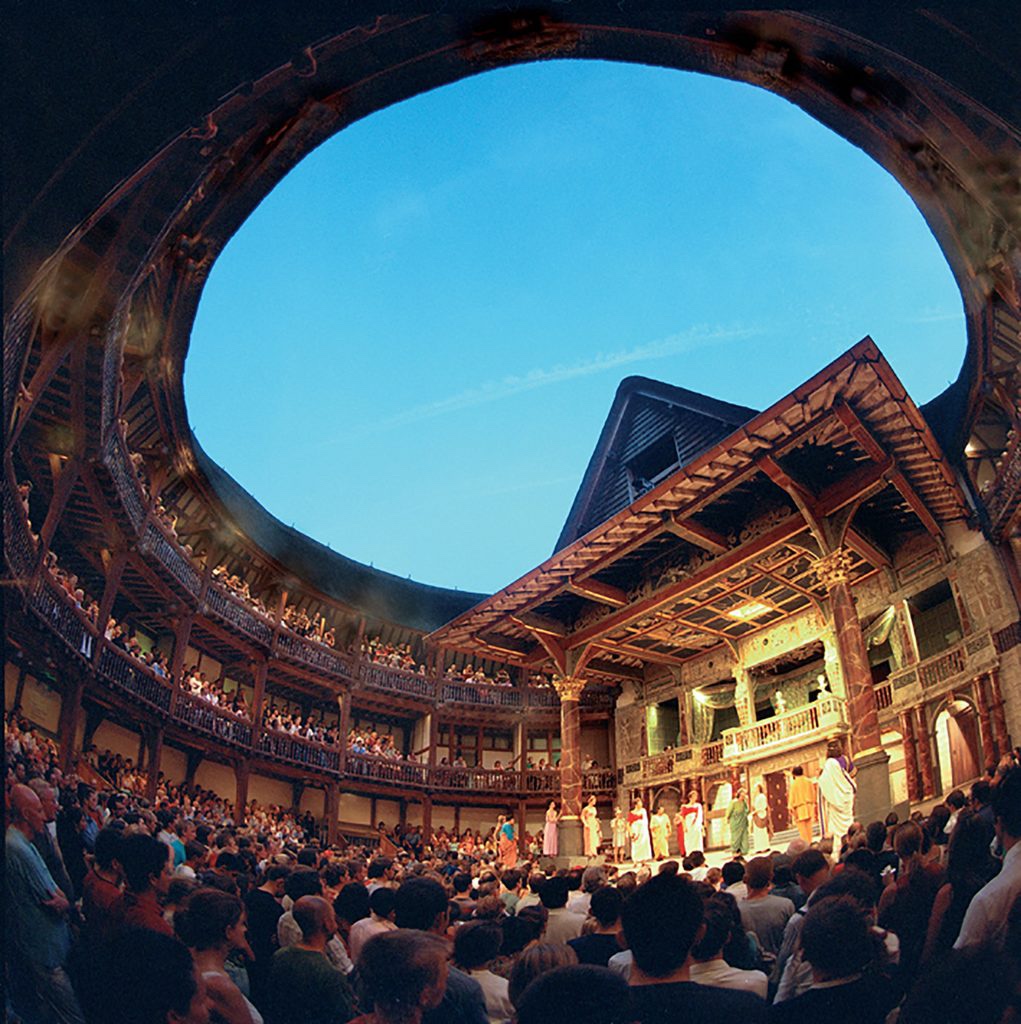
Elizabethan audiences loved the shocking drama. The blood had to be realistic and so the theatre management at “The Globe” had a small barn at the back where they kept sheep, lotsa sheep. Every two consecutive renderings, one was slaughtered and its blood, heart, lungs, liver, etc were used as props for the mayhem in the plot. When the props began to stink, they simply went ahead and killed another sheep.

The present-day Globe Theatre, London. This is a replica, the original having burned down in 1613.

————————-

Realism drove the theatre producers to even use actual human beings sometimes, I’m not kidding. In Thomas Kyd’s ‘The Spanish Tragedy’ (a sorta Andrew Lloyd Webber of gore), which had several gruesome revenge killings on opening night, they needed an actual human being to be strung up from a tree branch and hanged, so they simply got a condemned prisoner from the Tower to do the act.

The play became a overnight rage. Soon they were running outa fresh bodies, so the Queen’s dragoons began picking up random folks right off the streets who looked even remotely suspicious of any wrongdoing. Trials were fast-tracked and the death sentences confirmed, so they could act in Thomas Kyd’s play that very evening, even though it was going to be a one night stand. Since at least some of the sods really were criminals, the law and order situation in and around London improved drastically.

————-

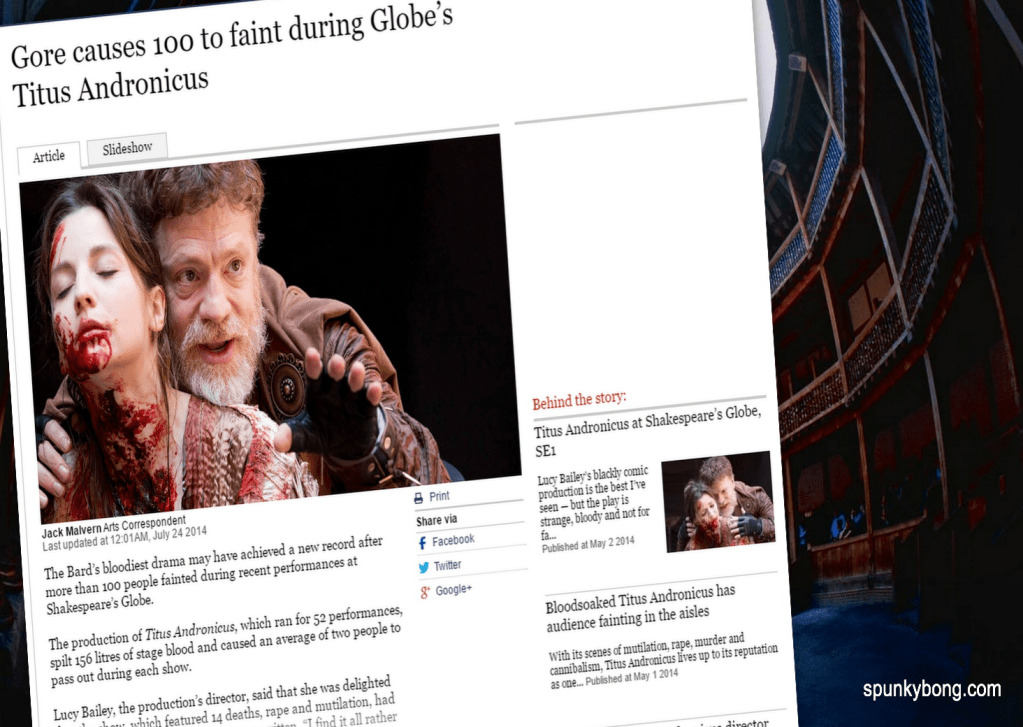
Some of Shakespeare’s most violent plays were by far the most popular. Titus Andronicus – Billy’s first and most violent tragedy – was a huge success at The Globe. Touring troupes fell over each other, wanting to play Titus Andronicus. In the play, two of the characters were baked in a pie……. literally……

Titus had the Roman emperor-to-be, Saturninus and his wife, Tamora, over for dinner and after the horses of the ovaries had been cleared away, Titus revealed that the meat pie the couple had just devoured was actually what remained of their two sons, Demetrius and Chiron. While they were in a state of shock, Titus butchered Tamora with a carving knife and in return, was killed by Saturninus right after.

Titus had to be stupid. If I was going to tell you I just baked your kids in a pie, I’d make sure I had back-up. Titus had justification for the pie though. The duo had raped and mutilated his only daughter, Lavinia and he had had to honor-kill her after he found out, ‘to spare her the shame’. Boohoo. And then, Titus’s son, Lucius, nabbed Tamora’s Moor lover boy, Aaron and had him buried in the desert sand upto his chin and left to starve ta death.

And you thought ‘Friday the 13th’ was horrifying.

Billy Shakes was particularly gruesome in Hamlet – when King Hamlet (Hamlet’s dad) was napping in his orchard, his treacherous bro Claudius, poured a ‘leperous distillment’ into his ear. The poison curdled his blood and caused his skin to develop horrible sores. The King died in his garden, hideously disfigured, a victim of his brother’s treachery.

I am imagining The Globe issuing a casting notice, a job ad, announcing…. ‘Actor wanted, to play King Hamlet. Must bring his own vial of henbane and dropper and don’t forget the down-payment on casket…’

And then there was that shmuck, Polonius, newly crowned King Claudius’s trusted aide. Acting on the orders of Claudius, Polonius hid behind the drapes in Queen Gertrude’s chambers, to eavesdrop on her conversation with Hamlet, whom Claudius suspected of plotting to overthrow him. Polonius however had this fatal habit of almost all of Willy Shakes’ characters – he constantly talked to himself.

Thus, while Hamlet spoke with his mom, Polonius had this running commentary going with himself, in a sort of a low mumble. Alas, the mumble wasn’t low enough – Hamlet overheard him and drove his sword through the tapestry, killing the shmuck.

If you wanted to play Polonius and at the same time had a desire to come out of the show alive, you had to have fast reflexes because you had only a microsecond from the time the sword emerged through the drapes and entered your gut.

Ophelia, driven insane by Hamlet’s murder of her beloved father, Polonius, plunged from a tree branch into the current below. Actually she slipped and didn’t know how to swim. But Elizabethan England would have labelled her a nitwit, so Billy Shakes wrote it in as a suicide.

That’s nothing. In Macbeth, Lady McDuff was chased across the stage at the Globe and slaughtered when she jumped off and fell into the arms of the ladies in the front row, splattering them with gore. It was so real that….it was real. Even for a million quid nobody wanted to play Lady McDuff in those days.

Willy Shakes really knew how to keep audiences titillated, with ingenious new ways in which to die. He was the 16th Century version of Quentin Tarantino.

If you were to believe everything Willy wrote, you would be a regular at the friendly neighborhood pharmacist in those days, shopping for a pitcher of concentrated hemlock. And its antidote of course. You would be a shmuck not to order the antidote and keep a vial chained safely to your waist, just in case somebody in your household poisoned you.

Antidotes those days were even more valuable than gold and silver. Look at today’s cyber-security stocks, Christ’s sakes, I have been saving up for a year to buy Crowdstrike, Palo Alto and Zscaler.

You think I am kidding about what went on in the Globe? Google it if you like. By the way, the Globe Theatre still exists. The original Globe Theatre, built in 1599, burned to the ground in 1613, was rebuilt but demolished in 1644. The modern Globe Theatre is said to a perfect replica of the original 1599 construction.

—————-

According to Willy, Mark Anthony and Cassius too ran themselves through. For different reasons of course. Cassius, for being Brutus’ defeated co-conspirator and Mark Anthony, for losing the power struggle with Octavian.

Cassius handed his loyal Parthian slave, Pindarus, the very sword with which he had stabbed Caesar. He then commanded, John Gielgud-style, “Now with this good sword, that ran through Caesar’s bowels, search this bosom…. And when my face is covered, as ‘tis now, guide thou the sword.” Pindarus later made his escape to some place Willy Shakes doesn’t mention in his play. Slaves didn’t count for much of a mention in 16th Century England. In forcing a slave to murder him, Cassius selfishly put Pindarus’ life in danger. If captured I shudder to think what would have been done to him.

Mark Anthony ran himself through alone, duped into believing that the love of his life, Cleopatra had already taken her life. She was in fact alive when his corpse was brought into her inner sanctum and laid to rest in her arms, under the orders of Octavian. At this point, the despondent Cleopatra shoved her hand inside a basket of dates that had an asp placed inside on her orders. Mark Anthony had been popular with Cleopatra’s generals and might easily have been able to commandeer a fast galley and a few slaves and skip to the friendly kingdom of Kush (present-day Sudan) to the south. But the schmuck that he was, Mark Anthony chose to run himself through.

———————

Shakespearean plots were always very complex, with rivalries and deceit, temporary alliances and treachery, cowardice and chivalry – all woven inside a huge cauldron of blood and gore. One moment you see two characters thick as thieves and after a coupla acts they are at each other’s throats.

Other than his Titus Andronicus, which was fiction, all of Shakespeare’s tragedies were based on history. If Billy Shakes had been alive in the present day, he would surely have found in Afghanistan the perfect fodder for a tragedy. The buddy movie of the American and the Taliban raising toasts in sunny Doha and then the treachery of the Americans, leaving their faithful Afghan fixers at the mercy of the Taliban.

Oh yeah, there’s a Shakespearean zigadoo in everything today. Take a look at who was fighting whom in Syria just a while back….

Bashar Assad was trying to put down an armed insurrection, with the help of his Shiite friends, Iran and and the Lebanese Hezbollah and his long-term ally and benefactor – Russia. The Americans were arming the rebels and drawing “red lines” against Assad, while they were also paying Assad to let them rent off-site real estate for torture and rendition in the so-called ‘war on terror’. The Israelis were, time to time, bombing Assad’s ammo dumps and all the while, making nice with Putin. And all this time Bashar was keeping alive a hope he would one day be back in America’s good books and be able to get his hands on all the frozen assets. All this, when at home Assad was playing a devoted husband with a British born prim and propah Syrian wife who liked to show off her Oxford accent and her pearls.

And all of them, the Syrians, the Americans, the Russians, the Israelis, the Iranians, the ships, the shoes, the sealing wax, the cabbages and the kings – they were all fighting the ISIS.

Truly Shakespearean, ain’t it??

Is God a just God?

———————————

“Every day, as we walk through our lives, we notice evil and good living side by side. That’s the nature of life” – The Dalai Llama

————————————

“He that is without sin, let him cast the first stone” – Jesus.H.Christ with the scribes and pharisees, in the Gospel according to Jack.
– painting by Philippe de Champaigne (~1670)
————————————

The Dalai Llama’s words in the blurb above the image seem to imply that the forces of evil are just as powerful as those of good. I happen to agree. History supports that view too. But coming from the Dalai Llama – the very custodian of his faith, it is an admission that God is not the only Sheriff in town.

James Irwin, the Lunar Module Pilot for the 1971 Apollo-15 mission to the moon, reported that while he was on his 18-hour sojourn on the surface of the moon, he felt the “presence” of God around him, coaxing, encouraging, guiding, reassuring him. I won’t make a snide remark about the presence. Irwin held a Master’s Degree in Aerospace Engineering. If he says he felt something, then he felt something.

On touching down at the bottom of the 36000-ft deep ‘Challenger Deep’ in the Marianas Trench, the deepest spot on Earth, the Oscar-winning movie director, James Cameron felt surreal as he looked out on the desolate landscape of the ocean bottom. Although he was completely isolated from human civilization, he says he felt a spiritual presence. I won’t sneer. Cameron is my favourite movie director. If he felt creepy, he felt creepy.

Maybe God does appear in extreme places, but here’s the thing – I don’t want to be only in life-threatening places, to feel His presence. If he wants me to believe he definitely exists, he has to appear while I’m having a beer by the riverside or taking a shower or watching porn or something. Otherwise, I am an atheist and an agnostic rolled in one. As an agnostic I don’t know for sure if God exists and at the same time as an atheist, I don’t believe he does.

I am starting on Aldous Huxley’s Point counter point and I found this terrific quote on one of the first few pages, a statement that protagonist’s brother-in-law makes while arguing that one cannot believe in things that one cannot rationalize as true within oneself – “If you have never had a spiritual experience, it is folly to believe in God. You might as well believe in the excellence of oysters, when you can’t eat them without being sick…” Well, I have never tasted oysters, so there.

But I do agree with the idea of good and evil and I do think they exist together at the same time. Like in Superman comics, there is a “Bizarre God” at the other end of town where everything is the opposite of everything on this side. Good is evil and evil is good. Each and every one of us is born with a season pass for both sides and we use it to bounce back and forth every day, every moment.

————————

Even Jesus seemed to agree. According to the Book of John (8:3-7) in the New Testament, the scribes and the pharisees – those early Jewish zealots – they hated Jesus. He was slowly usurping their power over the Jewish people with his straight talk. So, even though he made sense when he spoke, the establishment had had it with him and wanted him gone. They would be given their wish with his crucifixion in the end, but in the initial days they tried to trip him up with their semantics.

One day, these men gathered a crowd and dragged a woman accused of adultery up to Jesus. They threw her to the ground in front of him and asked what should be done with her, while reminding Jesus that in the Torah (there was no Bible then) God, through his spokesman – Moses, had ordered that women who committed adultery be stoned to death.

The zealots had no idea who they were dealing with. Jesus stared at them, haughty yet serene, and said in response, “He that is without sin among you, let him first cast a stone on her…”

Jesus’s response was an indirect admission – that there could be in the crowd those that have sinned. That was exactly what the Dalai Llama must have meant. Once again, I completely agree.

The proposed punishment for adultery that the woman faced was an unimaginably brutal one. As per practice, she was to be buried vertically in the ground with only her head sticking out. Her punishment was meant to be by public participation, so from then until she had breathed her last, it was going to be a barbaric free for all. Anyone in the crowd could pick up a stone or a brick and hit her with it. From all sides her head would be battered by rocks at 70-80 miles per hour, slamming into her face, her ears, her lips, splitting, crushing, cracking, giving her no chance to defend herself. After a while she would be knocked unconscious and finally, after a half hour of agony, she would die.

Man, that is a truly horrific way to die. And all because she, a married woman, had let a married man fuck her.

Now consider this – Jesus didn’t protest the barbaric modus operandi of the sentence, stoning. Neither was he in the least perturbed that no one had thought of punishing the man who had been the other half of the adulterous union. We know full well that usually it is the man who makes the first move in an adulterous relationship. Yet, the Bible doesn’t even mention the son of a bitch.

Jesus was not concerned about the adulterer either. Being fair in meting out justice didn’t seem to occur to the messiah at all. Even the Bible, written much later after the dust had settled, doesn’t bother with the man. Some holy book.

Here is something else to consider about Jesus’s response…. it implied that, had there been a man in the gathered crowd who (deceitfully or otherwise) simply stated that he was free from sin then he, Jesus, was okay with that person stoning the woman to death.

Jeeze, some messiah!! Some God!!

This is the same God who demanded that the virgin Mary bear Jesus. As written in the Book of Luke, the story goes that one day the archangel, Gabriel (one of the three heavies who enforced God’s bidding) appeared before a random destitute woman named Mary, a virgin living in Nazareth and told her that soon she would bear a male baby with the power of the Holy Spirit whom she should name “Jesus”.

It was a command, not a request. Gabriel grandiosely told Mary that she had “found favor with God”

Maybe she didn’t want a baby, but God didn’t care about her feelings about it. He was about to unleash upon the poor folk of the Levant a faith that didn’t give a flying fuck about women’s rights. The illiterate star struck hillbilly woman, thrilled that she had been conferred such an “honor”, responded, “Behold, I am the handmaid of the Lord; let it be to me according to your word.” 

Yeah, it is in fact a “Handmaid’s Tale”. Behold indeed. Behold a faith that has more priests who fuck little kids than any others in the universe.

———————————-

Let’s take this a bit further a closer look at the Book of Job…..

The Book of Job is a chapter in the Old Testament that is probably the most profound of all books in the Bible. It is the story of Job, a prosperous landowner and farmer in the ‘land of Uz’ which I am guessing must have been somewhere in the Fertile Crescent, a crescent-shaped swath of land that covers present-day Syria, Iraq, Israel, Lebanon and Palestine.

Job was something of a model citizen, a pious keeper of the faith. There must have been many who were equally virtuous, maybe living in China or Peru. Or Timbuktu. But God had for some unknown reason zeroed in on Job and showered him with all the riches – fertile lands to grow corn and barley, a thousand head of prime cattle, a hundred sheep and a family of seven strong sons and three beautiful daughters. Consequently, Job was wealthier than most.

Mind you, the Bible takes great pains to make it clear that God had given Job all his wealth and not that he had toiled for it. Though he was a hard-working man, Job had not earned his wealth through hard work, but as God’s reward for his blind devotion.

If you are a schmuck, you’ll ask – why this favoritism toward Job? But if you are a true Christian, you won’t question God’s actions. You’ll sagely shake your head side to side and speak the dictum of every evangelical Christian nut job – “The Almighty God has his ways. It’s not for us to question Him”.

————————-

Anyway, the story goes that as Job kept on getting richer, one day the Satan appeared before God and said, “Have you seen what’s going on down on earth, the sinful things that people are engaging in?”

God replied, “You’re always bitching about the bad stuff. See how Job lives his life, as a pure moral human being”.

Being well aware of Job’s special status, the Satan said, “Of course Job will be pious and obedient. You made it worth his while. Take away all that you have given him and then see how long he remains your obedient servant”.

So, God took the challenge and within the wink of an eye Job had lost everything. The next day, while Job’s sons and daughters were feasting at home, God sent a wind that rushed in and destroyed the house, killing all of them. Then, a bolt of lightning streaked down and torched all his lands and livestock.

And then God did a curious thing. He handed Job over to the Satan. Instantly Job was inflicted by a dreadful disease and large puss-filled boils appeared all over his body and he lay dying unable to move, writhing in pain.

Job wanted to scream, “Why, God, why?” But he knew a good thing when he saw one. He did a Paul Manafort (maybe Michael Flynn). He decided to keep his mouth shut and ride it out.

Turns out, Job was right. In recognition of his loyalty, God snatched him back and restored all his possessions, his family and his health to him, this time with fourteen thousand sheep, a thousand yoke of oxen and a thousand mules. He also gave Job a new set of sons stronger than the ones that He had had murdered and three new daughters more beautiful than all the women in the world.

What kind of God would bring such havoc to a moral and devout man, just so He could win a bet with the Satan? Why did the first set of sons and daughters, the first set of livestock have to die? How could God be a just God if so many innocents were punished for nothing?

I’ll say it again – Jeeze, some God.

————————————

To blind believers, the moral of the Book of Job is – whatever happens to you, keep your mouth shut and bear it.

In his book “When bad things happen to good people”, Harold Kushner urges the reader to consider three possibilities…(1) God is all powerful and nothing happens without his will, (2) God is just and the evil are punished while the good prosper and (3) Job is a good person.

As long as Job is healthy and wealthy, we can believe all three premises to be true. But if Job suffers, one or more of the three propositions don’t make sense. If God is both, just and all-powerful, then Job is a sinner, which is not true because he isn’t. If Job is a good person and still gets punished, then God is not just. If it was not God who made Job suffer, then God is not all-powerful.

Therefore, says Kushner, the Book of Job is an argument over which of the three propositions we are prepared to sacrifice, in order to keep on believing the other two.

—————————

I’m done with Job and now let’s get back to the Book of John in the New Testament and the part about the adulterous woman…..

No one came forward to cast that first stone and so the woman was set free.

Now here’s the thing – the Bible doesn’t dwell upon what happened next. Did the woman say “Phew, that was close” and then return home and beg her husband for forgiveness? Or did she run back to her adulterous fuck friend with a new-found confidence from the fact that nobody could touch her now?

Anyway, whatever happened to that woman afterward has never been recorded and now, more than two thousand years later, we still have no idea.

But we sure can tell what will happen to a young adulteress like her, today…….Nothing.

They won’t even bother to arrest her. Today the same woman can sit on her haunches “in the middle of 5th Avenue” and blow someone and all she’ll get is a ticket for blocking traffic and public indecency. Courts in most progressive democracies no longer recognize adultery as a criminal offence, citing personal liberty which is enshrined in their constitutions.

We have come a long way, baby. Today the prevailing ethos on adultery is – if two people want to fuck, it may not look nice but it is their choice. I believe that is how adultery should be viewed – disgusting, distasteful, debauched, but not illegal.

Lets not depend upon only one kind of justice – the divine kind.

——————————————

Battlefield Etiquette

battlefield etiquette

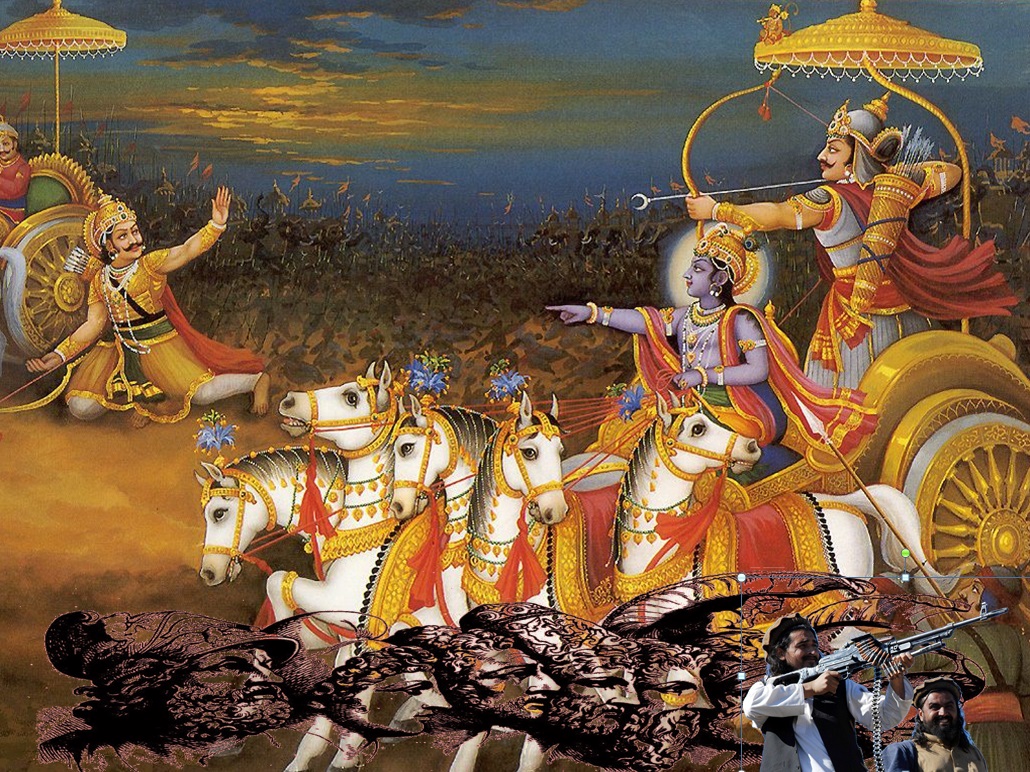
In the midst of the battle of Kurukhshetra, Karna has a flat tyre and guess what he does? He asks the enemy (Arjun and his charioteer, the divine Lord Krishna, purplish-blue, with the halo on the side of his head), to wait while he fixed his chariot.

Guess what happened then? Well, you have to read this piece to find out…


In the great epic, Mahabharata, when a defenceless Karna’s chariot wheel got mired in the mud in the middle of the battle of Kurukhshetra, he tried desperately to extricate it, but failed. Noting that the Pandava hero, Arjuna, was gaining on him and getting ready to slay him, Karna asked him to hold his fire and give him a hand.

Coming to an adversary’s assistance in those days was a component of what was known as battlefield etiquette, which required that when a fighter had been placed unwittingly in a position of disadvantage, his antagonist had to hold further fire until he had recovered and the playing field had been leveled. Something similar plays out in boxing today – punching a fallen opponent is against the rules.

Back in 5561BC (the date that vedic scholars think the Battle of Kurukshetra happened), battlefield etiquette was a very important component of the chivalry.

——————————–

In fact, battlefield etiquette was common all over the ancient world. In Homer’s epic, Iliad, the Mycenaean fighter, Ajax the Greater, chucked a huge stone at the Trojan hero, Hector, with such force that it dislodged Hector’s helmet and crushed his horse. Since he was still mounted on his own steed and had his helmet on, Ajax deemed it unfair to continue. He dismounted and paused to let Hector collect himself, a decision that would cost Ajax his life. Hector recovered his balance and strength in the brief interlude and they fought fiercely hand to hand, until Ajax was killed by a glancing blow from the haft of Hector’s sword.

In today’s world, Ajax would be derided as a stupid sucker. But not in 850BC Troy. Ajax was elevated posthumously to the pinnacle of chivalry and spoken of with adulation and awe by both, the Mycenaeans and the Trojans.

——————————-

But I digress… Getting back to the Mahabharata, on hearing Karna’s plea for help, Arjuna immediately rose to get off his chariot and give Karna a hand, when all of a sudden Arjun’s charioteer, revered Lord Krishna (who was at once Arjun’s master and servant), stopped him.

Instead of commending Arjun’s sense of chivalry, Lord Krishna reminded him that Karna was on the side of the bad guys and that it is not against battlefield etiquette to kill a man who has supported evil all his life. Arjuna lamely turned back, took aim and killed Karna.

What do y’know. Under his beatific smile, Lord Krishna was calculating, machiavellian. Not the first time that a God turned out less than godly. Remember the Christian God who ordered Abraham to slaughter his innocent son, Isaac, for no reason other than to prove his faithfulness to the Satan?

Go ahead, call me blasphemous if you will, for taunting the Hindus and the Christians at the same time. In actual fact, I want to believe in religion. I want to believe in what others believe. But I am me and I can’t believe, unless it makes sense.

—————————-

No thanks to Lord Krishna, battlefield etiquette still makes its presence felt – albeit sporadically – in the unlikeliest of places……..

Spring, 2009

A hamlet, 20 miles south of Spin Boldak, Afghanistan.

The night had been so brilliantly moonlit, it was almost like day. The hamlet they had surrounded was bathed in a diffused glow. They would have waited for the next new moon but there was no time.

Abu Salam was leading a TTP (Tehrik-e-Taliban Pakistan) squad that had bivouacked for the night in the bushes surrounding the cluster of adobe huts, just north of the border with Pakistan. The hamlet was nestled inside a cleared circle on a vast terrain covered by a dense thicket of waist-high shrubs that seemed ideal for concealment from a ground-based adversary, but completely exposed to an aerial attack by fixed-wing ground attack aircraft like AC-130 gunships and A-10 Warthogs or even choppers like the Apache or Black Hawk.

There was big game tonight and the Emir, Baitullah Mehsud himself, was by his side, toting a Stinger missile launcher to deter aerial support interference. The Stinger’s dull black mat finish hadn’t been scratched yet. Although it was an older version that Raytheon had stopped making a long time back, it was still brand new. It had been stowed away unused, in an Islamabad warehouse operated by Pakistan’s intelligence agency, the ISI and remained there after the Soviets had left Afghanistan.

The Stinger was a remnant of American largesse of the 80s and today it would be used to kill Americans. Salam smiled grimly at the irony.

————————–

Inside the hamlet were two dwellings – one, a large square adobe home with a courtyard in it’s middle and the other a small outhouse which had three Delta Force operatives from the US Special Operations Command and an Afghan interpreter in it.

The insurgents lay there, forming a neat circle round the hamlet, a battle-hardened TTP fighter every five yards or so. The fight with the Russians and the training from the ISI had taught them discipline. The Americans inside that outhouse might have drawn some consolation from the fact that they were about to be annihilated by a fighting force that paralleled their own professionalism. What this bunch didn’t have, in terms of equipment and technology, they made up for in their commitment to a cause, albeit, a crooked hijacked cause.

The owner of the compound, a grizzled Pashtun warlord who had fought the Soviets with Salam, had been a notoriously fickle-minded guy who had first decided to side with the Americans on receipt of a bagful of $100 bills and then, after taking the money, he had changed his mind. The Delta Force team had been dispatched along with an interpreter with orders to either get him back on their side or finish him off. The wily Pashtun had gotten word and contacted the TTP.

As Abu Salam felt the discomfort of the ground – still hard and cold from the winter, two of the Americans came out of the outhouse and started walking toward the bushes, possibly to take a leak. That’s when all hell broke loose. 7.62mm rounds began spewing out from the fanatics’ AK47s and the two Americans crumpled to the ground.

What followed was the moment that Abu Salam recognized why the Emir deserved to be called – the Emir.

The two fallen Americans had momentarily stopped moving and a deafening silence had set in and as Salam stared at the scene below, suddenly a third American emerged from the outhouse. He walked resolutely toward his fallen comrades, his steps unhurried, as if he was on an evening stroll. He reached one of the prone Americans, the one closest to him. He calmly slung him over his shoulders, hefted him with a huge shrug and started back toward the lee side of the outhouse. He was a target that begged to be taken down.

For a moment, Abu Salam’s Talib colleagues, including the Emir, were dumbfounded by the bravado. By the time they could gather their wits, the American had disappeared behind the adobe wall of the outhouse.

The Talib weren’t even done releasing the breaths they had been holding, when the shape appeared once again.

This time, the American walked in an even more measured pace, covering ground the way only someone who believed completely in himself would. As he advanced toward his fallen comrade, the Talib gaped, their faces aghast and their mouths hanging open in astonishment.

One fighter – no one knows for sure who – let out a burst. The American stumbled and fell. He still had a few yards to cover, but that was when the Emir let out one single shout – wadrega! (stop!)

As the firing fell silent, the Talib gunmen watched astounded as the American, mortally wounded, started crawling toward his buddy. Their eyes unbelieving, they watched him reach his pal and come to rest right next, his one good arm now engulfing his friend in a hug.

Abu Salam raised his AK to finish the infidel off, but suddenly he felt the muzzle shoved aside. It was the Emir.

‘Enough,’ said Baitullah Mehsud, ‘Don’t ever forget. We are all fighters and this is a brave one. Let him choose his time to die.’

After waiting a while, the Talib cautiously climbed down from their perch and approached the two fallen Delta Force men lying there in that macabre embrace. The Emir reached down and held his finger under the American’s nose, the one who had come out to help his fallen comrades. Mehsud felt his breath coming out in short ragged bursts. Given the extent of his wounds, he estimated the soldier had only seconds.

“Leave them alone,” said the Emir, “Give the infidels the chance to take him away. He has earned the right. We shall return, for another fight, another day…”

Then, as he turned to rise, the Emir’s eyes fell on the dog tag on the still breathing American. He stared at it a while and then stooped and removed it from the American’s neck. It said –

Giovanni F. Ricci

697-012-8326

RH Negative

Catholic

—————————

Today that dog tag rests inside a beautifully hand crafted teak and glass jewelry box on top of a TV cabinet in a small town called Lawrence, mid-way between Topeka and Kansas City in the United States. It is the home of an elderly couple. Somehow it had found its way from a dusty Afghan hamlet, via an Islamabad army installation and then finally to America on a C130 Hercules transport aircraft that had taken off from Shamsi Air Force Base , in Baluchistan, 12 time zones to the east.

Next to the jewelry box is another piece of metal attached to a gold-braided silk tape. It is the Congressional Medal of Honour, America’s highest military award for bravery in the battlefield. How the presidential citation had been so accurate, given that there were no witnesses, remains a mystery till this day.

The Religiosity of Organized Crime, a.k.a the Criminality of Organized Religion

Organized crime map of Italy

The Santuaro di Santa Maria di Polsi is a Catholic sanctuary in the heart of the Aspromonte mountain range that runs north to south along the middle of the toe of Italy, near San Luca in Calabria. Founded by Roger II, King of Sicily in 1144, the church and monastery are situated in a spectacular setting at the bottom of a gorge that is surrounded by high mountains on the east side of the 6000ft Mont Alto, the highest peak of the Aspromonte.

Like other pilgrimage destinations, such as the Haj for Muslims or Amarnath and Sabrimalai for Hindus in India, the inflicting of fatigue and pain upon the pilgrim is considered essential, in order to give him a sense of having ‘earned’ the right to spirituality. Somehow, kneeling in the corner of your prayer room at home isn’t the same thing. This is in spite of the widespread belief that God is omnipresent and is not necessarily found only in Jerusalem or Mecca or Sabrimalai.

Like the abovementioned pilgrimage destinations, the Polsi sanctuary too is difficult to access and cannot be reached by mechanised transport. The pilgrims, like any others around the world, feel that they have to trudge up to have a glimpse of the Santa Maria and bask in the momentary reflected piety. I have never understood this, but then I am not a religious man.

In September every year, around 200 leading members of arguably the most powerful organized crime group in the world, join the pilgrims in the long hike up the Aspromonte mountains, ostensibly to visit the sanctuary and express their devotion to the Virgin Mary.

I say ‘ostensibly’ because the real reason for their pilgrimage is not devotion, but to have a tête-a-tête. Since the 1950s, the chiefs of the locali have been meeting there during the September Feast. These annual get-togethers, known as the crimine, have traditionally served as a forum to discuss future strategies and settle disputes, under the auspices of the Catholic church.

In those days, the Catholic Church was as involved in hosting and laundering money for the Mafioso as it’s priests were, in fucking little boys and girls.

————————————————-

A 100 miles to the north, is a sleepy town called Cosenza that is bathed year round in bright sunlight. In January, with clear, azure-blue skies and a balmy 15°, Cosenza could well have been a tourists’ paradise.

One such day in January 2014, brought to the world an unspeakable horror that the locals are still trying put behind them and move on……

For 3-year-old Nicola “Coco” Campolongo, it had promised to be an exciting day. Coco had just been strapped into the car-seat in the back of the 8-year old Fiat Punto by his grandfather, Guiseppe Iannicelli, who drove while his Moroccan companion, 27-year-old Ibtissa Taoussa, sat in the front passenger seat. Taoussa was ‘Aunt Betty’ for Coco.

As the tiny car negotiated the busy thoroughfare, Coco’s head constantly swivelled round and round, as every child’s does, when he’s being taken on an outing. When he noticed a motorcycle keeping pace just inches away to his right, he gazed out at it in awe. The bike was one of those heavy Yamaha racing motorcycles.

Sitting astride were two men, dressed in leather from head to toe, with black helmets, their visors pulled down. When the man riding pillion turned his head to look at him, Coco waved wildly at the man and he even waved back. The motorcycle then speeded up, overtaking the Fiat and positioning itself in front. It remained there till the next intersection, where the bike came to a sudden halt, even though the light had turned green.

The old man was slow in reacting. He slammed on the brakes and fought to bring the skidding Fiat to a halt, barely managing to stop inches away from the tail lights of the Yamaha.

As the pillion rider twisted his torso, this time completely around facing the Fiat, the old man growled something in Calabrese that, roughly translated, meant, “Get the f—k out of my face, ars—le.” Grandpa Joe was a man with a mercurial temper.

The two seconds that the pillion rider took to unzip his jacket front and draw out a Beretta 7.62mm automatic would have been enough for a younger man to immediately put the car in gear and ram the motorbike, possibly run the two riders over and make his escape. Even if it had taken three seconds instead of two, he would probably have still made it, since the pillion rider would be too startled to aim accurately.

But Coco’s nonnino was old, no longer that murderous young button man with a leopard’s instinct for survival as he had once been. He just stared dumbly ahead till a third eye appeared in the center of his forehead. Immediately, the aged drug trafficker slumped forward on the wheel, pressing the horn down, setting it off.

The traffic around the two parked vehicles began to scatter and passersby did what this town had trained them since childhood for – they dived for cover. Just as well, because the pillion rider got off the bike and ambled over to the passenger side and peered in for just a second, before he brought the gun up once more and shot the terrified moll too, right between her eyes, at point blank range, the gun’s muzzle hitting the woman’s forehead before the round exited in a fiery flash.

Coco was beside himself by now, hopping up and down, restrained by his car seat, unable to comprehend what was unfolding in front of his eyes. He kept repeating, “Nonnino! Nonnino!” over and over.

The pillion rider didn’t get back on the bike. Instead, he strolled round to the rear of the hatchback and stood there for a while, not moving, his head swiveling around till he was satisfied there was no emerging threat. There couldn’t be. The outfit that he worked for owned this town.

Stretching out his right arm, he brought the Beretta up one last time, it’s muzzle bumping against the rear window of the car, six inches from the back of little Coco’s head. His expression impassive, the hit-man fired two shots in quick succession and Coco’s head exploded like a melon. The toddler slumped forward, his upper torso hanging in front, restrained by the car seat’s harness.

In the deathly silence that followed, the pillion rider casually walked over to the driver side, opened the door, dragged Iannicelli’s corpse out onto the pavement and out back, opened the trunk and stuffed it in. The bike revved up, the Fiat’s engine fired and the two-vehicle convoy began moving forward unhurriedly. At the next corner they took a sharp left and disappeared from view.

Iannicelli had been a convict on nocturnal payrole and when he didn’t call in for a couple of days, the cops went looking for him. Then, a few days later, a hunter spotted the burnt-out skeleton of a small hatchback inside the compound of a derelict building at the edge of town and alerted the police who discovered the macabre scene inside.

There was a body in the trunk, charred beyond recognition and another in the front passenger seat, similarly cooked. In the back seat, the investigators found the charred remains of a tiny body, still strapped to a blackened car-seat, unrecognizable as the remains of a human being.

A shiny 50-eurocent coin was found on the roof of the burnt-out car, a known custom of the criminal group that owned the town, a message that meant that it was a vendetta for an unpaid drug debt.

——————————-

Welcome to the world of the ‘Ndrangheta, the deadliest organized crime group in the world, with annual revenues from drug trafficking and murder of over $80 billion, a tidy sum which also happens to equal 3.5% of Italy’s GDP and double that of the auto behemoth, Fiat.

Guiseppe Iannicelli had been a card carrying member of the ‘Ndrangheta. Till he ran afoul, trying to make a drug sale on his own, without sharing the proceeds with his bosses, a capital offense to the ‘Ndrangheta. He too made those knee breaking pilgrimages to the Santuaro di Santa Maria di Polsi Catholic sanctuary in the hope that his Catholic God would choose to be on his side. Obviously he had been misled.

‘Ndrangheta tattoos. You gotta have ‘em if you’re going to be one of them. Like the Japanese Yakuza.
Maybe it is the apostrophe in front of the name, but it sends a chill down my spine.
Coco was not the only child collateral damage.
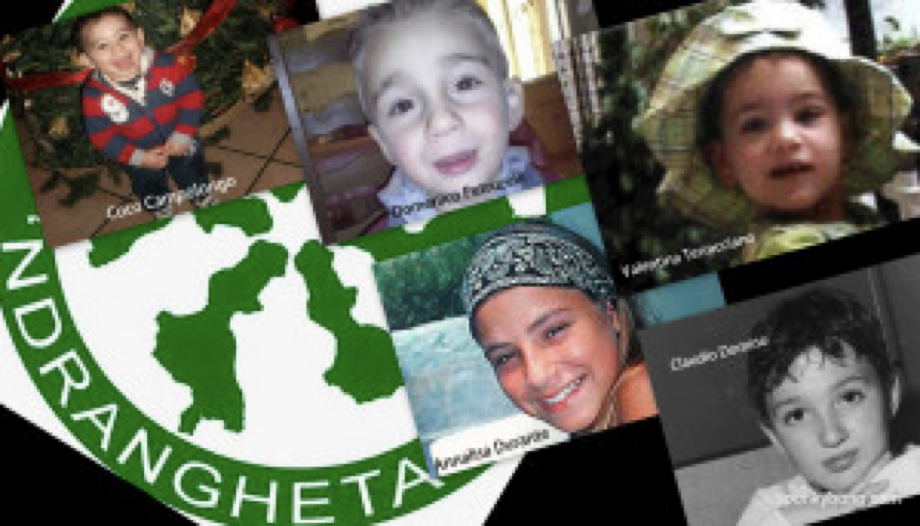
Clockwise from Coco, blue-eyed three-year-old Domenico Petruzelli didn’t know his mum’s boyfriend was a ‘Ndrangheta goon. One day in March 2014, hitmen forced the family car off the road and opened fire with machine guns. Domenico died instantly, in a hail of bullets. Valentina Terracciano, just two, was killed in 2000, in a machinegun crossfire which raked a flower shop in Pollena Trocchia, near Naples. The store belonged to her uncle, a Camorra member and the real target. Claudio Domino, 11, was shot in the forehead because he was witness to a murder, in Palermo, Sicily. Annalisa Durante, 14, was a bystander used as a human shield in a clash between two rival Naples clans in 2004. She was fatally shot in the back of the head.

In the last decade alone, over 80 children and some 800 innocent bystanders have fallen for being at the wrong place at the wrong time.

In a way, Coco Campolongo never had a chance; at least not at leading a normal life. Born into a family of drug pushers in ground zero of ‘Ndrangheta territory in southern Italy, the only occasion when the toddler had seen his parents was when someone found the time to take him to visit them in prison.

—————————————

Naturally there were cries of horrified indignation at the killing of Coco. Even for a country that has numbed itself to willful blindness at organized crime hits, the deliberate murder of a 3-year old looked like it was going to be a tipping point. From his pulpit, Pope Francis cried, “How could anyone kill an innocent little boy of just three years in this way?”

Then, as if to square things up, to show the world that evil always loses in the end and to thereby reaffirm the ‘law of conservation of spiritual entropy’, Pope Francis confirmed gravely that the child would surely go to heaven. He must know. After all, he is believed by Catholic suckers all over the world to be God’s own rep on earth.

The Pope went even further. “You, the mafia, are hereby excommunicated from the Catholic Church”, he announced, even though excommunication from the Catholic Church is a lengthy bureaucratic process and cannot be carried out by an single announcement. Still, the Pope put every bishop in Italy on notice. Henceforth, no mafia money should be accepted as donations and no mafia sponsors shall be sought for spring festivals like the Pasqua Processiones (Easter processions) that are organized every year by the church and sponsored by mafia money.

Two decades back, when the old Mustache Petes ruled the Italian organized crime syndicates, the Pope’s excommunication of organized crime members would have been a body blow to the mobsters. That’s because these guys, besides being very devout Catholics themselves, believed that they depended upon the goodwill of the hoi-polloi in order to thrive. You couldn’t run an illegal loan sharking operation or a protection racket if the folk who needed those services didn’t trust you.

The Catholic Church had it’s fingers on the goodwill switch and the power to negate that trust. It provided the Italian organized crime syndicates with an umbrella of legitimacy that made these monsters look warm and fuzzy in the eyes of the common folk. Bishops and cardinals were in the payroll of at least one of the four main crime groups.

As a religious institution, the Catholic Church was dirty to the core.

Except for John Paul-1, the Pontiffs who came before Francis either never did consider breaking with the Mafia a priority or were themselves in league with organized crime. Indeed, some Popes, like the 15th Century Borgias, were heads of their own crime syndicates, no kidding.

—————————-

There was another thing that the Catholic Church customized for the conscience of the mobster – the confessional. It was and still is a most ridiculous farce, a very convenient way to shrug off the burden of one’s sins. The confessional is where the Catholic priest takes the confessor’s sins upon himself, like Jesus Christ once did, though the justice behind it escapes me to this day.

And it is safe too. Like with a doctor, a statement made in a confessional to a priest is protected under most privacy laws and inadmissible in any court of law. You murder someone and then go to your priest and confess and you walk away, feeling cleansed. In exchange for a sham mea culpa, the priest helps you cut a deal, with the Catholic God.

Where is the penance, the repentance?

The priest doesn’t really give a damn. Years of listening to all sorts of sin every day have hardened him, made him immune to tales of sin. He himself has either done those things that he hears through the partition or at least fantasized doing them. A priest is human too, he forgets about your confession the moment your ass is out the door, gets himself a beer with the fiver you left in the donation box and goes back to the choirboy in his bedroom. You got a clean slate, the priest got his beer money and boy and the god of the Catholics is appeased. Who gives a shit what you did to a guy who deserved to get whacked anyway?

——————————

The times however have changed, even for the ‘Ndrangheta. An Ndranghetisti today doesn’t give a flying fuck about image or trust or how the common Calabrian Joe feels about the brutal way it conducts it’s business. While earlier, the killing of family members of a marked man or innocent bystanders was a strict no-no, little Coco is a stark reminder that the rules have changed, that there are no longer any rules. The stakes are just too high now. Nine out of ten sachets of Columbian cocaine that change hands in Europe, a market work $80 billion, come from the ‘Ndrangheta.

It is debatable if there is anyone that ‘Ndrangheta would hesitate to harm. Probably there is only one man – the Pope, but that is no longer a sure thing. The same goes for the other three crime syndicates that together virtually own Italy – the Sicilian Costa Nostra, the Sacra Corona Unita of Apulia and the Camorra from Naples.

—————————————-

It is not as if the Pope has always been above the organized crime’s reach…….

Shortly after 5am on September 28, 1978, just 33 days after his election as Pope, John Paul-1 was found dead by a nun who had brought him his morning coffee. Simple at heart and charged with a burning desire to rid the Vatican of it’s links to organized crime and usher the Catholic Church out of it’s criminal ways into a path of true spirituality, he was known to the world as the ‘Smiling Pope’.

It is widely believed that the coffee he was handed was laced with strychnine and that he was assassinated by one of his own senior staff, for trying to reform the mafia-ridden Vatican Bank which had turned itself into a money laundering enterprise for the Italian organized crime syndicates. It is not known as to which one of the four syndicates was responsible for the killing.

————————————————-

The safety net of religion and it’s nexus with organized crime is not restricted to just the Italian organized crime.

When he was declared a global terrorist by the US, his hosts (Pakistan) used the opportunity to tighten the screws on Indian-born Dawood Ibraham. Still alive and ever prospering, he is no.3 in the Forbes list of the world’s ten most dangerous criminals and has a personal net worth of $50 billion.

After he was found to be directly responsible for the series of powerful bomb blasts that killed 350 and injured over 1200, in Mumbai in 1993, the US moved to tag him as a wanted terrorist and the pressure on Pakistan to cough him up grew. Ibrahim, by then ensconced in a tony Karachi colony, realized it was now a matter of time before he became, to the Pakistani establishment, expendable.

But this is where his astuteness came into play. He knew before anyone else that Pakistan was soon going to be overrun by religiosity of the most virulent kind – Islamic fundamentalism.

In his early avatar in India, Dawood Ibrahim was known to be a secular mob boss, with a right-hand man who was a Hindu named Chota Rajan, but he decided to get a make-over and take refuge in religion. He began distributing largesse in the form of millions, to rogue Pakistani terrorist outfits like the Markaz-ud Dawa, the front organisation of Lashkar-e-Tayyeba, fuelling their gargantuan growth, laundering their funds from his bases in Europe and Southeast Asia, gaining their support and through them, the assurance of sanctuary by the equally rogue Pakistani intelligence agency, the ISI.

——————————————

Dawood Ibrahim’s generosity toward the terrorists changed the dynamics of Pakistan’s politics and ensured that he would never be touched. Today, he continues to lead a brazen existence amid opulence, in an elite neighborhood of the Pakistani city of Karachi, where he is known simply as ‘Sultan Shah’. He lives inside a heavily guarded compound that goes by the name of ‘White House’ and has five single-storied bungalows in it.

Inside the sprawling White House complex, Dawood is reported to have built his very own mosque, where he takes time every afternoon, to read from the Quran, his visage suitably grave and penitent. He too has found sanctuary in religion. Ibrahim even conducts conferences inside that mosque, planning hits and drug shipments, the holy environs of the mosque imparting some kind of legitimacy to his nefarious mindset. Just like the church does, for the ‘Ndranghetisti.

——————————————————

When he was controlling all the madka (numbers) rackets in the 70s, the Mumbai underworld don, Varadaraja Mudaliar (1926-1988), known to everyone as Vardhabhai, once caught one of his numbers runners cheating on a customer who had put the equivalent of 10¢ on a winning combination. It would have paid the guy off – $ 250.

Before he had the runner tossed out of the 20th floor of the Oberoi Trident Hotel in Nariman Point, Vardhabhai is reported to have told the man, “ On your way down, I want you to keep repeating ‘trust’, ‘trust’, ‘trust’.”

The don didn’t give a flying fuck about the customer who had lost his winnings, though he did make sure that the man was reimbursed in full. He just wanted to send out a message to all those poor sods, those daily-wage laborers who paid into the system, in nickels and dimes, hoping for a windfall. A message that the madka racket was a fair one and there was always a chance they would hit the jackpot if they kept playing and if a runner should cheat them, they’d be reimbursed their winnings, come what may.

Mudaliar, was an extremely pious man. He was never seen without those thick vibhuti lines on his forehead, made from sacred ash from holy wood burnt according to vedic rituals. Like Dawood and his backyard mosque, Vardhabhai too had a massive temple inside his compound.

Mudaliar liked to hedge his bets as regards his relationship with the Almighty. He made it a point to visit the dargah of Bismillah Shah Baba in Mumbai often, to offer food to the poor, an essentially Muslim ritual. Being on the right side of the every God mattered to Vardhabhai.

Likewise, Haji Mastan Mirza, another legendary don and a contemporary of Mudaliar, derived his name ‘Haji’ from the frequent Haj pilgrimages that he undertook, to cleanse himself of his sins.

——————————————————

For the criminal mind, immersion into religion is like a catharsis that he has to go through, in order to be able to live the life that he lives. It is much like biting into a twist of a lime after a shot of tequila, to take away the taste.

Monasteries and churches like the one in Polsi, dot the hills and dales of Calabria. Understandable. Like the deadly lupara, the Calabrian version of a sawed-off shotgun, religion too is an essential accessory. The Catholic Church secures his soul. Albeit, for a generous donation. Monks got ta eat, right?

In Mario Puzo’s book, The Godfather, terrified that he might go to hell for all his black deeds, Don Vito Corleone’s lifelong friend and consigliere, Genco Abandando, cries out from his death bed to the Don, “ Stay with me, Godfather. Help me meet death. If he sees you, he will be frightened and leave me in peace. You can say a word, pull a few strings, eh? We’ll outwit that bastard as we outwitted all those others.” Deep inside, he must have realized that all the thousands that he gave away as donations to churches and charities were probably not going to help now.

Whom did Genco Abandando refer to as “the bastard”, I wonder. Was it God or the Satan?

Ikeya Seki

The boy had been sitting on the man’s lap in the front porch, his eyes listless, unseeing. It was a typical Indian summer night, the air filled with the cacophony of crickets. A thousand tiny winged creatures kept buzzing round and round the porch light a few feet away.

The man he called Naw-Mesho was trying hard, to cheer him up.

The man pointed up at the sky. “Look, there, can you see it now? No? OK, try this. Pucker your eyes till they’re slits and now look. Do you see? Well?” Naw-Mesho gently lifted the boy’s chin up to the heavens.

The boy hesitated and then shook his head. Naw-Mesho took the little boy’s tiny hand in his, stretched the index finger out and pointed it up at the heavens. Around them, the clear night sparkled with fireflies while the constant background drone of crickets kept on their clamor. Everywhere, all was still.

Naw-Mesho scared the boy, he was so huge. In reality, he was a real cool guy. ‘Mesho’ in Bengali is your mother’s sister’s husband. The ‘Naw-‘ ahead of Mesho is a curious thing. Its like the ‘Additional’ in ‘Additional Secretary’. 

Let me explain how it works in Bengal. Suppose your mother has two elder sisters. To her, the eldest is ‘Bordi’ or simply ‘Didi’ and the one in between your mum and Didi is ‘Chordi’. Now if your mother has three elder sisters instead of two (like if your Gramps was catholic about birth control), then the sister between Didi and Chordi is your mother’s Naw-di and to you, she’d be Naw-Mashi and her husband, Naw-Mesho.

Even though he was a sweetheart, Naw-Mesho scared the boy all the same. The boy couldn’t see the bright object his uncle was pointing at. He shook his head and stammered,” I..I can’t..”

Naw-Mesho was an infinitely patient man. “Okay, here’s what you do. Don’t look directly at it. Look slightly to the left or right….”

The boy looked slightly to the left at a pitch dark region devoid of stars and there it was! It looked like a broom of the kind that was used in Indian households, a bunch of thin long sal bristles held together by a hemp band. Only, this one was shining white, coated with glittering diamonds. The open end of the bristles seemed slightly curved and pointed at an angle up above the horizon.

The boy began nodding his head in excitement,” I see it! I see it!” He started bobbing up and down on his uncle’s lap in the joy of discovery. He looked up at the large man’s face and saw him break into a broad grin.

Suddenly the boy stopped short and as Naw-Mesho’s hands gently gripped his shoulders, the boy’s eyes filled and he had a hard time controlling the tears.

——————————

The boy had been crying the past three days. Off and on, more on than off. Dada and Chorda (his elder brothers) seemed to be doing much better. They were quieter and more withdrawn. A doctor had dropped by to check on them, taking them aside one by one and speaking to them in low tones.

The boy dared not ask either brother what the doc had wanted. These were not normal older brothers. They were homicidal bullies. If you messed with Dada and Chorda, you stood a good chance of getting a thappor (open-palmed slap on the cheek) or a gatta (bare-knuckled klunk on your shiner). Theirs was one team sport you just couldn’t fix in your favor.

The past two days however, the boy could hardly recognize his two elder brothers. They held him in turns and comforted him every chance they got. The frowns of irritation, the murderous looks, the punches, they seemed as if they had never existed. Now they smiled gentle reassuring smiles through reddened eyes.

“She’ll be back, you’ll see,” Naw-Mesho was saying, “Your Ma has gone away just for a while. Don’t you sometimes wish you ran away and became a fighter pilot? It’s something like that”. (The Indo-Pak War was on and those days every kid the boy knew wanted to be Flt. Lt. Trevor Keelor). Naw-Mesho reached in his pocket and began to dab at the boy’s eyes softly with a kerchief.

——————————

The object in the sky was the comet, Ikeya-Seki. At that point in time when the boy caught sight of it, it was still a million miles from the surface of the sun. In the next two months it would gradually grow in luminescence until it would come to be known as the “Great Comet”, the brightest in a thousand years to have ever lit up the sky.

The year was 1965.

And the boy….me.

Turning the Corner

“To get lost …..is to find the way…” – old Zulu proverb

The wind picked up, making the sidewalk litter tumble along. The digital clock on the cash counter of Cafe Falafel said 4:00 AM.

This part of downtown Montreal is called “The Main” – Blvd St. Laurent, the heart of the heart of downtown – littered and filthy, but exhilarating and lively.

No one sleeps on The Main.

I remember every millisecond of the night of the 2nd February, like it happened yesterday……….

Slung high up on the rear wall of the cafe was a large flat screen TV that was on, 24/7. It had a weather bubble in a corner that said “-27°C / -42°C”, which meant that although it actually was -27, it ‘felt’ more like -42, a concept called “windchill”. (The windier it is, the lower is the perceived temperature). If you were to be outside the plate glass right now, your body would experience all the effects of a -42° ambient, like frostbite, hypothermia, etc. You’d have 30 minutes with adequate clothing and 30 seconds without.

—————————

After a while, the litter settled back and there was a brief lull before the wind picked up again and the sidewalk outside turned white with those tiny balls of ice. Beyond the glass, it was now just a white swirl. The pole with the placard right outside the front entrance, that read Autobus-51(Des Pins-Atwater), was now barely visible.

“Wish I could split”, I said out loud, to the TV on the wall. Of course, I couldn’t. I worked here and tonight my nightshift partner, a 19-year old Salvadoran student named Hector, hadn’t turned up. I was by myself, manning the joint alone. Earlier Ben, the owner, had made noises about coming over and giving me a hand but it was the middle of the week and there was no rush.

No, I couldn’t split. The money we had brought with us had run out and I needed this job, any job. Once again, I questioned the decision to migrate so late in life. Coming from a land where status was important, the sudden fall in my status here filled me with a certain despair, but then I thought of Hector and the others working at the cafe, PhDs waiting for a call from McGill, doctors trying to qualify to be able to practice, software engineers, dentists, all working to stay alive while aiming to settle in their professions. The graveyard shift, 10 to 6, was the only one possible, what with the Immigration Quebec’s French course running till 9.15.

————————————

My eyes fell on those yummy falafels under the counter. I took two out, heated them in the microwave, slapped a dollop of humus on the side and sat down in a corner with a plastic fork.

It was now 4.30am. The drunks had staggered in after the bars had closed, gorged and long gone. The drug-addled fences trying to hawk GPSs and cameras to those drunks were gone too. This was the downest part of downtown. Any downer and you might poke through into China. You could get anything you wanted here at a price.

The slick, sharp suited gents were always the last to arrive, sometimes with flashily dressed women. They would sit in the shadows in the corner and speak in whispers, at times bursting out in laughter. A couple of them invariably pealed off and took another table, closer to the door. Ben had pointed them out earlier, whispering, “Rizzutos…” and told me to make sure they had whatever they wanted, it was all on the house. It didn’t bother me none. They treated me with a kind of old fashioned respect and thanked me whenever I set the tables for ‘em.

What I loved the most about those thugs was their show of respect, their seeming readiness to pay. At the end of the meal they always asked politely for the bill and when I shook my head and said,”It is a pleasure”, they would thank me. They knew I was just a waiter, I was nothing but a piece of say, lint, or a doorknob or some other inane, valueless object to them but they never took anyone for granted. It was this gesture, this little pantomime that I appreciated.

One time some drunks were crowding me at the till, getting belligerent, making me real jittery, when one of the two goons by the door came over and led the bunch out the door, wordlessly and sat back on his seat, giving me a nod.

Maybe Ben passed them weekly packets of cash, I don’t know. If these were indeed members of the Rizzuto clan, then I can confirm I have actually met members of the Bonnano Crime Family of New York. Wow.

————————

Nearing closing time, an elderly woman in a smart dress came in with a scrawny homeless guy in tow. She held out a fifty and said,” Please, can you prepare a full plate for this man here? I found him sitting outside the metro. I have to rush, thanks. And do let him stay in here until that blows over.” She pointed toward the now full blown blizzard outside, flashed a smile and made an immediate exit.

Soon as the lady left, the guy stepped forward and said, “I don’t want no chow, man, just gimme the dough she gave you, okay?”

“No skin off my back,” I said to the guy and I passed the fifty back to him and he shuffled out. I rose and locked the front entrance doors after him and made myself a coffee.

We always locked up after 4.30am for security reasons. The restaurant would still be open for business, but you would have to pass my scrutiny, to be able to enter. This was an all-night joint in a scary part of town, closing only from 6am to 7am for a thorough clean-up, which meant doing the dishes, cleaning, sweeping, mopping and cleaning out the toilets (you should have seen the state that the drunks left the toilets in). With Hector absent, all this would be accomplished by yours truly in the morning before I closed up and left.

I was sitting well back in the shadows of a recess next to the cash register and as I sipped from my mug a wave of melancholy swept over me. Last week, we had been forced to down-size to a tiny one-room cubbyhole. When you folded down the bed, your nose bumped against the kitchen counter. On Fridays, our neighbors, a Pakistani family, cooked biryani. Fridays smelt good. Better than the tinned stuff we opened day after day.

Everything pointed to only one thing – this mad adventure known as migration had probably failed. Land of opportunity my ass. Was this it? Was this going to be the way the rest of my life would slip by? Was that cubbyhole going to be home from now?

—————————

I must have dozed off, I don’t know for how long. But as I sat in the shadows, my eyes began to notice this hooded form of a person. He was leaning against the locked glass doors, while around him the blizzard had turned into raw mayhem.

The figure outside the glass was rocking back and forth. I couldn’t trust my eyes but he appeared to be in just a T-shirt. Hands outstretched, he was trying to tap on the glass and steady himself at the same time, against the howling wind. The moment I started toward the door, a voice inside me began telling me I was being a schmuck. This could be a hold-up and I shouldn’t be opening the door to this creep. I should be calling 911 instead. There must have been more than two grand in the till. On The Main, restaurant servers got shot for much less.

As I approached the door, a sudden gust sent the man sprawling on the sidewalk. His cap went flying and his hood came off and a mass of auburn hair cascaded out. It was not a he, it was a she and as she lurched back up to the glass, I noted that she had only socks on.

Scrambling desperately I unlocked the doors and they swung open with such force that I was knocked clean off my feet. I got up, ran across and helped her in from the blizzard. And then, pushing my whole weight against the doors, I slammed them shut.

She was cold, real cold and as I held her, she shivered uncontrollably. I sat her down and brought in the spare hooded parka from the employees’ closet and draped it round her. She smelt awful but I somehow managed to hold her tight allowing her body to get warm. Gradually the shivering passed.

I moved her to a corner table and reached for the phone, “I’ll call 911, hang on” and the next thing I knew, she had her hand clamped tightly over my wrist. “No, please,” she whispered. That was when I noticed the multiple puncture marks running down the sides of both her arms.

“OK, relax, take it easy, are you hungry?” She nodded and after a while, I had a nice heaped plate of shish tauk, humus, fries and salad laid out in front of her. And a steaming glass of coffee. As she wolfed the food down, I couldn’t help noticing how pretty she was. She couldn’t have been more than 14, maybe 15. The eyes guileless, the bluest I’d seen. The hair, all messed up. Auburn- brown.

The hood of my parka encased an angel.

When she was done eating, she looked much better. “I don’t have any….cash”, she said, “but if you want…we can…I can…you know…I’m good, really good.”

I tried not to show the consternation I felt, at what I’d just heard. I simply shook my head. “It’s on the house, relax. Try to get some sleep” is all that I could manage. She laid her head on the table surface and was out like a light in no time. I balled up a couple of clean aprons, lifted her sleeping head gently and slipped the makeshift pillow under.

——————-

It was just past six and I was cleaning the serving counters and getting ready to close up and go home, when the girl stirred. She padded up to me in her socks and kissed me on my grey bearded cheek. Even though she smelt yucky as hell, it was hard for me not to smile.

“Can I use the loo?”

“Sure, it’s that way, to your right”, I nodded toward the back. I hoped she would be done and ready to move out soon. Ben, the owner, would be in any minute, to start the daily ritual of getting the restaurant ready for the first customers. I didn’t want to have a lot of explaining to do.

She didn’t take long and I couldn’t help stealing a glance when she emerged from the washroom. The grubby face was creamy and radiant now, the curls luxurious and the eyes the most beautiful I had seen in a while. If I had the means I would adopt you, I thought.

She didn’t mind waiting as I closed up and soon we were both on the sidewalk. The wind had subsided, but it was still bitterly cold. She looked comical, a pixie, in the large shaggy parka and those huge old snow boots an ex-employee had left behind a long time back and never returned to collect. In one hand, she held a brown paper bag filled with shish tauk and fries that I had prepared for her to take along. In the other, she clutched a 5 dollar bill I’d given her.

We stood there, at the bus stop, not saying a word. After a while, the 51 came up Des Pins, grunted to a stop and the doors sighed open. She was about to get in, when she hesitated, as if she wanted to say something. Then she turned and with a brief wave, disappeared into the bus.

I stepped off the curb to cross over to the metro entrance and as I did, I caught one last glimpse of the bus as it turned the corner. And I wondered, if she would turn hers.

I hoped I would turn mine. Some day soon.

———————————

Cafe Falafel closed its doors sometime around 2010.

Is that you, darling, are you home?

It’s five and already there’s a chill in the air. The ANRAD building is still humming with activity, but for you there is not going to be any more late evening meetings. No one is going to be calling you up.

You rise and drape the Kanuk overcoat over your shoulders and step outside, closing the door of your tiny office behind you. The corridor is swarming with eager young faces rushing about, files and folders in hand, balancing cell phones with their chins. You make your way to the bank of elevators and wait. Unlike the executive elevator which you once rode non-stop down to the reserved parking every day, this one stops at each floor before it opens up finally in the lobby, 60 floors down. That’s okay by you.

You step inside the elevator and as you shrink back into a corner your thoughts go to your house. It seems a bit too large now. Something smaller in Pointe Claire by the river should do just fine. A cottage with a couple of extra rooms for Arnav and Tina and the kids, when they visit. “I’ll call the Remax lady first thing tomorrow,” you resolve in your mind as you stare at the floor numbers tumble.

As the elevator stops at each floor and the crowd ebbs and flows, your gaze falls on the logo over the door. It says ‘ANRAD – Always building strength- in your defense’. The words are spread over a jagged imprint of a single lightning bolt. You’re transported back to the first time you saw the logo. Your first day at work and how it had all begun, a long time ago.

———————

First there was the adrenalin rush of the final interview and then the euphoria of the call from someone called Kristie ‘suggesting’ that the CEO would like you to join the team. That you’ve been shortlisted to spearhead a new initiative. To develop a game-changing new recoilless pulse rifle from green field to commercial production.

And finally, the lunch with the CEO in one of those exclusive golf clubs. Rear Admiral Patrick H. Hansen(Retd.), is a great one at massaging egos. He makes you feel like only you could have filled that job opening. Like as if they’d been searching all over for someone just like you and then you appeared and accepted the job through some divine intervention.

“You can call me Pat,” says Hansen, arms widespread and a broad smile, as he guides you to a sofa and leans back into the cushions right opposite. He makes it sound like it’s a done deal. You feel like the keys to the kingdom have just been bestowed upon you. Hansen is a real smooth talker. Relocation expenses, no problem, the sky is too limiting.

“Kristie has briefed you on the joining bonus, yes? Let me know if it meets your expectations. We can always work around it if necessary,” he’s patting down the icing now, “A suite is reserved for you and your family at the Queen Elizabeth. Till you find a home. I’d suggest Westmount. Bill and Doug have their cottages there. Peaceful and quiet but still a stone’s throw from downtown. The Sacred Heart Convent is practically next door. Our Annie went there. I’ll get Kristie to have a word with the principal, Gwen Arnold, no problem.”

He is referring to the exclusive $39000 tuition per year girls’ school for your daughter, Tina. North American senior executives get personal real fast. If they sound like that law firm in the John Grisham thriller The Firm, believe me, they actually are that intrusive at the higher levels. They’ll open up their homes to you, have their kids play with yours, insist on driving you to Sunday golf. Insist that you address them by their first names. At the weekend charity gala, his wife will ensure your wife and she have matching outfits. You’ll be ‘family’.

Pat Hansen knows all about you, every wart, make no mistake of it. And so do you, about him. You’ve taken the time to do some research of your own on your future boss. American, heavily built, ex-Navy aviator, he drove F4s for six years in the 60s. Approximately 240 sorties from the 93000ton Kitty Hawk, Carrier Task Force-3, 7th fleet, Gulf of Tonkin 1963-68. Legion of Merit and DFC awardee, twice recommended for the Medal of Honor.

The Medal of Honor recommendations were for conspicuous display of extraordinary bravery. That those recommendations didn’t actually result in an award had nothing to do with his sense of valor, sacrifice or patriotism and everything to do with politics at the Pentagon. His abrasive demeanor did him in. Once, in a meeting presided by the Chairman, Joint Chiefs of Staff, Hansen, then just a Lt. Commander, told a four-star general to go f–k his mother no less than five times. That he was never courtmartialed speaks for the respect he commanded over the rank and file.

One of the two MOH recommendations came from an incident where Hansen risked his life to save an A-10 pilot on the Kitty Hawk. The crippled Warthog was making an attempt to touch down on the heaving carrier deck in pitch darkness and very choppy seas. The pilot tried his best but made a mess of it. The jet weaved in drunkenly at 150knots, hit something on the deck, turned turtle, hurtling and skidding to a halt, precariously close to the edge, 200ft above the churning waters.

As the massive carrier pitched and yawed in the swells, the Warthog slowly slipped and slid toward the tipping point. Meanwhile, jet fuel gushed from the ruptured wing tanks and slowly spread over the carrier deck as flames began to sizzle up from somewhere behind the cockpit.

Lieut Commander Pat Hansen of the 25th Pathfinder Squadron, stepped out of the shelter of the rear 12inch gun turrets and walked briskly to the upturned jet, unmindful of his boots sloshing through the spreading jet fuel. He had a crowbar in his hand. He smashed a hole in the already cracked canopy and yanked the pilot, a Capt Joe Schwartz, from the cockpit. Capt Schwartz reported later that as he was being pulled out, Hansen looked at him and said in mock severity, “What the f—‘s takin’ you so long, Schwarz, there’s turkey for dinner, f’Christ’s sakes. Now go clean up and get yore ass to the mess hall on the double.”

The Warthog exploded as they reached the base of the flag bridge.

Retiring from the navy, now a Rear Admiral, Hansen joined the private sector and he’s been kicking asses since. A ruthless administrator, he doesn’t take ‘no’ for an answer. And right now, he isn’t done yet.

“We want you to be at home, feel comfortable, grow old with us. What’s your wife’s name again? Rani, what a charming name. And don’t forget to call Kristie, if you need anything at all”. The icing is a bit overdone but you’re not complaining. And he still isn’t done yet.

He leans back, his arms raised, elbows bent, hands joined, pudgy fingers locked behind, supporting the bullet head. “After you set this thing up and get it going, Arch (he’s already anglicized your name, from Arjun), I want you to go down and expand our Indian operations. India is where the future is. I believe it. The board believes it. We’ve got to get in there and now.” He settles back on the cushions. It looks like he’s finally done.

“Another brandy before we part? You must be tired”. You know a dismissal when you see one. You make polite noises and take your leave.

You catch a cab and come home in a daze. You’ve just signed up to join one of the world’s largest defense contractors. You look at the rusty 10yr old Mazda3 in your driveway. It has served you well but now it’ll have to go. ANRAD Vice Presidents are given fully loaded Cadillac Escalades by the company and you’ll have one too. Plus, a luxury sedan can be had for your wife, with a generous loan, advanced at zero percent payable over 15 years. You make a mental note to check out the Jaguar dealership sometime this week. It’s all unreal and suddenly happening very fast.

Soon as you are through the front door, Rani rushes up and springs into your arms. Like you, she’s beside herself. She keeps hugging and kissing you and cooing and gurgling, “I love you so, darling. Congratulations! I knew you’d make it!” she whispers.

You gaze at Rani. She’s beautiful. Has been, ever since you first spotted her at a ‘bhaiphota’ at your friend, Shibu’s house in Siuri. When you married her, it had to be a simple registered marriage as you couldn’t afford a fancy ceremony. And besides, her prosperous parents had refused to attend since you were a Kayastha and she a Brahmin.

The first home you two moved into, with your worldly possessions inside a weather-beaten suitcase, had been a tiny one-room apartment that Rani had tastefully furnished, with the little things that you could manage to buy. And when you used to come home from work, you’d find Rani on her haunches, leaning over the coal burning chullah, flipping phulko rotis (Bengali nan bread) for dinner, her soft hands singed repeatedly by the flying embers.

Hearing the front door open, she’d look up with unconcealed delight and call out, “Is that you, darling, are you home?” You’d step forward and try to take her hands in yours but she’d hide them behind her back. You’d reach around her, puzzled, find them and lift them up to kiss them. It’s then that you’d notice the tiny burn marks from the stove.

The years have flown fairly quickly after that. After moving to the west, Rani and you had one more child, a son, Arnav. He is going to Stanford since last August. Tina lives with her husband Dieter, in Schwedt. They have a cottage by the Elbe.

And Rani. It’s now a year since the very light of your life, your Rani, passed away, consumed by the cancer which had galloped unchecked through her thyroids.

———————-

And now back to you. The new product line was a huge success. It’s now one of the main revenue earners. The Indian stint saw ANRAD blossom into a major player in India, employing over 3000 engineers and staff. You’re still with ANRAD, though not in the ‘Penthouse’ any more. A few months after Rani was gone, it began to show.

They would never let you go. You had been a pillar, a star. You were ANRAD history. You were an ANRAD institution. Like in the case of Steve Wozniak, who keeps receiving a stipend from Apple, there is a tacit understanding that you will be there, drawing a salary, till the day you by yourself choose to leave.

You finally got gently eased out and moved into a tiny office four floors down. VP-Communications Strategy is what the plaque on your office reads. You have your own fresh-faced, temporary intern for an assistant. All your personal volumes and knick-knacks have had to be carted home as there’s no space inside your new office. You have only one photo standing on your desk. A tiny framed picture of Rani, a baby Arnav in her arms, with Tina standing by, clutching her sari and leaning against the Mazda3.

And Pat Hansen? The Rear Admiral had made landing on pitching carrier decks an art. But last summer, one balmy Sunday, his personal Embraer Phenom-100 cartwheeled and blew up in the middle of the Teterboro strip as he was coming in to land. He was killed instantly. The accident is still being investigated.

The elevator sighs to a final stop in the lobby. You jerk back from your little reverie, straighten and walk slowly out, buttoning your coat as you approach the plate glass doors leading to the sprawling basement parking lot. It seems an effort today, you don’t know why. Home and a shower is what I need, you say to yourself. A ‘geeta path’ (group reading of holy Hindu scriptures) is organized at Shankar Mullicks’, later in the evening. Today is Janmashtami, the day Lord Krishna was born. And Shankar’s wife, Sumona, won’t let you leave without eating, afterwards.

The walk to your tidy little BMW hatchback is an unusually long one today. You regret your habit of parking it way behind, in that dark secluded corner next to the emergency exit. As you walk, the rows and rows of cars seem endless. You never realized how huge this place really is.

You can see the car now. The silver grey seems to stand out, even in the gloom. You’re tired and you decide to rest for just a while on the bonnet of the Buick standing a few cars away. The Buick has been standing there for the past few days, it’s owner, Bill Mullholand, being gone on an overseas sales trip.

As you lean against the bonnet and try to turn your head, you keel over slowly and spill onto the garage floor, your head coming to rest next to the Buick’s front tyre. You gaze up through the mist and then you hear it clearly – a voice you’ve heard a million times before, a voice you’d come to love more than yourself…….

“Is that you, darling, are you home?”

Check-up

At 9.45am, the waiting hall at the Brunswick Family Clinic was filling up quick.

I was here for my annual check-up. The tests were done and I was waiting to see the doc. Everything seemed in prefect order. Various body parts humming along normally. Like the PW800 turbofan. If you’re getting a business jet, insist on Pratt and Whitney engines. The other guys distribute bibles free, with their engines.

There was an old couple sitting across, a low hum of conversation coming from their direction…”Did you hear from Caroline?”…..”No, she hasn’t written in years, ever since she moved to Burnaby. I wrote about my prostrate. She never replied.”….

A plump black woman brought in a stroller and, from it she picked up a frail child, a curly haired white girl. She deposited the kid gently right next to me and sat down next to her on the other side.

“Do you wanna peepee, Katie, it’ll take a while”, said the woman. The girl’s head constantly jerked about in a frenzied, panicky sort of manner. Her eyes blazing, she tried hard to hold their focus on the woman, as they rolled around. And all the while, her face twitched and her whole upper torso swayed back and forth.

I went back to my paperback.

Now, let me tell you something about reading in a doctor’s waiting room. I try to bring with me a page turner. But here’s the thing – never bring anything that’s too racy, or else you won’t hear your name being called and you’ll find yourself being escorted out, late in the evening by the janitor. This time I had with me a John Le Carre paperback, ‘The spy who came in from the cold’. The last time, I had with me a Jackie Collins and the doctor said I had BP. Nevil Shute and he told me I needed more nutrition.

I had just gotten into the main plot around page 50, when I felt a rhythmic nudge on my right arm. The girl, head lolling around, was now trying to concentrate on what I was reading, swaying back and forth. When she saw me take notice, her face broke into a smile. A smile which was on one hand the most beautiful and on another, the most pathetic. And on a purely superficial level, hideous.

As I went back to Le Carre, she broke into a burbling hum. The black woman looked up from her knitting, her deep eyes as loving as I had ever seen.

“She’s singin'”, the woman said, “She likes you.”

“Do you want me to read to you?” I asked the little girl and she immediately became a mass of wobbles, nods and shakes, her face pushing up against my arm as she shifted her frail weight closer. After a while, it seemed not to matter, that her saliva had soaked through my sleeve completely.

I started reading where I’d left off, this time the words loud enough for the little girl to hear, “A black cab goes past but it has its lights on. Not a spy cab then. A normal cab. Driven by a brutish man, with Slavic features. I say to myself, ‘What are you waiting for, Leamas, this is your last chance….’

I read on and on, my voice practiced and well-modulated. And as my words settled into a steady drone, I realized that her movements had gradually ceased and her little curly head was now resting on my arm, completely still. I turned carefully just a fraction, to look. She’d fallen asleep. The overworked muscles had fallen silent. The face was angelic, at peace.

The nurse called out my name and I gently lifted the kid’s head from my arm. The black woman put her knitting back in her bag and carefully rested the little head on her lap. Her huge ebony black fingers ran gently through the flaxen hair.

I rose, to follow the nurse in.

The Day I met the Mahatma

———————————-

“First they ignore you, then they laugh at you, And then they fight you and that’s when you win….” – Mohandas Karamchand Gandhi

——————————

Pune, India

1982

They gave me a white cotton shirt to wear over my t-shirt and told me not to tuck it into my jeans. That way the jeans wouldn’t be noticed. They said I could take the shirt home as a memento if I liked and I did.

I’d have preferred to take Candice Bergen home with me instead. She had played the role of the beautiful blonde prize-winning Life Magazine photographer, Margaret Bourke-White. She wasn’t shooting that day but would, the next day at the Aga Khan Palace.

I am referring to the filming of a scene from Sir Richard Attenborough’s ‘Gandhi’ in which I had the privilege of working as an extra. The scene was the part of the story that depicted his time in South Africa, gathering support for his resistance against the apartheid regime there.

The set was the N.M.Wadia amphitheater of the 100-year old Ferguson College – a massive wood panelled hall with tiered seats. I was 26 and my vivacious girlfriend, Meghna Jadhav, was also an extra. A petite BA (Performing Arts) student, Meghna was a gifted actress herself and a member of Dr Mohan Agashe’s theater group. The producers had approached Dr Agashe for a bit part as well as help in organizing crowds of extras for the filming and he had in turn ‘sub-contracted’ the crowd gathering chore to Meghna and her friends.

So there I was. For two days, I was in the thick of it, watching the Mahatma (Ben Kingsley) deliver a rousing speech, exhorting Indians in South Africa to resist being treated as second class citizens. It was a master class in acting.

In the shot, Kingsley says, “Let us be clear about General Smuts’ new law : that all Indians must now be fingerprinted like criminals. That no marriage, other than a Christian marriage, is valid. That under this act, our wives and mothers are whores and every man here is a bastard. That policemen may enter our dwellings and demand our identity documents. Understand, they do not have to wait at the door. They may enter.”

At that point, an audience member in the front row springs to his feet in rage and swears he’ll kill the first cop who walks through his doorstep uninvited.

In the crowd I recall seeing Amish Puri, Alok Nath and Dr Agashe. I think it was Puri as that audience member but I may be wrong. It’s been a while. Puri’s timing was impeccable and so was Kingsley’s dialogue delivery. It was obvious that Kingsley had practiced painstakingly. I got to know the extent of his prep for the role only later on, when filming broke for lunch.

Attenborough had this quaint way of wrapping up a shot. He never said, “Cut!!” He simply stood up, came around the camera and said in a quiet hoarse tone, “That’ll be enough of that.” Similarly, I never heard him say, “All ready..3..2..1..Action!!!” In that same hoarse tone, he would simply say,”Ready when you are…..”

Candice Bergen was not in the scene being shot but she was present on the set, watching the filming. Bergen wasn’t a very well-known actress, at least not in India, so no one took any notice of her, beyond the usual gawking at a pretty gora woman. In fact, most of the actors on the set were not well known, so there were no stampedes for autographs or hordes of awestruck fans. The only recognizable faces were the ones I mentioned above and they sat through the whole thing with poise.

Every time Gandhi/Kingsley spoke, Meghna would be overcome with emotion and vigorously wipe her tearful face on my shirt. My repeatedly whispered ‘take it easy, this is just a movie, yaar’ did nothing to stop her. Other extras standing next to us began turning their heads to stare at Meghna and all this while the camera was rolling.

It got so bad that, at one point, while Kingsley was speaking the lines, “They can break my bones but they cannot break my will…..” Attenborough said, “A minute, Ben” and walked up the tiers of seats to where we were standing and confronted Meghna. Both of us thought this is it. We were going to be chucked out on our tushes.

Instead, the director’s face, ruddy from the heat and glistening with sweat, softened and he said words to the effect,” You know, I have been crying ever since I started reading up on the Mahatma. Cry all you want, just keep it down”. He gave Meghna a quick pat on the shoulder and his eyes twinkled mischievously as he added,” Or I’ll have to send you the bill for the delay”.

The unit broke for lunch and everyone dispersed. Meghna and I had nowhere to go so we hung around the set, tripping over wires and stuff, till we set ourselves down on the ground and leaned back against a large box filled with sound equipment. Silence had fallen over the set. Those days there were no hulking security guys with wires coming out of their ears to manhandle you, so no one asked us to leave.

As we sat by the box, I heard a shuffle and looked over my shoulder. Seated cross-legged alone, barely an arm’s length away, next to a bunch of dormant klieg lights on the dirt floor was a barefoot Ben Kingsley. For the shot, he had been wearing a coat and pants but now he had on just a kurta. He sat there soaked in sweat. There was a thali (ordered from the nearby Roopali restaurant) perched on his lap and on the floor by him stood a glass of mango lassi.

As Meghna and I gawked, Kingsley noticed us staring. He smiled and cleared his throat. Almost instantaneously, a whispered hum rose from his lips, exquisite in its melody and so soft that we could just barely hear him….

“Raghupati raghava rajaram patita pavana seeta ram (Hail Rama, lord and master. Hail Seeta and Rama, who make even the fallen, pure)”

He paused and looked at us gaping at him dumbstruck. Meghna shivered and clung on to me. Kingsley’s diction and tone was pitch perfect. He dropped the chapati on the thali and raised his palms together in Hindu supplication, his eyes drawn shut and his head swaying from side to side. Very softly, as if setting free something very fragile, he let out the rest of the words…

“Ishwar e allah tero naam, Sab ko sanmati de Bhagwan” (You can be Ishwar or you can be Allah, but your benevolence is toward all)

What Kingsley hummed so beautifully was a Bhajan (Hindu devotional song) that used to be Mahatma Gandhi’s favorite. That bhajan appears multiple times in the movie.

Kinglsey paused and opened his eyes and gave us another terrific smile. The spell broke and he resumed devouring his chapatis and veg pulao. And he chewed and chatted. He told us that he had been walking around barefoot for the past year or so. At first he had blisters but now he didn’t feel anything. In his Blue Diamond Hotel suite, the A/C knob was left at zero and he had thrown the sliding widows open. Instead of ordering room service, he was subsisting on the fruit basket that room service had left on a side table.

Shortly after being told that he’d been picked to play the role of Gandhi, Kingsley turned a teetotaler and he intended staying that way for the rest of his life. At night in his hotel room, he read from a paperback concise translation of the Bhagwad Gita and after a while, he curled up on the floor and slept. “I’m trying to get them to remove the carpet…..one can make do with so little actually……,” he told us, breaking into that Gandhi smile every now and then.

There was no question about it – the actor had been touched by the greatness of the Mahatma.

———————-

Later that afternoon, they shot the pass-burning scene at the playground outside the amphitheater. It was getting late and Meghna had a mid-term exam the next morning, so we split. We stopped by the Vaishali snack restaurant where I had a dosa and she a plate of idlis and then I walked her home on Tilak Road, across the Mutha River.

As we walked hand-in-hand, not a word passed between us. I tried to make light of it by saying, hey, we forgot to take autographs, but I gave up and fell silent. Usually there was a fixed pattern by which our evenings together seemed always to end – with a long canoodle. That evening was going to be a no-canoodle evening, looked like.

We had just witnessed something very special. For a brief moment, through a roundabout route, across a canyon of decades, our lives had been touched by the Mahatma.

We need a new God

——————————-

Forgive, O Lord, my little jokes on Thee

And I’ll forgive Thy great big one on me.”

Robert Frost

——————————————————————-

Michelangelo’s ‘Creation of Adam’, fresco on Sistine Chapel ceiling, Vatican, one of the most admired paintings of all time. (Photo courtesy: Wikimedia). Michelangelo got the inspiration for the fresco from a cloud formation he noticed one late night, when he was stoned. This has nothing ta do with the subject of this piece, though. I have always wondered why famous renaissance artists and sculptors liked to draw such tiny richards. Noticed his sculpture, ‘David’, in Florence? David’s twidledeedum is even tinier than Adam’s. Maybe Mikey had a midget richard himself and tried to feel good by sculpting even tinier richards.

————————————————————————–

There is no question left in my mind that we need a new God. The old one isn’t working anymore. We have developed a God-resistance, like you get antibiotic-resistant.

Quite early in my life, I took pains to see that I had very little to do with any holy scriptures. Most holy books fall over each other trying to tell us what evil really is. I was born a Hindu and as I grew, the concept of goddesses with ten arms and gods with elephants’ torsos began to seem laughable to me. I grew to know yet other gods whom our epics themselves depict as fallible and petty, with just as many human frailties as us humans.

Over the years, Hinduism has begun to seem more like an Asian version of a JRR Tolkien series, than a religion. While a billion of my compatriots in India have chosen to go nuts over it, I have decided not to. When they sat mesmerized in front of their TV sets for two hours every Sunday morning in the 80s, tears streaming down their faces watching the great epics, Ramayana and Mahabharata, the roads would be devoid of traffic and the city took on the look of a ghost town. While they sat glued to their TV sets, I biked to the park, rolled a joint and listened to ‘shine on, you crazy diamond’ on my Walkman.

At one point, my late mother – a pious Hindu – told me that I had to make the effort to become a believer and I asked her why. Then, when I met my wife, who is a Shia Muslim, I was curious. To please her, I tried to adopt her faith but I realized that it went one step further. It combined Hinduism’s ludicrousness with it’s own single-minded isolationist zeal. My wife felt my disenchantment and never mentioned it further. Amen.

——————————

There is a belief that the world really began to grow less and less violent after the 6th century BC and that it was due to the advent of organized religion and philosophical study.

To the east, Gautama Buddha first set the ball rolling, around the 500 BC. Buddha held that true moral purity arises from freeing oneself from material desires and petty squabbles through meditation and living an ethical life without being hurtful and resisting the temptation of coveting what does not belong.

Around the same time, 2300 miles to the north-east, the Chinese teacher, politician and philosopher, Confucius emphasized personal and governmental morality, humility in social relationships, justice and sincerity.

Buddha and Confucius were followed a few centuries later, by Jesus Christ. While the two Asians were low-key and stayed under the radar most of the time, Jesus arrived with a bang. (Oops, actually without a bang. His mommy, Mary, was a virgin). Be that as it may, Jesus came with bells and whistles, shooting stars, frankincense and myrrh. And a luminescent disc behind his head that he couldn’t ever shake off. When he turned his head it bobbed, momentarily caught off guard, but settled back behind his head once he stopped moving it.

When Jesus moved from Galilee to Judea, it was not the most oppressed region in the world at the time, by any means. Rome had been brutally crushing revolt and enslaving thousands in North Africa around then. At that very moment in time, 7000kms to the east, ethnic cleansings, torture, enslavement, rape and murder of commoners by officials of Qin and Han Dynasty China were the norm. 4000kms to the north-west, conquering Norse hordes were making landfall on the Suffolk coast, raping and looting, grabbing women and children for slave labor.

And yet, we didn’t see a Swahili-speaking mahdi in Luxor or a Mandarin-speaking wise one at Tianjin, or a blonde Gaelic prophet preaching to the masses in Northumbria. God chose a small postage-stamp sized region with a combined population of just 15000, to send in his messiah. Why?

The conquering Romans were willing to let the residents of Judea live their lives the way they wanted, as long as they submitted to the authority of Rome. They did not burn their temples and neither did they murder their rabbis. In fact, during Emperor Tiberius’s occupation of Judea, trade and commerce improved vastly, spurred by the stability brought on by the security that the mighty Roman military provided. In an otherwise arid land organized agriculture flourished, thanks to the Romans’ ingenuity with irrigation aqueducts.

The Roman empire lasted 700 years because they built secure societies in captured territories and instilled law and order for the first time. We like to curse the Americans for encircling the world in a choke hold of 800 military bases, but we do not realize how much stability that has brought and how big a boost global commerce has received from it. Imagine land grabs like the annexation of Crimea happening every other month and you would imagine a world without the American omnipresence.

—————————

Now, I am not suggesting that there was no persecution under the Romans or under the rich Meccan Merchant kings. Of course there was persecution and there was slavery. Heck, slavery at the time was the norm, like owning a Toyota Corolla. Everybody had one. Kids got slaves for their birthdays. Toys-R-Us must have been called Nubians-R-Us. Even those nice, curly-haired beacons of western civilization, the Greeks, had slaves. Even slaves knew they had to be slaves. I swear even slaves had their own slaves, somewhat like Tier-2 suppliers.

But given the violent times in which much of the world lived those days, the people of Judea were probably better off under the Romans than they would have been under the Mithradatans, the Scythians, the Bythnians, the Greeks and the omnipresent and vicious nomadic tribes that roamed the grasslands, burning and pillaging everything in their way.

Judea was by no stretch the hot spot, as regards persecution and yet the Lord chose it for the prophet Jesus Christ to deliver the wretched masses.

In any case, Jesus began to spread this altogether new concept called ‘love thy enemies’. Initially everyone thought he was nuts. The ‘civilized’ world till then, had known only wars, subjugation and misery. Boy, he must have sounded exotic, like Steve Jobs and his first Ipod.

Be that as it may, I doubt that the world is now less violent because of organized religions. Rather, I think it is less violent in spite of organized religion.

I think the reason why we have more order and less violence today, in terms of percentage violent deaths, is the awareness that has emerged out of scientific progress. I don’t have the data but Harvard Psychology Professor, Steven Pinker, does and he has quite eloquently expressed his arguments in his The Better Angels of our Nature.

We have all had the experience of reading about a bloody conflict, a suicide bombing or a shocking crime and saying, “What is the world coming to?” But Steven Pinker asks, “Wasn’t the world far worse in the past?”

Here’s my understanding of what Pinker’s book says…

Pinker’s research shows that neolithic humans killed each other with much greater frequency than today. At least 25% of all deaths those days were through violent conflict. Tribal warfare around the third millennium BC was nine times as deadly as war and genocide in the 20th century. In Medieval times, the murder rate in Europe was more than thirty times what it is today. Slavery, sadism in incarceration and frivolous executions were mundane daily phenomena of life for millennia.

Fucking hell, those days you were normal if you were born with PTSD.

Developed nations no longer wage wars between themselves, the last time that happened being 70 years back. And in the developing world, wars kill just a fraction of the people they did a few decades ago. Statistically genocide, rape, hate crimes, deadly riots and child abuse are all substantially down.

Today, deaths caused by violence amount to just .03% of all deaths worldwide (As per Pinker. I haven’t checked the stats).

What led people to stop sacrificing children, stabbing each other at the dinner table, burning cats, drawing and quartering criminals alive as forms of mass entertainment and even eating each other? The key to explaining the decline of violence is understanding the inner demons that incline us toward violence and the better angels within us that steer us away.

Those better angels led us toward the spread of government, literacy, trade, cosmopolitanism and multiculturalism. Increasingly, we have grown to control our impulses, empathize with others, bargain rather than plunder, debunk toxic ideologies, and deploy our powers of reason to reduce the temptations of violence.

Pinker, in short, says that we always had it in us to be good. We just didn’t know it.

———————————-

Things have however taken a turn for the worse. Physical violence might have lessened but there are other forms of violence in the world today, pernicious forms of evil such as ‘economic violence’, the evil that is perpetrated by the rich over the poor, by organized crime through untaxed wealth, through corruption and embezzlement. Involuntary negligent violence like politicizing a pandemic.

Oh yeah, the world is not only in need of a new God but it is in the need of a new messiah as well. Let him be a wise, good-looking Bengali messiah. There is only one and I happen to know him intimately…….. me. I can already feel the glow of the shiny disc behind my head. Wish I could somehow unstick it so I could use it as a car seat warmer in winter.