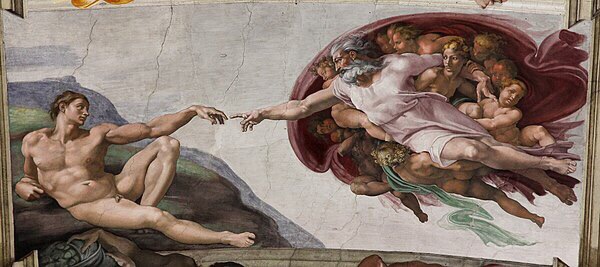
Michelangelo’s ‘Creation of Adam’, fresco on Sistine Chapel ceiling, Vatican, one of the most admired paintings of all time. (Photo courtesy: Wikimedia). Michelangelo got the inspiration for the fresco from a cloud formation he noticed one late night, when he was stoned. This has nothing ta do with the subject of this piece, though. I have always wondered why famous renaissance artists and sculptors liked to draw such tiny richards. Noticed his sculpture, ‘David’, in Florence? David’s twidledeedum is even tinier than Adam’s. Maybe Mikey had a midget richard himself and tried to feel good by sculpting even tinier richards.
————————————————————————–
There is no question left in my mind that we need a new God. The old one isn’t working anymore. We have developed a God-resistance, like you get antibiotic-resistant.
Quite early in my life, I took pains to see that I had very little to do with any holy scriptures. Most holy books fall over each other trying to tell us what evil really is. I was born a Hindu and as I grew, the concept of goddesses with ten arms and gods with elephants’ torsos began to seem laughable to me. I grew to know yet other gods whom our epics themselves depict as fallible and petty, with just as many human frailties as us humans.
Over the years, Hinduism has begun to seem more like an Asian version of a JRR Tolkien series, than a religion. While a billion of my compatriots in India have chosen to go nuts over it, I have decided not to. When they sat mesmerized in front of their TV sets for two hours every Sunday morning in the 80s, tears streaming down their faces watching the great epics, Ramayana and Mahabharata, the roads would be devoid of traffic and the city took on the look of a ghost town. While they sat glued to their TV sets, I biked to the park, rolled a joint and listened to ‘shine on, you crazy diamond’ on my Walkman.
At one point, my late mother – a pious Hindu – told me that I had to make the effort to become a believer and I asked her why. Then, when I met my wife, who is a Shia Muslim, I was curious. To please her, I tried to adopt her faith but I realized that it went one step further. It combined Hinduism’s ludicrousness with it’s own single-minded isolationist zeal. My wife felt my disenchantment and never mentioned it further. Amen.
——————————
There is a belief that the world really began to grow less and less violent after the 6th century BC and that it was due to the advent of organized religion and philosophical study.
To the east, Gautama Buddha first set the ball rolling, around the 500 BC. Buddha held that true moral purity arises from freeing oneself from material desires and petty squabbles through meditation and living an ethical life without being hurtful and resisting the temptation of coveting what does not belong.
Around the same time, 2300 miles to the north-east, the Chinese teacher, politician and philosopher, Confucius emphasized personal and governmental morality, humility in social relationships, justice and sincerity.
Buddha and Confucius were followed a few centuries later, by Jesus Christ. While the two Asians were low-key and stayed under the radar most of the time, Jesus arrived with a bang. (Oops, actually without a bang. His mommy, Mary, was a virgin). Be that as it may, Jesus came with bells and whistles, shooting stars, frankincense and myrrh. And a luminescent disc behind his head that he couldn’t ever shake off. When he turned his head it bobbed, momentarily caught off guard, but settled back behind his head once he stopped moving it.
When Jesus moved from Galilee to Judea, it was not the most oppressed region in the world at the time, by any means. Rome had been brutally crushing revolt and enslaving thousands in North Africa around then. At that very moment in time, 7000kms to the east, ethnic cleansings, torture, enslavement, rape and murder of commoners by officials of Qin and Han Dynasty China were the norm. 4000kms to the north-west, conquering Norse hordes were making landfall on the Suffolk coast, raping and looting, grabbing women and children for slave labor.
And yet, we didn’t see a Swahili-speaking mahdi in Luxor or a Mandarin-speaking wise one at Tianjin, or a blonde Gaelic prophet preaching to the masses in Northumbria. God chose a small postage-stamp sized region with a combined population of just 15000, to send in his messiah. Why?
The conquering Romans were willing to let the residents of Judea live their lives the way they wanted, as long as they submitted to the authority of Rome. They did not burn their temples and neither did they murder their rabbis. In fact, during Emperor Tiberius’s occupation of Judea, trade and commerce improved vastly, spurred by the stability brought on by the security that the mighty Roman military provided. In an otherwise arid land organized agriculture flourished, thanks to the Romans’ ingenuity with irrigation aqueducts.
The Roman empire lasted 700 years because they built secure societies in captured territories and instilled law and order for the first time. We like to curse the Americans for encircling the world in a choke hold of 800 military bases, but we do not realize how much stability that has brought and how big a boost global commerce has received from it. Imagine land grabs like the annexation of Crimea happening every other month and you would imagine a world without the American omnipresence.
—————————
Now, I am not suggesting that there was no persecution under the Romans or under the rich Meccan Merchant kings. Of course there was persecution and there was slavery. Heck, slavery at the time was the norm, like owning a Toyota Corolla. Everybody had one. Kids got slaves for their birthdays. Toys-R-Us must have been called Nubians-R-Us. Even those nice, curly-haired beacons of western civilization, the Greeks, had slaves. Even slaves knew they had to be slaves. I swear even slaves had their own slaves, somewhat like Tier-2 suppliers.
But given the violent times in which much of the world lived those days, the people of Judea were probably better off under the Romans than they would have been under the Mithradatans, the Scythians, the Bythnians, the Greeks and the omnipresent and vicious nomadic tribes that roamed the grasslands, burning and pillaging everything in their way.
Judea was by no stretch the hot spot, as regards persecution and yet the Lord chose it for the prophet Jesus Christ to deliver the wretched masses.
In any case, Jesus began to spread this altogether new concept called ‘love thy enemies’. Initially everyone thought he was nuts. The ‘civilized’ world till then, had known only wars, subjugation and misery. Boy, he must have sounded exotic, like Steve Jobs and his first Ipod.
Be that as it may, I doubt that the world is now less violent because of organized religions. Rather, I think it is less violent in spite of organized religion.
I think the reason why we have more order and less violence today, in terms of percentage violent deaths, is the awareness that has emerged out of scientific progress. I don’t have the data but Harvard Psychology Professor, Steven Pinker, does and he has quite eloquently expressed his arguments in his The Better Angels of our Nature.
We have all had the experience of reading about a bloody conflict, a suicide bombing or a shocking crime and saying, “What is the world coming to?” But Steven Pinker asks, “Wasn’t the world far worse in the past?”
Here’s my understanding of what Pinker’s book says…
Pinker’s research shows that neolithic humans killed each other with much greater frequency than today. At least 25% of all deaths those days were through violent conflict. Tribal warfare around the third millennium BC was nine times as deadly as war and genocide in the 20th century. In Medieval times, the murder rate in Europe was more than thirty times what it is today. Slavery, sadism in incarceration and frivolous executions were mundane daily phenomena of life for millennia.
Fucking hell, those days you were normal if you were born with PTSD.
Developed nations no longer wage wars between themselves, the last time that happened being 70 years back. And in the developing world, wars kill just a fraction of the people they did a few decades ago. Statistically genocide, rape, hate crimes, deadly riots and child abuse are all substantially down.
Today, deaths caused by violence amount to just .03% of all deaths worldwide (As per Pinker. I haven’t checked the stats).
What led people to stop sacrificing children, stabbing each other at the dinner table, burning cats, drawing and quartering criminals alive as forms of mass entertainment and even eating each other? The key to explaining the decline of violence is understanding the inner demons that incline us toward violence and the better angels within us that steer us away.
Those better angels led us toward the spread of government, literacy, trade, cosmopolitanism and multiculturalism. Increasingly, we have grown to control our impulses, empathize with others, bargain rather than plunder, debunk toxic ideologies, and deploy our powers of reason to reduce the temptations of violence.
Pinker, in short, says that we always had it in us to be good. We just didn’t know it.
———————————-
Things have however taken a turn for the worse. Physical violence might have lessened but there are other forms of violence in the world today, pernicious forms of evil such as ‘economic violence’, the evil that is perpetrated by the rich over the poor, by organized crime through untaxed wealth, through corruption and embezzlement. Involuntary negligent violence like politicizing a pandemic.
Oh yeah, the world is not only in need of a new God but it is in the need of a new messiah as well. Let him be a wise, good-looking Bengali messiah. There is only one and I happen to know him intimately…….. me. I can already feel the glow of the shiny disc behind my head. Wish I could somehow unstick it so I could use it as a car seat warmer in winter.
The North American caribou is a mid-sized deer that inhabits the Canadian and Alaskan tundra, far above the tree line. Timid and docile, they don’t hurt a fly and yet it is open season on them from Mid-August until Mid-September each year. The biblical “as you sow, so you reap” crap obviously does not apply to the caribou.
———————
If you are going caribou hunting in the Canadian Tundra, read this before you leave. It might save your life.
Foremost, you never call it a hunt over here. It is a ‘harvest’. You are going to harvest a deer, not kill it against it’s will. This is a wildlife conservation country. You conserve by killing, oh yeah.
In the west, you learn to couch your words. Forcibly kidnapping and transporting for the purposes of torture is rendition. Cancelling a supplier’s contract without reason, just because you can, is making a usage decision. The list of humans that are chosen by the CIA for targeted assassination by drone strikes is the disposition matrix.
But I like calling a spade a spade. It is a hunt you have chosen to go on. You will be killing in cold blood a living being who never did you any harm.
————————
Let me digress a bit here. This is called an ‘aside’ when a genius blogger veers slightly off topic, with a view to enlighten…
Australian moral philosopher, Peter Singer, speaks of ‘bio-ethics’ in his book, “Animal Liberation”. He asks us to imagine a really intelligent orangutan like say, Clyde, in the 1978 Clint Eastwood movie “Every which way but loose”. Clyde, a highly trained orangutan, acts like he is human. Even untrained Orangutans are known to be very intelligent and to display human-like emotions.
Now, compare Clyde with a child with Down Syndrome or a cognitively impaired woman stricken by Alzheimer’s. It is quite possible that Clyde might trump the above two humans in all those qualities that we take pride in as setting us apart from animals. And yet we would treat that child with Down Syndrome and that woman with Alzheimer’s with far more deference than we would treat Clyde.
So here’s the question – is it okay to stalk and kill an animal to eat it’s meat or simply for the sport, because we can? One argument is yes, it is okay to kill animals. Our digestive systems and taste buds are attuned to eating meat. We have evolved to be more intelligent and be smart enough to snare and consume. It’s the ‘cycle of life.’
The opposing argument asks us to imagine this .. ‘We men are physically stronger that women and if one assumes level of intellect between genders to be equal, men should be considered superior, so why should women have equal rights? Take slavery. Surely, there is no question white colonists were smarter than the black African natives – just as we humans are smarter than other living beings. If it is okay to hunt, why should slavery be condemned? Why shouldn’t the ‘cycle of life’ argument also apply to slavery?
——————-
My aside is over and if you still want to go harvest some caribou, read on..
It is September – caribou season, a one-month window when the Quebec Ministière de Forêts, Faune et Parcs permits you to hunt caribou. The period, coming just before the mating season begins, is well chosen. It is the time when the prey, getting horny and wanting to fuck, practices the least caution and emerges out in the open. It is the period when an animal is most vulnerable, easiest to kill.
Yeah, there is a designated season for everything. The MFFP designates the season for the type of device you can hunt with, the species, the number and even the gender of prey. The hours when you can hunt are restricted – usually a half hour before sunrise to a half hour after sunset. The zones where you can hunt, the kind of vehicle you can use to travel inside the hunt zone, when and where you can use hunting dogs or falcons, every tiny aspect is regulated. Break those regulations and you are looking at hefty fines upwards of $5000, confiscation of your firearm, license and even your truck and gear and worst, a ban if you display dangerous negligence.
Then there are the ‘random draws’. If you are a resident local, you can enter the random draw and win a tag to hunt one adult female deer or moose, over and above your regular quota of tags. Otherwise, hunting females is banned. You could also win a tag to go hunt inside protected wildlife reserves that teem with prey. That is permitted when the conservation folks at the MFFP deem it necessary to cull.
Notice that I keep referring to the word ‘tag’. A tag is a permit additional to your regular hunting license. You need to have the hunting tag on you when you are on a hunt. Non-compliance can land you in serious trouble if a ranger catches you without a tag. One tag gives you the right to harvest one animal. It is a piece of paper that specifies all the stuff that you can do, such as the type of game (deer, moose/elk, bear, boar or antelope). It is a form that has boxes on it that you’ll need to check if you kill an animal, the date and time of the harvest, the location and the sex and other descriptive features of the prey (eg: the number of points on the antler, etc).
The widely accepted way to mark a tag is to punch out (make a hole with your knife) the sections corresponding to the correct information pertaining to your hunt. So when someone says he “punched a tag” or “filled a tag”, it means he had a successful harvest. If a hunter says he had to “eat his tag” it means that he was unsuccessful, ie: instead of eating fresh wild game he is stuck dining on his permit. “Mmm, yummy tag sandwich…”
So, let’s say you punched your tag. Now you need to present the animal along with the duly punched tag at the nearest designated ranger station and the ranger will staple the tag to the animal’s ear. Up until then you are not permitted to decapitate the animal.
Wait, you’re not done yet. Load the animal back on your pick-up truck and drive to the boucherie. The boucher (butcher) will wait for the rigor mortis to pass which takes around 24 hours. He will then ‘dress’ the animal, which means skinning and removing the innards. Afterward, he will hang the animal up by it’s two hind hooves, inside a refrigerated room where the temp is maintained at around 0°C. He will leave it hanging there for around 5-7 days, to break down the collagen and allow the meat to age and gain tenderness and flavor. 2-3 decades prior, they left carcasses hanging outside in an unheated barn or shed but Septembers are a lot warmer now, so the fridge room.
After the visit to the boucher, you are done. Get back home and celebrate with a bottle of wine the fact that you murdered a living being who, given the option, would probably have liked to live on.
—————————
Let’s check out your weapon. You have brought along your TenPoint Viper. You have chosen well. A cross-bow is noiseless, except for the click of the latch and the twang of the string, hardly audible and easily drowned out by the howling wind. At 60 yards, the crossbow’s range might seem little but that won’t be a problem since the caribou don’t seem to mind it if you get real close.
So you get close, rest the barrel on something hard, aim and let loose. The Viper won’t start a stampede. A gun might.
The TenPoint Viper.
I remember the last time I used my Viper. It was on a moose hunt in 2016. The doe didn’t know what hit her, dead before she hit the ground. The bolt had pierced the left shoulder and exited through the right, not forgetting to bore a neat hole through her heart. After it exited, the arrow went on flying through the air with barely diminished momentum, disappearing in the brush beyond. I located and retrieved it, buried upto the fletching in the ground twenty feet beyond, it’s jagged saw tooth titanium point flecked with bone and sinew.
————————
Now lets backtrack to the caribou. A close cousin of the more popularly known reindeer, the caribou has the same magnificent antlers but is larger and heavier, adults sometimes weighing in at around 350-400lbs. Dressed and cleaned, a caribou will provide you upwards of 100lbs of fresh succulent meat. You won’t need to go to Costco for 6 months.
The other basic distinction is that while the reindeer can be domesticated, the caribou cannot. You won’t see any pet caribou but go up north and nearly everybody has a pet reindeer or two. The caribou is also the only deer species to have antlers on both, the male and female. In other types of deer, females do not have antlers.
The caribou, with it’s awesome antlers. The word “caribou” (meaning ‘like deer’) doesn’t have a plural. A hundred stupid caribous are still ‘caribou’.
An adult reindeer, the caribou’s darker brown cousin. It is interesting that, while the caribou’s grey-white pelt is a perfect camouflage against the snow, the reindeer has a much darker, more brownish and easily distinguishable hide. Perhaps nature noted this and decided to make the reindeer easier to be domesticated and thus, protected.
Unlike the moose or the whitetail, caribou roam in large, tight herds of hundreds, sometimes thousands. And like any beasts that live in a herd, they are way dumber – misled by the faux security in numbers. It makes them easier to kill. From the hunter’s perspective, there’s no thrill in the chase. A caribou herd is too closely packed. There are just too many of ‘em. All you need to do is aim in the general direction and you’ll have your allotted five kills.
But nature has given the caribou an even chance at survival, a compelling one that keeps them from being hunted with the same gusto as the whitetail and the moose – it is their habitat, a barren forbidding sub-zero expanse where the sun never sets in summer and never rises in winter, where if your frozen fingers fumble to cock your rifle or latch your crossbow bolt and aim within a few seconds at an approaching bear or wolf pack, it may turn out to be you that is the prey.
We have gotten too used to our creature comforts. Today’s hunter doesn’t want to fuck around in the -20° cold and face the very real possibility of losing the tips of his fingers and nose to frostbite, when he can just drive an hour east of Montreal and get a nice juicy whitetail, tag and register the kill, drop the animal off at the neighborhood boucherie and be back home by sundown. After 10 days, you drop by the boucherie and collect your 80lbs of succulent venison, in the form of neatly chopped and shrink-wrapped portions, take them home and stick them in your basement freezer. The whole hunt will cost you less than $200 including gas.
In comparison, a caribou hunt is a $15000 grand adventure, a northern safari, thousand miles from home, on barren land hundreds of miles north of the tree line.
———————
The first goal on a caribou hunt is not to punch your tag. It is to make sure you have the tools you need to survive the elements and get back home alive. Besides your Viper, bolts and paraphernalia, you packed your Bushnell Trophy binoculars, Galvatron flashlight, Nikon Weatherproof, battery packs and truck charger. And sunscreen and chapsticks. Dry skin and sunburn are omnipresent above the 60th parallel. Then there is your ‘peepee and kaka stuff’ – toilet paper and baby wipes.
You could pack a handgun, like a lightweight Glock, for emergencies(like frisky bears and wolf packs), but be aware that handguns are banned during season. But if you weigh the risk of being mauled against a fine, you would choose being fined wouldn’t you? A Glock however is not an absolute guarantee. It is just a fighting chance – if you broke your ankle and you’re lying in the snow, your back resting against a granite outcrop and you are trying to figure out how long it will take to drag yourself to the truck which is idling just beyond that ridge over there and at the same time, you are watching a large brown bear (otherwise known as ‘Grizzly’) approach, the chances he will get to you first and hurt you real bad are very high. It will have to be a head shot, right between the eyes, if you want to come out alive. Personally, I practiced at the range at Dorion for that eventuality, before I went on my one and only caribou hunt.
And medication. Pack a suitcase-sized first-aid kit that has, besides wound dressing paraphernalia, pill bottles of Tylenol(pain), Imodium(diarrhea) and Dramamine(motion sickness). Dramamine, because the rides (including the hair-raising ten-seater flight to the destination) are bumpy.
And chocolates – lots of Mars, Coffee Crisp and O’Henry bars. Nothing like chocolates to quell hunger and keep you warm.
————————
This is the Canadian Central Barren Ground, otherwise known as the Tundra. The caribou here are the almost white “barren ground caribou”. If you choose to hunt a little ways down south, but still above the tree line, you’ll come across the slightly dirtier-grey “woodland caribou”. Both species do not believe in migration. Dumb as doornails that they are, they just stay put and wait for you to come get ‘em. Here September is late fall.
Your Casio Rangeman says its 2pm and the temp is -20°C with wind chill. By late November it will have crossed -40°C. You have been outside the shack two hours and already the tips of my fingers and toes are numb and you are beginning to lose feeling in your feet, even with your fancy thermal socks on. That is a sign that you don’t have much time left before you have to get back inside the truck.
You are 20 miles south of Whapmagoostui, a Cree native American village (population : 20) at the edge of James Bay, the little spit of water which makes the 500,000 sq.mile Hudson Bay look like it is sticking its tongue out at the rest of Canada.
Tundra Adventures, the outfitters, had provided the charter flight to haul you over to the nearest airstrip at Kujjuarapik from Gaspé, where you had left your F150 at the parking lot of the Auberge sous les Arbres hotel. For 15,000 smackeroos you got a fully stocked shack at the site, a skiddoo (snow mobile), a Toyota Tundra with 100 free gallons of gas (ten bucks a gallon thereafter), a satellite phone and an insurance policy (subject to having a valid driving permit and hunting license). The policy included a free airlift to the nearest emergency ward, wherever that might be. Of course, you would have to be able to get your frozen fingers to dial the emergency number on the phone. Frostbite and hypothermia are unforgiving to fingers.
The Pilatus PC-12 with it’s single Pratt and Whitney PT-6 turbo-prop had been a scary flight. The forbidding sight of the terrain 12000 feet below was scary – sapphire blue lakes and snowy white pines, little patches amid a horizon to horizon expanse of white nothingness. If the Pilatus went down in there and you somehow survived the crash, you were a dead man for sure. Even a satellite phone wouldn’t save your ass in time for the medevac to arrive.
There had been six others in the charter flight, four hunters just as insane as you and two local Cree businessmen. The four were hardened arctic hunters – thrill seekers who had done this multiple times and got a kick out of, much like the American alpinist, Dave Hahn, who kept going back to the Everest, fifteen times between 1999 and 2013.
You learned that the four had always hunted in a group, but you are alone. Lone Daniel Boones are rare and they command a certain respect in the tribe. The four admired your spirit for that reason.
You are of course stupid to be alone. The Tundra is singularly unforgiving toward folks who venture out into the wilderness alone. The chances of your making it back in one piece, not frost-bitten and not bear-mauled, are less than four in ten when you’re alone. You won’t hear a bear coming until it is lightening your weight, removing pieces of skin and flesh off your back. If its any consolation, he won’t eat you. Bears don’t enjoy human flesh. He will just want to maul you to death, that’s all.
Or say your Toyota Tundra broke down on the hard-packed ice thirty miles from Whapmagoostui. Or maybe you just switched off the ignition, inadvertently. In the Tundra you don’t switch off the ignition. From the time the outfitters handed you the keys to the truck, right up until you hand them back three days later, the engine will be running, non-stop. You just have to keep gassing it up, time to time.
But it can happen – the Toyota is a machine after all – and when it does pack up, that is another way to die in the Tundra. For that reason, Caribou hunting is always done in groups of at least four, in two trucks.
Another reason for the multiple hunting buddies is you are permitted by law, four caribou per person and you’ll get your four kills within the first couple of days, easy. But if you are alone, what are you going to do, carry their 300-lb bulk all on your back all the way to the truck? And if you have shot two at the same time – when you’re back for the second carcass, there’ll be just blotches of blood left on the snow and a pack of twenty timber wolves, a welcoming committee waiting to tear you to pieces.
But then you are just that – a loner – and you are prepared to face the challenges that come with being one. The 18-round Glock in your jacket won’t save you from a wolf pack. They will keep coming at you. But it will scare away a bear for sure.
You might remember Ken Kesey from of his 1963 novel ‘One Flew Over The Cuckoo’s Nest’ and it’s more famous film adaptation. By the time the movie was released in 1971, Kesey was already creating a stir within conservative America.
Kesey was quite a piece of work. He was the kind of guy to whom if something looked weird, he was probably going to try it. He volunteered for the testing of a psychotropic drug that was later to be known all over as LSD or simply acid. He ended up loving the stuff, happy that he was getting paid to do a fun thing like getting high on it.
For the tests, Kesey had to be kept under observation in a hospital ward. One night he crept out of his bed, broke the lock of the infirmary and stole as many vials of LSD as he could lay his hands on. Fortunately there was no inventory list and his nocturnal raid went unnoticed. For the rest of his hospital stay he was perpetually zonked out of his mind, even on days he was not administered the drug, leading the researchers to draw entirely erroneous conclusions. And Kesey? Yikes, he was hooked. Cuckoo’s Nest incorporates some of his own experiences inside that hospital.
Ken Kesey became one of the symbols of the counterculture hippie movement that began in the 1960s. By the time I became a part of the counterculture scene, it was no longer that counter. Heck, I had pot-smoking professors in engineering school. Everyone was stoned. While I drew the line at an occasional Saturday night pre-movie joint of Trichy weed or fresh moist ‘Tal hash, the other guys were doing pills like mandies (Mandrax), lippies (Lippitone) and dexies (Dexedrin).
In 1970s Chennai in southern India, where my engineering school was situated, you could get powerful ‘downers’ and ‘uppers’ over the counter fairly easily. All you had to do was find a bent pharmacist and mumble a phony doctor’s name to him which he made a note of and then charged you a rupee a pill. For a broke student in those days, a rupee was a fortune.
The go-to guy for pills was a pharmacist near Moor Market, a cavernous building right next to the rail station, which housed hundreds of tiny stores crammed together, selling stolen and second-hand stuff – books, household appliances, electronics. Even the pennies there were bent. (Don’t try looking for Moor Market now, it doesn’t exist anymore).
The pharmacist himself was a heavy user, stoned out of his mind on mandies most of the time. Mandies and Lippies were very strong sleeping pills and the kick came when you resisted the drowsiness. If you took two of them, they could put you in such a tailspin that when you finally stopped resisting the snooze and let go, you ended up sleeping the next 48 hours, dead to the world.
I tried a Mandy once but found that when I spoke, the words came out funny. For example, if I wanted to say, “lets go for a movie, dude”, it sounded more like, “leh wo foah yayy mooo, joo”. After that one time, I decided that those kicks were not for me. Talking like a retard was not my scene.
Dexies on the other hand, kept you awake. I tried dexies too but like mandies, it was just once. Boy, did they keep me awake. I was stark, raving awake. The downhill after the drug wore off, was really downhill. I slept for a whole day.
Pills were very much in the scene at college, oh yeah. Guys took dexies going into class and mandies and lippies coming out of class. At any given time of the day, around half the population in campus was staggering around.
I didn’t mind getting high on weed occasionally those days, but I got stoned only to listen to music with friends, within the confines of my dorm. I had to have control, even when I was zapped. If I went out in public, stoned, there was a possibility I might start behaving like a jerk and that I could not tolerate.
Bands like Jethro Tull, Jefferson Starship, Uriah Heep and Pink Floyd were great music to get stoned with. Here’s the thing about marijuana, for those who have never tried it – even the crappiest music sounds like the work of a genius. Every tinkle, every note and every beat is sort of embedded into the consciousness through some sort of osmosis. The most mindless lyrics sound intelligent and deep. If you are lying down, the bed will seem to float up after a while. Even movies….if you are watching something really crappy, like one of those old KL Saigal films, it will seem like an edge of the seat masterpiece.
But if you are tired, depressed or stressed out and if someone passes you a chillum, don’t go for it. Just as it enhances the good, weed will amplify the bad too and your trip is quite likely going to turn into a nightmare.
Here are the other things weed does to you…. it makes you really hungry as hell. You’ll want to eat just about anything you can lay your hands on. And then there’s sex. If you are with someone who is stoned too, sex after a joint is just beautiful. You will turn into the world’s greatest lover. And she, Raquel Welch. Yucky stuff, like going down on her that you wouldn’t dream of doing otherwise will seem natural for you to want to do. Cross-eyed, sniveling, skinny, flat-chested, bad breath, smelly armpits, they will seem overpoweringly sexy to you.
In the end, after the effect of the marijuana wears off, you will fall into a deep restful sleep and if you haven’t had one too many joints, you will wake up fresh, without any hangover or any other after effects at all.
————————————
Wait, before you begin to think smoking pot is great, there are long-term side effects to regular marijuana use. Besides medical issues such as BP, lung cancer and pulmonary problems like bronchitis, prolonged use also affects you psychologically in tiny incremental stages. It makes you lethargic, impractical, unrealistic, aimless and generally unconcerned about your future. It makes you edgy, impulsive and easily excitable. Prolonged marijuana use is also known to play havoc with short-term memory and is believed to be responsible for a sizable number of incidences of Alzheimer’s Disease.
Nowadays I see how marijuana is becoming more and more socially acceptable and easily available and legislation is being tabled all over the world, to legalize it’s use. Frankly, I do not think that legalizing marijuana is a responsible thing for governments to do. Look at cigarettes. It might sound crazy now, but back in the 1930s, doctors actually recommended smoking ‘to remain fresh and alert’.
“Give your throat a vacation,” says this doctor in the 1931 Camels ad. Yeah, right.
——————-
ThIs fun and frolic-themed Peter Stuyvesant ad was a fixture on the back cover of Time magazine right up until the early 1990s
——————————-
”You’ve come a long way, baby,” says this 1970s Virginia Slims ad, attempting to link feminism and emancipation to smoking
———————————
Clean and healthy living never had a chance. Having an icon like James Dean model for Marlboro got millions of teenagers across America hooked.
———————————
The pendulum has swung. Today, cigarette ads are banned outright, everywhere across the world. In Quebec, stores are banned from even displaying cigarette packets on shelves. They now have a kind of hinged flap behind the counter that, when down, hides the packs from the eyes of a customer standing at the counter. The aim is to keep minors from seeing the cigarette packs and wanting to smoke. Seems a bit stupid if you ask me but any effort to reduce smoking is welcome. Look what banning cigarette ads, prohibiting smoking at public places and constant anti-smoking campaigning has done – cigarette smoking in North America has fallen from 45% among adults in 1950 to 19% in 2010. I am one of the 19%. I left smoking a decade back. Yay.
Cigarette shelves with their flaps down, behind the counter in a Quebec convenience store
—————————-
Then there was hooch.
Back in the 1970s, the Indian state of Tamil Nadu where my engineering school was situated, was under prohibition. Regular liquor brands were available on the black market but penniless college kids like me couldn’t afford them. And as 1920s America showed us, the moment the prohibition began in 1972, our own Al Capones, Joseph Kennedys and Dutch Schulzes came out of the woodwork with their bootleg liquor – Arak, an often lethal concoction.
Just outside the Velacherry gates of our college campus was a sprawling slum that had a hooch den. It was a ten by ten wooden platform in the center of a clearing in the palm trees. In one corner of the platform sat a massive, menacing lady with huge jugs, a dirt-caked drum of hooch by her side. For the villagers she had a look that said ‘you get outa line by even a micro-inch and you’ll get your butt kicked outa here’. She plunged the glass inside the drum with her grubby hand and handed the customer the spilling and sploshing drink.
Everybody called the woman Amma (‘mother’, in Tamil). She operated the den under a single light bulb that was connected by a long wire which traveled overhead supported by branches and palm fronds to a nearby hut that had electricity. The lamp threw long eerie shadows. Scrawny, inebriated day laborers staggered up to the woman with their hands clasped together in supplication, imploring her for one last slug for the road, signaling that they had run out of cash. For her financial well-being, Amma was mandated to keeping them hooked but she decided who could have one more and who could not.
A typical Indian hooch den. The Amma is off camera.
————————-
Students like us were given the red carpet treatment by Amma. Somehow she felt legitimized and honored by our presence (the way Kim Jong Un must feel when he gets to meet world leaders). Rickety steel chairs were hastily arranged for us and we were served the Arak in glasses that had been equally hastily washed in a nearby stream which didn’t exactly originate from a Swiss mountain spring. Twenty pairs of drunken eyes then watched us spellbound as we downed the stuff. The taste was terrible and if one of us made a face like a grimace, there was raucous laughter all around.
The liquor was colorless and if you looked closely, you could find stuff floating in it, some of the stuff multi-legged, able to propel themselves on their own. If you were desperate to get high as we sometimes were, then you closed your eyes, took a deep breath and downed it in one shot. Quite honestly, I am lucky to be alive and disease-free.
——————————-
But in all this, there never was any of the really hard stuff like crack or heroin going around in our college dorms, at least not in my time there. Thank the Lord or I would have tried that too and who knows, I might have gotten hooked.
Eventually after five short years of merriment and bliss, I graduated with a bachelors in Mechanical Engineering with honors. I recognized that I had to earn a living and so I left all the stuff we got high on, behind. Thereafter I touched only beer occasionally. No, make that every weekend, until June 2013, at which point I stopped even the beer. I am now a teetoatlah. Yay.
——————————-
Sometimes I think back on my college days and wonder what made me pull back from the brink of addiction while so many of my classmates succumbed. I recall with sadness a dear hostel-mate, a promising undergrad, who plunged to his death when he climbed out onto a 3rd floor window ledge of our dorm completely stoned, lost his footing and fell out head-first.
But I Didn’t end up splattered on the concrete. I think my holding it together had much to do with the company I kept at college, the circle of friends who coalesced around me and matured with me through engineering school. Like me, they experimented and got high but knew when was enough.
I don’t know if the Virginia Slims girl managed to get there, but I’ve come a long way, baby.
“Business is by nature collusive and conspiratorial, readily congealing into monopolies and cabals and it is a good thing, a must for Britain’s prosperity. We must fix the highest gain that can be squeezed out of the natives.” – Robert Clive (1725-1774), British business executive, army Major General, opium trafficker, plunderer and mass murderer.
——————————————–
Crest of the British East India Company, once the world’s largest business organisation and the world’s only commercial outfit that boasted a standing army of 250000 (Image source: Wikimedia)
On a bone chilling evening in January 1601, Britain’s Queen Elizabeth signed a royal charter, granting a joint stock company that had 220 merchants working for it, a trade monopoly in all the regions of the world that lay to the east of the Cape of Good Hope. Thus, the British East India Company (EIC) was born. In the 280 years that it existed, the EIC grew to be the world’s largest and single most unscrupulous business entity that man has ever known.
The Brits had it good, didn’t they? East of the Cape. With a flick of a ink-dipped quill, an ugly overweight woman with bejeweled fingers gifts half the world to just one company to do business with. Look at them now, making feeble attempts to look independent with their Brexits, Megxits and so on and no one takes them seriously anymore. The fall took another 350 years but good riddance anyway. Now I, an Indian, can tell a Brit to go fuck himself, better still, ”fuckxit”. No one will bat an eyelid.
The East India Company began with a simple mandate – commerce. It brought in silks, textiles, spices, coffee, indigo, tea and ivory from India and carpets and nuts from Persia and the rest of the middle-east, in exchange for gold and silver. The EIC leadership was made up primarily of British military officers and therefore it backed up it’s exclusive business with a standing army of 250000 soldiers, artillery and a fleet of ships.
And opium, the EIC dealt in lots and lots of opium. The quantities it trafficked would put the Colombian cartels and the Calabrian ’Ndrangheta to shame. The EIC made opium consumption fashionable. You weren’t a member of the 18th century London haute société if you didn’t regularly peruse opium. Where do you think Sherlock Holmes got his daily fixes from?
There was competition of course, though not from other British business entities. There were other jackals at the kill – the Dutch East India Company, the French East India Company and the Portuguese East India Company. And they had been there before the EIC. India had many suitors but the Brits won out, through sheer military muscle.
To make all that trade happen smoothly and profitably, the logistics had to be worked out. The EIC first set up an office at a coastal village with a natural harbor in south India, called Machlipatnam. From there, through the 17th century, it spread and established fortified trading posts at Mumbai, Chennai and Kolkata.
—————————————-
The logistics of the day weren’t like the way they are now. A business trip to and from India by a boss from the East India Company’s HQ in London was more like how we see inter-planetary space travel today – long and hazardous. Each trip to India was a two-year expedition, with four to six fully armed ships, mounted at considerable expense and fraught with immense risk. The waters were uncharted since the maps were rudimentary, the weather patterns were unfamiliar, tempests and 50 foot waves were frequent and as if that was not enough, pirates prowled the seas for easy pickings and they took no prisoners.
Given all the hazards, the chances that you would be back, sipping sherry with your mistress in a London salon at the end of it were 20-80.
If you wrote a letter to your branch rep in Kolkata, you would be lucky if his response came within the year. Under these circumstances, the EIC branch heads or ‘Governors’ were given an enormous amount of independence in how to conduct their business. And what happens when you have an employee at the other side of the world doing business any which way he likes? He throws the rules to the winds, kicks native butt and enriches himself of course.
Take it easy, don’t begin envying the Company men. Life was hard. Enriching oneself in the face of attacks from the French or the Portuguese, who were the other hyenas at the kill, or even the armies of the native rulers, or killer diseases like typhoid, flu, TB and malaria, the life of an EIC rep was not for the faint-hearted.
The EIC’s trading post chieftains were merchants and military commanders rolled in one. They had in their payroll, large armies that protected what they saw as their turf. If a regional raja or nawab didn’t negotiate business with them reasonably, he was looking at being invaded and ousted.
The Nawab of Bengal, Siraj ud-Daulah, was one of those unfortunate nawabs who paid with his life for his obstinacy, in the Battle of Plassey (c.1757). Those days, the British were still just traders looking for a secure base from which to conduct their business with Indian merchants. When they began to look like they were digging in and building a small empire within his territory, the Nawab told them to desist and leave.
Imagine a empire-building testosterone pumped white guys being told by some two-bit brown nabob to get the fuck out. Robert Clive took it personally.
In those days if you spoke up, you had to back up your words with military force. The Nawab and his league of like-minded Bengali military commanders had on their side, 45000 infantry and 20000 cavalry. Artillery had been provided by the French who saw the British as a threat to their own French East India Company, a similar ‘carpet-bagging’ outfit under the then French King Louis XIV. The French held two bases in India, one in Chandannagar, 50kms from Kolkata and the other in Pondicherry, a coastal town south of Chennai.
The EIC’s commander, the robber-baron I mentioned earlier, Colonel Robert Clive, had just 3000 men. The Nawab’s firepower should have been sufficient to beat the crap out of the Brits. But Clive had guile and a cool head. Like any successful military man, he had human intel and he looked for the enemy’s weaknesses. He came to know through a Bengali birdie that the Nawab had a huge stockpile of gold and silver that he had grabbed from his subjects over the years as tax and had not thought to share with his equally rapacious commanders.
Clive sought out those commanders and got them to change sides, after promising them a share of the spoils (which by the way, they didn’t get when the dust settled). The Nawab ran for his life, was caught and executed. What can I say? A Nabob who didn’t share was a dead Nabob, I guess.
Siraj-ud-Daulah has been portrayed by Robert Clive’s biographer as an 18th century Cesare Borgia, a mercurial monster of vice and depravity, given to harsh cruelty toward his subjects. I read somewhere that when he sent for his senior commanders, they trembled, much like the way those New York Mafioso felt when they were summoned for a sit-down, not knowing if they would come out feet first. Even if Bobby Clive’s biographer had been biased, enough is on record to suggest that maybe the Nawab got what was coming to him.
After his victory, Clive installed Mir Jaffar, the commander who had switched sides, as the new Nawab of Bengal and did what his EIC masters in London had emphasized was his Key Perfomance Criterion – loot, a word that actually originated from the Bengali word ‘loot’, which means just that – loot. Clive’s men looted Bengal’s treasury, loaded the gold and silver worth over 5 million 1757 dollars (which is around $ 1 billion today), on to a fleet of more than a hundred barges and sent them downriver to his base at Kolkata.
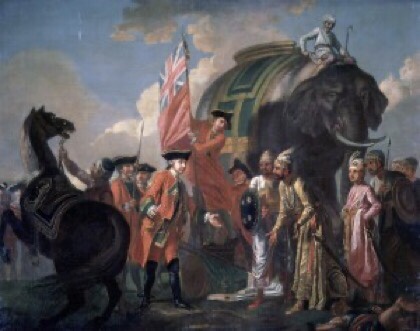
“Where the f—k is my share?” Sucker of the day, Mir Jaffar, with Robert Clive after the Battle of Palashi. (Image source:Wikimedia)
Clive got to keep 10% – 500000 dollars (~ $100 million today) for himself – finder’s fees, I guess. Palashi was the first step in the creation of the British Empire in India. It is perhaps better understood as the company’s most successful business deal.
500K here, a bag of diamonds there and Robert Clive went on to become one of the world’s richest men. Unfortunately, he broke the golden rule for drug traffickers and it took his life – he got hooked on the very opium that he traded in, to dull the pain that one historian says was caused by gallstones. One night, unable to bear, the constant pain, Clive over-dosed in a drug-riddled moment of frenzy. Poetic justice, innit?
In India, right up until the 1970s, they still had roads named after those British colonials. Thyagraja Marg in the heart of the Indian capital, New Delhi, was till recently Robert Clive Road, while in England the statue that adorns the frontage of the British Foreign office is his. Clive’s partner in crime, Warren Hastings, the first Governor General of India, had till the late 1970s numerous streets, buildings and parks named after him all across India. Oh yeah, we Indians have been in boot-lick mode for decades after gaining independence.
There was another act that the East India Company excelled in, just like the Exxons of today who splurge millions on ‘green’ ads. It went to great pains explaining to the public at home how it was delivering the wretched Indian natives from deeply ingrained backwardness, how it was planning to remodel education, how the ‘ignorance and superstition that was inherent in Hinduism’ was being addressed by dedicated Christian missionaries in its payroll. (The world hadn’t yet woken to pedophilic Christian priests but let’s just say that the first missionaries must have had a ball in India and leave it at that).
———————————
As the decades passed and the 19th century dawned and the Mogul Empire waned, the EIC’s mandate expanded, from just commerce to subjugation. The East India Company grabbed more and more territory as its own until all of India was theirs. The new nabobs were now the EIC chieftains like Robert Clive and Warren Hastings, wielding enormous power, not only in India, but in England as well, where they bribed, threatened and cajoled their way into both houses of Parliament.
The EIC now had, not only a trade monopoly, but also the right to tax the Indian citizens, mint its own coins with the company crest and maintain a 250000-strong army. For a while, before the bubble burst, EIC owned not only India but England as well. Profit became everything. It is universally believed that the great Bengal famine of 1770, which claimed the lives of 10 million of Bengal’s poor and the wretched, was brought on by rapacious greed and the lack of governance of the EIC.
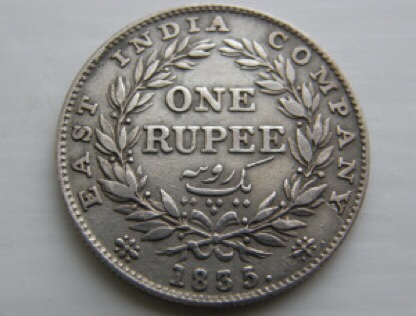
A one rupee coin issued by the East India Company (Photo source: Wikimedia)
Seeing that the harvest was doomed, EIC’s traders started buying up all the grain that they could lay their hands on, driving up the price and making it impossible for the poor Bengali commoners to feed their families. As if that was not enough, the EIC decided to raise taxes so that revenue levels would remain stable.
Those who aspire to rule have a responsibility toward their subjects. EIC was not concerned about any such responsibility toward the native Indians. But what the EIC honchos hadn’t bargain for were the men with a conscience back home (ie: if one can imagine colonizers having consciences). There was Adam Smith (1723-90), Scottish moral philosopher and economist and Edmund Burke (1729-97), an Irish author, orator, philosopher.
And a prick named Lord Thomas Macaulay (1800-59), historian and Whig politician, who loved listening to his own voice. Macaulay had gained infamy for attempting to wipe out the native languages of the colonies and replacing them with English He once remarked that the world was divided into two categories of people – civilized and barbaric. Britain of course was, in his scheme of things, the torchbearers of the former category and the colonies, the latter.
But even an asshole like Macaulay was alarmed enough by the shenanigans at the EIC that he had this to say about it…..“The traders of the East India Company simply wrung out of the natives every drop of blood as speedily as possible, so that they might return home to marry a peer’s daughter, buy some rotten borough in Cornwall and throw balls in St. James’s Square.”
All these “venerables” denounced the East India Company as a bloodstained bunch of thugs, bent upon mercilessly raping a nation of its wealth. Some historians consider the aftermath of the 1770 Bengal famine as the beginning of the end of the East India Company’s presence in India.
Around the same time as the Bengal famine, other events were conspiring to pull the rug from under the EIC’s feet. Its stock price crashed on the London market, in lock-step with a Europe-wide financial meltdown. The EIC’s handling of the Bengal famine came to the notice of the British parliament and did little to bolster investor confidence.
By the turn of the 18th century, the British government had taken away EIC’s monopoly and finally in 1873, the East India Company ceased to exist. India now became a full-fledged colony of the British Empire.
——————————
During its heyday, the East India Company not only established trade through Asia and the Middle East but also effectively became the ruler of territories. It created colonies like Singapore, an island that the EIC purchased from the ruler, the Sultan of Johor, and developed into one of the world’s richest and busiest mercantile hubs.
The East India Company has had quite a few parallels, in the modern age. The American conglomerate United Fruit Company owned every tiny Central American nation, to ensure unimpeded imports of fruits, especially bananas, into North American and European ports. The American mob co-owned Cuba, with the American telephone monopoly International Telephone and Telegraph. The solid gold telephone that the ITT rep presents Batista in Godfather II, really happened.
Some commentators opine that if Stalin’s Soviet Union hadn’t gone overboard with its purges and gulags, American style capitalism would have lost out to socialism and we would not have had to see the Reagans and Thatchers gloating obscenely, mistaking overkill for victory of the forces of good.
————————-
The late comic genius, Robin Williams, put it quite simply in December 2008 when he was performing in front of Britain’s Prince Charles. Referring to the placard that the US President, Harry Truman, had hung up on the wall behind his desk, which read, ‘the buck stops here’, Williams gave it a twist – ‘Yeah right, the buck stops here…for just a wee moment….and then it sorta ambles on, to Boeing and GM.”
It is the most abundant fruit in the world, available all year round at every grocery store regardless of ethnicity. Whether it is a mom and pop operation or it is a large chain store in Beverly Hills, you’ll find it occupying multiple shelves and if you look closely at the UI tags, you will never see a price more than 99¢/lb.
It is also perhaps the most consumer-friendly fruit known to mankind, with no worries about whether it has been washed before you sink your teeth in. Just peel and chomp. It leaves no aftertaste and I guarantee your breath won’t smell from it. You can walk while you chomp and when you are done, just flick the peel into a garbage bin without missing a step.
And don’t worry about sticky juices squirting from it and messing up your fingers or shirt front. It is firm but not hard, sweet but not chocolaty and as you chew, it melts inside your mouth with ease, without sticking to your gums or between your teeth.
It is packed with nourishment. Rich in manganese and potassium, vitamins B and C and dietary fibre, it is the perfect little snack to gobble if you are ravenously hungry but have to watch your weight at the same time. If you have ulcers and cannot remain on an empty stomach for too long, one is enough to keep the gastric juices at bay. And I have never heard of anyone who has an allergy to it.
You can gobble down as many in one sitting as you like. There’s no downside in eating too many of them. Just be sure to gargle afterward, as the little bit of sugar that is in them may cause tooth decay, long term.
Horny middle-aged women too have a unique use for it but I am too straight-laced to tell you about that.
Meet everyone’s favorite snack – the banana, the world’s fourth most popular food item after rice, wheat and milk. If you live anywhere on earth, bananas are sure to be a permanent item in your grocery list. Transported raw, they get just ripe enough by the time they are displayed on the grocery shelves.
——————————-
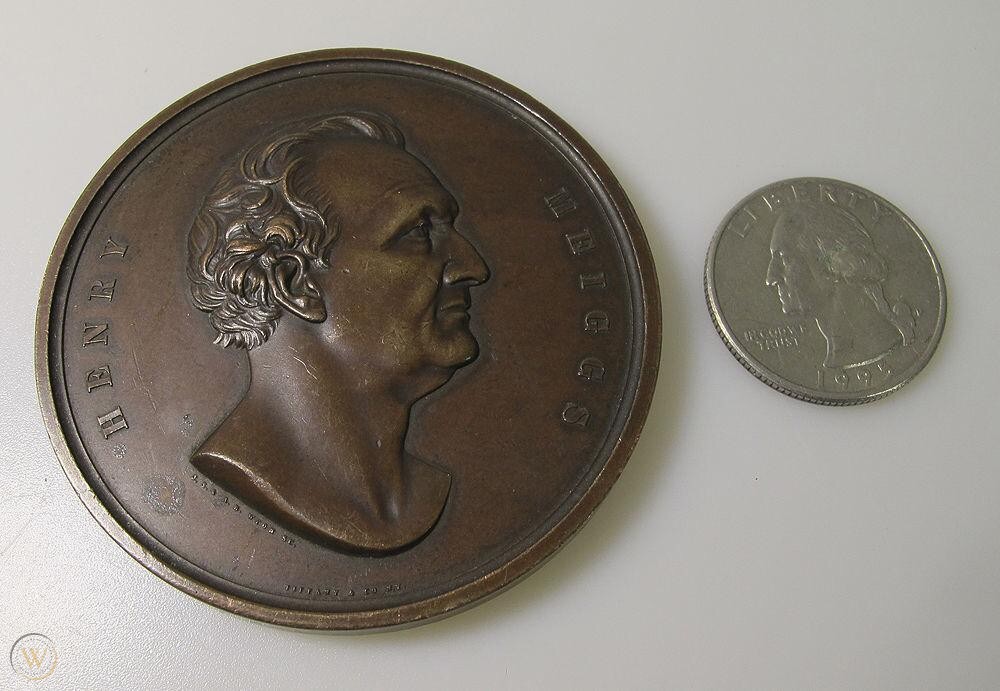
There was a time when the banana was a virtually unknown fruit in the developed west. That is, until an American named Henry Meiggs (1811-77) inadvertently started the banana boom.
Meiggs was one of the early robber barons of American business, an enormously powerful and ruthless individual who stopped at nothing to build a vast empire and lord over it. He was the torch bearer for the Kennedys, the Du Ponts, the Rockefellers and the De Beers.
Born in Catskill, NY, Henry Meiggs made his mark building railroads for Chile and Peru. Endowed with great entrepreneurial talents and a complete lack of scruples, Meiggs battered and bludgeoned his way through entire Latin American governments to make his millions.
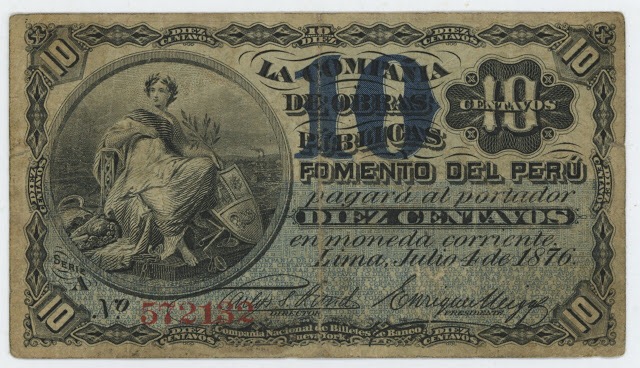
So powerful had he grown by the 1850s, that Henry Meiggs was considered Peru’s de-facto monarch. Here is a Peruvian bank note with his signature on it. ———————
In 1860, while Meiggs was in Peru, he was approached by President Tomás Guardia of Costa Rica, who wanted a railroad built to connect the Caribbean Sea port of Limón to the national capital, San José. Here is where the great banana story began.
At that time, Costa Rica’s economy was based mainly on coffee exports. Coffee was grown in the central plains around the capital city of San José and transported by mules to the nearest port at Puntarenas on the Pacific coast. Due to the ruggedness of the terrain to the east, the mules could not go the other way, to Limón on the Caribbean coast, from where the lucrative European market would have been easily accessible, across the Atlantic.
There was no Panama Canal in those days and so the coffee would travel by ship eastward from Puntarenas. Creating a railroad to carry the coffee east, direct to Limón on the Atlantic seaboard and thereby gaining easy access to Europe’s coffee drinkers became top priority.
Meiggs took the mega-contract but before he could begin building the railroad however, he died. Eventually, 14 years after his death, the construction was restarted by one of his nephews, Minor Cooper Keith, 14 years after his death.
Minor Keith eclipsed his illustrious uncle in ruthlessness and ambition. He saw opportunities that his uncle hadn’t. He and his partners got the Costa Rican government to donate free of cost 800,000 acres of prime land along the railroad he had built and he promptly turned the land into an enormous banana plantation. The new venture was called Tropical Trading and Transport Company.
While the passenger load density on the new railroad proved disappointingly low, Keith found that transporting the bananas he grew was enormously profitable. The railroad carried the bananas from his plantations to Limón and from there on to the US and Europe by ships that he and his partners owned and operated.
What is capitalism without mergers? And so it was with Minor Keith’s business. In time he merged his company with an equally gi-normous rival banana grower, Boston Fruit Company and the newly formed behemoth was named United Fruit Company (UFC).
It was a synergy made in heaven – Minor Keith’s railroads and ships and Boston Fruit’s pet Central American dictators and tax-free land that was ideal for banana plantations. At it’s height, 1930s to 50s, United Fruit Company directly controlled and distributed 90% of all bananas grown in Central America, the Caribbean and Northern South America.
In the movie Godfather-II, the rep of ‘General Fruit Company’ is shown at the conference table with the Cuban dictator, Fulgencio Batista, who was later overthrown by Fidel Castro. It is a thinly disguised reference to United Fruit Company which in it’s heyday, backed up by a garrison of US Marines, behaved like it owned Cuba.
The dictators, whom United Fruit (and the US government) went to bed with, were essentially nothing but powerful thugs inside a backward, desperately poor agrarian region, their main crop – bananas, a tasty novelty that America and Europe were just beginning to relish. These thugs maintained a highly unequal feudal structure that terrorized and subjugated the common folk.
The term Banana Republic was first coined by the writer, O’Henry, in his 1904 novel, “Cabbages and Kings”, to describe a fictitious Caribbean country called Anchuria, his narrative inspired by what he saw during a visit to Honduras. O’Henry meant Banana Republic to be a derisive term used for poor, backward nations that are riddled with corruption and whose despotic rulers were beholden to the United States for their personal survival. Nowadays the term is used more broadly, to refer to any autocratic regime ruled by a demagogue who thinks he is the law. Russia – and in some ways, even Trump’s America – can fall into the category of a banana republic today.
Interestingly, partnerships with the US were invariably unstable. Whenever the tin pots could not deliver the free and safe environment necessary for American companies to operate in, or if suddenly the ruler of the republic started feeling that the Americans weren’t paying him enough, disputes broke out and an invasion force of US Marines came in, to facilitate a coup and install a more pliable tin pot dictator.
Direct American military invasions into sovereign Caribbean and Central American countries were rampant in the first half of the 20th century. Between 1900 and 1945, the US invaded Honduras five times, the Dominican Republic three times, Haiti twice, Nicaragua thrice, Cuba thrice, Panama thrice, Guatemala twice and El Salvador once. This, in spite of the fact that none of these nations had ever done the US or any of it’s citizens any harm.
Wherever the marines went, CIA black ops agents were not far behind. They followed the GIs, torturing and murdering opponents of the regime they wished to install, training counter-insurgent death squads for those puppet regimes and terrorizing the general population. They were like the Nazi scum known as SS Einsatzgruppen who followed the regular Wehrmacht troops into the Soviet Union as a part of Operation Barbarossa, the invasion of the Soviet Union, in 1941.
———————————
In order to justify America’s strong-arm tactics in Central America and the Caribbean in front of the world, the US began a PR blitz that made America the civil liberties champion of the world and the Soviet Union the fall guy, even though declassified CIA documents show that it was all spin and that there had never been any commie threat at that point in time (The Cuban Missile Crisis came decades later).
The man chosen to be America’s spin master for the PR barrage was a very able guy whom the Americans proudly tout today as the ‘father of public relations’, a man named Edward Bernays. He achieved unparalleled success in projecting America as a benevolent, pain-filled and saddened nation which had no choice but to invade and save democracy and the rule of law. His successes led PR to ultimately become a regular course taught in American universities. It remains the only stream of study in the world that adds no value to your skill set but only shows you how to get a PhD in creating “alternative facts”.
———————————
By the late 1920s, United Fruit Company was huge, wielding power that would be comparable to the political clout that Google, GM, Microsoft or Goldman Sachs have today. UFC became the de-facto face of the US Government, bribing, threatening, cajoling, coercing and extorting it’s way into the governments of those tiny Central American nations.
Only one man was responsible for making United Fruit Company the largest business entity in America in the 1940s and everybody knew him as “Banana Sam”. I’ll tell you all about him in Part-2 after I have traveled to the fridge for amother beer.
You might have noticed that bananas on the supermarket shelf are either green or green, turning yellowish. This is because they have to be transported while they are still unripe or green, as otherwise by the time they are on the shelf, they will be overripe and worthless. Most of the wholesale business is therefore carried out with green bananas, otherwise known as greens.
The other two avatars that a banana goes through by the time you sink your teeth into it are first, as a turning (when it is yellowish ) and finally as a ripe. A ripe is what you have inside your fridge, ready to eat but you have to gobble it quickly or else it will turn into a pathetic gooey mass. Not a problem with me since I love bananas. A ripe doesn’t stand a chance in my fridge.
Bananas ripen for all sorts of reasons. Squeeze a green banana too hard and it will turn within days, instead of weeks. Ditto, if it is nicked or dented. And then ripening is contagious. A ripe banana will cause those around it to ripen and soon you have a whole shipload ruined while it is still on the high seas, chugging along west of the Azores, still weeks before it can dock at Marseilles.
————————
In the late 1800s, before refrigeration came along, as high as 15% of a shipment ended up as ripes by the time the ships were unloading at the wharf in the US. A ripe is perfectly okay if you intend to eat it within the next couple of days but the distribution system in place those days was a slow one. Freight trains traveled at a crawling pace and loading and unloading was labor intensive, nearly always done by hand, by work details of Chinese or Mexican migrants.
Big banana companies like United Fruit Co. did not like to waste their time with bananas that would be mush by the time they reached the supermarket shelves and so the ripes were discarded right there at the quay, before they were loaded into the railroad boxcars for destinations across the US. It didn’t bother Minor Keith and his gang. The banana business was booming. Americans had fallen in love with this cheap, delicious fruit-flower. He could afford to let go of 15% of his load.
Here is where a penniless but enterprising young man named Sam Zemurray stepped in, to build one of the US’s largest businesses brick by brick, starting by picking up those ripes that had been discarded at the quayside. He believed that, if he could somehow devise a transportation and distribution method that could deliver those ripes right up to the consumer within three to four days, he would have a business. And he set about doing exactly that.
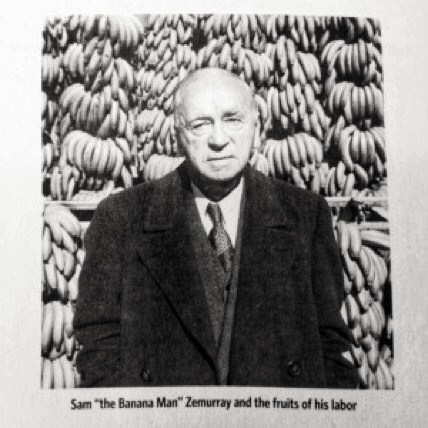
Born Schmuel Zmurri in present-day Moldova, Zemurray initially worked at his uncle’s business at Selma, Alabama, before launching his banana ripes business. Gradually, in time, his customers – those small traders and grocery store owners to whom he sold his ripes, he would come to be known as ‘Sam, the banana man’.
The bananas that did not pass muster were dumped by Minor Keith’s men on the side of the rail yard, where they were further divided into turnings and ripes. At the end of the day, the turnings were sold at a discount to local store owners and peddlers.
The ripes, nobody touched and Sam recognized a product where others saw only trash. He was the son of a poor Russian farmer, for whom food had once been scarce enough to make even a freckled banana seem precious.
After the ship had been unloaded, the trains had carried off the green bananas and the merchants and peddlers had taken away the turnings, Sam bought all the ripes lying around, from the company agent, for $150. He knew that he would have to sell his boxcar load of ripes within three days, maybe five max, or else they would be worthless and he would be ruined. $150 in the early 1900s was a ton of money to lose.
But Zemurray believed he could make it. As far as he was concerned, ripes were considered trash only because Boston Fruit and similar firms thought they were trash. They were not quick enough with their distribution system. Sam’s calculation was based upon an arrogance – I can hustle where others are satisfied with the easy pickings of the trade.
Zemurray’s first cargo consisted of a few thousand bananas. He did not spend all his money but retained a small balance, which he used to rent a railroad boxcar. he had just enough time to get to the main market at Selma.
Those days usually a fruit merchant liked to buy himself a berth in the caboose (a car on a freight train, that has bunk beds for the the crew and one or two passengers, usually attached to the rear of the train). But since he had spent all his cash on the freight charge, Zemurray traveled in the boxcar with his bananas, the door open, his long lanky legs hanging out and the great American prairies rolling by.
As the train chugged west, maddeningly slow, Zemurray sat in the doorway and fretted about his consignment. In the country, the train had the speed of a mule that was on a lazy trot. As it approached the little towns along the way, it slowed to a walking pace and inside town, it stopped completely for hours, waiting for cargo. All the while, Zemurray paced the railroad bed, hands on his hips, muttering.
In a Mississippi railway siding, where the redbrick buildings, cattle feed stores and tin smiths crowded close to the tracks, a brakeman, taking pity on Sam suggested that if he could just get word ahead to the towns along the line, the grocery owners would meet him at the platforms and buy the bananas right off the boxcars.
During the next delay, Zemurray went into a Western Union office and spoke to a telegraph operator. Having no money, Sam offered a deal – if the man radioed every operator ahead, asking them to spread the word to local merchants – dirt cheap bananas coming through for merchants and peddlers – Sam would share a percentage of his sales.
When the Illinois Central arrived in the next town, the customers were waiting. Zemurray talked terms through the boxcar door, a tower of ripes at his back. Ten for eight. Thirteen for ten. He broke off a bunch, handed it over and put the money in his pocket. The whistle blew and the train rolled on. He sold his last bunch of bananas in Selma and went home with $190. In six days, Sam Zemurray had earned $40.
Zemurray had stumbled upon a niche – ripes, overlooked by the big boys in the trade. All the while that the big fruit companies were busy with their railroads and ships to distribute the greens, the world of ripes had been wide open. Zemurray set out again and again, on his boxcar retailing trips, coming back with his pockets full each time. He had $100000 in his bank account by the time he was 21 and his first million just a few years on.
Sam Zemurray went on to become one of America’s richest and most powerful men who, in the 1930s through 50s, owned and lorded over whole Central American and Caribbean nations as he sat at the helm of United Fruit Company, engineering coup-de-tats wherever the local governments failed to do his bidding. In 1953, when the democratically elected government in Guatemala wanted to expropriate and redistribute among the peasants the hundreds of thousands of acres of land that the United Fruit Company had gotten free, Zemurray orchestrated a PR campaign to besmirch the Guatemalan President, Jacobo Arbenz, while the CIA began training right-wing guerrillas to stage a military coup. Arbenz was ultimately replaced by a more pliable leader who reversed the expropriation.
The Sam Zemurray story is an interesting truth that repeats itself so often. It is the story of a destitute who got a bright idea, capitalized on it and got rich and powerful and ultimately, instead of using his financial might to help other destitutes, became a part of the same corrupt system.
————————-
Life Magazine once did an in-depth of Zemurray, in which it wrote – ”Sam, the banana man, the tycoon who once used the railroads as pushcarts.”
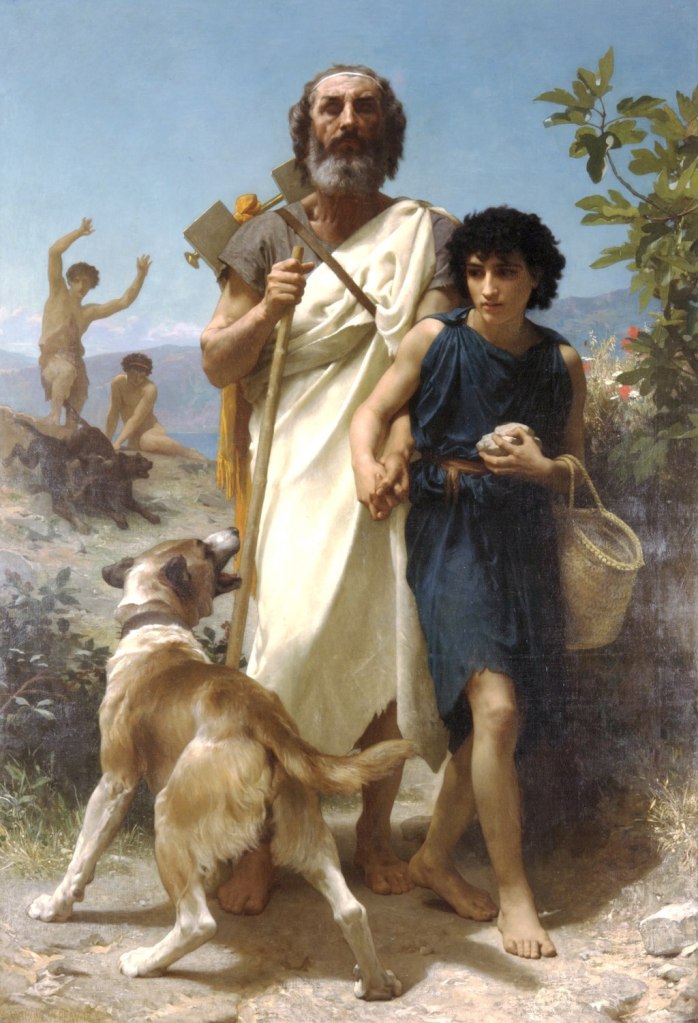
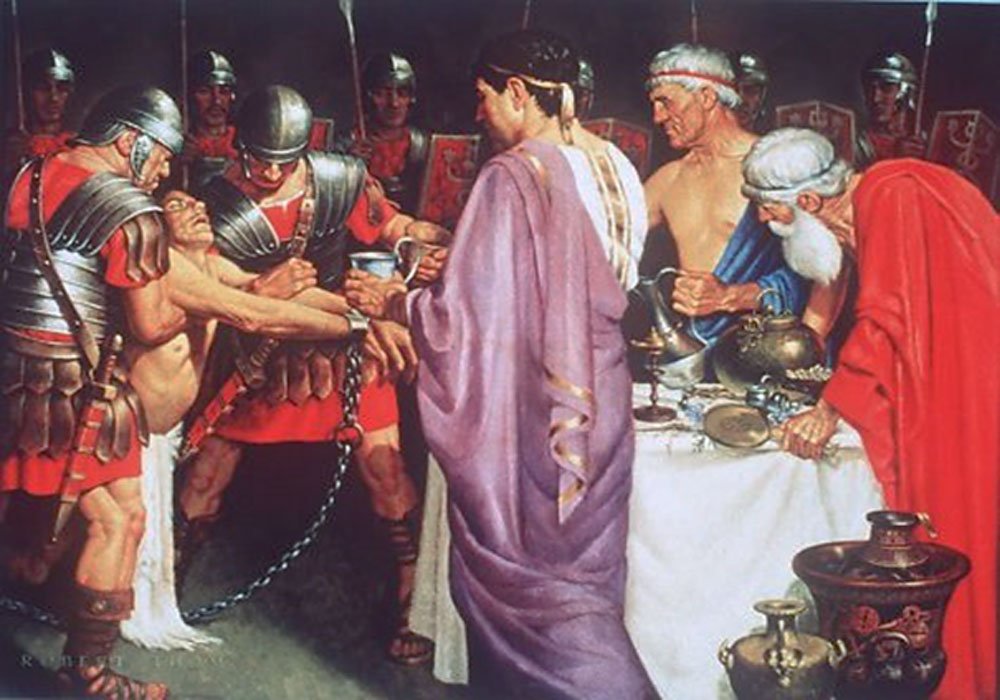
When Socrates(470-399BC) was standing trial for capital crimes, he spent time with his groupies musing about what death would be like. He hoped that one of three things would happen – he would be sent to spend eternity with Homer or Pythagoras or Diogenes or any of the other philosophers who had died before him and he would engage in lively gabfests with them (Socrates loved talking).
If he couldn’t get that, Socrates hoped he would fall into a deep, restful, dreamless sleep, the kind of sleep one drifts off to after smoking plantation-fresh, dew-moist Kodaikanal weed. Into a world devoid of anything except kaleidoscopic designs.
And if he were deprived of even sleep, Socrates wished he would be permitted to recline on a plush meadow looking up at the star-filled sky above while a beautiful boy with golden locks stimulated him for eternity. Socrates was a flaming pederast and pedophile, but then so were most members of the ancient Greek elite.
I like that. Not the pederasty bit, but the fact that Socrates thought simple thoughts about simple pleasures just before he died. He wasn’t concerned about all the BS like heaven and hell and soul.
Not that Socrates didn’t believe in Heaven and Hell and Soul. He did. In fact the concept of an entity called soul which inhabits the human body and leaves it upon death and goes on living for eternity, has been recorded since at least 3200BC during the first Egyptian dynasty.
It’s just that at the point of death Socrates, like most of us, was ‘unencumbered’ by extraneous crappy issues like was he going to heaven or hell and where would his soul be going after he was dead.
Crap generation officially began with the advent of organized religion in the form of Christianity, Jesus and his Holy Ghost dad. It was Christianity which put an official stamp on the mind fuck called “soul”, the part of us that is supposed to live on after death. The mind fuck part being that you’ll not feel soul unless you are already dead.
Hinduism too has a parallel concept of soul – Atma and if you want to know more about the Atma, Hinduism advises you to “find it in yourself” or go ask a “wise master” (a.k.a guru). I am a Hindu and I dare say I have looked and haven’t been able to find Atma in myself so far in my 68 years. About going to a wise guru, I wouldn’t be caught dead in a ditch with one of those phoney monkeys. I have first-hand knowledge of gurus. It was a guru who brainwashed and drove my mother from our home into a convent, when I was 12. He is lucky he is dead because if he had been alive, I would have gone over to India and strangled the son of a bitch with my own bare hands.
——————————————-
The 18th Century German philosopher, Immanuel Kant, believed that humans are capable only of posteriori knowledge – ie : knowledge gained empirically, through experimentation and observation. Kant concluded that the soul is a noumenon, something that is beyond human sensory ability or perception, an entity that cannot be proven to exist through experimentation and therefore he believed that proving or denying the existence of soul is a futile exercise. Like debating whether God exists, for instance. By the same definition, God too must be a noumenon.
The soul is therefore like the shape shifting alien, married to a unicorn, which lives down in my basement.
Research from interviews with hospice caregivers suggests that the most common last words spoken by dying patients are usually “Mom, are you there?”, “Fido, are you there?” , “Water, please” or simply “Sorry”. The words that are rarely spoken are “God”, “soul”, “pray”, “mercy”, “heaven” and “hell”. Faith and religion seem to be farthest from the mind.
So, why would I give a fuck about my soul if I was taking my last breath? Am I missing something here? Why can’t we keep it simple, like Socrates did?
I know what I am going to be saying just before I die. I have been memorizing it, like Neil Armstrong did for his “small step, giant leap” line. Since I believe soul exists just as much as I believe that the married shape-shifting alien in my basement just fathered a tiny fire-breathing dragon with the unicorn, my dying words are going to be short and simple…..
The discoverer of Polonium, Marie Curie (top right) and the men who were poisoned by one of it’s isotopes, from top left – Alexander Litvinenko, Sergei Skripal and Yasser Arafat —————————————
‘Po’ is a Tamil word that is generally used to express disgusted dismissal. Something like ‘go away, don’t bother me’. Back in university (1973), my girlfriend, a comely Tamil girl, would say it often when she was tired of my kisses and cuddles. Me being what I was back in those early days of long hair, bell-bottoms and awakening body parts, the only test I regularly used to pass with an A+ was the test of sterone.
What am I supposed to do? I am a touchy feely guy.
Po is also the chemical symbol for Polonium, an element discovered by French nuclear chemist, Marie Curie and her husband, Pierre, in the dying days of the nineteenth century. Named in her honor after her native country, Poland, Polonium is a metal that is so heavy that you’d need both hands and hunch your shoulders, to hold just a fist sized lump. If you see a guy with a crick in his armpits, could be he had been carrying Polonium around. Though, that would make him a schmuck because Polonium is a highly radioactive alpha emitter and you don’t want to have it lying around near you.
Don’t worry about the ‘alpha emitter’ bit. I shall explain what an alpha emitter is, a little later on. Just get yourself a beer, set yoreself down and make sure you can read simple sentences in English.
Placed just ahead of Bismuth in the periodic table, Polonium is known to exist in many forms or isotopes, 33 different isotopes in fact. Don’t know what an isotope is? I’d guessed as much. You cannot possibly know everything I do.
Isotopes of an element are like siblings from the same parents. All have the same number of protons but behave very differently because they have a different number of neutrons in the nucleus of the atom. I’m showing off, you can skip the page if you like. But this is really my blog and if I want ta fill it with isotopes, I will.
Highly radioactive, Polonium continuously loses mass, in a spontaneous process called radioactive decay. Because the numbers of protons and neutrons don’t match in isotopes, they are unstable, or in other words, radioactive. From the moment they are formed, they try desperately to reach a more stable state, by letting go of the excess neutrons and protons so that the number of each in the nucleus match. In this process of trying to reach stability, they form entirely new elements. Polonium, for instance, decays into an isotope of Lead, Pb-206, which is stable, ie: it is not radioactive and therefore will not decay to some other element.
Do you know how I know all this? I am a nuclear scientist, yeah. In fact there’s a charged particle named after me – ”Spunkyon”. Actually that’s not true. I just googled “fun facts about Polonium“. I am the bloggers’ version of a hustler who copies stuff from the internet and puts it in his blog. Nothing, but nothing, in here is original and I take pride in that fact.
There’s more to radioactive decay – like alpha decay, beta decay and gamma decay, but I won’t get into that, knowing how short and severely impaired your attention span is. Besides, I have no idea what they are and you’ll have to wait till I look them up on Wikipedia, which you could do by yourselves of course, but I’d rather you waited till I told you about them, at some later occasion. Remember, the only reliable information is the one that is in Spunkypedia.
——————————
Radioactive decay is remorseless. It happens spontaneously and there’s absolutely nothing you can do to make it change it’s mind and stop. Like the famous 1960s nautch girl of Bollywood, Helen and her screen lover, that short, stout guy in skin-tight pants in those old R.D.Burman dance sequences. The moment Helen entered a scene, you knew she was going to take her clothes off and Shorty would soon be writhing around her dancing figure, panting on the shiny nightclub floor…ahha,,ha,,ahha..ha, ahha..ha. No way you could stop them from doing that.
The time it takes for a radioactive isotope to decay down to half it’s original mass is termed it’s half-life. Let’s take Polonium 210 which has a half-life of 138 days. A 10 gm sample will have 5 gms remaining after 138 days, while the rest is converted to Pb-206. After the next 138 days, there will be only 2.5 gms. And so on. Thus, the content of Po 210 will get smaller and smaller exponentially, halving in mass every 138 days.
Of the 33 known isotopes of Polonium, only three are the rock stars – Po-208, 209 and 210. They’re the three evil step sisters. The others’ half-lives are in microseconds. The three sisters stand out with appreciable half-lives and are therefore available for exploitation. Po-208 has a half-life of 2.9 years and Po-209, 103 years And Po-210, 138 days. All three are lethal and you wouldn’t want to be anywhere near them.
—————————————-
I’d love to tell you more about all three step sisters but Pierre, my carpool partner, will arrive any moment and I have to get to work, so I’ll focus on only the most scary, the zinger – Polonium 210. As a start, let’s assume Po-210 is female, being toxic and all. So let’s call her PollyTwoTen. I always give objects names. Who knows, maybe they’re alive and it’s us who are dead.
A dull, sinister-grey metal, PollyTwoTen keeps releasing massive amounts of energy spontaneously in the form of intense heat and alpha particles. A lump of Polonium-210 will cast an evil greenish glow and remain really hot, 500°C hot, as it decays to Lead-206. Aside from the sophisticated technology necessary to produce even 10 gms of it, handling and storage of this mother is a branch of nuclear science in itself.
Remember I said I’ll tell you what alpha decay is? Alpha decay is the spontaneous release by a radioactive isotope of high energy alpha particles and alpha particles are sub-atomic particles, each consisting of 2 protons and 2 neutrons joined together in matrimony. Alpha particles are deadly but more of that later.
PollyTwoTen exists in nature in such insignificant concentrations that the metal has to be extracted and that’s done by carefully controlled radioactive decay, either from Uranium-238 or Radium–226, inside a nuclear reactor. The extraction process is high-tech and classified, the technology strictly controlled and available with only a few governments round the world, those that have produced nuclear bombs – US, Russia, China, UK, France, India, Pakistan and Israel. Given the investment necessary and the strictures in place on import and export of Po-210, it is unlikely that any private commercial enterprise will be able to or even be allowed to produce the stuff. Only around 100gms of the metal are produced worldwide every year, mostly in Russia.
Since it has extra neutrons lying around, Polly is used as an initiater in a nuclear bomb, to bombard a lump of Uranium-235 with a blizzard of neutrons to hasten the chain reaction that causes a nuclear detonation. Besides use in a nuclear bomb, Polly210 also finds application in “static eliminators“ that neutralize static electricity build-up in manufacturing set-ups.
Back in the 1960s, PollyTwoTen’s natural ability to radiate heat made the metal invaluable as a heat and power source to keep the electronics inside spacecraft functioning normally in deep space where ambient temperatures hit 2-3º above absolute zero. However, due to it’s short half-life of only 138 days, it was replaced by another hot babe with a much longer half-life of 87.7 years – Plutonium-238. How do you think the Voyager-1, now in interstellar space, 13.5 billion miles from earth – 42 years after launch, is still going strong? It is expected to retain it’s hard-on through 2050.
——————————
In recent decades, Polonium-210 has found a sinister use – assassinations. State-sponsored assassinations. When inhaled or ingested through food or a cut or wound, the alpha particles from Polly will smash through bone and tissue at the atomic level, combining and changing the very molecular cell structure of the organ it strikes, mutating cells, fragmenting nuclei and damaging DNA irreversibly, in a sort of drunken binge. They will start a chain reaction that sees the body gradually turn upon itself when it realizes that it’s now made of something else other than healthy blood and tissue. The process is gradual and terminal and the poor sod who gets the dose is history within a matter of two to three very agonizing weeks.
Among radioactive elements, Polonium is considered the most lethal, but in general, all gamma and alpha emitters are considered lethal, as well as any element that has a short half-life which means that it will emit massive amounts of radiation in a short while. PollyTwoTen is 250000 times more toxic than the most toxic poison, potassium cyanide and a maybe million times more lethal than highly toxic mercury.
Some of us consume Polly willfully. Tobacco contains polonium and inhalation of cigarette smoke causes the polonium to be deposited on the mucous lining of the respiratory tract. It starts emitting alpha particles from there, damaging the linings of cells, leading to lung cancer.
There is a silver lining though – alpha particles released from decaying Po-210 don’t get too far – just a couple of centimetres actually. They can be easily stopped by an ordinary sheet of bond paper or even the epidermis (the outer crust of the human skin), provided it isn’t ruptured, as in a wound. The risk of contamination is minimal, unless it is inhaled or ingested through food or the blood.
——————————
The story of the assassination of Alexander Litvinenko is a well known one. In the 1990s Litvinenko, a lieutenant-colonel in Russia’s internal security agency, investigated corruption and organized crime in Russia that all too often led to the doors of senior bureaucrats. In 1998, he went on TV to denounce the order to assassinate the billionaire dissident, Boris Berezovsky in England. By going public, Litvinenko pissed off the establishment, big time.
Soon Litvinenko was telling anyone who’d listen that the 1999 Moscow apartment bombings were carried out not by Chechen terrorists but by FSB agents, on orders coming straight from the very top. The purpose – to justify the start of a brutal campaign of suppression in Chechnia. Exactly the same strategy the Nazis used to win support for Hitler’s extreme policies, when in 1933 they burned down their own parliament building, the Reichstag.
In 2000, fearing arrest, Litvinenko fled to the UK where he wrote two damning books further infuriating his erstwhile masters, ‘Blowing Up Russia: Terror from Within’ and ‘Lubyanka Criminal Group’. Litvinenko also accused Putin of ordering the now infamous killing of Russian journalist, Anna Politkovskaya.
By constantly levelling serious accusations, Litvinenko stepped over a rubicon and signed his own death warrant.
On an overcast November 2006 evening in London, Alexander Litvinenko put on his favourite hunting jacket, kissed his wife, Marina, lightly on her cheek and walked over to Soho to meet longtime ex-FSB buddies, Andrei Lugovoi and Dmitry Kovtun for drinks and dinner. Immediately after, Litvinenko started feeling stomach pains and had to be hospitalised, where he initially suffered from severe diarrhoea and vomiting.
The hospital, at first, diagnosed him with a stomach infection and began treatment for it. However, Litvinenko’s condition continued to worsen and doctors discovered that his white blood cell count had plummeted, impairing his immune system. After a while, his skin turned yellow, indicating possible liver dysfunction. Having no clue initially, doctors had him tested for the two most likely causes, hepatitis and AIDS, but both tested negative.
It was when Litvinenko’s hair began falling out in clumps that the attending surgeons realized he was suffering from radiation poisoning. Further tests identified Polonium-210 as the culprit.
14 days after he had taken the first sip from a tea cup at a cafe in Soho, Alexander Litvinenko’s body stopped fighting itself, on November 23, 2006.
———————————
Something similarly sinister is now believed to have befallen Yasser Arafat, the late enigmatic leader of the paramilitary group Al Fatah and Chairman of the PLO. One afternoon in October 2004, Arafat collapsed during a meeting, suffering from vomiting and diarrhoea. An hour earlier he had ingested medications that were routinely imported for him, into the Ramallah Compound on the Gaza Strip, in an ambulance that had to pass through several Israeli check points. Usually the ambulance driver was ordered to remain at the wheel while Israeli border guards opened the rear door of the van and pulled out the box and inspected the medications.
Within hours, Arafat began developing symptoms very similar to Litvinenko’s and as his condition deteriorated, he was airlifted to the Percy Military Hospital in West Paris. His illness galloping unchecked through his body, refusing to respond to treatment, Arafat passed away on November 11, 2004. The French doctors did not suspect radiation poisoning and therefore he was not tested for it. Strangely, these specialists were never questioned and are known to have gone to ground since.
Eight years after Arafat died, Al Jazeera’s investigative unit, with the consent of Arafat’s widow, Suha, launched an investigation to find out if Polonium-210 had been used to kill him. Arafat’s last-worn clothes, his iconic kaffiyeh, his toothbrush and other personal belongings were sent to the Institut de Radiophysique, in Lausanne, Switzerland, which detected unusually high levels of radiation.
In 2012 Suha Arafat had the Palestinian Authority exhume his body for more detailed tests. Samples were sent to three different labs, in Switzerland, Russia and France. The Swiss test results showed 18 times the normal level of Po-210 in Arafat’s body. Given that 8 years had passed since his death, the initial dose must have been massive. The Swiss report stated that the findings “support the proposition that the death was by poisoning with Polonium-210”.
The French investigations could not confirm the presence of Po-210 in the remains and failed to check for Lead-206, which Po-210 decays to and whose presence would indicate the presence of Po-210. The whole thing stank of political pressure from Israel, which by then had a burgeoning nuclear program and ample opportunity to stockpile Polonium. Incidentally, the Israeli reactor at Dimona was built by French engineers.
That wasn’t the first time that the French buckled under Israeli pressure. Mossad’s wanton assassinations of Iraqi nuclear scientists on French soil in the 1980s with the covert blessings of the french security service, the DGSI, are well documented.
As to the investigations by the Russian lab, the results from Russia were negative. Al Jazeera has quoted an unnamed Russian source alleging that the Russian forensic team had been instructed by the Russian foreign ministry to announce negative results. The source claimed that it was an effort by Putin to distance Russia from the murder. Strange behaviour, given Arafat’s historically warm relations with the Soviets and later on, Putin’s Russia. Political observers surmise that Putin considered Israel to be a bridge to Washington didn’t want to upset the Israelis by publishing findings that pointed to murder.
Israel has vehemently denied having anything to do with Arafat’s death and on seeing the responses from the French and Russian labs and feeling the undercurrents, the Swiss – forever the slithery double-dealing diplomats – receded into the background, making themselves unavailable for further comment.
Arafat had many enemies, both within and without. His longevity, his makeover from terrorist to good guy and his winning the Nobel for peace, his charisma and his secular credentials, all of these attributes were a thorn to the Israelis who were desperately looking for a raison de survivre – extremist groups like the Hamas, Hezbollah and Islamic Jihad who helped Israel maintain the illusion of a threat of Arab invasion and thereby justify the huge amounts of military aid that they demanded from America. Arafat, with his iconic international stature and the extended olive branch, frustrated them. Israel, like Pakistan, is incapable of survival without external support.
Killing by Po-210 has a major disadvantage – traceability. Every batch has a chemical signature that can be traced to it’s source of manufacture. In the case of Litvinenko, the production source was found to be a Russian nuclear reactor.
In Arafat’s case, the source – suspected to be Israel’s Dimona reactor – was never revealed. Such is the power and political reach of a pipsqueak nation that measures just 250 by 70 miles, one that a modern airliner would take just 7 minutes to cross from east to west.
—————————-
Next comes the question ‘why’. Why commit murder with a messy hazardous-to-handle substance that leaves traces all over? Why choose a method that takes two horrible pain-filled weeks to kill?
The answer lies in the question itself. Po-210 is meant by the killers to be discovered. The killer, invariably a sovereign state, is protected by the doctrine of “sovereign immunity” whereby a sovereign state is immune from prosecution at the International Criminal Court. Po-210 is a stark warning from a criminal state to those who rebel or dissent.
To the assassin, Po-210 is a darling because only an amount equivalent to a grain of salt (roughly 3milligrams) is needed to kill the average Joe. The assassin finds it easy to transport the stuff provided he does not himself accidentally ingest it. The victim’s symptoms come on gradually, giving the assassin sufficient time to make good his escape. In the case of Alexander Litvinenko, the assassins (Lugovoi and Kovtun) were safely inside Moscow before the British realized what had actually happened. Another important advantage to the assassin is that an alpha emitter like polonium does not set off radiation detectors in airports and therefore can be smuggled into a country easily.
——————————-
Polonium-210 is also believed to have killed several other people, including Marie Curie’s daughter Irene, also a Nobel Prize winning nuclear physicist like her mother. In 1946, a glass vial containing Po-210 that she was holding slipped from her hand and hit the lab table inches from her, shattering explosively and coating her face with the deadly powder. Irene Curie contracted leukemia shortly thereafter and died at 58 a month later.
Marie Curie herself died from aplastic anemia, brought on by radiation poisoning from being in close proximity to another hottie, Radium, an element she discovered on her way to winning the first of her two Nobel Prizes.
In addition to alpha emission, radium also emits lethal gamma rays that are virtually unstoppable and can penetrate through three metres of concrete. Ironically, today gamma rays are used in radiation treatment to ’burn’ cancerous tumors.
Like polonium, radium too glows naturally. Marie Curie would casually stuff vials of the glowing stuff in her lab coat pocket and repeatedly let it come in contact with her freely. “Radium, my beautiful Radium,” she would be heard whispering to it, as she brought the vial up, to stare at the stuff inside.
Madame Curie had no idea how hazardous radium was. No one did at the time. Today, radiation sickness is an entire branch of medical science.
Did you read Part-1? If you didn’t – maybe outa sheer apathy or treachery – read it before you read Part-2, or else I’ll banish you to the 5th dimension where you’ll languish for eternity, with only Lex Luther and Mr.Mxyzptlk for company.
I apologize. Didn’t mean to offend your sensibilities. Just thought you needed a lighter moment in the middle of this horrendous Corona Virus outbreak. Honestly, those cute microscopic red and purple balls with green suckers that look like Shrek’s ears, are jerking us all off.
Don’t get me wrong, I love being jerked off, but by a fucking virus????
Mithridatus VI (Part-2)
————————
“Everything has poison. It is the dosage that decides whether we live or we die…”
– Mithridates VI of Pontus (120-63BC)
———————————
Mithridates VI of Pontus (foreground center), in his ‘toxicology’ lab, about to administer an antidote to a condemned slave, minutes after he has forced the poor wretch to swallow belladona (c 70BC)
————————————-
Just as present-day governments commission geological surveys for oil, back in 70 BC, Mithridates VI (a.k.a. ‘Mitsy’ in this blog) had his minions scour the countryside for poisonous plants and minerals, to develop poisons from.
Mitsy had a research facility going that had only one assistant – a herbalist by the name of Crataeus. So guarded was Mitsy about the stuff he was concocting that he had Crataeus’s family locked up under permanent house arrest 24/7, to be executed summarily in case Crataeus betrayed him. Albeit, Crataeus and his family were provided with a fortified palace to live in opulence, not wanting for any pleasure. If Crataeus’s wife wanted one of those well hung nubian slaves to orally stimulate her, she just had to say it.
Mitsy researched all sorts of poisonous herbs, like hemlock, aconite, deadly nightshade (belladonna), castor, hellebore, azalea, rhododendron, realgar (arsenic), mercury and sulphur, to name just a few. He had Crataeus blend and mix the powders and pastes and then fed the concoctions to captured prisoners and slaves. And while some of those unfortunate suckers were monitored for symptoms and duration of survival prior to death, others were put on an antidote regimen, to test the antidotes that he simultaneously engineered.
Countless prisoners and slaves died horrible deaths as a result of Mitsy’s experimentations. By today’s sensibilities, Mithridates would be recognized as a psychotic mass murderer, on par with the prominent Nazis like the infamous bio-weapons expert, Walter Schreiber and endurance medicine researcher, Josef Mengele, physicians who practiced a similar craft during the Second World War.
But those were the times that Mitsy grew up in. A man interprets morality as he sees it. Mitsy recognized his own mother’s treachery when she poisoned his father. Life inside any royal household in those times was an all-pervasive mantle of suspicion, conspiracy, treachery, intrigue and paranoia and Mitsy lived in the midst of that.
In that milieu, poisoning happened to be the preferred method of assassination. There was no such thing as forensic science and poisons left no trace. You could spike a guy’s wine with arsenic and pass the death off as cardiac arrest and no one would be the wiser.
Even when an assassination was carried out in broad daylight before hundreds of witnesses, the justice system in the ancient world perceived it as a crime if the folks that mattered saw it as such. Delivering his corny “Romans, countrymen and lovers, lend me your ears..” monologue in front of thousands of Romans, Brutus convinced them that killing Caesar was the right thing to do.
Wait right there, before you fact check me. The “lend me your ears” bit was from Mark Anthony’s rebuttal monologue, not Brutus’s.
Who gives a shit anyway?
————————————
Prior to 300BC, the civilized world (Southern Europe) had been an oasis of heightened consciousness – of discipline, obedience and the rule of law, the standards set by first the Greeks and then the Romans.
Then, as if someone had flipped a switch, things slid into an age of decadence and greed for the next 300 years, until the 1st century AD with the ascendence of the Julio-Claudian Emperor dynasty (Augustus – Tiberius – Caligula – Claudius – Nero) when everyone who was anyone was either poisoning or being poisoned, making this form of killing a sort of status symbol. You were a nobody if you simply died of old age.
During this period, women of the elite gained some notoriety as poisoners. Noblemen had multiple wives and concubines and these women were all conniving to ensure that the inheritance went to their biological son. Queens did likewise, to ensure that they could rule as regent until little Billy Bob came of age and was crowned the king.
Emperor Augustus’s wife, Livia Drusila was quite the Lalita Pawar of old Bollywood movies. She not only orchestrated the poisonings of a number of Augustus’s grandchildren, but she had Augustus himself poisoned, in her single-minded zeal to get her son, Tiberius from a previous marriage, to the throne. Likewise, all across Roman nobility, mothers were poisoning stepsons and encouraging their biological sons to poison their fathers if they lived too long.
Then there was the infamous trio, Canidia, Martina and Locusta, who poisoned their way through the entire Julio-Claudian dynasty and it’s court.
Not much is known about Canidia except that she was a vicious contract killer who poisoned hundreds of Roman noblemen for cash. Canidia is thought to have helped Livia murder Augustus. It was when she began thinking she was invincible and started taking money from both sides, that she met a gruesome end, eviscerated alive and strung up in public. No painless drifting off to death by poisoning for dear Canidia, no siree.
(The dreaded ‘chairman’ of Murder Incorporated, mafia don Albert Anastasia was killed for a very similar reason. If you are a contract killer you don’t profit from both sides, is the moral)
Martina poisoned Tiberius’s nephew and heir Germanicus. A highly competent general posted in Germania, Germanicus was winning battle after battle, expanding Rome’s influence over central and eastern Europe. To his troops and to the Roman populace, Germanicus was the Roman version of Alexander the Great. Unfortunately in ancient Rome it didn’t pay to be more popular than the emperor, unless you could back it up with the Praetorian Guards’ muscle.
Tiberius was getting antsy at all the adulation accorded to Germanicus. So he had Martina recruit a trusted henchman named Piso to poison Germanicus with a special “delayed-action” concoction over a period of 15 days, making it look like he simply took ill and gradually died. Those days contracting an unknown illness and dying from it was commonplace, so no one batted an eyelid.
And then there was Locusta. On the orders of Agrippina the Younger – empress to Claudius, Locusta poisoned his son from his marriage to Messalina, Britannicus, whom he had named after the island he had invaded and annexed – present day Britain. Agrippina wanted her own biological son, Nero, to be emperor. So, when it began to seem like Claudius would go on forever, she had Locusta poison him too. Nero was crowned and he later signed Locusta up on a lifetime contract as a sorta “court-appointed poisoner”.
If you were a Roman nobleman in the 1st Century AD, you knew better than to fuck with Locusta and the other two.
Alas, Locusta too met with a horrible death. Soon as Nero was dead (assisted suicide), his successor, Galba, had Locusta arrested and slaughtered in public.
————————
The spread of Christianity did not seem to slow down greed even a bit. By 400AD, the Dark Ages – also known as the Middle Ages or Medieval Period – set in. It was a period of moral recession that wiped outevery bit of enlightenment that had been attained through the early Greco-Roman civilization.
Christianity could do nothing to arrest the onset of the Dark Ages. Religion in fact is credited by some, to have been the catalyst which fueled the Dark Ages, rather than being the provider of enlightenment. Christianity brought with it religious bigotry and officially sanctioned oppression and even wholesale genocide by it’s overseers – the Catholic Church, perpetrated in the name of God in much the same way Islamic extremism goes about it’s business today.
It was as if civilization had pressed a reset button and gone back to the wantonness of 5000BC. (The dark ages lasted right up until the Renaissance in the mid-17th century.)
Through all the chaos, poisons and poisoning played a central role in the mayhem of the dark ages. Indeed, a whole dynasty of Catholic Popes, the infamous Borgias of the 15th century, thrived on the art of poisoning. The murderous patriarch of the family, Rodrigo Borgia, battered and slammed his way to the Papacy, becoming Pope Alexander VI. In time, he made his equally murderous son, Cesare – who was running an organized crime family at the time – a Cardinal.
The Borgias entertained frequently. With word having already spread about their prowess with poisons, guests who were invited to dinner at the Borgia residence considered the invitation a death sentence. Refusal meant almost certain death and so did acceptance of their invitations.
If I had met Jesus Christ personally I would have told him, “Cut it out, Dude. If Pontius Pilate summons you, make that deal with him and shut the fuck up.” Wouldn’t a live Jesus Christ have been better for the future of the world than a dead one?
——————————————–
Enough about the Romans and Christianity for now. I know how short your attention span is, so let’s get back to Mitsy.
Mitsy was a paranoiac. Those days every monarch had to be one. Fearing being poisoned with some unknown new concoction after he had gained the throne, he set out to perfect a “universal” theriac or antidote. After many tests which wiped out an entire prison population, he finally settled on a universal antidote. He named it Mithridatiumand carried it with him in a tiny marble jar wherever he went.
However, the more he solidified his position on the throne, the more paranoid Mitsy got. The assuring presence of mithridatium didn’t help. Mitsy was smart enough to realize that new poisons were being created by others every frigging day and mithridatium needed constant upgrades if it had to remain effective. (Much like the cyber security industry today).
Not satisfied with having the all-in-one antidote, Mitsy began consuming sub-lethal doses of all kinds of poisons with the belief that this would build up his immunity against them. As to how far he was successful is debatable, though the concept of immunity through controlled ingestion is an infallible one.
Mitsy’s work in toxicology gave birth to a new kind of practice, called Mithridatism – protecting oneself against a poison by gradually self-administering non-lethal amounts.
Mithridatism had been in vogue in other parts of the world as well. In ancient India, legend has it that during the rule of the king Chandragupta Maurya (320–298 BCE), there was this practice of regularly administering poison in small amounts to specially hand-picked, extremely pretty pubescent young girls as they were growing up, gradually making them immune to poison.
The girls who got the doses were called vishakanyas (visha – poison, kanya – maiden). Vishakanyas found employment with the wealthy elite as assassins. The modus operandi was a simple one. A Vishakanya would be told to seduce a nobleman who had been shortlisted for murder. She would invite the sucker to share a pitcher of wine with her before engaging in sex. Witnessing her drinking from the same pitcher, the victim would surmise it was safe and he would drink too. While she survived, he would die. The moral : when a woman invites you over for a drink, be sure ta fuck her first.
Take it easy, this post is x-rated. Leave your prim and propahness at the door before you enter this blog. Here we talk dirty and have a belly laf over it. Sex is funny.
As a kid in India, I remember watching in awe while a snake charmer nonchalantly shoved his hand inside a sack filled with cobras, drawing one out and toying with it, pressing it’s jaws so they would reluctantly open and you’d see it’s fangs. Sometimes he’d deliver sharp whacks on it’s head with his open palm and you could see the cobra getting pissed it off, it’s head flattening into a broad hood, it’s upper lip quivering as it retracted, baring a purple-pink gum with two large fangs, it’s forked tongue flailing wildly, while it issued a hissing snarl. After a few whacks, unable to stand the humiliation any longer, the cobra would repeatedly lashed out with lightning speed and stick it’s fangs into him.
It was a fucking cobra and nothing ever happened to the guy! I used to wonder why.
——————————————-
I have covered Mitsy’s death in Part-1, so if you haven’t already read it, go read it before I send over a lactating vishakanya to get you.
The poison Mitsy took as Ptolemy’s forces closed in was not going to be sufficient to kill him, given his lifelong immunization through his own practice of mithridatism. He had to have his bodyguard stick a stiletto in him.
But Mitsy had to have known that the poison wouldn’t kill him. In fact, historians suggest he had secretly developed a deadly fast-acting ‘poison-x’ for which he had deliberately not created an antidote.
So, why didn’t he use that poison when the Romans were closing in?
Here’s what I think happened. Mitsy misplaced the containor and just when he needed it the most, he couldn’t find it. It must have been one of the first instances of shit happening.
—————————
Legend has it that two thousand years after Mitsy committed suicide – around the time Crimea became a part of the Soviet Union in 1921, Russian archeologists unearthed a small earthenware pot that was filled with some kind of a powder, at the site where Mitsy is believed to have taken his life.
When Soviet archeologist left the pot on top of a table and went out for lunch, his cat came in and sniffed around. On his return, Chuchukin found the cat dead under the table and the jar lying on it’s side open.
Minute amounts of the powder found inside the pot were tested and found to contain some of the deadliest herbs known to mankind – aconite, hellebore, belladonna, thorn apple and hemlock. However, 86% by weight was an unknown element that later on proved to be highly toxic thallium, a substance that is now known as the “poisoner’s poison”, since it is colorless, odorless and tasteless.
The pot was rushed to the Kamera (Russian for ‘chamber’), a highly secretive facility within the Active Measures section of the KGB’s First Chief Directorate where research was ongoing to find a poison that could kill quickly and leave no trace. Kamera had begun work in 1921, under Lenin’s Cheka, the Soviet secret police agency which would later transform into the KGB, now known as the FSB.
The lab report on the ingredients of the powder was being prepared when one of the technicians, the man who had gathered up the spilled powder from the table, collapsed from a heart attack. Later on, a pinch the size of a pin head, when administered to an otherwise healthy Sevostlag gulag inmate who was serving a life sentence without parole, killed him within two minutes. An invasive forensic autopsy showed no signs other than that of a heart attack.
That the contents of that little pot unearthed on the shore of the Black Sea were still potent after two milennia was testimony to Mithridates’ prowess as a toxicologist. Little could he have known though, that his ‘magic bullet’ would find use 2000 years later, at the Cheka-NKVD-KGB-FSB juggernaut, (who would then take it even further, to more exotic agents like Polonium-210).
As for Mithridates’ antidotes, Mithridatium is still available at apothecary outlets in present day Italy.
“And its one,two,three,four, what are we fightin’ for // Don’t ask me I don’t give a damn, next stop is Vietnam // So five,six,seven,eight, open up the pearly gates // There ain’t time ta wonder why, whoopie!! We’re all gonna die…
”Come on mothers, throughout the land, pack yore boys off to Vietnam // Come on Dads, don’t hesitate, to send off your boys before its too late // Be the first ones in your blocks, to bring your son back in a box”
Country Joe (1972)
—————————-
That’s enough country music. Let’s get back to the here and now.
Among US Military combatants, the demographic whose members are the most susceptible to PTSD seemed in the beginning to be the most unlikely, given the fact that these fighters never have to smell the burning flesh of innocents and the cordite of the battlefield.
Meet the new-age warriors of today – the drone pilots.
Although a soldier, a drone pilot leads a life that is just like ordinary working civilians. He signs in 9am, he sits on a tall straight backed seat in front of a large screen, inside a climate controlled hut at the Creech Air Force Base in Nevada. Thanks to technology, he doesn’t have to be present where the action is.
In the pilot’s right fist is a video game style joystick which controls the flight of an MQ9 Reaper drone, it’s single tail mounted 900-hp Honeywell turbine engine keeping it flying in a lazy figure ‘8’ pattern 20000 ft above an arid Iraqi hamlet. His colleague sitting right next has an almost identical set-up that controls the munitions (which are considerable).
The Reaper got it’s name from the “Grim Reaper” which is a euphemistic term that we use for death. A very apt name indeed and its because of the laser guided AGM-114 Hellfire missile slung under it’s belly that can hit a target with an accuracy of 25cms. Detonated, the high explosive in it’s nose will wipe out everything within 50 metres all around the strike point. At maximum payload capacity, the Reaper can stay aloft for 14 hours at a stretch. This one still has 5 hours to go, having taken off 9 hours prior, from a strip in Djibouti, in the horn of Africa where the CIA has bribed the local government and coerced it into providing space to build a base.
Up front, just below it’s chin, the Reaper has a hyper-sensitive infra-red camera that can detect the heat signature of a human body from an altitude of 4 miles. The camera is not sophisticated enough to tell between a boy playing with a stick and a militant brandishing an AK-47, but those who are flying the Reaper really don’t care. There are no rules of engagement that the drone pilot has to worry about. It’s just a cut and dried two-man chain of command. In under 10 seconds, the pilot will get the go-ahead, “This one looks like a bad guy. He’s moving around suspiciously. Burn the m…ther f…cker.” That’s all that it takes.
A slight pressure from the pilot’s thumb will send down a 100-lb high explosive-tipped laser guided Hellfire missile which will bore down on the target at 1.5 times the speed of sound and annihilate people who have done him, his family or his nation personally no harm. The target will not sense even a whisper, since the projectile is supersonic.
After his shift gets over, the drone pilot will strut out into the dazzling Nevada sun and drive home in the F-350 truck that he has souped up with his considerable overtime pay. He will be filled with a sense of having accomplished something, ie: eliminating a “bad guy”.
At home, the drone pilot has work to do – like taking his kids out for their little league baseball and maybe a slice of pizza after.
“Intrepid” drone pilots, picking targets between swigs of Moka and bites of donuts with sprinklies on them
—————–
“Hey, Bud, I think that was a kid in there.”
“Take it easy. Relax. We’ll say it was a goat…..”
—————–
All within a span of 24 hours, a drone pilot will careen between two vastly different lives –one, in which he will engage in wholesale slaughter where women and children often get vaporized and the other, in which he goes home and leads the life of a typical “all-American family”. Day in and day out.
In the beginning, the drone pilot finds his bizarre bipolar existence thrilling. He develops a sense of playing God, instantly vaporizing people at will. But the adrenaline high is short-lived. All the wanton killing of faceless people thousands of miles away destroys his sense of humanity and ultimately gives way to massive guilt at the enormity of the mayhem that he willingly unleashes. He finds it increasingly difficult to square how what he is doing can “save American lives”.
Like it or not, we all have a moral compass “factory installed” within us. Most drone pilots suffer from a variant of PTSD known as “moral injury”. It is the injury to a person’s conscience and moral values from a morally repugnant act that can induce profound guilt.
————————————-
In all fairness, some strong arguments against the ‘just war’ theory also exist.
Many believe that the premise that a morally justified war is psychologically clean and therefore PTSD-free, is a myth. They argue that there were in fact comparable numbers of the PTSD-afflicted among WW2 vets too. The vets just didn’t know they had it, calling it simply, ‘shell shock’ or ‘battle fatigue’. Unaware that PTSD was a sickness that needed treatment, they kept it to themselves and just sort of muddled along, trying to make the best of what post-war life had to offer them.
I still believe that the good guys and the oppressed tend to suffer less from PTSD. What helps them is the moral high ground.
Take the Vietnamese, for example. In those 11 years that they fought the American invaders, nearly 1.6 million gave up their lives. They suffered horrible burns from Napalm and they were consumed by Agent Orange. Countless others died in massacres such as the one at the hamlet of Mai Lai in 1968, when American soldiers went berserk, killing hundreds of innocent villagers. We recall Tây Vinh, Gò Dài, Binh Tai, Tinh Son, Bình Hòa and last but not the least, ‘Operation Speedy Express’ which was a macabre ‘reverse hearts and minds’ effort that killed 11000 innocent Vietnamese villagers. The list of known massacres committed by the US troops in Vietnam is long and grotesque.
In comparison, the American deaths from the Vietnam War were 52000, lesser by a factor of 1 in 32. The incidences of PTSD among the Americans would naturally be expected to be in the same proportion, but it is just the opposite, as per a research funded by and American non-profit, The American-Vietnamese Friendship Foundation, presented in 2005. The study found that as against 35% for American vets, only 19% of the Vietnamese vets were found to have PTSD.
”American-Vietnamese Friendship Foundation”. Irony, isn’t it? The nation that, by it’s brute power, devastates also has in it people with real guilt, real conscience.
Interestingly, a similar trend was noticed in another study comparing British and American WW2 vets. It was observed that the number of Americans suffering from ‘combat fatigue’ (they didn’t call it PTSD then) was double that of the British. That was believed to be because the British and the Vietnamese had one thing in common. They were fighting for their very survival. Perhaps having a solid reason to fight staved off PTSD in both cases.
——————————
And then there are the holocaust survivors. Most holocaust survivors have rebuilt their lives. Almost to the very last man, they have picked up the pieces and moved on to build successful careers in business and industry wherever they settled after the war. I’m not saying they didn’t have the occasional nightmare. They did, but they chose to look beyond.
When the state of Israel was still young, it was teeming with holocaust survivors. Out of a total Jewish population in 1948 of 806000, holocaust survivors made up 250000, which means that one out if three Israelis was a holocaust survivor – a walking skeleton with a damaged psych.
If any one group of people were expected to suffer from massive long-term PTSD, it was the Holocaust-surviving Jewish settlers in Israeli. Instead, just the opposite happened in Israel. They farmed the arid land, set up its cutting-edge industry and built one of the world’s most feared defence forces. It fought off murderous neighbours on all sides and took the battle into their territory.
Fighting for their survival and building a nation at the same time kept the holocaust survivors in Israel busy and saved their nation from becoming a basket case. Stray incidences of PTSD did begin to crop up in the 1980s, when the holocaust survivors began leading retired lives with very little to occupy them and in some cases, became lonesome, with a spouse dead and nobody to talk to and a tiny percentage of them began having nightmares related to PTSD.
————————————————
My elder bro, an intellectual, sent me this excerpt from an essay by an Indian journalist, Mukul Sharma, that kinda resonated somewhere within my head…..
“Does the universe care about what we do or what happens to us or whether we live or die?
If we were to believe hard-core amoral nihilists who say that the universe is just a physical phenomenon with no spiritual component, that events are random and have no deeper meaning or purpose and that there are no consequences to our actions, then the answer is obviously no.
Yet, even if that were true, it certainly doesn’t mean that we can’t care about the universe because, unlike it, we have evolved into sapient creatures that are capable of wonder and love. Meaning, we can infuse it with the same whether it cares or not. In fact, with that kind of involvement on our part, who cares whether it cares or not?
If we were to do that, we could begin living in a basically spiritual universe, ordered by feelings of good and bad; a cosmic
order that would in turn, underpin and motivate all our actions. It would be like a moral force where our actions have definite effects that we carry with us. In this respect, its meaning would then be close to the Hindu concept of Karma.
The notion of a moral universe would also buttress spirituality and form the basis for kindness, compassion, altruism and caring for others. This is because it places a value on human life and living things that goes beyond what seems suitable if we regard people and living things merely as a collection of atoms, and essentially no different from any other unfeeling, non-sentient structures such as rocks soil, mountains or planets”.
—————————————–
I am an atheist but I believe in a “moral universe”, a universe that distinguishes between good and evil and ultimately rewards morality.
How can we stop a soldier and make him think of a moral universe? How can we make him ask, “what am I fighting for?’