A Narcissistic Psychopath called “God”

“I strode up to the stake and examined the dead man, impaled and naked, stripped of dignity. The stake had entered his anus and protruded through his gaping mouth, his face a death mask, frozen in a look of horror. It filled me with a warmth even the best wine cannot bring…”

– Vlad III(1428-1477) – ruler of Wallachia (present day Romania)

————————

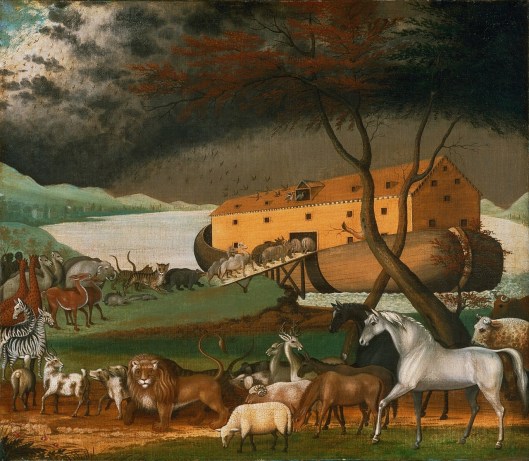
“The Deluge”A depiction of all those who didn’t have a reservation on Noah’s Ark

-Gustave Doré (1866)

————–

According to the Book of Genesis, God awoke one day and said he’d had enough. Humankind’s misdeeds had grown out of control and something drastic had to be done. Like a reset.

So God decided to return the Earth to it’s pre-Creation watery chaos by flooding it. No one knows why God chose Noah but I have my own theory about it. God must have asked a passing cherub, “Hey, Shorty, so who is the go-to guy down there who can help reset the world, d’you know?”

The cherub was in a hurry. He had an appointment at the mechanic’s. The ball joints inside his wings were not articulating well. Impatiently he replied,”No”.

“That’s right, Noah!!” God cried. Trust me, that’s real history. I doubt if Noah ever realized how lucky he was, with a name like that. If it had been say, Dick, he’d be toast.

The above might look like I am being inappropriate, making fun of a religion. That’s exactly right. I am making fun of Christianity, just as I make fun of all other religions, especially my own, Hinduism. Ridiculous beliefs need to be laughed at. If you don’t like it, you can go f__, carry out intercourse with your own self.

————————–

Convinced that a reset was the only way, God ordered Noah to build a huge wooden vessel that the Bible calls the “ark”. The word has grown into something Christians associate with holiness and piety. As ludicrous as Noah’s Ark is the “Ark of the Covenant” which is supposed to house the original tablets God gave Moses with the Ten Commandments scribed on them, eight of which admonish us not to commit sins that are not even considered crimes anymore by almost all democratic nations of the world.

God waited till Noah had finished building the ark and had loaded a pair of every living being for resettlement in a future virtuous utopia. Then he boomed, “Watch this, Noahkins!” and he flooded the earth, killing every living being that had not been chosen. Even an earthworm, who had never possessed the capacity to discern between right and wrong and therefore could not have committed any misdeed, drowned.

Noah’s ark-a barn on a ship. Historians pinpoint the location of the building of the ark as modern day Iraq. Don’t even ask how African elephants and orangutans from Java managed to get there.

That’s right, all animals that weren’t on the ark that day, drowned or had their heads smashed against the rocks by the waves and then drowned. FOR NO FAULT OF THEIR OWN.

What can one call such an extinction-level annihilation? Whatever God’s act is called is entirely irrelevant. What is relevant is that three thousand years after the ‘reset’, absolutely nothing has changed. Look at the world today. Where is that virtuous utopia?

But hang on. There are among us 4.2 billion suckers – the Abrahamics (Christians, Jews and Muslims) – who believe that it was a good thing God did what he did. Me, I think God had ample opportunity to do things more humanely with love, but instead, he chose annihilation. To this day God has gotten away with it and as long as we have right wing evangelical kooks, mullahs and gurus, it’ll stay that way.

Pray to this God? I wouldn’t, even if you held a fucking gun to my head. I think God is a psychopath and given his craving of adulation, a narcissistic psychopath.

Of all the religious crap I have ever read, the story of Noah is the crappiest.

———————————

At the time of the deluge, Noah is said to have been 500 years old. God must have prescribed Noah some special kinda viagra, because no sooner had the flood waters receded, Noah and his wife began fucking each other silly. They had to repopulate the world with virtuous humans, remember? “Dear, come back to bed. God said fuck. Hurry.” (In Aramaic of course).

Alas, the post-deluge world turned out to be even more blood thirsty. The Book of Samuel details what God commanded King Saul of Israel to do to the Amalekites, a nomadic tribe that had settled in the Negev desert, who minded their own business and had their own religious beliefs. When the Amalekites spotted hordes of Israelis crossing the desert (which they considered their territory), they understood it to be an invasion and attacked.

The Amalekites hadn’t known that the Israelis were God’s favorites – his “chosen people”, on their way to “the promised land”. Long story short, God was pissed that his chosen people had been attacked by a bunch of heathens who didn’t even pray to him. According to the Book of Samuel, he roared at Saul, “Destroy all that they have. Do not spare them. Kill both, man and woman, infant and nursing child, ox and sheep, camel and donkey.”

Saul did carry out God’s command but only partially. He killed all the humans and only the sickly animals. He believed that killing perfectly healthy animals that could help with farming and provide much needed nourishment, was itself a sin and he decided to rear them instead. To beg God’s pardon and satiate his blood lust, Saul offered God a sacrifice or two.

But Saul didn’t know the extent of God’s blood thirst. When God said kill everything, he meant kill everything. Saul’s sacrifices didn’t work. God was apoplectic.

There are many theories on how Saul died (like him committing suicide by falling on his sword, etc) but let me choose the one that is the sexiest…..

On hearing that Saul had disobeyed him, God ordered the then reigning prophet, Samuel, to expel him. Cast out in the wilderness, he was never heard from again. Thus the founder of the State of Israel and its first monarch, King Saul, passed into history, a friendless and ragged man. All because he hadn’t slaughtered innocent animals.

All three holy books of the Abrahamic faiths, the Holy Bible, the Holy Quran and the Holy Tora record in gory detail all the times that God has encouraged, exhorted, commanded and rewarded actions of extreme violence.

The Hindu scriptures are not far behind in violence either. Remember the purple God, Krishna, with the deceptively beatific smile and the circular saw with jagged teeth that he balances on his index finger. It flies off on its own and slices off the heads of his enemies and whirls back to his finger. (The fact that the saw hasn’t sliced off Krishna’s finger by accident might indicate it has some sort of advanced docking radar.)

That PTSD took five millennia to be recognized as a problem, is astonishing. Since the Gods are the ones responsible for most of it.

——————————–

Participating in gut-wrenching brutality on a day-to-day basis had been commonplace (maybe even the norm), from the first settlement at Jericho right up to the Renaissance. Victorious invaders were expected to rape, enslave, pillage and burn. Absolute ruthlessness was the only way for monarchs to maintain order. Good governance was another word for ruling by terror. Physical and mental trauma must have been part and parcel of daily life.

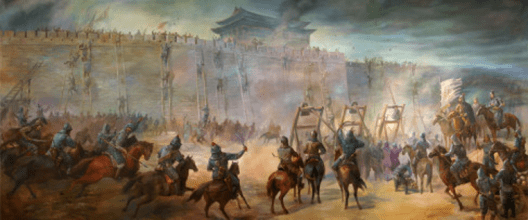
The great Mongol chieftain, Genghiz Khan, at the gates of the besieged Jin Dynasty city of Xi Xia in 1209, had this to say to his troops….“Nothing should make you happier than to chop off the head of your enemy, burn his temples, snatch away his gold and enjoy his wives and his daughters and savor his despair.”

Genghiz Khan didn’t pause to consider if winning the hearts and minds of the conquered people instead wouldn’t have been a better idea. It might not have even occurred to him.

But then maybe, the common folk in conquered lands in those times hadn’t really known what being governed by a benevolent ruler was. They might have taken Genghiz Khan to be weak if he had shown them any mercy or empathy. Those were brutal times, when mothers had to give up their 6-year old sons to be trained as warriors.

ptsd3

Genghiz Khan’s armies, during the seige of Xi Xia (1209)

—————————————-

The Khan practiced what he preached. He was not being unduly cruel as per the perceptions of the time. He was just following the norm through the ages. Annihilation – Genghiz Khan style was by then already a well-established war-craft, 4000 years after God’s “Project Reset”.

Take Babylon 680BC, when the city fell to the mighty Assyrian King Sennacherib. You wouldn’t want to be there. Sennacherib’s account of the plunder went thus….

“…I leveled the city and its houses from the foundations to the top, I destroyed them, and I consumed them with fire. I tore down and removed the outer and inner walls, the temples and ziggurats built of brick, and dumped the rubble in the Arahtu canal. And after I destroyed Babylon, smashed its gods and massacred its population, I tore up its soil and threw it into the Euphrates so that it was carried by the river down to the sea…”

(Sennacherib’s was a more labor-intensive method of destruction than the ‘Little Boy’ or the ‘Fat Man’, but the effect on the psych of those at the receiving end must have been about the same.)

So much mayhem but do the history books mention any PTSD among the hoi polloi of either Babylon or Xi Xia? Heck, for millennia empires and city-states were constantly rising and falling, plundered by rampaging marauders from the surrounding grasslands. Being treated brutally, having dear ones raped and ravaged right in front of their eyes, seeing blood and gore, these were almost a weekly occurrence in most ‘civilized’ regions of the ancient world.

———————————————

I’d imagine that in ancient times, around 95% of the world population must have lived constantly under the threat of serious physical and mental trauma. And yet, we have not turned out severely flawed, have we? In fact, the world on the whole appears to have shaped up quite well over the centuries and we – the descendants of aggressors and victims alike, seem to have not only shaken off the trauma but progressed by leaps and bounds. Today, we go about our lives in a state of peace and prosperity, governed by laws – an existence that Sennacherib or Genghiz Khan could never have imagined possible.


Those Power Moms of Ancient Rome

nerone-davanti-al-corpo-di-agrippina

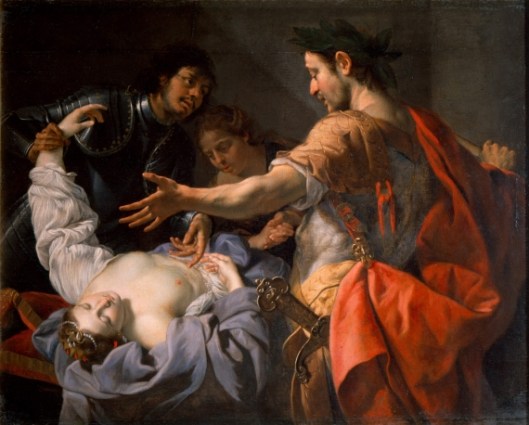
The Roman Emperor, Nero, standing over his mother, Agrippina the Younger’s corpse. The painter intended to show Nero grief-stricken, even though in First Century AD Rome, the grapevine had it that, Nero was fed up with her domineering, meddling ways and had had her assassinated by a hired Libyan assassin.

————————–

(If you have the feeling you have seen the above pic somewhere before, I poached it from an earlier post titled,”The impressionists and their genitalia envy“. Do read it. It’s all about how impressionists liked to paint bare tits and tiny dicks.)

—————————

Before I tell you about all the power moms of ancient Rome, let’s take a closer look at the emperors of the Julio-Claudian dynasty that the power moms assassinated….

Augustus : 27 BC – AD 14 (First emperor of Rome / Julius Caesar’s stepson) :

Most likely poisoned by wife, Livia, so her son from an earlier marriage, Tiberius, could be emperor and she could sorta run things for him. Livia Drvsilla was one of the most Machiavellian women of her time, destroying her enemies while managing to retain friendly relations with those of the elite that mattered and that included the Praetorian Guard.

Oh yeah, if you wanted go up the pecking order in Ancient Rome, you had to have the Praetorian Guard (aka the Emperor’s personal security) in your corner. They were the king makers, no question about it. And if one of them wanted to be emperor himself (which happened often), you simply stood back and let him, unless you wanted to slog in an arsenic-laced gold mine for the next two decades as a day labourer.

Perhaps it was because all the patronage she bestowed that Livia was the only Roman power mom who got away with murder and died a natural death.

Let’s back up a bit. Augustus, in spite of having fucked thousands of women as Emperor, couldn’t manage to have a son and thereby an heir. A male heir was a big deal those days. So Augie did the next best thing – he designated his two grandsons as his heirs.

This was millenia prior to the discovery of stuff like penicillin or antibiotics. It was a time when going down with even a sore throat and a cough could kill you. Pasteurization and refrigeration weren’t even concepts and you could easily end up consuming putrefied meat which could bring you down with salmonella and sure death.

Heck, you could die of a stomach ache in those days.

Augustus’s grandsons didn’t survive into the double digits. They most likely died of typhoid and he was left trying to figure out a way to secure his lineage. That was when Livia began badgering him to adopt Tiberius, her son from a previous marriage. Augustus couldn’t stand to be in the same room with Tiberius but Livia was persistent.

Alas, in ancient Rome signing adoption papers was akin to signing your own death warrant. Historians agree that, no sooner had the ink on the adoption papers dried, Livia fed Augustus poisoned figs and as soon as Augie began raising the daisies, she had Tiberius installed.

Tiberius turned out to be a corrupt cross-dresser and sexual deviant and would go on to be emperor around the time Jesus Christ was crucified.

————————–

Tiberius   : AD 14 – AD 37 (Augustus’s stepson) :

Smothered to death with a sofa cushion by a Praetorian Guardsman while another impaled him with a cyanide-tipped spear up his ass. I am absolutely not kidding – it did go up his ass. The 1st Century AD historian, Pliny the Elder, wrote that Agrippina the Elder (granddaughter of Augustus, mother of Caligula) orchestrated the killing. She wanted her son to be Emperor so she could be the power behind the throne. She succeeded, choosing an apt method. Tiberius was known to sodomize light-skinned Tunisian boys, so the cyanide-tipped enema.

Caligula   : AD 37 – AD 41  (Augustus’s great grandson) : Turned out to be another asshole. Stabbed to death by his Praetorian Guards, because he was an asshole. During one of his drunken binges, he made his horse, Incitatus, a Consul. Consul in those days was a position that reported directly to the Emperor, a very big deal. Let me give you a parallel….

Imagine General Michael E. Kurilla, the guy who head’s America’s CENTCOM (United States Central Command), a military jurisdiction that covers the whole of the Middle East, including West Asia, up to Iran and Afghanistan and in the south, Egypt. Now imagine that these are conquered lands and General Kurilla has the power of life and death over the inhabitants of this vast region. He would then be exactly what a Consul in the Roman Empire used to be and Caligula made his horse a Consul. Wouldn’t you say Caligula was an asshole?

Caligula might still have gotten away with being a jerk but this time his Power Mom, Agrippina the Elder wasn’t around to save his ass. You see, she had already been incarcerated and beaten and starved to death by one of Tiberius’s henchmen, a horrible guy called Lucius Aelius Sejanus, as revenge for killing Tiberius. Let me introduce Sejanus to you…

If you have been paying attention, the term “Praetorian Guard” has popped up in the text above. The Praetorian Guard was an elite unit whose members initially served as personal bodyguards of Emperor Augustus. Over successive generations however, they gradually expanded and evolved into a powerful entity that owned vast tracts of real estate and farmland, ran businesses, poked their noses into Roman statecraft and foreign policy, assassinated emperors and chose and installed their successors. The Praetorian Guard was much like Saddam’s Republican Guard Corps or Iran’s Quds Force. These modern day parallels don’t target their masters though. They terrorize all others.

Roman emperors came to depend on their Praetorian Guards to keep them in power and at the same time, they feared their power. The Prefect of the Praetorian Guard in Tiberius’s reign was that guy, Sejanus and he wanted vengeance for the killing of his boss, Tiberius.

In the movie, “Gladiator” Tomas Arana was Quintus Laetus, commander of the Praetorian Guard, who in the end refuses to come to the aid of his emperor (Joaquin Phoenix’s Commodus).

Claudius  : AD 41 – AD 54  (Mark Antony’s grandson) :

Perhaps the only just and reformist emperor of ancient Rome (aside from Marcus Aurelius two centuries later). Claudius was the 1st Century equivalent of 15th Century English monarch, King Richard-III. While Dicky was known to be a great king, he was a hunchback who suffered from a spinal condition known today as scoliosis. Naturally his appearance made him a singularly unattractive man. Claudius too looked like a fucking bozo. He had a perpetually running nose and an embarrassing stutter.

The historian, Tacitus wrote that the only thing that saved Claudius from assassination was his apparent harmlessness. After Caligula was killed by the Praetorian Guard, they came looking for him. Fearing a purge, afraid that he would be murdered next, Claudius hid behind the drapes in his bedroom, but the guardsmen found him. Claudius fell to his knees, begging for his life, but amazingly, instead of killing him they bowed and proclaimed him Emperor!

Praetorian-Guards

Claudius, begging for his life and the Praetorian Guard, bowing and swearing allegiance

————————————–

The Praetorian Guard expected Claudius to rule as a figurehead but he surprised everyone, turning out to be an astute leader and a great conqueror. Claudius was the Roman Emperor who annexed Britain and gave it it’s name – Britannia. Maybe being handicapped makes one try harder and leads your adversaries to underestimate you, to their detriment.

Being good however didn’t help Claudius in the long run. He was married  to a power hungry siren, Agrippina the Younger, a member of the Julio-Claudian dynasty, great granddaughter to Augustus, granddaughter to Tiberius, daughter of Agrippina the Elder.

Agrippina the Younger was one particular Roman power mom who always fascinated me. Large breasted and exceptionally beautiful, she rose to become one of the most powerful women in the Roman Empire ever.

I am not sure if Grippy had large breasts. I just like women in my blog posts to have large breasts and even if they didn’t actually have large breasts historically, my blog endows them with big jugs and if my post says she had large breasts, she had large breasts, period.

While still in her teens, Grippy plotted against her own brother, the Emperor Caligula and when discovered, managed to escape execution by seducing him into a ménage à trois with another sister. I like a free thinking flower girl. She married her uncle, Emperor Claudius and attempted to inveigle her way into a position of influence but Claudius was smart. He kept her at an arms length.

Maybe not too smart. Like her mom before her, Grippy the Younger too had plans for her son, an immoral 17-year old alcoholic prick whippersnapper called Nero. Not content to wait, one moonlit night when Claudius was settling down to dinner, Agrippina fed him a deadly herb called atropa belladonna (known today as ‘nightshade’).

Exit stage up, O great Claudius. Enter stage left : all round asshole – Nero.

Nero        : AD 54 – AD 68  (Claudius’s stepson) : Started off as Claudius’s great-nephew and then adopted as his stepson. Turned out to be a flaming asshole, run through with his own sword by his secretary on his orders. Why? Earlier that day, the senate had declared him ‘enemy of the state’ because he had turned out to be an asshole. And trust me, he really was an asshole. He fiddled while Rome burned to the ground on his orders.

This time, his power mom, Agrippina the Younger, wasn’t there to save his ass. She had already been murdered by him for interfering too much in his governing.

The sentence that the Senate passed required him to be beaten to death by the Praetorian Guard. Obviously Nero saw being run through as a quicker and less painful option.

—————————–

You saw any of the emperors die in bed of old age? Naah, assassinations were the norm in those days.

Like in the Mafia. Except for Joseph Bonanno and Carlo Gambino, almost all mafia capos were ‘whacked’ and for the same reason – succession. But of course, they weren’t killed by Machiavellian machinations of power moms, like their 1st century ancestors were.

————————

Oh yeah, poisons were a big deal in those days. There was no forensic science then, so you could poison someone and pass it off as a stomach ache and no one was the wiser. Members of the elite financed and maintained hidden laboratories, churning out ever more exotic poisons.

What separated the men from the boys was the ability to develop antidotes in case you were poisoned. You had to have the resources to pay highly qualified chemists to develop not only the poisons but also their antidotes, just in case. And you had to be rich enough to have a dungeon full of slaves to try your concoctions out on.

The chemists led lavish lives. As long as they produced potent poisons, they were rewarded handsomely, awarded vast estates and armies of Nubian slaves. But often those lavish lives were short ones. A chemist could be executed on just the suspicion of leaking secrets to adversaries or he could be killed out of spite for moonlighting for another nobleman. In the end, most chemists were put to death when their masters died.

One of the more well known chemists of the time was a broad named Locusta. She was the go-to girl for Rome’s power moms. A favorite of Nero’s, she was executed by his successor, Servius Galba, the moment Nero was assassinated. Galba himself was beaten to death by the Praetorian Guard a year later.

Aren’t you glad you weren’t living in ancient Rome? Phew! Who says the world is a more violent place now, eh?

Holy Cow!

Picture1

Cows are cuddly, I’ll hand you that. Check out a cow at close quarters and her eyes will blow you away, so beautiful are they….large, with long eyelashes, those eyes are trusting, serene, all comprehending – as if she is saying to you, “I know you need my body for your daily nourishment, your survival. Don’t beat yourself up with guilt when you use me – I completely understand….”

One Sunday, last summer, a colleague and I had to be at work finishing a project that we had to present, Monday. Around 3 pm we were done, when Marie-André said she was going over to her parents’ at St. Bruno, a farming community on Montreal’s south shore. She suggested I come along and check out what a typical Quebec farm looks like from up close. Marie-André’s dad is a retired Air Force Lt. Colonel who rears cattle and sheep.

I couldn’t resist the invitation.

The farm has around a hundred head of cattle and fifty odd sheep and these animals are having a ball. Judging by its neatness, one get’s the impression that the farm really knows how to look after the animals. They are healthy and they are organic. They are raised exclusively for meat.

Marie-André’s dad went to great lengths explaining that the animals are killed very humanely, without cruelty. “I could have fifty pounds of sirloin, chuck and ribs ready for you to pick up this fall. Pick your animal and I’ll call you when it is all shrink-wrapped and ready,” he said.

————————————-

Most folks feel very strongly about animal suffering and yet we all seem to get along fine with the idea that we can kill and eat them. Looking at the cows, lazily grazing across a lush green meadow, I wondered how both those feelings could be held within one’s conscience at the same time. And when I wonder, I Google and therefore this piece.

Sometimes seeking an answer to certain questions have a habit of broadening the issue until it becomes an unmanageable web of little but important angles.

Australian moral philosopher, Peter Singer, currently a professor of ‘bioethics’ in Princeton University, is also author of Animal liberation. I picked up a copy last summer but left it after fifty pages since it isn’t exactly my kind of reading. But his arguments are convincing.

The central message of the book is that even though there are far more differences between a chimpanzee and an earthworm, than there are between a chimp and a human, we humans still lump the ape and the worm together as ‘animals’ while we see ourselves as privileged – above all other species. Therefore while we find it not okay to kill a human, it is fine to kill another species of animal.

Singer argues that we should treat killing animals as an ethical issue because there is no ‘red line’ between humans and non-humans. He explains this by going into an analogy, substituting the word ‘species’ with the word ‘race’ – so when a white man looks at another white man and says ‘he is like me, so I’ll treat only him and folks like him as I treat my own’, it should be acceptable and appropriate, but it isn’t – it is racism.

Again, suppose we consider a really intelligent orangutan, like say, Clyde, in the 1978 Clint Eastwood movie “Every which way but loose”. Clyde is a trained pet who acts like he is almost human. Orangutans are known to be highly intelligent and display human-like social behavior patterns.

Now if you compare Clyde with say, a child suffering from acute Down Syndrome or a cognitively impaired woman stricken by Alzheimers, it is quite possible that the orangutan would trump the human in all those qualities that we pride in ourselves as setting us apart from animals. And yet we would treat that child or that woman with far more deference than we would treat Clyde.

So, do we have to lose any sleep over killing a cow to eat it’s meat? One argument is – no, humans have evolved with mouths, teeth and digestive systems that are specifically designed to eat meat and therefore we should not worry about the morality of it. But some behavioral scientists take exception to this sweeping statement on how we were designed to eat other animals. Since men have evolved to be stronger, should it then be natural for them to dominate over women?

Spreading the net wider, if one went by the ‘evolved to dominate’ assumption, then slavery was a natural instinct, wasn’t it? Of course it was. White folks were better in every way – they were stronger than the impoverished negro villagers of Africa, had better technology, better weaponry, were healthier and better educated. So, the argument that those white folks in America simply evolved to lord it over the Negros would seem quite reasonable, if one went by the evolved-to-dominate theory. But slavery is universally condemned, as it should be.

It is also not true that we need to eat meat, for our sustenance. Any nutritionist will confirm that meat consumption is not absolutely essential. Take India for instance – almost 35% of all Indians, that is around 400 million people, are vegetarians.

——————————————–

Now about the morality in killing other animals – how does one justify the killing of animals, on moral grounds?

Peter Singer suggests we consider a hypothesis. He says that, for argument’s sake, let us assume that all sheep and cows are reared on farms like Marie-André’s dad’s, where animals are treated humanely, right up until the time they are slaughtered – painlessly – for food. Let us further assume that up until the last instant, the cow or lamb is unaware that it is going to be killed and is therefore it’s usual happy, normal, cud-chewing self.

So we have put aside the question of cruelty toward those animals and their suffering. In those perfect conditions, is there anything wrong with killing an animal for it’s meat? I don’t really know but the trip to Marie-André’s dad’s farm did throw up interesting arguments…….

When we had come upon him, the old man had been walking a bullock toward the tailgate of a pickup truck that had a tall rectangular wooden enclosure in the back. He had opened the gate of the pen and solemnly herded the animal forward, seeming sombre and deferential toward it. “I’ve done this a million times but it is still saddening,” he said.

“Why so? Guilt – that he has to die?” I asked.

“I guess you could call it that.”

“But wasn’t he just like one of those other faceless animals in your farm?”

He turned sharply, almost as if I had offended him by calling the beast faceless. “I know each one by name. This one is Gucci. She came to us one stormy night in 2011. She has this habit of coming up silently behind and giving you a gentle nudge and then brushing past, as if to say,’ It’s been a while and I’m famished. How about some chow, big guy?’

Chuckling to himself, the old man guided Gucci up a slanting ramp onto the back of the pickup. He stooped to carefully arrange a bed of hay and some fodder and emerged, closing the tailgate firmly behind him. “When you live among them, feed them, look after them, it dawns on you that they all have distinct personalities,” his voice was gravelly, filled with emotion.

Then he said something that sounded strange but which I later realized could be absolutely true – “If humans didn’t rear cows and lambs for meat, milk, leather, etc, these animals might not have existed at all. Given how fragile, harmless and vulnerable they are, they would probably have been rendered extinct by carnivorous predators long ago.”

I was amazed at the idea. “So, maybe, we have done them a favor and they should thank us for letting them live and exist this long at least – is that what you are saying?” My tone must have sounded incredulous.

“Why, of course. At least they have had some existence – comfortable, disease-free lives inside a farm where food is abundant and a vet comes and checks them every now and then. Isn’t it better than not having existed at all? As long as they have no inkling that they’ll be killed and so long as they are killed painlessly, I don’t see why killing them is morally wrong.” he replied.

“So, a lamb is better off living for a year and then being killed for it’s meat, than not having lived at all. Should he thank us for the opportunity?” My incredulity grew and I couldn’t tell if he was kidding or not.

‘Absolutely,” he replied. “A morally good action is one that maximizes happiness (which we do by looking after the animals’ needs while they are alive) and which minimizes pain (which we ensure, by killing them painlessly).”

By this time, I was willing to take up their invitation to stay for supper, so interesting a man was Marie-André’s father.

———————————————————

I did stay for supper and the steak was succulent. It had been breathing just that morning. I felt a tinge of guilt eating it. Aren’t animals’ rights – the right to live and not be killed – the same as humans’ rights? Moral philosophers like Peter Singer believe that they are.

Marie-André’s father admits that each cow and lamb behaves differently, as individuals. To someone like me, visiting the farm, they might all look and behave alike but to someone who interacts with them on a daily basis, they are individually identifiable, with distinct personalities. He senses that they have the sentience – the capacity to feel. They respond when called by name and they act in a manner that clearly indicates that they have memories. At times they clearly are happy and playful, says he.

Therefore, judging by the old man’s own admission, what happens to his cows and lambs in the future matters to them and, given a choice, they would like to live as long as they possibly can.

————————————-

Jeff McMahan, another moral philosopher who teaches at Oxford, has found a way to draw a line between those animals that should not be killed and those that can be killed without suffering moral injury. He says that there are living beings that are – unlike cows and lambs – unaware of their past, present or future. They do not have a narrative. Like worms, for instance. I have never heard of any moral dilemma attached to the killing of a worm.

McMahan recommends that before we kill an animal, we need to ask ourselves ‘ how psychologically connected is it, to it’s future self?’ The more connected it is, the more morally unacceptable it is – to deprive the animal of that future.

My religion, Hinduism, has never encouraged any debate on animal slaughter, at least not one that I have read about. Hinduism bans killing cows not because it considers killing another living being immoral but simply because Hindu scriptures say cows are sacred, period.

The hypocrisy shows when one considers the fact that, while Hinduism reveres cows and bans cow slaughter, it is totally indifferent about buffalo slaughter, even if buffalos are from the same taxonomic classification as cows. But we know why that is. It’s simple – cows are white and buffaloes are black. Indian society equates white with good/revered and black with bad/inferior.

———————————

A male colleague at work is an avid hunter who believes that hunting must be as humane as possible. Before he skins and cleans his kill, Francois lays his open palm gently on the rump of the whitetail and says,” I apologize for this but it had to be done for my sustenance and that of my family. I promise I won’t waste any of your flesh….” He makes himself believe that without the kill, he and his family would die of starvation.

Francois always takes careful aim so he won’t just wound the whitetail and let it skimp away only to drop from exhaustion and lie dying a mile away, writhing in pain in the thick brush or somehow survive and live out the rest of it’s life a cripple, unable to outrun and therefore be set upon and torn apart by a coyote or wolf pack.

Francois doesn’t pull the trigger until he is certain he’ll drop the animal in it’s tracks. With his bolt-action Ruger, he waits until he has the animal within 15-20 feet, facing broadside. Once he has the animal positioned perfectly, he shoots through the near-side shoulder. The high-powered 129-grain projectile snaps the spinal cord and takes out the upper lung area (and maybe even the forelegs) and exits through the opposite shoulder. It’s hard for even the toughest buck to remain standing after a hit like that. The animal remains transfixed for a few moments – in ‘hydrostatic shock’ – and then collapses in a heap, literally not knowing what hit him.

Francois is the most ‘ethical’ hunter I know. The whitetail might differ though.

————————————–

After supper, as Marie-André’s dad lead me out to my car, I decided to place an order for one of Gucci’s rumps.

It takes more than friezes to deliver justice

“But Grandpa, where’s God?”

Boy who ventured into the main hall of the US Supreme Court and stared at the friezes of famous law makers from ancient times

———————————————–

Picture1

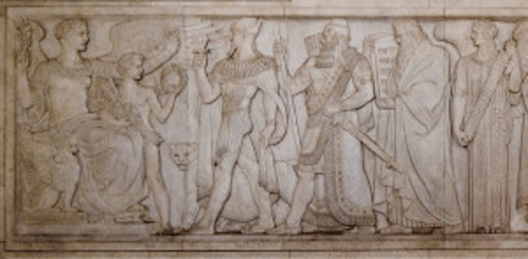
A section of the carved friezes in the great hall of the US Supreme Court, depicting legendary law makers. The friezes are meant to represent justice, liberty and peace. There’s Moses, second from right, clutching those laughably useless Ten Commandments. 

Occupying nearly the highest point of the luminous, gold-edged hall, above the 30-foot Ionic columns, the friezes inspire awe. When Sherman Minton, a Supreme Court justice from 1949 to 1956, pointed out each historic figure to his grandson, the 10-year-old listened in silence and then asked in puzzlement, “But Grandpa, where’s God?”

Indeed. Looking at today’s America, the question does reverberate….Where is God?

———————————————–

The US Supreme Court building is an imposing sight, ringed by pillars, it’s walls covered with carvings and quotes and bas reliefs. There’s sheer white marble as far as the eyes can see and great big Ionic pillars that rival the Acropolis. The ceilings are high and the marble staircase – it appears to lead directly up to the heavens.

It is not really a court by the definition of the word. Rather, the US Supreme Court is a hyper-partisan institution whose members are not really concerned with delivering justice as mandated by the American constitution. They are nominated and installed solely to pander to partisan political interests, by whoever happens to be in power with a majority in the Senate. There is this continuous tug-of-war between ‘liberals’ and ‘conservatives’, when the conflict should be about proving crime and upholding innocence.

Over the past century, the US Supreme Court has delivered such travesties of justice and held up such emblems of hate and bigotry, that to outsiders like me the US Supreme Court seems more like a sick joke rather than a symbol of the rule of law. And yet, even storied liberal political commentators like Fareed Zakaria have refused to criticize it, insisting on calling it “the last bastion of the free world that is above the political frey.” Flowery words. But then, America and its millionaire media personalities have always believed in perceptions, rather than the reality.

If you spoke with an Indian or a Chinese or even a Brit and asked if they knew the names of even one of their Supreme Court justices, you’d draw a blank. An Indian judge performs his task without fanfare and is rarely quoted or mentioned, other than when major cases are being argued in front of them. Even then, I doubt if any member of the Indian or Chinese public would pay much attention to who the judge actually was.

Not the Americans. Americans might not be able to name all 50 states in the US or which countries are their neighbors, but they sure know their Supreme Court judges. To them, the Supreme Court must be perceived to be this great big haloed institution. A hush must fall over everyone when the US Supreme Court is mentioned.

Just imagine, documented evidence and reams of witness testimony make it clear that at least two of the nine US Supreme court justices have been sexual predators and they continue to sit on the bench, despite the evidence. I am referring to Clarence Thomas and Brett Kavanaugh. Two more are actually owned by billionaires.

Hey, ten out the first twelve US presidents were slave holders. Nearly every speaker of the US House of Representatives was a slave holder. 18 of the first thirty-one US Supreme Court justices were slave holders.

Which direction do you think the US constitution would go, from the very beginning that this cesspool formed? What can Americans really expect from this court? Justice?

———————————–

And then, there are those grandiose wall friezes. The nine sitting justices (who enjoy cushy lifetime appointments) are not the only presiding presence. High above the mahogany bench, are friezes with the figures of 18 historical lawmakers from different races and ethnicity, dating to as far back as 5800BC (give or take).

The South Wall Frieze depicts personalities from the ancient pre-Christian world. It includes Menes, Hammurabi, Moses, Solomon, Lycurgus, Solon, Draco, Confucius, and Octavian.

The North Wall Frieze shows lawgivers from the Middle Ages on and includes representations of Justinian, Muhammad, Charlemagne, John of England, Louis IX of France, Hugo Grotius, Sir William Blackstone, John Marshall, and Napoleon.

Picture2

The courtroom of the US Supreme Court, the three friezes of those 18 lawmakers, high up on the walls. 

———————————————-

The friezes are meant not only to honor the above mentioned historical figures but also to depict diverse legal tradition and heritage from around the world that have directly or indirectly shaped the concept of what Americans perceive to be law and justice in America. For Americans, those 18 dudes on the friezes are the gold standard of justice, law and order.

Now let’s take a closer look at some of these 18 dudes and judge for ourselves whether they really are the great judicial geniuses that America idolizes…..

Menes (c. 3100 B.C.)

The first Pharaoh of Egypt’s first dynasty, Menes single-handedly created the world’s the first nation-state. Centralized government, through a coherent set of laws, was born. Menes did many great things but, like all great men, Menes had his quirks. At his Temple of Ptah in Memphis, Menes liked to offer human sacrifices to the Gods “whenever the Gods demanded it”. And that was on a pretty regular basis. Like once, maybe twice, a day. And don’t hold your breath over who made the shortlist of the sacrificial suckers – slaves, of course. Egyptian gods were particularly slave thirsty.

What if one of Menes’ slaves came alive and traveled through time to the US Supreme Court, to be confronted by the frieze of Menes up there on the wall? Would he be pleased?

Hammurabi (c. 1792-1750 B.C.)

Reigning in Babylon, Hammurabi produced the first surviving set of laws. A compilation of legal procedure and penalties, the ‘Code of Hammurabi’ covered all civil and criminal disputes and reflected the belief that law can be fixed and certain, rather than a series of random responses by political leaders to various forms of conduct.

And boy oh boy, were they laws. Here is a sampling….

If a man has stolen goods from a temple or house, put him to death and he that received the stolen property, put him to death too.

———————————

If a woman has loafed around, neglecting her house, not caring for her husband’s needs, drown that woman in the river

—————————————–
If a man is in debt and is unable to pay his creditors, take away his properties, his wives, sons or daughters. Use them, deliver them up for “servitude”

————————————-

If a boy steals talents from his father’s money bag, his hands shall be “hewn”

————————— 

Imagine Hammurabi as one of the nine American Supreme Court justices. Would this be a courtroom or would it be a body-parts wholesale business?

Moses (c. 1270 B.C.)

According to biblical accounts, the great Hebrew prophet delivered his people from slavery and received the Ten Commandments. His figure on the frieze is meant to suggest existence of a higher authority, beyond human control. There are just a few things that escape reason…..

It is virtually certain that, had Moses chosen to remain in his position as Prince of Egypt, he would have succeeded the great Pharaoh, Seti I, to the Egyptian throne, since the old man had already chosen him, over his own biological son, Ramases II. Had he hung in there and succeeded Seti-I, Moses could have, from his position of power, accomplished a great deal of good for his people – the Jews – a people who had by then developed the uncanny ability to get screwed into an art form. Moses, as Pharaoh, might have been able to elevate the Jews to the status of full citizens.

In any case, looking at Israel, a nation that is constantly under turmoil and the ever growing scourge of Antisemitism in the non-Jewish world today, one gets the feeling that Moses ultimately failed.

Now let’s look at the Ten Commandments. Aside from the fact that most of the commandments are no longer considered cognizable offenses in almost all courts of law in the modern free world, Moses can’t take credit for them, anyway – you see, Moses didn’t think them up. They were handed to him by God, remember?

So why is messenger boy up there in those friezes?

Solomon (c. 992-953 B.C.)

Regarded as a great king of Israel, Solomon’s name is synonymous with judicial wisdom. When two women came to him, both claiming to be the mother of the same child, Solomon determined who was the mother by watching the women’s responses to his suggestion that he cut the baby in half and give each a share. One woman agreed to the proposal while the other yielded her claim, thereby proving through her concern, that she was the real mother.

Great, but here’s the thing – King Solomon had 700 wives and 300 concubines. Any woman he took a fancy to, whether she was already married or not, had to be his. Some of them later turned him toward idol worship and orgiastic drinking parties. Being predisposed to debauchery, Solomon wholehearted took part in bacchanalian galas.

King Solomon’s descent into sin has been recorded in the Bible. What is Soly doing up there in the US Supreme Court? No, wait, its the perfect spot for a philanderer like him!!

Lycurgus (c. 800 B.C.)

A leading statesman of Sparta in ancient Greece, Lycurgus guided reform of the Spartan constitution and instituted more efficient public administration. All his reforms were directed towards the three Spartan virtues: equality among citizens. Note the word ‘citizens’. Since slaves weren’t considered citizens, they didn’t figure in the equality gravy train. The other two values were austerity and military fitness.

According to legend, Lycurgus believed that the most serious crime of all was retreat in a conflict. He had never bloodied his own hands in battle, I hasten to add. Even so, at first glance Lycurgus seems like the only one who deserves a place at the US Supreme Court frieze.

There is just one tiny little problem – Historians are still debating whether he really existed or was just part of a mythological legend, like Achilles and Hector and Thetis and Zeus, yada, yada, yada.

Solon (c. 638-559 B.C.)

The Athenian, whose name survives as a synonym for “legislator,” codified the laws of the Greeks and is credited with laying the foundation for the world’s first ‘democracy’.

Wait till you hear what the word ‘democracy’ meant to the Greeks. Solon ended exclusive autocratic control of the government, substituting it for an elitist version of democracy in which a cabal of wealthy citizens governed, somewhat akin to the Senate of ancient Rome, prior to the Julio-Claudian era.

Great, haven’t I heard something like this being called an oligarchy? So, where is the real justice for the common folk here?

Draco (late 600s B.C.)

Another prominent legislator in Athens, Draco was the first to write an Athenian code of laws. The problem is that Draco knew of only one punishment for all crimes, even the most trivial – death. You swiped your neighbor’s strawberries and the next thing you knew, you were sleeping with the fishes. It is not for nothing that today the term for harsh and cruel laws is ‘Draconian’.

Draco sure does merit a permanent spot at any US court. He’d have loved to administer justice in the US. Cops randomly shooting unarmed folk would have warmed the cockles of his heart. If Draco could make it to the Supreme Court chamber walls, so could they.

Octavian (63 B.C.-14 A.D.)

The first dictator of Rome, Augustus Caesar single-handedly put an end to collective decision-making in the Roman Senate, killing what little democratic process there was.  A singularly dour individual, he was a vainglorious man. Forever ready to go to war (like the Americans today), he chose ‘Imperator’ (victorious commander) as his first name – Imperator Caesar Divi Filius Augustus. As in the case of Solon, the laws that we lionize Octavian for, were meant to make life for the wealthy and well-connected easy. The slaves, who constituted as much as 30% of the population inside the Roman Empire did not figure in this Octavian dude’s jurisprudence. Neither did the free commoners.

Muhammad (570-632)

He was a loner, a man who liked to be by himself. I am such a man myself. Like him, I too like to find myself in a secluded hilltop, gazing down at my surroundings or staring up at the night sky. In fact, we do have a grassy knoll behind our backyard, where I like to spend late summer evenings sometimes. I am just plain unlucky that the Angel Gabriel hasn’t appeared before me. Maybe he knows that I’ll tell him to go fuck himself.

But if Angel Gabriel does appear before me, surely I cannot take credit for what he asks me to note down and convey to my fellow humans? After all, am I not pretty much like a secretary who takes shorthand?

Just like Moses, Mohammad too was only the accidental messenger. He was not the lawmaker, God was. And pretty much like Moses, he left his community in a much worse shape than when he founded it.

King John (1166-1216)

The last time I heard the words “Magna Carta” was when Barack Obama eulogized the Brits in his speech at Westminster Hall sometime around 2011. For 800 years, Magna Carta has been something most Brits are proud of and it is still the most popular term used in eulogies and speeches by foreign dignitaries wanting to suck Brit cock.

Ruler of England from 1199 to 1216, King John’s claim to fame was the Magna Carta, a document which was supposed to have elevated the importance of individual rights and the concept of due process – the idea that laws must be administered in the same way for all.

The only problem is that King John didn’t write the Magna Carta on his own. He had to be persuaded, with the threat of a coup-de-tat. Imagine a group of the richest and most powerful people in the country who are tired of paying high taxes, having their rights restricted by government – a cabal of robber barons who think the King is an asshole and detest him. Imagine that they get together and agree to use their wealth to force the government to behave the way they want it to behave.

Sound familiar? It should. It’s the way it has always been, and probably always will be. Wealth is power, even in governments supposedly of, by and for the people. The Magna Carta barons were analogous to wealthy campaign donors, corporations or Super PACs using their wealth to gain special privileges.

Consider this one clause in this ‘revered’ document so often cited as the foundation for the rule of law and ‘a jury of your peers’……

“… no freeman ought to be taken, or imprisoned, or disseized of his freehold, liberties, or privileges, or outlawed, or exiled, or in any manner destroyed, or deprived of his life, liberty, or property, but by the judgment of his peers, or by the law of the land.”

Equal rights and the rule of law for all freemen. Cool, right? Except for another tiny fact. The word ‘freeman’ had a very narrow definition and meant the wealthy barons, no one else. All others – the serfs, the infantrymen, the farmers, the blacksmiths, the bakers and the road layers – worked for them or were outright owned by them as bonded labor. Equal rights, my ass.

In any case, King John was a greedy and cruel monarch who was hated by 99.999% of his subjects, nobles and serfs alike. With King John, nobody’s wife was safe. When your approval rating is 0.001%, should your likeness be on a frieze in the highest court of the world’s most haloed democracy?

Louis IX (1213-1270)

King of France from 1226 to 1270, Louis IX led the seventh and eighth crusades against the Muslims, in the process of which he came to hold, albeit temporarily, vast tracts of territory that belonged to the Muslims. He was known to exhort his troops on the battlefield not to take any prisoners. The King was even canonized as Saint Louis, for these acts of aggression, by the Catholic Church. By that yardstick, I would think that today the late head of ISIS, Abu Bakr Al-Baghdadi, has a similar right to being accorded a place on that US Supreme Court frieze.

John Marshall (1755-1835)

In 1820, the U.S. Revenue Service cutter Dallas seized a slave ship that was carrying a ‘cargo’ of 281 African slaves, some of the claimed owners being Portuguese and Spanish. The U.S. Supreme Court heard five days of arguments before packed courtrooms. On the fifth day, the Chief Justice himself delivered the unanimous opinion, beginning by stating that he himself did not find any moral fault with slavery. He then went into some legal ‘spin’, declaring the slave trade a violation of natural law but not the law of nations, meaning that it may be wrong but is legal where protected by legislation.

Since the international slave trade was by then deemed illegal in the United States, slaves bound there were released, but since it was legal in Portugal and Spain, slaves of those owners were returned to bondage.

Guess who that Chief Justice of the Supreme Court was – John Marshall, a slave-owner himself. Oh yeah, John Marshall should definitely be up there in the frieze, no?

Napoleon Bonaparte (1769-1821)

Emperor of France, Napoleon is celebrated and demonized for his warfare. But his legacy in the law is an 1804 civil code that influenced laws in Europe, Latin America and, to a lesser degree, the United States. Louisiana’s unique civil code traces to the Napoleonic Code. Among its overriding principles were personal freedom, the ability to make contracts, equality among citizens and an end to church control of civilian institutions.

Too bad that those for whom his civil code was meant, didn’t live long enough to enjoy the fruits of the legislation, thanks to his almost insatiable thirst for raw unprovoked military aggression. Thousands upon thousands of his soldiers trusted in him and he simply rode them off the cliff, waging foolhardy invasions of neighboring countries.

————————————————————–

I heard that the sculptor of the Supreme Court friezes got a crick in the neck and stopped, otherwise he had plans of fitting in Genghiz Khan, Lynndie England and Mohammad Bin Salman too, in the frieze

So, a recap… A cursory glance will tell you that 9 of the 18 gents up there on the friezes, were either slave-holders themselves, actively abetted slavery or at best found ‘nothing wrong’ in the owning of slaves.

In a way, I can understand the friezes in the US Supreme Court. They are in fact quite apt, for an institution that has constantly lied to it’s black, latino and aboriginal citizens over the past century, making them believe that it’s justice was accessible to them all, quoting those flowery words of the constitution to tell them that they counted, that they were free.

But I am not impressed by the sham presented by the cavernous room, the red carpets, the marble pillars and the grandiose friezes. They can all go fuck themselves.

It takes more to deliver true justice, than shitty wall carvings.

—————————————————


The Impressionists and their Genitalia Envy

nerone-davanti-al-corpo-di-agrippina

In the above painting by Luca Ferrari [1605-1654], Roman Emperor Nero is standing with his arms outstretched over his dying mother, Agrippina the Younger.

Nero is like, “What the fuck happened here, I say? I was gone only a minute, for fuck’s sakes!” And then, knowing Nero’s proclivities….”Wow, get a load of mom’s jugs, will ya!”

It is more likely that the painter intended to show Nero appear grief-stricken, even though 1st century AD Roman grapevine suggested he actually had had her assassinated by a hired Libyan assassin, because she was on a power-behind-the-throne trip and had gone a bit too far undermining him.

Plutarch told me all this.

————————————

Let’s look at Agrippina’s two jigglipoos with a critical eye – no sag, no overt heaviness, no hand grenade-sized nipples, non-existent aureoles. Pure and virtuous, not naughty and seductive. They’re just not enough of a palmful……

That painting is a disgrace.

——————————

A 19th Century oil, ‘Liberty Leading the People’, (Delacroix 1830), depicting liberty in the form of a bare breasted woman leading the charge against the French King Charles X’s forces.

Certainly not the recommended outfit for hand to hand combat. But she won. The French monarch abdicated.

No wonder King Chuck lost. If I were there, facing off with this woman, would I give a fuck about fighting? Look at those boobies. Musta spilled out when a bayonet accidentally snipped a strap. Again, no sag, no obscene bulge, no plum nipples, armpits shaved, just runa-the-mill plain and guileless, not saucy.

They are the “Oops, sorry they just fell out” kind, not the “Come and get it, Tiger” kind. The men around her don’t seem aroused at all. They appear to be saying matter-of-factly,” Cover yoreself, Libby honey and let’s go kick some butt”.

———————————

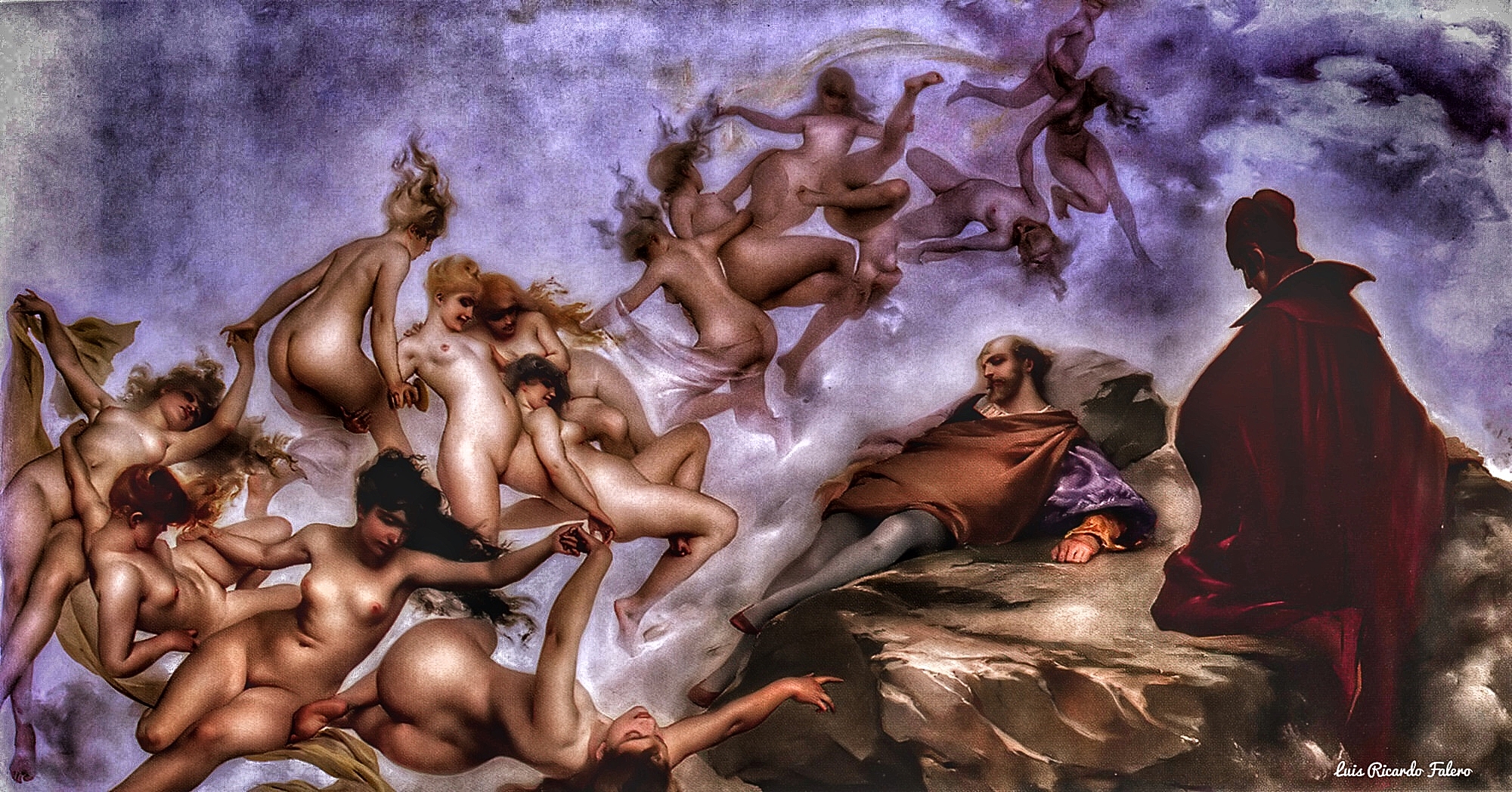
Faust, lying spent after a night of pleasure with multiple nymphs, with the Satan standing over him (Falero 1880).

No, Satan isn’t saying, “Now, Fausti-boy, remember the deal”. The Satan is actually apologetic, his head bowed in shame as Faust falls asleep in sheer boredom. And Satan is saying, “Sorry bud, they’re all I had. If you wanted real tits, didn’t you know all broads with big tits go ta heaven?”

Again, the breasts Falero has painted are helter skelter, disorganized and plain. Rogers and Hammerstein would have observed, “They are flibbertigibits, they are willow-the-wisps, they are lambs.”

Yawwwn. I’ve never been so bored writing a post. Tennis anyone?

————————————– 

And don’t even get me started on paintings of Aphrodite, or Penthesilia, the queen of the Amazons or Venus or Helen of Troy. Tits, tits and more tits. All less than ordinary. Personally I like tits so large that they give me a crick in my jaws when I try to orally stimulate ’em.

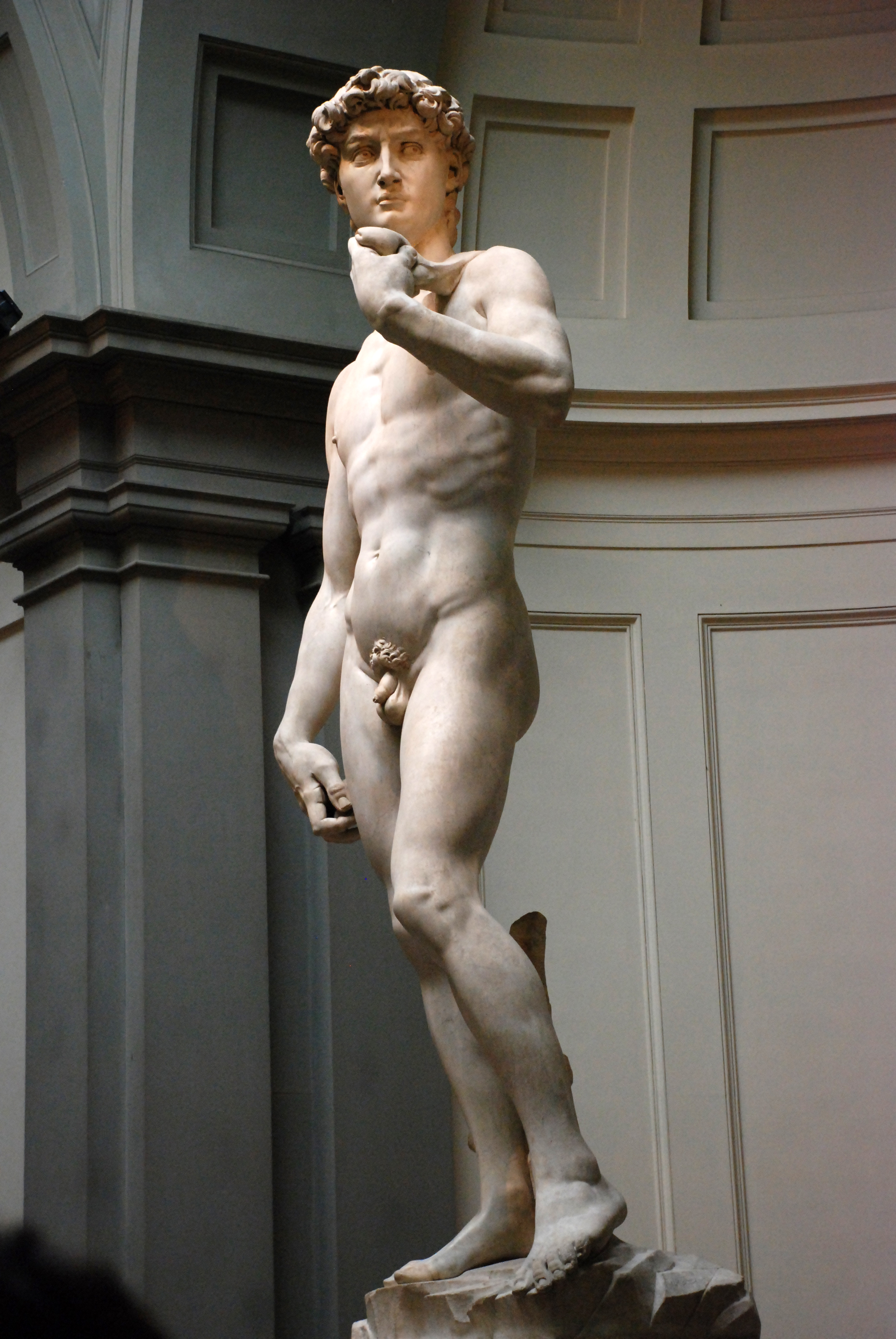
Then there’s the male nudity thing in art, where the obsession is with penises……. shamefully little peanut richards. Muscular men with tiny dickies.

Michelangelo’s “David”. Just take a look at his tiddlytoo. So tiny. If you held up your pinkie in front of it, you’d block the view totally. Of course, it can be inspiring to a certain demographic – men who have tiny penises. Like “look, you can have wee little richards and still be able ta slay Goliaths.

Michelangelo’s famous fresco “The Creation of Adam”. If I had had a richard like Adam’s, I would be bullied outa boarding school.

——————————-

Classical painters insisted on painting tiny richards. Maybe they didn’t want dick-envy so they painted richards that were smaller than theirs’. I am willing to bet you never saw a renaissance painting that had a hunk with a 12-inch boner.

I recently visited the Montreal Museum of Fine Arts and I really think they should name the joint “Montreal Museum of unimpressive tit and dick pics”.

—————————-

But honestly, what’s with all this nudity thing that early impressionists were so obsessed with? Please, I know all that crap about symbolism, aesthetics and the ethereal beauty of the human body. I get that their focus was not on eroticism but on natural beauty. The impressionists did not count on teenaged boys in the shower three centuries later, trying to make something more outa their paintings. I was one of them.

All I want to know is how a guy like Rembrandt could sit through all those sessions with those gorgeous nudes and not end up with an erection? I guess he just strapped his boner to his inner thigh and kept repeating,”aesthetics first…aesthetics first…aesthetics first…aesthetics first…aesthetics first…”

But why the mundane tits and tiny dicks?

If I had been a Duke in 17th Century Italy awarding an impressionist a commission, I would tell him, “So go ahead and paint tits and dicks all you like – even in unusual settings like the battlefield or the farmer’s market, I don’t care. But please paint ’em big is all I ask, with richards that can knock on a castle door and nipples that can crack your skull if you bump into them.”

I reached for AI. DeepSeek says it all started with the ancient Greeks. The raunchy Greek vase painter, Aristophanes, thought that the ideal male should have a little ‘psolí’. The Greeks equated small richards to rationality and control and large cocks to idiocy and impetuousness.

I don’t give a flying fuck about rationality and control. I wanted so much to be an impetuous idiot. Sigh….look what I got.

Objectified attachments

Tags

,

—————————————-

Overheard…..

“Sometimes, when I grab a coffee cup from my cabinet, I will pick one that’s in the back and never gets used because I think the cup feels depressed that it isn’t fulfilling it’s mission of holding coffee.”

“I used to work at a toy store and if anyone ever bought a stuffed animal I would leave its head sticking out of the bag.. so it could breathe.”

———————————————–

object

A friend once told me, “I feel bad for inanimate objects, all the time.” I confessed to her that I did too. I have an old heavily scratched water bottle I am unable to discard. Even though I have replaced it with a newer one, it lies at the back of a kitchen cupboard.

Why is this? Why do some of us sometimes sense a pang of guilt while throwing a pair of worn-out shoes in the garbage bin or neglecting to wear an old shirt with a frayed collar that’s been with us a long time? We know these things do not feel joy or loneliness and yet, every now and then our emotions inform us otherwise. Perhaps this is the result of all those Disney films featuring a motherly teapot or brave little toaster.

History however suggests this behavior predates any cartoon depiction of household items with people-like personalities. From the worship of idols to an animistic worldview, various cultures from around the world have long believed that material objects either contain spirits or possess some kind of special connection to us.

Take Galileo for example. The spacecraft “Galileo”, that is……

Galileo had been aptly named. Carried into space by the shuttle Atlantis, in 1989, Galileo performed a finely choreographed series of loops – one around Venus and two around the earth – maneuvers that in Nasa parlance are known as ‘Gravity Assist’. Gravity Assist is like a slingshot, meant to increase velocity – necessary to enable the two and a half ton, schoolbus-sized spacecraft to reach its goal – Jupiter.

Six years later, Galileo arrived over Jupiter and fired it’s thrusters to slow it down and it parked itself into an orbit half a million miles above the stratospheric storm clouds of the gas giant. There had been life threatening glitches on the way but this artificially intelligent robot had listened to the commands from it’s rapidly receding masters and it had come through unscathed.

Like the astronomer whose illustrious name it bore, Galileo scored many firsts. The first flyby of the irregularly shaped asteroid named ‘243Ida’ and the discovery that it had it’s own moon. Gravity-Assist flybys of the Jovian moons Europa, Ganymede and Callisto. The discovery of liquid water bubbling and frothing under the icy crust of Europa and the realization that Europa might harbor life in some form. (Arthur C Clarke had seen water under Europa two decades prior in his “2001 – A space odyssey” but that’s another story.)

Galileo sent back grotesquely dramatic video of active volcanoes on another Jovian moon, Io, erupting and ejecting plumes of basalt and sulfur hundreds of miles into space, the pictures having much greater resolution than the ones that Voyagers I and II had sent back more than a decade earlier. Then came the unbelievable real time video of the comet Shoemaker-Levy, slamming into Jupiter’s 90% hydrogen atmosphere and breaking up into multiple fireballs, leaving huge vortex-like holes in Jupiter’s clouds.

And many more. Galileo was designed to last 8-10 years and the scientists at Nasa’s Jet Propulsion Laboratory would have been satisfied if it had conked out by 1997, the year that the mission was officially scheduled to end.

But Galileo was just getting warmed up. July, 1995, right after it had injected itself into Jupiter orbit, Galileo released a probe, which plunged into Jupiter’s thick atmosphere and by the time it’s parachute had slowed it down, it had transmitted to Galileo 58 minutes of invaluable data on why Jupiter is what it is, for onward transmission to earth, before succumbing to the punishing heat and atmospheric pressure.

By early 2003, Galileo itself had completed all its mission goals (and some) and now it was time to put it down. On September 21, 2003, it was commanded to fire a ‘de-orbiting burn’ and once again it faithfully obeyed. The de-orbit burn caused it to slow down to the point where centripetal force overcame centrifugal force, drawing it inward, into Jupiter. It hit the upper atmosphere at 174000 mph and disappeared into the thick soup forever. 26 years after construction had first begun, the talkative robot finally fell silent. The Galileo-Jovian Project was over.

Immediately following Galileo’s demise, a funny thing happened. Let me back up a bit.

The engineers and scientists dedicated to the mission had been young, in their late twenties and thirties, when Galileo had been first conceived and started being built. Trials and tribulations, marriages, breakups, deaths, disease – they had gone through it all, buoyed by the intensity of their commitment to Galileo’s success. They had cheered at each milestone – delirious with awe at the Shoemaker-Levy spectacle, stunned at the evidence of liquid water sloshing around underneath Europa’s icy crust, laughing hysterically at the oddity of watching a piddly asteroid with it’s own moon and the many other firsts that Galileo had achieved.

Now here they were, three decades later, in their middle age, 365 million miles from their ‘baby’. And they were watching it die. Scientists and engineers – from a dozen nationalities and ethnic backgrounds, men and women – stood up from their consoles and hugged each other, sobbing openly, overcome by a sense of loss that comes with bidding farewell to a loved one, as Galileo – for one last time, faithfully on command – plunged into Jupiter.

—————————————–

Ever since we have existed, we humans have always attempted to form attachments toward everyday objects that have become a part of our lives, in part because we are loving creatures and affection is in our nature. Love is a fixed part of our species needs. When we are small, it is the teddy bear or the security blanket we couldn’t live without. Remember Linus, in ‘Peanuts’, clinging on to his blanket and sucking his thumb?

As we grow, we fall in love with all sorts of objects in our daily lives. In my case, it’s the old beige corduroy jacket that always seems to lift my spirits the moment I slip it on. Or my first car in Canada, a 1998 Corolla that had to be constantly coaxed into taking me where I wanted to go, but still came through when desperately needed – like in a snow storm on Highway 20 in the middle of a February night. The car was so dear to me that I had even given it a name – Bertha.

Or even the house I grew up in…..

I remember deciding to make a trip to Durgapur, while on a visit to India in 2010, just to see with my own eyes the two-storied bungalow that I had grown up in, six decades back around 1964. It was here that my life had changed. It was in this house that, as a 10-year old, I had watched helplessly as my father picked up an old leather slipper that everyone used to go out into the slush during the rains and then proceeded to slap my mother’s face repeatedly with it. My father harboured this suppressed rage that burst forth frequently and my mother bore the brunt of it. It didn’t seem to matter if his children were in the room or not.

The ‘thwap thwap’ of slippers and the rage-filled “whore!” is now a gif inside my head. ‘Whore’ – the word that men use so easily when mottled with rage. I have never heard a woman scream ‘gigolo!’ at me, ever.

The bungalow had a run-down look. A middle-aged woman opened the door. She appeared to be alone, except for a maid who was sweeping the passage floor. When I told her I that as a child I had spent many years in this house, she let me in.

I wandered from room to room, touching the windows, the walls, while the memories flooded in. For a while, the woman followed me room to room but when she sensed me begin to cry, she quietly turned around and went back into the hall.

I found myself in the bedroom that my two brothers and I had slept in. Next to the window there used to be a tiny space in the corner where my mother had her prayer stuff, her prayer mat, the idols, the holy books, the box of incense sticks, etc. She would be up at 4am and while her three sons slept just feet away, she would silently pray. Sometimes I would awaken. Her anguished cries in front of those stone gods and goddesses were barely audible.

The first time I heard my mother cry in there, I made to get up and run to her, but my elder bro, lying next, gripped my arm and pushed me down. “Shh!,” he whispered,” Go back to sleep.” I realized then that I wasn’t the only one awake.

The memories flooded back in as I walked to the window and stared down at the grassy patch outside and I felt I could hear happier times, like my Ma calling from the kitchen, “Jobbu, that’s enough of playing, now come on inside and go over your school bag and see if you have everything. School starts tomorrow”.

The window sill over which I had flung Ma’s treasured Ganesha out in rage (because I was caught bullying the neighbor’s daughter and had been made to sit in the corner), that window appeared not to have changed one bit, though I could barely see over it then, even on my tippy toes. Later on, Ma told me she would never have guessed I had flung all them idols out, had it not been for the Krishna figurine teetering on the ledge. I had taken out my anger on multiple gods, but the fact that I have grown into a well-adjusted adult proves that Hindu gods don’t hold grudges.

For the men and women who had nurtured Galileo, seeing it plummet into Jupiter must have felt like they were euthanizing a family member. For three decades, Galileo had been a part of their daily lives.

Without doubt, inanimate objects are just that – inanimate. Or are they? After all, we haven’t yet fully grasped what reality really is, have we?

Before I go, let me share with you what someone wrote on Facebook:-

————————————————-

“….this post is not seeking sympathy. It is merely trying to shed a little light on the total weirdness and unpredictability of grief. Those who have experienced deep loss already know. But for those who have not….

I washed the orange cup today.

“The orange cup” is not a metaphor. It’s a small, plastic cup—one of several in a multicolored set. It is small and just perfect for the kitchen sink. It is just big enough for a sip of water in the middle of the night, or to wash down daily meds. I had not washed it since before January 1st. Before you get too grossed out I had not used it either.

You see, that little orange cup is the last thing in the house that Mark’s lips touched on January 1st before he was loaded into an ambulance never to return.

I had picked up the orange cup several times before, thinking it was time to wash it and put it away. But each time it wasn’t. I would hug that little cup, cry a little (or a lot), and return it to the counter next to the sink. It wasn’t time to wash it—until today.

Today, I washed the orange cup….”

————————————————–

Jardin enchanté

“The first thing that Almighty Lord did was plant a garden……” – Anonymous

IMG_0036

A trip to the Montreal Jardin Botanique de Montréal leaves one kinda unfulfilled. When it’s time to leave after spending the day there, one is always left feeling like, ‘Hope I didn’t miss anything’.

There’s simply so much to see in this 75-acre picture postcard Garden of Eden.

Besides, how do you decide just how long you need to spend at each section – the rolling Chrysanthemum beds crowded with red-yellow, blue-purple and angel white Chrysanthemums so huge that if they were any bigger, they would have their own atmosphere, gravity and moons. Or the gushing brook that’s stuffed with colorful bass and overfed rainbow trout that brazenly waddle up and pout at you and let you caress them before they say ‘stop touching me’, wriggle free and scoot away.

Or the sunflower section? You thought there were only them inch sized sunflowers on God’s earth? Nope, the Jardin Botanique has those but they also have ones that are a foot in diameter, teeming with bees that look like salesmen exchanging stories of great deals at the sports bar I go to Friday nights.

Or the weeds section? Oh yeah, the much maligned weeds. Weeds are plants too, some even having their own pretty flowers. It’s only that they appear at places you don’t want them ta be in. Just because they are hardy, need no maintenance to survive and multiply like crazy, they are considered evil. Personally I love weeds because I love the underdog, like. The Jardin Botanique has a whole section here that teems with buttercups, goldenrods, thistles, catnips, jasmines, milkweed and of course, dandelions.

——————

Then there’s the book. I always have a book with me wherever I go. I can’t stand being somewhere by myself with nothing ta read. I’m fidgety, but that’s okay. All geniuses are fidgety people.

Today I am rereading “The girl with the dragon tattoo”. It’s not the ideal book for a trip to the botanical gardens but it’s so fucking interesting, I can’t put it down, so I brought it along. I am fascinated by Lizbeth Salander. She is unruly, unwashed, probably has bad breath but I am turned on by her. I  picture her savagely squeezing me with her vaginal muscles while I have torid sex with her. Wild, tightly coiled women drive me nuts.

How did this post turn to sex? It was supposed to be about flowers for Christ’s sakes. I was wanting ta write a post on my visit to the Botanical Gardens and here I am, with a stiffening richard the lion heart, thinking of fucking Lizbeth. (Maybe I really want to fuck Rooney Mara).

Wherever you go, you have to choose the book you want ta take with you very carefully. If you are in a doctor’s waiting room, take something comic, like a Richard Gordon, an Emma Bombeck or a Wodehouse. Nothing too racy like a Jackie Collins or else you might fail ta hear the nurse call out your name and even if you don’t, the doc might decide you have high BP. Don’t take Nevile Shute either or else you’ll be stuck being told you have hypotension. A long train journey or a trans-Atlantic flight is true crime / serial killer time. You need the hours ta fly. But if you’re on the bus or the subway, try not to read at all lest you miss your stop. Just watch the girls and day dream like I do.

The Jardin is strewn with reclining wooden armchairs and my ambition is to find the right spot where I can settle and read. As I make my way from one section to the next, I am constantly scoping it out for the armchair that is positioned just right for a long delicious read.

Alas, in the end I don’t actually get ta spend much time reading, because I have been spending the whole time looking for that perfect spot. And by the time I have found it, it’s nearing closing time. What a jerko di tutti jerki I am.

With a half hour ta go before the gates close, I end up at the Restaurant Organique. Soon as I enter, I feel the pure oxygen in there. I munch a vegan sandwich and an ice cold melon kombucha. All 100% organic. The food is excruciatingly healthy, something that my body simply isn’t used to. But I’m famished so I eat it anyway.

The girl at the counter is a picture of health. Plump, baby blue eyes, pink-cheeks, boisterously vivaciously bouncy. I tell her I want ta adopt her and she blushes and laughs, displaying pearly white teeth.

That’s one of the advantages of being an old man. You flirt audaciously and instead of being offended, they blush.

IMG_0013IMG_0018IMG_0020IMG_0021IMG_0023IMG_0024IMG_0026IMG_0027IMG_0033IMG_0034IMG_00456241659520_IMG_0337IMG_1808

My first smoocherooney

sm

It must have been 1966, in a small eastern Indian town called Durgapur. I was 11 and so was she. I am going to be 71 soon, but listen, you’ll never ever forget your first smoocherooney, trust me.

It was like yesterday, I remember that day so vividly. The rest of the school was out at the stadium race-track for the annual parade dress rehearsal. The morning had gone by playing the fool, leaving corny notes on each other’s desks, hiding our compass boxes from each other and generally poking good natured fun at one another.

This thing between Rashmi and me had been going on for a while and we were beginning to feel like it was all sort of building up to something but we didn’t know what that was.

Just last week my lips had brushed against her ear while we were on an arts and crafts project together and I had managed to say, “Surprise attack!” and grinned. She had expressed mock shock and given me a playful slap and run off to the other girls.

This was 1960s India, a deeply conservative joint where girls were supposed to act demure and aloof.

That day, the bell rang for the parade rehearsal and everyone began trooping down to the stadium – except Rashmi, who had been loitering behind. Instead of following the crowd, she gave me a quick glance to ensure she had my attention and slipped away and disappeared inside the chemistry lab.

I followed her in. The Spanish conquistador, Hernán Cortés, would have been proud of me.

I found her at the far corner, behind a cupboard filled with the burettes and pipettes. She just stood there facing the doorway, her arms outstretched, gripping the shelves, her sparking eyes filled with delicious foreboding. The moment I swung into her field of vision, her hands flew to her face and covered her eyes, her middle and forefingers parting a crack to see if I was making any progress toward her.

In a few strides I was on her and as I held her tight, she kept trying to wriggle free, though not with any genuine conviction. Rashmi somehow knew she was desirable and therefore her brain was configured to be coquettish and frisky. I guess its one of those things that no one teaches pretty girls, they are just born knowing it.

Instead of breaking out of my grasp, she kept real quiet and that should have told me something but it didn’t. In fact I kinda lost my balance holding her and she thought I was stepping back. Her hands snaked up my back and yanked me back to her tight.

Now that should definitely have told me something, no? This time it did. It emboldened me. I stared at her beautiful lips and said,“ What would you do if I kissed you right now?” Her beautiful face took on a devilish twist. She seemed like she wanted nothing else.

“I would kiss you right back,” she whispered and before her palms could fly right back up to her face, I had them in mine.

Rashmi was a head shorter and had her face buried in my chest so I wouldn’t be able to reach her lips with mine. Still, I tried. I crouched low, not letting go of my grip on her shoulders for even a moment, as I tried to reach down with my lips, but they could barely make it down to her pretty nose. I

About to give up, I sighed and gently gave the tip of her nose a peck and started to move away, when she stopped struggling and went slack in my arms. She brought her face up to mine, her bright beautiful eyes an inch away from mine, so close that I had only her eyes in my vision. Suddenly their texture changed, the pupils widened and the corners crinkled. Though I couldn’t see her full face from up that close, I knew she was grinning.

Taking this as a cue, I plunged my lips down but instead, I felt her knee come up and connect with my adolescent testicles with a crunch and I let go with a yelp. She sprang free and ran, but then she came to a stop a few yards away.

Then she did a funny thing. She stopped turned. Woooooo!! It wasn’t over yet, I rejoiced silently. Pretending to be really seriously hurt, I fell to the lab floor and gasped, my face screwed up in mock agony. Taking hesitant steps, she inched back toward me, the devilishly naughty look now replaced by one that was puckered in genuine concern.

Curling up in a ball, gasping for breath, I bided my time letting her come within reach until she was stooping over me to take a closer look, strands of her hair falling all over my eyes and my chin. Suddenly my whole being was being assaulted with the scent of Brahmi Amla Kesh Coconut Oil. It took all my adolescent self-restraint to keep my eyes open just a slit, like as if I was in agony.

I don’t know when exactly she caught on I was pretending but it was too late by then. As she knelt over me, I uncoiled in a speedy blurr, reached out and grabbed her. She responded by letting out a high-pitched squeal, more in excitement mixed with delight, than fright. Sometimes all you need to win a girl is a little subterfuge.

As we lay entwined, the chill of the chem lab floor made Rashmi shiver and she whispered, “They’ll look for us!” said she and shivered,” Hurry!”

———————————

Now take it easy. Between the 1966 ‘hurry’, and the 2025 ‘hurry’, there have been genuine advances. Bras and panties became passé, folks streaked naked over open ground and the word ‘f–k’ stormed the lexicons of the world. The 1966 ‘hurry’ meant just a kiss. And not even a French kiss, just a close-lipped kiss.

——————————

It was bliss as we lay there, Rashmi on top of me with her head on my chest, her curls tickling my nose, one leg draped over me with her black uniform shoes touching the floor on my other side.

The thought of progressing toward something more just didn’t cross our minds. This, what we had achieved so far, in itself was manna – like summitting Everest. Around us, two silent shelves filled with syringes, glass bowls and distilling columns were still, staring down with disapproval, like Lhotse and Cho Oyu.

After a long while we stood, retreating to a corner. I took her soft hands in mine and my lips skimmed over her forehead, her eyes, her ears and her nose just grazing against each while her breath clouded my specs. I could write a saga on just that breath – it had a scent of Amul butter, milk and bread crumbs on it.

Till then, I had never known anything about myself, never known want, never felt so utterly aroused. I was inhaling greedily when finally I found her lips and tarried there a while. It was the first time my lips had been on a girl’s and I explored the tiny ridges that run vertically along lips that are maiden – they form when the weather is cold and dry. I didn’t know it was cold out there, jeeze, I was sweating like crazy.

For a moment the Amerigo Vespucci in me took over once again and I couldn’t resist feeling those ridges with my tongue but she recoiled in horror, so I hurriedly put my tongue back in. That didn’t deter the oral explorer in me, though. Since that day, my lips have been on safaris that have ventured into more than twennie pu…baby cats, in my adulthood.

Honestly, if Capt. James Cook was hiring scouts for his Australia expedition, he would have offered me a handsome signing bonus.

Getting back to Rashmi, we remained that way, giving each other tiny pecks and kisses, for what seemed like an eternity. Nothing was said, the words pouring out through our lips, google-translated into kisses. The Almighty created lips for communication but I am sure even He didn’t figure how well kisses can articulate.

In the middle of our kiss, her lips stretched, her teeth made contact with mine and her eyes crinkled and once again that Amul baby breath lingered out and engaged my nostrils and I knew she was smiling again. Right then, if she had demanded that I walk off a cliff onto jagged thorns and hyenas below, I woulda.

The shouts and yelps alerted us to the fact that the parade dress rehearsal was over and the kids were coming back in. She pushed me back against the burette/pipette shelf, making it jangle and almost tipping over some of the pipettes that were near the edge.

And then she ran away, blowing a kiss at me as she turned the corner and disappeared.

After that first time, the back of the chemistry lab served us well in our canoodling, being empty most of the time. Our chemistry teacher sucked and hey, doesn’t chemistry suck on the whole?

Anyways, there we would crouch – not speaking, just kissing interminably long kisses. I think 1966 kisses were definitely longer than 2025 kisses, simply because they didn’t come with any feeling up or squeezing you-know-whats.

About a year later, Rashmi moved away with her family, to Asansol, another nondescript small town like Durgapur where nothing really happened. Rashmi had lovely feet and wore nupurs (ankle bracelets) that jingled just a wee bit and drove me nuts. The day before she left we had one last marathon canoodle behind a rack of bunsen burners. She cried a little and knowing how much her nupurs turned me on, she left me a pair of faux silver ones.

“I’ll tell my mother I lost them,” she tearfully whispered.

——————————

Actually I am not sure how much of this anecdote really happened – all those years and all. Throw into that my imagination and y’know how it is, things get a bit hazy. Did I find her behind the cupboard in the chemistry lab or did our trysts happen in the library? Did we have a chemistry lab at all, or was the lab from my memories of my next school, La Martiniere where, a few years later, I ….. oh, forget it, you won’t believe what happened in La Marts anyway.

But, listen, if you haven’t yet kissed anyone and want ta, prepare yourself for a very surreal roller-coaster ride. As your lips meet, every nerve ending shall twang, every hair stand on it’s end. Your eyes shall swim, finding it nigh impossible ta focus. It isn’t a sexual thing. Guys, you won’t even get a hard-on even if you are old enough to have one, but the excitement will be so intense as to make you feel faint. At that moment you’ll be ready to do anything for the girl. If her lips are slightly parted and she uses a breath freshener, the sensation of slipping your lower lip in will simply blow your mind. Take this from a man who has kissed maybe a thousand women.

Those days, Indian girls were very passive and demure. They made no moves by themselves. They just sat back and loved being kissed all over. I would say Rashmi was a bit more precocious than most other girls of that era. Rashmi’s face would take on a flushed glow when we kissed, I swear to ya.

And me – I was flushed too but suffice it to say that those days the parts of me that were usually soft during the normal course of the day, remained that way even when I was flushed with excitement. I believed then that a stiff dick was just another term for an obstinate 12th century English King with a backache and a lion heart.

I will never be able to go back and stand there in that school in that tiny town in India, without feeling the taste of Amul butter on my lips.


The Erastes, the Eromenos and the Pathikos

**************************

A civilized world is one where there are no taboos – Socrates

**************************

1

‘Abduction of Ganymede’ (painting by Peter Paul Reubens, 1611)

—————————————–

For any female, born in an urban slum or in rural India, there is an 80% likelihood of her being either raped or molested at least once in her lifetime. For a boy who was born in 500BC Greece, the odds of something similar happening to him were identical.

Ganymede was a Trojan boy barely out of his teens, whom the 8th Century BC poet, Homer, had described as the most beautiful of mortals. Even the Gods couldn’t take their eyes off him. So taken by his beauty was the lecherous old Zeus that he stole in one day, disguised as an eagle, lofted Ganymede into the heavens and whisked him away to his pad at the Mount Olympus.

Oh yeah, Zeus had this habit of appearing in disguise as a bird whenever he felt horny. He once appeared before Leda, the Spartan King Tyndareus’s wife, as a swan and ravished her. Legend has it that, out of the union was born Helen of Troy. Helen of Sparta actually. Helen of Troy is a misnomer.

Spartan Queen Leda, being ravished by Zeus disguised as a swan. Even Gods can be pricks.

————————

As for Ganymede, in exchange for steamy anal sex, Zeus gave him eternal youth and immortality and a permanent position as the official cup bearer – like a bus boy – to the gods.

There is no record of what Zeus’s old lady, Hera, had to say about this new love-affair. Probably nothing. Given the times and the open practice of pederasty that was the custom among adult Greek noblemen and their Gods in those days, she may have just yawned and said,” Tennis anyone?”

The same milk of forgiveness ran through Roman wives as well. The emperor, Hadrian (76-138AD), took a male lover in the form of a Bythinian youth named Antinous. As a foreigner it was perfectly acceptable for Antinous to appear in public next to the emperor and his wife Sabina.

Hadrian and Antinous were lovers for five years until Antinous fell overboard from a galley into the Nile and drowned. Grapevine has it that Sabina had a centurian persuade the boy to jump one night when Hadrian wasn’t looking but I can’t submit any evidence of it. Heartbroken, Hadrian had Antinous declared a god, built temples to him all over the empire, named a star after him and built a city in Egypt, Antinopolis, in his honor.

———————————————

Up until the Roman Empire turned Christian under Constantine the Great and Christianity began being rammed down everyone’s throats under threat of death all across Europe and beyond, homosexuality in all it’s forms was a universally accepted practice in the so-called ‘civilized’ world. Sodomy was practiced mostly among the upper classes. (The hoi-polloi were too busy trying to survive invasions and deprivation).

In the pre-Christian world, men f–king other men was du jour.

Philosophers of the day, Aristotle and Socrates, waxed eloquent on how the human anatomy had placed the anus in just right level and orientation to be shtupped by the erect penis of another man, so convenient that even the anal passage had the same angle of inclination to the horizontal as a fully erect penis.  Therefore, they surmised, we were all meant to be fucked up our asses. I can see Euclid exclaiming, ‘QED!’

Around the 400BCs there were other ancient cultures that practiced homosexual sex. The Indian philosopher, Vatsayana, writing in his “Kama Sutra”, held forth on the number of ways adult males could pleasure each other orally.  But the deluge of direct evidence of homosexual liaisons in ancient Greece that archeologists have dug up is astonishing. Hundreds of vases have been unearthed along the Aegean Sea coast of Greece, that have erotic paintings on the sides, depicting males in sexually intimate positions, dating back to 1000BC.

The vase paintings have a common theme running through them – the sexual intimacy depicted is invariably shown happening between a bearded adult male and a pubescent or adolescent boy, usually the son of another free citizen with whom the adult has a business or family connection. One might wrinkle his nose in disgust today but that was the norm then. The boy knew that his coming-of-age required submitting to anal penetration by a grown adult male, who took him under his wing like a mentor and proceeded to take charge of his education. It started invariably with a period of elaborate courtship when the mentor showered the boy with presents until he eventually broke and submitted.

The Greeks had developed a strict code of conduct as regards homosexuality. An adult Greek male could not have sex with another adult Greek male. It would make the man being penetrated (the pathikos or passive partner), seem effeminate and submissive. That was something which the Greek society – essentially a martial culture – deemed a humiliation and therefore inappropriate. It would bring down the submissive male to the level of women, who at that point in history were considered lesser mortals in this highly patriarchal culture. He could be ridiculed and laughed out of town and even lose the right to hold public office.

The ban on adult to adult male sex did not extend to slaves however. It was open season on slaves. You could do absolutely anything you wanted with your slave, since you owned him. An adult Greek male could f—k an adult male slave till he was blue in the face. Slaves, usually the citizens of conquered lands, were acquisitions and had no rights whatsoever.

———————————————-

In ancient times, you had to be prepared to be a slave if your city-state got invaded and sacked by an invasion force. A run-of-the-mill invasion usually netted around 15-20000 able-bodied slaves who could then be sold for hard cash. The slave trade was the by far the largest and most profitable business venture in not only Ancient Greece, but all across the ‘civilized’ world.

During his 8-year long expedition of conquest through the Middle-East, Asia Minor, right up to the banks of the Jhelum River in present-day Pakistan, Alexander the Great is reported to have taken into captivity and sold more than 500,000 slaves from the lands he conquered.

Thanks to Alexander’s zeal, soon there was a glut in the market. Supply outstripped demand and the powerful slave cartels in Greece and Asia Minor, pretty much like the OPEC of today, hated him for flooding the market.

Besides the booties that Alexander looted from the vanquished Persian King Darius III’s coffers, the slave trade was a major source of revenue that helped pay his soldiers’ above-average salaries and frequent bonuses. It is said that on one occasion, after he had sacked the city of Tyre, he paid his troops the equivalent of 8 years’ pay as bonus. If it hadn’t been for his largesse, his men, tired of the fighting and homesick, would have turned and gone back much earlier.

Alexander was huge on the slave trade but he was also a fair man. If a state readily submitted to his invasion force and acknowledged him as their monarch without a challenge, he not only spared them a massacre but in fact enthusiastically waded into their culture, encouraging his commanders and troops to go forth and marry their women and intermingle. He allowed the citizens of the annexed lands to retain their culture and traditions and even offered sacrifices to their Gods at their temples. The slaves came from the states that tried in vain to repel his invasion and faced his wrath as a result.

Alexander was a horny bastard too, of that there is very little doubt. He didn’t believe in harems like his arch-rival, Darius III, who had 365 concubines, one for every night of the year (I suppose he rested on leap years). Alexander however had a string of affairs and wives and he also had at least two male lovers that I know of. He was very respectful of folk he had sex with and there was no rough stuff, unlike other conquerors of his time.

Alexander was a good looking guy, as per the 1st Century AD historian, Plutarch. Says he, “…Not very tall, perhaps a little over five podes and a half, Alexander was light brown skinned and had a tinge of red on his face and upon his breast. Aristoxenus, in his memoirs, spoke at length of Alexander’s sharp features and bright blue eyes. He had heard Aristotle speak in amazement of a most alluring scent that emanated from his skin. His breath and his body were so fragrant that they perfumed his undergarments……” Ugh!

Powerful city-states like Athens and Sparta and empires too, like the Persian and Roman empires, had large populations of slaves who had been nabbed from conquered lands and put to work in mines or construction and even as domestic help. At the height of it’s golden age – around 450BC – one in three inhabitants of Greece was a slave.

The slave-to-citizen ratio was even higher with the Romans and that could be a reason why in the 1st Century BC, a Thracian slave named Kirk Douglas managed to band together a well-organized fighting force of 70000 slaves against the Roman legions and was able to get as far as he did, massacring thousands of well-trained and superbly equipped Roman legionaries, before he was finally apprehended and killed. Even though he did not succeed in the end, Douglas is still an interesting example of how far the will to be free can take you, but I shall have to leave that for another occasion.

What? Did I say Kirk Douglas? Oh, sorry, the slave was called Spartacus. Kirk Douglas only played the role of Spartacus and co-produced the 1960 Stanley Kubrick movie by the same name. At my age, it is easy to get mixed up a bit. Do watch it if you get the chance.

But during the heroic and classic ages of the Greek civilization, a few centuries before Spartacus, the thought of organizing their own ‘Greek Spring’ hadn’t yet occurred to the slaves.

————————————————-

While the adult-to-adult male sex was a no-no in ancient Greece, the acceptable practice was what we term today as pederasty – sex between an adult male (the erastes) and a boy in the age bracket of around 10 to 17 (known as the eromenos). It was pedophilia with a slightly narrowed age range. Pederasty was a practice that was regulated by the State as an institution, no kidding. It was generally taken as a supplement to a heterosexual marriage, which the Greek deemed as essential for the purpose of procreation. Thus, the adult men who practiced pederasty were basically bisexuals.

Today, the age of consent varies from country to country but overall, pederasty is considered just as heinous a crime as pedophilia and most nations in the modern world have strict laws against it. The same Socrates, whom we like to lionize, would be cooling his heels inside a maximum security penitentiary, serving a lengthy sentence, had he been around today.

Back then, institutionalized as it was, pederasty was commonplace. There were even public places where noblemen met and swapped their boy lovers. The Grecian baths for example were places where nobles lazed around and exchanged boys. If they had internet they would probably call it swapboy.com or something.

2

An Erastes with his Eromenos, on a Greek vase (Image coutesy: Wikimedia)

———————————-

The pederasty practiced in ancient Greece was in fact cyclic – as soon as the eromenos began to sport a beard, it was a sign that he was now an adult and therefore could not continue his sexual liaison with his erastes. He could in fact himself start leading life as an erastes now and have his own eromenos. Oh Goody!!

In ancient Greece, if you were a male from the upper classes, you were either an erastes or an eromenos. You didn’t fight it. You humped or you got humped. By another male. That was that. Grecian stores even stocked different varieties of depilatory products to help you keep your eromenos looking young and therefore ‘acceptable’.

3

The Greek poet, Anacreon, and his little lover. Anacreon’s poetry was all about passion, love, infatuation, revelry and parties, like an ancient version of Jackie Collins, except in his case, the protagonists were invariably pederasts. 

Interestingly, most sculptures, bas-reliefs and paintings depicting ancient Greek pederasty, are found in the Vatican palaces and museums today. Should this be a surprise at all?

———————————————

The Greek city-state of Sparta mandated an austere existence, devoid of any kind of extravagance (and hence the adjective ‘spartan’). Military training was mandatory and stretched right through a boy’s formative years, starting at age six, right up until twenty-two. During this period, the little boys got paired off with the older boys or men in the military academy, who became their mentors. They spent long hours working out inside gyms and arenas, practicing the five exercises of the pentathlon – wrestling, races, long jumps, throwing the discus and hurling the javelin.

The youths in the gymnasia were always naked and sexual intimacy was inevitable and encouraged as an essential part of the kid’s education. The word ‘gymnasium’ is reported to have been derived from the Greek word ‘gymnos’, which means ‘naked’.

It got so bad with the 22-year old graduating cadets of the Spartan military academy that, on their wedding night, their brides had to resort to dressing like men in order to arouse their grooms and help them make the transition from homosexual to heterosexual sex.

—————————————-

Isn’t it an irony that we see the ancient Greeks as the very fountain of western civilization, when most of what they practiced – pederasty, slavery – are considered heinous crimes today?

Seeking comfort in inanity

“Crito, we owe a cock to Asclepius. Do pay it. Don’t forget”

― Socrates to personal aide, minutes before he was forced to kill himself by consuming hemlock, 399BC

—————————————

The citizens of Athens bore a massive grudge against Socrates.

The philosopher preached totalitarian dictatorship as the only feasible way to govern and spawned through his teachings, students who specialized in overthrowing democratically elected governments and instituting a reign of terror.

Socrates shaped the world view of at least two of his star pupils, Alcibiades and Critias. Alcibiades (450-404 BC) was an Athenian General who proposed that the only successful mode of governance was not democracy but an oligarchy of a few powerful leaders who should decide the fate of the populace. The other pupil, Critias, became a member of a group of bad guys called the thirty tyrants, a pro-Spartan oligarchy that unleashed a reign of terror on the Athenians for more than a year, around 404 BC.

Together, with Spartan support, Alcibiades and Crtitias usurped power and wreaked havoc, in which thousands of Athenians were deprived of their property and either banished from the city or executed.

Aside from his extreme views on governance, Socrates was also well known for his pederasty, the practice of forcing young pubescent boys into having sex with him.

The world lionizes this guy today.

———————————

Ancient Arab merchants had a saying – “if you teach your pupils how to kill, it is only a matter of time when you will yourself be the victim”. So it came to pass with Socrates.

No one knows exactly when or how Socrates fell afoul of the oligarchs or if his open sexual deviance did him in. One day in 399 BC, he was made to stand trial before a  jury of 500 of his fellow Athenians.

Those days, just about any offense could be deemed a capital crime. Long story short, Socrates was found guilty and sentenced to die by lethal poison. His famous student, Plato, has recorded what happened next – an executioner handed Socrates a cup that contained an extract of hemlock called coniine and said,” Just drink it and walk around until your legs begin to feel really heavy. Then lie down. It will soon act.’

Socrates did as directed and then walked around until his legs began to feel heavy like the executioner had said they would and then, he lay down on his back.

As the chill sensation got to his waist, Socrates suddenly rose up on his elbows as if he had remembered something, rubbed his eyes and said to his faithful Crito, “ Crito, we owe a cock to Asclepius. Do pay it. Don’t forget.”

Do you just believe this guy? He was about to die and here he was, thinking of something as inane as repaying a personal debt of a cock.

————————————–

Socrates’ last-minute command to his servant might be considered trivial but inanity at a moment of deep personal trauma is not uncommon. At the point of death, condemned men seek to suppress the conscious knowledge of the direness  of their circumstances by speaking of inane things and trying to maintain an illusion in their minds that everything is normal.

The English King Henry VIII’s Queen, Anne Boleyn, insisted on leaving detailed instructions for the maintenance of her potted plants. The serial murderer, Ted Bundy, repeatedly reminded a warder to post a letter of complaint he had written, to a magazine that had incorrectly mentioned his place of birth.

Nobel Laureate and Nazi concentration camp survivor, Eli Wiesel, has written about a neighbor whom he heard asking an SS storm trooper (who was shoving him into a truck bound for the Bogdanovka Concentration Camp) in an everyday matter-of-fact tone, to turn off the lights inside his apartment, since electricity was expensive. The act of turning off lights in an empty apartment of a man who knew he was being carted off to his death, would in no way change his circumstances and yet that was the first thing that came to Wiesel’s neighbor’s mind.

Just seconds before the trapdoor he was standing on, gave and he plummeted to his death, Saddam Hussein was asking the Shiite militia guy adjusting the noose round his neck, to move the knot a bit to the side as it was tickling his nose. The executioner obliged, in a final act of kindness toward a man who did not deserve any.

————————————–

A similar urge toward the inane also happens when one is on the verge of saying farewell to loved ones, just before the last call for departure is announced at the airport or when the signal turns orange at the rail station. As parting becomes imminent, the mind goes sort of numb, unable to think of anything consequential to say. Desperate to keep a conversation going, to maintain the feeling of being together, we say the most inane of things.

When I left India for good, my mother was at the airport. There was a wall-to-wall plate glass window inside the lounge where we sat waiting, watching aircraft take off and land. Security had already been called and it was just minutes before departure would be announced. I had no words to say to the one person to whom I owed so much.

“See how cute that kid is?” I said pointing at a toddler who was trying to break free from his mother’s grasp by biting on her fingers. My mother smiled and nodded, trying hard to hold back her tears.

“Can you read what’s written on that counter over there? I do have to get my eyes checked. Haven’t done it in a while,” said she. I nodded and smiled.

We kept up a banter, while inside us raged emotions like wildfire, real conversations, that remained unsaid. Instead one was trying to read something hung up on a counter while the other found a pain-in-the-ass unruly kid, cute. The closer you are, to the one you are leaving behind and the closer it comes to the good-byes, the more inane the conversation seems to turn.

Ah, but for the soothing emptiness of inanity. We are brimming with inanity. Getting rid of our inanities cannot be achieved without getting rid of ourselves.